Abstract
In the current study investigated the relationship between the decision making styles with emotional intelligence among the information technology leaders. The purpose of this paper is to identify practical approaches to the application of emotional intelligence to the decision-making. These practical approaches are designed to instruct and aid decision makers in the utilization of emotional intelligence skills to improve decision-making. The participants were 130 information technology leaders selected through convenient sampling method in Bangalore, India. The Bar-On's emotional intelligence inventory and Decision-Making questionnaire of Leon Mann were utilized to develop a methodology for the practical application of emotional intelligence skills to decision-making. The 31 to 35 aged group information technology leaders were high in vigilance and hyper-vigilance decisional style. Self-regard has a negative relationship with vigilance style of decision-making. Further, implications of the study are discussed in this article.
Keywords : Emotional Intelligence, Decision-making and Information Technology
Introduction
The goal of the present study is to find out the role of emotional intelligence in the decisional styles of the information technology leaders. Today's business environments make information technology companies look for leaders who have various skills to cope with changes in appropriate ways. One of the most important personal factors affecting leader's responses in such situations is their emotional capability which management scholars, educators and development practitioners have evidenced their interest in understanding it in the work place.
Emotional intelligence is an important factor in work place performance both on individual level and group level. According to the Bar-On (1997) emotional intelligence "an emotional competencies, skills and facilitators that determine how well we understand
* Assistant Professor cum Liaison Officer, Management Wing, DDE Study Centre, Annamalai University, Basavangudi, Bangalore - 560 004.
Decision Making Styles of IT Professionals in Relation to
their Emotional Intelligence
and express ourselves, understand others and relate with them, and cope with daily demands, challenges, and pressures."
Emotionally intelligent leaders are thought to be happier and more committed to their organization (Abraham, 2000) and use positive emotions to improve their decision making and instil of enthusiasm, trust and co-operation in other employees through interpersonal relationships (George, 2000). The theory of emotional intelligence proposes that individuals have the ability to perceive, express, understand, and manage emotions (Bar-On, 1997; Goleman, 1995; Mayer & Salovey, 1997; Salovey & Mayer, 1990).
The purpose of this paper is to present a framework describing what that role might be. First, however, it is useful to sample the literature and research findings attesting to the central role of emotional intelligence in decision making.
Decision-making
Decision making is the cognitive process of reaching a decision; "a good leader must be good at decision making." Decision-making is an essential aspect of modern management. It is a primary function of management. A leader's major job is sound/ rational decision-making. He or she takes hundreds of decisions consciously and subconsciously. Decision-making is the key part of leader's activities. Decisions are important as they determine both managerial and organizational actions. What does emotional intelligence or EQ have to do with good decision making?
Emotional intelligence does not only entail being aware of one's own emotions, but also using these emotions in functional ways. Emotional intelligence can likely help you stop any emotions not just negative ones, like stress and anxiety, but also good ones, like excitement from influencing unrelated decisions. They remove emotions that have nothing to do with the decision.
George (2000) has cited (following on the work of Easterbrook, 1959, Frigda, 1988, Mandler, 1975, Simon, 1982): "When leaders know and manage their emotions, they may be able to use them to improve their decision making." Further George (2000) has stated by recognizing their emotions and their roots, leaders can successfully use emotional input in decision making.
Need for the Study
to deal with these extreme situations. Hence, the leader's should evaluate their current emotion quotient skills and develop more creative and innovate ways in their decision making.
The need of the study was to investigate the relationship of emotional intelligence in the styles of decision making among the leaders who works in information technology companies. Beside various organizational and environmental factors, leader's responses to decision making situations seem to be different because of their personal characteristics and orientations.
Therefore, researcher has to consider special factors that influence decision making. The leaders in information technology sectors should look for effective personal characteristics that affect their responses to decision making situations positively, instead of just relying on traditional and bureaucratic approaches. In this case it is predicted that emotional intelligence as an important personal factor can play an important role in information technology leaders' orientation or disorientation to a special decision making style.
Researcher going to show this effect by investigating the relationship between emotional intelligence and six general decision-making styles; that is, vigilance, hyper vigilance, rationalization, buck passing, procrastination, and defensive avoidance. Thus this paper provides a critical analysis of decision making styles of the information technology leaders' with respect to their emotional intelligence. This approach should help organizations look and prepare for the future more effectively. By studying the relationship of emotional intelligence with decision making styles, aimed to contribute to the decision making literature and to test emotional intelligence applications in decision making.
Method
A sample of 130 individuals who working full time and who resided in the Bangalore area completed self-report surveys containing items assessing the variables described below. The surveys contained the thirty one items of the Leon Mann, Radford, and Kalucy (1986) decision making styles inventory. The survey items designed to assess vigilance, hyper vigilance, defensive avoidance, procrastination, buck passing, and rationalization of their decisions. These items featured a three-point response format ranging from not true (one point) to true for me (three points).
buck passing 0.46, and rationalization 0.59. This tool possesses both content and constructs validity. The factorial validity of the scale ranges from 0.56 to 0.83 for all the six dimensions.
The emotional intelligence of the information technology leaders was measured by Bar-On (1997) Emotional Quotient Inventory in ten dimensions viz., empathy, assertiveness, flexibility, reality testing, stress management, problem solving, interpersonal relationship, impulse control, emotional self awareness and self-regard by sixty six items. There are five response categories for each item ranging from not true (zero point) to true (four point) for positive item and true (zero point) to not true (four point) for negative items. The average Cronbach's alpha coefficients were high for all of the sub-scales, ranging from 0.69 to 0.89, with an overall average internal consistency coefficient of 0.76.
Bar-On (1997) established the validity of the tool by conducting studies in six different countries (India is one among the six countries). This tool possesses content and face validity. Moreover, the criterion group validity was established as 0.81.
Hypothesis
The following hypotheses are framed to study the relationship between decision making and emotional intelligence of the information technology leaders
1. There is a significant difference in decision making and emotional intelligence leadership of information technology leaders' basis of their age, length of service, marital status and number of dependents.
2. Decision making styles (vigilance, hypervigilance, buck passing, procrastination, rationalization, and defensive avoidance) will positively relate to Emotional intelligence (and each of its ten components such as interpersonal relationship, problem solving, stress management, self regard, reality testing, flexibility, assertiveness, and empathy, impulse control and emotional self awareness).
Results and Discussion
Hypothesis:1 - "Age of Information Technology Leaders has a significant
influence on their emotional intelligence and decision-making"
From the Table 1, it is found that 'F' values are significant for the decision making dimensions viz. hyper vigilance, vigilance, buck passing and procrastination. And for the emotional intelligence, it is found that 'F' values are significant with emotional self awareness, reality testing, self regard, problem solving, flexibility, and inter personal relationship dimensions along with the total and hence the hypothesis is accepted for both the decision making and emotional intelligence. It is concluded that the information technology leaders significantly differ in their decision making and emotional intelligence based on their age.
Table - 1: Decision Making and Emotional Intelligence with Respect to Their Age
AGE F – value Posthoc
Decision-Making Styles 1 Mean (S.D) 2 Mean (S.D) 3 Mean (S.D) 4 Mean (S.D) Hyper Vigilance 7.85
(1.31) 10.10 (1.59) 9.92 (1.64) 9.78 (1.50)
18.555* 2 vs 3 vs 4 vs 1
Rationalization 9.95 (1.38) 10.05 (1.56) 10.26 (2.02) 10.00 (1.18)
0.272 ----
Vigilance 11.64 (1.61) 12.41 (1.90) 11.64 (2.90) 7.11 (2.75)
32.595* 2 vs 1, 3, vs 4
Defensive Avoidance 10.05 (1.52) 9.44 (1.60) 9.62 (1.60) 9.89 (1.63)
1.156 ----
Buck Passing 9.82 (2.19) 11.02 (2.53) 11.67 (2.14) 13.48 (1.01)
16.422* 4 vs 3 vs 2 vs 1
Procrastination 9.56 (1.87) 9.41 (1.55) 10.31 (1.59) 10.59 (1.39)
4.210* 4 vs 3 vs 1 vs 2
Emotional Intelligence Dimensions
Stress Management 24.49 (2.86) 25.39 (2.13) 24.87 (2.69) 25.70
(2.00) 1.624
----
Emotional Self Awareness 17.56 (2.62) 18.93 (1.68) 18.15 (2.15) 19.33
(1.62) 4.934
* 4 vs 2 vs 3 vs 1
Reality Testing 19.21 (1.91) 19.07 (1.97) 18.21 (2.40) 19.96
(1.53) 4.241
AGE F – value Posthoc Self Regard 26.31
(3.31) 27.66 (2.47) 27.56 (3.01) 28.74
(2.45) 4.093
* 4 vs 2 vs 3 vs 1
Impulse Control 14.46 (2.39) 15.59 (2.19) 15.18 (2.01) 15.93
(1.92) 2.970
----
Assertiveness 18.21 (2.240 18.61 (1.69) 18.49 (2.11) 18.81
(1.59) 0.575
----
Empathy 15.00
(2.16) 15.54 (1.80) 14.90 (2.67) 15.93
(1.47) 1.920
----
Problem Solving 17.92 (2.78) 19.02 (2.43) 18.77 (2.62) 26.11
(1.71) 9.595
* 4 vs 2 vs 3 vs 1
Flexibility 23.67 (3.01) 25.90 (2.40) 24.72 (3.62) 26.11
(3.18) 4.931
* 4 vs 2 vs 3 vs 1
Inter Personal Relationship 19.74 (2.67) 22.27 (2.55) 21.95 (3.14) 24.00
(2.15) 15.223
* 4 vs 2 vs 3 vs 1
EI_Total 196.56
(12.79) 207.98 (7.79) 202.79 (13.58) 215.70
(8.93) 17.148
* 4 vs 2 vs 3 vs 1
1. Less than 30 years - 39 persons *Significant at 0.05% level
2. 31 to 35 years - 41 persons
3. 36 to 40 years - 39 persons
4. Above 40 years - 27 persons
From the Table - 1, it is observed that 31 to 35 aged information technology leaders were high in vigilance and hyper-vigilance decisional style. It may be due to the nature of project allotted to the individuals make them to be vigilant in their decisions. Hyper vigilance refers to a tendency to make decision impulsively. When we have a lot of pressure due to nature of work we may get irritated and make decisions impressively.
The 't' values are significant for the emotional intelligence dimensions viz. emotional self awareness, reality testing, self regard, problem solving, flexibility, inter personal relationship and emotional intelligence total. It is noticed that in all of these dimensions, information technology leaders with more than 40 years of age have shown significantly higher emotional resources than their counter parts.
With growing age, information technology leaders have faced a variety of life situations which in turn made them to be emotionally more intelligent. The good relationship with more experience makes the leaders to express their thoughts and ideas clearly. It is observed from the table that the aged leaders have higher score than the other aged groups; it may be due to the urge to prove them as an asset to the organization.
Hence it is quite natural that the information technology leaders with more than 40 years of age have better emotional self awareness, reality testing, self regard, problem solving, flexibility, inter personal relationship and emotional intelligence total, than the younger ones. It is concluded that the information technology leaders significantly differ in their decision making and emotional intelligence based on their age.
Hypothesis:2 - "Information technology leaders differ in the emotional intelligence and decision making on the basis of years of service."
From the Table 2, it is found that 'F' values are significant for the decision making dimensions viz. hyper vigilance, vigilance, buck passing and procrastination. And for the emotional intelligence, it is found that 'F' values are significant with reality testing, self regard, impulse control, problem solving, and inter personal relationship dimensions along with the total and hence the hypothesis is accepted for both decision making and emotional intelligence. It is concluded that the information technology leaders significantly differ in their decision making and emotional intelligence based on their service.
Table - 2: Decision Making and Emotional Intelligence Based on Years of Service
Years of service F – value Posthoc Decision Making Styles 1
Mean (S.D) 2 Mean (S.D) 3 Mean (S.D) Hyper Vigilance 8.79
(1.87)
9.92 (1.67)
9.73 (1.42)
6.881* 2 vs 3 vs 1
Rationalization 9.98 (1.45)
10.16 (1.85)
10.09 (1.42)
0.178 ----
Vigilance 12.03 (1.87)
11.71 (2.48)
8.15 (3.47)
28.902* 1 vs 2 vs 3
Defensive Avoidance 9.79 (1.53)
9.51 (1.62)
9.94 (1.65)
0.821 ----
Buck Passing 10.21 (2.34)
11.61 (2.40)
13.00 (1.44)
18.636* 3 vs 2 vs 1
Procrastination 9.52 (1.78)
10.00 (1.61)
10.50 (1.44)
3.983* 3 vs 2 vs 1
Emotional Intelligence dimensions
Stress Management 24.84 (2.63)
25.14 (2.46)
25.38 (2.30)
0.551 ----
Emotional Self Awareness 18.13 (2.41)
18.39 (2.02)
19.06 (1.81)
2.085 ----
Reality Testing 19.35 (1.92)
18.29 (2.23)
19.56 (1.86)
5.301* 3 vs 1 vs 2
Self Regard 26.95 (3.19)
27.33 (2.76)
28.65 (2.67)
3.981* 3 vs 2 vs 1
Impulse Control 14.60 (2.31)
15.63 (2.15)
15.85 (1.76)
5.010* 1 vs 3 vs 2
Assertiveness 18.40 (1.94)
18.41 (2.14)
18.85 (1.64)
0.702 ----
Empathy 15.30
(2.05)
15.14 (1.86)
15.50 (2.15)
0.316 ----
Problem Solving 18.21 (2.52)
18.63 (2.67)
21.26 (1.62)
19.139* 3 vs 2 vs 1
Flexibility 24.60 (3.00)
25.35 (3.02)
25.35 (3.72)
0.981 ----
Inter Personal Relationship 20.59 (2.66)
22.33 (2.59)
23.41 (3.03)
13.112* 3 vs 2 vs 1
1. Less than 3 years - 63 persons 2. 3 to 6 years - 49 persons
3. Above 6 years - 34 persons
Whereas less than 3 years of experience as information technology leaders were high in vigilance decisional style. It is quite natural that the young and energetic leaders are optimistic about finding the solution to the issues faced by them in the work environment. The sufficient time available to the individuals, makes them to consider all the possible alternatives and to make decisions.
The information technology leaders whose experience was more than 6 years are high in buck passing and procrastination decisional style. It may be due to the promotional system or the performance appraisal system adapted by the organization. The individual who waits for the promotion, who promotion were delayed further makes them to adapt the buck passing or procrastination decisional style.
From the Table - 2, it is noticed that more than 6 years of experience as information technology leaders were high in all the significant dimensions (viz. rreality testing, self regard, empathy, problem solving, inter personal relationship , and total emotional intelligence) of emotional intelligence other than impulse control. Emotional intelligence is about knowing feelings as well as facts. Once the individual developed the ability to aware of others feelings and shape their own feelings can easily regulate their emotions and stand high in emotional intelligence dimensions and emotional intelligence total.
Less than 3 years of experience information technology leaders were high in impulse control. Impulse control is the ability to resist or delay an impulse, drive or temptation to act. It is no wonder that the individuals whose experience were less than 3 years as leaders in the project want to be best in their part. Makes them to consider all the alternatives available to them and take a decision which is suitable. It is concluded that the information technology leaders who have more than 6 years of service are high in emotional intelligence and prefer buck passing and procrastination decisional style.
Hypothesis:3 "Information technology leaders differ in their
emotional intelligence and decision-making with respect to their marital status"
From the Table - 3, it is found that unmarried information technology leaders were high in vigilance decisional style. The conditions that characterize the real-world or naturalistic tasks places the unmarried leaders to the luxury of implementing a more elaborate analytic procedure and adapt the best one suitable for the current situation.
Table - 3: Decision Making and Emotional Intelligence: Marital Status Comparison
Marital Status F value
Decision Making Married
Mean (S.D)
Unmarried Mean (S.D)
Hyper Vigilance 9.67
(1.65)
8.20 (1.66)
0.299
Rationalization 10.11
(1.63)
9.94 (1.45)
0.051
Vigilance 10.91
(3.29)
11.37 (1.55)
20.119*
Defensive Avoidance 9.66
(1.59)
9.97 (1.56)
1.360
Buck Passing 12.01
(2.12)
9.17 (2.13)
0.811
Procrastination 10.05
(1.57)
9.49 (1.95)
3.033
Emotional Intelligence dimensions
Stress Management 25.25
(2.38)
24.49 (2.78)
2.930
Emotional Self Awareness 18.74
(1.90)
17.46 (2.66)
8.257*
Reality Testing 19.00
(2.13)
19.14 (1.91)
0.181
Self Regard 27.99
(2.65)
25.83 (3.15)
1.723
Impulse Control 15.36
(2.10)
14.86 (2.49)
1.642
Assertiveness 18.61
(1.84)
18.20 (2.25)
2.699
Empathy 15.42
(1.92)
14.89 (2.23)
Empathy 15.42 (1.92)
14.89 (2.23)
1.423
Problem Solving 19.42
(2.49)
17.91 (2.96)
2.185
Flexibility 25.37
(3.13)
23.94 (3.17)
0.107
Inter Personal Relationship 22.37
(2.77)
20.11 (2.84)
0.012
EI_Total 207.54
(11.21)
196.83 (14.62)
7.070*
And married information technology leaders were high in emotional self awareness and emotional intelligence total. The ability to recognize that self-related aspects can be cause the pleasantness or unpleasantness to them clear in the mind that emotions have important social functions, in communicating personal status and needs to others cause them high in emotional self-awareness and emotional intelligence total. It is concluded that unmarried information technology leaders were high in vigilance decisional style. And married information technology leaders were high in emotional self awareness and emotional intelligence total.
Hypothesis: "Information technology leaders differ significantly in their emotional intelligence and decision making on the basis of their gender."
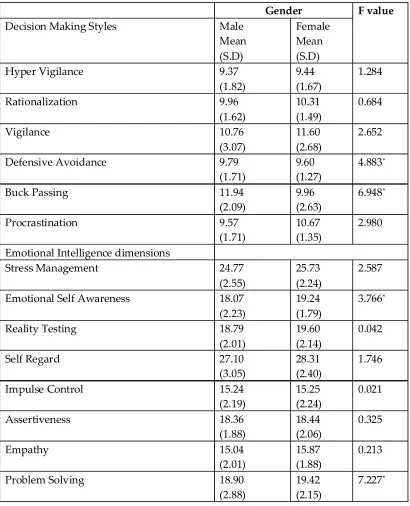
From the Table - 4, it is inferred that 't' values are significant for defensive avoidance and buck passing decisional style. And for the emotional Intelligence, it is found that 't' value is significant for emotional self awareness, problem solving, interpersonal relationship and with the emotional intelligence total. Hence the hypothesis is rejected for both the decision making and emotional intelligence.
From the Table - 4, it is found that male information technology leaders were high in defensive avoidance and buck passing decisional style. It may be due to nature of the project that the solution to the issues or problem has to handle by the software engineers who developed the programmes or who maintains the same. They tries to shifts responsibility onto someone else or rationalizing the least objectionable alternative.
TABLE - 4: Decision Making and Emotional Intelligence: Gender Comparison
Gender F value
Decision Making Styles Male
Mean (S.D)
Female Mean (S.D)
Hyper Vigilance 9.37
(1.82)
9.44 (1.67)
1.284
Rationalization 9.96
(1.62)
10.31 (1.49)
0.684
Vigilance 10.76
(3.07)
11.60 (2.68)
2.652
Defensive Avoidance 9.79
(1.71)
9.60 (1.27)
4.883*
Buck Passing 11.94
(2.09)
9.96 (2.63)
6.948*
Procrastination 9.57
(1.71)
10.67 (1.35)
2.980
Emotional Intelligence dimensions
Stress Management 24.77
(2.55)
25.73 (2.24)
2.587
Emotional Self Awareness 18.07
(2.23)
19.24 (1.79)
3.766*
Reality Testing 18.79
(2.01)
19.60 (2.14)
0.042
Self Regard 27.10
(3.05)
28.31 (2.40)
1.746
Impulse Control 15.24
(2.19)
15.25 (2.24)
0.021
Assertiveness 18.36
(1.88)
18.44 (2.06)
0.325
Empathy 15.04
(2.01)
15.87 (1.88)
0.213
Problem Solving 18.90
(2.88)
19.42 (2.15)
Flexibility 24.96 (3.34)
25.18 (2.85)
0.250
Inter Personal Relationship 21.90 (3.20)
21.67 (2.28)
6.305*
EI_Total 203.13
(14.38)
209.11 (7.31)
16.355*
The ability of the female information technology leaders to understand and express ourselves, understand others and relate with them results in high in emotional self-awareness. Whereas high in "problem solving" dimension of emotional intelligence may be due to the ability to identify and define problems as well as to generate and implement potentially effective solutions.
Male information technology leaders were high in "interpersonal relationship" dimension of emotional intelligence. It is welcome one that male leaders were high in interpersonal relationship, traditionally were female are better. It may be due to the individual character that, approaching everyone in respect and warm and presenting themselves as approachable and conveying intimacy to other. It is concluded that the gender of the leaders does not have significant relationship with their emotional intelligence and decision-making styles.
Hypothesis: "Information technology leaders differ significantly in their emotional intelligence and decision making on the basis of the number of dependents."
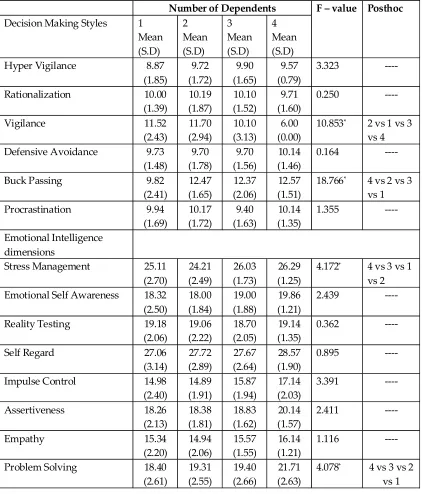
From the Table - 5, it is noticed that 'F' values are significant for vigilance and buck passing decisional style. And for the emotional Intelligence, it is found that 'F' value is significant for stress management, problem solving, flexibility, interpersonal relationship and with the emotional intelligence total. Hence the hypothesis is rejected for both the decision making and emotional intelligence.
TABLE - 5: Decision Making and Emotional Intelligence Based on The Number of Dependents
Number of Dependents F – value Posthoc
Decision Making Styles 1
Mean (S.D) 2 Mean (S.D) 3 Mean (S.D) 4 Mean (S.D)
Hyper Vigilance 8.87
(1.85) 9.72 (1.72) 9.90 (1.65) 9.57 (0.79)
3.323 ----
Rationalization 10.00
(1.39) 10.19 (1.87) 10.10 (1.52) 9.71 (1.60)
0.250 ----
Vigilance 11.52
(2.43) 11.70 (2.94) 10.10 (3.13) 6.00 (0.00)
10.853* 2 vs 1 vs 3
vs 4
Defensive Avoidance 9.73
(1.48) 9.70 (1.78) 9.70 (1.56) 10.14 (1.46)
0.164 ----
Buck Passing 9.82
(2.41) 12.47 (1.65) 12.37 (2.06) 12.57 (1.51)
18.766* 4 vs 2 vs 3
vs 1
Procrastination 9.94
(1.69) 10.17 (1.72) 9.40 (1.63) 10.14 (1.35)
1.355 ----
Emotional Intelligence dimensions
Stress Management 25.11
(2.70) 24.21 (2.49) 26.03 (1.73) 26.29 (1.25)
4.172* 4 vs 3 vs 1
vs 2
Emotional Self Awareness 18.32
(2.50) 18.00 (1.84) 19.00 (1.88) 19.86 (1.21)
2.439 ----
Reality Testing 19.18
(2.06) 19.06 (2.22) 18.70 (2.05) 19.14 (1.35)
0.362 ----
Self Regard 27.06
(3.14) 27.72 (2.89) 27.67 (2.64) 28.57 (1.90)
0.895 ----
Impulse Control 14.98
(2.40) 14.89 (1.91) 15.87 (1.94) 17.14 (2.03)
3.391 ----
Assertiveness 18.26
(2.13) 18.38 (1.81) 18.83 (1.62) 20.14 (1.57)
2.411 ----
Empathy 15.34
(2.20) 14.94 (2.06) 15.57 (1.55) 16.14 (1.21)
1.116 ----
Problem Solving 18.40
(2.61) 19.31 (2.55) 19.40 (2.66) 21.71 (2.63)
4.078* 4 vs 3 vs 2
Flexibility 24.71 (2.93)
23.55 (2.60)
26.47 (2.39)
31.57 (0.79)
22.182* 4 vs 3 vs 1
vs 2 Inter Personal Relationship 20.98
(2.73)
20.89 (2.66)
24.03 (1.83)
26.14 (1.68)
19.152* 4 vs 3 vs 1
vs 2
EI_Total 202.35
(13.24)
200.98 (11.16)
211.57 (7.76)
226.71 (5.65)
14.923* 4 vs 3 vs 1
vs 2
1. No dependents - 62 persons *Significant at 0.05% level
2. Less than 2 dependents - 47 persons
3. 3 or 4 dependents - 30 persons 4. More than 4 dependents - 7 persons
It is observed from the table that information technology leaders with more than 4 dependents in their family have higher stress management, problem solving, flexibility, and interpersonal relationship skills and emotional intelligence total than their counter parts. Traditionally, it is stated that if there are more number of dependents in the family better will be the emotional intelligence. Further, it is evident in this study.
It is concluded information technology leaders with have less than 2 dependents were high in vigilance decisional style and who have more than 4 dependents were high in buck passing decisional style. Whereas for emotional intelligence leaders with more than 4 dependents in their family have higher stress management, problem solving, flexibility, and interpersonal relationship skills and emotional intelligence total.
Hypothesis: "There is a significant relationship between emotional intelligence and decision-making of information technology leaders."
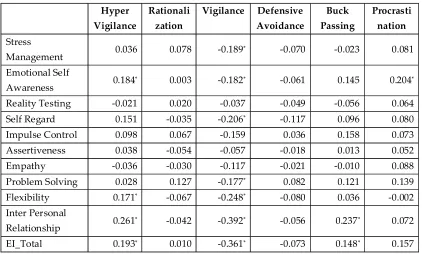
TABLE - 6: Decision Making and Emotional Intelligence: Correlational Analysis
Hyper Vigilance
Rationali zation
Vigilance Defensive Avoidance
Buck Passing
Procrasti nation Stress
Management 0.036 0.078 -0.189
* -0.070 -0.023 0.081
Emotional Self
Awareness 0.184
* 0.003 -0.182* -0.061 0.145 0.204*
Reality Testing -0.021 0.020 -0.037 -0.049 -0.056 0.064 Self Regard 0.151 -0.035 -0.206* -0.117 0.096 0.080
Impulse Control 0.098 0.067 -0.159 0.036 0.158 0.073 Assertiveness 0.038 -0.054 -0.057 -0.018 0.013 0.052
Empathy -0.036 -0.030 -0.117 -0.021 -0.010 0.088
Problem Solving 0.028 0.127 -0.177* 0.082 0.121 0.139
Flexibility 0.171* -0.067 -0.248* -0.080 0.036 -0.002
Inter Personal
Relationship 0.261
* -0.042 -0.392* -0.056 0.237* 0.072
EI_Total 0.193* 0.010 -0.361* -0.073 0.148* 0.157
Emotional self-awareness has a positive relationship with hyper-vigilance and procrastination whereas negative relationship with vigilance styles of decision-making may due to the lack of awareness of one's own emotions. The positive relationship with the hyper vigilance and procrastination may be due to the situation when the leaders feel they are disorganized and inefficient makes them to behave so. Because the leaders do not have the luxury of implementing a more elaborate analytic procedure.
Self-regard has a negative relationship with vigilance style of decision-making. The pessimistic approach by information technology leaders, towards finding the solution and beliefs they have was that, there is insufficient time to take decision. This makes the leaders to evade the conflicting decision-making by procrastinating or shifting responsibility for making the decision to someone else or constructing wishful rationalizations.
Inter personal relationship has a positive relationship with hyper-vigilance whereas negative relationship with vigilance styles of decision-making. The positive relationship with the hyper vigilance may be due to the limited awareness of one's own emotions is linked to a decisional style characterized by the need to entrust one's self to others for decision-making. The negative relationship with the vigilance may be due to the failure to recognize to trust their feelings and allow them by carrying the negativity of the bad decisions.
Flexible people are agile, synergistic, and capable of reacting to change without rigidity. Flexibility has a positive relationship with hyper-vigilance and buck passing decisional style. The positive relationship of flexibility with the hyper-vigilance may be due to ability of the leaders to adapt them to the unfamiliar, unpredictable, and dynamic circumstances and the handling the issue in the time bound pressure. And the buck passing may be due to the hardness of the issue or the subject makes them to passing the buck to others.
Negative relationship with the vigilance may be due to the nature of job and monotony of the work that push the executives to boredom and dissatisfaction aroused from the routine and specialized tasks. Finding time to make decisions itself is an ultimate challenge that requires the flexibility and initiative. Emotional intelligence total has a positive relationship with hyper-vigilance and buck passing whereas negative relationship with vigilance styles of decision-making. The positive relationship with the hyper-vigilance may be due the individuals' attention process and emotion perception fails to read the decision making process. Though they have better understanding and regulation of one's emotions the personal coping capabilities at the work place and affect the decision making process.
The rapid pace of organizational changes forces the individual to accommodate to the needs of the organization. Change requires the employee to function in a different manner and this requires considerable expenditure of emotional resources, when it fails it results in the negative relationship with the vigilance decisional style. Hence, it is concluded that there is no significant correlation between the emotional intelligence and decision making of the information technology leaders.
Conclusion
and management of emotions, and use those emotions in the procedure of decision making.
This research provides a number of contributions to the theoretical debate about emotional intelligence and decision making style, that is, "Decision Making Styles of IT Professionals in relation to their Emotional Intelligence." The first contribution is that this study explored the relationship between leader emotional intelligence and their tendencies to different decision making styles. Moreover, we constructed our research work on the valid models of emotional intelligence and decision making style. The second contribution establishes that emotional intelligence does lead to wide variety styles of managerial decision making and finally the result of the current study tried to make leaders pay much more attentions to emotional intelligence in their training programs and managerial assignments.
References
1. Abraham, R. (2000). The role of job control as a moderator of emotional dissonance and
emotional intelligence - outcome relationships, The Journal of Psychology, 134, 169-184.
2. Amalor, D. (1992). A study of decision making styles in relation to some personality
characteristics of university students. Unpublished M.Phil., thesis, Dept of Psychology, Annamalai University, India.
3. Bar-On, R. (1997). EQ-i. Bar-On emotional quotient inventory: A measure of emotional
intelligence: Technical manual. Toronto, ON: Multi-Health Systems Inc.
4. Easterbrook, J.A. (1959) The effects of emotion on cue utilization and the organization of
behavior. Psychological Review, 1959, 66, 183-200.
5. Frigda, N.H. (1988) The laws of emotion. American Psychologist, 1988, 43, 349-58.
6. Gardner, L. & Stough, C. (2001). Examining the relationship between leadership and
emotional intelligence in senior level managers, Leadership and organizational Development Journals, 23(2), 68-78.
7. George, J.M. (2000) Emotions and Leadership: The role of emotional leadership, Vol. 53 No,
8. London, Thousand Oaks CA, New Delhi.
8. George, J.M. (2000). Emotions and leadership: The role of Emotional Intelligence, Human
relations, 53, 1027-1041
9. Goleman, D. (1995). Emotional Intelligence. New York: Bantam Books.
10. James D. Hess and Arnold C. Bacigalupo (2011). Enhancing decisions and decision-making
processes through the application of emotional intelligence skills, Management Decision, 49 (5), 710-721.
12. Mandler, G. (1975), Mind and emotion. New York: Wiley, 1975.
13. Mayer, J.D., & Salovey, P. (1997). What is emotional Intelligence? In P. Salovey & D.J. Sluyter
(Ed.), Emotional Development and Emotional Intelligence, New York; Basic Books.
14. Salovey, P., & Mayer, J.D. (1990). Emotional Intelligence. Imagination, Cognition and
Personality, 9, 185-211.
15. Simon, H.A. Comments. In M.S. Clark and S.T. Fiske (Eds), Affect and cognition. Hillsdale, NJ: