www.pharmascholars.com
157
Original Article
CODEN: IJPNL6
Development and Validation of Stability Indicating RP-HPLC method for
simultaneous estimation of Epalrestat and Pregabalin in bulk and tablet
dosage form
B. Madhu Harika
1, Y. Rajendra Prasad
21
VJ’s College of Pharmacy, Rajahmundry, Andhrapradesh, India
2College of Pharmaceutical Sciences, Andhra University, Visakhapatnam, Andhrapradesh, India
*Corresponding author e-mail: [email protected].
Received on: 07-11-2016; Revised on: 29-11-2016; Accepted on: 26-03-2017
ABSTRACT
The proposed study, a new stability- indicating RP-HPLC method has been developed for estimation of Epalrestat and Pregabalin in bulk and tablet dosage form. The present method was a sensitive, precise, and accurate RP-HPLC method for the analysis of Epalrestat and Pregabalin. To optimize the mobile phase, various combinations of buffer and organic solvents were used on Xterra-(150x4.6mm, 5µ) column. Then the mobile phase containing a mixture of Ammonium acetate buffer (pH 10): ACN 70:30 % v/v was selected at a flow rate of 1.0 ml/min for developing the method and the peaks with good shape and resolution was found resulting in short retention time, baseline stability and minimum noise. The retention times of Epalrestat and Pregabalin were found to be 2.516 min and 3.132 min respectively. Quantitative linearity was obeyed in the concentration range of 37.5-225 and 18.75-112.5 µg/mL of Epalrestat and Pregabalin respectively. The limit of detection and limit of quantification were found to be 0.19µg/mL and 0.57µg/mL (Epalrestat); 0.50µg/ mL and 1.51 µg/mL (Pregabalin) respectively, which indicates the sensitivity of the method. The high percentage recovery indicates that the proposed method is highly accurate. No interfering peaks were found in the chromatogram indicating that excipients used in injection formulations didn’t interfere with the estimation of the drugs by the proposed HPLC method.
Key Words: Stability RP-HPLC, Epalrestat and Pregabalin, Validation
INTRODUCTION
Epalrestat(1-8) is a carboxylic acid derivative and a noncompetitive and reversible used for the treatment of which is one of the most common long-term complications in patients. Chemically, Epalrestat is 4-[4-(4-chlorophenyl)-4-hydroxypiperidin-1-yl]-1-(4-fluorophenyl) butan-1-one. Chemically, Epalrestat is unusual in that it is a drug that contains a group. Aldose reductase is the key enzyme in the polyol pathway whose enhanced activity is the basis of diabetic neuropathy. Aldose reductase inhibitors (ARI) target this enzyme. Out of the many ARIs developed, ranirestat and fidarestat are in the trial stage. Others have been discarded due to
unacceptable adverse effects or weak efficacy. Epalrestat is the only ARI commercially available. It is easily absorbed into the neural tissue and inhibits the enzyme with minimum side effects.The chemical structure of Epalrestat was given in fig 1.
Pregabalin(9-17) is an anticonvulsant drug used for neuropathic pain, as an adjunct therapy for partial seizures, and in generalized anxiety disorder. It was designed as a more potent successor to gabapentin. Chemically it is (3S)-3-(aminomethyl)-5-methylhexanoic acid. Pregabalin is marketed by Pfizer under the trade name Lyrica. It is considered to have a dependence liability if misused and is classified as a Schedule V drug in the U.S. The chemical structure of Pregabalinwas given in fig 2.
International Journal of Pharmacy
www.pharmascholars.com
158
The review of literature revealed that severalanalytical methods have been reported for Epalrestat and Pregabalin [18-21] in Spectrophotometry, HPLC, HPTLC and LC/MS individually and in combination. To date, there have been no published reports about the stability indicating studies and simultaneous estimation of Epalrestat and Pregabalin by HPLC in bulk drug and in tablet dosage forms. This present study reports for the first time stability indicating simultaneous estimation of Epalrestat and Pregabalin by RP-HPLC in bulk drug and in tablet dosage form.
MATERIALS AND METHODS
Chemicals and Reagents
Epalrestat and Pregabalin were obtained as gift samples from Spectrum Pharma Research laboratory in Hyderabad and Tablets (Prealdonil, Zydus.) containing Epalrestat -150 mg and Pregabalin-75 mg were purchased from local market. Acetonitrile, Water were obtained from Merc, Mumbai and Potassium dihydrogen ortho phosphate, Triethylamine, Ortho phosphoric acid obtained from RANKEM, Mumbai. All solvents used in this work are HPLC grade.
Instrument and chromatographic conditions
RP-HPLC waters 2695 separation module equipped with 2996Photodiode Array Detector was employed in this method.The Empower 2 software was used for LC peak integration along with data acquisition and data processing. The column used for separation of analytes Xterra -(150x4.6mm, 5µ). Mobile phase consisting of Ammonium acetate (pH 10.0) and Acetonitrile 70:30 %v/v at a flow rate of 1.0 ml/min. It was filtered through 0.45μm nylon filter and sonicated for 5 min in ultrasonic bath. Samples were analysed at 210 nm at an injection volume of 10 μL.
Preparation of Mobile phase:
Preparation of 1M Acetic acid:
5.7ml of Ammonia solution is transferred in to 100ml of volumetric flask and added about 90ml of milli-Q water and Sonicated to degas and finally make up the volume with water.
Preparation of pH 10 Buffer:
Added 25ml of 1M Acetic acid to 1000ml of water and added 6.2ml Ammonia solution and mixed well, then adjusted the pH 10 with Ammonia solution. Sonicated for degassing.
Preparation of Solutions:
Preparation of Epalrestat stock solution
Accurately Weighed and transferred 15mg of Epalrestat into 10ml of the clean dry volumetric
flask, added 7ml of diluent, then sonicated for 10min and make up the volume with diluent.
Preparation of Pregabalin stock solution
Accurately weighed 7.5mg of Pregabalin and transferred into 10ml of the clean dry volumetric flask, added 7ml of diluent, then sonicated for 10 min and make up the final volume with diluent.
Preparation of Epalrestat standard solution
From the above Epalrestat stock solution, 1ml was pipetted out into 10ml of the clean dry volumetric flask and make up the final volume with diluent.
Preparation of Pregabalin standard solution
From the above Pregabalin stock solution, 1ml was pipetted out into a 10ml clean dry volumetric flask and make up the final volume with diluent.
METHOD VALIDATION
The validation of the method was carried out as per ICH Guidelines. The parameters assessed were specificity, linearity, precision, accuracy, stability, LOD and LOQ.
Specificity
Specificity is the ability of the analytical method to measure the analyte response in the presence of interferences including degradation products and related substances.
Accuracy
The accuracy was determined by calculating % recoveries of Epalrestat and Pregabalin. It was carried out by adding known amounts of each analyte corresponding to three concentration levels (50, 100, and 150%) of the labelled claim to the excipients. At each level, six determinations were performed and the accuracy results were expressed as percent analyte recovered by the proposed method.
Precision
Precision of an analytical method is usually expressed as the standard deviation. The repeatability studies were carried out by estimating response of Epalrestat 150µg/ml and Pregabalin 75µg/ml six times. The intra-day and inter-day precision studies (intermediate precision) were carried out by estimating the corresponding responses three times on the same day and on three different days for three same concentrations and the results are reported in terms of relative standard deviation.
Linearity
www.pharmascholars.com
159
of Epalrestat and 18.75-112.5 µg/ml of Pregabalinfrom the stock solution.
Robustness
Robustness of the method was investigated under a variety of conditions including changes of composition of buffer in the mobile phase, flow rate and temperature. This deliberate change in the method has no effect on the peak tailing, peak area and theoretical plates and finally the method was found to be robust.
System suitability
System suitability was performed by freshly preparing standard solutions containing Epalrestat150µg/ml and Pregabalin 75µg/ml. From the prepared solutions 10µl solution of each was injected 6 times into the HPLC system and the suitability of the system was evaluated.
Limit of Detection & Limit of Quantitation
The LOD can be defined as the smallest level of analyte that gives a measurable response and LOQ was determined as the lowest amount of analyte that was reproducibly quantified. These two parameters were calculated using the formula based on the standard deviation of the response and the slope. LOD and LOQ were calculated by using equations, LOD=3.3 × s/s and LOQ=10 × s/s, where s = standard deviation, S= slope of the calibration curve.
Assay of Epalrestat and Pregabalin in injection
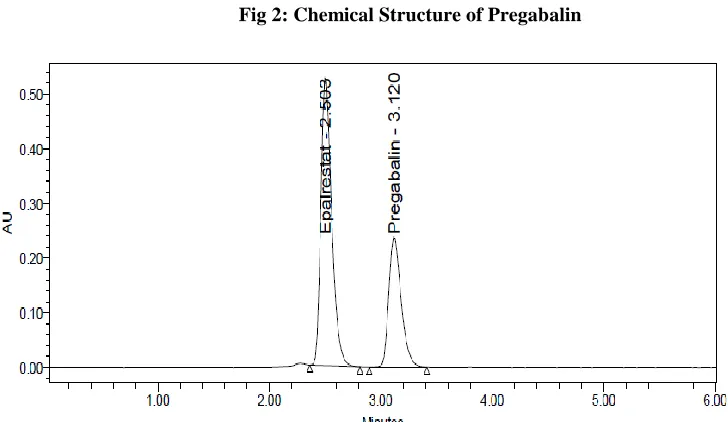
Assay of marketed product was carried out by using the developed method. Sample solutions were prepared and injected into RP-HPLC system. The sample solution was scanned at 210 nm. The % drug estimated was found to be 99.60 and 100.22% respectively Epalrestat and Pregabalin. The chromatogram showed two single peaks of Epalrestat and Pregabalin was observed with retention times of 2.516 and 3.132 min (Figure 3).
Forced Degradation studies
Stress studies are performed according to ICH guidelines under conditions of hydrolysis (acidic and alkaline), photolysis, oxidation, and thermal studies.
Preparation of hydrogen peroxide induced degradation product:
To 1 ml of Epalrestat and Pregabalin stock solutions were taken into two volumetric flasks. 1 ml of freshly prepared 20% H2O2 solution was added separately into two volumetric flasks and solutions were kept at 60 0C for 30min. Then the resultant solution was injected into HPLC system to get the chromatograms.
Preparation of Acid induced degradation Product:
1ml of Epalrestat and Pregabalin stock solution was taken into Round Bottom (RB) flask and refluxed with 2N Hydrochloric acid at 60 0C for 30 min. The resultant solution was collected, diluted with mobile phase to get the concentration of 150µg/ml & 75µg/ml and the10µl solution was injected into HPLC system and chromatograms were recorded.
Preparation of Alkali induced Degradation Product:
To 1ml of Epalrestat and Pregabalin stock solutions, add 2N sodium hydroxide and refluxed for 30 min at 60 0C. After 30 min the resultant solutions were diluted with mobile phase to obtain 150µg/ml & 75µg/ml. Then the10µl solution was injected into the system and chromatograms were recorded to assess the stability of the sample.
Dry Heat Induced Degradation Product:
To study the dry heat degradation studies, the standard drug solutions of Epalrestat and Pregabalin was placed in anoven for 6hrs at 105 0C. The resultant solutions were diluted to get the concentration of 150µg/ml & 75µg/ml and the10µl solution was injected into HPLC system and chromatograms were recorded to assess the stability studies
Photochemical Stability induced Product:
The photochemical stability studies of the drugs were studied by exposing the sample concentrations of 150µg/ml & 75µg/ml to UV light in UV chamber for 7 days or 200 Watt hours/m2. Then the resultant solution was diluted and the10µl solution was injected into the HPLC system.
RESULTS & DISCUSSIONS
Optimized Chromatographic conditions
www.pharmascholars.com
160
studies were carried out under conditions ofhydrolysis, dry heat, oxidation, UV light and photolysis and the drug substances were degraded in all conditions. Acid and base hydrolysis was performed by exposing the drug substances with 2N HCl and 2N NaOH at 60 oC for 30min and it was showed degradation of Epalrestat and Pregabalin with degraded products peak at retention time 2.516 and 3.132 min respectively. Degradation studies under oxidative conditions were performed by heating the drug sample with 20% H2O2 at 60
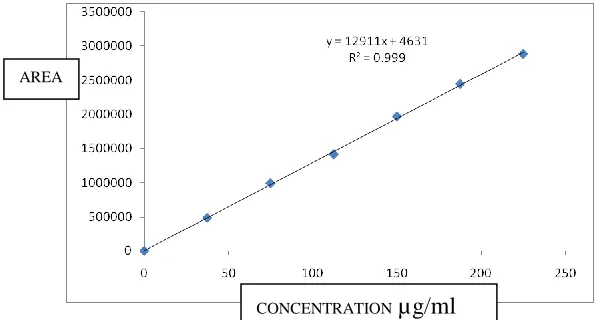
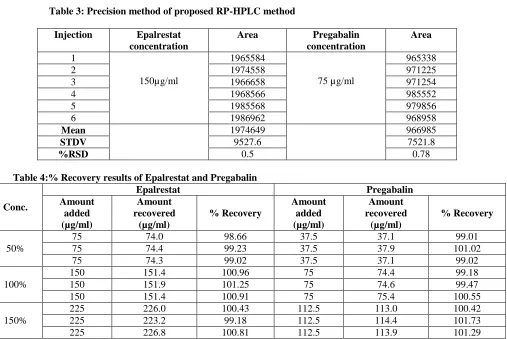
o C and degraded product peaks were observed. Both Epalrestat and Pregabalin are sensitive to acid and alkali and there was no degradation occurs under UV light and thermal conditions. The results of forced degradation studies were given in table 2. Precision was evaluated by a known concentration of Epalrestat and Pregabalin was injected six times and corresponding peaks were recorded and % RSD was calculated and found within the limits. The low % RSD value was indicated that the method was precise and reproducible and the results were shown in the table (Table 3). Accuracy of the method was proved by performing recovery studies on the commercial formulation at 50, 100 and 150% level. % Recoveries of Epalrestat and Pregabalin ranges from 98.66 to 101.25% and 99.01 to 101.73% for Epalrestat and Pregabalin respectively in simultaneous equation method and the results were shown in the (Table 4). Linearity was established by analyzing different concentrations of Epalrestat and Pregabalin respectively. The calibration curve was plotted with the area obtained versus concentration of both Epalrestat and Pregabalin (Fig 5&6). In the present study six concentrations were chosen ranging between 37.5 - 225 µg/mL of Epalrestat and 18.75 - 112.5 µg/mL of Pregabalin. The regression equation and correlation coefficient for Epalrestat and Pregabalin was found to be y = 12911x + 4631 and R2=0.999 and y = 13322x - 8423 and R2=0.9990
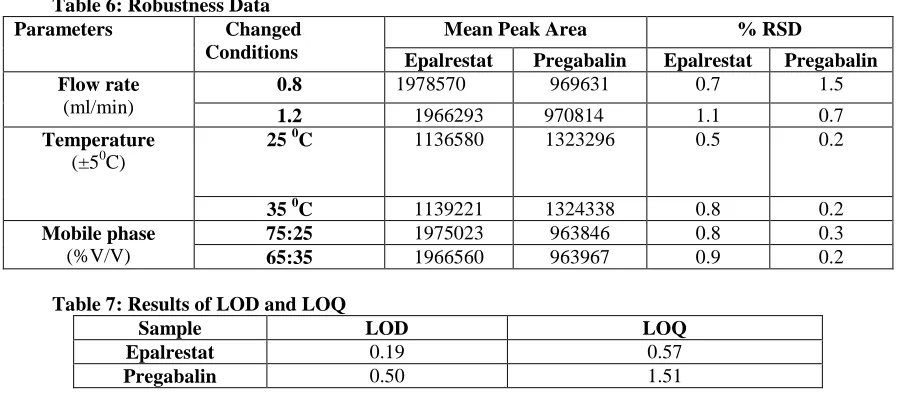
respectively and results were given in table 5. Robustness of the method is the ability of the method to remain unaffected by small deliberate changes in parameters like flow rate, mobile phase composition and column temperature. To study the effect of flow rate of the mobile phase it was changed to 0.1 units from 1.0 mL to 0.8 mL and 1.2 mL. The effect of column temperature also checked by changing temperature to ± 5 oC. This deliberate change in the above parameters has no significant effect on chromatographic behaviour of the samples and results were given in table 6. LOD and LOQ of Epalrestat and Pregabalin were evaluated based on relative standard deviation of the response and slope of the calibration curve. The detection limits were found to be 0.19µg/mL and 0.50µg/mL for Epalrestat and Pregabalin respectively. The quantification limits were found to be 0.57µg/mL and 1.51µg/mL for Epalrestat and Pregabalin respectively. The results were given in the table 7.
CONCLUSION
A new stability- indicating RP-HPLC method has been developed for estimation of Epalrestat and Pregabalin in bulk and tablet dosage form. The developed method was validated and it was found to be simple, sensitive, precise and robust and it can be used for the routine analysis of Epalrestat and Pregabalin in both bulk and pharmaceutical dosage forms. The forced degradation studies were carried out in accordance with ICH guidelines and the results revealed suitability of the method to study stability of Epalrestat and Pregabalin under various degradation conditions like acid, base, oxidative, thermal, UV and photolytic degradations. Finally it was concluded that the method is simple, sensitive and has the ability to separate the drug from degradation products and excipients found in the dosage form.
..
www.pharmascholars.com
161
Fig 2: Chemical Structure of Pregabalin
Fig 3: A typical chromatogram of Epalrestat and Pregabalinin tablet dosage form
www.pharmascholars.com
162
Fig 5: Linearity curve of Epalrestat
Fig 6: Linearity curve of Pregabalin
Table-1: Optimized Chromatographic conditions
Parameter Condition
RP-HPLC Water 2695 separation module with PDA detector
Mobile phase Ammonium acetate buffer pH 10:ACN 70:30%v/v
Column Xterra-150x4.6mm, 5µ column
Column Temperature 30 0C
Wavelength 210nm
Diluents Water:ACN (50:50)
Injector volume 10µl
Flow rate 1ml/min
Runtime 10min
Retention time Epalrestat-2.516min and Pregabalin-3.132min
Theoretical Plates Epalrestat -3242 and Pregabalin -3937 AREA
CONCENTRATION µg/ml
AREA
www.pharmascholars.com
163
Table 2: Results of Forced Degradation Studies
Stress condition
Epalrestat Pregabalin Purity of
angle
Purity of Threshold
Purity of angle
Purity of Threshold Acid degradation 0.170 0.598 0.100 0.252
Base degradation 0.154 0.605 0.874 0.956
Peroxide degradation 0.154 0.605 0.822 0.956
Dry heat degradation 0.075 0.281 0.108 0.297
Photolytic degradation 0.074 0.280 0.108 0.303
Table 3: Precision method of proposed RP-HPLC method
Injection Epalrestat concentration
Area Pregabalin concentration
Area
1
150µg/ml
1965584
75 µg/ml
965338
2 1974558 971225
3 1966658 971254
4 1968566 985552
5 1985568 979856
6 1986962 968958
Mean 1974649 966985
STDV 9527.6 7521.8
%RSD 0.5 0.78
Table 4:% Recovery results of Epalrestat and Pregabalin
Conc.
Epalrestat Pregabalin
Amount added (µg/ml)
Amount recovered
(µg/ml)
% Recovery
Amount added (µg/ml)
Amount recovered
(µg/ml)
% Recovery
50%
75 74.0 98.66 37.5 37.1 99.01
75 74.4 99.23 37.5 37.9 101.02
75 74.3 99.02 37.5 37.1 99.02
100%
150 151.4 100.96 75 74.4 99.18
150 151.9 101.25 75 74.6 99.47
150 151.4 100.91 75 75.4 100.55
150%
225 226.0 100.43 112.5 113.0 100.42
225 223.2 99.18 112.5 114.4 101.73
225 226.8 100.81 112.5 113.9 101.29
Table 5: Results of Linearity
Linearity curve Epalrestat Pregabalin Slope Intercept Slope Intercept
Value 12911 4631 13522 8423
Correlation
www.pharmascholars.com
164
Table 6: Robustness Data Parameters Changed
Conditions
Mean Peak Area % RSD
Epalrestat Pregabalin Epalrestat Pregabalin Flow rate
(ml/min)
0.8 1978570 969631 0.7 1.5
1.2 1966293 970814 1.1 0.7
Temperature
(±50C)
25 0C 1136580 1323296 0.5 0.2
35 0C 1139221 1324338 0.8 0.2
Mobile phase
(%V/V)
75:25 1975023 963846 0.8 0.3
65:35 1966560 963967 0.9 0.2
Table 7: Results of LOD and LOQ
Sample LOD LOQ
Epalrestat 0.19 0.57
Pregabalin 0.50 1.51
REFERENCES
1. https://en.wikipedia.org/wiki/Epalrestat.
2. https://www.scbt.com/scbt/sv/product/epalrestat-82159-09-9. 3. https://www.ncbi.nlm.nih.gov/pmc/articles/PMC2771994/
4. Terashima, H: J. Pharmacol. Exp. Ther., 229, 226 (1983).
5. Kikkawa, R: Diabetologia, 24, 290 (1983).
6. Kojima, K: Jpn. J. Ophthalmol., 29, 99 (1985).
7. Ramirez, Mary Ann; Borja, Nancy L "Epalrestat: An Aldose Reductase Inhibitor for the Treatment of Diabetic Neuropathy".Pharmacotherapy.(May 2008);28(5): 646–655.
8. Steele, John W.; Faulds, Diana; Goa, Karen L. "Epalrestat".Drugs & Aging.1993;3(6): 532–555.
9. https://en.wikipedia.org/wiki/Pregabalin. 10. https://www.drugbank.ca/drugs/DB00230.
11. https://www.scbt.com/scbt/product/Pregabalin/148553-50-8.
12. Kumar et al., Evidence that Pregabalin reduces neuropathic pain by inhibiting the spinal release of glutamate. J.Neurochem.1986; 113552.
13. ArainPregabalin in the management of partial epilepsy. Neuropsych.Dis.Treat.2009; 5 407.
14. Field et al.,Pregabalin may represent a novel class of anxiolytic agents with a broad spectrum of activity. Br.J.Pharmacol.2001; 1321
15. Schifano, Fabrizio. "Misuse and Abuse of Pregabalin and Gabapentin: Cause for Concern?".CNS Drugs.2014;28(6): 491–6.
16. Pregabalin - Drugs.com.www.drugs.com. Retrieved 2016-11-07.
17. Summary of product characteristics European Medicines Agency. 6 March 2013. Retrieved 6 May 2013.
18. Mili Patel. Development and Validation OfStability IndicatingHplc Method For Simultaneous Estimation Of Epalrestat And Methylcobalamin In Tablet Dosage Form.International Journal of Recent Scientific Research Research 2015; 6(4), 3673-3678.
19. JanakiPathi P.The Estimation of Epalrestat in Tablet Dosage Form by RP-HPLC. Asian J. Pharm. Ana. 2012;
2(2), 49-51.
20. Kasawar GB, Farooqui MN. Development and validation of HPLC method for the determination of pregabalin
in capsules.Indian J Pharm Sci. 2010 Jul; 72(4):517-9.