Int. J. of Engg. Sci. & Mgmt. (IJESM), Vol. 2, Issue 4: Oct.-Dec.: 2012, 364-368
INTERNATIONAL JOURNAL OF ENGINEERING SCIENCES
&
MANAGEMENT
“A STUDY AND ANALYSIS OF SMART ANTENNAS FOR SOFTWARE RADIO ARCHICTURE IN WIRELESS COMMUNICATION APPLICATION”
Prof. Prajapati G.R *1 ,Ast.Prof. Gupta.A2
*1,2AIT UJJAIN, INDIA
ABSTRACT
Recently, there has been considerable interest in using antenna arrays in wireless communication networks to increase the capacity and decrease the co channel in reference. Adaptive beam forming with smart antennas at the receiver increases the carrier-to-interference ratio (CIR) in a wireless link. This paper considers a wireless network with beam forming capabilities at the receiver which allows two or more transmitters to share the same channel to communicate with the base station. The concrete computational complexity and algorithm structure of a base station are considered in terms of a software radio system model, initially with an Omni directional antenna. The software radio computational model is then expanded to characterize a network with smart antennas. The application of the software radio smart antenna is demonstrated through two examples. First, traffic improvement in a network with a smart antenna is considered, and the implementation of a hand-off algorithm in the software radio is presented.
Index Terms—Adaptive beam forming, handoff, power control, smart antennas, software radio.
1. INTRODUCTION
Smart Antennas are being regarded by many as the key solution to increasing the spectral efficiency and improving the system performance in mobile communication. In principle, an antenna is smart only when it can recognize and track the signal of a
particular mobile telephone while
suppressing interfering signals. This can be achieved by forming a beam towards the mobile telephone, hence, the term beam forming is widely used in literature. The evolution of the software radio technology, combined with the recent advances in digital signal processors, has motivated researchers around the globe. Furthermore, the
development of VLIW DSP architectures, such as that of the Texas Instruments
TMS320C6201 processor, has left
researchers curious as to its suitability towards a variety of applications, especially that of smart antennas.
This paper describes the design and implementation of a beam forming system
on a Distributed Shared Memory
architecture. This architecture relies on a PCI local bus for communication between
the TMS320C6201 processors. A
Int. J. of Engg. Sci. & Mgmt. (IJESM), Vol. 2, Issue 4: Oct.-Dec.: 2012, 364-368
memory and, hence, doubles the rate at which data is moved between processors. The beam forming system is based on software radio where the analog to digital conversion for each antenna element occurs as close as possible to the antenna.
Furthermore, the in-phase and quadrature (I and Q) components of each antenna signal are generated in the digital domain using the Harris HSP50214 programmable down converter. The beam forming system described in this paper is being used to evaluate the processing requirements for the
recursive least-squares (RLS) algorithm.
We start by giving an overview of beam forming. For illustration purposes, the results of simulating the RLS algorithm in MATLAB are presented. After we give a formal description of the RLS algorithm, we carry on describing the beam forming system architecture. Finally, we report the results of running the RLS algorithm on the TMS320C6201 processor. Though
these results are preliminary, they are valuable in terms of finding new directions
for optimizing the overall system
performance.
2.Beam forming Basics
Beam forming is the term used to describe the application of weights to the inputs of an array of antennas to focus the reception of the antenna array in a certain direction, called the look direction or the main lobe [3]. More importantly, other signals of the same carrier frequency from other directions can be rejected. These effects are all achieved electronically and no physical movement of the receiving antennas is necessary. In addition, multiple beam formers focused in different directions can share a single antenna array; one set of antennas can service multiple calls of the
same carrier. the theoretical spatial response of a four element beam former rejecting Signals from -45°, -10°, and +60°, and forming a main lobe towards a desired signal at+30°. Note that the direction of the main lobe is not exactly at 30°. This phenomenon arises from the properties of the beam former; it is optimized to reject interfering signals rather than to direct the main lobe towards the desired signal .It is no coincidence that the number of elements in the above diagram equals the number of incoming signals. A beam former of L antenna elements is capable of accepting one signal and reliably rejecting L-1 signals. A greater number of interfering signals will diminish the performance of the beam former. Beam forming presents several advantages to antenna design. Firstly, space
division multiple access (SDMA) is
achieved since a beam former can steer its look direction towards a certain signal. Other signals from different directions can reuse the same carrier frequency. Secondly, because the beam former is focused in a particular direction, the antenna sensitivity can be increased for a better signal to noise ratio, especially when receiving weak signals. Thirdly, signal interference is reduced due to the rejection of undesired signals. For the uplink case of transmitting from the antenna array to a mobile telephone, system interference is reduced since the signal is only transmitted in the look direction. A digital beam former is one that operates in the digital domain.
Traditionally, beam formers were
Int. J. of Engg. Sci. & Mgmt. (IJESM), Vol. 2, Issue 4: Oct.-Dec.: 2012, 364-368
components. A beam forming algorithm implemented on one or more digital signal processors then processes the I and Q components to determine a set of weights for the input signals. The input signals are then multiplied by the weights and summed to output the signal of interest (SOI). Figure2 below illustrates the process.
An adaptive beam former reliably updates its set of weights to track the direction of the SOI. Hence, if the SOI is that of a mobile telephone, the beam former will constantly update its set of weights such that the look direction of the beam former and more
importantly, the directions of signal
rejection are steered as the signal sources change in azimuth with respect to the plane of an antenna array.
3.The RLS Algorithm
One of the foremost advantages offered by the software radio technology is flexibility. Because beam forming is implemented in software, it is possible to investigate a wide range of beam forming algorithms without the need to modify the system hardware for every algorithm. Consequently, researchers can focus their efforts on improving the
performance of the beam forming
algorithms rather than on designing new hardware, which can be a very expensive and time consuming process.
A complete description of the RLS algorithm can be found in This algorithm was chosen for its fast convergence rate and ability to process the input signal before demodulation. While the first reason is important especially when the environment is changing rapidly, the later reason decreases the algorithm dependency on a specific air interface.
Note that applying the RLS algorithm does
not require any matrix inversion
computations as the inverse correlation
matrix is computed directly. The RLS
algorithm recursion is initialized by
choosing a starting value for the inverse correlation matrix P(n) that assures the non-singularity of the correlation matrix. The weights vector w$(0) is set to zero. Subsequently, for every input sample n, a gain factor k(n) and an absolute error a (n) are computed, which in turn are used to compute the weight vector w$ (n) .
4.System Architecture
The system consists of the following: 1. An L-element antenna array; 2. L RF receiver stages;
3. L analog to digital converter stages (PMC-MAI);
4. L/2 digital down-converter stages (PEM-2PDC); and
5. L/2 Daytona dual TMS320C6201 PCI boards.
Daytona provides two 200 MHz
TMS320C6201 DSP processing elements on a single board with industry-standard I/O
and a fast PCI interface. Each
TMS320C6201 processor provides 400 Mbytes/s access to a local bank of Synchronous Burst SRAM and a local bank of Synchronous DRAM. An 8K bank of 32-bit dual port RAM is shared between the processors for low-latency message passing. Daytona features one Processor Expansion
Module (PEM) site supporting two
TMS320C6201 processors with a theoretical total transfer rate of 400 Mbytes/s. It also features one PCI Mezzanine Connector (PMC) site.
Int. J. of Engg. Sci. & Mgmt. (IJESM), Vol. 2, Issue 4: Oct.-Dec.: 2012, 364-368
The PMC-MAI is a PMC module that samples an IF signal at a rate up to 65 MSPS and converts the 12 bit wide parallel data into a high-speed serial data stream. The PMC-MAI provides high-accuracy, low-noise sampling of signals, different input filtering options and offers six high-speed serial outputs for inter-connection with the PEM-2PDCmodules.
The PEM-2PDC is a PEM module that receives high-speed, serial data streams of digitized IF signals and down-converts them to base-band signals. The PEM-2PDC has two Harris HSP50214 programmable down-converter (PDC) chips. Each PDC chip can be tuned to a narrow-band radio signal anywhere within the IF bandwidth. The PDC chip converts the signals to base-band signals centered at 0 Hz and provides complex digital samples at a programmable low rate. The I and Q data is passed from the PDC chips through a set of FIFO chips and is accessible by the DSP through the PEM interface. In order for any beam forming algorithm to work properly, the PDC chips must be synchronized. This can be achieved by programming one PMC-MAI module to send are set signal to all of the PEM-2PDC modules. When the reset signal is de-asserted, all of the PDC chips start processing input samples at the same time.
5.Experimental Results
The effective sampling rate of the FIFO’s data is 6 kHz. The time it would take for a specified number of samples to arrive from the down converters to DSP memory is calculated .Theory states that the complexity of the RLS algorithm increases as the square of L, or O(L2), where L is the number of antenna elements. Though it is difficult to see, Figure 5reflects this exponential increase. As for the increasing number of
samples, the algorithm’s complexity should increase linearly. Figure 5 verifies the prediction of an exponential and linear increase in processing time with respect to the number of antenna elements and samples processed, respectively. Clearly, even the processing time of the two-element scenario is greater than the amount of time it takes for the data to arrive. That is, real time performance cannot be achieved. The primary explanation is that the floating-point math is running on a TMS320C6201fixed-point processor. The question at hand is whether we would like to achieve real time performance for the adaptive beam former. If not, the advantages of utilizing only one DSP per beam former are realized. However, if required, then a single DSP running the implemented algorithm may not suffice, even with a floating-point processor. A method of utilizing multiple DSP processors is necessary.
6.References
[1] B. Haller, “Algorithms and VLSI Architecture for RLS-Based Time Reference Beamformingin Mobile Communications,” Proceedings of the International Zurich
Seminaron Broadband Communications
IZS’98, Zurich, Switzerland, 1998.
[2] S. Haykin, Adaptive Filter Theory, Englewood Cliffs, NJ: Prentice-Hall, 2nd Ed. 1991.
[3] J. Litva and T. Lo. Digital Beamforming
in Wireless Communications, Boston,
MA:Artech House, 1996.
[4] M. Darwish, “Distributed Shared Memory - A New High Performance
DSPBoard Architecture,” ICSPAT
Int. J. of Engg. Sci. & Mgmt. (IJESM), Vol. 2, Issue 4: Oct.-Dec.: 2012, 364-368
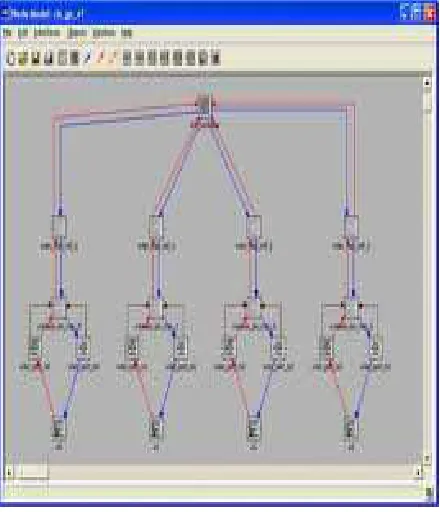
Figure 2 Beam forming
Figure 3 swri
b1b2b3b4b5b6....
b1b4
...
b6 b3 b2b5...
...
S
IG
N
A
L
P
R
O
C
E
S
S
IN
G
b1b2b3b4b5b6....
S
IG
N
A
L
P
R
O
C
E
S
S
IN
G b2b5...
b2b5...
...
b6 b3
C1
C3 C2 A1
A3 A2
B3 B2 B1
A1 C1
B3 B2 B1
A3 A2
C3 C2
Figure 1. Spatial Multiplexing opens