ISSN (e): 2250-3021, ISSN (p): 2278-8719
Vol. 09, Issue 4 (April. 2019), ||S (III) || PP 11-16
Interfacing User Centric Design of Human Computer Interaction
in Quality of Software
Bineet Kumar Gupta
1, Rajat Sharma
2*, Sanjai Diwakar
21 Associate Professor, Department of Computer Application, Shri Ramswaroop Memorial University 2Research Scholar, Department of Computer Application, Shri Ramswaroop Memorial University*
2Research Scholar, Department of Computer Application, Shri Ramswaroop Memorial University
Corresponding Author:Bineet Kumar Gupta
Abstract: Improvising software engineering methods with growing and changing market demands is the need
of hour. It always have been a great challenge and issue to get software quality in tandem with the today’s market or user requirements which is ever changing and flexible. With this study we proposed a methodology in which software engineering will consider HCI, Human Computer Interaction, to its very core and further develop the product. Our study shows how HCI would prove to be a masterstroke for overcoming the current quality issues. Thus the product developed will be highly efficient and effective. Further we proved that how this user centric design will be efficient in future development of software and usability of human computer interaction has an important role to play in the future of the software engineering research and practice.
Keywords:
Software Quality, Software Process, User Centric design, Human Computer Interface.--- --- Date of Submission: 04-04-2019 Date of acceptance: 19-04-2019 --- ---
I.
INTRODUCTION
"Quality comprises all characteristics and significant of features and characteristics of a product or a service that bears on its ability to satisfy the given needs. A software product that bears on its ability to satisfy given needs: for example, conform to specifications.
Software quality is important for following:
a. Making changes to improve software quality requires time and money to: b. Connect it to the real cause
c. Fix the requirements, design, and code d. Test the fix for this problem
1.1 Software Process: A software process is a dynamic chain formed from a group of interrelated activities employed by a project or an organization to create software products and services in terms of user. Each process can be decomposed into its activities and each activity is characterized by its tasks [3] [13].
1.2 Software process model: It is one of the important topics to explore software process. Software process models often represent a networked sequence of activities, objects, transformations, and events that embody strategies for accomplishing software evolution. Such models can be used to develop more precise and formalized descriptions of software life cycle activities.
1.3 Process quality
A quality process must meet the needs of its users to produce quality products efficiently. A quality process must contain following:
• To produce a quality product consistently • To be usable and efficient
• To be easy to learn and adapt to new circumstances
1.4 PSP
1.5 Quality Measures
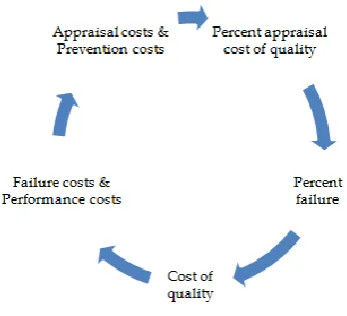
PSP data enable determining measures of product and process quality and the effectiveness of the process at removing defects.
Percent appraisal cost of quality (COQ): Percent failure COQ:
Cost of quality (COQ): Performance costs: Failure costs Appraisal costs:
Prevention costs: the costs of devising and implementing measures to prevent failures
Figure 1: Quality Measure Cycle
1.6 The Challenges of Data Quality
One data type is unstructured data, for example, documents, video, audio, etc.
The second type is semi-structured data, including: software packages/modules, spreadsheets, and financial reports.
The third is structured data. The quantity of unstructured data occupies more than 80% of the total amount of data in existence.
II.
RELATED WORK
Human computer interaction and development of software are highly related to each other hence it can be said that ability of PSP deals to assess at the level of knowledge achievement and at the level of skill in today’s knowledge to be applied. A quality requirement is taken as nonfunctional requirements in the early steps of software development, influence greatly the software system architecture. At the same time it can be observed that the quality requirements have to be “sensible” during the design process [15]
Some literature regarded web data as research objects and proposed individual data quality standards and quality measures to describe six evaluation criteria authority, accuracy, objectivity, currency, coverage/intended audience, and interaction/transaction features for web data [27]. There are four categories for the information quality of an individual website and a questionnaire to check the significance of each of these a new established information quality groups. Users can put attention towards the question that how web users determine the information quality of individual sites?
The studies of the same area focus on two phases: The first one a series of studies of web data quality and second one studies in particular areas for example biology, medicine, geophysics, telecommunications, scientific data, etc. Big data as an emerging technology, which is responsible to handle large volume of data , variety of data and velocity of large data that secures more and more attention at the same time lacks research results in establishing big data quality and assessment methods under multi-source, multi-modal environments [30].
framework. Then, there is need to formulate a dynamic big data quality assessment process with a feedback mechanism, which has laid a good foundation for further study of the assessment model [32].
III. STATEMENT OF PROBLEM
The modification of client needs over time. Those days are over where clients did not need any modification or changes in the software product delivered. User’s request time to time to upgrade the functions of software process. Client modification need means provide a facility to modify any client code after the program or software has been executed.
The fast rate of modification in both hardware and software. Due to the rapid growth of technology there is high need in the modification of hardware and software for the interface unit to remain competitive in a global environment. Changing environment of new technologies to meet customer’s needs and making changes to both process and technology to gain a competitive edge in the prime challenge in addition it can provide significant benefits to an organization.
The shortage of knowledge of client needs at the start: As seen from experience as a client, there is gap between a reliable process to identify and supply the quality software engineers and corresponding the top developers to planned programs. Both the engineers and the clients are struggling to quality projects. The high expectations of customers, mainly with respect to adaptableness: Customers are more willing
than ever to customer service expectations these days and they want representative to contact them, rather than always having to initiate contact themselves. It is essential to be able a reliable way to measure satisfaction about setting expectations, meeting expectations or resetting expectations.
IV. HUMAN COMPUTER INTERACTION APPROACH FOR QUALITY OF SOFTWARE
Quality of software is an observation or an assessment of data's fitness to support its purpose in a givencontext in software development. Concept of user centric design and usability is crucial part to ensure successful implementation of global software engineering to maintain the high credibility of software for better interaction between human and computer [17].
4.1 User-Centric Design Process (UCD)
User centric design concept of human computer interaction is aimed to provide easiness towards user’s interface. It is also called interface design process that emphases on usability goals, user characteristics, environment, tasks, and workflow. For analysis, design, and evaluation of mainstream hardware, software, and web interfaces the UCD monitors a sequence of well-defined methods and techniques [35]. UCD process is an iterative process, where design and evaluation steps are constructed in from the first stage of projects, through implementation. It focuses on following:
o Users behaviour o observe, record,
o Analyse users’ reactions and performance o Iterative design
o Involvement of user in process
4.2 Usability
Usability can be considered the one of the effective concept in the area of quality factor in the HCI domain - usable by humans’ is appropriate to recall the taxonomy of computers in those days and the purposes for which they were used. Usability is an extremely difficult quality factor to define. The main reason for this is the vast variety of users with their different needs. Some will be novices while others will be experts and a quality product will support them all [16] [20].
Usability as an outcome: applications, websites those are usable
Usability as a process: a methodology or approach (usually called “user-centered design”)
Usability as a set of techniques: usability testing, contextual inquiry, heuristic evaluation – there are many techniques whose aim is to improve usability
Usability as a philosophy: where improved usability is a value that motivates the way in which products are developed
Usability is the process of identifying users’ needs to ensure a product can achieve precise goals effectively and efficiently, which results in overall satisfaction and success.
Usability=Quality attributes that accesses how easy user interfaces are to use
User can be able to evaluate usability as method which improves the usefulness of project during design phase. Usability= Methods for improving the usefulness during design phase
Intuitive Design and/or user interface
Ease of learning
Efficiency of use
Memorability
Error prevention
User Satisfaction
Here it can easily be observed that usability does not only mean to make process easy in addition usability is an integral part of software development with respect to user interface and user satisfaction.
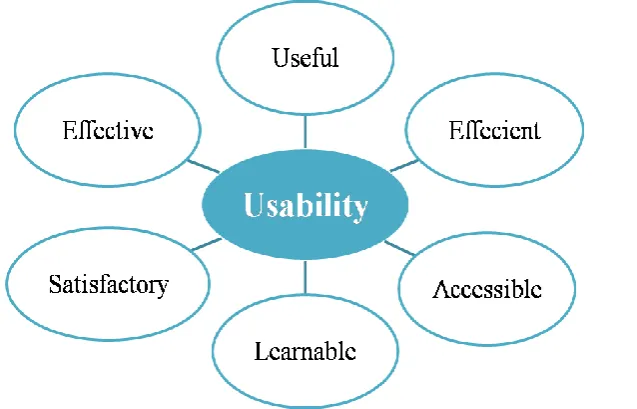
Figure 2: Usability Role
Usability is not only helpful in efficiency of use or in error prevention but at the same time it’s responsible for overall user satisfaction. Figure 2 briefly explores role of usability in the designing of a software module.
Figure three put sight towards various goals of usability which can be carried out during the software development. Before delivery of finished software project a user developer can find its effectiveness, usefulness, efficiency, accessibility, learnability and satisfaction of user.
V.
RESULTS AND CONCLUSION
The study briefly illustrated an initial attempt to use an HCI design model together with SE issues. Our goal was to provide a common reference point for both HCI designers and software engineers to point out the quality currently existing issues. Now users are able to answer that what kind of design decisions are facilitated by presented approach, and what are the impacts (good and bad) in the HCI and SE processes effectively promotes collaboration between SE and HCI 21] [22].
This collaboration may be further propagated to other models, both in HCI and in SE to produce innovative and effective contributions of personal software process is an essential movement of users as society increasingly depends on software in most modern products services and automated processes. Hence we can say user centric design and usability of human computer interaction has an important role to play in the future of the software engineering research and practice.
REFERENCES
[1]. A. Powell, G. Piccoli, B. Ives, “Virtual teams: A review of current literature and direction for future research”. The DATA BASE for Advances in Information Systems 35(1), pp. 6–36, 2004.
[2]. Ankit Kumar Srivastava, Neeraj Kumar Tiwari & Bineet Kumar Gupta (2014 ). “Green Wall: A Methodology for Sustainable Development using Green Computing”, International Journal of Scientific and Innovative Research, P ISSN: 2347-2189; E ISSN:-2347-4971, Volume 2(1), pp 78-82,.
[3]. A.F. Rutkowski, D. R. Vogel, M. Van Genuchten, T.M.A. Bemelmans, M. Favier, “E-collaboration: The reality of virtuality”, IEEE Transactions on Professional Communication 45(4), pp. 219–230, 2002. [4]. Bineet Kumar Gupta, Neeraj Kumar Tiwari, NoopurSrivastava (2015) “Pertaining Classification for
Decision Support System in the Form of Decision Tree for Disseminated Database”, in the 19th International Conference on Systems: Recent Advances in Systems, Zakynthos Island, Greece July 16-20, 2015, ISSN: 1790-5117 ISBN: 978-1-61804-321-4, pp 443-446 .
[5]. Bineet Gupta, MohdHussain& Neeraj Tiwari (2014), “Formation of Algorithms Module and Dynamic Interface in Web Mining and Storage Process to Retrieve Metadata”, in Science for Information(SAI), London, UK, 27-29 August 2014, ISBN: 978-1-4799-3981-7,pp 242 – 246.
[6]. D. Raffo, W. Scacchi, “Special Issue on Software Process Simulation and Modeling”, Software Process--Improvement and Practice, 5(2-3), pp. 87-209, 2000.
[7]. Du Plessis, E. (2011) The Branded Mind: What Neuroscience Really Tells Us About the Puzzle of the Brain and the Brand, Kogan Page Publishers, London.
[8]. Glass R, Ramesh V, Vessey I. An Analysis of Research in Computing Disciplines. Communications of the ACM, 2004.
[9]. Gobe, M. 2009, Emotional branding: the new paradigm for connecting brands to people, Allworth Press, New York, New York, USA.
[10]. Humphrey, W. PSP: A Self-Improvement Process for Software Engineers. Addison-Wesley, Upper Saddle River, NJ, 2005.
[11]. Hill, D. 2010 Emotionomics: leveraging emotions for business success, 2nd Ed, Kogan Page Ltd., London, UK.
[12]. Holt, D. and Cameron, D. 2010, Cultural strategy: using innovative ideologies to build breakthrough brands, Oxford University Press, Oxford, UK.
[13]. Ikonen, V., Leikas, J., Strömberg, H. (2005): Nomadic Elderly: design requirements for technologically enhanced traveling experience. 5th International Conference of the International Society for Gerontechnology, Nagoya, Japan, May 2427, 2005.
[14]. J. D. Herbsleb, A. Mockus, “An empirical study of speed and communication in globally distributed software development”. IEEE Transactions on Software Engineering 29(6), pp. 481–494, 2003.
[15]. J. Noll, W. Scacchi, “Specifying Process-Oriented Hypertext for Organizational Computing”, J. Network and Computer Applications, 24(1), pp. 39-61, 2001.
[16]. J. Wiley, F. Sons. Paternò, “Model-Based Design and Evaluation of Interactive Applications”, London, Springer-Verlag, 2000.
[17]. J.C. Campos, M. D. Harrison, “Model checking interactor specifications. Automated Software Engineering”, pp. 275–310, Aug. 2001.
[18]. Jokela, T. (2004): When Good Things Happen to Bad Products: Where arethe Benefits of Usability in the Consumer Appliance Market? ACM Interactions XI.6: pp 2835.
[19]. Jokela, T. (2004): “ Evaluating the usercentredness of development organisations: conclusions and [20]. implications from empirical usability capability maturity assessments.” Interacting with Computers.
Interacting with Computers 16(6): 10951132.
International organization of Scientific Research
16 | Page
[22]. Karam. M., and Schraefel, M. C., (2005), “A Taxonomy of Gestures in Human Computer Interaction”, ACM Transactions on Computer-Human Interactions 2005, Technical report, Electronics and Computer Science, University of Southampton.[23]. Kurosu, M., M. Ito, Y. Horibe and N. Hirasawa (2000). Diagnosis of Human Centeredness of the Design Process by the SDOS. Proceedings of UPA 2000, Usability Professionals Association, Asheville, North Carolina.
[24]. Leikas, J., Väätänen, A., Virtanen, T. &Suihkonen, R. (2005): Design rationale Bridging the Gap between user requirements and implementation. HCI International 2005 Conference, HCII 2005. Las Vegas, 22 27 July 2005. HCII. USA (2005).
[25]. M. Jorgensen,M. Shepperd,”A Syestematic Review of Software Development Cost Estimation Studies,”, Software Engineering, IEEE Transactions on, vol. 33. pp 33-53, 2007.
[26]. N. Kumar, B.K. Gupta, V. Sharma, V. Dixit, and S.K. Singh (2013), “E-Health: Stipulation of mobile phone technology in adolescent Diabetic Patient Care” Paediatric Diabetes, Jon Wily & Sons A/A, Volume 14(18), ISSN P: 1399-543X, O: 1399-5448, p-90,
[27]. NoopurSrivastava, Bineet Kumar Gupta (2014), “An Algorithm for Summarization of Paragraph Up to One Third with the Help of Cue Word Comparison”, International Journal of Advanced Computer Science and Application (IJACSA), O ISSN: 2156-5570, P ISSN: 2158-107X, Volume5 (5), pp 167-171. [28]. NoopurSrivastava, Bineet Kumar Gupta, & Neeraj Tiwari (2014), “An Approach to Develop a
Framework to Enhance the Performance of Digital Notes Based on Auto Arranger” in International Journal of Research Engineering and Development, e-ISSN: 2278-067X, p-ISSN: 2278-800X. Volume 10(4), pp 53-57.
[29]. P.J. Agerfalk, B. Fitzgerald, “Flexible and distributed software processes: Old petunias in new bowls?”, Communications of the ACM 49(10), pp.26–34, 2006.
[30]. P.K. Garg, M. Jazayeri (eds.), Process-Centered Software Engineering Environment, IEEE Computer Society, pp. 131-140, 1996.
[31]. R. L. Baskerville, L. Levine,B. Ramesh, J. Pries-Heje, ”The high speed balancing game: How software companies cope with internet speed”, Scandinavian Journal of Information Systems 16 pp. 11–54, 2004. [32]. R. Prikladnicki, J.L.N. Audy, R. Evaristo, “Global software development in practice, lessons learned”.
Software Process Improvement and Practice 8(4), pp. 267–279, 2003.
[33]. Rosenbaum, S., Rohn, J. A. and Humburg, J. (2000): A Toolkit for Strategic Usability: Results from Workshops, Panels, and Surveys. CHI Letters 2 (1). Pp. 337344.
[34]. S. Beecham, N. Baddoo, T. Hall, H. Robinson, H. Sharp, “Motivation in software engineering: A systematic literature review, Information and Software Technology 50, pp. 860–878, 2008.
[35]. S.D.J. Barbosa, M.G.Paula, “Interaction Modelling as a Binding Thread in the Software Development Process”. Workshop Bridging the Gaps Between Software Engineering and Human-Computer Interaction, at ICSE 2003. Oregon, USA, May. 2003
[36]. S.S. Toaff,” Don’t play with “mouths of fire” and other lessons of global software development”. Cutter IT Journal 15(11), pp. 23–28, 2005.
[37]. Tse T H, Chen T Y, Glass R L. An assessment of systems and software engineering scholars and institutions (2000–2004). Journal of Systems and Software, 2006.
[38]. Wong W E, Tse T H, Glass R L, et al. An assessment of systems and software engineering scholars and institutions (2001–2005). Journal of Systems and Software, 2008.
Dr. Bineet Kumar working as an Associate Professor, Faculty of Computer Science and Engineering, Department of Computer application, Shri Ramswaroop memorial University Lucknow Deva road UP.. His area of research is e learning, Information Retrieval and Security, and ICT. Dr. Gupta has about 8 years of teaching experience at higher education including national and international level.