ACO-based algorithm in Cognitive Radio
Networks
Siny Daniel PG Student
Department of Electrical & Computer Engineering Mount Zion College of Engineering, KadammanittaKerala, India
Abstract
For a dense network of collaborative cognitive radio (CR) sensors with limited energy supply, the maximization of throughput is considered. In this case, the sensors are heterogeneous and are battery powered. To optimally schedule the activities of the sensors and to provide the required sensing performance, an ant colony-based energy-efficient sensor scheduling algorithm (ACO-ESSP) is proposed to increase the overall secondary system throughput. The proposed algorithm is an enhanced version of the conventional ant colony optimization algorithm. It is specifically tailored to the formulated sensor scheduling problem. A more realistic sensor energy consumption model is used here and CR networks employing heterogeneous sensors (CRNHSs) is considered. Simulations demonstrate that this approach improves the system throughput efficiently and effectively compared with other algorithms.
Keywords: ACO, ACO-ESSP, CR, CSS, PU, throughput maximization
________________________________________________________________________________________________________ I. INTRODUCTION
Cognitive radio (CR) is a form of wireless communication in which a transceiver can intelligently detect which communication channels are in use and which are not, and instantly move into vacant channels while avoiding occupied ones. This optimizes the use of available radio-frequency (RF) spectrum while minimizing interference to other users. One of the main requirements of cognitive radio (CR) is reliable detection of unused frequency bands [6]. Instead of embedding a sensing functionality into each individual secondary user (SU), it take advantage of a dedicated sensor networks that performs the sensing and report decision to the SUs via the base station (BS), which is less costly [3]. To improve the sensing performance in fading environments, collaborative spectrum sensing (CSS) is proposed in which multiple sensors perform spectrum sensing simultaneously [8]. Since battery-powered sensors are energy-constrained and it is impractical or infeasible to replace or recharge the batteries, energy efficiency is one of the important issues to be considered in the implementation of CSS for spectrum sensor networks. By more efficient use of the limited amount of energy, the overall secondary system throughput may be increased. Particularly, sensor scheduling methods, which only activate a subset of sensors for sensing at any one time while keeping other sensors in low-energy sleep mode, have been shown to be effective.
There exists much research effort on the problem of energy minimization in CR networks (CRNs). However, they concentrate on finding one subset that has minimum energy consumption instead of efficient use of the finite energy source. Recently, researchers have given more attention to the efficient energy usage in CRNs. A sensor scheduling scheme through which dividing the sensors into a number of non-disjoint subsets with each subset being activated successively to extend the network lifetime is proposed[10]. Compared with the limited research on energy efficiency in CRNs, many methods exist that address the energy-efficient coverage problem in wireless sensor networks. For example, a number of methods that aim to energy-efficiently schedule the sensor activities to extend the network lifetime while the area of interest is fully covered have been proposed.
II. LITERATURE SURVEY
between spectrum scarcity and underutilization, which enables SUs to opportunistically utilize the channel when PUs are absent, and to vacate it instantly when PUs are in operation to avoid interfering with the licensed usage.
Spectrum sensing is fundamental for CR networks as it detects the state of channel for opportunistic reutilization [5]. There are two important metrics in spectrum sensing:
1) detection probability Pd and
2) false alarm probability Pf .
The higher the Pd, the better the PUs are protected; the lower the Pf , the more efficiently the channel can be reutilized by SUs.
In CR networks, one architecture is to incorporate the spectrum sensing functionality into individual SU transceiver, which raises the cost and exposes certain security vulnerability. An alternative is to take advantage of dedicated sensors that perform spectrum sensing and report decision to SUs as a service [2]. Local spectrum sensing has a hidden terminal problem, where one single sensor might perform poorly when the channel suffers multipath fading or shadowing. To address this issue, multiple sensors can be coordinated to perform cooperative spectrum sensing. One of the most crucial issues of local spectrum sensing is the hidden terminal problem, which happens when the channel suffers multipath fading or shadowing. In such cases, one single sensor cannot reliably detect the presence of PUs due to the very low SNR of the received signal at the sensor. To address this issue, multiple sensors can be coordinated to perform cooperative spectrum sensing, which can greatly increase the detection probability [7],[9]. The cooperation steps are as follows:
1) Each sensor Si performs local spectrum sensing and makes a binary decision Di∈ {0, 1} independently.
2) They forward the 1-bit decision low bandwidth requirement. 3) The BS fuses these decisions to make a final decision.
The above steps are referred to as decision fusion. An alternative is data fusion, i.e., instead of reporting the 1-bit decision to the BS, each sensor directly transmits the value of the collected energy Ei. Decision fusion has the advantage of low bandwidth.
In such sensor-aided CR network, before scheduling, the BS acquires information on the average SNR at each sensor (such information is required only once, after that, each sensor only needs to forward its 1-bit decision for fusion); thus, the detection and false alarm probabilities Pd,i and Pf,i of the sensor Si can be evaluated The sensing period ts is assumed to be the same among
all sensors. Since the collected energy Ei depends on the sensing period, it makes sense to have the energy threshold εi dependent
on ts. Based on the average SNR at each sensor and the same ts, we assign an optimal εi to each sensor to maximize its individual
Pd,i and meanwhile minimize its individual Pf,i. Our problem is to schedule each sensor active time for cooperative spectrum sensing
while satisfying the necessary detection and false alarm thresholds Qd and Qf to prolong the network lifetime. In general, the
scheduling steps are the following:
1) Based on each sensor Pd,i and Pf,i, the BS designs an optimal schedule and broadcasts.
2) Each sensor then alternates between active and sleep modes according to the schedule.
The sensor scheduling problem in CSS can be described as finding a number of non disjoint feasible subsets Φ1,Φ2, . . . ,Φk of
sensors from Ω under the energy constraints. Each subset is activated successively and lasts for a single time frame. Sensors that are selected in the current subset are activated and perform the spectrum sensing collaboratively, while other sensors are put in a low-energy sleep mode. Note that the subsets can be identical or different. The objective is to maximize the network throughput, which is jointly determined by the number of scheduled subsets, the global probabilities of false alarm, and the number of active sensors.
Both cooperative detection and false alarm probabilities rise with an increase of sensor number, where the OR rule is adopted for decision fusion. This characteristic leads to the following tips. If a subset does not satisfy Qd ≥ Qd, we can add more sensors
into the subset to make it satisfied. However, if a subset does not satisfy Qf ≤ Qf , adding sensors will make no sense. Such approach
wipes off some unnecessary calculations. Despite high computational complexity, the algorithm, which we call Implicit Enumeration (IE), can find out all feasible subsets. Greedy Degradation degrades ECSSP into a series of sub problems, where the least weighted subset of sensors satisfying the necessary detection and false alarm thresholds is selected from the available set at each iteration.
III. PROPOSED SYSTEM
The optimal solution for ESSP is difficult to derive analytically since its simplified version is already NP-complete .Thus, it is preferable to solve the problem by using a heuristic and/or stochastic method. Here, the ACO-ESSP algorithm is proposed, for maximizing the secondary system throughput in CRNHS due to the outstanding performance of ACO in solving combinatorial optimization and graph problems.
Representation and Objective Function
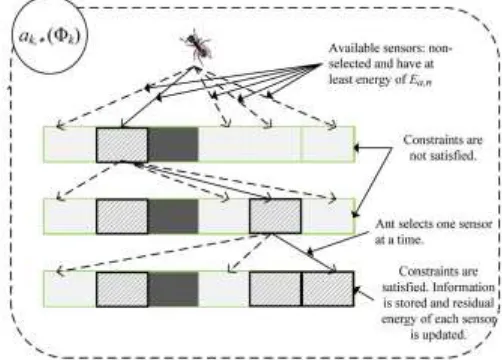
Each ant in a colony represents a candidate solution. The solution is defined as a K × Ns matrix, i.e., A, that consists of sensor
assignment indicators θk,n∀k,n as shown in the left-hand side of Fig. 2. The novelty of this 2-D solution construction is that the kth
row of A, i.e., ak,,∗ corresponds to the feasible subset Φk In addition, the total energy consumption of sn does not exceed its battery
To maximize the system throughput, a criterion is designed to evaluate the possibility of improving the throughput of existing subsets. When two ants have the same average network throughput, an ant with high residual energy will be preferred to increase the network throughput. By integrating this criterion into the network throughput, the objective function of the solution can be calculated.
Fig. 1: Representation and construction behavior of ants
Construction Behavior of Ants:
Here, the construction rules that the ants follow to build their own solutions are introduced. We propose a multiple-layer mechanism to build the variable length 2-D solutions. In each layer, the ants concentrate on finding one feasible subset, as shown on Fig. 1. Starting from an empty subset, artificial ants add a sensor to the subset one by one according to a set of criteria until the set of selected sensors satisfies the conditions. When a feasible subset is found, the residual energy of each sensor is updated. Then, the ants carry out the above process repeatedly until the sensing requirement is no longer satisfied by any set of sensors.
In selecting a sensor snfrom Ωallowed for the current subset (layer) Φk, the ants follow the following construction rules:
n = { argmaxHnηn β
roulette wheel selection if q ≤ q0
where Ωallowed = {sn|θk,n = 0 and Er,n ≥ Ea,n} is the set of unassigned sensors whose residual energy is sufficient for at least one
time sensing, q0 ∈ (0, 1) is a predetermined value, q is a uniform distributed variable between 0 and 1, Hn is the historical
information, ηn is the heuristic information, and β > 0 is a parameter that is used to adjust the influence of ηn on the decision. In the
roulette wheel selection, a probability of selection is associated with each individual sensor in Ωallowed and is calculated.
We first calculate the historical information Hn of sn. In our proposed algorithm, the pheromone is deposited on the edges
between the sensors to record the desirability of grouping the sensors into the same subset based on search experience. To assign an unassigned sensor into a subset Φk, the ant calculates the average pheromone level between a candidate sensor sn and the sensors
that are already assigned to Φk. Suppose the pheromone between sn and sm is denoted by τnm. The heuristic information ηn is
associated with sn in ACO ESSP to measure the cost of sn. Mathematically, the heuristic value for activating sensor sn is calculated
In this way, the algorithm is encouraged to choose the sensors with more energy for sensing and less energy to maintain necessary functionality in the sleep state.
After an ant finishes building its own solution, the pheromone trail amount τnm is updated locally according to the following
formula:
τnm= (1 − ρ)ατnm+ (1 − (1 − ρ)α)τ0
where ρ ∈ (0, 1) is the local pheromone decay parameter, τ0 = 1/n=1((_Bn/Ea,n)/(Pf,n + Pm,n)) is the initial pheromone value, and
α is the number of subsets containing both sensor sn and sm. The local pheromone updating rule is intended to avoid edges with a
very high pheromone level being chosen by all the ants, which thus leads the algorithm to become stuck at a local optimum. After the tour of a colony of Na ants ends, an initial best solution Abs is determined. Then, τnm is updated according to a global pheromone
updating rule to reinforce the pheromones on the edges belonging to Abs, so that the subsequent ants are attracted to explore the paths in the vicinity of the best tour.
IV. SIMULATION RESULTS
Here, the results of the performance evaluation of the proposed ACO-ESSP algorithm are presented. MATLAB is used as the simulation tool for implementing this project as, it
computation, algorithm development, modeling, simulation and prototyping, data analysis, exploration, and visualization, scientific and engineering graphics, and also for application development, including Graphical User Interface building. Since the objective of our research is to maximize the system throughput, instead of the network lifetime, modified the algorithm to fit the problem by utilizing the same heuristic information with ACO-ESSP.
The heterogeneous sensors are uniformly deployed in a circular area with a radius of 50 m and a fusion center located at the center. An 8 K mode DVB-T OFDM signal with a channel bandwidth of 8 MHz is employed as the primary signal [4]. The SNR at each sensor is distributed uniformly in a predefined range [SNRmin,,SNRmax]. The battery capacity is 50 mJ. The energy consumption of an active sensor per frame is given by the sum of energy required for receiving, calculation, and decision transmission. An IEEE 802.15.4/Zigbee standard [11]-based transceiver is considered to compute the receiving and transmission energy consumption [5],. The energy related to calculation is calculated as (no. of operations) × (energy per operation). The first term depends on the sensing approach employed, which requires different numbers of operations. In this simulation, the CRN consists of equal number of three types of sensors, namely, energy, cyclo-stationary, and pilot-based detectors, with different numbers of required operations given in [12]. Moreover, each sensor is equipped with a 133-MHz Intel Strong ARM SA-1100 processor whose processing speed is 150 million instructions per second and whose power consumption is 200 mW (approximately 1.3 nJ per operation). The energy consumption of a sleep sensor snis distributed uniformly and randomly over [Ea,n/20,Ea,n/7] [10].
Assume that Ts = 20 ms, Tr = 4 μs, and Ttotal = 100 ms. Furthermore, C0 is normalized to be 1 bit/s, r is set to be 0.01. Firstly,
compared the average throughput derived from the algorithms to the optimal values obtained by brute-force search. Since the complexity of the brute-force search grows exponentially with the size of the network. Also compared the computational complexity of the proposed ACO-ESSP approach with other algorithm. As expected, the greedy algorithm has the lowest complexity, most of which comes from the sorting operation. In the case of ACO-ESSP, the total time complexity is dominated by the calculation of historical information. Although the complexity of ACO-ESSP is larger than that of the greedy algorithm and the GA method, the proposed algorithm exhibits better performance When the network size is small, the brute-force algorithm is more promising than ACO-ESSP due to lower complexity and optimal performance.
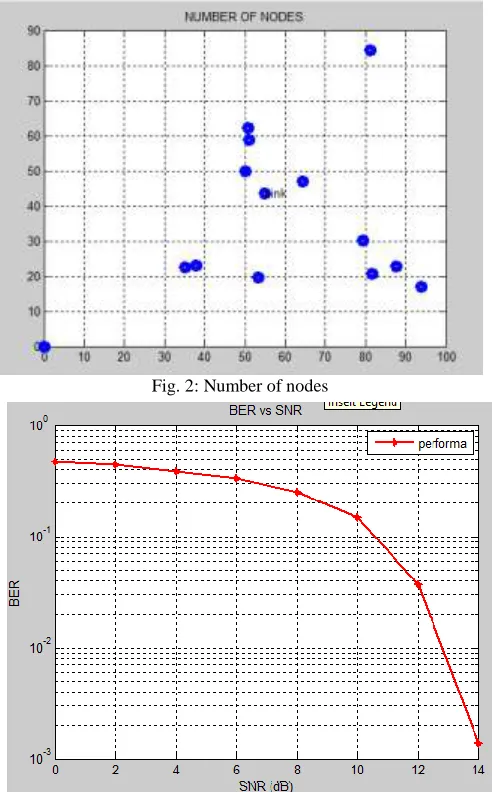
Fig. 2: Number of nodes
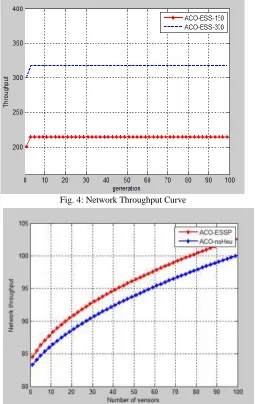
Fig. 4: Network Throughput Curve
Fig. 5: Comparison of network lifetime with different numbers of CR sensors.
V. CONCLUSION
In this paper, the ESSP has been discussed with the objective of maximizing the network throughput under a constrained energy supply for CRNHSs. In contrast to the existing literature, used a more realistic energy consumption model in this paper. An ACO-based sensor scheduling method is proposed to increase the throughput by scheduling non-disjoint feasible subsets. The conventional ACO was designed and tailored to the formulated problem by introducing introducing a novel construction rule, new heuristic information, and self-pheromone information. Simulation results show that the proposed ACO-ESSP algorithm outperforms the other algorithms with lower computational complexity.
REFERENCES
[1] 1. S. Maharjan, Y. Zhang, C. Yuen, and S. Gjessing, “Distributed spectrum sensing in cognitive radio networks with fairness consideration: Efficiency
of correlated equilibrium,” in Proc. IEEE MASS, Valencia, Spain, Oct. 2011, pp. 540–549
[2] M. B. H. Weiss, S. Delaere, and W. H. Lehr, “Sensing as a service: An exploration into practical implementations of DSA,” in Proc. IEEE DySPAN, Singapore, Apr. 2010, pp. 1–8
[3] M. B. H. Weiss, S. Delaere, and W. H. Lehr, “Sensing as a service: An exploration into practical implementations of DSA,” in Proc. IEEE DySPAN, Singapore, Apr. 2010, pp. 1–8
[4] S. Maharjan, C. Yuen, Y. H. Chew, Y. Zhang, and S. Gjessing, “ Distributed spectrum sensing for cognitive radio networks with heterogeneous users: A
game theoretical framework,” in Proc. IEEE CogART, Rome, Italy, Nov. 2010, pp. 1–5
[5] A. Ghasemi and E. S. Sousa, “Spectrum sensing in cognitive radio networks: Requirements, challenges and design trade-offs,” IEEE Commun. Mag., vol.
46, no. 4, pp. 32–39, Apr. 2008.
[6] A. Ghasemi and E. S. Sousa, “Spectrum sensing in cognitive radio networks :Requirements, challenges and design trade-offs,” IEEE Commun. Mag., vol.
46, no. 4, pp. 32–39, Apr. 2008
[8] S. M. Mishra, A. Sahai, and R. W. Brodersen, “Cooperative sensing among cognitive radios,” in Proc. IEEE ICC, Istanbul, Turkey, Jun. 2006,vol. 4, pp. 1658–1663.
[9] A. Ghasemi and E. S. Sousa, “Collaborative spectrum sensing for opportunistic access in fading environments,” in Proc. IEEE DySPAN, Baltimore, ML,
Nov. 2005, pp. 131–136
[10] M. Cardei, M. T. Thai, Y. Li, and W.Wu, “Energy-efficient target coverage in wireless sensor networks,” in Proc. IEEE INFOCOM, Miami, FL, USA, Mar.
2005, pp. 1976–1984.
[11] A. Ghasemi and E. S. Sousa, “Collaborative spectrum sensing for opportunistic access in fading environments,” in Proc. IEEE DySPAN, Baltimore, ML,
Nov. 2005, pp. 131–136.
[12] W. B. Heinzelman, A. P. Chandrakasan, and H. Balakrishnan, “An application-specific protocol architecture for wireless micro sensor networks,” IEEE