ISSN (e): 2250-3021, ISSN (p): 2278-8719
Vol. 08, Issue 5 (May. 2018), ||V (I) || PP 92-102
Power Quality Improvement: Algorithmic and Performance
Analysis
Naresh Kumar Yadav
Electrical Engineering Department, Deenbandhu Chhotu Ram University of Science & Technology Murthal (Sonepat)
Abstract
—
Through an extensive utilization of power electronic devices in power system like inverter, rectifier and so on, the scenario creates a major problem with respect to power quality. Some of the problems related to the power quality improvement are creation of current and voltage harmonics creating distortion in load waveform, voltage dip, voltage fluctuation, heating of equipment, etc. In this paper, 20 research works under various power quality improvement methods are analyzed. Finally, the analytic results are viewed under pictorial representation and tabulation.Keywords—
Power Quality, Harmonics, Algorithm Analysis, Performance MeasuresNomenclature
Acronym Description PQ Power Quality
CPI Common point of interconnection CPD custom power device
DSTATCOM Distribution Static Compensator UPQC Unified Power Quality Conditioner DVR Dynamic Voltage Restorer
THD total harmonic distortion BESS battery energy storage system WECS wind energy conversion system PCC point of common coupling SOC state of charge
FPD + I fuzzy proportional-derivative and integral VRDT Voltage regulation distribution transformer OLTC on load tap changer
CPT Conservative Power Theory PFC power factor correction
RLPLL repetitive learning-based phase locked loop SRF-PLL synchronous reference frame PLL
GDBP gradient descent back propagation VSC voltage source converter
mPPT Minimum Power Point Tracking VSI Voltage Source Inverter
MPP Minimum Power Point
ERPS electrical railway power system RPFC railway power flow controller V-I voltage-current
DG Distributed Generation
DGUs distributed generation units PWM-VSI PWM voltage source inverters
DT-CWT Dual Tree-Complex Wavelet Transform PI proportional integral
LVDC low-voltage DC PFC Power factor correction BCM boundary conduction mode UPF unity power factor
SMHC sliding mode harmonic compensation
PWM-VSC pulse-width modulated voltage source converter kVAR kilo volt-amphere reactive
SRF-PLL synchronous-reference-frame phase-locked loop
I.
INTRODUCTION
Nowadays, various grid-connected DGUs were enlarged due to an interface in power electronic causes problems in harmonic distortion. Depends on the harmonic distortions, the power [21] quality may be greatly adverse in accordance with instance, control and protection systems, interfering with communication, minimization in the lifespan of equipment, creates extra losses in power system, stability problems, and resonance. The harmonic distortion occurs based on harmonic sources, other than due to the communication within loads, grids and other DGU’s. Additionally, the power networks includes power electronic converters (closed-loop controlled) , the harmonic sources that contained the harmonic content is attached with signal’s harmonics estimated by the control system; presenting unwanted behavior of the performance control that will still direct to problem with stability. Hence the harmonic propagation and generation have to be exactly minimized inside the power quality limits. In the systems that were designed on the basis of power [22] electronics, the harmonic communication is taken into consideration for better modeling and analysis to be done. Te amount of PQ that is acceptable in a power distribution system is said to be a main problem in today life on the basis of the commercial, domestic and industrial loads that is certainly nonlinear within environment. Non-sinusoidal currents were drawn by these nonlinear loads that produce the distortion of voltage near a CPI. The current supplies that are deformed in CPI were the resource of bad voltage for additional customers that are at the same CPI. Bad PQ produces a heavy loss in the loads that is sensitive because of the failure of equipment control and also lifetime of equipment was minimized. Because of this loss, it offers the customers carefulness regarding the electric power [23] features provided for the services. Hence it is a shared job of the customers as well as the suppliers to make sure the better quality of power and the customer’s loads is moreover in charge of the bad PQ.
PQ has to be enhanced thereby fitting the shifting devices in the CPI to offer the power supply without any troubles to the customers. A CPD is an effective answer for development and innovation for the easing of disturbances in PQ. The separation of CPDs based on shunt compensator is (DSTATCOM), a combination of series and shunt compensators (UPQC) and a series compensator is separated as (DVR). The disturbances that are related to the current such as poor power factor, harmonics control, load unbalancing, etc. are shifted using shunt compensator CPDs. The sequence of CPDs is utilized in the problems that are related by voltage is given as swell, sag, harmonics and others.
This paper reviews certain power quality improvement methods by means of algorithmic representation, performance measure and best performance measures. The paper is organized as Literature view, algorithmic analysis, performance measure is given in Section II. The research work and challenges are explained in Section III. Section IV concludes this framework.
II.
LITERATURE REVIEW
A. Related works
power demand. The main purpose in this framework included the (a) distortions have to be reduced and maximize stability that is dynamic in dc link voltage (b) increasing the grid support at the time of over-contrast and (c) to develop a THD in the executed power. The microgrid consists by the Li-ion BESS and WECS. At the time of variation in the speed of wind, that was supplied to the PCC based on the variation in dc link voltage, the wind power, infraction in the contract power associated with the grid and a SOC in battery. The supervisory controller has used these variations in this input to calculate the extra power helping for the grid. The behavior of fuzzy-supervisory controllers was analyzed along with supervisory controller that is classic by using similar dispatch variables in power. Moreover, by utilizing a FPD + I controller, the inverter currents were synchronized to develop a dynamic response and to minimize distortions of the discharged power.
In 2017, Sudheer Mokkapaty et al. [2] have found a solution named VRDT to preserve the source voltage in official value in the distribution of electrical systems. Here, VRDT furnished by OLTC that allowed the adjustment in voltage without interruption within the loaded situation. An OLTC was engaged with a grouping with vacuum tubes of high-speed-resistor-type technology. This system comprised of a changeable current with sufficient value between 30- 100A, without considerable loss and it was completely safe in nature. This improved VRDT was thus created, processed, verified and operated well in the grids distribution.
In 2018, Ali Mortezaei et al. [3] have said that the utilization of a multilevel converter (cascaded) in the application of the smart-grid is to obtain the power situation that was feasible. The major characteristics in this invented system were to exploit independent DC links, by minimized the voltages. Further, it provides the topology with a unique applicant for high and medium application of power, by attaining reliability at its maximum. The implemented control scheme managed the DC-link voltages that were independent in every H-bridge cell. It can also permit the flexible and selective compensation of disturbing currents that work on the variation in voltage conditions with no need of any reference frame transformation. In the CPT, the selective control scheme depends upon the decompositions that were produced, resulted in numerous current-related terms that were combined with the particular load characteristics. These current components were utilized for describing different compensation schemes that were independent of one another. In this proposed model the investigational reports said that the measurement of performance and the probabilities were done by using the voltage condition (degenerated).
In 2018, Saravana Prakash P et al. [4] have proposed a three-phase three-switch three-level boost (Vienna) type PWM rectifier. It was said to be a front-end PFC rectifier that was operated to improve the quality of power from the telecom load. The sensor-less voltage control technique was also implemented, which doesn’t depend on several input voltage information resulted in authentic and powerful performance. A short explanation was discussed about the operation principle and the more beneficial modulation method. The possible switching states were found in which the implemented front-end converter which was active results in minimizing stress switching, and DC ripples. Control logic that depends on Triangular carrier was performed and the source current gets a curved shape, which does not require a sensing in the input voltage. Analysis was done briefly for the front-end PFC converter, and its takes place by the corresponding analysis in the circuit. Moreover, by using the hardware intend strategy, the calculation of efficiency and the entire loss in the converter has been performed externally. At the time of failure in one-part of the main, the projected performance of the system and its functional ability were checked in MATLAB, and the outcomes were listed. In the laboratory for validating the simulation outcome, the investigational setup rate by 9 kW was implemented. From the outcome performance of the hardware function, it is referred and noted that the methods in power quality were developed also works fine inside the IEEE, IEC standards.
split-capacitor DSTATCOM that was used in reactive compensation power, harmonic shifting, balancing the load, etc.
In 2018, Subham Sahoo et al. [6] have invented a RLPLL in order to develop the quality of power in grid that was related across dc microgrids in the distributed voltage of the grid. In high impedance network, the harmonic modules that were existed in grid current amplify the distortion in voltage, thereby generates instability. The performance in conservative SRF-PLL was altered along with the gain of the proportional-integral controlled with harmonic rejection bandwidth that will lead to inactive reaction. Still, RLPLL assists that drawback using a dynamic performance that was analyzed and improved harmonic attenuation principles. By utilizing a Lyapunov-based application in the estimation of harmonics, the performance can be attained that ease the periodicity and boundedness of the harmonic module for obtaining the learning depends on flexible upgrade. The conservative problem can be done by offering another model (low-computing) in this implemented framework. The proportional analysis with SRF-PLL along with dynamic reaction of RLPLL was directed using various events that affect the dc voltage. Further, it was risky for the dc microgrids operation.
In 2017, Anup Panda Kumar, Mrutyunjaya Mangaraj [7] have presented a innovative hybrid management method named GDBP-based i cos ϕ meant for a three-phase two level DSTATCOM is by execute the purpose like correction of power factor, harmonic mitigation in reactive loads. Thereby in VSC, the DC voltage was additionally minimized over the self-supported capacitor. The weighted value of primary active and reactive modules in load current that produced the reference supply current is obtained by this implemented method. Moreover, the VSC of the DSTATCOM was triggered by using these currents. The efficiency of these control techniques was established using simulation of sim power system tool boxes and MATLAB/SIMULINK. The outcome shows the robustness of the implemented framework DSTATCOM, it reveals that within the numerous loading conditions the excellent harmonic compensation capabilities maintained the entire distortion in harmonic source current at <5%, which is the maximum value according to IEEE-519 standard
In 2017, Rubens Tadeu Hock Jr., et al. [8] has proposed distribution grids of voltage to minimize the voltage regulator named as, voltage-controlled DSTATCOM-based voltage regulator. The voltage regulator has been intended for meeting the grid code for some certain time, unplanned investments was delayed when a perfect solution was designed to evaluate the regulation problems. The power stage comprised of a low-pass filter (second order) and a VSI with three-phase four-wire source. Voltage loops with two dc bus and output voltage with three loops by energetic damping were involved in this control strategy. Moreover, the implemented control schemes involve two loops: the idea of the frequency loop and mPPT. The voltage regulator was permitted by the mPPT to function at the mPP, thereby avoids the motions of unwanted compensation on reaction. The voltage regulator was permitted by the frequency loop to be free from the grid voltage data; Thereby utilized the instructions that are existed in PCC, particularly in grid angle. The implemented framework outcome illustrates the regulation capacity, the frequency stability for linear and nonlinear loads characteristics algorithm of mPPT.
In 2016, Sijia Hu, et al. [9] have focused on the ERPS on the freight-train dominant varied with ac-dc-ac locomotives (power fac-dc-actorϵ[0.70,0.84]) and ac-dc-ac- dc, this framework intend on improving the power quality in EPRS by placing the power factor in RPFC for improving the power quality of EPRS. This implementation studied about the complete relationship between the two phase load currents and the converter capacity in the primary power factor. Further, the main objective of this work was to analyze the best compensating scheme suitable for the two phase loads that were placed randomly, and to design depends on tracking substation in real world. Thereby fulfills (a) improving RPFC’s control flexibility, (b) satisfying the power quality standard, and (c) minimizing converter’s capacity.
sharing of average power was protected by the sharing scheme in the distributed power system that deploys a consensus protocol. The voltage conditioning scheme at fundamental and dominant harmonics generates the compensation signals, and thereby the quality of voltage has been enhanced within this sensitive load bus.
In 2016, Sushree Diptimayee Swain, et al. [11] has established about the harmful economical impact on the attributes and customers were produced by the degradation in power quality. By deploying HSAPF, one of the problem factors i.e. the harmonics in voltage and current was processed. By utilizing the sliding mode controller-2, they proposed a new controller to make the HSAPF more strong and stable. Moreover by using this precise averaged model, the three-phase HSAPF was obtained.
In 2016, Miguel Esparza, et al. [12] have presented the quality problems in power sources and its operation in electric systems. The DGUs create this objectionable harmonic distortion, depending on the power electronic inverters created these issues. The amount of distortion was based on the features and its internal parameters of the DGUs named as grids, and controls, loads along with others. The implementation defines the complete method, determined on quality of power indexes and the effectiveness for the creation of micro-grids having numerous DGUs organized to AC grid by multi-Megawatt medium-voltage PWM-VSI (three phase). This framework depends on the minimal square result utilizing the harmonic scheme based on modeling to efficiently examine the features of the harmonic DGUs and the straight and cross-coupling relations with the loads, grid, etc. Wide model and analysis of PSCAD were developed in accordance with respect to the excellent characteristics of the implemented design model.
In 2016, Raj Kumar et al. [13] have developed an algorithm in distribution system named, DT-CWT) depending on algorithm that controls the distribution static compensator (DSTATCOM to enhance the PQ. PQ conflicts such as opening as well as ending of unbalancing in entire phase load currents and harmonics were too measured within a same time. The load current (distorted) in every level was separated into numerous frequency levels using these techniques to obtain the relevant line frequency module in a measurement of the reference power module that was active. The divergence of relevant load currents that was sensed with this approximate reference modules was deployed to create the control over VSC in the reference currents utilized as DSTATCOM. At numerous load situations there obtains the performance calculation of DSTATCOM. The control algorithm that was developed is hence proved using a laboratory prototype in DSTATCOM were tested. The supply current in the THD has estimated the unity power factor fewer than 5% having several load situations, hence satisfies in accordance with IEEE- 519 standard.
In 2015, Chayan Bhattacharjee , Binoy Krishna Roy [14] have provided an brilliant withdrawal of discharges and its optimal power by utilizing the hybrid generation scheme’s fuzzy logic within the grid tied composed of a synchronous generator with permanent magnetic function on the basis of photovoltaic generator with low attention and wind turbine. In photovoltaic generator, fuzzy logic within changing solar irradiance generates the point tracking guide over maximum power. Fuzzy function based on error of dc voltage creates a power that was obtained by wind turbines gets change in the direct axis current rate and its error in the inverter. Thereby a minimized value was achieved by the frequency oscillation that was extracted by the wind power. A mode of failure and effective analysis was made for potential mitigation schemes, and power converters were recommended for various errors. At the inverter output, they deployed a 1:1 delta wye-grounded transformer for eliminating the harmonics (triplet). Moreover, active features of both classical PI controller and FPD+I controller, were measured, in which used for controlling the inverter currents. The implemented model showed as an improvement in distortions and oscillations; and enhanced power discharge with current converter. Further, the additional passive modules and the probability in failure of the converted switch can be minimized.
hysteresis controllers. By the outcome of the MATLAB/SIMULINK, the efficiency of the controller has been established. By deploying the dSPACE1104 processor, hence proved the prototype method that used for validating and testing had been improved.
In 2015, Ashish Shrivastava, Bhim Singh [16] has studied about UPF, BCM-based electronic ballast for a T8; that includes design, modeling, and performance. BCM based boost converter was utilized in the lower power applications due to its low inductor value, attaining an overall harmonic distortion that <10% has complicated for AC mains that spread worldwide. A boost power factor corrected converter that functioned in BCM was deployed at universal AC mains by UPF, which was constant on time control. The obtained constant DC voltage has transformed into an AC voltage with high frequency by utilizing a series resonant inverter (quasi-half bridges) to start the distortion, and thereby the fluorescent lamp wills operate with a constant current. Sim power system tool-boxes in MATLAB-Simulink environment were used for the simulation and modeling. By attaining zero voltage switching, the switching losses can be minimized at a switching frequency that operates and achieves 46 kHz. Numerous predicted modules were there as per the IEC61000-3-2 international standard’s of class C regulations.
In 2015, Sung-Wook Kang, Kyeong-Hwa Kim [17] have proposed a method to enhance the power quality in distributed generation systems in discharged situation on grid by deploying a narrative SMHC scheme. Non-linear loads carried a power losses and heating and a distorted grid voltage in electrical equipment that was created by the harmonic pollution in the electrical network. Harmonic detector and a SMHC controller that depends on the integral sliding mode control are involved in this implemented SMHC scheme. The implemented harmonic detector may effectively obtain the harmonic components by utilizing the fourth order bandpass filter with no phase delay. These harmonic components in particularly repressed by accepting the SMHC by high-speed dynamic reaction. While the conservative sliding mode schemes managed all the current values, whereas the implemented SMHC scheme managed only the harmonic modules by spited the inverter voltage into essential and harmonic models. Proportional-integral controller manages the power flow in the essential modules thereby there is a slight decrease in the chattering. The implemented model was a non-deterministic harmonic compensation thereby it minimized the computational burden within the conservative selective schemes. 2 kVA laboratory prototypes were used for the simulation and experimentation in grid- connected inverter and thereby the conventional model was validated.
In 2014, Ram Niwas, Bhim Singh [18] have designed a model for power quality improvement in wound field diesel generator (DG) (synchronous -based) to get the standalone supply system by using PWM-VSC. This method includes a diesel engine driven synchronous generator (wound field), linear/non-linear loads, and a three-leg PWM-VSC associated with DC link capacitor. The major kVAR was provided to the loads by PWM-VSC that preserves the DG set’s unity power factor. The supply current was discharged, and load balancing was offered in the harmonics. The generator’s field excitation power controlled the terminal voltage whereas source frequency was managed by using the speed controlling method in diesel engines. To evaluate the reference currents least-mean-square algorithm was used based on variable step size filter-x algorithm was made for VSC control.
In 2012, Fran González-Espín, Gabriel Garcerá [19] have considered a method for estimating the division of the voltage in grid was operated by utilizing the synchronization procedure in of grid-connected power electronics converters. The quality of the distributed or consumed electrical power was linked in the operation of the synchronization procedure. Because of efficient actions and the simplicity of operation, the SRF-PLL can be generally utilized. Though, the calculated part may have unnecessary ripple with significant quantity when the conflicts in grid voltage were not accurately discarded. The main objective was to introduce an adaptive SRF-PLL that firmly discards this conflict even when the grid voltage changes with their essential frequency. Adaptive infinite-impulse-response notch filters were utilized to achieve this objective that was produced with respect to of an inherently even Schur-lattice configuration. This solution is accurate to be planned in DSPs with fixed-point. The adaptive SRF-PLL that was implemented has been measured with respect to the TI TMS320F2812 DSP. The attained outcome gives that the processed synchronization procedure greatly reduces the unwanted harmonics when the essential harmonic frequency with greater grid voltage pollution unexpectedly changes
and series converter having same dc link was involved in UPQC. Shunt converter can remove the nonlinear load effect that produced by harmonics in current, however, the supply part produce a voltage sag/swell that was removed by series converter. Depends on the improved nonlinear adaptive filter and phase-locked loop the controller for shunt and series converters were developed, whereas fuzzy-logic controller depends on dc power control scheme. Efficiency was good in shifting the consequences of voltage sag/swell, and the load harmonics current were crushed by discharged source situations, can accomplished in this implemented UPQC.
B. Algorithmic Analysis
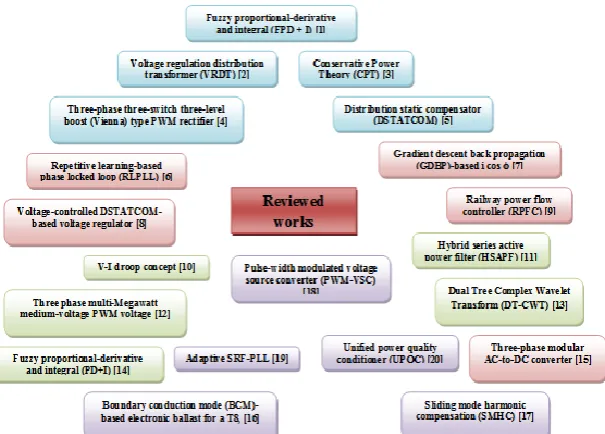
The algorithms that have used in this framework are symbolized in Fig.1. This pictorial representation illustrates the various methods that have been utilized by the authors to increase the power quality. The proposed optimization theory of various algorithms is stated as follows:FPD + I are the algorithms that used in [1] [14] to solve the power quality problems. VRDT is proposed in [2]. The author in [3] describes CPT. Three-phase three-switch three-level boost (Vienna) type PWM rectifier is deployed in the framework [4]. DSTATCOM [5] is reviewed by the author. RLPLL [6] is utilized by the author in [6]. In [7], the author developed a GDBP-based i cos ϕ algorithm. Voltage-controlled DSTATCOM-based voltage regulator is used in [8]. RPFC [9] algorithm is used in railways issues. The author introduced a V-I droop conceptin [10]. HSAPF [11] is proposed by the author. Three -phase multi-Megawatt medium-voltage PWM-VSI is deployed in [12].In [13], the author implements the DT-CWT algorithm. In [15], three-phase modular AC-to-DC converter is used. BCM-based electronic ballast for a T8, is implemented in [16]. SMHC is used by the author in [17]. In [18], PWM-VSC is presented by the author. Adaptive SRF-PLL is used in [19] to enhance the problem by the author. UPQC is developed by the author in [20].
Fig. 1:Algorithmic classification of the reviewed works
C. Performance measure
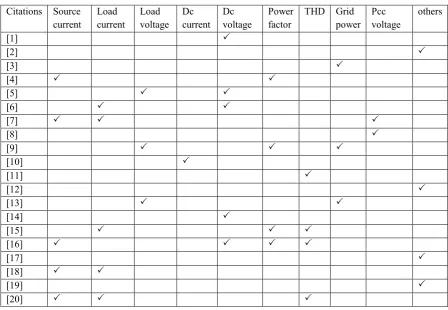
TABLE I. PERFORMANCE MEASURE OF REVIEWED WORKS
D. Maximum Achieved Measure
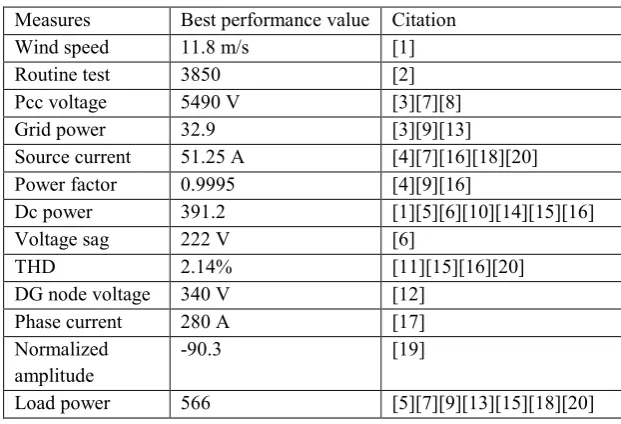
Table II explains the efficient measure for this model. Here the efficient performance of the wind speed in [1] is 11.8m/s. The routine test has an efficiency of 3850 in [2]. The pcc voltage contribution has attained a value of 5490V. Then the grid power source obtains an effective value of 32.9. The source current that is used in this model accomplished 51.25A of current. The source of power factor attains 0.9995. The voltage of the dc power is given as 391.2. The voltage sag that occurs in [6] gains 222 V. The THD factor has a efficiency of 2.14% in this framework. The dc node voltage referred in [12] acquires 340V. The phase current in [17] gains an effective value of 280A. The normalized amplitude is the outcome in [19], and it is given as -9.03.the load power factor has attained an efficacy of 566.
Citations Source current
Load current
Load voltage
Dc current
Dc voltage
Power factor
THD Grid power
Pcc voltage
others
[1]
[2]
[3]
[4]
[5]
[6]
[7]
[8]
[9]
[10]
[11]
[12]
[13]
[14]
[15]
[16]
[17]
[18]
[19]
TABLE II. MAXIMUM ACHIEVED MEASURE
E. Controller Contribution
In this survey the usage of controller is found. Some of the controllers that are used are PI, PID, and PD. In Fig 2, the contribution percentage of controller is illustrated. Here, PI controller attains a maximum contribution of 65 %. And the rest of the controllers gains only 5% of the reviewed works.
Fig. 1: Algorithmic Analysis on Reviewed Works
III.
RESEARCH GAPS AND CHALLENGES
A principle distribution system is anticipated to have a pure sinusoidal voltage and current waveforms of primary frequency in which the voltage magnitude can leave inside few pre-specified bounds. Any improper variation in the waveform magnitude, frequency or purity is referred as a power quality problem. The current is said to be the very essential component, there is a requirement for measuring the problems in current while regarding power quality problems. Power quality with poor measures can increase the electricity consumption and equipment failure. The equipment failure is the major challenge, and it should be rectified in the future works. The other challenges in overheating of equipment is because of the various factors such as unbalance, harmonics, and overloading that separated from consistent overvoltage. The power quality problems mostly caused in the distribution system network because of the underground cables that are used other than the overhead lines.
The power quality problem also occurs due to the natural reason because of its manmade quality, particularly due to the touch of tree branches to lines or in windy days, lightning and so on. The other challenges in this existed model are high energy cost and low efficiency in operations. These problems are to be solved by the improved methods in future. Harmonic problem is not the only issue in Power quality problem, but it also deals with the distortion in the supply voltage and its impacts on the equipment that are associated with it. Supply voltage that varies at pcc is the major problem for the customers. The various problems that affect the power quality are listed below: Transients, sags, swells, harmonics, unbalance notches, high-frequency noise, flicker, and high-frequency variations.
Measures Best performance value Citation
Wind speed 11.8 m/s [1]
Routine test 3850 [2]
Pcc voltage 5490 V [3][7][8]
Grid power 32.9 [3][9][13]
Source current 51.25 A [4][7][16][18][20] Power factor 0.9995 [4][9][16]
Dc power 391.2 [1][5][6][10][14][15][16]
Voltage sag 222 V [6]
THD 2.14% [11][15][16][20]
DG node voltage 340 V [12]
Phase current 280 A [17]
Normalized amplitude
-90.3 [19]
Load power 566 [5][7][9][13][15][18][20]
0 20 40 60 80
PI PID PD
co
n
tr
ib
u
tion
p
e
rc
e
n
tage
IV. CONCLUSION
This paper analyses 20 papers regarding different power quality improvement methods that were solved. The analyzed outcome reviewed the numerous methodologies, also with the review under the performance review and maximum achieved measures. The pictorial representation and tabulation reviews, analyses the used frameworks. Further, the challenges were examined and also the future work has been explained clearly.
REFERENCES
[1] C. Bhattacharjee and B. K. Roy, "Fuzzy-supervisory control of a hybrid system to improve contractual grid support with fuzzy proportional–derivative and integral control for power quality improvement," IET Generation, Transmission & Distribution, vol. 12, no. 7, pp. 1455-1465, 4 10 2018.
[2] S. Mokkapaty, J. Weiss, F. Schalow and J. Declercq, "New generation voltage regulation distribution transformer with an on load tap changer for power quality improvement in the electrical distribution systems," CIRED - Open Access Proceedings Journal, vol. 2017, no. 1, pp. 784-787, 10 2017.
[3] A. Mortezaei, M. G. Simões, T. D. C. Busarello, F. P. Marafão and A. Al-Durra, "Grid-Connected Symmetrical Cascaded Multilevel Converter for Power Quality Improvement," IEEE Transactions on Industry Applications, vol. 54, no. 3, pp. 2792-2805, May-June 2018.
[4] S. Prakash P, R. Kalpana, B. Singh and G. Bhuvaneswari, "Design and Implementation of Sensorless Voltage Control of Front-End Rectifier for Power Quality Improvement in Telecom System," IEEE Transactions on Industry Applications, vol. 54, no. 3, pp. 2438-2448, May-June 2018.
[5] H. Myneni, G. Siva Kumar and D. Sreenivasarao, "Dynamic dc voltage regulation of split-capacitor DSTATCOM for power quality improvement," IET Generation, Transmission & Distribution, vol. 11, no. 17, pp. 4373-4383, 11 30 2017.
[6] S. Sahoo, S. Prakash and S. Mishra, "Power Quality Improvement of Grid-Connected DC Microgrids Using Repetitive Learning-Based PLL Under Abnormal Grid Conditions," IEEE Transactions on Industry Applications, vol. 54, no. 1, pp. 82-90, Jan.-Feb. 2018.
[7] A. Panda Kumar and M. Mangaraj, "DSTATCOM employing hybrid neural network control technique for power quality improvement," IET Power Electronics, vol. 10, no. 4, pp. 480-489, 3 31 2017.
[8] R. T. Hock, Y. R. de Novaes and A. L. Batschauer, "A Voltage Regulator for Power Quality Improvement in Low-Voltage Distribution Grids," IEEE Transactions on Power Electronics, vol. 33, no. 3, pp. 2050-2060, March 2018.
[9] S. Hu et al., "A Power Factor-Oriented Railway Power Flow Controller for Power Quality Improvement in Electrical Railway Power System," IEEE Transactions on Industrial Electronics, vol. 64, no. 2, pp. 1167-1177, Feb. 2017.
[10] M. S. Golsorkhi, M. Savaghebi, D. D. C. Lu, J. M. Guerrero and J. C. Vasquez, "A GPS-Based Control Framework for Accurate Current Sharing and Power Quality Improvement in Microgrids," IEEE Transactions on Power Electronics, vol. 32, no. 7, pp. 5675-5687, July 2017.
[11] S. D. Swain, P. K. Ray and K. B. Mohanty, "Improvement of Power Quality Using a Robust Hybrid Series Active Power Filter," IEEE Transactions on Power Electronics, vol. 32, no. 5, pp. 3490-3498, May 2017.
[12] M. Esparza, J. Segundo, C. Núñez, X. Wang and F. Blaabjerg, "A Comprehensive Design Approach of Power Electronic-Based Distributed Generation Units Focused on Power-Quality Improvement," in IEEE Transactions on Power Delivery, vol. 32, no. 2, pp. 942-950, April 2017.
[13] R. Kumar, B. Singh, D. T. Shahani and C. Jain, "Dual-Tree Complex Wavelet Transform-Based Control Algorithm for Power Quality Improvement in a Distribution System," IEEE Transactions on Industrial Electronics, vol. 64, no. 1, pp. 764-772, Jan. 2017.
[14] C. Bhattacharjee and B. K. Roy, "Advanced fuzzy power extraction control of wind energy conversion system for power quality improvement in a grid tied hybrid generation system," IET Generation, Transmission & Distribution, vol. 10, no. 5, pp. 1179-1189, 4 7 2016.
[16] A. Shrivastava and B. Singh, "Constant on time controlled zero voltage switching electronic ballast with power quality improvement," IET Power Electronics, vol. 8, no. 9, pp. 1710-1722, 9 2015.
[17] S. W. Kang and K. H. Kim, "Sliding mode harmonic compensation strategy for power quality improvement of a grid-connected inverter under distorted grid condition," IET Power Electronics, vol. 8, no. 8, pp. 1461-1472, 8 2015.
[18] R. Niwas and B. Singh, "Solid-state control for reactive power compensation and power quality improvement of wound field synchronous generator-based diesel generator sets," IET Electric Power Applications, vol. 9, no. 6, pp. 397-404, 7 2015.
[19] F. Gonzalez-Espin, E. Figueres and G. Garcera, "An Adaptive Synchronous-Reference-Frame Phase-Locked Loop for Power Quality Improvement in a Polluted Utility Grid," IEEE Transactions on Industrial Electronics, vol. 59, no. 6, pp. 2718-2731, June 2012.
[20] A. Teke, L. Saribulut and M. Tumay, "A Novel Reference Signal Generation Method for Power-Quality Improvement of Unified Power-Quality Conditioner," IEEE Transactions on Power Delivery, vol. 26, no. 4, pp. 2205-2214, Oct. 2011.
[21] Manish Kumar Saini, Naresh Kumar Yadav, Naveen Mehra,"Transient Stability Analysis of Multi machine Power System with FACT Devices using MATLAB/Simulink Environment", International Journal of Computational Engineering & Management,vol. 16, no. 1, 2013.
[22] Parveen Dabur, Naresh Kumar Yadav, Ram Avtar,"Matlab design and simulation of AGC and AVR for single area power system with fuzzy logic control", International Journal of Soft Computing and Engineering, vol. 1, no. 6, pp. 44-49, 2012.
[23] Parveen Dabur, Naresh Kumar Yadav, Vijay Kumar Tayal,"Matlab design and simulation of AGC and AVR for multi area power system and demand side management", International Journal of Computer and Electrical Engineering”, vol. 3, no. 2, pp. 259-264, 2011.