An Improved PSO Algorithm with
Object-Oriented Performance Database for Flight
Trajectory Optimization
Sibin Zhu
School of Mechatronics Engineering, Harbin Institute of Technology, Harbin, China Email: [email protected]
Guixian Li
School of Mechatronics Engineering, Harbin Institute of Technology, Harbin, China Email: [email protected]
Junwei Han
School of Mechatronics Engineering, Harbin Institute of Technology, Harbin, China Email: [email protected]
Abstract—In order to improve accuracy and convergence speed for flight trajectory optimization program in flight management computer and enhance its maintainability, an improved particle swarm optimization (PSO) algorithm with object-oriented performance database is proposed. Firstly, an object-oriented performance database is built by Microsoft Visual C++ and MATLAB/SIMULINK mixed software development environment. Through synthetically use class hierarchy and specialized function library, the flight performance data is retrieved and its data file can be replaced with adapt for different aircraft types. Secondly, the mass point motion mathematical model is built according to mass point dynamics and energy states. Objective functions for trajectory optimization in vertical flight profile are acquired by the Minimum Principle of Pontryagin. Thirdly, adaptive inertia weight is introduced, the equality constraints is processed using the penalty function method. Finally, trajectory in vertical flight profile is optimized through using the improved PSO based on the object-oriented performance database. Meanwhile, the PSO algorithm flow for vertical flight profile trajectory optimization is given. Through using of the improved PSO, trajectory optimization of Boeing 737-800 aircraft in vertical flight profile is carried out. Comparison results between optimization results and flight test data show that the calculated results of proposed algorithm rapidly converges to optimal solution with higher precision.
Index Terms—object-oriented technique, particle swarm optimization, flight trajectory optimization, local optima, flight simulator, convergence speed, penalty function
I. INTRODUCTION
As standard equipment on commercial transport vehicles [1], flight management computer (FMC) plays an important role in business transportations. The main functions of the FMC are flight planning, trajectory optimization, performance prediction as well as guidance,
navigation and control. With the performance
optimization of FMC, the economy of operation is improved considerably [2]. Thus, it is significance to study the flight trajectory optimization with the transition of the flight state.
The performance database is the data source of trajectory optimization which provides aerodynamic coefficients, engine thrust and fuel flow rate etc. Peng built aircraft performance model (APM) according to flight manual [3]. The author studied the searching
method of the database under non-real-time
circumstances and the feasibility of data searching in the context of real-time environment. Wang also construct APM on the basis of the flight manual and designed a sub-optimal trajectory based on the flight profile data acquired from flight manual [4]. NASA cooperates with Boeing for updating and improving the performance data of CTAS [5]. BADA (base of aircraft data) developed by the Euro control Experimental Center provided a set of ASCII code including parameters of aircraft performance and running procedures [6]. These parameters are used to calculate aerodynamic forces, engine thrust and fuel flow in order to figure out all the flight parameters needed. Furthermore, trajectory optimization techniques have been investigated by a large number of academicians [7-9]. Whereas, no matter which kind of trajectory optimization techniques are adopted, the authentic and maintainable performance database is the presupposition.
As closely related to the operating costs of airline, trajectory optimization in vertical profile is also studied by many researchers. Wu studied on the guidance
Figure 1. Base class and component classes for performance database.
CLimiter
CLimIntegrator CLookupTable
CDeadBand
CVector
CLowPassFilter
CWhiteNoise CDelay
CAngle CTrigger
Figure 3. Algorithmic classes in the class of performance database model.
CModel
+RunMode{} : enum +RefreshRate{} : enum +RunMessage{} : enum -m_pRoot : static CModel -m_pNext : static CModel -m_pTail : static CModel
-(*m_pInputFnc)() : void //pointer to input function
+CModel() //Constructor for low level classes +CModel( char *name, void (*InputFunction)() ) +Iterate(RunMode mode, double Timestep) : static int +Run(RunMode mode, double Timestep):virtual int #Init(double dTimestep):virtual int
#Process(double dTimestep):virtual int #Close():virtual int
#Set_inputs():virtual void #Output():virtual void
-PushIntoLinkedList(CModel *p) : void
Figure 2. Diagram of the parent class.
technique for optimal vertical flight trajectory with Fibonacci search method based on a total energy control system [10]. Zhou researched the vertical profile flight trajectory of heavy military airlift with the time cost based on the simple genetic algorithm [11]. Wang solved the trajectory optimization problem using simple optimization algorithm based on cost function with the fuel economy [12]. Although these algorithms solved optimal trajectory problem, but the disadvantages of slow convergence and sinking into local optima may infect the real-time capability.
With originally developed by Kennedy and Eberhart in 1995 based on social behavior, such as bird flocking, fish schooling [13], particle swarm optimization (PSO) is widely used in optimization problems. With respect to genetic algorithm (GA), PSO algorithm possesses the ability of adjusting search strategy dynamically according to the current searching information. Besides, the complicated genetic manipulation can be avoided with the velocity-displacement model. Many search and optimization problems involve a number of constraints which the optimal solution must satisfy. The most common approach adopted to dispose constrained search space is the use of penalty functions [14, 15]. Nevertheless, their application in constraint optimization is limited [16-18]. The main reason is they lack an explicit mechanism to bias the search in constrained search space.
This paper describes the work on behalf of computations of optimal flight trajectory in vertical profile using modified particle swarm optimization algorithm with object-oriented performance database. First, based on object-oriented programming method, a maintainable and extensible performance database is built. Then, the point mass dynamical model with energy-state is built. According to minimum principle, the objective functions of each flight phrase are given. With adaptive inertia factor, the standard PSO is modified and through penalty function method, the equality constraints are processed. By the improved PSO, trajectory Boeing 737-800 aircraft in vertical flight profile is optimized and flight test are carried out with Boeing 737-800 flight simulator. Finally, the work is concluded and its effectiveness is indicated.
II. OBJECT ORIENTED PERFORMANCE DATABASE
The function of aircraft performance database involves the aerodynamic coefficients model and engine performance model which provides essential data for trajectory optimization. The purpose of performance database design using object oriental technique is to provide applicable and reliable performance data for optimal trajectory search corresponding to specified airplane. In performance database, each sub-module should be independent and cooperate in harmony. The class inheritance, dispatching method, the definition of model and data management of performance database are discussed as follows.
A. Class and Class Inheritance
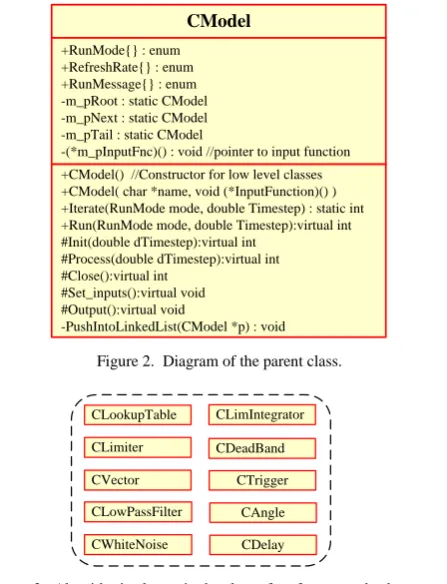
Each sub-model is derivate from the parent class named CModel, as shown by figure 1. The parent class provides abstraction interface to access derived class.
Figure 2 shows the functions and attributes in the parent class-CModel. In CModel, by using the function Run(RunMode mode, double TimeStep), the initialization, data receiving, data transfer, results output and destructor of the derived classes are realized. These functions are virtual functions and protected in the parent class. For each derived class, the virtue functions are overloaded to describe various characteristic. Meanwhile, data can be processed and stored by the parent class.
B. Operating Functions
Performance Database
Aerodynamics Model Aerodynamic
coefficients Engine performance data
Lift coefficients Drag coefficients Fuel flow
Thrust
Optimization Program Lift force
Drag force Fuel flow Aircraft geometric
parameter Wing area
Figure 6. Data flow relationship between optimization program and performance database.
[N1Corr_PLA]
Altitude = 0.0 10000.0 20000.0 30000.0 40000.0
[Altitude_0]
Mach = 0.0 0.2
-109.2 = 82.12 82.32 -103.8 = 82.12 82.32 -97.8 = 74.50 74.68 -62.2 = 18.0 20.0
0.0 = 18.0 20.0
4.8 = 18.0 20.0
16.97 = 51.88 51.94
29.0 = 69.70 69.77
41.45 = 82.93 83.00
44.0 = 84.45 84.50
52.0 = 88.25 89.94
54.8 = 90.50 91.18
57.6 = 93.98 94.66
60.65 = 94.48 95.16
keywords keywords
separator
variable value variable name
Figure 5. The 3-Dimensional data table.
Figure 7. Running results of program debugger for performance database.
Figure 4. The 2-Dimensional data table.
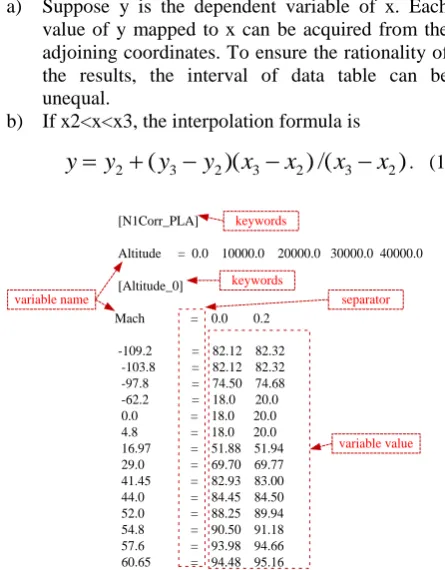
Through these algorithmic classes, the performance database modeling is much convenient based on C++. For example, in practice, aerodynamic data and engine performance data composed of a great quantity of data tables are hard to process. By using the function CLookupTable, the data tables can be disposed. In the aerodynamic coefficients model, the relationship between flight parameters and aerodynamic coefficients are classified and organized into several data tables. Figure 4 gives an example of the 2-Dimensional data table of the aerodynamic coefficients.
In figure 4, clbas is the dependent variable of alfad and dfef. The first line involves the name of dependent variable. The second line refers to the second corresponds to the values of the second independent variable. And the column on the left side of the equal mark involves all the values of the first independent variable in this mapping.
For the established data tables, the desired data is acquired by interpolating function of CLookupTable. The mathematical expression of the function CLookupTable is shown as follows
a) Suppose y is the dependent variable of x. Each value of y mapped to x can be acquired from the adjoining coordinates. To ensure the rationality of the results, the interval of data table can be unequal.
b) If x2<x<x3, the interpolation formula is
)
/(
)
)(
(
3 2 3 2 3 22
y
y
x
x
x
x
y
y
. (1)C. Data Structure of Performance Database
During the process of trajectory optimization, the aerodynamic coefficients, engine performance data and aircraft geometric parameters are essential. As the objective of optimization is specific airplane, extensible markup language (XML) in JSBSim is unnecessary. In the data file, the data tables include keywords, variable name, separator and variable value. All the aerodynamic data and engine performance data are stored in Aero.dat and Engine.dat respectively. Figure 5 shows a part of 3- Dimensional data table in the file Engine.dat.
D. Implementation of Performance Database
In FMC, as the data basis of the optimization program, the performance database provides lift coefficients, drag confidents, fuel flow, thrust and wing area for the aerodynamic model. And, the lift force, drag force which calculated by the aerodynamic model and fuel flow are transferred to optimization program. The data flow relationship is shown in figure 6.
The FMC performance database is implemented by
Microsoft Visual C++ and MATLAB/SIMULINK mixed software development environment. In order to validate the correctness of the data structure, the performance database is called by FMC. The results of the program are shown by figure 7.
III. TRAJECTORY OPTIMIZATION IN VERTICAL PROFILE
In trajectory optimization, mass point and rigid body dynamics equations are used to describe aircraft motion [19]. In practice, to reduce complexity and enhance the real-time performance in online computation, a simplified point mass performance model is adopted by flight management system for optimal trajectory generation.
A. The Mass Point Model with Energy-state
w
V
V
x
V
h
mg
L
T
V
m
mg
D
T
V
m
cos
sin
cos
sin
sin
cos
. (2)
where, m is the weight of aircraft; V the flight velocity; T
the engine thrust; α the angle of attack; D the Drag force;
L the lift force; θ the flight path angle; h the flight altitude;
x the flight distance; Vw the velocity of the wind. The
variables in (2) are calculated by the following equations.
2
2
)
,
,
(
)
,
,
(
2 2 .
w D
w L
S
C
V
D
S
C
V
L
V
h
TLA
T
T
f
m
V
h
TLA
f
f
. (3)
where, ρ represents the air density, Sw the wing area, CL
the lift coefficient, CD the drag coefficient, T the engine
thrust force, f the fuel flow, M the Mach number, TLA the thrust level angle.
In flight, each point of the trajectory corresponds to a certain amount of energy states. In relation to potential energy, the rotational energy is too small so as to be neglected. Thus, the total energy per unit mass of the aircraft is defined as follows.
2
2
1
V
g
h
E
. (4)Combined (4) into (2), the mass point model with energy state is acquired.
V
mg
D
T
E
V
V
x
W
cos
cos
. (5)
Furthermore, based on the replacement of variable dE
and dt, (5) can be simplified as follows
mg
V
D
T
V
V
dE
dx
w)
cos
(
cos
. (6)
For there is no violent maneuver in airline operation, the normal acceleration of mass point can be neglected, that is
0
V
. (7)Constraint equation act on aircraft in flight trajectory is converted into (8).
0
cos
cos
L
mg
T
. (8)B. Cost Function
Solving the flight state corresponds to the minimum operation cost is an important approach to reduce direct operation cost (DOC) and enhance air transportation economic. Thus, DOC is adopted as the performance index in the trajectory optimization problem. The definition of DOC is shown as follows
f f t
z
C
t
C
m
C
. (9)where, Cz is the direct operation cost; Ct the coefficient of
time cost; t the total time cost in flight; Cf the coefficient
of fuel economic; mf the total fuel consumed in flight.
Taking the functional equation of (10) as performance index of the optimization problem, namely
tft
C
tC
ff
dt
J
0
)
(
. (10)where, t0 is the start time of the flight; tf the completion
time of the flight; f the specific fuel consumption.
C. The Principle and Analysis of the Problem
Suppose that, the whole vertical flight profile consists of three phases which are climb, cruise and descent phase respectively. The total energy per unit mass of the aircraft
E is increasing monotonically in climb phase, decreasing
monotonically in descent phase, and keeping constant while cruising.
In cruise, the aircraft maintain steady flight, that is, the flight path angle θ is equal to zero and the flight velocity
V maintain constant. Thus, the equations of static
equilibrium of the aircraft are
0
cos
D
T
. (11)0
cos
L
mg
T
. (12)Taking the flight cost per unit flight distance as the performance index in cruise. The expression of optimization is shown as
V
f
C
C
E
t fV c
min
)
(
. (13)where, λ is the operation cost per unit flight distance in cruise; Ec the total energy per unit mass of the aircraft in
cruise.
0 0
|
/
)
cos
(
|
cos
/
)
cos
(
cos
E Wd d E Wc cmg
V
D
T
V
V
mg
V
D
T
V
V
dE
dx
. (14)
)
(
)
(
)
(
0 d c tt t f
t
t t f
d
d
d
dt
f
C
C
dt
f
C
C
J
f cf ci
. (15)
where, Vc is the flight velocity while climbing; VWc the
velocity of wind while climbing; Vd is the flight velocity
in descent; VWd the velocity of wind in descent; d the total
flight distance; dc the total climb distance; dd the total
descent distance.
Converting the total energy per unit mass as an independent variable in performance index, (15) can be written as 0 0
|
|
)
(
)
(
))
(
)
(
(
(
)
(
0 0
E E E f t E E E f t c d c c E E f tdE
E
f
C
C
dE
E
f
C
C
E
d
E
d
d
dE
E
f
C
C
J
c f c f
. (16)
Based on the analysis discussed above, the problem of solving optimal trajectory in vertical profile can be converted into calculating the minimum value of (16) under the constraint conditions of (14). The Hamiltonian function defined as shown in (17).
)
|
/
)
cos
(
|
cos
/
)
cos
(
cos
)(
(
|
|
)
(
)
(
0 0 0 0
E Wd d E Wc c E f t E f tmg
V
D
T
V
V
mg
V
D
T
V
V
E
E
f
C
C
E
f
C
C
H
. (17)where, χ(E) is the covariant.
In (17), the end-point condition E0 is constant, whereas,
Ec, as well as dc(Ec) and dd(Ec) are free of restraints.
According to the Minimum Principle of Pontryagin [20], the transversality condition is acquired.
(
)
)
(
)
(
)
(
E E cd c d c c
E
d
d
d
d
d
E
c
. (18)Based on the minimum principle, the optimum control variable V and TLA should minimize (18), namely
c b descent
TLA
V
H
E
V
TLA
L
L
L
lim
,
(
,
,
,
)
min
. (19)where, Lclimb and Ldescent correspond optimization model in
climb phase and descent phase, in which the initial energy of climb E0 is decided by the initial flight altitude
and velocity in climb, the initial energy of descent Ef is
acquired based on the termination flight altitude and velocity in descent. The expressions of Lclimb and Ldescent
in (19) are shown as follows.
]
/
)
cos
(
cos
)
(
[
min
0 0 , lim
E Wc c E f t TLA V b cmg
V
D
T
V
V
E
f
C
C
L
. (20)
]
|
/
)
cos
(
|
cos
|
|
)
(
[
min
0 0 ,
E Wd d E f t TLA V descentmg
V
D
T
V
V
E
f
C
C
L
. (21)
IV. IMPLEMENTATION OF THE MODIFIED PARTICLE
SWARM OPTIMIZATION ALGORITHM
A. Population Initialization of Particle Swarm
In the flight management system, the outputs from trajectory optimization calculation module to the automatic flight control system (AFCS) are objective airspeed and objective altitude, which is used to the control of vertical flight profile. Thus, the Mach number
M and the flight altitude h are adopted as the particles of the population. Suppose that, the size of population is l, the population described as follows.
2 2 2 1 1
...
...
l l lh
M
h
M
h
M
X
. (22)In order to reduce the search space, accelerate the convergence rate, based on the Boeing 737-800 flight
plan and performance manual [21], the search space S is
set as
41000
6000
85
.
0
0
max min max minh
h
M
M
S
. (23)B. Objective Function Construction
one without constraints. Then the fitness function of cruise is obtained.
2 2
)
cos
(
)
cos
(
mg
L
T
D
T
V
f
C
C
fitness
t f
. (24)
The fitness function of climb and descent are shown as (25) and (26).
2
)
cos
cos
(
/
)
cos
(
)
cos
(
)
(
mg
L
T
mg
V
D
T
V
V
E
f
C
C
fitness
t f c Wc
. (25) 2)
cos
cos
(
|
/
)
cos
(
|
cos
|
|
)
(
mg
L
T
mg
V
D
T
V
V
E
f
C
C
fitness
t f d Wd
(
)
. (26)C. Inertial Factor
As the procedure of searching the optimal solution in search space is nonlinear. To balance the ability of global search and local search, a nonlinear adaptive inertial factor is introduced into the standard PSO to improve the searching performance. In the modified PSO, the fitness value of particles can be adjusted dynamically. When the fitness value of each particle trends to local optimal solution, the inertial factor increases, whereas, when the fitness value of each particle trends to be scattered, the inertial factor decreased. Meanwhile, if the fitness value is superior to the average level, the particle is protected, otherwise, inertial factor of the particle corresponds to the worse fitness value should be increased to make the particle close to a better solution. The adaptive inertial factor can be described as (29).
avg avg avgf
f
w
f
f
f
f
f
f
w
w
w
w
max min min min max min)
)(
(
(27)where, w is the inertial factor; wmax the maximum value
of w; wmin the minimum value of w; f the fitness value of
particle; favg the average value of total particles; fmin the
minimum value of the whole population.
D. Population Updating
Suppose that, the velocity of i-th particle in population
X denoted as Vi=[vi,1, vi,2, …, vi,l], the best position the
particle experienced and the optimal position the whole population experienced are describe as Pi=[pi,1, pi,2, …,
pi,l] and Pg respectively. Then the evolution equation of
the population is shown as (26).
)]
(
)
(
[
)]
(
)
(
[
)
(
)
1
(
2 2 1 1t
x
t
P
r
c
t
x
t
P
r
c
t
wv
t
v
ij gj j ij ij j ij ij
. (28)
where, i is the serial number of the particle; j represents the dimension of the particle; t the iterations; w the inertial factor; c1 and c2 the acceleration constants; r1 and
r2 the random numbers of stochastic distribution.
In (28), the best position the particle experienced at t is calculated as (29).
))
1
(
(
))
1
(
(
)
1
(
)
(
))
1
(
(
))
1
(
(
)
1
(
)
(
t
P
f
t
x
f
if
t
X
t
P
t
P
f
t
x
f
if
t
P
t
P
i i i i i i i . (29)The iteration expression of the optimal position the whole population experienced can be revealed as shown in (30).
)
))
1
(
(
,
)),
1
(
(
)),
1
(
(
(
min
)
(
0 1
t
P
f
t
P
f
t
P
f
t
P
s g
. (30)The iteration equation of the particle position is obtained.
)
1
(
)
(
)
1
(
t
x
t
v
t
x
ij ij ij . (31)E. Algorithm Procedure
First, the optimal solution of cruise phase is calculated and the optimal cost of cruise is acquired. The process is as follows.
a) The population is initialized according to (22) and (23).
b) The fitness value of each particle is calculated by (24) and the inertial factor is updated through (27).
c) The local optimum is obtained by (29).
d) The global optimal solution is acquired
according to (30).
e) The velocity and position of each particle are evolved based on (28) and (31) respectively.
f) If the iterations reach the max number of
iterations and satisfy the tolerance of termination 10-5, the algorithm is terminated and the optimal solution is output. Otherwise, step a to e are repeated.
Then, the optimal cost of cruise is substituted into (25) and (26) and the computing process of optimal trajectory in climb and descent phrase is shown as follows.
a) The population is initialized according to (22) and (23).
b) The fitness value of each particle in climb and descent phrase are computed according to (25) and (26) respectively, the inertial factor is updated through (27).
c) The local optimum is obtained by (29).
d) The global optimal solution is acquired
cOptimization : COptimization
: CModel cPMDB : CPMDB
cAerodynCoef : CAerodynCoef
cFlightDyn : CFlightDyn
::Iterate ( CModel::_INIT , m_dTimeStep )
Run ( CModel::_INIT, m_dTimeStep )
Return
Return
Run(...)
Return
...
Run(...) Return
Figure 8. Initialization sequence diagram for optimization procedure.
a) The interior of the flight simulator. b) Waypoints in flight on the Navigation Display.
Figure 9. The Boeing flight simulator.
Figure 10. Convergence comparison.
e) The velocity and position of each particle are evolved based on (28) and (31) respectively.
f) If the iterations reach the max number of
iterations and satisfy the tolerance of termination 10-5, the algorithm is terminated and the optimal solution is output. Otherwise, step a to e are repeated.
V. TRAJECTORY OPTIMIZATION AND DISCUSSION
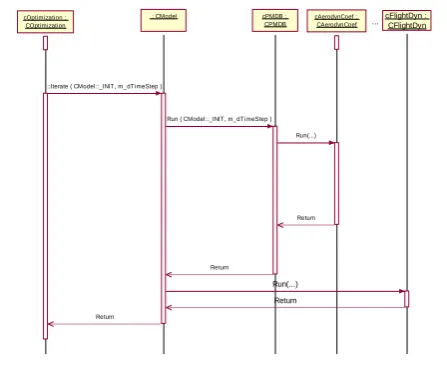
By invoking the functions defined in the parent class-CModel, the optimization procedure can be executed. Take program initialization as an example, after the objects are instantiated, the function Iterate() of the object cOptimization is called to initialize of each object. During the process, each sub-classes are initialized
through invoking the function Run(RunMode mode,
double TimeStep) by their parent classes. The sequence diagram of the program initialization is shown as figure 8.
According to the modified PSO algorithm, the optimal trajectory is calculated. The performance data used in trajectory optimization is derived from the performance database specified for Boeing 737-800. The flight experiment is carried out on Boeing 737-800 flight
simulator. Figure 9 shows the interior of the flight simulator and the waypoints of the air route in flight.
A. The Search Performance Comparison
Taking the optimization trajectory in cruise as an example, the GA algorithm, the simple PSO algorithm and the modified PSO algorithm are used to solve the optimal vertical trajectory respectively. The iteration parameters of the modified PSO algorithm are shown in
table 1 and the convergence performance of the various algorithms is indicated in figure 10.
As shown in figure 10, in the simulation, using the same iterations, the modified algorithm is trapped in to local best once, whereas, the standard PSO algorithm reaches local best three times and the GA algorithm experiences four local best solutions. It can figure out that the modified PSO possesses faster converge rate and better ability of avoid local optima.
B. Optimization Results
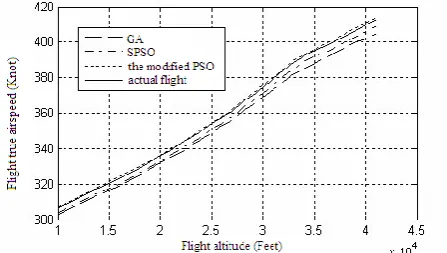
The GA, the standard PSO and the modified algorithm are adopted to solve flight trajectory respectively. All of the optimization results are used to flight test on the simulator platform. Figure 11 and 12 reveal optimal TAS at various altitude in cruise on flight simulator platform and the optimal solution comparison between the GA, the standard PSO and the modified PSO algorithm. Figure 13 shows the optimal TAS at various altitude while climbing on flight simulator platform and the
optimal solution comparison between the GA,the
standard PSO and the modified PSO algorithm.
In figure 11, at the cruise altitude of 35700 feet, the optimal true airspeed on flight simulator is 456 knots,
TABLE I.
ITERATION PARAMETERS IN THE IMPROVED PSOALGORITHM
Denotation Parameters Values
wmin The minimum inertia factor 0.4
wmax The maximum inertia factor 0.9
N The size of the population 30
D The dimensions of the population 1
Figure 11. Optimal TAS at various altitudes in cruise and the optimal solution comparison.
Figure 12. Optimal N1 at various altitudes in cruise and the optimal solution comparison.
Figure 13. Optimal TAS at various altitudes while climbing and the optimal solution comparison.
whereas, according to the modified PSO, the standard PSO and the GA, the results of computation are 455.5, 455 and 454.4 knots respectively.
In figure 12, when the aircraft weight is 150 kilo lbs, the low pressure rotor speed is 88.6 on the flight simulator platform, whereas, through the modified PSO, the standard PSO and the GA, the results of optimization are 88.5114, 88.3785 and 88.4671 respectively.
In figure 13, at the climb altitude of 30000 feet, the optimal true airspeed of the simulator is 376 knots, whereas, by the modified PSO, the standard PSO and the GA, the results are 371, 368 and 374.5knots respectively.
VI. CONCLUSION
In this paper, the performance database for FMC is built by object oriental technique and the aircraft optimal flight trajectory in vertical flight profile is solved by
using the modified particle swarm optimization algorithm. According to object-oriented principle, the class and their inheritance are designed. Through designs the operating function library for data table processing, the complicated performance data can be disposed and calculated conveniently. Based on the proposed data structure, the data files are reorganized and classified into a unified format which can be easily stored and maintained. And by replacing the data file, the performance database can be expanded into different types for various airplanes. The particle swarm optimization algorithm is modified by introducing adaptive inertia factor. Meanwhile, by combination with the penalty function method, the trajectory optimization with constraint conditions is converted into unconstrained optimization problem. Based on the modified PSO algorithm, the optimal vertical trajectory of Boeing 737-800 is calculated. Comparison between optimization and experiment results reveal that the optimal solution acquired by modified PSO algorithm is approximately equal to actual flight data and the modified algorithm convergence faster than other algorithms.
ACKNOWLEDGMENT
This work was supported by the fund of China's "World class university (985)" project (CDAZ98502211) and supported by Program for New Century Excellent Talents in University (NCET_04_0325).
REFERENCES
[1] Qin Qingsheng, Flight management computer system, National Defence Industry Press, Beijing, 1990.
[2] Wu Shufan, Guo Suofeng, Shen Yongzhang, “Development of flight management system and key technologies”, Fire Control and Command Control, vol. 14(4), pp. 1-7, 1989.
[3] Peng Junyi, Jia Rongzhen, “Research on flight management system for real-time simulation”, Journal of System Simulation, vol. 9(3), pp. 88-99, 1997.
[4] Wang Jiangyun, Yang Xiaoyang, “Modeling and Simulation of the Civil Flight Management System”, Flight Dynamics, 43(2), pp. 81-84, 2008.
[5] William Chan, Ralph Bach, Joseph Walton, “Improving and Validating CTAS Performance Models”, AIAA- 2000- 4476, 2000.
[6] Euro control Experimental Center, User Manual for the Base of Aircraft Data Revision 3.6, EEC Note No.10/04 Project ACE- C- E2, 2004.
[7] Greedon, J. F, “Flight Management Systems: What are they and why are they being developed?”, AIAA- 83-2235. [8] Sorenson, J. A., “Computer Program for Generation and Evaluation of Optimal Vertical Profile”, NASA CR 3688. [9] S. Esteban, J. Aracil, and F. Gordillo, “Three-Time Scale
Singular Perturbation Control for a Radio-Control Helicopter on a Platform”, AIAA Atmospheric Flight Mechanics Conference and Exhibit, pp.1-19, 2005. [10]Wu Shufan, Shen Yongzhang, Guo Suofeng, “Trajectory
Optimization of Aircraft Vertical Flight Profile”. Control Theory and Applications, vol. 9(4), pp. 380-384, 1992. [11]Zhou Kun, Wang Lixin, “Vertical flight trajectory
[12]Wang Qunwei, Wu Chengfu, Chen Huaimin, “The trajectory optimization of fuel-optimal flight of UAV based on energy-state control”. Fire Control and Command Control, vol. 33(11), pp. 105-111, 2008.
[13]Song Le, Zhao Shuli, “Best flight cost performance optimization for large aircraft”. Ordnance Industry Automation, vol. 28(6), pp. 43-45, 2009.
[14]Zhang Jin, Wang Wei, Ning Dongfang, “Fuel optimal trajectories of airplane based on genetic algorithm”. Journal of Projectiles, Rockets, Missiles and Guidance, vol. 25(4), pp. 453-455, 2005.
[15]Wang Wei, Ning Dongfang, Zhang Jin, “A genetic algorithm for the trajectory optimization of fuel-optimal flight based on energy-state control”. Measurement & Control Technology, vol. 25(1), pp. 56-65, 2006.
[16]Wu Di, Wang Feng, YANG Shengyao, “Hybrid genetic algorithm optimization for aerospace vehicle fuel consumption”, Journal of Wuhan University of Technology, vol. 32(20), pp.147-155, 2010.
[17]Cui Zhihua, Zeng Jianchao, Particle Swarm Optimization, Beijing: Science Press, 2011.
[18]Wang Ling, Liu Bo, Particle swarm optimization and scheduling algorithms. Beijing: Tsinghua University Press, 2008.
[19]Lu Huimin, Mathematical modeling and practices in flight simulation, Beijing: Aviation Industry Press, 2007. [20]Jing Haiying, Optimal control and method, Shenyang:
Northeastern University Press, 2002.
[21]Boeing commercial airplane group, D632A008-ZZ080 Boeing 737-800 Flight plan and performance manual, City of Seattle, USA.
Sibin Zhu, born in Shandong, China, 1982, has got a master degree of computer science in 2006, at the School of Automobile Engineering, Harbin Institute of Technology. He is a PhD candidate at the School of Mechatronics Engineering, Harbin Institute of Technology.
His main research interests include flight management system, real-time system and software architecture, etc. He has
published more than 3 scientific papers about flight simulation and real-time system in various periodicals and conference proceedings.
Guixian Li, born in Heilongjiang, China, 1941, she became a professor of Harbin Institute of Technology since 1991. Now, she is a Ph.D. supervisor in School of Mechatronics Engineering, Harbin Institute of Technology, Harbin, China.
Her research interests include special mechanical transmission multiple objective optimization design and intelligent design, random fuzzy system dynamics, space meshing theory, reverse engineering theory and application, etc. He has published over 200 scientific papers in various periodicals and conference proceedings.
Professor Guixian Li is a member of the national gear specialized committee and moreover she is a communication evaluation experts of defense following key discipline. She attained the Heilongjiang province education commission scientific and technological progress first prize in 1997 and the provincial science and technology progress prize in 1998 by the research and application of CAD institutions.
Junwei Han Born in Liaoning, China, 1964, he received PhD from Harbin Institute of Technology in 1992. Now, he is a professor in School of Mechatronics Engineering, Harbin Institute of Technology, Harbin, China.
His research interests include system integration design theory and technology, computer control technology, electro- hydraulic servo control theory and application, modern control theory and application, etc. He has published over 100 scientific papers in various periodicals and conference proceedings.