© Medical Education Department, School of Medical Sciences, Universiti Sains Malaysia. All rights reserved.
CORRESPONDING AUTHOR: Dr. Fatimah Lateef, Senior Consultant, Director of Undergraduate Training and Education, Dept of Emergency Medicine, Singapore General Hospital,Singapore.
Email: [email protected]
Introduction
Resuscitation of the critically ill in the emergency department can be chaotic. Baker et al defined a team as two or more individuals, with specialized knowledge and skills who
perform specific roles, and complete
interdependent tasks to achieve a common goal or outcome [1]. Medical teams often function with a high workload of critical tasks that are frequently evolving, and thus, teams must adapt dynamically to achieve their goals. However, there are numerous barriers to achieving and maintaining team-level expertise [2]. The
ABSTRACT
Introduction: Resuscitation of the critically ill in the emergency department can be stressful and at times, chaotic. We believe that simulation training for emergency teams (STET) will help improve team performance during actual resuscitation, thus synonymously leading to better patient outcomes. We aim to evaluate the effectiveness of STET for resuscitation team training. . Method:
Eight sessions of STET using low fidelity simulation were conducted during March to April 2015. Doctors and nurses participated in the sessions, as they would work together in teams on a day to day basis. The participants evaluated the effectiveness of the training after the sessions on a 5-point Likert Scale. The following were assessed: benefits of simulation training; realism and appropriateness of scenarios; enhancement of medical knowledge and practical skills, thereby improving patient outcomes; and teamwork, with a focus on leadership and communications. Results: Twenty doctors and 13 nurses participated in STET. The doctors were residents (Emergency Medicine, Internal Medicine, Family Medicine, Orthopaedics) in their first to third year of training. STET received a mean score of 4.3 across all domains. Participants scored the benefit of STET with a mean of 4.5. Though the scenarios were appropriate (mean score = 4.4), the low fidelity simulation lacked realism (mean score = 3.8). With the right training objectives, STET could enhance both medical knowledge and practical skills (mean score 4.4 versus 4.3 respectively). Participants believe that learning points from STET could improve patient outcomes (mean score 4.4). Finally, STET provides an avenue for team training (mean score = 4.4) with development of team leadership and communication. Conclusion: STET was effective for the purpose of resuscitation team training. However, the limitation of this educational intervention was that we do not know the directness and extent of its impact on actual patient outcomes. This would be the subject of a future follow=up study of this nature.
Simulation Training For Emergency Teams
Pek Jen Heng, Wong Evelyn, Fatimah Lateef
Department of Emergency Medicine, Singapore General Hospital, Singapore.
DOI:10.5959/eimj.v7i4.395 www.eduimed.com
ARTICLE INFO
Received : 03/10/2015 Accepted : 24/10/2015 Published : 15/12/2015
KEYWORD
Institute of Medicine Report ‘To Err is Human’ highlighted that 60–80% of medical errors are primarily a result of human errors such as ineffective communications and teamwork [3]. Therefore, repeated, effective methods of teamwork training for providers responding to emergencies are necessary. Simulation has become a primary strategy to improve teamwork skills [4,5]. Simulation is an ideal opportunity for the deliberate practice of critical, nontechnical skills such as teamwork by exposing teams to high-risk patient encounters [6,7]. Interaction and communications within the teams are critical to both quality and safety of patient care, as well as the establishment of a shared mental model and education of the team members [8]. This form of interprofessional education allows healthcare professionals to learn their respective practices in an integrated way, leading to
positive outcomes including improved
emergency department culture and patient
satisfaction [9], and collaborative team
behaviour and reduction of clinical error rates resulting in enhanced patient safety [10].
In this work, we explored a simulation-based education for both doctors and nurses within the emergency department, in an attempt to understand more how this training impact team performance. We believe that simulation training for emergency teams (STET) will help improve team performance during actual resuscitation. This will translate to better patient outcomes as teams are better prepared for crisis management.
Method
Setting
This study was conducted in the Department of Emergency Medicine of Singapore General Hospital.
Design
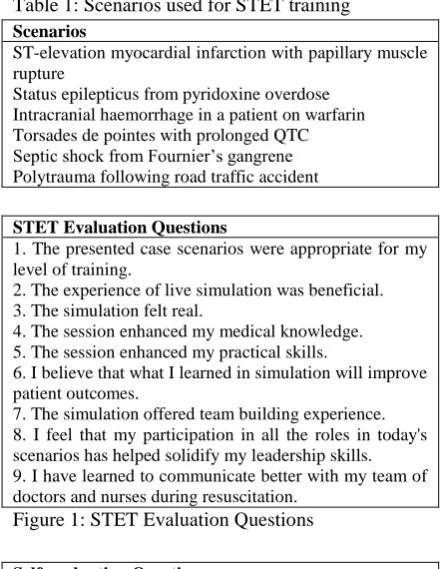
Each session of STET involved training with low fidelity simulation. This was conducted within the department. Each 1-hour session consisted of two scenarios (Table 1). Time allocation was provided for conduct of scenarios and feedback. Doctors and nurses participated in the sessions as
teams. The participants evaluated the
form (Figure 1), using a 5-point Likert Scale. Participants also filled in a self-evaluation form (Figure 2), using a 5-point Likert Scale before and after the training session.
Table 1: Scenarios used for STET training Scenarios
ST-elevation myocardial infarction with papillary muscle rupture
Status epilepticus from pyridoxine overdose Intracranial haemorrhage in a patient on warfarin Torsades de pointes with prolonged QTC Septic shock from Fournier’s gangrene Polytrauma following road traffic accident
STET Evaluation Questions
1. The presented case scenarios were appropriate for my level of training.
2. The experience of live simulation was beneficial. 3. The simulation felt real.
4. The session enhanced my medical knowledge. 5. The session enhanced my practical skills.
6. I believe that what I learned in simulation will improve patient outcomes.
7. The simulation offered team building experience. 8. I feel that my participation in all the roles in today's scenarios has helped solidify my leadership skills. 9. I have learned to communicate better with my team of doctors and nurses during resuscitation.
Figure 1: STET Evaluation Questions
Self-evaluation Questions
1. I am competent in managing a critically ill patient. 2. I am confident in managing a critically ill patient. 3. I know the clinical problems during resuscitation. 4. I know management priorities during resuscitation. 5. I can speak up and give my inputs during resuscitation. 6. I understand clearly what is being communicated during resuscitation.
7. I always practise closed loop communication during resuscitation.
8. There is mutual respect among members in my resuscitation team.
Figure 2: Pre- and post- evaluation questions
Statistical Methods
Statistical analysis was performed using SPSS version 16. Summary statistics were described with mean and standard deviation for parametric variables, and median with inter-quartile range for nonparametric variables.
Result
Participants Characteristics
The doctors were residents from Emergency Medicine, Internal Medicine, Family Medicine and Orthopaedics (Table 2). They were in their first to third year of training. The nurses were trained in medical and trauma resuscitation courses conducted by the department. This course was to equip nurses with the knowledge and skills required for work in the resuscitation (P1) area.
Table 2: Doctors profile
Specialty Number of Residents
(%)
Internal Medicine 11 (55) Emergency Medicine 3 (15)
Orthopaedics 2 (10)
Family Medicine 2 (10)
Urology 2 (10)
STET Evaluation
STET received a mean score of 4.3 across all domains (Table 3). Participants scored STET as being beneficial with appropriate scenarios, even though the low fidelity simulation lacked realism. With the right training objectives, STET could enhance both medical knowledge and practical skills, leading to improved patient outcomes. STET provided an avenue for team training with development of team leadership and communication.
Table 3: STET Evaluation Scores
STET Evaluation Questions Score
(Mean ± SD)
1. The presented case scenarios were appropriate for my level of training.
4.37 ± 0.47
2. The experience of live simulation was beneficial.
4.47 ± 0.51
3. The simulation felt real. 3.84 ± 0.72 4. The session enhanced my medical
knowledge.
4.42 ± 0.50
5. The session enhanced my practical skills.
4.26 ± 0.70
6. I believe that what I learned in simulation will improve patient outcomes.
4.42 ± 0.51
7. The simulation offered team building experience.
4.42 ± 0.51
8. I feel that my participation in all the roles in today's scenarios has helped solidify my leadership skills.
4.11 ± 0.70
9. I have learned to communicate better with my team of doctors and nurses during resuscitation.
4.26 ± 0.45
Self-evaluation
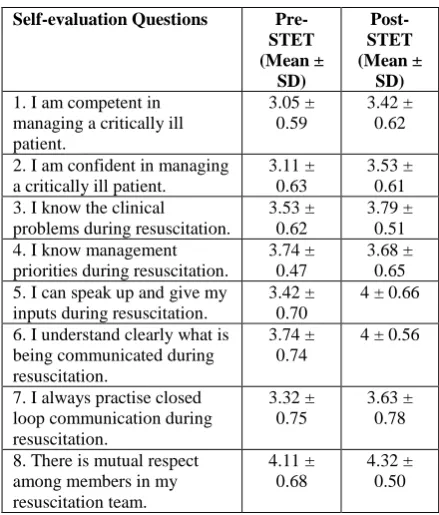
Self-evaluation of the participants before and after STET showed an improvement in mean score, suggesting that participants felt more confident and empowered (Table 4).
Table 4: Pre- and Post-STET self evaluation results
Self-evaluation Questions
Pre-STET (Mean ± SD) Post-STET (Mean ± SD)
1. I am competent in managing a critically ill patient.
3.05 ± 0.59
3.42 ± 0.62
2. I am confident in managing a critically ill patient.
3.11 ± 0.63
3.53 ± 0.61 3. I know the clinical
problems during resuscitation.
3.53 ± 0.62
3.79 ± 0.51 4. I know management
priorities during resuscitation.
3.74 ± 0.47
3.68 ± 0.65 5. I can speak up and give my
inputs during resuscitation.
3.42 ± 0.70
4 ± 0.66
6. I understand clearly what is being communicated during resuscitation.
3.74 ± 0.74
4 ± 0.56
7. I always practise closed loop communication during resuscitation.
3.32 ± 0.75
3.63 ± 0.78
8. There is mutual respect among members in my resuscitation team. 4.11 ± 0.68 4.32 ± 0.50 Other benefits
Clinical updates, departmental workflows and patient safety issues (Table 5) were also incorporated into STET. These can be used to further develop the training curriculum to harness the greater potential of STET.
Table 5a: Updates in STET Training
Clinical Updates and Departmental Workflows
Cardiac catheterization laboratory activation Apneic oxygenation for Rapid Sequence Intubation Use of Prothrombin Complex Concentrate in warfarin reversal
Extracorporeal Membrane Oxygenation in cardiac arrest Antibiotics guideline
Trauma activation and massive transfusion protocol
Table 5b: Updates in STET Training Patient Safety Issues
Discussion
The use of simulation in educating and training healthcare professionals enables them to practice the necessary skills in an environment that allows for errors, repetitions and professional growth to take place without risking patient safety. The Emergency Department is a unique
healthcare setting with the following
characteristics which affect how healthcare providers make decisions [11,12]:
i. ill-structured or ill-defined acute
presentations and problems,
ii. incomplete or conflicting initial
information,
iii. dynamic situations,
iv. multiple competing goals,
v. intense time pressure,
vi. serious consequences of error.
During STET scenarios, the participants, as a team, were able to experience the above characteristics of the emergency department. They were allowed to make decisions in a safe environment with immediate feedback on performance. The debriefing sessions of STET focused on the nontechnical dimensions of maintaining team structure and climate; applying problem-solving strategies; communicating with the team; executing plans, managing workload; and improving team skills. For instance, under team communications, team members were encouraged to speak up when they had patient safety concerns. This can be achieved by using assigned critical language for calling a time out, such as ‘I’m uncomfortable’ or ‘I’m concerned’.
This allowed patients to be evaluated
independently of the chain of command within the team [13]. Acquisition of medical knowledge and procedural skills competency were not emphasized, as the focus of STET was on team performance.
Given the nature of shift work in the emergency department, it is uncommon for members of a resuscitation team to be consistent. The membership of the emergency teams changes constantly and may even include ad-hoc members such as rotating residents from other
involved in STET was a random assortment of doctors and nurses. Separate hierarchies of power and training add additional layers of complexity, making it difficult to anticipate team members’ skills, knowledge and attitudes [14]. Representative examples include knowledge
(shared understanding of the situation,
familiarity with teammates’ abilities); skills (how to communicate effectively, such as ‘closing the loop’, how to monitor teammates’ performance); and attitudes (team cohesion and mutual trust)1. Teamwork and communications training are even more critical for these dynamic, complex teams to function effectively in achieving timely and safe patient care.
We conducted in situ simulation which was conducted in the actual care environment. Teams were able to train in their typical roles in a familiar setting, using equipment, resources and system processes involved in actual patient care
[15]. Clinical updates and departmental
workflows were incorporated into STET. For instance, activation of the massive transfusion protocol in the trauma scenario allowed staff to familiarize themselves with the institutional indications and process of activating the blood bank. Latent threats could also be identified. In situ simulation sessions are logistically difficult to organize and schedule [16] due to drawbacks such as the potential to interrupt actual patient care, less time for didactic teaching and debriefing, and difficulty in reaching providers on all shifts.
Patient safety issues were also incorporated into STET as part of a culture of safety within the
department. Safety lessons from risk
management system records were identified, with the conditions for near misses or errors to occur replicated in the STET scenarios. Through this form of learning, participants were engaged and safety lessons can be disseminated, leading to improved safety attitudes and improved patient safety.
results respectively and thus could not conclude whether the satisfaction and knowledge of teamwork gained from STET translated to improved teamwork during actual resuscitation and improved patient outcomes. Teamwork was observed only in a simulated setting as it was difficult to do because of the unpredictable nature of critically ill patients presenting to the emergency department and non-standardized set of conditions with regards to team formation. Our study adds to the growing body of literature which suggests that simulation can serve as an effective training tool for the interprofessional team by creating a safe learning environment relevant for them to immerse in. STET is unique in that we emphasized on the development of nontechnical skills, and incorporated both departmental protocols and patient safety issues into the training sessions. The positive outcomes observed in this study meant that these are potential areas in which simulation training can be applied, according to the educational needs of participants and department. The educational strategy here is an experiential opportunity to learn and develop under guidance as well. This STET team training offers training that can help improve function in stressful and tension-filled situations. [17]. Simulation as this can help departments evaluate cost-effectiveness of our training programmes, systems-based approach and also iron out inter-discipline workflows. Future research in this area can incorporate measures of cognitive, motivational and emotion processes in order to gain better insight into the mechanism through which simulation-based training can impact leanring and performance
Conclusion
Simulated emergencies provided an excellent opportunity for team performance training. Interprofessional learning can occur without endangering patient safety. The ratings showed that STET was effective for the purpose of improving team performance during actual resuscitation. This learning will inadvertently, translate to actual behaviours and improved patient outcomes as teams are better prepared for crisis management. It shows great potential as a
medium to create highly relevant training contexts and inculcate active learning processes.
Reference
1. Baker DP, Gustafson S, Beaubien JM, Salas E, Barach P. Medical teamwork and patient safety: the evidence-based relation. Rockville, MD: Agency for Healthcare Research and
Quality. 2005.
http://www.ahrq.gov/qual/medteam/.
2. Weller J, Boyd M, Cumin D. Teams, tribes and patient safety: overcoming barriers to effective teamwork in healthcare. Postgrad Med J. 2014 Mar;90(1061):149-54.
3. Kohn LT, Corrigan J, Donaldson MS. To err is human: building a safer health system. Washington, DC: National Academy Press; 2000.
4. Ziesmann MT, Widder S, Park J, Kortbeek JB, Brindley P, Hameed M, et al. Development of a national, multidisciplinary trauma crisis resource management curriculum-results from the pilot course. J Trauma Acute Care Surg. 2013 Nov;75(5):753-8.
5. Patterson MD, Geis GL, LeMaster T, Wears RL. Impact of multidisciplinary simulation-based training on patient safety in a paediatric emergency department. BMJ Qual Saf. 2013 May;22(5):383-93.
6. Cheng A, Duff J, Grant E, Kissoon N, Grant VJ. Simulation in paediatrics: An educational revolution. Paediatr Child Health. 2007 Jul;12(6):465-468.
7. Eppich WJ, Adler MD, McGaghie WC. Emergency and critical care pediatrics: use of medical simulation for training in acute pediatric emergencies. Curr Opin Pediatr. 2006 Jun;18(3):266-71.
8. Künzle B, Kolbe M, Grote G. Ensuring patient safety through effective leadership behaviour: A literature review. Saf Sci. 2010;48:1-17. 9. Campbell JC, Coben JH, McLoughlin E,
Dearwater S, Nah G, Glass N, et al. An evaluation of a system-change training model to improve emergency department response to battered women. Acad Emerg Med. 2001 Feb;8(2):131-8.
10. Morey JC, Simon R, Jay GD, Wears RL, Salisbury M, Dukes KA, et al. Error reduction and performance improvement in the emergency department through formal teamwork training: evaluation results of the MedTeams project. Health Serv Res. 2002 Dec;37(6):1553-81.
12. Orasanu J, Connolly T. The reinvention of decision making. In: Klein G, Orasanu J, Calderwood R, Zsambok CE, editors. Decision making in action: model and methods. Norwood, NJ: Ablex; 1993.
13. Leonard M, Graham S, Bonacum D. The human factor: the critical importance of effective teamwork and communication in providing safe care. Qual Saf Healthcare 2004; 13 (Suppl 1):i85–i90.
14. Klein KJ, Ziegert JC, Knight AP, Xiao Y. Dynamic delegation: shared, hierarchical, and deindividualized leadership in extreme action teams. Administrative Science Quarterly 2006; 51:590–621.
15. Miller KK, Riley W, Davis S, Hansen HE. In situ simulation: a method of experiential learning to promote safety and team behavior. J Perinat Neonatal Nurs. 2008 Apr-Jun;22(2):105-13.
16. Patterson MD, Geis GL, Falcone RA, LeMaster T, Wears RL. In situ simulation: detection of safety threats and teamwork training in a high risk emergency department. BMJ Qual Saf. 2013 Jun;22(6):468-77. 17. Aggarwal R, Mytton OT, Cerbrew M et al.