Journal of Technical Education and Training Volume 2 Number 2 (2010)
43
DYNAMIC TEACHING RATIO PEDAGOGIC MODEL
1
Chen Jiaying, 2Wee Keat Kheng,
3
Soh Guan Kiong and 4Lim See Yew
School of Electronics and Info-Comm Technology, Institute of Technical Education, Singapore
Email: [email protected], [email protected], 3[email protected], 4[email protected]
____________________________________________________________________
ABSTRACT
This paper outlines an innovative pedagogic model, Dynamic Teaching Ratio (DTR) Pedagogic Model, for learning design and teaching strategy aimed at the postsecondary technical education. The model draws on the theory of differential learning, which is widely recognized as an important tool for engaging students and addressing the individual needs of all students. The DTR model caters to the different abilities, interest or learning needs of students and provides different learning approaches based on a student’s learning ability. The model aims to improve students’ academic performance through increasing the lecturer-to-student ratio in the classroom setting. An experimental case study on the model was conducted and the outcome was favourable. Hence, a large-scale implementation was carried out upon the successful trial run. The paper discusses the methodology of the model and its application through the case study and the large-scale implementation.
Key words: dynamic teaching ratio, differential learning, ability grouping, flexibility
Journal of Technical Education and Training Volume 2 Number 2 (2010)
44 1. Introduction
No one would ever say that all students are the same. Yet in schools, we often treat students as if they were, even though all those faces look so different (Gayle & Carolyn, 2002). The traditional teaching pedagogy often adopts a one-tier learning approach with a fixed learning pace and environment for all students. All students, regardless of learning ability and pace, are provided with the same delivery approach and learning resources. However, the three principles from brain research, which are emotional safety, appropriate challenge, and self-constructed meaning, suggest that a one-size-fits-all approach to classroom teaching is ineffective for most students and harmful to some (Tomlinson & Kalbfleisch, 1998).
Therefore, recognizing the differences among students and providing appropriate teaching and learning strategies to different groups of students are important aspects that educators should address and act upon. Consequently, it follows that although essential curriculum goals may be similar for all students, methodologies employed in a classroom must be varied to suit to the individual needs of all students, i.e. learning must be differentiated to be effective (Priscilla, 2004). Differential learning is an important tool for engaging students and addressing the individual needs of all students. Differentiating instruction means creating multiple paths so that students of different abilities, interests or learning needs experience equally appropriate ways to absorb, use, develop and present concepts as a part of the daily learning process (Priscilla, 2004).
Journal of Technical Education and Training Volume 2 Number 2 (2010)
45 students because teachers are better able to give them more attention and design more appropriate activities to suit their abilities.
In brief, this paper sets out to help educators design and deliver lessons to suit the student’s ability more effectively by utilizing the theory of differential learning and providing a practical design methodology, the Dynamic Teaching Ratio (DTR) Pedagogic Model. The objective of this multi-tier pedagogic model is to enhance students’ academic performance and potentials, so as to equip them with the skills and knowledge for employability in a global economy and progression to higher education.
2. Methodology Of Dynamic Teaching Ratio Pedagogic Model
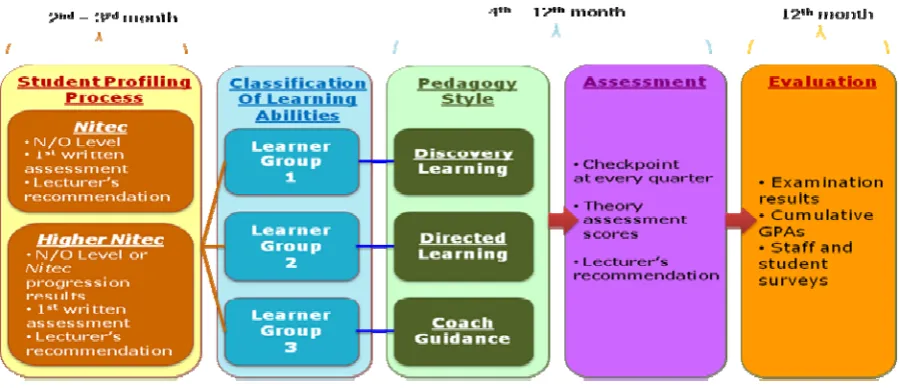
The DTR pedagogic model is an active intelligence learning strategy that facilitates differential learning. It creates an active learning environment and caters to the different learning abilities of students. It is introduced to 1st year students studying National ITE Certificate (Nitec) or Higher National ITE Certificate (Higher Nitec) courses in the Institute of Technical Education (ITE), Singapore. Students go through the profiling process during the first three months of study and are categorized as Learner Group 1 (LG1), Learner Group 2 (LG2) or Learner Group 3 (LG3) based on their learning needs and learning pace. The reason for grouping the students into three groups instead of two or four (or even more) groups is in consideration of the student’s profile and the amount of resource needed to provide the different instructional materials. Grouping the students into two groups may not reflect the actual profile of the students and may result in too much diversity in each group as the academic profile of the students spreads over a considerably wide range. Categorizing into four or more groups requires much more resources to develop the different instructional materials, which is not feasible in practice.
Journal of Technical Education and Training Volume 2 Number 2 (2010)
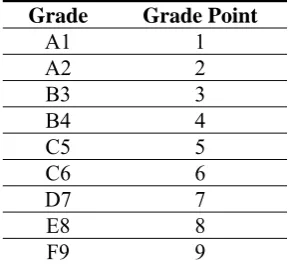
46 Table 1. Grading system of GCE O-Level and N-Level examinations
Grade Grade Point
A1 1 A2 2 B3 3 B4 4 C5 5 C6 6 D7 7 E8 8 F9 9
A study was carried out based on randomly selected graduates to examine the correlation between students’ academic grades from the O-Level or N-Level examinations and their cumulative Grade Point Average (GPA) when they graduated from ITE courses. In this study, the sum of the points of the best four subjects from the O-Level or N-Level examination was the first variable. And student’s GPA was the second variable. The correlation coefficient between these two variables was computed and the result showed that there was a moderate correlation between them. As shown in Table 2, the negative correlation coefficient indicated that as the sum of the best four subjects decreased, the cumulative GPA increased. In other words, students with better academic results from their secondary schools were likely to continue to achieve better academic performance in ITE.
Table 2. Correlation between students’ academic profile and cumulative GPA
Course Name Class
Number of Students
Correlation Coefficient
Electronics Class 1 Class 2 38 38 -0.858 -0.628
Multimedia Technology
Class 3 38 -0.622 Class 4 38 -0.677
Info-Communications Technology
Class 5 38 -0.549 Class 6 34 -0.742
The second profiling is based on teacher’s recommendation, with reference to 1st theory assessment result if available. The time allocated for this process is three months to allow teachers to have a better understanding on the profile of the students. The key evaluation factors are student’s academic performance and class attendance. Different pedagogy styles are provided to different groups of students based on their learning abilities after the profiling process.
out-of-Journal of Technical Education and Training Volume 2 Number 2 (2010)
47 classroom discovery learning, which prepares them for polytechnic courses or competition projects.
Learner Group 2 is the middle group of students who are less dependent on teachers, but need more practice to enhance their understanding. Therefore, they will move on to non-supervised in-classroom directed learning with supplementary learning materials to further enhance their learning on completion of lesson requirements.
Learner Group 3, who needs the most guidance, will be given focus coaching from lecturers as the amount of guidance needed by the rest of the students has been reduced.
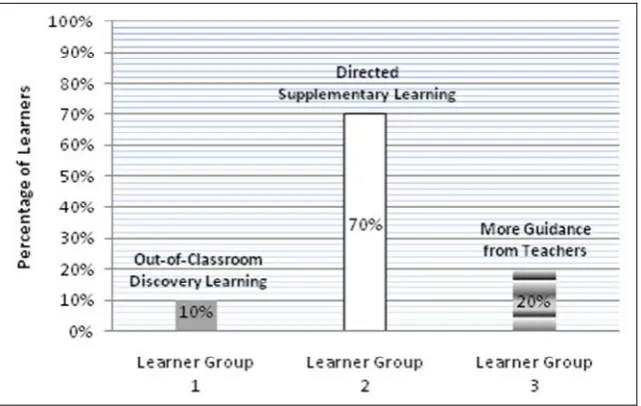
Figure 1 illustrates the ability grouping within a class. The percentages of learner groups are for illustration purpose and the actual percentage varies depending on the profile and learning ability of learners in each class. When LG1 and LG2 move on to advanced or supplementary learning with less guidance, the number of students in the class will be reduced significantly, and lecturers are able to focus their attention on LG3. Thus, the lecturer-to-student ratio will increase without increasing the number of lecturers.
Figure 1. Ability grouping within a class
Lecturers certainly find it easier to teach students with similar academic ability and therefore are able to design activities more appropriate for them. They will be able to attend to students’ problems, which are expected to be less diverse than those found in heterogeneous groupings. Lecturers of heterogeneous classes have problems giving attention to all students within the limited time because of the diverse learning needs of students.
Journal of Technical Education and Training Volume 2 Number 2 (2010)
48 3. Design Of Experiment
The methodology of the DTR pedagogic model explains the concept underpinning the model. A small-scale experimental case study of this DTR model was conducted to evaluate the effectiveness of the model in 2009. There was an improvement of student performance from the case study. Therefore, a large-scale implementation was carried out from Jan to Jun 2010.
3.1. Case Study
The case study was based on IT Essentials & PC Support, a year one module of the 2 year Nitec in Info-Communications Technology course. In this module, students learn to assemble, configure and test microcomputer system. The study involved participation of 17 to 19 year old students attending the course in ITE. The sample of 83 students were drawn from the same pool who were admitted to the same course from the same intake. The students were further broken down into two groups, a control group (C Group) consisting of 41 students and an experimental group (E Group), consisting of 42 students. A t-test is commonly used to examine differences between two groups measured on an interval/ratio dependent variable (Frederick, 2006; Wiersma & Jurs, 2005). Hence, an equal variances t-test, carried out to assess the equivalence of the groups in terms of academic ability, showed no statistically significant difference between the mean GCE N-Level mathematics and science grades of the C Group and the E Group students, t(81)= 0.508, p = 0.6126, d = 0.26 as indicated in Table 3. Mathematics and science grades were chosen as there is intensive amount of course content that requires the knowledge of mathematics and science.
Table 3. Results of t-test on the GCE N-Level grades for the C Group and E Group students
Mean Standard
Deviation
t-test* (df = 81, p < 0.05)
C Group
(n=41) 6.05 2.35 p = 0.6126 t = 0.508 d = 0.26
Not Significant E Group
(n=42) 6.31 2.35 *assumption on equal variances tested
Journal of Technical Education and Training Volume 2 Number 2 (2010)
49 Figure 2. Implementation framework of DTR model
Stage 1: Profiling of students
As discussed above, profiling of students is the first and most important step in the entire model. The E Group students were categorized as Learner Group 1, Learner Group 2 or Learner Group 3 based on their academic profile (sum of mathematices and science grades of GCE N-Level examination). Only Learner Group 1 was aware that they would be given additional and advanced learning activity, while the grouping of Learner Group 2 and 3 was not made known to the students so as to avoid negative stereotyping.
For the purpose of result comparison and discussion, the C Group students were also categorized into three groups accroding to the same guideline. No intervention was acted upon this group and students were not aware that they were in a control group excluded from a support intervention. The categorization of learners is shown in Table 4.
Table 4. Categorization of learners (academic profile)
Groups
Sum of Mathematics and Science Grades of GCE N-Level Exam
Number of Students
C Group E Group
Learner Group 1 2 4 4
Learner Group 2 ≥ 3 and ≤ 7 29 28
Learner Group 3 ≥ 8 8 10
Stage 2: Implementation of the DTR model
Journal of Technical Education and Training Volume 2 Number 2 (2010)
50 Learner Group 1 was released 1 hour earlier from the scheduled lesson after they completed the coursework. With the available time and space, they took up additional and advanced online learning under the supervision of another lecturer. The students had also gone the extra mile to meet up with the lecturer during their free time for further learning and discussion. The additional learning activity was based on students' current curriculum and gave extra knowledge and practice to build up a stronger foundation. When the students were competent in their fundamentals, they moved on to the development of in-house or on-going competition projects.
Learner Group 2 mostly finished their coursework 30 minutes ahead of the lesson schedule. Since this group of students required less guidance from the lecturer, they were provided with PC and Internet access and given online learning materials to revise their lessons. The comprehensive e-learning materials, containing lecture notes, diagrams, simulation videos and quizzes, provided an excellent platform for students to further enhance their learning.
Learner Group 3, who needed the most guidance, were given more attention from the lecturer as the amount of guidance required by the rest of the students had been reduced. The lecturer was able to revise the lesson topics with this group of students and demonstrate the practical labs in a small group setting. With more help and support available, students were motivated to learn and complete their assignments on time.
Before the DTR model was introduced, there were lecturers assigned to guide students for the development of in-house or on-going competition projects. As such, with this DTR model, there was no additional manpower requirement to supervise Learner Group 1 for technology projects. The lecturer-to-student ratio was 2:42 at the beginning of the lesson. When the four students from Learner Group 1 were released from the lesson to take up advanced learning, the ratio increased to 2:38 without additional manpower involved. Furthermore, when an approximate number of 10 students from Learner Group 2 took up e-learning and required less guidance, the ratio was further increased to 2:28 dynamically and more attention was given to Learner Group 3, who needed the guidance most.
Stage 3: Monitoring of progress
At this stage, students' in-course performance was monitored closely by the research team. Bi-weekly assessments were conducted and reviewed to monitor the progress of the students. If there was a deterioration in any of the individual performances, module lecturer would obtain feedback from the student to ascertain the root cause and advise the student accordingly. If necessary, the student would be re-catogorized to the lower grouping. This regular monitoring approach also identified potential lower academic performers and helped to ensure the quality learning of students.
Stage 4: Evaluation of outcome
Journal of Technical Education and Training Volume 2 Number 2 (2010)
51 Table 5. The E Group students obtained a higher mean score of 63.17 compared to 55.02 in Group C.
Table 5. T-test results of class test scores for the C Group and E Group students
Mean Standard
Deviation
t-test* (df = 81, p < 0.05)
C Group
(n=41) 55.02 14.33 p = 0.0155 t = 2.473 d = 8.14
Significant E Group
(n=42) 63.17 15.62 *assumption on equal variances tested
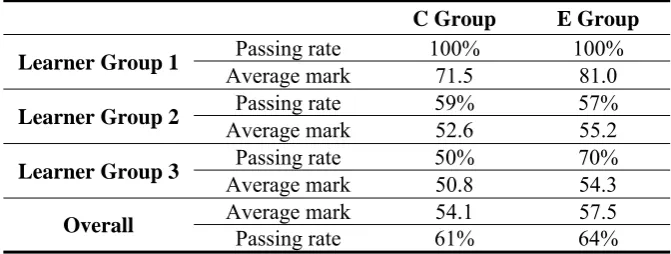
The second comparison was done between the exam scores of the C Group and E Group students. The result showed that all the three groups of students from Group E achieved better performance than Group C in terms of passing rate and average mark, as shown in Table 6.
Table 6. Comparison of exam performance for the C Group and E Group students
C Group E Group
Learner Group 1 Average mark Passing rate 100% 71.5 100% 81.0
Learner Group 2 Average mark Passing rate 59% 52.6 57% 55.2
Learner Group 3 Average mark Passing rate 50% 50.8 70% 54.3
Overall Average mark Passing rate 54.1 61% 57.5 64%
Journal of Technical Education and Training Volume 2 Number 2 (2010)
52 Table 7. Categorization of students (exam results)
Groups Exam Results Number of students
C Group E Group
Learner Group 1 ≥ 80 2 9 Learner Group 2 > 50 and < 80 19 23 Learner Group 3 ≤ 50 20 10
3.2 Large-Scale Implementation
From the case study, there was a significant improvement in the performance of lower academic performers. Furthermore, it enriched the learning experience of higher academic performers by engaging them in project works and competitions. Hence, with the successful case study, a large-scale implementation at the school level was carried out from Jan to Jun 2010.
The target population for the implementation was first year students from School of Electronics & Info-Comm Technology at ITE College East. In this study, a sample of 502 students from the 2 year Nitec in Info-Communications Technology and Nitec in Electronic Engineering courses were chosen.
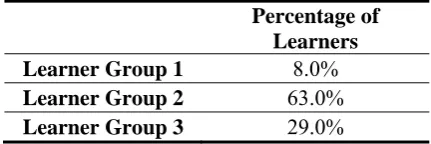
The DTR model was applied on the lessons of the two core modules that the students undertook in the first semester over a period of 6 months. The implementation process was same as the case study described in the preceding section. The categorization of learners after the profiling process was shown in Table 8.
Table 8. Categorization of learners (academic profile)
Percentage of Learners
Learner Group 1 8.0%
Learner Group 2 63.0%
Learner Group 3 29.0%
After the 6-month implementation, evaluation was conducted based on students' cumulative GPA at the end of the semester and results are discussed in the next section.
4. Results And Discussion
Journal of Technical Education and Training Volume 2 Number 2 (2010)
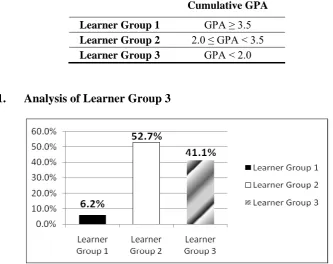
53 Table 9. Guideline for categorization of learner groups
Cumulative GPA
Learner Group 1 GPA ≥ 3.5
Learner Group 2 2.0 ≤ GPA < 3.5
Learner Group 3 GPA < 2.0
4.1. Analysis of Learner Group 3
Figure 3. Movement of learner group 3
From Figure 3, 6.2% (9 students) of Learner Group 3 (146 students) moved up to Learner Group 1 and 52.7% (77 students) moved up to Learner Group 2. 41.1% (60 students) remained in the Learner Group 3. A more detailed study showed that these movements were due to the greater attention given by the lecturers to Learner Group 3.
4.2. Analysis of Learner Group 2
Journal of Technical Education and Training Volume 2 Number 2 (2010)
54 From Figure 4, 25.3% (80 students) of Learner Group 2 (316 students) moved up to Learner Group 1 and 57.9% (183 students) remained in the Learner Group 2. The movement is due to the provision of supplementary materials, which provides more examples for the Learner Group 2. On the other hand, 16.8% (53 students) moved to Learner Group 3. The findings for this movement were: firstly, there was no correlation between GCE O-Level or N-Level results and student learning ability for certain cases; secondly, some students, especially foreigners, could not understand the lesson due to language proficiency; lastly, there were other factors such as peer influence that could affect student performance.
4.3. Analysis of Learner Group 1
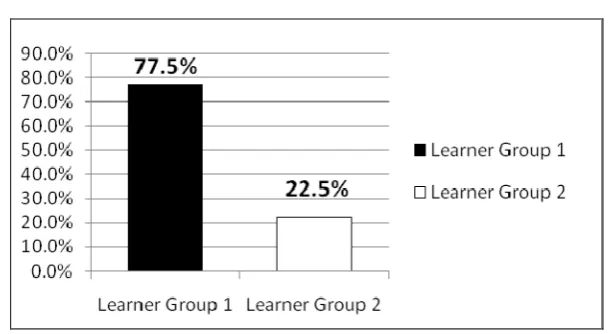
Figure 5. Movement of learner group 1
From Figure 5, 77.5% (31 students) of Learner Group 1 (40 students) remained in Learner Group 1, and 22.5% (9 students) moved to Learner Group 2.
4.4. Survey Findings
Journal of Technical Education and Training Volume 2 Number 2 (2010)
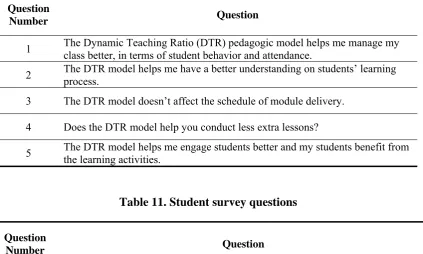
55 Table 10. Staff survey questions
Table 11. Student survey questions
5. Conclusions
Substantial advantages have been gained from the implementation of the DTR model. Lecturers have been able to identify the diverse learning needs of students and provide various learning activities to the different groups of students after the students have gone through the same coursework. This has allowed the matching of expectations between lecturers and students and helped students learn at their own pace and improve their performance.
Further evaluation of the model is under way, but it can be concluded at this stage that the use of the DTR model has not only enriched higher academic
Question
Number Question
1 The Dynamic Teaching Ratio (DTR) pedagogic model helps me manage my class better, in terms of student behavior and attendance.
2 The DTR model helps me have a better understanding on students’ learning process.
3 The DTR model doesn’t affect the schedule of module delivery.
4 Does the DTR model help you conduct less extra lessons?
5 The DTR model helps me engage students better and my students benefit from the learning activities.
Question
Number Question
1
Are you currently on
- Option 1: Polytechnic enrichment learning/projects?
- Option 2: Self-learning in class with supplementary learning materials? - Option 3: Small-group learning?
2 The learning activities have helped me on my studies.
3 I am able to improve my academic performance.
4 I am able to carry out the learning activities with minimum amount of guidance from teachers.
Journal of Technical Education and Training Volume 2 Number 2 (2010)
56 performers by engaging them in learning of more advanced topics, but also improved the performance of lower academic performers. The dynamic change of lecturer-to-student ratio has been made possible through the model. This innovative pedagogic model offers a useful tool that can easily be used by lecturers to design lesson delivery that caters to the different learning abilities of students and optimizes the learning process.
References
Bandura, A., & Walters, R. H. (1963). Social learning and personality development. New York: Holt, Rinehart & Winston.
Chen, J. Y., Chen, X. L., Wee, K. K., Soh, G. K., & Lim, S. Y. (2009). Dynamic Teaching Ratio Pedagogic Model. Paper presented at the 3rd International Symposium on Advances in Technology Education, Singapore.
Frederick, L. C. (2006). Statistics: a gentle introduction. Thousand Oaks, Calif.: Sage Publications.
Gardner, H. (1983). Frames of Mind: The Theory of Multiple Intelligences. New York: Basic Books.
Gardner, H. (1993) Multiple Intelligences: The Theory In Practice. New York: Basic Books.
Gayle, H. G. & Carolyn, C. (2002). Differentiated instructional strategies: one size doesn't fit all. Thousand Oaks, Calif.: Corwin Press.
Glass, G. V. (2002). School reform proposals: The research evidence. Grouping students for instruction. [Summary]. Tempe, AZ: Education Policy Studies Laboratory, Education Policy Research Unit, Arizona State University.
Priscilla, T. (2004). Enhancing learning with technology. Retrieved from http://www.enhancelearning.ca/
Singapore Examinations and Assessment Board. (2010). National examinations. Retrieved from http://www.seab.gov.sg/index.html
Slavin, R. E. (1986). Ability grouping and student achievement in elementary schools: a best-evidence synthesis. Baltimore, MD: Center for Research on Elementary and Middle Schools.
Tomlinson, C. A. & Kalbfleisch, M. L. (1998). Teach me, teach my brain: a call for differentiated classrooms. Educational Leadership, 56(3), 52-55.