DOI 10.1007/s13173-010-0015-1 O R I G I N A L PA P E R
Content distribution in trail-aware environments
Jader M. Silva·João H. Rosa·Jorge L.V. Barbosa· Débora N.F. Barbosa·Luiz A.M. Palazzo
Received: 25 November 2009 / Accepted: 3 June 2010 / Published online: 11 July 2010 © The Brazilian Computer Society 2010
Abstract In mobile computing environments, the tracking of users allows applications to adapt to the contexts visited by users (Context Awareness). In recent years, the use of context information and users’ profiles has been considered an opportunity for context-aware content management. The improvement and the wide adoption of location systems are stimulating the tracking of users, allowing the use of Trails. A trail is the history of the contexts visited by a user during a period. This article proposes a model for trails management and its application in the content management. In this text, we consider that Trail-Aware is an evolution of the simple use of contexts and profiles. The text presents a prototype and its application in an educational environment for distri-bution of learning objects using trail-aware.
Keywords Mobile computing·Context awareness· Trails·Content distribution
J.M. Silva·J.H. Rosa·J.L.V. Barbosa (
)University of the Sinos Valley, Unisinos Ave., São Leopoldo, RS, 950, Brazil
e-mail:[email protected] J.M. Silva
e-mail:[email protected] J.H. Rosa
e-mail:[email protected] D.N.F. Barbosa
La Salle University College, Victor Barreto Ave., Canoas, RS, 2288, Brazil
e-mail:[email protected] L.A.M. Palazzo
Catholic University of Pelotas, Félix da Cunha Street, Pelotas, RS, 412, Brazil
e-mail:[email protected]
1 Introduction
Currently, the evolution of mobile devices and high-speed wireless networks has been stimulating researches related to Mobile Computing [15,39]. In this area, the improvement and proliferation of Location Systems [21,22] have moti-vated the adoption of solutions that consider the user’s pre-cise location in the providing of services (Location-Based Services [13,44]). However, lately, mobile applications have also become to take into account the user’s current context to distribute content and services (Context Awareness [5,7,
23,30]).
applications can create their own services to obtain standard behaviors of the monitored entities. Moreover, UbiTrail pro-pose an ontology to standardize the trails data.
An important application area of the joint use of context and profile is the education [4,31,46]. In this field, some applications distribute contextualized and personalized ped-agogical content [6,7,30]. In the same way that occurs in context-aware applications, in the learning domain, applica-tions are limited to take decisions based on profile and con-text information. Furthermore, the use of students’ profiles in context-aware environments [8] and the automatic im-provement of these profiles [29] are recent research topics. Nevertheless, content distribution guided by the students’ trails is still an opened research area. Hence, we propose the use of trails in the educational scenario, expecting to im-prove the content distribution. In this article, we present a case study in which UbiTrail was integrated with a ubiqui-tous learning system (LOCAL [8]) and used for contextu-alized distribution of learning objects. The integration oc-curred in the context of the UbiCampus project, which is fi-nanced by CNPq (Brazilian Council for Scientific and Tech-nological Development) through the Universal Announce-ment 15/2007.
The article is organized into six sections. Section 2 de-scribes the UbiTrail architecture and the proposed ontology. The third section discusses the UbiTrail use in the content distribution guided by trails. Section 4 presents the UbiTrail and the LOCAL prototypes as well as the integration be-tween them. This section still describes and evaluates the results obtained from a case study involving the use of trails in contextualized distribution of learning objects. Section 5 discusses related works, focusing on the contribution of this work. And finally, Sect. 6 presents the conclusions and the future works.
2 The UbiTrail model
This section presents the model of trails management. Sec-tion2.1describes the main terms used by the model, mainly those related to the trails composition. Section2.2describes the ontology proposed by UbiTrail, and finally, Sect. 2.3
presents the model architecture.
2.1 Entities, trails, ptrail, and trailpoint
UbiTrail was designed to manage entities’ trails. In this con-text, entities represent persons, accessing computational re-sources (for example, a smartphone), or mobile objects (for example, a vehicle). We choose entity, instead of user, be-cause then the model could manage trails of any mobile ob-ject. In this scenario, different applications can be developed
for trails. For example, a vehicle could have a trail, record-ing information considered relevant, such as the occurrences of maintenances or failures.
Applications that use UbiTrail must temporally store data that composes a trail. For this reason, we propose that the applications have internally a structure calledptrail(piece of trail), which is composed of the following attributes: en-tity,resource,event,extension, andlocation. The values of theentityandresourceattributes are stored statically in the ptrailafter that an entity logs in the model. Nonetheless, the values of theevent,extension, andlocationattributes are au-tomatically updated as the actions or movements made by the entity and monitored by the application. Theptrail ar-chitecture was defined according to the UbiTrail ontology, which is discussed in the next section. The possible values of the attributes also are defined according to the ontology.
The records related to the contexts visited by an entity are stored in only one trail. The trail is composed of a se-quence of records of the ptrail. A record is composed of ten attributes organized into three categories:identification, content, andproperties. The first category contains only one attribute to identify the trail. All the records that compose a trail have the same identification. The second category is used to store theptrailcontent. The last category contains the following attributes:date/time, representing the time of the record creation;visibility, indicating if the record is pub-lic or private (access restricted to the own entity).
We namedtrailpointthe process that makes the trail com-position. This process sends the values contained in the ptrailto be recorded in the entity’s trail, which is stored in a server. Thetrailpointoccurs when the application automati-cally identifies that an entity performed an event, for exam-ple, entry or exit from a location, interaction with another entity, access to a file, among others.
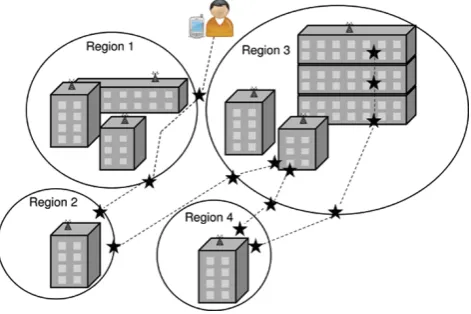
Figure1shows the trail creation of a mobile device user. This user moves around the four regions. On the way, each star represents the occurrence of an event, which causes a trailpoint.
Fig. 2 The UbiTrail ontology (extended from UbiWorld [20])
2.2 Ontology
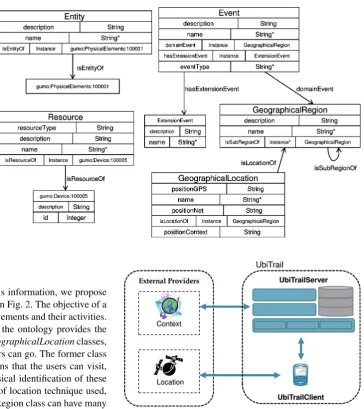
Aiming at standardizing the trails information, we propose an ontology, which is presented in Fig.2. The objective of a trail is to record the entities’ movements and their activities. To satisfy the first requirement, the ontology provides the GeographicalRegionand theGeographicalLocationclasses, which map the places where users can go. The former class identifies the geographical regions that the users can visit, whereas the later keeps the physical identification of these regions. Depending on the type of location technique used, an instance of the GeographicalRegion class can have many instances of the GeographicalLocation class referring to it. For instance, if a region is mapped through GPS coordinates, it would be necessary many coordinates to represent it. On the contrary, it would be difficult to identify the region. The model supports three location forms: (1) by satellites coordi-nates (see thepositionGPSattribute of the GeographicalLo-cationclass); (2) by network identification, using the host’s IP (supported by thepositionNETattribute); (3) and by con-texts sent by a location system (represented by the position-Contextattribute).
Aiming at supporting the description of entity’s possible activities, the ontology provides the Event and the Exten-sionEvent classes. The Event represents the activities that entities can do. This class has the domainEvent attribute, which enables to restrict the regions that an event can oc-cur. TheExtensionEventdescribes the additional fields that an event supports, thus enabling to register context data. For example, the file reading event could have a context infor-mation indicating the format of the file.
Beyond the entity’s movements and actions, the trails must record information about the entity and the resources
Fig. 3 The UbiTrail architecture
they are using. Hence, the ontology provides theEntityand the Resource classes, which extend the PhysicalElements andDeviceclasses proposed by the UbisWorld project [20]. The UbisWorld provides a set of ontologies that represent various elements of the real world.
2.3 The model architecture
2.3.1 General organization
describe all these components, justifying why they are nec-essary.
2.3.2 External providers
There are many different ways to acquire location data in mobile computing [21]. For instance, using measurements taken within cellular networks, the following methods have been proposed [43]:received signal strength(RSS);time of arrival(TOA);angle of arrival(AOA); andenhanced ob-served time difference(E-OTD). On the other hand, using an external positioning system, there is the satellite-based Global Positioning System technology [11]. Furthermore, other location techniques have been studied, such as re-sponse rate of Bluetooth inquiries [9] and triangulation of Wi-Fi antennas [10]. There are still studies on the hybrid use of technologies to obtain more precise location and to optimize the power consumption [18,48].
In the same way, there are many different approaches on how to acquire context information [5]. Chen et al. [12] presents three different methodologies (Direct sen-sor access,Middleware infrastructure, andContext server). Differently, Winograd [45] introduces three different con-text management models (Widgets,Networked services, and Blackboard model). For this reason, it is necessary to sepa-rate the detection and the use of context data to improve the extensibility and reusability of systems [5]. In the same way, this strategy could be applied to location.
In UbiTrail, we separated from the model the obtainment of context and location information. This task is performed by external providers, which must be attached to the model. The external location provider must be periodically accessed by UbiTrailClient due to the entities’ mobility. The time of obtainment of the location data can be set according to the application’s necessity. UbiTrailClient obtains the location and sets the value of thelocationattribute of theptrail.
Many authors describe the “context” word according to their own definitions of what context actually includes. However, a popular form to classify context instances is to define different context dimensions [5]. Gustavsen [19] and Prekop and Burnett [33] name these dimensions external andinternal. In the same sense, Hofer et al. [24] refer to physical andlogical context. The externalor physical di-mension refers to context that can be measured by hardware sensors (for example, sound, light, touch, temperature, and air pressure). Differently, theinternalorlogicaldimension is mainly described by users or obtained by monitoring their interactions (for example, the user’s goals, tasks, work con-text, business processes, and emotional state).
Due to the two context dimensions, UbiTrailServer was designed to receive context data from two different sources. The first is the UbiTrailClient, which provides information related to the internal or logical dimension. As this type of
Fig. 4 The UbiTrailServer architecture
data is related to the entity’s interactions, we had to choose the component closer to the entities. Thus, as UbiTrailClient runs on the entities devices, it was the chose component. UbiTrailClient obtains data from the application and sets the value of theextensionattribute of theptrail.
The second source is the context external provider, which provides information related to the external or physical di-mension. This kind of data is related to the physical area around the entity. Consequently, entities within the same lo-cation can have the same context information, such as, light, vehicles flow, and weather. Hence, it is not necessary that each entity sends information of its physical context. On the contrary, this data could be captured by only one compo-nent, thus being available for all entities within the same location. UbiTrailServer is the component responsible for this task. It receives theptrail sent by UbiTrailClient and analyses whether is necessary to obtain physical context in-formation. Being necessary, it consults the context external provider and complements the receivedptrailbefore records it.
2.3.3 UbiTrailServer
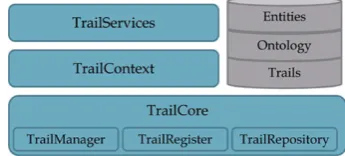
Some of the UbiTrailServer basic tasks are to manage the entities’ trails and to enable application querying the trails. To perform these functions, we designed theTrailServices module (see Fig.4, which presents the UbiTrailServer archi-tecture). TheTrailServicesprovide some basic servicesto manage the trails and, moreover, enables applications build-ing their ownspecialized servicesaccording to their needs (see Fig.5).
Fig. 5 Organization of the TrailServices layer
the services that allow queries related to the trails, such as: (1) quantity of ptrailsin a trail (total or within a period); (2) parts of trails linked to a period (set ofptrails); (3) con-tent of a specificptrail.
UbiTrailServer enables applications adding to the model their own specialized services, which can be composed of one or more basic services. Section 3.2 describes five specialized services created to support content distribution guided by trails. These services are presented in Fig.5.
As discussed in Sect.2.3.2, UbiTrailServer is in charge for the physical context information, i.e. it has to commu-nicate with the context external provider. To perform this task, we propose the TrailContext component. When the TrailServicescomponent receives aptrail, it analysis if the event of theptrailhas associated a physical context infor-mation. Case it has, theTrailServicescalls theTrailContext to obtain the data. Due to the different approaches on how to acquire context information [5], we delegated the Trail-Contextspecification to those who will apply UbiTrail in a specific domain.
The server has three repositories to store information of the entities, the ontology, and the trails. The entities repos-itory stores identification data of the entities related to the trails that are been managed. The ontology repository stores the standard terms used for the regions, locations, events, extension of events, entities, and resources. The trails repos-itory stores theptrailsthat compose the entities’ trails.
Some services can have common functions, for example, to query the ontology and to manage the trails. For this rea-son, we designed theTrailCorecomponent, which performs basic operations that can be used by the services. The Trail-Core is divided into three subcomponents: the TrailMan-ager, theTrailRegister, and theTrailRepository. The Trail-Manager manages the trails, mainly consulting the ontol-ogy repository and organizing the data in the access to the trails repository. One of its main tasks is the composition of the record for the storage of aptrailat thetrailpoint so-licitation moment. TheTrailRegister module manages the
Fig. 6 The UbiTrailClient architecture
entities’ register as well as their access in the server, using mainly the entities repository. TheTrailRepositoryprovides an interface to access the repositories, thus supporting the TrailManagerand theTrailRegister.
2.3.4 UbiTrailClient
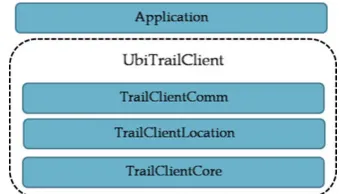
Figure6presents the UbiTrailClient architecture. This com-ponent runs on mobile devices and has three basic tasks: (1) to communicate with UbiTrailServer; (2) to obtain the entities’ location; (3) and to capture the events made by the entities. Thus, UbiTrailClient is divided into three compo-nents. TheTrailClientCoremodule has internally aptrail structure, which is set and sent to the server whenever oc-curs an event. This component constantly monitors the en-tity’s behaviors within the application. When the entity per-forms an event, TrailClientCore obtains its location, through the TrailClientLocation component, and sends the ptrail instance to the server through theTrailClientComm mod-ule. The TrailClientLocation consults the location external provider to obtain the location data.
The final entities do not interact directly with UbiTrail-Client. They only interact with the applications that are us-ing UbiTrail to manage their trails. UbiTrailClient moni-tor those applications, sending events information to Ubi-TrailServer.
3 Content distribution
This section presents the strategy used in the content dis-tribution guided by trails. Section 3.1 describes the ubiq-uitous learning environment, in which UbiTrail was inte-grated. Section3.2describes how the trails were used in the selection process of Learning Objects (LOs).
3.1 The ubiquitous learning environment
not support the automatic distribution of content. The Se-lene [34] and the Elena [40] projects consider user’s profiles and learning objects in distributed environments, but they do not take into account location data. The SmartClassroom [47] and the AmbientWood [35] systems use location infor-mation, but they do not consider profiles and learning ob-jects. The LOCAL model [7,8] uses these three resources together, i.e., it distribute content guided by the users’ pro-files and their locations. In the same way, GlobalEdu [6] supports profiles, location information, and learning objects. Nevertheless, GlobalEdu needs of a middleware (for exam-ple, ISAM [2,3]) to perform the main services of ubiquitous computing. LOCAL does not requires complement of a mid-dleware, i.e., the model is self-sufficient.
Initially, LOCAL (Location and Context Aware Learn-ing) was organized into six components and supported only basics functionalities [7]. Thenceforth, it was improved through the inclusion of support to the treatment of events as well as the improvement of the User Profiles and the Learning Objects Repository subsystems [8]. Therefore, the environment became to be composed of seven com-ponents (Fig. 7): (1) User Profiles—stores learner’s spe-cific information; (2)Personal Assistant(PA)—runs on the learner’s mobile device; (3)Location System—determines the physical location of the mobile devices; (4) Learning Objects Repository—stores and indexes the content related to the pedagogical process; (5)Communication System— establishes the communication with the learners; (6)Event System—schedules tasks; (7)Tutor—is an analysis engine that makes inferences based on the users’ profiles and their locations.
The content distribution depends on its representation, selection, and availability [7]. The representation, in LO-CAL, is based on a metadata, which categorizes the learn-ing objects accordlearn-ing to the IEEE/LOM standard [26]. There are five categories for content representation. TheGeneral category groups general information which describes the objects. TheTechnicalcategory groups their requirements and technical features. TheEducationalcategory groups the educational and pedagogical features. TheRightscategory groups the proprietary rights and the objects terms of use. TheRelationscategory supports the description of relation-ships among objects, allowing, for example, the definition of prerequisite among objects. The selection of the learning ob-jects is made by Tutor using the learner’s location and profile and the Communication System in charge for providing the selected objects to the users.
3.2 Content selection using trails
3.2.1 Specialized services in UbiTrail
The content distribution guided by trails was based on spe-cialized services created in UbiTrail and accessed by Tutor
Fig. 7 The LOCAL architecture [8]
Table 1 Specialized services created in UbiTrail
Name Description
PreferredMedia Returns a list with the learner’s preferred media in a context (for example, text, video, or audio).
PreferredDevices Returns a list with the learner’s preferred devices in a context (for example, iPAQ or desktop).
PrefApplications Returns a list with the learner’s preferred applications in a context (for example, Adobe Reader or Microsoft Word).
SchedulingLOs Returns a list containing time suggestions to access an LO to the learner.
PreferredLOs Returns a list with the LOs most accessed by all learners in a context.
of LOCAL. Table1 summarizes the created services. The information returned by the services is obtained through the analysis of the learners’ trails. The preferences are deter-mined by the use frequency of media, devices, and applica-tions in a context.
3.2.2 Dynamic and contextualized profile
area [1]. Finally, theStylesection contains the user’s learn-ing style [17]. Tutor manages the LOs distribution to the learners according to their profile and still considering the available objects in each context.
The UbiTrail/LOCAL integration uses the trails to man-age the profiles dynamically and contextually. Using the first three services provided by UbiTrail (see Table1), Tutor dy-namically determines the learner’s preferences in the context that is being visited. The history of visits in the contexts, recorded in the learner’s trail, enables Tutor to determine the learner’s contextualized and updated preferences, be-cause they could have changed while the learner interacted with LOs. The integration of UbiTrail does not replace the learner’s profile kept by LOCAL. Tutor uses the trails and the profiles together, as described in next section. Further-more, we did not create any new storage structure for the profiles, because the UbiTrail services use the trails stored in theUbiTrailServerrepository to run the specialized ser-vices.
3.2.3 The UbiTrail/LOCAL integration
The UbiTrail/LOCAL integration was based on the follow-ing changes in LOCAL: (1) we included the support to the UbiTrail services in the Personal Assistant; (2) the Tutor in-ferences became to consider the learners’ profiles and the services available by UbiTrail (described in Table1).
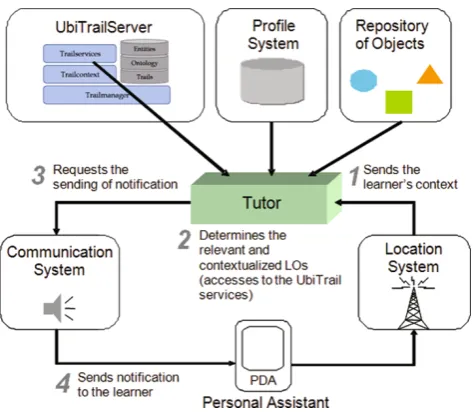
Figure 8 presents the dynamic of the integration. In LOCAL, the learning objects are provided to the learn-ers according to the opportunities that emerge during their changes of contexts. Location System informs to Tutor the context in which the learner is (step 1). Tutor uses this information, combined with the learner’s profile, to deter-mine the relevant objects to the learner (step 2). In this stage, Tutor uses the UbiTrail services to improve its in-ferences. Tutor notifies the learner of the available objects in the context through Communication System (step 3). The learner receives a message informing the availability (step 4). This contextualized distribution cycle can be started by two events: (1) the learner’s context change or (2) the in-sertion of new material in the objects repository (in this case, the system only performs the last three steps).
4 Prototype and case study
This section describes the UbiTrail and the LOCAL imple-mentations (Sect.4.1). Furthermore, it discuss the case study (Sect.4.2) used to validate the model.
4.1 The UbiTrail and the LOCAL prototypes
The UbiTrailServer prototype was implemented through the Java programming language. The JENA framework [27] was
Fig. 8 Distribution of LOs guided by trails
used to access the ontology represented in OWL. The ser-vices of theTrailServiceslayer are available through Web services.
The LOCAL prototype [8] was implemented through the C# programming language. The Tutor component was de-signed as a Windows service. The Personal Assistant mod-ule was developed with .NET Compact Framework and runs on HP iPAQs 4700 with Windows Mobile. The additional components provide their services to the Tutor and to the Personal Assistant through Web services. Moreover, to cap-ture Wi-Fi signals, we used the OpenNETCF library.
The integration between the UbiTrail and the LOCAL prototypes was mainly based on changes made in Tutor in order to access the services provided by the Web services of TrailServices. The UbiTrailClient prototype was developed through the addition of new functionalities in Personal As-sistant.
The LOCAL profile system was implemented using MySQL. The information is registered by the users using a Web page created in PHP and AJAX. This Web page can be accessed through either mobile devices or desktop comput-ers. The metadata that describes the LOs are stored in XML, using the LOM standard [26]. Currently, the repository does not support the objects storage. The metadata contains the Web addresses in which the objects are stored.
Fig. 9 Map of the simulation environment
4.2 Case study
4.2.1 Obtainment of the trails
The case study was based on simulated generation of learn-ers’ trails, which were used in the real scenario described in the validation environment (Sect.4.2.2). The choice of sim-ulation was based on the following factors:
– Interest in the generation of trails for many regions with wide geographical distribution (involving Porto Alegre and São Leopoldo cities in the south of Brazil);
– Interest in the generation of trails that covered at least one semester of the Computer Engineering1course at Univer-sity of the Sinos Valley (Unisinos);2
– The impossibility of the students use the mobile devices outside the University campus, which is based in São Leopoldo city.
Figure9presents the simulation environment used in the trails generation, which is composed of thePorto Alegre, the Metro, and theUnisinosregions. We defined these regions because we wanted to monitor the learners’ activities while they were moving from their houses to the university. Within the regions, we mapped some location where the users could go, for instance, the public library, the restaurant, and sta-tion 1.
The Metroregion represents the area in which the stu-dents move from their houses to the university campus and vice versa. This region contains a location for each one of
1Reference Ungraduate Course in Computer Engineeringhttp://www. unisinos.br/graduacao/bacharelado/eng_comp.
2University of the Sinos Valley (Unisinos)http://www.unisinos.br.
the three stations and a location that represents the student’s presence on the train. Therefore, the system can record the events made by the learner during the movement between the stations.
The third region corresponds to the university campus. Within the university region, we defined a subregion repre-senting the rooms of the Building 6B, in which is based the Computer Engineering course. These rooms were organized into six locations. Among them, the classroom and the lab-oratory stand out.
The regions and locations of the environment were imple-mented through instances of the GeographicalRegion and theGeographicalLocationclasses of the UbiTrail ontology. A region can be composed of one or more subregions, but in both cases the subregions are instances of the Geograph-icalRegionclass. Each region or subregion contains at least one location with the values of its geographical position.
The simulation involved five students of the Program-ming Techniques3discipline during the second semester of 2008 of the Computer Engineering course. The students’ profile information was registered in LOCAL, focusing their preferences, possible learning styles, and interest related to the studied discipline (using the ACM knowledge areas [1]). The trails generation was based on the possible activities (events) made by the learners during the second semester of 2008, which covers the period from August 1 to Decem-ber 23. The trails generation was simulated using an appli-cation developed specifically for this purpose.
Considering the schedule of theoretical classes (presence in the classroom) and practical activities (presence in the
Table 2 Quantity of records generated in the simulation
Learner Change of Device Application Access Total
location use use to LOs
João 609 783 348 1479 3219
Leonardo 480 512 110 598 1700
Vicente 345 223 211 466 1245
Rodrigo 231 167 89 433 920
Douglas 126 122 33 542 823
Total of records 7907
laboratory), the application generated records related to the events of entry and exit from the locations. The learners João and Leonardo still had records of movements from their houses (1 learner’s houseand2 learner’s house) to Unisi-nos, passing through the locations related to the Metro ( Sta-tion 1, StaSta-tion 2, Train,andUnisinos Station).
During the generation of the records related to the move-ment events, the application created registers of devices and applications use based on the contents scheduled for the Pro-gramming Techniques discipline. In addition, the applica-tion generated records of learning objects access.
Table2presents the quantity of event records generated during the simulation. Table3presents an example of these records, which are used in the trails composition.
4.2.2 Validation environment
Figure10presents the map of the second floor of the Build-ing 6B at Unisinos. On this floor are based the MobiLab4 laboratory and the graduate course in Computer Engineer-ing. The validation scenario is composed of nine rooms, in which we installed four wireless antennas Cisco Aironet 1100. Location System of LOCAL [36] is based on the strat-egy of antennas triangulation and allows the exactly deter-mination of the rooms in which the users are. In the experi-ment, we used iPAQs 4700. The equipments used in the de-velopment and validation of the prototype were donated by HP Computers.5
In the evaluation of the UbiTrail/LOCAL prototype, the rooms presented in Fig.10were mapped to the simulation environment presented in Fig.9. Therefore, we established a relationship between the real environment (Fig.10) and the simulated environment (Fig.9), according to the presented in Fig.11. The rooms 206 and 215 were mapped to the rep-resentations of the locationstrainand1 learner’s house. The other rooms were considered the university’s real rooms in Building 6B.
4Laboratory of Research and Development in Mobile Computing http://www.inf.unisinos.br/~mobilab.
5Prize awarded to MobiLab—“Grant HP Mobile Technology for Teaching 2005—Latin American Region”.
Table 3 Examples of the records
Learner Device Event Location Extension Date
João iPAQ Entry Classroom – Aug. 4
into 20:01
location
Leonardo iPAQ Entry Classroom – Aug. 4
into 20:12
location
Vicente Desk. Entry Laboratory – Aug. 6
into 14:32
location
Vicente Desk. Exit Laboratory – Aug. 6
from 15:31
location
Vicente Desk. Login Laboratory – Aug. 7
device 16:55
Rodrigo Desk. Login Laboratory Microsoft Aug. 7
appli. Media Player 19:22
Rodrigo Desk. Logoff Laboratory Microsoft Aug. 7
appli. Media Player 19:33
Rodrigo Desk. Logoff Laboratory – Aug. 7
device 19:55
João iPAQ Access Classroom File: PDF Aug. 18
to LO Media: Text 8:25
Subj.: Interfaces
Leonardo Desk. Access Laboratory File: MPEG Aug. 18
to LO Media: Video 14:13
Subj.: Networks
Vicente iPAQ Access Laboratory File: MP3 Aug. 25
to LO Media: Audio 07:45
Subject: Java
Therefore, during the prototype evaluation, the move-ments among the real rooms represented virtual movemove-ments. For example, a movement from room 214 (classroom) to room 206 (train) represented the learner’s presence on the train, moving from Unisinos to Porto Alegre. The presence in the virtual representationtrainmakes Tutor initiates the analysis process of educational opportunities, as though the learner actually was physically in the train location.
4.2.3 Validation through a scenario
The scientific community has been using scenarios to val-idate context-aware environments (according to Dey’s ap-proach [14]) and ubiquitous environments (according to Satyanarayanan [38]).
Fig. 10 Map of the validation environment
Fig. 11 Validation scenario
This scenario focuses on the distribution of LOs in differ-ent contexts based on the learner’s trail, according to the de-scribed below:
“Jorge is professor of the Programming Techniques dis-cipline of the Computer Engineering course at Unisinos. At the beginning of the week scheduled to the basic teaching of programming using the Java language, he registered in the LOCAL repository a group of learning objects (LOs) that support different preferences of media (for example, text, video, and audio). The register involved the indication of the contexts in which the objects would be available.
In the classroom, Jorge registered some curricular ob-jects concerning the basic concepts. In the laboratory, he registered optional objects that will be available for im-provement, involving different themes (such as “Interfaces” and “Parallel Programming”).
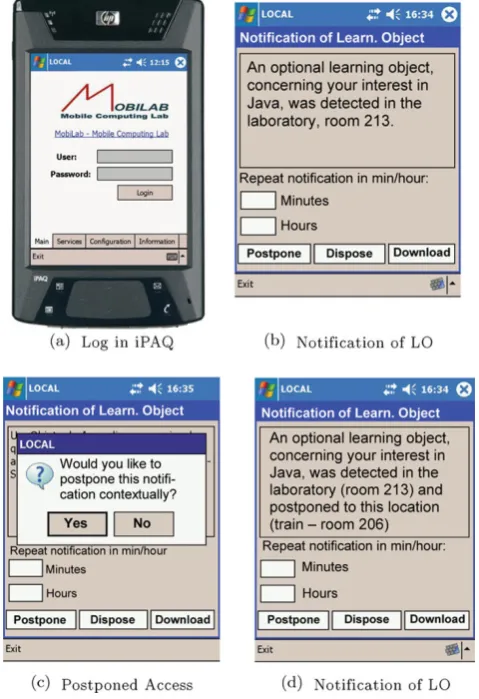
João is a Computer Engineering student. At the day of the Programming Techniques class, João entered the class-room and logged in the LOCAL system (see Fig.12(a)), sub-sequently he received a notification of the availability of a curricular LO. João accessed the object and received a PDF file (preference text). LOCAL used thePreferredMedia ser-vice of UbiTrail to determine this preference, because João already had many classes and was used to use textual ob-jects. Objects of all preferences of media were available, i.e.,
João could have accessed an object related to other prefer-ences, fact that would be recorded in his trail and used in the dynamic determination of media preferences in that context. After the class, João entered the laboratory and received a notification regarding the availability of a LO related to the subject of his interest in Java (in this case, “Interfaces”). This object had been used by all students who were inter-ested in Java. Thus, LOCAL, using thePreferredLOs ser-vice, recommended it to João.
In the laboratory, João preferred audio objects, because he could listen to them while he was using the computer (determined by thePreferredMediaservice). João accessed the object and, after its use, received another notification of available object (see Fig.12(b)) concerning the subject of his interest (this time, the object was about “Parallel Pro-gramming”).
Always that the students receive a notification of LOs, they can delay the access. This action indicates that the stu-dents are interested in the object, but they do not want to access it at the moment, i.e., they want to access the object at the first opportunity of available time. João postponed the access to the optional object (see Fig.12(c)).
Table 4 Dynamic of the validation scenario Character Action
Professor Registers the learning objects in LOCAL, relating them to contexts.
Learner Enters the classroom and logs in LOCAL using an iPAQ 4700; see Fig.12(a)
UbiTrail/LOCAL LOCAL detects the entry of the learner into the classroom. Tutor uses thePreferredMediaservice to determine the learner’s preference of media in the context. Subsequently, it requests the sending of a message about the LO available in the preferred media.
Learner Accesses the curricular object. Learner Moves to the laboratory.
UbiTrail/LOCAL LOCAL detects the entry of the learner into the laboratory and uses thePreferredLOsservice to verify the available LOs, related to the student’s interest, that had many accesses in that context. Tutor still uses thePreferredMediaservice to define the learner’s preferred media in the context. Finally, Tutor requests the sending of messages about the available LOs; see Fig.12(b). Learner Accesses one of the two identified objects and
postpones the access to the other to the first moment of available time (see Fig.12(c)). Learner Moves to the train.
UbiTrail/LOCAL LOCAL detects the entry of the student into the train and calls theSchedulingLOsservice to verify the LOs that can be accessed during the trip. LOCAL identifies the postponed object and notifies the learner, see Fig.12(d).
Learner Accesses the object that has been postponed. Professor Registers a new optional LO concerning
“Polymorphism” in Java that can be accessed in any context.
Learner Enters his home.
UbiTrail/LOCAL LOCAL informs the learner of the new optional LO available that corresponds to his areas of interest.
Learner Accesses the new object.
SchedulingLOsservice to define the sending. Getting home, João still received another notification saying that the pro-fessor had provided an additional object to a subject of his interest (“Polymorphism” in Java). In the register, the pro-fessor informed that the interested students should be noti-fied independently of their locations.”
The scenario was tested in the validation environment de-scribed in Sect. 4.2.2. The João student carrying an iPAQ 4700 simulated the scenario, moving around the environ-ment rooms. The train and the learner’s house were simu-lated through the rooms 206 and 215. Table 4 summaries the actions, emphasizing the character involved in each one.
Fig. 12 The scenario snapshots
5 Related works
Hermes [16] is a framework for creating applications that involve the movement of users during the performance of actions in different locations. In Hermes, a trail consists in the route suggested to the users accomplish their tasks effi-ciently. The proposal does not consider the record of activ-ities in contexts, as proposed by UbiTrail. Hermes does not support the distribution of content either.
Levene and Peterson (Trail Records [28]) propose the use of a mobile device to record learning experiences us-ing different media (for instance, text, video, and audio) while visiting different locations. The sequence of records forms a structure named trail, which can be used to recover the learner’s experience in the visited path. Although Trail Records links content with locations, it does not contain any approach to support content distribution guided by the contexts. Furthermore, the model is not generic, focusing specifically on the record of experiences with media.
Table 5 Comparison among the proposals
Criterion Hermes Trail PELEP Life UbiTrail records annotation
History No Yes No Yes Yes
of contexts
Content No No Yes No Yes
distribution
Standardized Yes No Yes No Yes
register
Automatic Yes Yes Yes Yes Yes
generation
Register No Yes Yes Yes Yes
of context
Generality Yes No No Yes Yes
based on these records, updates their preferences constantly. PELEP does not record the learners’ history in contexts, i.e., it does not support the management of trails. Furthermore, the model focuses on ubiquitous learning specifically.
Life Annotation [41,42] proposes the annotation of the locations visited by mobile devices users, composing a trail of the visited locations. In addition, the model proposes the record of the much information as possible related to each context. The objective is to record a user’s activities, allow-ing future requests. The proposal allows generics requests related to the trails, but it does not contain any mechanism enabling content distribution. Furthermore, Smith proposes as a future work of his doctoral dissertation [42] the use of ontology to standardize the trails information.
Table5shows the comparison among the proposals, in-cluding the UbiTrail. The table is based on the following cri-teria: (1)history of contextsindicates if the proposal stores the history of visited contexts; (2)content distribution in-dicates the existence of some mechanism that supports con-tent distribution based on trails; (3)standardized register indicates if it is used some strategy to standardize the trails information; (4)automatic generationindicates if the trails information is generated automatically; (5)register of con-textindicates if the proposal register context information in trails; (6)generalityindicates if the model supports differ-ent applications.
Based on the bibliographic review of this article, we can affirm that the UbiTrail/LOCAL integration creates the first environment supporting content distribution guided by trails. Furthermore, among the researched works, UbiTrail is the only model that standardizes the information through an ontology, and also the only model capable of managing trails of any interested mobile entity.
6 Conclusion
This article has proposed a model to manage trails and its application in the content distribution in ubiquitous learn-ing environments. Although UbiTrail initially has been inte-grated with LOCAL, its proposal is generic enough to be ap-plied to other systems that might use trails for improvement. The use of trails allows the ubiquitous learning systems to act more effectively, because they can use more precise in-formation of the learners’ behaviors.
The objective of the case study was to demonstrate that is viable to integrate ubiquitous systems with UbiTrail as well as to use the trails to improve automatic decisions, in our case, content distribution. Nonetheless, the Ubi-Trail/LOCAL integration is limited, because the specific ser-vices created to improve content distribution consider ba-sically only technical aspects, such as most used applica-tions, devices, and media. There is a service that considers a temporal characteristic (SchedulingLOs) and another that takes into account a social aspect (PreferredLOs), however, they are very simple. The PreferredLOs service suggests the learning objects most accessed by all learners within a specific context. This service could be improved, becom-ing to take into consideration the learners with similar trails. In addition, this service could use the time that the users spend reading a learning object, for instance, it could at-tribute higher importance to the objects read for more than five minutes than to those just opened and closed.
Although we have created only one service related to so-cial aspect, UbiTrail supports any other. All that is necessary to develop a service is to have the correspondent informa-tion recorded in the trails. Thus, firstly we have to define the desired social events in the ontology (for example, interac-tions, tasks, activities). After that, it is necessary to develop the UbiTrailClient, which is responsible for monitoring the entities’ activities and composing the trails. So, the appli-cation can develop the desired service and add it in Ubi-TrailServer.
Currently, the trailpoint process, i.e., the sending the ptrailto the server, occurs whenever the entity performs an event. If an entity does too much events in a short period of time, depending on the network bandwidth, it can influ-ence on the network speed. Hinflu-ence, it could be interesting to keep the entities’ trails in the mobile device for some time, for example, the activities performed during the day could be sent to the server only in the end of the day. In this way, the network speed can also be influenced, but it would be only during the synchronization between the client and the server. So, we believe that would be important to carry out further studies in this perspective.
of visited contexts stimulates the use of mobile devices as instruments to access contextualized contents; (3) UbiTrail supports content distribution guided by trails; (4) the proto-type and the experiment attest the proposal feasibility.
UbiTrail as well as its integration with LOCAL is an ini-tial proposal. The following activities will allow the conti-nuity of the study: (1) we will run additional tests with the trails obtained from simulation, for example, the Preferred-Devices and PrefApplicationsservices were not used yet; (2) the heuristic to determine the preferences in the contexts (frequency of use) can be improved through additional infor-mation, for example, time of each use; (3) the services per-formance involving a significant amount of records must be evaluated, because the experiment considered a few number; (4) the ideal evaluation will involve the monitoring of users to generate real trails, during a period that allows the evalu-ation of their behaviors, according to the Smith’s approach that involved one user during 2 years [41,42].
References
1. ACM Computing Classification System (2010) http://www. acm.org/class/1998. Accessed April 2010
2. Augustin I, Yamin AC, Barbosa JLV, Geyer CFR (2002) ISAM: a software architecture for adaptive and distributed mobile appli-cations. In: VII IEEE symposium on computers and communica-tions, Messina, pp 333–339
3. Augustin I, Yamin AC, Barbosa J, Silva LC, Real R, Geyer C (2004) ISAM, joing context-awareness and mobility to build-ing pervasive applications. In: Mobile computbuild-ing handbook, New York, US, pp 73–94
4. Al-Mekhlafi K, Hu X, Zheng Z (2009) An approach to context-aware mobile Chinese language learning for foreign students. In: ICMB’09: proceedings of the 2009 eighth international confer-ence on mobile business, pp 340–346
5. Baldauf M, Dustdar S, Rosenberg F (2007) A survey on context-aware systems. Int J Ad Hoc Ubiquitous Comput 2:263–277 6. Barbosa DNF, Geyer CFR, Barbosa JLV (2005) GlobalEdu: an
architecture to support learning in a pervasive computing environ-ment. In: IFIP workshop on educational technology (EDUTECH), Perth, Australia, pp 1–10
7. Barbosa JLV, Hahn RM, Rabello SA, Barbosa DNF (2007) Con-tent distribution in context-aware environments. In: XIII Brazilian symposium on multimedia and the Web (WebMedia), Gramado, RS, Brazil, pp 1–8
8. Barbosa JLV, Hahn RM, Rabello SA, Barbosa DNF (2008) LOCAL: a model geared towards ubiquitous learning. In: Pro-ceedings of the 39th SIGCSE technical symposium on computer science education, Portland, OR, USA. ACM Press, New York, pp 432–436
9. Bargh M, Groote R (2008) Indoor localization based on response rate of bluetooth inquiries. In: International conference on mo-bile computing and networking, San Francisco, California, USA, pp 49–54
10. Brunato M, Battiti R (2005) Statistical learning theory for location fingerprinting in wireless LANs. Comput Netw 47:825–845 11. Buluso N, Heidemann J, Estrin D (2000) GPS-less low cost
out-door localization for very small devices. IEEE Pers Commun Mag 7:28–34
12. Chen H, Finin T, Joshi A (2003) An intelligent broker for context-aware systems. In: Adjunct proceedings of UbiComp, pp 183–184
13. Dey AK, Hightower J, Lara E, Davies N (2010) Location-based services. IEEE Pervasive Comput 9:11–12
14. Dey AK, Salber D, Abowd GD (2001) A conceptual framework and a toolkit for supporting the rapid prototyping of context-aware application. Hum Comput Interact 16:97–166
15. Diaz A, Merino P, Rivas FJ (2009) Mobile application profiling for connected mobile devices. IEEE Pervasive Comput 9:54–61 16. Driver C, Clarke S (2008) An application framework for mobile,
context-aware trails. Pervasive Mob Comput 4:719–736 17. Felder RM, Silverman LK (1988) Learning and teaching styles in
engineering education. Eng Educ 78:674–681
18. Guillemette M, Fontaine I, Caron C (2008) Hybrid RFID-GPS real-time location system for human resources: development, im-pacts and perspectives. In: HICSS Hawaii international conference on system sciences, p 406
19. Gustavsen RM (2002) Condor—an application framework for mobility-based context-aware applications. In: Proceedings of the workshop on concepts and models for ubiquitous computing, Goeteborg, Sweden
20. Heckmann D, Loskyll M, Math R, Recktenwald P, Stahl C (2009) UbisWorld 3.0: a semantic tool set for ubiquitous user modeling. In: User modeling, adaptation, and personalization (UMAP), Saar-brücken, Germany
21. Hightower J, Gaetano B (2001) Location systems for ubiquitous computing. Computer 34:57–66
22. Hightower J, LaMarca A, Smith I (2006) Practical lessons from place lab. IEEE Pervasive Comput 5:32–39
23. Hoareau C, Satoh I (2009) Modeling and processing informa-tion for context-aware computing: a survey. New Gener Comput 27:177–196
24. Hofer T, Schwinger W, Pichler M, Leonhartsberger G, Altmann J (2002) Context-awareness on mobile devices—the hydrogen ap-proach. In: Proceedings of the 36th annual Hawaii international conference on system sciences, pp 292–302
25. IEEE LTSC 1484.2 (2010) Draft standard for learning technology—public and private in-formation (PAPI) for learners (PAPI learner). http://www.cen-ltso.net/Users/main.aspx?put=230. Accessed April 2010
26. IEEE/LTSC/LOM (2010) Draft standard for learning object metadata. ltsc.ieee.org/wg12/files/LOM_1484_12_1_v1_Final_ Draft.pdf. Accessed April 2010
27. JENA (2010) a semantic web framework for Java.http://jena. sourceforge.net. Accessed April 2010
28. Levene M, Peterson D (2002) Trail record and ampliative learning. Research Report BBKCS-02-01, School of Computer Science and Information Systems, University of London
29. Levis D, Barbosa JLV, Pinto SCCS, Barbosa DNF (2008) Auto-matic improvement of the learner’s profile in ubiquitous learning environments. Braz J Inform Educ 16:29–41
30. Lewis M, Nino C, Rosa J, Barbosa J, Barbosa D (2010) A man-agement model of learning objects in a ubiquitous learning envi-ronment. In: IEEE international workshop on pervasivE learning (PerEL), Baden-Württemberg, Mannheim, Germany, pp 256–261 31. Ogata H, Yano Y (2003) How ubiquitous computing can support
language learning. In: Proceedings of KEST, pp 1–6
32. Ogata H, Yin C, Yano Y, Oishi Y (2005) JAPELAS: supporting Japanese polite expressions using PDA(s). In: Towards ubiquitous learning
33. Prekop P, Burnett M (2003) Activities, context and ubiquitous computing. Comput Commun 26:1168–1176. Special issue on ubiquitous computing
35. Rogers Y, Price S, Randell C, Fraser DS, Weal M, Fitzpatrick G (2005) Ubi-learning integrates indoor and outdoor experiences. Commun ACM 48:55–59
36. Rolim CR, Sonntag N, Barbosa JLV (2008) HLS: model for de-velopment of applications sensitive to location. In: IX workshop in high-performance computing systems, Campo Grande, Mato Grosso do Sul, Brazil, pp 227–234
37. Sangkeun L, Sungchan P, Sang-goo L (2009) A study on issues in context-aware systems based on a survey and service scenarios. In: 10th ACIS international conference on software engineering, arti-ficial intelligence, networking, and parallel/distributed computing, pp 8–13
38. Satyanarayanan M (2001) Pervasive computing: vision and chal-lenges. IEEE Pers Commun 8:10–17
39. Satyanarayanan M, Bahl P, Caceres R, Davies N (2009) The case for VM-based cloudlets in mobile computing. IEEE Pervasive Comput 8:14–23
40. Simon B, Miklós Z, Nejdl W, Sintek M (2003) Elena: a mediation infrastructure for educational services. In: WWW conference, Bu-dapest, Hungary
41. Smith AD, Hall W, Glaser H, Carr LA (2006) Towards truly ubiquitous life annotation. In: Memories for life colloquium. The British Library, London, England
42. Smith AD (2008) Who controls the past controls the future—life annotation in principle and practice. Ph.D. thesis, University of Southampton
43. Türkyilmaz O, Alagöz F, Gür G, Tugcu T (2008) Environment-aware location estimation in cellular networks. EURASIP J Adv Signal Process 139:1–9
44. Vaughan-Nichols SJ (2009) Will mobile computing’s future be lo-cation, lolo-cation, and location? Computer 42:14–17
45. Winograd T (2001) Architectures for context. Hum Comput Inter-act J (HCI) 16:401–419
46. Yang SJH, Chen IYL (2006) Providing context aware learning ser-vices to learners with portable deser-vices. In: Proceedings of the sixth IEEE international conference on advanced learning technologies, pp 840–842
47. Yau SS, Gupta SKS, Gupta EKS, Karim F, Ahamed SI, Wang Y, Wang B (2003) Smart classroom: enhancing collaborative learning using pervasive computing technology. In: II American society of engineering education, pp 13633–13642
![Fig. 7 The LOCAL architecture [8]](https://thumb-us.123doks.com/thumbv2/123dok_us/867251.1584232/6.595.305.544.296.467/fig-the-local-architecture.webp)