a We want to thank Michael Breuer, Patrick Eugster, Charles Holt, Harry Telser, Christian Wyss, participants at the ASTIN conference and at the annual meeting of the Swiss Society of Economics and Statistics, seminar participants at the Universities of Virginia and Zurich and at the Curtin Business School (Perth, Australia) for valuable comments. Financial sup-port came from the Swiss Federal Office of Energy and the Swiss Institute of Technology. Yves Schneider acknowledges financial support by the Swiss National Science Foundation via grant PBZH1-117037. Any errors and omissions are ours.
b University of Lucerne and Polynomics, Baslerstrasse 44, 4600 Olten, Switzerland. Email: yves. [email protected].
c Emeritus, Department of Economics, University of Zurich, Switzerland. Email: peter. [email protected].
for Avoiding Nuclear Risks
Yves Schneiderb and Peter Zweifelc
JEL-Classification: R3, L94, C9.
Keywords: citation, discrete choice experiment, liability insurance, nuclear accident, willingness to pay.
1. Introduction
As to the second risk, distance from plant should not have an impact on wtp for having a solution to the waste disposal problem (MWPW). The reason is that even an individual residing far from plant may face the possibility of trucks with radiating materials to pass close by.
By choosing a location further away from nuclear power plants, individuals self-insure: They reduce their losses which are caused, for example, by radiation in case of a severe nuclear accident. Ehrlich and Becker (1972) analyze the effect of the simultaneous availability of self-insurance and market insurance and conclude that both “technologies” are substitutes as long as the price of market insurance is independent of the amount of self-insurance. Since up to now it has not been possible for Swiss citizens to buy insurance against the financial consequences of nuclear risks, the only option available is self-insurance. In the absence of an insurance market, the optimal level of self-insurance increases with increased risk aversion (see e.g. Dionne and Eeckhoudt, 1985).
We conducted a discrete choice experiment that introduces a hypothetical market for insurance against nuclear risks. In Schneider and Zweifel (2004) we estimated respondents’ willingness to pay for increased insurance coverage against nuclear risks but did not take the spatial dimension of respondents’ pref-erences into account. However, respondents evidently make their choices in our experiment after having set their optimal level of self-insurance through their residential choice. Although there is no need to account for strategic interaction between market insurance and self-insurance (Kelly and Kleffner, 2003), it is necessary to account for self-insurance that has taken place prior to the experi-ment. Thus, estimated wtp for insurance coverage is expected to vary system-atically with the degree of self-insurance, i.e. with respondents’ distance from nuclear power plants in the present context.
There is a large body of empirical work estimating the effect of proximity to a source of disamenity on property values. The case of nuclear power plants was first studied by Nelson (1981) and Gamble and Downing (1982). In the wake of the 1979 incident at Three Mile Island, they find weak or even reversed dis-tance effects, viz. higher property values in the vicinity of the plant. Folland and Hough (2000) extend their focus beyond a single power plant, analyzing a panel data set of broad market areas across the United States. Their evidence points to a negative impact of nuclear power plants on land prices, with distance again having an ambiguous effect. Gawande and Jenkins-Smith (2001) find that being five miles away from a nuclear waste shipment route was associated with a 3 percent increase of average house value compared to property on the route.
disamenities such as Superfund sites and polluted water negatively influence the value of residential property. Farber (1998) finds that the effect of distance from the source of the disamenity depends on the type of facility, community characteristics, and setting (rural or urban). Chemical refineries and nuclear power plants seem to have roughly comparable (positive) gradients, amounting to USD 200–300 per mile of distance (in 1993 dollars). Compared to other facili-ties, this is a rather small effect, as a proposed radioactive waste disposal site was associated with a gradient of USD 4,440 per mile. As Clark and Allison (1999) found in their study, the distance effect weakens over time, suggesting that relo-cation of individuals may replenish demand for property close to the source of the externality by those who believe to be little affected.
Turning to stated choice rather than market-based studies, Smith and Des-vousges (1986) employ a contingent valuation study to analyze the impact of distance between respondents’ homes and land based disposal sites for hazardous wastes on the subjective value of these homes. They obtain a positive distance gradient of USD 330–495 per mile. A study related to the present paper is by Riddel, Dwyer, and Shaw (2003), who estimate the effect of several planned nuclear waste transportation routes from power plants to the Yucca Mountain (Nevada) repository. They find evidence that perceived risk decreases with dis-tance to the planned transportation route and that higher perceived risk results in a higher probability of moving away from the route.
Most existing studies rely on hedonic modeling, linking price data to a set of characteristics of real estate property. As Davis (2004) points out, the heteroge-neity of individuals (with respect to income or preferences in general) contam-inates housing price data. Furthermore, the cost of changing location, which constitutes the cost of this particular self-insurance technology, is arguably not trivial. Moreover, market prices also depend on supply which in turn is affected by zoning laws and building regulations. For these reasons, estimates of indi-vidual wtp derived from analyzing the compensating differentials contained in market data are potentially distorted and incomplete. Experimental evidence, while having its own drawbacks (see e.g. Diamond and Hausman, 1994), may thus complement information gleaned from market data.
1 Bishop and Heberlein (1979) followed by Hanemann (1984) introduced discrete choice contingent valuation experiments to environmental economics. For an overview see Louviere, Hensher, and Swait (2000).
2. The Discrete Choice Experiment
Our discrete choice experiment (DCE)1 was conducted in 2001 and was designed to elicit individuals’ wtp for reducing their financial exposure to two nuclear risks: accident at the plant and disposal of spent fuel.
In discrete choice experiments, respondents are confronted with hypothetical choice situations where they have to decide whether they prefer the status quo or some alternative product (which potentially differs in all product attributes). For each such choice set, respondents have to indicate their preferred choice, which requires them to trade off one set of attributes against the other, implicitly reveal-ing their preferences regardreveal-ing the different attributes.
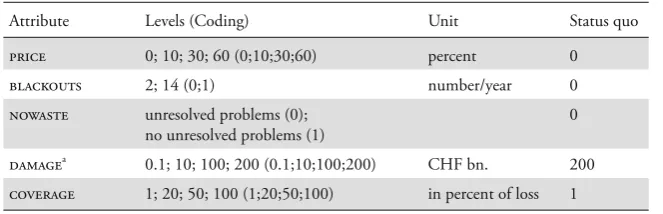
Table 1: Levels of Attributes
Attribute Levels (Coding) Unit Status quo
price 0; 10; 30; 60 (0;10;30;60) percent 0
blackouts 2; 14 (0;1) number/year 0
nowaste unresolved problems (0); no unresolved problems (1)
0 damagea 0.1; 10; 100; 200 (0.1;10;100;200) CHF bn. 200 coverage 1; 20; 50; 100 (1;20;50;100) in percent of loss 1 a Values in USD bn.: 0.1; 10; 100; 200 (USD 1 ∼ CHF 1 at 2010 exchange rates)
2 At the time of the DCE, operators were obliged to insure for CHF 1.8 billion (bn.), which amounts to approx. USD 1.8 bn. [USD 1 ≈ CHF 1 at 2010 exchange rates].
emerged as the most important (see Table 2): average price per kwh (price), reli-ability defined as low frequency of blackouts (blackout), secure and sustain-able waste disposal (nowaste), size of area exposed to hazard (damage), and financial compensation of victims in case of an accident (coverage). Because this study is concerned with insurance against financial risks of a nuclear acci-dent, damage was defined as billions of CHF at risk rather than area exposed to hazard while reducing the financial consequences of nuclear power plant acci-dents was framed in terms of an increase of mandatory liability insurance car-ried by nuclear plant operators.2
Table 2 shows the different levels of each attribute. price was framed as a 0%, 10%, 30%, or 60% increase of the respondents’ annual electricity bill. Because respondents also provided information on their annual electricity bill, we con-verted these relative price increases into absolute price increases expressed in CHF and termed this new variable outlay.
The attribute blackout served as a proxy for service quality and was coded binary: The electricity product is either associated with a low incidence of black-outs (2 per year, blackout = 0) or a high incidence of blackouts (14 per year, Blackout = 1).
The waste disposal problem was incorporated through the binary attribute nowaste. It can either attain the level “unresolved problems with waste disposal” (nowaste = 0), which corresponds to the status quo, or the hypothetical level “no unresolved problems with waste disposal” (nowaste = 1). The attribute was described as follows, “... Disposal of waste occasions problems and risks of vari-able magnitude. This holds in particular for nuclear waste, where these problems are not resolved yet.” Respondents were instructed to assume that whenever a type of power was associated with “no unresolved problems with waste disposal” waste disposal was indeed solved and no longer an issue.
The attributes damage and coverage described the possible damage a power plant can cause and what part of it was covered by a liability insurance. damage was framed in CHF billions and coverage as the percentage of that damage covered by insurance.
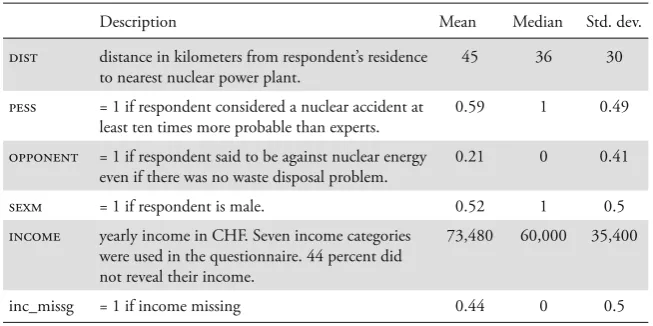
3 We used the program Gosset by Hardin and Sloane (1991–2003) to find the optimal design. if they considered an accident to be more than ten times more probable than experts do (see Table 2).
The various levels of the five attributes result in a total of 256 (= 4 ⋅ 2 ⋅ 2 ⋅ 4 ⋅ 4) possible scenarios. Out of these 256 potential attribute combinations we choose a D-optimal design that allows us to estimate all linear, quadratic, and inter-action effects.3 A D-optimal design maximizes the determinant of the Fisher information matrix for linear models. This does generally not result in an opti-mal design for linear models like ours. However, an optiopti-mal design for non-linear models depends on the value of the estimated coefficients and is thus not easily determined ex ante before estimating the model. One could employ an iterative procedure in which the design is updated based on results from a first round of estimates. The updated design would then be used to generate a new set of estimates, and so on. Unfortunately we were not able to implement such a considerably more costly survey procedure. We chose a D-“optimal” design which, although not optimal for our non-linear model, is more robust than the truly optimal design which is sensitive to the assumed parameter estimates. For a discussion of issues in the design of discrete choice experiments see, for example, Louviere, Pihlens, and Carson (2010).
The questionnaire for the main survey was divided in three parts: warm-up questions, the actual choice experiment, and socioeconomic information. In the first part, data on monthly electricity outlay, attitudes towards nuclear energy, and the importance of choice between different types of electricity was collected. Respondents then had to read a description of the risks of nuclear and hydro power plants. Emphasis was put on possible worst-case scenarios and their finan-cial consequences. Respondents were also told that nuclear power plants were already mandated to have liability insurance but that coverage fell far short of possible financial loss in case of a major accident. A more detailed description of the questionnaire can be found in Schneider and Zweifel (2004) and is avail-able from the authors.
4 This procedure assumes that information on income is missing at random.
scale, respondents marked their estimated accident probability at least one order of magnitude higher than experts. This variable serves as an indicator for the respondent’s concern about nuclear risks.
Moreover, respondents were asked to indicate their income. Since more than 40 percent of respondents refused to indicate their income, restricting the sample to individuals with information on income had to be avoided. The solution retained is to equate missing values to zero (income = 0) while creating a dummy variable inc_missg that takes on the value of one if income information is not available.4
Face-to-face interviews were performed with randomly drawn respondents in the German-speaking part of Switzerland. In total, 391 persons were interviewed. Each respondent evaluated 14 choice scenarios, resulting in 5,474 recorded deci-sions. After excluding inconsistent choices (we added one dominated alternative to check for consistency of responses), “cannot decide” answers, and missing values, a total of 4,613 observations were retained.
3. Hypotheses to Be Tested
We focus on the effect of distance from nuclear power plants on marginal will-ingness to pay for (i) increased insurance coverage against accidents at nuclear power plants and (ii) for solving the nuclear waste disposal problem.
Table 2: Sample Description of Explanatory Variables
Description Mean Median Std. dev.
dist distance in kilometers from respondent’s residence to nearest nuclear power plant.
45 36 30 pess = 1 if respondent considered a nuclear accident at
least ten times more probable than experts.
0.59 1 0.49 opponent = 1 if respondent said to be against nuclear energy
even if there was no waste disposal problem.
0.21 0 0.41
sexm = 1 if respondent is male. 0.52 1 0.5
income yearly income in CHF. Seven income categories were used in the questionnaire. 44 percent did not reveal their income.
73,480 60,000 35,400
(i) When deciding about the choices presented to them in the DCE, participants arguably take the distance from their residential location to the next nuclear power plant into account. If located far away, they are less affected by an accident. This argument assumes that respondents’ residential location choice, which took place prior to the experiment, was independent of the presence of a nuclear power plant. Because the last nuclear power plant in Switzerland was built in 1984, it seems quite implausible that residential location occurred independently of deci-sions concerning distance to nuclear power plants. Assuming that respondents differ with respect to their preferences for (against) nuclear power (e.g. because of heterogeneous subjective accident probabilities), the more skeptical types should be found farther away from the plant. Therefore, respondents located farther away from the plant have a higher disutility from nuclear risk and may well be willing to pay more for additional insurance coverage against operational risk than those located in its vicinity.
However, by locating farther away these types reduced their exposure to the accident risk. The two counteracting effects of sorting (the skeptical types select locations far away) and self-insurance (being farther away reduces exposure) gen-erate an inverted U-shape relationship of wtp for additional insurance coverage (denoted by MWPC) and distance from the plant: Near the plant, MWPC values are low and increase with distance because the more concerned people live far-ther away (selection effect dominates). Beyond a certain distance, MWPC values start to decrease because the consequences of an accident at the plant become less important (the self-insurance effect dominates).
Nuclear risk is but one of many factors governing the choice of residential loca-tion. Employment opportunities, proximity to the family, recreational consider-ations are some of the factors affecting choice of one’s residence. Hence, there is a significant cost associated with relocating, and sorting with respect to operational risk is expected to be less than perfect. However, the stronger a person’s attitude towards nuclear risk, the greater is the weight of this risk in his or her decisions. Only persons with a strong negative attitude, high perceived risk or marked risk aversion are expected to rank operational risks high enough to make the sorting effect measurable in the available data.
5 Until recently, men had the legal authority in Switzerland to decide about the residential loca-tion of a household.
6 Although a waste disposal site has not yet been designated in Switzerland, geological consider-ations make it unlikely for a future waste disposal site to be near the six existing plants (which are all located on rivers).
(2003) conclude that men have a lower perception of risk than women. There-fore, sexm is predicted to display a negative relationship with MWPC.
In Section 5 we show that women do indeed have significantly higher MWP for increased insurance coverage than men. However, their wtp monotonically decreases with distance from the plant as opposed to men’s wtp. This points to another possible effect of gender on wtp. Because households rather than indi-viduals choose their residential location, the intra-household decision process affects the degree of sorting. Suppose that on average the main breadwinners’ preferences are reflected in a household’s decision concerning place of residence. In this case, only the main breadwinner’s MWPC is expected to increase with distance, while the other household members’ (who did not sort) MWPC should be decreasing with distance. If the main breadwinners are predominantly men, then it is expected that they are more strongly spatially sorted than women.5
(ii) Unlike the case of operational risks, individuals who fear the risk from nuclear waste transport or disposal gain little from putting more distance between their residence and a nuclear power plant.6 Therefore, dist should not be a relevant predictor of wtp for solving the problem of nuclear waste (MWPW). This statement needs to be qualified in the following way. Shipping of radio-active waste and spent fuel necessarily originates at plants from where they are directed to the future national disposal sites (at present, the destinations are Le Hague in France and Sellafield in Great Britain). This implies that there is and will be an increased exposure to the risk of nuclear waste in the vicinity of the plant. For most values of dist, however, the effect of distance on MWPW is expected to be zero.
The preceding arguments may be summed up in the following predictions:
2. By controlling for respondents’ attitude and gender, and hence the sorting effect, MWPC is predicted to be a negative function of distance to plant. 3. Wtp for solving the waste (and hence transportation) problem (MWPW) is
predicted not to depend on distance, except in the immediate vicinity of the plant.
4. Ceteris paribus, increasing values of MWPC and MWPW are expected with higher income since the marginal utility loss due to the increase in the price of electricity caused by stepping up liability insurance requirements should be decreasing in income.
4. Econometric Specification
Let an individual be confronted with a discrete choice, e.g. whether to buy a certain product or not. Given this choice, individuals maximize their (expected) utility with respect to their budget constraints, obtaining certain utility values. These values define an indirect utility function conditional on the alternative selected. It depends on individuals’ characteristics, their incomes, on the par-ticular attributes of the alternative (including price) as well as on various unob-servable effects, which are assumed to be random.
In the present experiment, respondents were confronted with 14 binary choice situations, involving the status quo and an alternative. The dependent variable yi equals one if respondents chose the alternative and zero if they stayed with the status quo. Respondent i’s expected indirect utility of the alternative in choice situation j is denoted by Vij; the one of the status quo, by Vmj. Respondents there-fore chose the alternative (yi= 1) if Vij−Vim≥ 0. The posited utility function reads
0 1 2
3 4 5
2
6 7
2
8 9
2
10 11
2 12
25
ij j j
j j j
j i j
i j i j
i j i j
i j
V
…
β β β
β β β
β β
β β
β β
β β
= + ⋅ + ⋅
+ ⋅ + ⋅ + ⋅
+ ⋅ + ⋅ ⋅
+ ⋅ ⋅ + ⋅ ⋅
+ ⋅ ⋅ + ⋅ ⋅
+ ⋅ ⋅ +
+ ⋅
coverage nowaste
blackout damage outlay outlay dist nowaste
dist nowaste dist damage dist damage dist coverage dist coverage
income outlayi⋅ j +β26⋅inc_missg outlayi⋅ j+ .ij
(1)
7 A similar random effects probit specification is also used, e.g., in Telser and Zweifel (2002) as well as Gyrd-Hansen and Slothuus (2002).
utility difference Vij−Vim determines choice, socioeconomic variables, that do not influence individuals’ valuation of the status quo and the alternative prod-uct, cancel out. Put differently, unless socioeconomic variables are interacted with product attributes, they drop out of the equation. Therefore our estimated utility function contains various interaction terms between socioeconomic variables and product attributes in order to control for differences across socioeconomic groups. A second consequence of the constant status quo utility Vim is that the error term im in the utility function for the status quo does not change either. This gives rise to an individual-specific error term μi≡im. Because only differences Vij−Vim are relevant for an individual’s decision, the error term of the estimated function is given by μi−ij , calling for a random effects specification.
7
The estimated utility function V Zˆ( ), with Z being the vector of socioeconomic variables and product characteristics, permits to calculate marginal wtp for the different product attributes. It is defined as the marginal utility of the attribute divided by the marginal utility of income,
ˆ( )
( )
ˆ( )
C
V Z
MWP Z
V Z
∂ ; /∂
; := .
∂ ; /∂
coverage coverage coverage
coverage outlay (2)
In the case of wtp for solving the nuclear waste problem, one has
ˆ( 1 ) ˆ( 0 )
( )
ˆ( )
W
V Z V Z
MWP Z
V Z
= ; − = ;
:= .
∂ /∂
nowaste nowaste
outlay (3)
Willingness to pay values reported are in USD per year. Note that incomei⋅outlayj and outlayj2 permit marginal utility of income to vary with income.
5. Results
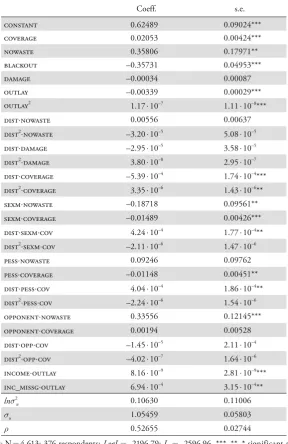
Table 3: Random Effects Prohibit Estimation Results.
The Dependent Variable Is the Probability of Accepting the Alternative Type of Power.
Coeff. s.e.
constant 0.62489 0.09024***
coverage 0.02053 0.00424***
nowaste 0.35806 0.17971**
blackout –0.35731 0.04953***
damage –0.00034 0.00087
outlay –0.00339 0.00029***
outlay2
1.17 ⋅ 10–7
1.11 ⋅ 10–8 ***
dist⋅nowaste 0.00556 0.00637
dist2⋅
nowaste –3.20 ⋅ 10–5
5.08 ⋅ 10–5
dist⋅damage –2.95 ⋅ 10–5
3.58 ⋅ 10–5 dist2⋅
damage 3.80 ⋅ 10–8
2.95 ⋅ 10–7
dist⋅coverage –5.39 ⋅ 10–4
1.74 ⋅ 10–4 *** dist2⋅
coverage 3.35 ⋅ 10–6
1.43 ⋅ 10–6 **
sexm⋅nowaste –0.18718 0.09561**
sexm⋅coverage –0.01489 0.00426***
dist⋅sexm⋅cov 4.24 ⋅ 10–4
1.77 ⋅ 10–4 ** dist2⋅
sexm⋅cov –2.11 ⋅ 10–6
1.47 ⋅ 10–6
pess⋅nowaste 0.09246 0.09762
pess⋅coverage –0.01148 0.00451**
dist⋅pess⋅cov 4.04 ⋅ 10–4
1.86 ⋅ 10–4 ** dist2⋅
pess⋅cov –2.24 ⋅ 10–6
1.54 ⋅ 10–6
opponent⋅nowaste 0.33556 0.12145***
opponent⋅coverage 0.00194 0.00528
dist⋅opp⋅cov –1.45 ⋅ 10–5
2.11 ⋅ 10–4 dist2⋅
opp⋅cov –4.02 ⋅ 10–7
1.64 ⋅ 10–6
income⋅outlay 8.16 ⋅ 10–9
2.81 ⋅ 10–9 *** inc_missg⋅outlay 6.94 ⋅ 10–4
3.15 ⋅ 10–4 **
lnσ2
u 0.10630 0.11006
σu 1.05459 0.05803
ρ 0.52655 0.02744
Schneider and Zweifel (2004). Note that coverage measures the increase in insurance coverage in percentage points, whereas nowaste is an all-or-nothing variable indicating whether or not there are any problems regarding nuclear waste.
Respondents are not only concerned about the risks associated with nuclear energy (coverage, nowaste), but also about the frequency of power outages (blackout). Interestingly, respondents value a low frequency of power outages (2 instead of 14 per year) by the same amount as solving the waste disposal prob-lem in that both variables have a coefficient of 0.36.
Respondents also care about the cost of electricity (outlay and outlay2). The coefficient of outlay is –0.00339 meaning that each Dollar spent on electricity reduces utility be 0.00339 units. At the median level for outlay, amounting to USD 120 annually, utility is reduced by 0.41 units. This is comparable to the util-ity gained by solving the waste disposal problem or by having a low frequency of blackouts (both 0.36). The positive coefficients of outlay2 and income ⋅outlay point to a decreasing marginal utility of income.
Because 44% of the respondents did not report their income, we added the term inc_missg ⋅outlay (see last term in Table 1). The coefficient of this term turns out to be 85,050 times greater than the coefficient of the term income ⋅outlay, indicating that those respondents not reporting income value nuclear risk as though their income was roughly CHF 11,500 greater than the average income of those reporting income (CHF 73,480, see Table 2). By includ-ing inc_missg ⋅outlay in our regression, we take this effect into account. In addition, we checked whether those respondents not reporting income differ sys-tematically in their valuation of the product attributes from those not reporting income. To this end we added interaction terms between the dummy variable inc_missg and the product attributes. Because all these interaction terms were not statistically significant, we conclude that missing observations for income do not systematically distort our findings.
5.1 Effect of Attitudinal Variables on Willingness to Pay
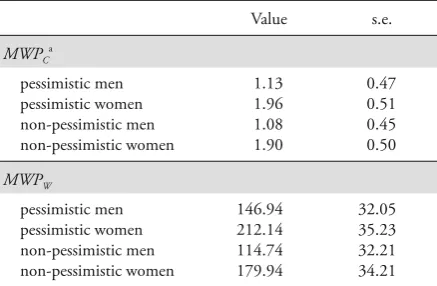
Using eqs. (2) and (3), respectively, MWPC and MWPW are evaluated for dif-ferent values of sexm and pess while keeping the remaining variables at the sample median values (see Table 2). The results in Table 2 indicate that women are more concerned about nuclear risks than men (see the negative coefficient of sexm ⋅ coverage in Table 3).
for solving the waste disposal problem (MWPW = 212 USD/year compared to 147 USD/year). This differential is similar for non-pessimistic women in relative terms, viz. some 75 percent with respect to increased insurance coverage and 55 percent with respect to solving the waste disposal problem.
Table 4. Marginal Willingness to Pay for Increased Coverage (MWPC) and for Solving
the Waste Disposal Problem (MWPW), Evaluated at Median Distance (36 km) in USD per Year
Value s.e.
MWPC
a
pessimistic men pessimistic women non-pessimistic men non-pessimistic women
1.13 1.96 1.08 1.90
0.47 0.51 0.45 0.50
MWPW
pessimistic men pessimistic women non-pessimistic men non-pessimistic women
146.94 212.14 114.74 179.94
32.05 35.23 32.21 34.21 a for a percentage point change, e.g. from 1 to 2 percent of maximum loss.
5.2 The Effect of Distance on Willingness to Pay
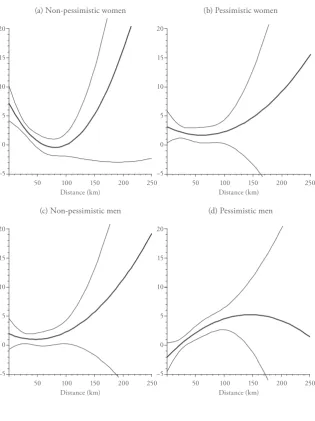
The results in Table 1 show that dist ⋅coverage has a negative coefficient, meaning that the marginal utility from additional insurance coverage decreases with distance from the plant. However, dist ⋅pess ⋅coverage is positive, signif-icantly reducing the overall effect of distance on marginal utility of insurance coverage. Also, non-pessimistic women (sexm = 0 and pess = 0) exhibit a strong negative distance gradient whereas pessimistic men show a positive distance gra-dient for MWPC. These findings indicate that sexm and pess are able to control for respondents’ attitudes.
but increases to about USD 5 per year for those living about 100 km away from the nuclear power plant. This is a substantial amount. Assuming constant mar-ginal utility of additional insurance coverage, a pessimistic man living at 100 km distance from the plant is willing to pay up to USD 500 (USD 5 per percentage point) per year for full insurance coverage.
Next, prediction (2) states that controlling for attitudinal variables in the regression makes a difference by identifying the (negative) direct effect of dis-tance from plant on MWPC. This means that pessimists (pess = 1) should exhibit a positive effect relative to optimists. The coefficient of dist ⋅pess ⋅coverage in Table 1 is positive. Also, opponents (opponent = 1) to nuclear energy should exhibit a positive effect as well.Here, the coefficient of dist ⋅opp ⋅cov is negative but lacks significance. As argued in Section 3, men are hypothesized to be more strongly sorted than women, causing the sorting effect to become (more) promi-nent. In fact, a positive coefficient is found for dist ⋅sexm ⋅cov.
Because the indicators pess, opponent and sexm are designed to capture the sorting effect, the marginal wtp for more comprehensive insurance cover-age (MWPC) should be decreasing in distance for non-pessimistic women not opposed to nuclear energy (pess = 0, opponent = 0, sexm = 0). Figure 1 shows that non-pessimistic women close to the nuclear plant do exhibit positive wtp for additional coverage amounting to USD 7. However, their marginal willingness to pay drops with distance from plant and becomes indistinguishable from zero for non-pessimistic women living 50 kilometers or more away from the plant.
In contrast, Figure 1 reveals a positive but constant MWPC for pessimistic women. Non-pessimistic men (Figure 1) also exhibit constant but lower MWPC values. In all, hypothesis (2) is largely confirmed.
Turning to the waste problem, hypothesis (3) states that sorting should not make a difference with respect to MWPW. Both dist ⋅nowaste and dist
2⋅
Figure 1. Marginal willingness to pay for increased coverage with respect to distance (measured in km) from nuclear power plant, in USD per year. The thin lines show the
95 percent confidence intervals calculated using the Delta method.
20
15
10
5
0
–5
50 100 150 200 250 20
15
10
5
0
–5
50 100 150 200 250 Distance (km) Distance (km)
20
15
10
5
0
–5
20
15
10
5
0
–5
50 100 150 200 250 50 100 150 200 250 Distance (km) Distance (km)
(a) Non-pessimistic women (b) Pessimistic women
6. Conclusion
This article investigates the effect of distance from nuclear power plants on Swiss citizens’ marginal willingness to pay for avoiding two particular risks from nuclear power: the risk of an accident at power plants, and the risk associated with nuclear waste disposal. The reduction of the (financial) risk from nuclear accidents was framed as increased insurance coverage against losses caused by accidents at power plants.
In the case of Switzerland, respondents had ample opportunity to choose their residential location according to their preferences regarding nuclear power. If spatial sorting of individuals is indeed important, one would expect to find more strongly concerned people residing at a greater distance from plants, result-ing in an inverted U-shaped relationship between marginal willresult-ingness to pay for increased insurance coverage (MWPC) and distance. On the other hand, if spatial sorting is not important, one would expect a negative relationship between MWPC and distance because exposure to the accident risk decreases with distance.
Using data obtained from a discrete choice experiment, respondents distance from nuclear power plants proves to be a significant explanatory variable for MWPC. Controlling for attitudinal variables, the distance gradient of MWPC turns out to display the predicted inverted U-shaped profile: Close to the plant (less than 30 km), marginal willingness to pay is not statistically different from zero. At greater distance, however, it reaches USD 4 to USD 5 per year for a one percentage point increase in insurance coverage. On the other hand, individuals who did not sort spatially with respect to their nuclear risk preferences show a negative distance gradient: Marginal willingness to pay starts at USD 7 per year for those living close to a nuclear power plant and reaches USD 0 at a distance of 50 km from the plant.
Because the risk emanating from nuclear waste disposal is hardly affected by the distance between the individual’s residential location and nuclear power plants, distance from plant is predicted to have no impact on willingness to pay for a solution to the waste disposal problem. Our analysis confirms this hypoth-esis as well: Regardless of distance, respondents are willing to pay up to USD 212 per year for having the waste disposal problem solved.
decisions such as phasing out nuclear power. Because respondents must trade off several desirable attributes of electricity such as a low accident risk, a low price, and a high security of supply against each other, this method permits to put a reliable price tag on each attribute. Table 1, for example, indicates that respond-ents value security of supply by roughly the same amount as they value a solution to the waste disposal problem. Discrete choice experiments clearly provide more detailed information than surveys that simply ask citizens whether they approve or disapprove a nuclear phase-out.
A. Appendix
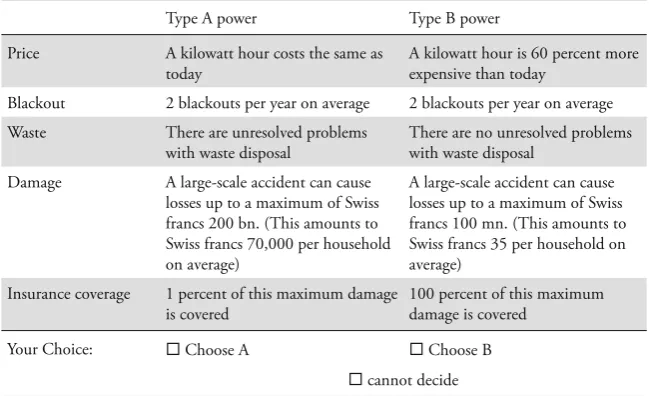
A.1 Example of a Choice Scenario
Table A1: Example of a Choice Scenario
Type A power Type B power Price A kilowatt hour costs the same as
today
A kilowatt hour is 60 percent more expensive than today
Blackout 2 blackouts per year on average 2 blackouts per year on average Waste There are unresolved problems
with waste disposal
There are no unresolved problems with waste disposal
Damage A large-scale accident can cause losses up to a maximum of Swiss francs 200 bn. (This amounts to Swiss francs 70,000 per household on average)
A large-scale accident can cause losses up to a maximum of Swiss francs 100 mn. (This amounts to Swiss francs 35 per household on average)
Insurance coverage 1 percent of this maximum damage is covered
100 percent of this maximum damage is covered
Your Choice: Choose A Choose B
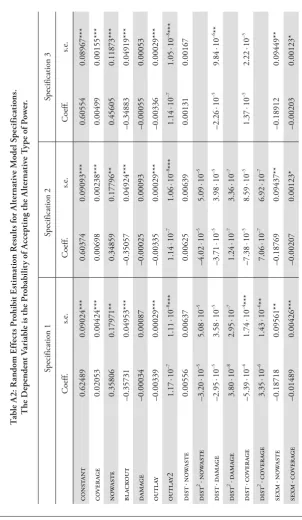
A .2 M or e E stim ation R esults T able A 2 : R and om E ff ec ts Pr oh ibi t E st im at ion R es u lt s f or A lt er n at iv e M o d el S p ec if ic at ion s. T h e D ep end en t V ar ia b le i s t h e Pr ob ab il it
y of A
cc ept in g t h e A lt er n at iv e T yp
e of P
ow er . Specification 1 Specification 2 Specification 3 Coeff . s.e. Coeff . s.e. Coeff . s.e. c onst ant 0.62489 0.09024*** 0.60374 0.09093*** 0.60554 0.08967*** c o vera ge 0.02053 0.00424*** 0.00698 0.00238*** 0.00499 0.00155*** no w aste 0.35806 0.17971** 0.34859 0.17796** 0.45605 0.11873*** bl ack out –0.35731 0.04953*** –0.35057 0.04924*** –0.34883 0.04919*** dama ge –0.00034 0.00087 –0.00025 0.00093 –0.00055 0.00053 outl ay –0.00339 0.00029*** –0.00335 0.00029*** –0.00336 0.00029*** outl ay2 1.17 ⋅ 10 –7 1.11 ⋅ 10 –8 *** 1.14 ⋅ 10 –7 1.06 ⋅ 10 –8 *** 1.14 ⋅ 10 –7 1.05 ⋅ 10 –8 *** dist ⋅ no w aste 0.00556 0.00637 0.00625 0.00639 0.00131 0.00167 dist
2 ⋅ no
w aste –3.20 ⋅ 10 –5 5.08 ⋅ 10 –5 –4.02 ⋅ 10 –5 5.09 ⋅ 10 –5 dist ⋅ dama ge –2.95 ⋅ 10 –5 3.58 ⋅ 10 –5 –3.71 ⋅ 10 –5 3.98 ⋅ 10 –5 –2.26 ⋅ 10 –5 9.84 ⋅ 10 –6 ** dist
2⋅ dama
ge 3.80 ⋅ 10 –8 2.95 ⋅ 10 –7 1.24 ⋅ 10 –7 3.36 ⋅ 10 –7 dist ⋅ c o vera ge –5.39 ⋅ 10 –4 1.74 ⋅ 10 –4*** –7.38 ⋅ 10 –5 8.59 ⋅ 10 –5 1.37 ⋅ 10 –5 2.22 ⋅ 10 –5 dist
2 ⋅ c
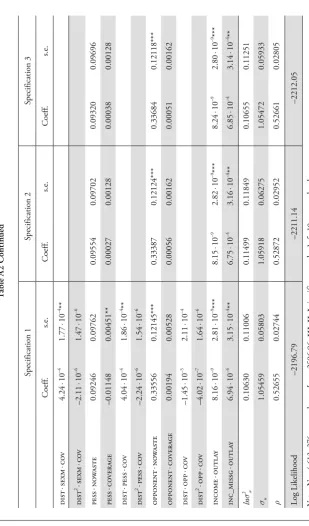
Specification 1 Specification 2 Specification 3 Coeff . s.e. Coeff . s.e. Coeff . s.e. dist ⋅ sexm ⋅ c o v 4.24 ⋅ 10 –4 1.77 ⋅ 10 –4 ** dist
2 ⋅ sexm
⋅ c o v –2.11 ⋅ 10 –6 1.47 ⋅ 10 –6 pess ⋅ no w aste 0.09246 0.09762 0.09554 0.09702 0.09320 0.09696 pess ⋅ c o vera ge –0.01148 0.00451** 0.00027 0.00128 0.00038 0.00128 dist ⋅ p ess ⋅ c o v 4.04 ⋅ 10 –4 1.86 ⋅ 10 –4** dist
2⋅ p
ess ⋅ c o v –2.24 ⋅ 10 –6 1.54 ⋅ 10 –6 opponent ⋅ no w aste 0.33556 0.12145*** 0.33387 0.12124*** 0.33684 0.12118*** opponent ⋅ c o vera ge 0.00194 0.00528 0.00056 0.00162 0.00051 0.00162 dist ⋅ opp ⋅ c o v –1.45 ⋅ 10 –5 2.11 ⋅ 10 –4 dist
2 ⋅ opp
⋅ c o v –4.02 ⋅ 10 –7 1.64 ⋅ 10 –6 inc ome ⋅ outl ay 8.16 ⋅ 10 –9 2.81 ⋅ 10 –9*** 8.15 ⋅ 10 –9 2.82 ⋅ 10 –9*** 8.24 ⋅ 10 –9 2.80 ⋅ 10 –9*** inc_missg ⋅ outl ay 6.94 ⋅ 10 –4 3.15 ⋅ 10 –4 ** 6.75 ⋅ 10 –4 3.16 ⋅ 10 –4 ** 6.85 ⋅ 10 –4 3.14 ⋅ 10 –4 ** ln σ 2 u 0.10630 0.11006 0.11499 0.11849 0.10655 0.11251 σu 1.05459 0.05803 1.05918 0.06275 1.05472 0.05933 ρ 0.52655 0.02744 0.52872 0.02952 0.52661 0.02805 Log Likelihood –2196.79 –2211.14 –2212.05 No te s: N = 4 ,6 13 ; 3 76 r es p ond en ts ; L0 = – 25 9 6 .9 6 ; * ** , *
*, * si
References
Bishop, Richard C., and Thomas A. Heberlein (1979), “Measuring Values of Extramarket Goods: Are Indirect Measures Biased?”, American Journal of Agricultural Economics, 61(5), pp. 926–930.
Clark, David E., and Tim Allison (1999), “Spent Nuclear Fuel and Residential Property Values: The Influence of Proximity, Visual Cues and Public Infor-mation”, Papers in Regional Science, 78(4), pp. 403–421.
Davis, Lucas W. (2004), “The Effect of Health Risk on Housing Values: Evidence from a Cancer Cluster”, American Economic Review, 94(5), pp. 1693–1704. de Bekker-Grob, Esther W, Mandy Ryan, and Karen Gerard (2010),
“Dis-crete Choice Experiments in Health Economics: A Review of the Literature”, Health Economics, 21(2), pp. 145–172.
Diamond, Peter A., and Jerry A. Hausman (1994), “Contingent Valuation: Is Some Number Better than No Number?”, The Journal of Economic Perspec-tives, 8(4), pp. 45–64.
Dionne, Georges, and Louis Eeckhoudt (1985), “Self-Insurance, Self-Pro-tection and Increased Risk Aversion”, Economics Letters, 17(1–2), pp. 39–42. Ehrlich, Isaac, and Gary S. Becker (1972), “Market Insurance, Self-Insurance,
and Self-Protection”, The Journal of Political Economy, 80(4), pp. 623–648. Farber, Stephen (1998), “Undesirable Facilities and Property Values: A
Sum-mary of Empirical Studies”, Ecological Economics, 24(1), pp. 1–14.
Folland, Sherman, and Robbin Hough (2000), “Externalities of Nuclear Power Plants: Further Evidence”, Journal of Regional Science, 40(4), pp. 735–753. Gamble, Hays B., and Roger H. Downing (1982), “Effects of Nuclear Power
Plants on Residential Property Values”, Journal of Regional Science, 22(4), pp. 457–478.
Gawande, Kishore, and Hank Jenkins-Smith (2001), “Nuclear Waste Transport and Residential Property Values: Estimating the Effects of Per-ceived Risks”, Journal of Environmental Economics and Management, 42(2), pp. 207–233.
Gyrd-Hansen, Dorte, and Ulla Slothuus (2002), “The Citizen’s Preferences for Financing Public Health Care: A Danish Survey”, International Journal of Health Care Finance and Economics, 2(1), pp. 25–36.
Hanemann, W. Michael (1984), “Welfare Evaluations in Contingent Valua-tion Experiments with Discrete Responses”, American Journal of Agricultural Economics, 66(3), pp. 332–341.
Hartog, Joop, Ada Ferrer-i Carbonell, and Nicole Jonker (2002), “Link-ing Measured Risk Aversion to Individual Characteristics”, Kyklos, 55(1), pp. 3–26.
Ida, Takanori, and Toshifumi Kuroda (2006), “Discrete Choice Analysis of Demand for Broadband in Japan”, Journal of Regulatory Economics, 29(1), pp. 5–22.
Kelly, Mary, and Anne E. Kleffner (2003), “Optimal Loss Mitigation and Contract Design”, The Journal of Risk and Insurance, 70(1), pp. 53–72. Louviere, Jordan, David Hensher, and Joffre Swait (2000), Stated Choice
Methods – Analysis and Applications, Cambridge University Press.
Louviere, Jordan J., David Pihlens, and Richard Carson (2010), “Design of discrete choice experiments: A discussion of issues that matter in future applied research”, Journal of Choice Modelling, 4(1), pp. 1–8.
Nelson, Jon (1981), “Three Mile Island and Residential Property Values: Empir-ical Analysis and Policy Implications”, Land Economics, 57(3), pp. 363–372. Nielsen, Jesper B., Dorte Gyrd-Hansen, Ivar Sønbø Kristiansen, and
Jørgen Nexøe (2003), “Impact of Socio-demographic Factors on Willing-ness to Pay for the Reduction of a Future Health Risk”, Journal of Environ-mental Planning and Management, 46(1), pp. 39–47.
Riddel, Mary, Christine Dwyer, and W. Douglass Shaw (2003), “Envi-ronmental Risk and Uncertainty: Insights from Yucca Mountain”, Journal of Regional Science, 43(3), pp. 435–457.
Schneider, Yves, and Peter Zweifel (2004), “How Much Internalization of Nuclear Risk Through Liability Insurance?”, Journal of Risk and Uncertainty, 29(3), pp. 219–240.
Smith, Kerry, and William H. Desvousges (1986), “The Value of Avoiding a LULU: Hazardous Waste Disposal Sites”, The Review of Economics and Sta-tistics, 68(2), pp. 293–299.
SUMMARY