1109
Block Chain Technology Adoption Using TOE
Framework
Dr.Mugdha Kulkarni,Dr.Kanchan PatilAbstract: This research explores the acceptance of BlockChain Technology (BCT) in Banking services. BCT has changed from traditional centralised system to decentralized ledger which is a total 360 degree change .Adoption of BCT is a challenge and hence this research scrutinies the adoption of BCT using the Technology-Organization-Environment framework theory. The study highlighted that blockchain technologies hold the potential to store tempered proof data, i.e. append-only database and consensus-based on a distributed ledger system. For blockchain technologies to become the foundation stone for banking and financial services, an understanding of BCT adoption in Indian banks is essential. Therefore, the researcher explored the antecedents of BCT adoption and its outcomes. This study investigated Information Technology officers, bank managers and bank employees of banks in India about BCT adoption through a structured questionnaire. Data collected was analyzed using the PLS-SEM. In conclusion, BCT infrastructure, BCT knowledge, relative advantage, transaction cost, perceived security, organizational scope, consumer readiness, competitive pressure, government policies and bank partner readiness are the factors that affect the Blockchain technology adoption . This study provides valuable insights into bank managers/employees and technology vendors. It also gives suggestions to government officials involved in the 'Digital India' initiative of Government of India (GoI).
Index Terms: Block Chain Technology, banking services, Technology-Organization-Environment, Distributed ledger, PLS-SEM
————————————————————
1.
INTRODUCTION
Blockchain technology is becoming the driving forces in the business world of innovation. It has revolutionized various industries such as finance, healthcare, mobile application, retail etc. [1] [2] [3] [4].This research study is specific to how the convergence of blockchain technology will change the face of the banking and financial services industry. Block chain is the distributed Leger or Open ledger technology or decentralised digital ledger [5].Block chain is nascent technology which has potentially disrupted financial service sector by making it cost effective, secured, and visibly more transparent [6]. In short, it is decentralized distributed and public digital ledger capable of recording transactions across multiple computers so that the record cannot be modified or deleted. [7], [8] [9]. BCT is the distributed ledger with privacy ,quality of unchangeable object, Security and transparency. In blockchain, data in the distributed ledger is immutable that is irreversible. In case of any technical mistake there should be a process to revoke that mistake or the process of undo shall be there. Undo is the ability to check the integrity of the data. If any breach happens due to the misuse of any user credentials then there shall be the property of reversibility hence reversibility becomes the biggest challenge. [10], [11]. Transaction in this technology cannot be deleted only modified or altered. This traditional banking transaction like letter of credit process, lending taking weeks has transformed the process into days increasing the efficiency. It is linking the records or blocks with the chain of all synched with matching sequence. The storage devices for the database are not attached to common processor and each block is a ordered record having a timestamp and a address of previous block. Cryptography implemented allows users to edit parts of the blockchain having their ownership through the private keys necessary to append to the file. All users' copy of the distributed
blockchain is synchronized. [12]
2.
RESEARCH GAP
Being a developing economy like India there is dynamic growth of service sector. Also, digital initiative in banking and finance sector had evolved the technology. Block chain is one of the Technologies in the forefront. Block chain in Banking has reduced processing cost and given BFSI sector a global network solution [13]. About 77% of Fintech is expected to adopt blockchain in their production system by 2020. (2017). So, in comparison to existing studies, our research focuses on Technology-Organization-Environment framework (TOE) of BCT in Banking and Finance to explore if the environment is conductive of adoption of technology.
RQ: Identify the factors that impact Blockchain tenology adoption in banking and financial services provided Indian Banks.
3.
LITERATURE REVIEW
3.1 Banking and financial Services
BFSI is the significant constituent of service sector in India. The share of BFSI has multiplied from 2.78% from 1980 [14].According to the RBI the growth rate of this sector is predicted to be around 6.3%.
3.2 Blockchain technology (BCT) adoption-
According to NASSCOM report –Avasant Block Chain Service report published in 2019 mentions that in India BFSI leads with 55% in adoption of blockchain although other industries like insurance, healthcare, retail, and manufacturing are catching up. [15].Apart from disturbed ledger other technology used is validation of land records, assets inventory audit, Healthcare agriculture. [1] [16]. It has reduced the middlemen or financial intermediaries, which in turn reduces the cost burden. Banks are eager to advantage of the reduction in transaction cost, paper saving, data handling, and disintermediation. [17]It is also predicted that investment banks could save up to $10 billion by using BCT for recovering and payment settlements. [18]
————————————————
* Correspondence Author
Dr. Mugdha Kulkarni, Symbiosis Centre for Information Technology, Symbiosis International Deemed University, Pune, India. Email:
Dr. Kanchan Patil*, Symbiosis Centre for Information Technology, Symbiosis International Deemed University, Pune, India.. Email:
3.3 Banking and financial services BCT adoption
Financial sector technology or Fintech has made sizeable investment in range of BFSI sector. Blockchain became one of the revolutionary technologies which have an incredible possibility to transform financial sector in recent years. Main properties of block chain such as decentralisation, Transparency and Immutability are important characteristic of BCT. [9], [11]. [7].This has reduced fraud in the financial domain where up to 45% of financial intermediaries are seen having fraud and financial crimes. [5], [19]. In the era of cyber age, the vulnerability to attacks, privacy is very common [20].Block chain has thus reduced the money laundering process through Smart contracts, Blockchain have facilitated secured usage through private key encryption. [21], Banking services in India have started efficiently using KYC process accessible through this technology. SBI being pioneering in using BCT later private banks like HDFC, ICICI, Axis,Kotak followed the path. [22] [23], In-spite of extraordinary possibilities offered by BCT in BFSI sector but still are organisational environment ready for the adoption of the technology. This research explores to find the technology usage of the organisation.
3.4.Research Objectives
To confirm T-O-E factors relationship for blockchain technology (BCT) adoption for banking and financial services of Indian banks. To explore how BCT infrastructure, BCT Knowledge, Relative advantage, Transaction cost, perceived security, Organization competence, Customer readiness, Competitive pressure, Partner bank readiness and Government policies contribute towards BCT adoption in Indian banking and financial services.
3.5 Literature Review And Hypothesis
Organizational technology adoption
Technology-organization-environment (TOE) theoretical framework has been employed by technology adoption studies at organizational level [24] because these three represent ―both constraints and opportunities for technological innovation‖. TOE framework addressed EDI (Electronic Data interchange) adoption [25, 25] [26] [27], ERP (Enterprise resource planning) [28],IS (Information systems) ( [29], 1999), open system
adoption [30], MRP (material resource planning) [31], mobile reservation system for hotels [32]and Electronic business adoption [33] [34]. However, studies for blockchain technology adoption using any theoretical framework at organization level are at nascent stage.
3.6 Conceptual Framework
Technological context
The technological context consists of technology equipment, infrastructure and processes. Blockchain is distributed ledger technology having potential to transform the banking and financial services industry to lower costs, reduce paper work and increase their efficiency. BCT is decentralized and exists among multiple servers not owned by single organization. BCT will facilitate banking organizations to complete payments speedily and without any errors and reduce transaction costs. Processes for letters of credit, lending, that take weeks to complete a transaction can be fastened. Banks should employ the BCT infrastructure necessary to create and operate BCT global network. BCT in banking industry would need to handle an extraordinarily large data set, therefore scalability is very important. BCT knowledge is essential to transform the way people exchange value as transactions recorded on the blocks cannot be altered once they are added. Participants can see their ledger of transactions through cryptography making payments more secure through BCT. Shared databases and cryptography in BCT allows multiple users from different cities/states or countries to have concurrent rights to the regularly revised digital ledger [35]. Currently transferring money takes more time and mostly requires process intermediaries, charging a service charge and requires stronger regulation and more cost because of the possibility of fraud occurrence. Blockchain eliminates intermediaries thereby improving security, lowering transaction and processing costs. BCT can lead to more trust between trading bank partners as they can access shared records and the security characteristics. Transactions in real-time lead to speedy money transactions and capital investments. Smart Contracts can automatically implement terms of multi-party agreements depending on matching of terms, authenticated by transaction parties without the an intermediary. As per the above discussion researcher proposes following hypotheses:
H1: BCT infrastructure positively impacts BCT adoption in BFSI.
H2: BCT knowledge positively impacts BCT adoption in BFSI. H3: Relative advantage of BCT positively impacts BCT adoption in BFSI.
H4: Transaction costs for BCT positively impacts BCT adoption in BFSI.
H5: Perceived Security of BCT positively impacts BCT adoption in BFSI.
Organization competence
As per the above discussion researcher proposes following hypothesis:
H6: Organization competence positively impacts BCT adoption in BFSI.
Environmental context
The environment consists of the competitors in banking industry, the macro environment, and the government regulations. Industry competition and market uncertainty forces banks to aggressively adopt technology [30].Trade partners can interact with a trustworthy conversation, by just using a shared truth version on the blockchain, which increases the efficiency and access funding time will be saved throughout the trade process. BCT can be used for transfer of funds, book keeping and other related functions [40]. BCT as a innovative technology will help to replace centralised international trade finance procedure to an digital decentralized ledger that gives all the stakeholders, including banks, the ability to access a single source of information. Thus monitoring of all records and validating or certifying the possession of assets digitally in actual run- time enviornment can be done. BCT enables money in form of Bitcoin and other cryptocurrencies which could be challenging to central banks’ control of monetary policy in traditional the banking. Individuals and corporations can transact directly, without legacy payment networks, proprietary bank systems or bank accounts and thus without banks. BCT will offer customers different ways of paying with a decrease in consumer banking costs therefore customers’ readiness shall allow banks to adopt BCT [33].The BCT that would be used by banks would need to comply with privacy laws and need to ensure the safety of the data. The regulatory policies for this new technology need to be framed by the government.
As per the above discussion researcher proposes following hypotheses:
H7: Customer readiness positively impacts BCT adoption in BFSI.
H8: Competitive pressure positively impacts BCT adoption in BFSI.
H9: Government policies positively impacts BCT adoption in BFSI.
H10: Partner bank readiness positively impacts BCT adoption in BFSI.
4.RESEARCH METHOD
Researcher conducted empirical research using survey for quantitative analysis. Interviews of bank and financial institution employees were undertaken to comprehend their attitudes towards BCT adoption, to know the existing information and communication technologies employed for banking processes.
4.1.Measures
The Scale to measure enablers for BCT adoption was adapted from T-O-E ( [41], [33] [34] [25]; [42]. Banking employees’ responses was quantified using a five-point Likert scale.
Research Instrument design
Adapted scale measuring 10 constructs through 36 variables for BCT infrastructure, BCT knowledge, relative advantage, transaction costs, perceived security, organization competence, customer readiness, competitive pressure, trading bank readiness, Government policies and BCT
adoption was developed. Construct validity and scale reliability was checked [32]. Face validity for all constructs was confirmed by taking suggestions from five experts from blockchain technology , middle level and top level bank employees, advisors and academicians. PLS SEM was used for the analysis .Sample of 150 was the pilot Sample. Cronbach’s alpha (α) ensured the reliability of the data. The operationalized constructs are as shown in Table 2.
4.2. Data Collection
Data was collected from middle level and top-level bank employees in Pune city. Secondary data was obtained through the online database, reference books, journals papers, white papers, company reports. Sample size calculated was ten times the item numbers of the most important construct BCT adoption [33]. Therefore the sample size calculated was 340 . The sampling frame consisted of bank employees knowing about technologies in Pune city. The bank employees participated in research voluntarily, only if they had knowledge about the advantages and requirements of the BCT. Anonymity and confidentiality of employees was protected. Six hundred twenty questionnaires were sent online or filled face to face. However 447 bank employees responded. 407 responses were completely filled for the data analysis. In short 91% of sample were considered for the study [43]. Harmans’ test was conducted to address common method bias( [44] and Organ, 1986).
5.DATA ANALYSIS
Structural equation modelling(SEM) was done using Partial least square (PLS) data analysis software. This research extends the T-O-E framework hence PLS-SEM was used [46]. Smart PLS 2.0 software tool specified outer and inner model [45]
Table I. Sample Profile
Category No of
Respondents Percentage
Public sector 98 23.96
Private sector 102 24.94
Financial Institution 76 18.58
Co-operative Bank 58 14.18
Non-Banking financial Institution
75 18.34
409 100
5.1. Measurement model
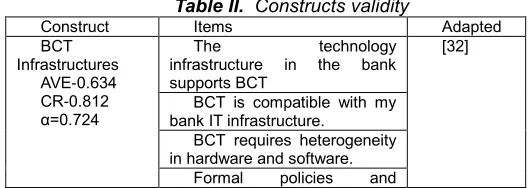
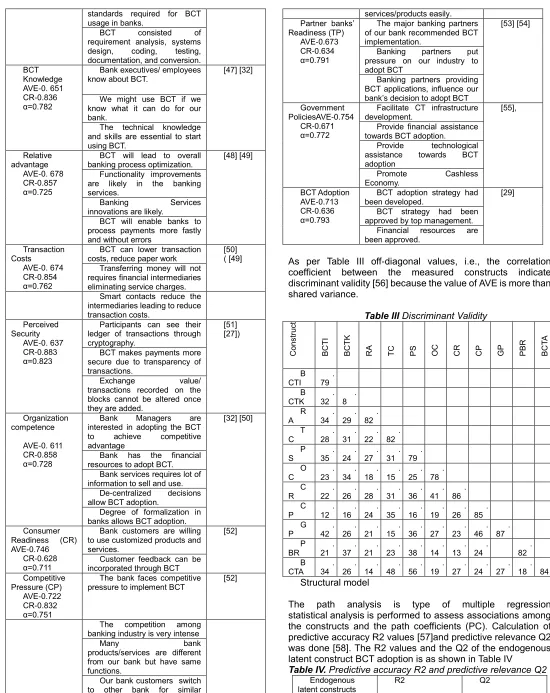
Table II shows the reflective constructs measured in the conceptual framework. Factor loadings calculated [46] and Cronbach's alpha computed were higher than 0.7 for all the constructs indicating constructs reliability. Composite reliability values of all constructs ensured internal consistency as the mentioned in Table II. Average Variance extracted (AVE) was more than 0.5 ensured convergent validity.
Table II. Constructs validity
Construct Items Adapted
BCT Infrastructures
AVE-0.634 CR-0.812 α=0.724
The technology
infrastructure in the bank supports BCT
[32]
BCT is compatible with my bank IT infrastructure.
BCT requires heterogeneity in hardware and software.
standards required for BCT usage in banks.
BCT consisted of requirement analysis, systems design, coding, testing, documentation, and conversion. BCT
Knowledge AVE-0. 651 CR-0.836 α=0.782
Bank executives/ employees know about BCT.
[47] [32]
We might use BCT if we know what it can do for our bank.
The technical knowledge and skills are essential to start using BCT. Relative advantage AVE-0. 678 CR-0.857 α=0.725
BCT will lead to overall
banking process optimization. [48] [49] Functionality improvements
are likely in the banking services.
Banking Services innovations are likely.
BCT will enable banks to process payments more fastly and without errors
Transaction Costs
AVE-0. 674 CR-0.854 α=0.762
BCT can lower transaction
costs, reduce paper work [50] ( [49] Transferring money will not
requires financial intermediaries eliminating service charges.
Smart contacts reduce the intermediaries leading to reduce transaction costs. Perceived Security AVE-0. 637 CR-0.883 α=0.823
Participants can see their ledger of transactions through cryptography.
[51] [27]) BCT makes payments more
secure due to transparency of transactions.
Exchange value/ transactions recorded on the blocks cannot be altered once they are added.
Organization competence
AVE-0. 611 CR-0.858 α=0.728
Bank Managers are interested in adopting the BCT to achieve competitive advantage
[32] [50]
Bank has the financial resources to adopt BCT.
Bank services requires lot of information to sell and use.
De-centralized decisions allow BCT adoption.
Degree of formalization in banks allows BCT adoption. Consumer
Readiness (CR) AVE-0.746
CR-0.628 α=0.711
Bank customers are willing to use customized products and services.
[52]
Customer feedback can be incorporated through BCT Competitive
Pressure (CP) AVE-0.722 CR-0.832 α=0.751
The bank faces competitive
pressure to implement BCT [52]
The competition among banking industry is very intense
Many bank
products/services are different from our bank but have same functions.
Our bank customers switch to other bank for similar
services/products easily. Partner banks’
Readiness (TP) AVE-0.673 CR-0.634 α=0.791
The major banking partners of our bank recommended BCT implementation.
[53] [54]
Banking partners put pressure on our industry to adopt BCT
Banking partners providing BCT applications, influence our bank’s decision to adopt BCT Government
PoliciesAVE-0.754 CR-0.671 α=0.772
Facilitate CT infrastructure development.
[55], Provide financial assistance
towards BCT adoption. Provide technological assistance towards BCT adoption
Promote Cashless Economy.
BCT Adoption AVE-0.713 CR-0.636 α=0.793
BCT adoption strategy had been developed.
[29] BCT strategy had been
approved by top management. Financial resources are been approved.
As per Table III off-diagonal values, i.e., the correlation coefficient between the measured constructs indicate discriminant validity [56] because the value of AVE is more than shared variance.
Table III Discriminant Validity
C on st ru ct B C TI B C TK
RA TC PS OC CR CP GP PBR BC
TA B CTI . 79 B CTK . 32 . 8 R
A 34 . 29 . 82 . T C . 28 . 31 . 22 . 82 P S . 35 . 24 . 27 . 31 . 79 O
C 23 . 34 . 18 . 15 . 25 . 78 . C R . 22 . 26 . 28 . 31 . 36 . 41 . 86 C P . 12 . 16 . 24 . 35 . 16 . 19 . 26 . 85 G
P 42 . 26 . 21 . 15 . 36 . 27 . 23 . 46 . 87 . P BR . 21 . 37 . 21 . 23 . 38 . 14 . 13 . 24 . 82 B CTA . 34 . 26 . 14 . 48 . 56 . 19 . 27 . 24 . 27 . 18 . 84 Structural model
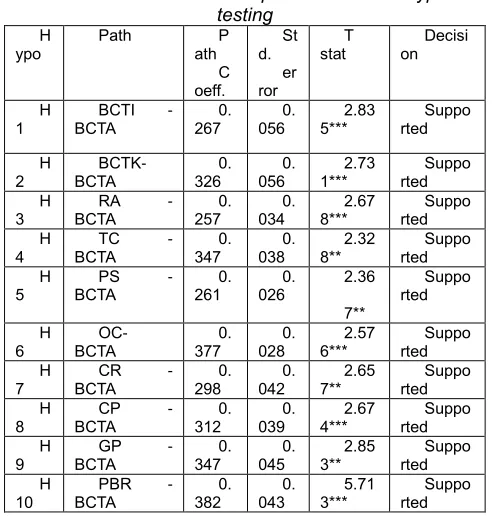
The path analysis is type of multiple regression statistical analysis is performed to assess associations among the constructs and the path coefficients (PC). Calculation of predictive accuracy R2 values [57]and predictive relevance Q2 was done [58]. The R2 values and the Q2 of the endogenous latent construct BCT adoption is as shown in Table IV
Table IV. Predictive accuracy R2 and predictive relevance Q2
Endogenous latent constructs
BCT Adoption .674 .293
Table V Structural relationships and results of hypothesis testing
H ypo
Path P
ath C oeff.
St d.
er ror
T stat
Decisi on
H
1 BCTA BCTI - 267 0. 056 0. 5*** 2.83 rted Suppo H
2
BCTK- BCTA
0. 326
0. 056
2.73 1***
Suppo rted H
3
RA - BCTA
0. 257
0. 034
2.67 8***
Suppo rted H
4
TC - BCTA
0. 347
0. 038
2.32 8**
Suppo rted H
5 BCTA PS - 261 0. 026 0. 2.36 7**
Suppo rted H
6
OC- BCTA
0. 377
0. 028
2.57 6***
Suppo rted H
7
CR - BCTA
0. 298
0. 042
2.65 7**
Suppo rted H
8
CP - BCTA
0. 312
0. 039
2.67 4***
Suppo rted H
9
GP - BCTA
0. 347
0. 045
2.85 3**
Suppo rted H
10
PBR - BCTA
0. 382
0. 043
5.71 3***
Suppo rted
6.RESULT AND DISCUSSION
H1 path coefficient = 0.267, t-statistics = 2.835 indicates, BCTI significantly predicts BCT adoption. Technological competence due to bank’s internal resources like IT infrastructure and internet providing foundation for BCT adoption ( [34]
H2 path coefficient = 0.326, t-statistics = 2.731 indicates, BCTK significantly predicts BCT adoption. BCT knowledge is the significant predictor for BCT adoption [34] [59]
H3 path coefficient = 0. 257, t-statistics = 2.678 indicates, RA significantly predicts BCT adoption. BCT adoption in banking and financial services depends on the attributes of innovative technology like relative advantage and perceived security [60]Relative advantage is the perceived technological benefits provided by BCT to the banks [61]
H4 path coefficient = 0. 347, t-statistics = 2.328 indicates, TC significantly predicts BCT adoption.
H5 path coefficient = 0. 261, t-statistics = 2.367 indicates, PS significantly predicts BCT adoption. BCT provides operational benefits by improving banking functions in everyday processes like eliminating middlemen thereby reducing transaction costs, increasing data accuracy and security and higher transaction speed [62]
H6 path coefficient = 0. 377, t-statistics = 2.576 indicates, OC significantly predicts BCT adoption. BCT adoption and sustaining is possible only if banking organizations have enough organizational resources, funding, technical skills and motivation to innovate. Top management support, bank size and technological competence positively impact BCT adoption ( [34]. Top management are the decision maker to create conducive environment for innovation adoption, securing resources and overcoming any resistance [63]
H7 path coefficient = 0. 298, t-statistics = 2.657 indicates, CR significantly predicts BCT adoption. CT adoption provides strategic benefits and development of corporate strategies through relation building with customers, competitors and banking partners thereby improving bank’s image ( [64].
H8 path coefficient = 0. 312, t-statistics = 2.674 indicates, CP significantly predicts BCT adoption.
Pressure from competitors and banking partners are important predictor for BCT [65]; [66]).
H9 path coefficient = 0. 347, t-statistics = 2.853 indicates, GP significantly predicts BCT adoption. Pressure exerted by government policies on banks forces them to adopt innovative technology [50].
H10 path coefficient = 0. 382, t-statistics = 5.713 indicates, PBR significantly predicts BCT adoption. Partner bank readiness facilitates well-organized coordination throughout banking services life cycles [34].
7.IMPLICATIONS
This study established that T-O-E framework is applicable to identify the drivers of BCT adoption in Indian banks. This study goes beyond BCT and considers entire ecosystem of banking partners, competitors, customers, the workforce, and operational considerations to explain to explain large portion of variance in BCT adoption. Blockchain is disruptive technology capable of transforming the financial services industry by making transactions faster, cheaper, more secure and transparent. Block chain compared to driverless car. The cost reduction of driverless car bring equivalent idea can be implemented in terms of Banks. In case of driverless car freeing of driver’s time, stress leading to innovation similarly in banking will help disintermediation, Transparency, provenance where data cannot be tampered, BCT eliminates the middlemen, increase transparency creating public record in the ecosystem. This also creates the chronology of the ownership, custody or location of a historical object. BCT can handle multiple data processing and transaction functions, however error free payments and strong security in payments is the highest priority. BCT can facilitate recoverability of loans granted by the banks. Smart contracts i.e. self-executing contract can automate workflows lowering processing time and reducing human errors. BCT has comply with privacy laws government regulations.
8.CONCLUSION
9.LIMITATIONS AND FUTURE SCOPE OF STUDY
This paper describes the basics of blockchain application adoption in the banks. Author has studied BCT adoption but not BCT implementation and BCT continuance. It was limited to drivers like technical competence, organization competence, and Environment factors for BCT adoption. Future research to evaluate measures such as the effect of bank category like the public/private/co-operative can be studied. The study can be with respect to cost estimates of block chain implementation. The development and adaptation of digital technology by the government of India for implementation of its public policies and schemes using TOE technique can be elaborated.10.REFERENCES
[1] "Blockchain technology use cases in healthcare.," In P. Zhang, D. Schmidt, ,. J. White and G. Lenz, Advances in Computers, vol. 111, pp. 1-41, 2018. [2
]
A. Ekblaw, A. Azaria, J. Halamka and Lippman, "A Case Study for Blockchain in Healthcare:―MedRec‖ prototype for electronic health records and medical research data.," in In Proceedings of IEEE open & big data conference ., (2016, August)..
[3
] outlook in the banking industry," Financial Innovation, vol. Guo, Ye, Chen and Liang, "Blockchain application and 2, no. 1, p. 24., 2016.
[4 ]
M. Swan, "Blockchain: Blueprint for a new economy," O'Reilly Media, Inc., 2015.
[5
] Communications of the ACM,, vol. 59, no. 11, pp. 15-17, S. Underwood, "Blockchain beyond bitcoin.," 2016.
[6 ]
H. Wang, K. Chen and D. Xu, "A maturity model for blockchain adoption. Financial Innovation," vol. 2(1), p. 12, 2016.
[7
] ready manufacturing supply chain using distributed S. A. Abeyratne and R. P. Monfared, "Blockchain ledger.," 2016.
[8
] kudos: A distributed system for educational record, ,. M. Sharples and J. Domingue, ". The blockchain and reputation and reward.," in In European Conference on Technology Enhanced Learning (pp.)., 2016, September. [9
] as a decentralized security framework [future directions]," D. M. N. M. S. P. K. E. &. Y. C. Puthal, " The blockchain . IEEE Consumer Electronics Magazine, vol. 7, no. 2, pp. 18-21., 2018.
[1
0] using blockchain.," 2018. P. Jain, " Improving the process of container shipping [1
1] IEEE International Conference on Computer and Z. Huang, X. Su, Y. Zhang, C. Shi and H. Zhang, in 3rd Communications (ICCC), (2017, December). A decentralized solution for IoT data trusted exchange based-on blockchain. 2017.
[1
2] enabler of service systems: A structured literature S. &. S. R. Seebacher, "Blockchain technology as an review.," In International Conference on Exploring Servces Science, pp. 12-23, 2017.
[1
3] e-voting recording system design," in In 2017s R. &. R. B. (. O. Hanifatunnisa, "Blockchain based
(TSSA)11th International Conference on
Telecommunication Systems Services and Application,
2017. [1
4] financial services-a case study of banking services," A. &. M. V. Sharma, "Service quality perceptions in Journal of services research, vol. 4, no. 2, p. 205, 2004. [1
5] India Blockchain Report , 2019. NASSCOM Avasant, "Blockchain: Hype to Hope," [1
6] "Blockchain:The evolutionary next step for ICT Y. Lin, J. Petway, J. Anthony and H. Mukhtar, e-agriculture," Environments, p. 50., 2017.
[1
7] retail banking: Making the connection," Mckinsey & co, M. Higginson, A. Hilal and E. Yugac, "Blockchain and June 2019.
[1 8]
Blockchain Council, 2019.
[1
9] blockchain-based H. Hyvärinen, M. Risius and G. G. Friis, ". A approach towards overcoming financial fraud in public sector services.," Business & Information Systems Engineering, vol. 59, no. 6, pp. 441-456., 2017.
[2
0] characteristics and consensus in modern business W. Viriyasitavat and D. Hoonsopon, ". Blockchain processes.," Journal of Industrial Information Integration, vol. 13, pp. 32-39., 2019.
[2
1] Interoperable and Secure E-Wallet Architecture based on K. Singh, N. N. Singh and D. Kushwaha, "An Digital Ledger Technology using Blockchain.," in In 2018 International Conference on Computing, Power and Communication Technologies (GUCON), 2018.
[2 2]
A. Manikandan, "ICICI, Kotak, Axis among 11 to launch blockchain-linked funding for SMEs," Economictimes.indiatimes, 28 Jan 2019.
[2 3]
A. Gupta and S. Gupta., "BLOCKCHAIN TECHNOLOGY: APPLICATION IN INDIAN BANKING SECTOR.," Delhi Business Review, vol. 19, no. 2, pp. 75-84., 2018.
[2 4]
R. DePietro, E. Wiarda and M. Fleischer, "The context for change: Organization, technology, and environment.," The processes of technological innovation, vol. 199(0), pp. 151-175., 1990.
[2 5]
K. Chau and P. Kuan, "A perception-based model for EDI adoption in small businesses using a technology– organization–environment framework," Information & Management, vol. 38, no. 8, pp. 507-521, 2001.
[2 6]
M. Chertow, "Uncovering‖ Industrial Symbiosis," Journal of Industrial Ecology, vol. 11, no. 1, pp. 11-30, 2008.
[2
7] adoption across industries in European countries," T. Oliveira and M. Martins, "Understanding e‐business Industrial Management & Data Systems, vol. 10, no. 9, pp. 1337-1354, 2010.
[2 8]
M. Pan and W. Y. Jang, "Determinants of the adoption of enterprise resource planning within the technology-organization-environment framework: Taiwan's communications industry.," Journal of Computer information systems, 48(3), 94-102., vol. 48, no. 3, pp. 94-102, 2008.
[2 9]
adoption in small businesses.," Omega, vol. 23, no. 4, pp. 429-442, 1995.
[3 0]
P. Tam and Chau, "Factors Affecting the Adoption of Open Systems: An Exploratory Study," MIS Quarterly, vol. 21, no. 1, 1997.
[3 1]
B. Ramdani, D. Chevers and D. Williams, "SMEs' adoption of enterprise applications," Journal of Small Business and Enterprise Development., vol. 20, no. 4, pp. 735-753, 2013.
[3 2]
Y. Wang, Y. Wang and Y. Yang, ""Understanding the determinants of RFID adoption in the manufacturing industry", Technological Forecasting and Social Change,," vol. 77, no. 5, pp. 803-815, 2010.
[3 3]
K. Zhu and K. Kraemer, "Post-Adoption Variations in Usage and Value of E-Business by Organizations: Cross-Country Evidence from the Retail Industry," Information Systems Research,, vol. 16 , no. 1, pp. 61-84, 2005.
[3
4] adoption by European firms: a cross-country assessment H. Zhu, K. Kraemer and S. Xu, ""Electronic business of the facilitators and inhibitors"," European Journal of Information Systems, vol. 12, no. 4, pp. 251-268, 2003. [3
5] adoption: T. Clohessy, A. Thomas and R. Nichola, ""Blockchain Technological, organisational and environmental considerations..," Business Transformation through Blockchai, pp. 47-76, 2019. [3
6] "Dynamics of blockchain implementation-a case study S. Albrecht, S. Reichert, J. Schmid and J. Strüker, from the energy sector.," in In Proceedings of the 51st Hawaii International Conference on System Sciences., 2018.
[3 7]
L. Wong, L. Leong, J. Hew and G. Tan, "Time to seize the digital evolution: Adoption of blockchain in operations and supply chain management among Malaysian SMEs.," International Journal of Information Management., 2019.
[3
8] Adoption of Digital Innovation: the Case of Blockchain F. Holotiuk and J. Moormann, "Organizational Technology," ECIS, p. 202, 2018.
[3 9]
H. Gangwa, H. Date and R. Ramaswamy, "Understanding determinants of cloud computing adoption using an integrated TAM-TOE model.," Journal of Enterprise Information Management, Vols. 28(1),, pp. 107-130, 2015.
[4
0] "Organizational and Interorganizational Determinants of K. Ramamurthy, G. Premkumar and ,. M. Crum, EDI Diffusion and Organizational Performance: A Causal Model," oJournal of Organizational Computing and Electronic Commerce, vol. 9, no. 4, pp. 253-285,, 1999.. [4
1]
H. Lin and S. Lin, "Determinants of e-business diffusion: A test of the technology diffusion perspective," Technovation, vol. 28, no. 3, pp. 135-145, 2008.
[4
2] context for change: Organization, technology, and R. DePietro, E. Wiarda and M. & Fleischer, "The environment.," The processes of technological innovation, vol. 199, pp. 151-175, 1990.
[4
3] Nonresponse Bias in Mail Surveys",," Journal of J. Armstrong and T. Overton, "Estimating Marketing Research, vol. 14, no. 3, p. 396, 1977.
[4 4]
P. Podsakoff and D. Organ, "Self-Reports in Organizational Research: Problems and Prospects," Journal of Management, vol. 12, no. 4, pp. 531-544, 1986.
[4 5]
Ringle, Sarstedt and Straub, "Editor's Comments: A Critical Look at the Use of PLS-SEM in," MIS Quarterly, vol. 36, no. 1, p. iii, 2012.
[4
6] on partial least squares structural equation modeling J. Hair, G. Hult, C. Ringle and M. Sarstedt, "A primer (PLS-SEM)," 2014.
[4
7] Usage and Value of E-Business by Organizations: ". K. Zhu and K. Kraemer, "Post-Adoption Variations in Cross-Country Evidence from the Retail Industry," Information Systems Research,, vol. 16 , no. 1, pp. 61-84, 2005.
[4
8] adoption in small businesses using a technology–K. K. a. P. Chau, "A perception-based model for EDI organization–environment framework",," Information & Management, vol. 38, no. 8, pp. 507-521, 2001.
[4
9] Open Systems: An Exploratory Study," MIS Quarterly, P. Tam and C. a. K., "Factors Affecting the Adoption of vol. 21, p. 1, 1997.
[5
0] EDI adoption in small businesses using a technology–K. Kuan and P. Chau, "A perception-based model for organization–environment framework",," Information & Management, vol. 38, no. 8, pp. 507-521, 2001.
[5
1] information technology adoption models at the firm T. Oliveira and M. F. Martins, "Literature review of level.," The electronic journal information systems evaluation, vol. 14, no. 1, pp. 110-121, 2011.
[5
2] diffusion K. Zhu, S. Dong, S. Xu and K. Kraemer, "Innovation in global contexts: determinants of post-adoption digital transformation of European companies," European Journal of Information Systems, vol. 15, no. 6, pp. 601-616, 2006..
[5 3]
A. Mishra, P. Konana and A. A. Barua, "Antecedents and Consequences of Internet Use in Procurement: An Empirical Investigation of U.S. Manufacturing Firms," Information Systems Research, vol. 18, no. 1, pp. 103-120, 2007.
[5
4] frequency identification (RFID) adoption in the healthcare C. Lee and J. Shim, "An exploratory study of radio industry," European Journal of Information Systems, vol. 16, no. 6, pp. 712-724, 2007.
[5
5] adoption by European firms: a cross-country assessment K. Zhu, K. Kraemer and S. Xu, ""Electronic business of the facilitators and inhibitors," European Journal of Information Systems, vol. 12, no. 4, pp. 51-268, 2003. [5
6] with Unobservable Variables and Measurement Error: C. Fornell and D. Larcker, "Structural Equation Models Algebra and Statistics"," Journal of Marketing Research, vol. 18, no. 1, p. 382, 1981.
[5
7] squares path modeling algorithm," Computational Henseler, "On the convergence of the partial least Statistics, vol. 25, no. 1, pp. 107-120, 2009.
[5 8]
[5 9]
D. Harrison, P. Mykytyn and C. Riemenschneider, "Executive Decisions About Adoption of Information Technology in Small Business: Theory and Empirical Tests," Information Systems Research, vol. 8, no. 2, pp. 171-195, 1997.
[6
0] pp. 415-416, 1962. M. York and N. Rogers, The Free Press of Glencoe, [6
1] Motivators and Inhibitors," MIS Quarterly, vol. 17, no. 1, p. P. Cragg and M. King, "Small-Firm Computing: 47, 1993.
[6
2] interchange: Characteristics of users and nonusers," s. Banerjee and D. Golhar, "Electronic data Information & Management, vol. 26, no. 2, pp. 65-74, 1994.
[6
3] information technologies in rural small businesses," ". G. Premkumar and M. Roberts, "Adoption of new Omega, vol. 27, no. 4, pp. 467-484, 1999..
[6 4]
N. Reekers and S. Smithson,, "EDI in Germany and the UK: strategic and operational use," European Journal of Information Systems, vol. 3, no. 3, pp. 169-178, 1994. [6
5] Partnerships: Antecedents and Dimensions of EDI Use P. Hart, Saunders and C. , "Emerging Electronic from the Supplier’s Perspective," Journal of Management Information Systems, vol. 14, no. 4, pp. 87-111, 1998. [6
6] "Implementation of Electronic Data Interchange: An G. Premkumar, k. Ramamurthy and S. Nilakanta, Innovation Diffusion Perspective," Journal of Management Information Systems, vol. 11, no. 2, pp. 157-186, 1994..
[6 7]
D. M. N. M. S. P. K. E. &. Y. C. Puthal, "The blockchain as a decentralized security framework [future directions].," IEEE Consumer Electronics Magazine, Vols. 7(2), , pp. 18-21, 2018.
[6
8] growing influence," PWC, 2017. P. G. F. R. 2017, "Redrawing the lines:FinTech’s [6
9] Everett M. Rogers.," New York: The Free Press of ". Wilkening, "DIFFUSION OF INNOVATIONS. By Glencoe, vol. 41, pp. 415-416, 1963..
[7 0]
S. B. a. D. Golhar, "Electronic data interchange: Characteristics of users and nonusers," Information & Management, vol. 26, no. 2, 1994.
[7
1] Systems Adoption in Small Businesses," Journal of J. Thong, "An Integrated Model of Information Management Information Systems, vol. 15, no. 4, pp. 187-214, , 1999..
[7 2]
P. P. a. D. Organ, "Self-Reports in Organizational Research: Problems and Prospects," Journal of Management, vol. 12, no. 4, pp. 531-544, 1986.
[7
3] Bullet," Journal of Marketing Theory and Practice, vol. 19, C. R. a. M. S. J. Hair, "PLS-SEM: Indeed a Silver no. 2, pp. 139-152, 2011.
[7 4]
S. a. S. Ringle, "Editor's Comments: A Critical Look at the Use of PLS-SEM," MIS Quarterly, vol. 1, pp. iii,, 2012.. [7
5] test H. L. a. S. Lin, "Determinants of e-business diffusion: A of the technology diffusion perspective," Technovation, vol. 28, no. 3, pp. 135-145, 2008.
[7 6]
T. a. C. Yap, "CEO characteristics, organizational characteristics and information technology adoption in
small businesses," Omega, pp. 429-442, 1995. [7
7] squares path modeling algorithm," Computational ". Henseler, "On the convergence of the partial least Statistics, vol. 25, no. 1, pp, vol. 25, no. 1, pp. 107-120, 2009.
[7 8]
Guo, Ye, and Chen Liang, "Blockchain application and outlook in the banking industry," Financial Innovation, vol. 2, no. 1, p. 24., 2016.
[7
9] blockchain adoption. Financial Innovation," vol. 2(1), p. H. Wang, K. Chen and D. Xu, "A maturity model for 12, 2016.
[8 0]
S. A. Abeyratne and R. P. Monfared, "Blockchain ready manufacturing supply chain using distributed ledger.," 2016.
[8
1] distributed system for educational record, reputation and M. &. D. J. Sharples, ". The blockchain and kudos: A reward.," in In European Conference on Technology Enhanced Learning (pp.)., 2016, September.
[8
2] International Z. S. X. Z. Y. S. C. Z. H. &. X. L. Huang, in 3rd IEEE Conference on Computer and Communications (ICCC) , (2017, December). A decentralized solution for IoT data trusted exchange based-on blockchain. 2017 .
[8
3] "Blockchain:The evolutionary next step for ICT Y. P. P. J. A. J. M. H. L. S. W. C. C. F. &. H. Y. F. Lin, e-agriculture," Environments, p. 50., 2017.
[8 4]
A. A. A. H. J. D. &. L. A. Ekblaw, "A Case Study for Blockchain in Healthcare:―MedRec‖ prototype for electronic health records and medical research data.," in In Proceedings of IEEE open & big data conference ., (2016, August)..
[8
5] banking: Making the connection," Mckinsey & co, June A. H. ,. a. E. Y. Matt Higginson, "Blockchain and retail 2019 .
[8 6]
A. Manikandan, "ICICI, Kotak, Axis among 11 to launch blockchain-linked funding for SMEs," Economictimes.indiatimes, 28 Jan 2019.
[8
7] European firms: a cross-country assessment of the K. K. a. S. X. K. Zhu, ""Electronic business adoption by facilitators and inhibitors"," European Journal of Information Systems, vol. 12, no. 4, pp. 251-268, 2003. [8
8] Open Systems: An Exploratory Study," MIS Quarterly, P. C. a. K. Tam, "Factors Affecting the Adoption of vol. 21, no. 1, 1997.
[8
9] enterprise applications," Journal of Small Business and D. C. a. D. W. ". B. Ramdani, "SMEs' adoption of Enterprise Development., vol. 20, no. 4, pp. 735-753, 2013.
[9
0] Interorganizational Determinants of EDI Diffusion and G. P. a. M. C. K. Ramamurthy, "Organizational and Organizational Performance: A Causal Model," oJournal of Organizational Computing and Electronic Commerce, vol. 9, no. 4, pp. 253-285,, 1999..
[9 1]
Y. W. a. Y. Y. Y. Wang, " "Understanding the determinants of RFID adoption in the manufacturing industry", Technological Forecasting and Social Change,," vol. 77, no. 5, pp. 803-815, 2010.
2] European firms: a cross-country assessment of the facilitators and inhibitors," European Journal of Information Systems, vol. 12, no. 4, pp. 51-268, 2003. [9
3] adoption across industries in European countries," T. Oliveira and M. Martins, "Understanding e‐business Industrial Management & Data Systems, vol. 10, no. 9, pp. 1337-1354, 2010.
[9 4]
J. M. S. L. M. a. C. R. Hair, "Identifying and treating unobserved heterogeneity with FIMIX-PLS: part I – method," European Business Review, vol. 28, no. 1,, vol. 28, no. 1, pp. 63-76, 2016.
[9 5]
M. J. &. J. W. Y. (. Pan, " Determinants of the adoption of enterprise resource planning within the technology-organization-environment framework: Taiwan's communications industry.," Journal of Computer information systems, 48(3), 94-102., vol. 48, no. 3, pp. 94-102, 2008.
[9
6] Organization, technology, and environment.," The R. W. E. &. F. M. DePietro, "The context for change: processes of technological innovation, vol. 199(0), pp. 151-175., 1990.
[9
7] "Blockchain technology use cases in healthcare.," In P. Zhang, D. C. Schmidt, J. White and G. Lenz, Advances in Computers, vol. 111, pp. 1-41, 2018. [9
8] of Internet Use in Procurement: An Empirical M. A, K. P and B. A, "Antecedents and Consequences Investigation of U.S. Manufacturing Firms," Information Systems Research, vol. 18, no. 1, pp. 103-120, 2007. [9
9] imperfections, high‐tech investment, and new equity R. Carpenter and B. Petersen, "Capital market financing.," The Economic Journal,, Vols. 112(477),, pp. 54-72, 2002.
[1 00]
F. C and D. Larcker, "Structural Equation Models with Unobservable Variables and Measurement Error: Algebra and Statistics," Journal of Marketing Research, vol. 18, no. 3, p. 382, 1981.
[1 01]
W. Chengen, B. Zhuming and X. Li Da, ""IoT and Cloud Computing in Automation of Assembly Modeling Systems",," IEEE Transactions on Industrial Informatics, vol. 10, no. 2, pp. 1426-1434, 2014..
[1 02]
C. Shim and J. Lee, "An exploratory study of radio frequency identification (RFID) adoption in the healthcare industry," European Journal of Information Systems,, vol. 16, no. 6, pp. 712-724, 2007.
[1 03]
H. D, M. P and R. C, "Executive Decisions About Adoption of Information Technology in Small Business: Theory and Empirical Tests," Information Systems Research, vol. 8, no. 2, pp. 171-195, 1997..
[1 04]
G. Premkumar, Ramamurthy and S. Nilakanta, "Implementation of Electronic Data Interchange: An Innovation Diffusion Perspective," Journal of Management Information Systems, vol. 11, no. 2, pp. 157-186, 1994.
[1
05] Nonresponse Bias in Mail Surveys," Journal of Marketing J. Overton and T. Armstrong, "Estimating Research, vol. 14, no. 3, p. 396, 1977.
[1
06] Journal of Industrial Ecology, pp. 11-30, 2008. M. Chertow, "Uncovering‖ Industrial Symbiosis"," [1 N. Smithson and S. Reekers, "EDI in Germany and the
07] UK: strategic and operational use," European Journal of Information Systems, vol. 3, no. 3, pp. 169-178, 1994.. [1
08]
P. King and M. Cragg, "Small-Firm Computing: Motivators and Inhibitors," MIS Quarterly, vol. 17, p. 47, 1993.
[1 09]
P. Hart and C. Saunders, "Emerging Electronic Partnerships: Antecedents and Dimensions of EDI Use from the Supplier’s Perspective," Journal of Management Information Systems, vol. 14, no. 4, 1998..
[1 10]
W. Viriyasitavat and D. Hoonsopon, "Blockchain characteristics and consensus in modern business processes.," Journal of Industrial Information Integration, vol. 13, pp. 32-39., 2019.
[1 11]
H. Hyvärinen, M. Risius and G. Friis, ". A blockchain-based approach towards overcoming financial fraud in public sector services.," Business & Information Systems Engineering, vol. 59, no. 6, pp. 441-456., 2017.
[1
12] TECHNOLOGY: APPLICATION IN INDIAN BANKING A. Gupta and S. Gupta, "BLOCKCHAIN SECTOR.," Delhi Business Review, vol. 19, no. 2, pp. 75-84., 2018.
[1
13] Interoperable and Secure E-Wallet Architecture based on K. Singh, N. Singh and D. Kushwaha, "An Digital Ledger Technology using Blockchain.," in In 2018 International Conference on Computing, Power and Communication Technologies (GUCON), 2018.
[1
14] adoption: T. Clohessy, T. Acton and N. Rogers., ""Blockchain Technological, organisational and environmental considerations..," Business Transformation through Blockchai, pp. 47-76, 2019. [1
15]
F. Holotiuk and J. Moormann, "Organizational Adoption of Digital Innovation: the Case of Blockchain Technology," ECIS, p. 202, 2018.
[1
16] Neumann and G. Fridgen, "Dynamics of blockchain S. Albrecht, S. Reichert, J. Schmid, J. Strüker, D. implementation-a case study from the energy sector.," in In Proceedings of the 51st Hawaii International Conference on System Sciences., 2018.
[1 17]
L. W. Wong, L. Y. Leong, J. J. Hew, G. W. H. Tan and K. B. Ooi, "Time to seize the digital evolution: Adoption of blockchain in operations and supply chain management among Malaysian SMEs.," International Journal of Information Management., 2019.
[1
18] "Understanding determinants of cloud computing H. Gangwar, H. Date and R. Ramaswamy, adoption using an integrated TAM-TOE model.," Journal of Enterprise Information Management, Vols. 28(1),, pp. 107-130, 2015.