The Development Of Student Activity Sheets
Integrated With Scientific Approach To Increase
Students’ Skills In Completing Natural
Environment Problems
Gio Mohamad Johan, Lili Kasmini, Waspodo Tjipto Subroto
Abstract— The purpose of this research is to develop a product in the form of student activity sheets integrated scientific approach to fourth grade students of elementary school. The student activity sheets integrated with scientific approach is an activity sheets that presents material, instructions and various kinds of tasks for students that are integrated with scientific approach activities in the form of (1) observing, (2) asking questions, (3) gathering information, (4) processing information, and (5) communicating. The purpose of developing the product of student activity sheets integrated with scientific approach is to train students' sensitivity in observing the state of the natural environment and facilitate the teacher in the process of teaching material in the natural environment. This type of research is a research and development or R & D (research and development) type. The student activity sheets are developed based on the standard of content eligibility, language feasibility, graphic feasibility, and feasibility of presentation. In this research process, the result is that the development of student activity sheets integrated with scientific approach has a high value of validity, practical and effective to be used in the learning process especially to improve the skills of the fourth grade students in solving surrounding natural environment problems.
Keywords --- Student activity sheets, scientific approach, natural environment problem solving skill.
—————————— ——————————
1 I
NTRODUCTIONThe student activity sheet is an indicator of activity for students in learning to apply or practice the knowledge they has obtained. The sheet is very important to stimulate them to comprehend and master the knowledge that has been taught. Through working on the student activity sheet, the teacher can observe students who have understood the material provided and students who have not understood it yet. This sheet is one of the teaching materials used to enhance the teacher's role and is very important in the effectiveness of the learning process (Lee, 2016). Therefore, it takes an ideal student activity sheet according to the standard set by the government regarding national education standards which include content feasibility, language feasibility, graphic feasibility, and feasibility of the presentation so that students are able to understand the material provided during teaching and learning activities.[1][2]
With the activity student sheets that are integrated with scientific approach, the teacher only needs to act as a facilitator, no longer as the main source of learning. This is also supported by advances in digital technology that changes the way we interact with surrounding people such as student-to-student interaction, student-to-material interaction, and student-to-teacher interaction. Teachers in the teaching and learning process in the 21st century no longer transmit knowledge to students, but they only need to facilitate the acquisition of students' values, knowledge and competencies by using inquiry strategies for their learning practices in the classroom (Dembo, 2001).[3][4]
One of the factors causing the saturated feeling on elementary school students in teaching and learning activities is the use of student activity sheets that have not met the standards set by the government--as the organizer of the education process. Learning activities using the student activity sheets only requires them to answer multiple choice questions. As a result, they become bored and lazy immediately, especially if it is used by the teacher as
homework (Prastowo, 2014). Thus, the learning is limited to merely doing exercises or answering questions on the activity sheet. The bad impact happens when the students are at home doing homework from the student activity sheets, they may not struggle and solve the problems they face independently. On the other hand, they seek and apply illegal ways to answer the questions such as cheating, asking their friends, parents or tutors. In fact, the revolution of learning in 21st century requires major changes in developing habits of thinking and learning to accomplish something that will create intellectual skills (Snape, 2012). Therefore, students' understanding of problem solving skills toward the surrounding natural environment problems is very lacking. Finally, the students only prioritize the results not a process. [5][6]
understand the meaning of the approach in the context of education (Tang, X, 2008). The learning approach is defined as our starting point or point of view of the learning process, which refers to the view of the occurrence of a process that is still very common, in which it accommodates, inspires, strengthens, and bases learning methods with a range of specific theories. The student activity sheets that are integrated with scientific approach is presented by following the flow of the scientific approach which consists of five parts, namely: observing, questioning, gathering information or trying, processing information, and communicating (Khairiah, 2013). To find out the definition of the student activity sheets which are integrated the scientific approach, one should know first the meaning of the scientific approach. The true scientific learning process is a combination of the learning process which initially focuses on exploration, elaboration, and confirmation completed by observing, asking, reasoning, trying, and communicating. Then it can be concluded that the student activity sheets integrated with scientific approach is a series of questions containing activities, images, graphics that reflect any natural environment problems around students and are arranged in an integrated manner following the structure of the scientific approach with reference to the education curriculum that aims to improve problem solving skills toward natural environment problems (Gürses et al., 2015). Problem solving activities as learning situations to introduce concepts, develop skills, and use their knowledge to solve all problems (Yee, 1994). Problem solving is defined as complex and multi-layered skills needed to find new answers and create solutions (Selçuk, Çaliskan, & Erol, 2008). It underlies problem solving as a decision making process when students are faced with challenging tasks that cannot be solved automatically (Prevost & Lemons, 2016).[8]
The presented problems are not only routine ones, but also non-routine problems that require high-level thinking skills. Thus, the purpose of problem solving in the teaching process is to provide a condition where students interact with each other and learn how to learn and solve problems (Nozari & Siamian, 2014) by using science process skills. In this regard, the student activity sheets integrated with scientific approach functions as a teaching material that helps students conclude a problem. Before the concluding activity is done by the students, they would choose the precise problem solving. The most important part of the student activity sheets that are integrated with scientific approach serves to encourage students to actively do, create, work, evaluate or apply the knowledge directly in society. Therefore, the students will be independently accustomed to solving the problem with the knowledge they have through working on the student activity sheets. Moreover, 68% were very glad to learn using the activity sheets, 29% with learning textbooks, and 32% enjoyed learning with homework (Podolak & Podolak, 2013).
The purposes of the student activity sheets are: (1) to present material and assignments that can guide students in solving problems in the surrounding natural environment; (2) train students' sensitivity in observing the problems of the surrounding natural environment; (3) make it easier for educators to train and improve the skills in solving problems in the surrounding natural environment. The student activity sheets are included in the form of student activity sheets based on their objectives. The sheets help the students to apply the concepts in life (Prastowo, 2014). The concept of working on the activity sheets is the concept of skills to solve problems in the surrounding natural environment.[9]
The scientific approach is actually possible to be integrated into the development of student activity sheets in order to improve students’ competence to the fullest. The scientific learning process is a combination of the learning process which initially focuses on exploration, elaboration, and
confirmation completed by observing, asking, reasoning, trying, and communicating. Thus, the student activity sheets are combined with the scientific approach component, so students will learn by observing, questioning, gathering information or trying, processing information, and communicating. The student activity sheets are presented with the components of the scientific approach, so teaching materials are created in the form of student activities that are integrated with the scientific approach.
In working on the student activity sheets, the students are invited to observe problems, determine alternative solutions, and evaluate the results of the settlement. It is because in the student activity sheets which are made general only instruct the students about the subject that is previously taught by the teacher, while the problem solving skills have not been taught. The student activity sheets are needed in the learning process because they contain learning activities that all students may participate visually, verbally or kinestheticely. The use of the student activity sheets in empirical learning results effectively. The students gain knowledge of information needed through learning activities using the student activity sheets (Krombaβ & Harms, 2011).[10]
Through the use of student activity sheets, the learning activities will upgrade all students’ potential. More than that, they will enjoy learning if the activity sheets are used in the class (Astuti & Setiawan, 2013). The student activity sheets provide an opportunity to students to be more innovative and creative to develop their problem solving skills. The benefit is that when the students face a problem in their daily lives similar to what they find in the students activity sheets, they can solve it easily (Saygılı, 2012).[11]
The general goal of this research is to describe the feasibility of the student activity sheets which are integrated with scientific approach whether can improve problem solving skills toward surrounding natural environment problems for students in grade IV of elementary school and at the same time as supporting constituent of The Curriculum 2013. In detail, the goal describes the validity of student activity sheets; (2) describes the practicality of using student activity sheets; (3) describes the effectiveness of using student activity sheets.
2.
M
ETHODOLOGY3.
R
ESULT ANDD
ISCUSSIONAccording to the results of the research, it can be concluded that the development of the student activity sheets integrated with scientific approach is eligible since it covers the following elements of validity, practicality and effectiveness.
1. Validity of student activity sheets integrated with scientific approach
The results of the validation of the student activity sheets integrated with scientific approach show that all components of the validation assessment had an average score of 3.72 or with a percentage of 90.15% with good quality interpretation. The validation results with good quality interpretation of the validator is due to the completeness of the content in the student activity sheets that are in accordance with the education curriculum used in Indonesia, material accuracy, material reality, material presentation techniques, presentation support, coherence and conformity of thought lines that are in line with the development of elementary school students, the language used that adapts the development of the students, the selection of the appropriate font size and type, the cover design, and the interesting contents.
2. Practicality of student activity sheets integrated with scientific approach
Student activity sheets have excellent practicality values. So that the activity sheets is practicable to be used in the learning process in the class. The results of the practicality assessment of the student activity sheets are based on the observational data of activities carried out by the students and teachers while using the student activity sheets that are integrated with scientific approach to the learning process as follows.
a. Data from the observation of the activities of fourth grade students in the experimental class in the coastal area while learning using the integrated scientific student activity sheets show that the total average of all components is 2.86 with a percentage of 95.22%. The result of 92.55% indicates the criterion "very high".
b. Data from the observation of the activities of class IV students in the experimental class in the highlands while learning using the integrated scientific student activity sheets show that the total average of all components is 2.84 with a percentage of 94.76%. The result of 94.76% indicates the criterion "very high".
c. Data from the observation of the activities of fourth grade students in the experimental class in urban areas while learning using the integrated scientific student activity sheets show that the total average of all components is 2.85 with a percentage of 94.93%. The result of 94.93% shows the criterion "very high".
d. Data from the observation of the activities of fourth grade teachers in the experimental class in the coastal area while learning using the integrated scientific student activity sheets score an average of all components which is 3.72 with the criterion "very good". The overall percentage acquisition is 93.06% with the category "very high".
e. Data from the observation of the activities of fourth grade teachers in the experimental class in the highlands while learning using the integrated scientific student activity sheets score an average of all components which is 3.63 with the criterion "very good". The overall percentage acquisition is 90.83% with the category "very high".
f. Data from the observation of the activities of fourth grade teachers in the experimental class in urban areas while learning using the integrated scientific student activity sheets score an average of all components which is 3.66 with the criterion "very good". The overall percentage acquisition is 91.36% with the category "very high".
Based on the observational data on the activities of students and teachers while using the student activity sheets integrated with scientific approach, it obtains a very high average value because of teachers’ practical methods during the learning process and teacher’s position who acts firmly and pleasantly and engage his students to play an active role in learning. The teachers who master the basics of teaching will create learning effectiveness (Arends, 2009). In addition, the use of student activity sheets integrated with scientific approach is different from that the student activity sheets usually used by the teacher. The content of the activity student sheets integrated with scientific approach contains several instructions for the activities completed by students; (1) observing the surrounding natural environment, (2) asking about problems that occur in the surrounding environment, (3) gathering information on causes of problems that occur in the surrounding environment, (4) finding the right solution to the problems, and (5) presenting the solutions in the class and applying them to overcome the problems.
3. Effectiveness of student activity sheets integrated with scientific approach
The student activity sheets integrated with scientific approach has a high effectiveness value. So that the activity sheets are feasible to use in the learning process in class. The assessment of effectiveness of the student activity sheets is based on the students’ data taken from the test with indicators; (1) students can clearly state the surrounding natural environment problems, (2) students can determine the right solution to those problems, (3 ) students can mention the advantages and disadvantages of the solutions, (4) students can explain the solutions undoubtedly in oral and written form. The data of the test results are as follows.
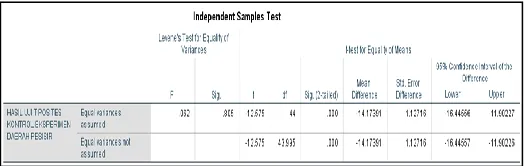
not use the student activity sheets integrated with scientific approach. In other words, H1 is accepted (H1 : µ1 ≠ µ2).
Table 1. The Result of T-Data of Post-test in Experimental and Control Classes in the Coastal Area
b.The results of the ttest of the post test result of problem solving skills to surrounding natural environment problems in the control class and the experimental class amount to 13,823 with a predetermined ttable 2,042. So, the results of the ttest<ttable are 13,832> 2,042. Thus, it can be concluded that the scores on surrounding natural environment problem solving skill test to the fourth grade students in the experimental class in the highlands that used student activity sheets integrated with scientific approach are higher than that in the control class that did not use the student activity sheets integrated with scientific approach. In other words, H1 is accepted (H1 : µ1 ≠ µ2).
Table 2. The Result of T-Data of Post-test in Experimental and Control Classes in the Highland Area
b. The results of the ttest of the post test result of problem solving skills to surrounding natural environment problems in the control class and the experimental class amount to 8,993 with a predetermined ttable 2,042. So, the results of the ttest<ttable are 8.993> 2.042. Thus, it can be concluded that the scores on surrounding natural environment problem solving skill test to the fourth grade students in the experimental class in the urban area that used student activity sheets integrated with scientific approach are higher than that
in the control class that did not use the student activity sheets integrated with scientific approach. In other words, H1 is accepted (H1 : µ1 ≠ µ2).
Table 3. The Result of T-Data of Post-test in Experimental and Control Classes in the Urban Area.
Based on those data, the results of the ttest obtained by the students in the experimental class using the student activity sheets integrated with scientific approach in the learning process are higher than that in the control class. This is because the students in the experimental class used the activity sheets that are integrated with scientific approach so they directly interacted much more with the surrounding natural environment and the existing community. Therefore, it could stimulate students' ideas in finding solutions to the surrounding natural environment problems.
4.
CONCLUSION
Student activity sheets integrated with scientific approach can ideally improve students' skills in solving environmental problems because the activity sheets contain steps that can encourage students to actively observe, search, proceed and convey the data of the problems that occur in the surrounding environment. Simply, the life of the natural environment around the students becomes the object of learning that is consequent with the scientific approach. Especially if the student activity sheets are innovated, it will boost up students’ sciential spirit in uncovering learning material in the surrounding natural environment freely (Podolak & Podolak, 2013). The student activity sheets should present a material that is exactly similar to the surrounding environment. This is in accordance with Ausubel's famous theory of "Meaningful Learning" which means that children learn well if the material is acceptably defined and taught in a good method as well. The student activity sheets integrated with scientific approach that contain good quality material may not be comprehended well by students if the instructor cannot convey it properly. Through various images or texts that describe the natural environment around students in the student activity sheets, it will greatly support students' curiosity and awareness. In Piaget's theory, it is known as "Cognitive Development" that states that children's cognitive is built according to the level of development and experience toward surrounding natural environment. The student activity sheets integrate the scientific approach that presents the actual state of the natural environment around the students in the form of images, so it will greatly help students grow cognitive students. Especially, the elementary school students in the fourth grade, which according to the theory, the child is in the concrete operational stage. The child is able to think logically and critically, focuses, be able to respond to any problems that he face. In addition, in its development, Piaget's theory was developed by Vygotsky called the "Constructivistic" theory which commands that children to learn and cognitively increases if the learning can be interpreted well, uses good language, and is influenced by interactions with the surrounding natural environment. The three are elements are interconnected and require the student activity sheets that are integrated with scientific approach to present it with good interest, use comprehensible speech and the teacher is able to teach material in a good method that can foster a spirit of exploration about student experience.
will not get bored quickly in working on questions or tasks because there are interesting illustrations and images in each command. It is supported by Bruner's theory which is known as "Discovery Learning" that students will discover their own learning material independently along with observing, searching for data, and processing data from the given commands. The students learn to think and discover the material themselves with commands and attention to the given illustrations.
5. REFERENCES
[1] “Astuti, Y., & Setiawan, B. (2013). Pengembangan lembar kerja siswa (LKS) berbasis pendeka-tan inkuiri terbimbing dalam pembelajaran kooperatif pada materi kalor. Jurnal Pendidikan IPA Indonesia. https://doi.org/10.15294/jpii.v2i1.2515 Dembo, M. H. (2001).”
[2] “Astuti, Y., & Setiawan, B. (2013). Pengembangan lembar kerja siswa (LKS) berbasis pendeka-tan inkuiri terbimbing dalam pembelajaran kooperatif pada materi kalor. Jurnal Pendidikan IPA Indonesia. https://doi.org/10.15294/jpii.v2i1.2515.”
[3] “Dembo, M. H. (2001). Learning to teach is not enough - Future teachers also need to learn how to learn. Teacher Education Quarterly.”
[4] “Gürses, A., Çetinkaya, S., Doğar, Ç., & Şahin, E. (2015). Determination of Levels of Use of Basic Process Skills of High School Students. Procedia - Social and
Behavioral Sciences.
https://doi.org/10.1016/j.sbspro.2015.04.243.”
[5] “Irwanto, I., Saputro, A. D., Rohaeti, E., & Prodjosantoso, A. K. (2018). Promoting Critical Thinking and Problem Solving Skills of Preservice Elementary Teachers through Process-Oriented Guided-Inquiry Learning (POGIL). International Journal of Instructio.”
[6] “Krombaβ, A., & Harms, U. (2011). Acquiring knowledge about biodiversity in a museum — are worksheets effective? Journal of Biological Education. https://doi.org/10.1080/00219266.2008.9656134.” [7] “Lee, C.-D. (2016). Worksheet Usage, Reading
Achievement, Classes’ Lack of Readiness, and Science Achievement: A Cross-Country Comparison. International Journal of Education in Mathematics,
Science and Technology.
https://doi.org/10.18404/ijemst.38331.”
[8] “Ozrecberoglu, N., & Caganaga, C. K. (2018). Making it count: Strategies for improving problem-solving skills in mathematics for students and teachers’ classroom management. Eurasia Journal of Mathematics, Science and Technology Education. https://doi.org/.”
[9] “Prastowo, A. (2014). Panduan Kreatif Membuat Bahan Ajar Inovatif. Jogjakarta: Diva Press.”
[10] “Prevost, L. B., & Lemons, P. P. (2016). Step by step: Biology undergraduates’ problem-solving procedures during multiple-choice assessment. CBE Life Sciences
Education. https://doi.org/10.1187/cbe.15-12-0255.” [11] “Saygılı, G. (2012). Determination of the Problem