Licensed under Creative Common Page 352
http://ijecm.co.uk/
ISSN 2348 0386
INVESTIGATING NON-COMPLIANCE WITH
PROCUREMENT DOCUMENTATION AND RECORDS
KEEPING IN TANZANIA PUBLIC PROCUREMENT
Mordecai Chrysostom Matto
Institute of Accountancy Arusha, Tanzania [email protected]
Haruna Issa Athumani
Institute of Accountancy Arusha, Tanzania [email protected]
Abstract
A record keeping is a fundamental activity of any government. More importantly, good records
management is essential for measuring public procurement performance. In Tanzania, despite
section 61(1) of PPA 2011 to emphasize maintaining procurement records, each year
non-compliant behavior on record keeping is reported by the oversight bodies. This study assessed
reasons for non-compliance with procurement documentation and record keeping and why they
occur. The study adopted a descriptive survey as a research design where 155 procuring
entities were sampled. Self-administered questionnaires were prepared online using Google
forms. The questionnaires were filled by procurement practitioners in 118 procuring entities in
Tanzania between February and August 2018. This study confirms that non-compliance with
procurement records and documentation caused by three major factors, namely, the absence of
procurement records procedure manual, procurement practitioners of procuring entities had not
trained in records management, and management of procuring entities has not provided the
adequate support towards records management.
Licensed under Creative Common Page 353 INTRODUCTION
Every nation has records laws that create the need for effective records management. Basing on this view, a record keeping is a fundamental activity of any government. Records management includes the establishment of a structure for records management and their disposal. Records are accessible sources of information and evidence that enhance good governance and decisions making (ISO 15489–1:200; Keorapetse & Keakopa, 2012; PPOA,
2008; Öberg & Borglund, 2006; OECD 2007). To put it differently, the public servants must have information to carry out their work. With respect to this, records represent a particular and crucial source of information. By implication, records evidence compliance or non-compliance with laws, rules, and procedures. Surprisingly, record keeping in sub-Saharan Africa has been a low priority in governments (Asogwa, 2012). Specifically, in procurement Ntayi et al. (2010) and Ahimbisibwe (2014) voiced their concern that the public sector has problems of keeping a complete record in the procurement process. Tukamuhabwa (2012) identify lack of systematic approach on managing records in developing countries that results in most of the records to contain inadequate information. Unfortunately, that inadequate information in records management had an adverse effect on supplier performance and good governance (Kemoni & Ngulube, 2008). Therefore, good record management is essential for measuring public procurement performance (Mrope et al., 2017; Mlinga, 2006).
Licensed under Creative Common Page 354
procurement records, procurement records were scattered in various departments, inadequate storage facilities and inadequate space for keeping procurement records. This research, therefore, assessed reasons of occurrence for non-compliance with procurement documentation and record keeping.
LITERATURE REVIEW
The term record keeping is used to mean all activities of making and maintaining complete, accurate and reliable evidence of official business in the form of recorded information (PPOA, 2008). In relation to this view, a record is more than just information, it is supposed to be trustworthy: reliable and authentic, able to serve as evidence, and to support accountability (Öberg and Borglund, 2006).
Theoretical Perspective: Record Management Theory
This study is grounded in record management theory based on the reprint by Michael Buckland in 1994. According to him, records management can be perceived in functional, professional, and intellectual contexts. This will depend on the role of records toward achievement of the organization’s goals. First, in the context of the organization, the mission of a records
management service needs to be related to and supportive of the mission of the organization as a whole (Greenhalgh et al., 2008). Second, in professionalism context, records management is seen as one member of a family of retrieval-based information systems both manual and electronic. Third, in the intellectual perspective, Buckland (1994) argue that the idea is a fundamental source of records management. This theory brings number contributions to our understanding of procurement records and documentation. Procurement records and documentation should serve the organization mission and objective. Further, the life of the record, documenting style, its archival will depend on the policy as well as procedures of the particular organization. Thus, in some ways, procurement records should be integrated with the overall record management policy of an organization. In addition, records management is a profession like any other profession, therefore procurement practitioners should receive training on how to manage records manually and electronically.
Procurement Records Keeping as per the PPA, 2011
Licensed under Creative Common Page 355
Procurement Act of 2011”. The PPA 2011 has the following requirements on procurement
records management.
Section 9(1)(g) requires PPRA to conduct periodic inspections of the records.………. of
the procuring entities to ensure full and correct application of this Act;
Section 9(2)(b)&(d-e) requires PPRA to have access to all books, records, documents,……. belonging to the procuring entity, tenderer whether in the possession of
any officer of a procuring entity or a tenderer;
Section 18(2)(b) requires PPRA (where deemed necessary) may examine such records
or other documents and take copies or extracts there from;
Section 34(b) tender board have the power to examine such records or other documents
and take copies or extracts therefrom;
Section 38(l) one functions of PMU is to maintain and archive records of the
procurement and disposal process;
Section 39(1)I one functions of PMU is to maintain and archive records of contracts
management;
Section 61 requires procuring entity to maintain a record of its procurement proceedings
in which it is involved, including decisions taken and the reasons for it and such record shall be kept for a period of not less than five years from the date of completion of the contract and be made available when required to the Minister and the Controller and Auditor General;
Section 64(3)(b) requires procuring entity, when used non-competitive procurement method, to include in the records….a statement of the grounds for its decision and the
circumstances leading to, or justifying the restriction;
Section 104(2) states that a failure or refuse to give information, produce any document,
records is an offense;
105(2)(o) requires a minister to make regulations prescribing the manner and duration
for keeping procurement records by procuring entity; and
Section 7 of the third schedule requires the Public Procurement Appeals Authority to
record in writing, the proceedings at the hearing by the members or by any other authorized person;
Management Support and Procurement Records Keeping
Licensed under Creative Common Page 356
resources (Bruqué-Cámara et al., 2004). Top management plays a crucial role in deciding what area should the investment is directed so as to enhance the proper record keeping. Top management decision in important in providing and facilitating the required resources for the success of any project (Staehr, 2010). Green (1995) reiterates that the projects with top management support were less likely to be unsuccessful. Therefore, top management is an important source to achieve organizational goals.
Training and Records Keeping
In investigating records management, Kusi et al., (2014) found a major challenge to be cumbersome documentation processing and record keeping. The same study recommends practical training on areas of procurement records keeping. This could increase procurement practitioners with appropriate knowledge on records management specifically in procurement and PPR as well as guidelines and the standard documents prepared by PPRA. According to PSPTB code of ethics and conduct (2009) records keeping is a professional requirement in procurement. Therefore, training on record keeping enhances compliance on public procurement act and its regulation. Trepte (2005) compliments the professionalism on record keeping that it provides the procurement practitioners skills and knowledge that is boosting their compliance in the management of procurement and become efficient and economic.
Procedural manual and Procurement Records Keeping
Having a procurement guide is essential to ensure consistency and uniformity among users. This helps to reduce the gaps and challenges that undermine the effective and efficient management of procurement records management. The manual identifies the office responsible for control, coordination, maintenance and the disposal of records. NPPP (2012) identifies the lack National public procurement policy in Tanzania that is important in providing guidelines and procedures including establishing adequate procedure manual on procurement record keeping significantly enforces compliance in procurement.
METHODOLOGY
The study adopted a descriptive survey as a research design. The study was undertaken in Tanzania’s public procuring entities. According to the statistics obtained from PPRA website, as
Licensed under Creative Common Page 357
design, size of the sampled population and using a general rule as advocated by Saunders et al., (2009) we used 30 percent of the accessible population as a sample size and resulted into 155 procuring entities. Self-administered questionnaires were prepared online using Google forms. The questionnaires were of a five-point Likert scale, multiple choice and yes or no questions to respond. The respondents were given a link to the questionnaire (https://docs.google.com/forms/d/e/1FAIpQLSdOwX2bSyUR-3R4trVQIUzV5xbAICwtTQobmM HmLQ7VtkrIww/viewform?usp=ppurl&entry.1495167749) to respond. The respondents from procurement management units (PMU) were purposely selected from the procuring entity. The reason for using purposive sampling selection was because the researchers target procurement staffs from PMU who according to the PPA, 2011 are responsible for the custodian of procurement records. The respondents were free to fill a questionnaire using a computer, mobile phone or other electronic devices subject to the availability of internet connection. The collected data was processed online using Google forms.
RESULTS AND DISCUSSION
The questionnaires were filled by procurement practitioners in 118 procuring entities in Tanzania between February and August 2018. The characteristics of respondents by gender indicated that male respondents were almost half of the female who responded to the questionnaires by 68.3% to 30% and 1.7% preferred not to mention their gender category. This implies that there was no gender equality in responding to the survey. Further, the questionnaire required respondents to indicate their education and experience in procurement functions. The finding revealed that, respondents with master’s degree (36.7%), professional qualifications
(33.3%), and advanced diploma /first degree (30%). Likewise, on experience aspect, the respondents about (45%) had working experience between 5–10 years, followed by (30%) with work experience between 1–3 years, (16.7%) had work experience of between 3-5 years, and
then (8.3%) had work experience of more than 10 years. This implies that majority of our respondents were well educated to carry out procurement functions and had a mixed experience of different levels from those with less experienced to those with a good working experience to perform procurement functions effectively and efficiently in either PMU or user department.
Licensed under Creative Common Page 358
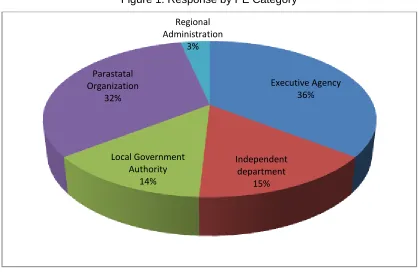
councils, as well as regional administrative offices. Figure 1 below depicts the responses from the survey done of a different category of procuring entities with more respondents from procuring entities falling under executive agency by 36%, followed by the parastatal organizations by 32%, independent department by 15%, local government authorities by 14% and Regional administration offices by 3%.
This indicates that our survey covered almost all of the areas where public procurement is done. It may be seen that regional administrative have few respondents but this does not mean response rate is low but it is because there few regional offices comparing to other categories of public procuring entities.
Figure 1: Response by PE Category
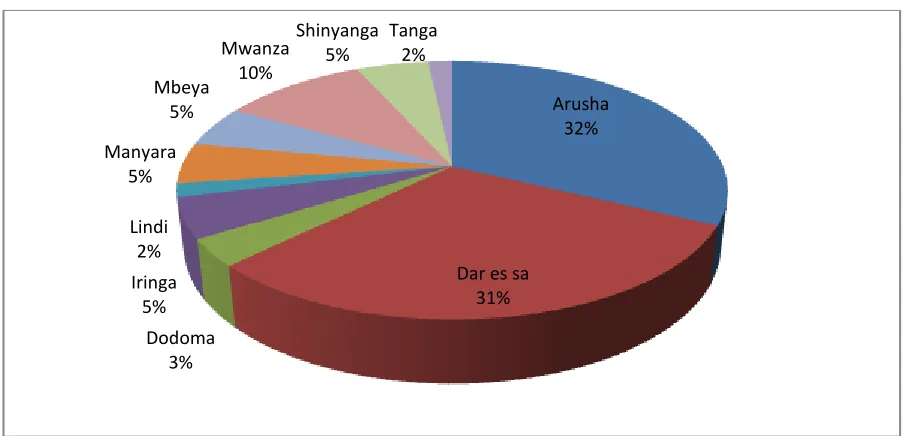
Tanzania mainland has 26 regions; our respondents according to figure 2 below were from 11 regions which are 42% of all regions with Arusha leading with number of respondents by 32% followed by Dar-es Salaam with 31%, then Mwanza 10%, Shinyanga 5%, Iringa 5%, Mbeya 5%, Manyara 5%, Dodoma 3%, Lindi 2% and Tanga 2%. However, it should be clear that before government to move its headquarters from Dar es salaam to Dodoma, 42% of PEs were found in Dar es salaam region followed by Arusha (5%), Dodoma (3.8%), Mbeya (3%), and Mwanza (2.5) [extracted from http://tenders.ppra.go.tz/pe-directory.php]. This implies that our respondents were covered adequately in region wise.
Executive Agency 36%
Independent department
15% Local Government
Authority 14% Parastatal Organization
32%
Regional Administration
Licensed under Creative Common Page 359
Figure 2: Response by Region
Custodian of Procurement Records within Procuring Entities
The respondents were asked the custodian of procurement records. This question follows section 61 of PPA, 2011 and regulation 15 of GN No. 446 of 2013 which requires the PEs to maintain records of the procurement or disposal proceedings. The results indicated that 73% of respondents confirm that procurement records are kept by PMU, while 17% their records are scattered to different departments, followed by 5% in which procurement records are kept by user department, and registry section. Therefore, despite 73% PEs have complied with section 61 of PPA, 2011, however, 27% of PEs was not complying with the section under discussion.
The Influence Procurement Record Keeping
The respondents were asked to rank their preference on the most influential factors affecting records keeping. The first factor ranked was concerning the availability of a complete record from initiation to contract management stage. The second-ranked was the arrangement of all records concerning procurement or disposal of asset in successive stages of procurement process, followed by the adequate space for archiving procurement and disposal of asset records for security and easy accessibility when they are required, and adequate facilities for archiving procurement and disposal of asset records for security and easy accessibility when they are required. The factors on keeping in a single file all records concerning certain procurement and disposal of the asset was least preferred. The response to this question has established that complete procurement records from initiation to contract stage is essential and it can affect the performance of procurement function.
Arusha 32%
Dar es sa 31% Dodoma
3% Iringa
5% Lindi 2% Manyara
5% Mbeya
5%
Mwanza 10%
Shinyanga 5%
Licensed under Creative Common Page 360 Procurement Records Management Procedures Manual
This study reveals that unavailability of procurement records management manual for the public sector to maintain uniformity and consistency among PEs is one of the barriers to effective procurement records keeping. In Tanzania, there are no procurement records management procedures manual to provide theoretical and practical guidance for management of procurement records. The PPRA is responsible for issuing guidelines from time to time subject to the power vested under section 106 of the PPA, 2011. Therefore, the study argued to the regulatory authority of procurement to prepare procurement records management manual. We emphasize that procedure manual increase obligation and uniformity to the procuring entities and later on boosting the overall compliance in public procurement.
Training on Management of Procurement Records
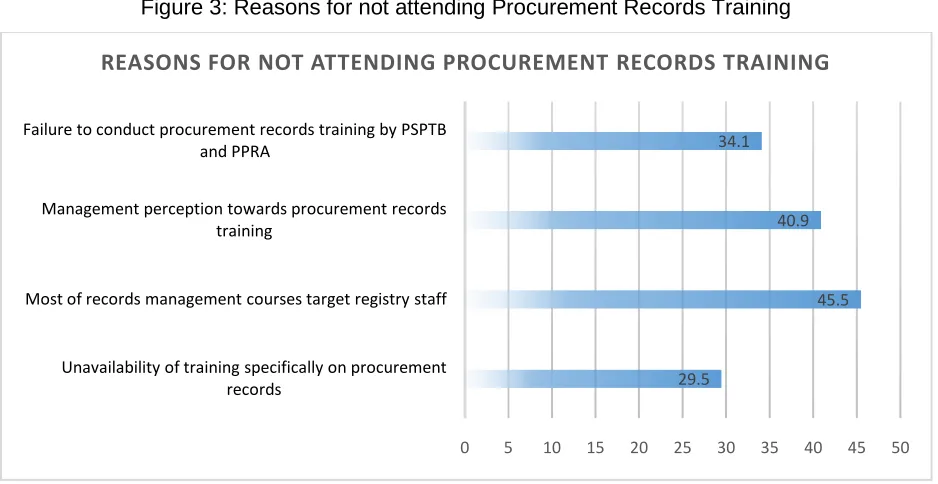
The literature reviewed above suggest that training on record keeping enhances compliance on public procurement act and its regulations. In this survey, we asked procurement officers in the public sector to confirm whether had ever attended training specifically in procurement documentation and records keeping within the last 5 years. Further, we had the interest to know the reasons for not attending such training. The reasons were grouped using the following headings, namely, unavailability of training specifically on procurement records, most of records management courses targeted registry staff, management perception towards procurement records training, failure to conduct procurement records training by PSPTB and PPRA.
Licensed under Creative Common Page 361
Figure 3: Reasons for not attending Procurement Records Training
One of the key assumptions in this study is that, training of practitioners leads to increased skill to apply knowledge of the procurement records and documentation consequently improving their compliance in public procurement. Further, intensive workshop is required (not only to procurement officials but also information technology staff) in order to implement the procurement management information system (PMIS). The documentary review data has indicated weaknesses in the management of e-records. For instance, the following documents were not submitted to the PPRA through the PMIS: annual procurement plan, complete checklist, contract completion report, monthly procurement reports, quarterly procurement reports and annual procurement reports.
Management Support
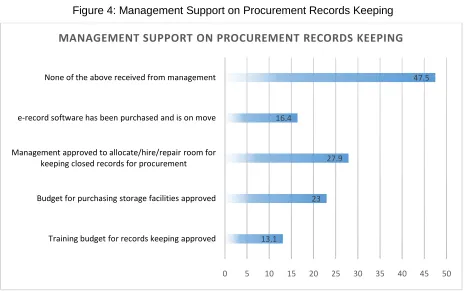
The comments by Staehr (2010) bring the attention that, the top management support is important in providing and facilitating the required resources for the success of any project. Basing on this view, we asked procurement officers to confirm the support provided by the management toward compliance with procurement documentation and records keeping. The questionnaire survey required respondents to select relevant support based on the five aspects, namely, training budget for records keeping approved, budget for purchasing storage facilities approved, management approved to allocate/hire/repair room for keeping closed records for procurement, e-record software has been purchased and is on move, and lastly none of the above received from management (see figure 4).
29.5
45.5 40.9 34.1
0 5 10 15 20 25 30 35 40 45 50
Unavailability of training specifically on procurement records
Most of records management courses target registry staff Management perception towards procurement records
training
Failure to conduct procurement records training by PSPTB and PPRA
Licensed under Creative Common Page 362
Surprisingly, 47.5 percent of the respondents perceived that, they had not received any support from the management despite several requests submitted. Further, 27.9 percent of the respondents perceived that, management approved to allocate/hire/repair room for keeping closed records for procurement, 23 percent of the respondents perceived that, budget for purchasing storage facilities approved by the management, 16.4 percent of the respondents perceived that, e-record software has been purchased and is on move, and 13.1 percent of the respondents perceived that, training budget for records keeping approved.
Figure 4: Management Support on Procurement Records Keeping
From the findings above (figure 4) it can be noted that practices towards records keeping differ from one entity to another. However, half of the sampled population confirms that management has not availed adequate efforts on record keeping. This is supported by recent procurement audit (year 2016/2017) conducted by PPRA which revealed the manual record score was 68% while electronic records score was 48% and the year targeted score was 80%. The major weaknesses related to this were inadequate storage facilities as well as inadequate space for keeping procurement records. Therefore, our major argument is that, the management that is not investing in records keeping and documentation is less likely to comply with section 61(1) of PPA 2011 and vice versa.
13.1
23 27.9 16.4
47.5
0 5 10 15 20 25 30 35 40 45 50
Training budget for records keeping approved Budget for purchasing storage facilities approved Management approved to allocate/hire/repair room for
keeping closed records for procurement e-record software has been purchased and is on move
None of the above received from management
Licensed under Creative Common Page 363 CONCLUSION
The literature reviewed in this study confirms that, a record is more than just a piece of information. The record is supposed to be trustworthy, reliable and authentic, able to serve as evidence and to support accountability (Öberg and Borglund, 2006). A sound records management system is essential for effective policy formulation, decision making, business operations, implementation and monitoring of programs and activities (PPOA, 2008 p.15).
Further, this study confirms that non-compliance with procurement records and documentation caused by three major factors. First, the absence of procurement records procedure manual to guide procuring entities on records keeping. With this regard, the study recommended the regulatory authority of procurement to prepare procurement records management manual. This is because procedure manual increase obligation and uniformity to the procuring entities and later on boosting the overall compliance in public procurement. Second, procurement practitioners of procuring entities had not trained in records management. The study proposed that, training of practitioners leads to increased skill to apply knowledge of the procurement records and documentation consequently improving their compliance in public procurement. Third, management of procuring entities has not provided adequate support towards records management. The major argument in this study is that, the management that is not investing in records keeping and documentation is less likely to comply with section 61(1) of PPA 2011 and vice versa.
This study opens up further discussion in the field of procurement and records management. The scope of this study was limited to the three variables (manual, training, & management support) which influence compliance level. However, basing on the literature, there are several controllable and uncontrollable factors which influencing records management. Further, research should be carried out to determine the extent to which record management risk affect the compliance level in public sector procurement. The most identifiable risks are categorized in terms of control, information, and resources (Egbuji, 1999). Based on the collected data, there is feelings from procurement officers that the requirements in the “Records and Archives Management Act of 2002” contravenes with the “Public Procurement Act of 2011”. We recommend further study to analyze critically the two
Licensed under Creative Common Page 364 REFERENCES
Ahimbisibwe, A. (2014). The influence of contractual governance mechanisms, buyer-supplier trust, and supplier opportunistic behavior on supplier performance. Journal of African Business, Vol. 15 No. 2, pp. 85-99
Asogwa, B.E (2012). The challenge of managing electronic records in developing countries: Implications for records managers in sub Saharan Africa. Records Management Journal, 22(3), 198-211, https://doi.org/10.1108/09565691211283156.
Bruqué-Cámara, S., Vargas-Sánchez, A., & Hernández-Ortiz, M.J. (2004). Organizational determinants of IT adoption in the pharmaceutical distribution sector. European Journal of Information Systems, 13(2), 133-146.
Buckland, M., (1994). Perspective: On the nature of records management theory. American Archivist, (57) 346-351. Egbuji, A. (1999). Risk management of organizational records. Records Management Journal, 9(2), 93-116, https://doi.org/10.1108/EUM0000000007245.
Greenhalgh, T., Stramer, K., Bratan, T., Byrne, E., Mohammad, Y., Russell, J. (2008). Introduction of shared electronic records: Multi-site case study using diffusion of
innovation theory. BMJ, (337), 1786.
Green, S.G. (1995). Top management support of R&D projects: A strategic leadership perspective. IEEE Transactions on Engineering Management, 43(3), 223-232.
International Standards Organization, 2001, ISO 15489-1:2001 Information and documentation: Records management standard, ISO, Geneva.
Kemoni, H. & Ngulube, P. (2008). Nations relationship between records management, public service delivery and the attainment of the United Nations Millennium Development Goals in Kenya. Information Development, 24 (4), 296-306. Keorapetse, D.L., and Keakopa, S.M., (2012). Records management as a means to fight corruption and enhancing accountability in Botswana. ESARBICA Journal, 31, 24-35.
Kusi, L.Y, Aggrey, G.A.B, Nyarku, K.M. (2014). Assessment of Public Procurement Policy Implementation in the Educational Sector (A Case Study of Takoradi Polytechnic). International Journal of Academic Research in Business and Social Sciences, 4(10), 260-278.
Mlinga, R.S. (2007). Procurement Monitoring in the Tanzanian Public Sector. Public Procurement Regulatory Authority. Dar es Salaam, Tanzania. Retrieved from: https://azslide.com/procurement-monitoring-in-the-tanzanian-public-sector_5a28cc7d1723dd878d4a25c2.html.
Mrope, N.P., Namusonge, G.S., & Iravo, M.A. (2017). Does Compliance with Rules Ensure Better Performance? An Assessment of the Effect of Compliance with Procurement Legal and Regulatory Framework on Performance of Public Procurement in Tanzania. European Journal of Logistics, Purchasing and Supply Chain Management, 5(1), 40-50.
National Public Procurement Policy 2012 (first draft). (2012, September 10). Retrieved from http:
//www.mof.go.tz/mofdocs/anouncement/THE%20NPPP-%20FIRST%20DRAFT%20SEPT-2012%20A%2010%20(1)%20AA-3%2018.pdf.
Ntayi, M.J., Namugenyi, I. and Eyaa, S. (2010). Supplier delivery performance in Ugandan public procurement contracts. Journal of Public Procurement, 10(4), 479-511.
PPOA (2008, December) Procurement Records Management Manual
Public Procurement Act 2011. (2011, December 30). Retrieved from https://www.ppra.go.tz/ phocadownload/attachments/Act/Public_Procurement_Act_2011.pdf.
Public Procurement (Amendment) Act 2016. (2016, July 7). Retrieved from https://www.ppra.go.tz/phocadownload/attachments/PPA_Ammendment_Act_2016.pdf.
Public Procurement Regulatory Authority (2014, 2015, 2016 & 2017). Annual performance and evaluation report for the financial years 2013/2014, 2014/2015, 2015/2016 & 2016/2017 [Report]. Retrieved from: http://tenders.ppra.go.tz/tanzania-procurement-journal.php?id=2.
Öberg, L-M and Borglund, E. (2006). What are the characteristics of records? International Journal of Public Information Systems, 1, 55-76.
Licensed under Creative Common Page 365 Saunders, M., Lewis, P., & Thornhill, A. (2009). Research Methods for Business Students (5th ed.). Harlow: Financial Times Prentice Hall.
Staehr, L. (2010). Understanding the role of managerial agency in achieving business benefits from ERP systems. Information Systems Journal, 20(3), 213-238.
The procurement and supplies professionals and technicians code of ethics and conduct, 2009 (2009, November 6). Retrieved from https:http://www.psptb.go.tz/publication_categories/acts?mid=60.
Trepte, P., (2005). Ensuring accountability in public procurement: Bridging the information asymmetry in Fighting Corruption and Promoting Integrity in Public Procurement, OECD Publishing.