Fabrication Of Novel (PVA/NiO/SiC)
Nanocomposites, Structural, Electronic And
Optical Properties For Humidity Sensors
Hind Ahmed, Ahmed Hashim
Abstract: The nanocomposites are really promising for industrial, environmental and medical applications. In this work, new types of nanocomposites have been prepared from (PVA-NiO) and SiC for humidity sensor with high sensitivity and low cost.The experimental and theoretical studies on structural and optical properties of nanocomposites have been investigated.The optical microscope and FTIR studies were examined. In variation of wavelength(220–800)nm, the optical properties of nanocomposites were examined. Results showed thatthe optical absorbance of (PVA-NiO) increases with increasing of ((SiC)) nanoparticles concentrations. The energy gap decreases while the optical constants of ((PVA-NiO)) are increase by increasing of (SiC) nanoparticle concentration. In variety of humidity ((40–80)) RH.%. The different of electrical resistance for ((PVA-NiO-SiC)) nanocomposites with relative humidity is studied. The results showed that ((PVA-NiO-SiC)) nanocomposite have a great sensitivity for relative humidity.
Keywords: humidity sensors, metal oxides, density function theories, optical constant.
————————————————————
Introduction
At present, the field of polymeric nanotechnology, study of polymeric nanocomposites must involve many care given the wide range of applications. The polymer nanocomposites deeply trust on dimension delivery, combination, geometry , superficial chemistries the organic-inorganic nanoparticle by way of matrix/nanoparticle connections. However , possessions the nanocomposite which founded depended on sort nanoparticles, gratified the nanoparticle and the countryside of the physical , chemical binding by matrix's, polymer [1].Green chemistry is the application of technology and science to manipulate the matter at molecular and atomic scale. It has the ability to build macro and micro materials and products with atomic accuracy[2].Nanotechnology is not new in polymer science as previous studies were in the early era of nanotechnology. Nanoscale dimensions but were not specifically mentioned to as nanotechnologytill recently[3].Polymer nanocompositesit's polymer contains a nanoscale armored matrix (nanoparticle) like nanoparticles, nanotubes, nanoparticles and nanoparticles. etc. The physical properties of these compounds largely depend on the interaction between polymer molecules and nano-fillers[4].Polymeric nanocomposites are highly dependent on aggregation, volume distribution, geometry, surfaces chemistries the organics and inorganics nano-particles by way of nanoparticles communications [5] . Emerging nanocomposites could be a solution to regulate the properties of separate nanomaterial suitably .In the field of semiconductor materials, nanocomposites are widely used consisting of two or more materials to alter their electronic and optical properties [6].
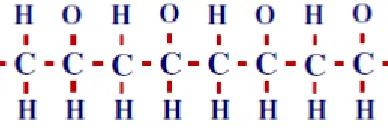
Due to its good dispersion capability in the polymeric system, nickel oxide (NiO) is considered a potential candidate in manufacturing nano-materials to multi-function requests. (NiO) nano-fillers is combined into polymer- matrix to grow polymer- nanoparticles by better electric and di-electric possessions. (Nickel – based) metals transitions oxides with extraordinary electro-chemical possessions must becomes novel type of energy storage material [7]. (Poly (vinyl alcohol) (PVA)) complicated upkeep many study because of the inspiring possessions as optically possessions, low cost, decent charges storage capacities, great dielectric strength, commercial availability and good mechanical [8].(PVA) have mainly using : insulating material, film or glue owing it is solubility's water [9]. (Poly (vinyl alcohol)) doesn't poisonous insulation with good transparency, a biocompatible synthetic polymer and the transmission of debauchery in the nano electrode composite interface [10]. (PVA) have (carbon chains) column with hydroxyl- group ((-OH)) associated with methane carbonate, and these groups (-OH) can be a basis to hydrogen bonding, and future help to form inorganic nanoparticle within (PVA) materials. [11], Figure(1) illustrations the structures to (poly(vinyl alcohol))[12].
Fig -1. structure of( polyvinyl alcohol).
Addition of NiO particles in the (PVA) matrix's predictable to attain conductive polymeric nanomaterials by single possessions that used as multi-functional materials to dissimilar requests[13].Transition metals carbides forms an stimulating class of materials in which cations and anions are kept together by a blend of robust covalent, metallic, and ionic bonds[14].Sensors are equipment that can notice external exciter and change them into consistent indication. Conservative sensors are typically stiff and cannot willingly distort,. In dissimilarity, stretchy sensors can be simply committed to many surfaces and can be used in portable _______________________________
Hind Ahmed and Ahmed Hashim
University of Babylon, College of Education for Pure Sciences, Department of Physics, Iraq.
electronics and wearable. stretchy sensors may permit applications in skin, electronic robot sensing , wearable health monitoring [15,16].Temperature and humidity are critical factors for both living the environment and creatures. Temperature sensing has been under stood out of many mechanisms such as the pyroelectric result[17],infrared radiation[18]and the thermal resistance effect[19].The humidity sensor essentially senses the relationship between sensor and moisture materials, like polymers, semiconductor ceramics, electrolytes, etc. [20] . Humidity defined as amount of water vapor in the air. At the top of the crystalline grains in the places that are run in the surface, the reaction of a specific amount of water vapor molecules is chemically intensified (chemical absorption), which is brought by separation, a mechanism for steam molecules to form hydroxyl groups, (hydroxyl ions) water molecule). As a binding between the adsorbed water and the surface ions of grain neck, the hydroxyl group is absorbed from every water molecule by metals cation situated to ounce surface and have countless densities aimed at charge carriers and strong electrostatic fields, therefore producing a movable protons. Protons travel from one spot to another on the surface and respond with adjacent O-2 groups (oxygen surface) to form a second hydroxyl group(−OH)[20,21].In biological processes, chemical and physical, humidity is an important issue[22]. Understanding the complex communication between polymeric material (PVA-NiO) and SiC nanoparticles, we have been made using a comparison of experimental results and a theoretical method density functional theory (DFT). It's main technique of quantum's mechanical simulated of cyclic schemes. Its assumed through quantum's chemist then now extensively use to mimic of energy surfaces to molecules [23].The drive to these works, construction a novel sorts ofnanocomposites for humidity's sensor . The produced humidity sensors have high sensitivity, low cost, low weight and flexible compare with other humidity sensors which are fabricated by previous researchers. Also, the present work include the experimental part and theoretical part by using density functional theory (DFT).
Theoretical Part
The optical properties of nanomaterials depend on criteria such as shape, surface properties, feature size, and other variables including steroids and interaction with the
surrounding environment or other
nanostructures[16].Polymers containing oxides of metallic nanoparticles are investigating additional material aimed at optically requests like planer wave-guide device then fine optically element. Growth the nanoparticle polymers structures resulting from their convenience in manufacture , dispensation, decent contact through reinforcing element, resilient to ecological erosion, lights bulk and elongated mechanicals presentation[17,24].Study of optical properties of large-scale polymeric requests in optical , electronic strategies, alike fuel cell, solar cell, technological, medicinal , solids battery requests[25].Optical linear absorption coefficient obtained using Beer Lumber's relation:
t
A
303
.
2
……..(1)(A) is define as (log (I0/IT)) ,(I0) and (IT )are event and
conveyed forte beams individually, (t) samples thickens [26].The lengthily to optically constant like multifaceted di-electric functional ((real and imaginary)),extermination constant ((k)), indexes refractivity ((n)) are real important to study solids thin materials,optical properties. R a unoccupied is the usual incidence reflectivity and calculate by [27]:
(R) = ((n-1)2)+k2 /((n+1)2)+k2…...(2)
refractive index ((n))intended by calculation[28]: (n) = (1 + R01∕2) ∕ (1 – R01∕2)….(3)
Allowed direct indirect optical transformations can be evaluated by the presence of a straight line in the strong absorbent spectral region through the Tauc relationship. Absorption coefficient can be assumed by photon energy:
r opt g
E
h
B
h
)
(
)
(
0
..(4)(Eg), (hν) the optically bands gap then photons energies, correspondingly, it's with value,((2, 3, 1/2 or 3/2)) to transitions chosen as (indirect permitted) , (indirect prohibited), (direct permitted) and (direct prohibited), correspondingly [29]. calculations value to optically energies bands gap comprises the calculating of ((αhν)1/r
) through (hν)[30].
extinctions coefficients ((k)) calculation through[31]: K = αλ∕ 4π…(5)
real parts ((εr)) , imaginary((εi)) part di-electric constants
could intended through next relations[29]: εr= n
2 – κ2…(6) εi= 2nκ….(7)
Optically conductivity(σopt) is electrically conductivities causing movement to charges carry due to intermittent electrical fields to incidents electr-omagnetic wave,, giving through use equations[32]:
σopt = αnc ∕ 4π..(8)
FMOs (boundary molecular orbits) known as HOMO and LUMO represent the ability to give or accept electrons respectively in any compounds and play an important role in their chemical reactions and electronic properties. HOMO, the highest orbital energy (far) containing electrons, is the orbit that acts as a donor for the electron. Then, LUMO, is the lowest (deepest) orbital energy that has space to accept electrons [33]. The difference between the highest levels of full molecular orbital energy and the lowest molecular orbital energy is not mentioned in the band gap calculated by Koopmans's theory [34].
Eg= ELUMO - EHOMO……..(9)
In molecular orbital (MO) theory within the limitation of Koopmans' theorem [35], the orbital energies of the frontier orbitals are given by:
IP= -EHOMO…….(10) EA= -ELUMO…….(11)
According to Koopmans formula, it defines negative charge values to average energies level of HOMOs , LUMOs[23]:
( )
…… (12)
The chemical hardness (η) is a measure of the resistance to charge transfer. Finite difference approximation to chemical hardness gives[36]:
……(13)
The global chemical softness, S, is a property of molecules that measures the extent of chemical reactivity. It is the
……(14)
The Electromagnetism is defined as an indicator that measures energy stability when the system acquires an additional electronic charge from the environment [38]. ….(15)
Cohesive energy is defined as the energy required to separating the condensed material into isolated free atoms. The cohesive energy Ecoh is given by[39]:
Ecoh =(Etot / n)-E free- E0.…(I6)
To determine the presence of correlation arrangements , function group in infra-redspectroscopy, the complex is an real valued spectrometer implemented to these drive by absorbing lights in infrared range of electro-magnetic spectra[40]. The nitrogen atom system absorbs the amount of energy that will oscillate with three degrees of freedom for both translation and rotation, and (3N-6) degrees of freedom for vibration of ring molecules. System oscillations have two types of ranges, primary and non-fundamental oscillation ranges. Core bands are associated with further changes in bipolar moments and are categorized according to high intensity such as long oscillations, deformation, vibration, shaking, rolling and bending while non-core and hot bands and bands have low intensity [33].
Experimental Part
Nickel oxide nanoparticles ( NiOused as powder from Nano ShelUSA company with size (30nm) and high purity(99.9%). ((SiC)), it was obtained as powder from US Research Nano-materials, Inc, USA with size (<80nm,cubic)and great purity (99.%). Polyvinyl alcohol (PVA) used as powder with high purity (99.8%).The polyvinyl alcohol-Nickel oxide- Silicon Carbide nanocomposites prepared by use casting technique of concentrations((98.5wt.%)) of (polyvinyl alcohol), and(1.5 wt.%) Nickel oxide nanoparticles. The Silicon Carbide (SiC)
nanoparticles were added to (PVA- NiO) nanocomposites , with changed weight percentages are (x= 0, 1.5, 3, 4.5 and 6) Wt.%. The optical absorbance was recorded by UV/1800/Shimadzu spectrophotometer in range of wavelength (220–800) nm. The specimen was positioned in case and was used vapor of the water as a source of humidity. For different humidity yield(40–80RH.%),the electrical resistance measured using a Keithly electrometer sort 2400 source of mater.
Results and Discussion
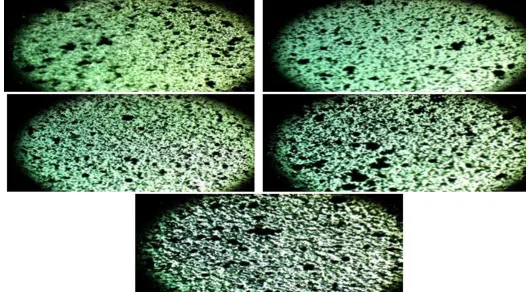
Fig.((2)) illustrations the absorption different of ((PVA-NiO-SiC)) in wave length of the event lights. From figure shows increase absorptions to totally sample of (UV) range, this is since irritation electron from occupied bands level to conductions bands on this energy[41].With increasing of concentrations for nanoparticles, the absorbance of (PVA-NiO-SiC)nanocomposites is increasing and this is because of the accumulation of nanoparticle through increase concentrations then increasing numerical value of charges carry[42], Figure.(3).In contrast, geometry of nanocomposites was theoretically calculated. geometry to nanocomposites determine numerous of physically and chemically possessions. It's essential to discovery relaxationof nanocomposites, which optimize structures of the nanocomposites is the structure a minimum energy. Fig.(4) show the optimize structure, was got by (DFT) technique use the (three-parameter hybrid-functional of Becke) ((B3LYP)) with((6-31G)) basis set. More than one model of nanocomposites with different length of polymer chains has been tested and thus a difference in the number of atoms that forming the nanocomposites, thereby; it has been investigation that it is possible increasing the concentration of the nanocomposites both theoretically and practically.
Fig.3.Photo-micrograph (×10) for(PVA-NiO-SiC). A- pure, B- 1.5 wt% SiC nanoparticles ,C- for 6wt% SiC.
Fig. 4.Optimized geometry for (PVA-NiO-SiC)contain(46Atom) at the (B3LYP/ 6-31G basis set). Table (1) illustrations geometric parameters
((PVA-NiO-SiC)) nanocomposite involved the bond length in Angstrom and bond angle in degree by using the Gaussian 09 package of programs by employing the DFT with the B3LYP/6-31Glevel .It has been deduced that the DFT method is an efficient to estimate the optimized structure of
Table1: Average bond lengths in (Å) and angles in degree.
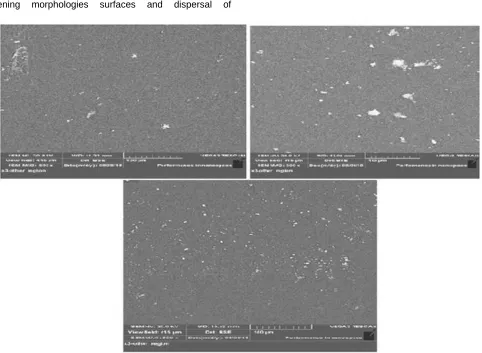
The scattering the nanoparticle in a polymer matrix is one of greatest significant standards in the manufacture of nanoparticles. SEM is an outstanding techniques to screening morphologies surfaces and dispersal of
nanoparticle in polymeric nanocomposite. As shown in Figure (5) micrographsof SEM (PVA-NiO) by increase attention of SiC nanoparticle.
Fig.5. Images of SEM ((PVA-NiO-SiC)) nanocomposites(A) pure (PVA-NiO),(B) (1.5 wt.%) SiC nanoparticles (C) for (6 wt.% )SiC nanoparticles.
Fig.(6) and Table(2) show the results of FTIR obtained by using the (Gaussian view 5.0) programs , (density functional theory) ((DFT)) AND ((6-31G)) basis set.
Values The optimization parameters
Linear
1.53851 ( C C )
Bonds A0
1.47131 ( C O )
1.09826 ( C H )
1.00348 (O H)
1.75545 (Ni C)
2.01069 (Ni O)
1.75545 (C:::Si)
87.06136 (O Ni O)
Angles deg.
113.25337 ( C C C )
106.34545 ( C O H )
Fig.6. IR spectra ((PVA-NiO-SiC)) at the B3LYP/ 6-31G basis set.
Table 2: IR frequencies with their assignments of (PVA-NiO-SiC) nanocomposites for part.
The visible and ultraviolet spectrum depends on the electronic structure of the molecule. Figure 7 shows theoretically obtained ultraviolet spectra using Gaussian 09 and Gaussian 5.0.8 and the use of B3LYP-level DFT with 6-31G core groups. From the figure shows that the spectrum
is within the boundaries of visible ultraviolet (UV-Vis) of the spectrum . Calculation take the highest concentration where the sample will be completely opaque only seen in the visible area of the spectrum and at a lower concentration which will be in the area of the spectrum.
Assignment Type of vibrational mode Frequency
(cm-1) Typical vibrational frequency (cm-1)
Ni-O stretching 452.99 457-600 [46] Ni-C Symmetric stretching 694.24 419-820[47] C C Stretching and bending 733-1561 700–1250 [48] Si=C stretching 1061.21 1050–1110[49] C O Stretching 1138 1000-1280 [50] C-O-C Bending 1247 1238-1291 [49] CH2 in–plane bending 1354 1340–1465[48]
Fig.7. UV-Vis spectrum (PVA-NiO-SiC) (46 Atom) using B3LYP/ lanl2dz. Raman intensities are more difficult to compute in
comparison with IR intensities, as a mixed third derivative is required to approximate the change in the molecular polarizability with respect to the vibration that is computed. Raman is a very powerful tool for analysis and chemical monitoring. Fig(8) shows the Raman spectrum of
(PVA-NiO-SiC)nanocomposites. It shows from the figure that the active region in IR is similar with less activity in Raman. The peak intensities in Raman spectrum depend on the probability that a particular wavelength photon will be absorbed.
For the electronic properties of structures under theoretical study, Table(3) demonstrates the energies, cohesive energy (Ecoh), ionization potential (IP), electron affinity (EA),
electronegativity (EN) , electrophilicity (ω) and lattice constant for these structures.
Table 3: The values of some electronic properties in eV of the studied structure.
The computed total energy ET and cohesive energy Ecoh
[relaxation energy, Erlx, defined as the difference of the total
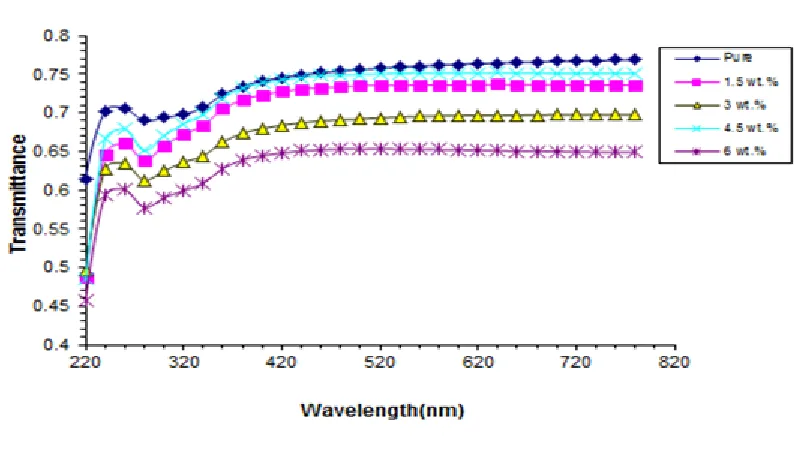
energies of the film with truncated bulk and fully relaxed structures data shown in Table(3) suggest that it decreases (in magnitude) significantly with increase in the number of atoms for two studied nanocomposites. This values are close to the previous studies values which were[51,52] The transmission of (PVA-NiO-SiC) nanocomposites increase TO wholly nano-composites as exposed by Figure.(9)its demonstrations the difference of transmission to nanocomposite through the wave length to incidents lights. Figure illustrate that transmittance decrease with increasing in concentrations of the SiC nanoparticles. It's clear thats increased permeability with increasing wavelength of different concentration, as well as decrease with increasing concentration of nickel carbide nanoparticle due to the fact that nickel carbide nanoparticles absorb and diffuse incident light from nanosambite film [53].
Fig. 9. Difference transmittance to ((PVA-NIO-SiC)) nanocompositeswith wave length.
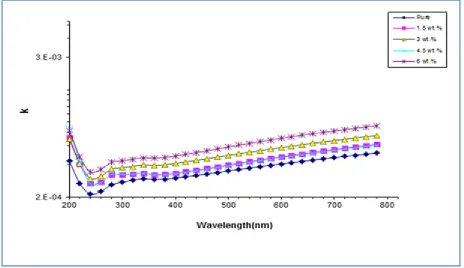
Extinctions factor variation ((PVA-NiO-SiC)) nanocomposite through wave length of incidents lights i drawing by Figuer.(10)which demonstrations that increasing ((SiC)) nanoparticle attention result to an increasing of extinctions coefficients increase for ((PVA-NiO); it's since increase of absorptions coefficients [54].
Property PVA-NiO-SiC 46 Atoms
Total energy -28847.6028
cohesive energy -5.1209
Ionization potential 3.3578
Electron affinity
-
0.6342Electronegativity 1.3618
Chemical hardness 1.996
Chemical softness 0.2505
Chemical potential 1.3618
-
Fig. 10. Extinctions coefficients variation to ((PVA-NiO-SiC)) with wave length of incidents lights. With increases wavelength ((PVA-NiO-SiC)), the refractive
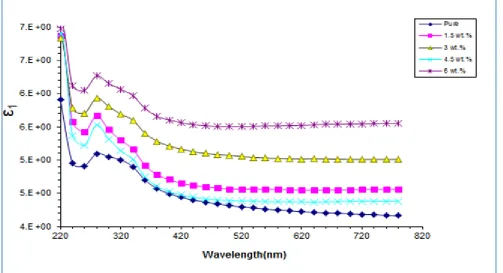
index decreases. Fig.(11)shows the refractive index increases with an increasing of concentration of SiC nanoparticle; performance could credited for increase the stuffing concentration consequence of fillers contents. For (PVA-NiO-SiC) nanocomposites, the imaginary and real
parts of dielectric constant with wave length exposed by Fig.((12)) , Fig.(13)correspondingly. Figures illustration that imaginary , real part di-electrics constants ((PVA-NiO) increasing with increasing SiC nanoparticle attentiveness, these manner credited by increasing electrically polarizations owing nanoparticle attention[55].
Fig. 12. real part difference to ((PVA-NiO-SiC)) nanocompositeswith wave length.
Fig . 13. The imaginary part variation for (PVA-NiO-SiC) nanocompositeswith wavelength. For nanocomposites, the optical conductivity decrease with
the increasing the wave length as shown in Fig.(14), this conduct credited to conductivities strongly depend on wave length. High absorption to whole tasters for nanocomposite
Fig. 14. Optical conductivity variation for (PVA-NiO-SiC) nanocompositeswiththe wavelength. The photoconductivity of nanocomposites (PVA-NiO-SiC)
increases with increasing concentrations of SiC nanoparticles, this behavior related to the formation of local levels within the energy gap, and increased concentrations of SiC nanoparticles which increases the density of central phases in the band structure. Thus increasing the optical conductivity of nanocomposites (PVA-NiO-SiC) [56]. Fig.(15)shows the absorption coefficient for (PVA-NiO-SiC)nanocompositesas function of photon energy. The absorption The coefficient helps to identify the nature of the
transition of the electron. When the absorption coefficient values for a high sample (α> 104
) are cm-1, the electron transmission is expected to be direct, but is expected to be indirect transmission when the absorption coefficient values for the sample are low (α <104
) cm -1 if the concentrations increase SiC nanoparticles, the absorption coefficient of nanocomposites (PVA-NiO-SiC) is increased due to the increase of the charge carriers of numbers, thus increasing the absorption (PVA-NiO-SiC) coefficient in mathematics or degree [54,56].
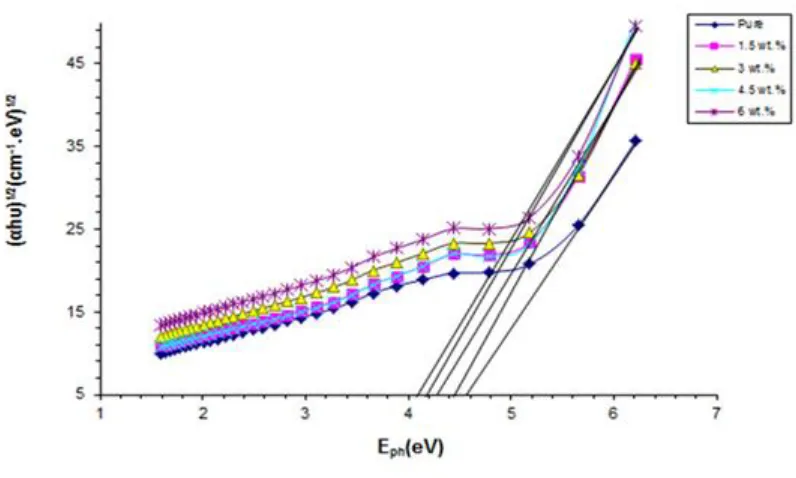
Fig.(16)show the energies gaps for allowing in direct transitions. Energies gaps to ((PVA-NiO-SiC)) decrease by increasing of (SiC) nanoparticle concentrations, this is owing to formation stages in energies gaps, by way consequence of increasing the SiC nanoparticles concentrations[49].
Fig.16. Difference the ((ahυ)1/2) to ((PVA-NiO-SiC)) with photons energies. This experimental result the energy gap was close to the
theoretical result and was equal(3.992ev),these values is near to preceding studies values whichwas [52] , Anywhere adding ((SiC))nanoparticle, energies gaps ((PVA-NiO) decreases from (4.5 to 4.1ev). These values are near to preceding studies value were (3.85-3.57ev)[57]. The energies bands gaps theoretically calculate by equation (9)). bands gaps mentions to differences energy among the uppermost occupies molecule orbitals and lowermost un occupied molecule orbitals rendering to Koopmans theory.
Table (4) shows the energy gap for nanocomposites (PVA-NiO-SiC)(46Atom). Fig.(17) illustrates the 3-D distribution of HOMOs and LUMOs for the studied nanocomposites. From these figures, the form of the nanocomposites has same an effect on both HOMO and LUMO distribution. The change of the form of the nanocomposites leads to change the map of HOMO and LUMO distribution according to the linear combination of atomic orbitals-molecular orbital LCAOs-MO.
Table 4: The variation of optical band gap of the studied structuretheoretically. PVA-NiO-SiC
46 Atom
EHOMO (eV)
ELUMO
(eV)
Eg
(eV)
Fig.17. The distribution of HOMO (up) and LUMO (down) for (PVA-NiO-SiC) contain(46 Atom) The strength of interactions can be further studied by
analyzing orbital interactions between the atoms of nanocomposite , in terms of density of states DOS as shown in Fig.(18).The DOS rules numerous physic
Fig.18. densities statuses as function of bond length for (PVA-NiO-SiC)(46Atom). Fig.(19) illustrates the electrostatic potential ESP
distribution surface of nanocomposites calculated from the total self-consistent field SCF. The ESP distributions for the nanocomposites in results from the strength of repulsion or attraction of the areas that surrounding each
Fig.19.The electrostatic potential distribution surface for (PVA-NiO-SiC), contain(46 Atom) (up: 2-D counter; down: 3-D). For the sample of nanocomposite, The resistance decrease
by increase humidity's also the nanocomposite had greater compassion in great humidity, that behavior can clarified that polymers as a (polyvinyl alcohol) mixes up in water protest higher compassion humidity's sensor in room temperatures,. the presence humidity its entice (–OH) group henceforth the confrontation decreases [58]. When nanocomposites condense moisture, they decrease resistance due to increased charge carriers. Water adsorption on the surface of nanoparticles indicates the
breakdown of hydrogen ions. These hydrogen ions are welded with a lattice oxygen atom surface, forming hydroxyl groups as shown in the equation:
……(17)
–
H+ + O0 ↔ [OH]
Where Oo represent to oxygen at lattice sites. Hydroxyl groups are connected to the atom network and release free electrons. That electrons is charges of electric conductivities [59], as shown in Figs.(20) and (21).
Fig.21. Resistance difference to ((PVA-NiO-SiC)) by relatives humidity.
Conclusions
1. B3LYP level with 6-31Gdensity functional theory has been proved its validity in studying the geometry optimization and calculating the geometrical parameters (angles and bonds length). 2. The absorbance's of ((PVA-NiO)) increase by
increases the (SiC) concentrations.
3. With the increased concentration of SiC nanoparticle, optical constants are increased. 4. Big convergences between practically and
theoretically result for energies bands gaps. 5. The ((PVA-NiO-SiC)) nanocomposites require
greater sensitivities for greater humidities.
6. The theoretical results of FTIR measurements showed convergent values of nanocomposite bonds
7. The present calculations show that the total cohesive energy (absolute value) increases as the Sic nanoparticles increases but the average cohesive energy decreases with respect to increase of the SiC nanoparticles .
Acknowledgement
The authors thank the University of Babylon –Iraq (College of Education for Pure Sciences, Department of Physics and College of Science, Department of Physics).
References
[1] Ningaraju, S., Prakash, A. G., & Ravikumar, H. B. (2018). Studies on free volume controlled electrical properties of PVA/NiO and PVA/TiO2 polymer nanocomposites. Solid State Ionics, 320, 132-147.
[2] Kumar, A., Kaur, K., & Sharma, S. (2013). Synthesis, characterization and antibacterial potential of silver nanoparticles by Morusnigra leaf extract. Indian J Pharm Biol Res, 1(4), 16-24. [3] Paul, D. R., & Robeson, L. M. (2008). Polymer
nanotechnology:
nanocomposites. Polymer, 49(15), 3187-3204.
. [4] Sharma, S. K., Prakash, J., Sudarshan, K., Sen,D., Mazumder, S., &Pujari, P. K. (2015). Structure at Interphase of Poly (vinyl alcohol)–SiC Nanofiber Composite and Its Impact on Mechanical Properties: Positron Annihilation and Small-Angle X-ray Scattering Studies. Macromolecules, 48(16), 5706-5713.
[5] Ningaraju, S., Prakash, A. G., &Ravikumar, H. B. (2018). Studies on free volume controlled electrical properties of PVA/NiO and PVA/TiO2 polymer
nanocomposites. Solid State Ionics, 320, 132-147.
[6] Xiang, Q., Yu, J., &Jaroniec, M. (2012). Graphene-based semiconductor photocatalysts. Chemical Society Reviews, 41(2), 782-796.
[7] Sk, M. M., Yue, C. Y., Ghosh, K., & Jena, R. K. (2016). Review on advances in porous nanostructured nickel oxides and their composite electrodes for high-performance supercapacitors. Journal of Power Sources, 308, 121-140.
[8] Hdidar, M., Chouikhi, S., Fattoum, A., Arous, M., &Kallel, A. (2018). Influence of TiO2 rutile doping
on the thermal and dielectric properties of nanocomposite films based PVA. Journal of Alloys
[9] Jang, J. H., & Han, J. I. (2017). Cylindrical relative humidity sensor based on poly-vinyl alcohol (PVA) for wearable computing devices with enhanced sensitivity. Sensors and Actuators A: Physical, 261, 268-273.
[10]Rathod, S. G., Bhajantri, R. F., Ravindrachary, V., Sheela, T., Pujari, P. K., Naik, J., &Poojary, B. (2015). Pressure sensitive dielectric properties of TiO2 doped PVA/CN-Li nanocomposite. Journal of Polymer Research, 22(2), 6.
[11]Aziz, S. B., Rasheed, M. A., Saeed, S. R., & Abdullah, O. G. (2017). Synthesis and characterization of CdS nanoparticles grown in a polymer solution using in-situ chemical reduction technique. Int J Electrochem Sci, 12, 3263-3274.
[12]Abdullah, O. G., &Saeed, S. R. (2013). Effect ofNaI doping on same physical characteristic of (PVA) 0.9-(KHSO4) 0.1 composite films. Chemistry and Materials Research, 3(11), 19-24.
[13]Mahendia, S., Tomar, A. K., & Kumar, S. (2010). Electrical conductivity and dielectric spectroscopic studies of PVA–Ag nanocomposite films. Journal of Alloys and Compounds, 508(2), 406-411.
[14]Balko, J., Csanádi, T., Sedlák, R., Vojtko, M., Kovalčíková, A., Koval, K., ... &Naughton-Duszová, A. (2017). Nanoindentation and tribology of VC, NbC and ZrC refractory carbides. Journal of the European Ceramic Society, 37(14), 4371-4377.
[15]Zhao, X., Long, Y., Yang, T., Li, J., & Zhu, H.(2017). Simultaneous High Sensitivity Sensing of Temperature and Humidity with Graphene Woven Fabrics. ACS applied materials & interfaces, 9(35), 30171-30176.
[16]Yang, T., Xie, D., Li, Z., & Zhu, H. (2017). Recent advances in wearable tactile sensors: Materials, sensing mechanisms, and device performance. Materials Science and Engineering: R: Reports, 115, 1-37.
[17]Yang, Y., Zhou, Y., Wu, J. M., & Wang, Z. L. (2012). Single micro/nanowire pyroelectric nanogenerators as self-powered temperature sensors. ACS nano, 6(9), 8456-8461.
[18]Usamentiaga, R., Venegas, P., Guerediaga, J., Vega, L., Molleda, J., &Bulnes, F. G. (2014). Infrared thermography for temperature measurement and non-destructive testing. Sensors, 14(7), 12305-12348.
.[19]Kong, D., Le, L. T., Li, Y., Zunino, J. L., & Lee, W. (2012). Temperature-dependent electrical properties of graphene inkjet-printed on flexible materials. Langmuir, 28(37), 13467-13472.
. [20]Farahani, H., Wagiran, R., &Hamidon, M. N.(2014). Humidity sensors principle, mechanism, and fabrication technologies: a comprehensive review. Sensors, 14(5), 7881-7939.
[21]Wang, Y. (2013). Fabrication of Relative Humidity
Sensors based on Polyimide
Nanoparticles (Doctoral dissertation, Applied Sciences: School of Engineering Science).
[22]Karthick, S., Lee, H. S., Kwon, S. J., Natarajan, R., &Saraswathy, V. (2016). Standardization,
calibration, and evaluation of tantalum-nano rGO-SnO2 composite as a possible candidate material in humidity sensors. Sensors, 16(12), 2079.
[23]Young, D. C. (2001). A Practical Guide for ApplyingTechniques to Real-World Problems.
[24]Zhong, Z. J. (2009). Optical properties and spectroscopy of nanomaterials. World Scientific.
[25]Ilican, S., Caglar, M., &Caglar, Y. (2007). Theeffect of deposition parameters on the physical properties of CdxZn1-xS films deposited by spray pyrolysis method. journal of optoelectronics and advanced materials, 9(5), 1414-1417.
[26]Hamad, T. K., Yusop, R. M., Abdullah, B., &Yousif, E. (2014). Laser induced modification of the optical properties of nano-ZnO doped PVC films. International Journal of Polymer Science, 2014.
[27]Nathan, A. A., Onoja, A., & Amah, A. (2015). Influence of PVA, PVP on Crystal and Optical properties of Europium doped Strontium Aluminate Nanoparticles. American J. Eng. Res, 4(4), 85-91.
[28]Suresh, S. (2013). Investigation of the optical anddielectric properties of the urea L-malic acid NLO single crystal. Am. Chem. Sci. J, 3(3), 325-337.
[29]Lalithambika, K. C., Shanthakumari, K., &Sriram,S. (2014). Optical properties of CdO thin films deposited by chemical bath method. Int. J. Chem Tech Res, 6(5), 3071-3077.
[30]Ghodsi, F. E., &Absalan, H. (2010). Comparative study of ZnO thin films prepared by different sol-gel route. ActaPhysicaPolonica-Series A General Physics, 118(4), 659.
[31]Gaffar, M. A., El-Fadl, A. A., &Anooz, S. B. (2003). Influence of strontium doping on the indirect band gap and optical constants of ammonium zinc chloride crystals. Physica B: Condensed Matter, 327(1), 43-54.
[32]Imam, N. G., & Mohamed, M. B. (2016). Environmentally friendly Zn0. 75Cd0. 25S/PVA hetero system nanocomposite: UV-stimulated emission and absorption spectra. Journal of Molecular Structure, 1105, 80-86.
[33]Atkins, P., & De Paula, J. (2011). Physical chemistry for the life sciences. Oxford University Press, USA.
[34]Kavitha, E., Sundaraganesan, N., & Sebastian, S. (2010). Molecular structure, vibrational spectroscopic and HOMO, LUMO studies of 4-nitroaniline by density functional method.
[35]W. J. Hehre, L. Radom, P. R. Schleyer and J. A. Pople, "Ab initio molecular orbital theory ", John Wiley & Sons Inc, New York , 1986.
[36]Oftadeh, M., Naseh, S., & Hamadanian, M. (2011). Electronic properties and dipole polarizability of thiophene and thiophenol derivatives via density functional theory. Computational and Theoretical Chemistry, 966(1-3), 20-25.
compounds–A DFT study. Computational and Theoretical Chemistry, 963(1), 227-235.
[38]Abdulsattar, M. A. (2009). Size effects of semi empirical large unit cell method in comparison with nanoclusters properties of diamond-structured covalent semiconductors. Physica E: Low-dimensional Systems and Nanostructures, 41(9), 1679-1688.
[39]Hugosson, H. W. (2001). A theoretical treatise on the Electronic Structure of designer Hard Materials (Doctoral dissertation, Acta Universitatis Upsaliensis).
[40]Hoffman, R. V. (2004). Organic chemistry: an intermediate text. John Wiley & Sons.
[41]Indolia, A. P., & Gaur, M. S. (2013). Optical properties of solution grown PVDF-ZnOnanocomposite thin films. Journal of Polymer Research, 20(1), 43.
[42]Amin, G. A. M., &Abd-El Salam, M. H. (2014). Optical, dielectric and electrical properties of PVA doped with Sn nanoparticles. Materials Research Express, 1(2), 025024.
[43]Pham, N. K., Vu, N. H., Van Pham, V., Ta, H. K. T., Cao, T. M., Thoai, N., & Tran, V. C. (2018). Comprehensive resistive switching behavior of hybrid polyvinyl alcohol and TiO2 nanotube nanocomposites identified by combining experimental and density functional theory studies. Journal of Materials Chemistry C, 6(8), 1971-1979.
[44]Yu, M., Jayanthi, C. S., & Wu, S. Y. (2009). Bonding Nature, Structural Optimization, and Energetics studies of SiC Graphitic-Like layer Structures and Single/Double Walled Nanotubes. arXiv preprint arXiv:0901.3567.
[45]Dietzel, P. D., Johnsen, R. E., Fjellvåg, H.,Bordiga, S., Groppo, E., Chavan, S., & Blom, R. (2008). Adsorption properties and structure of CO2 adsorbed on open coordination sites of metal– organic framework Ni2 (dhtp) from gas adsorption, IR spectroscopy and X-ray diffraction. Chemical communications, (41), 5125-5127.
[46]Ramosa, J. M., Maurıcio, M. C., Anilton Jr, C. C., Otavio, V., & Claudio, A. T. S. (2011). Fourier transform infrared spectrum: Vibrational assignments using density functional theory and natural bond orbital analysis of the bis (guanidoacetate) nickel (II) complex. Science Asia, 37, 247-255.
[47]Fan, L., & Ziegler, T. (1992). Application of density functional theory to infrared absorption intensity calculations on main group molecules. The Journal of chemical physics, 96(12), 9005-9012.
[48]Atkins, P., & De Paula, J. (2011). Physical chemistry for the life sciences. Oxford University Press, USA.
[49]Suart, B. (2004). Infrared spectroscopy: Fundamental and applications. Google Scholar.
[50]
Hoffman, R. V. (2004). Organic chemistry: an
[51]Casassa, S., Ferrari, A. M., Busso, M., & Pisani, C. (2002). Structural, magnetic, and electronic properties of the NiO monolayer epitaxially grown on the (001) Ag surface: an ab initio density functional study. The Journal of Physical Chemistry B, 106(50), 12978-12985.
[52]Sriram, S., Chandiramouli, R., Balamurugan, D., Ravichandran, K., & Thayumanavan, A. (2013). Quantum chemical studies on NiO nanoclusters. J. Atom. Molec. Sci, 4(4), 336-348.
[53]Hashim A. and Hadi Q. (2018). Structural, electrical and optical properties of (biopolymer blend/ titanium carbide) nanocomposites for low cost humidity sensors. Journal of Materials Science: Materials in Electronics, 29:11598–11604.
[54]Hashim A. and Hadi Q.(2018). Synthesis of Novel (Polymer Blend-Ceramics) Nanocomposites: Structural, Optical and Electrical Properties for Humidity Sensors, Journal of Inorganic and Organometallic Polymers and Materials, 28(4): 1394–1401.
[55]Kumar, N. B., Crasta, V., & Praveen, B. M. (2014). Advancement in microstructural, optical, and mechanical properties of PVA (Mowiol 10-98) doped by ZnO nanoparticles. Physics Research International, 2014.
[56]Hashim A., Agool I. R. and Kadhim K. J. Novel of
(Polymer Blend-Fe3O4) Magnetic
Nanocomposites: Preparation and Characterization For Thermal Energy Storage and Release, Gamma Ray Shielding, Antibacterial Activity and Humidity Sensors Applications. Journal of Materials Science: Materials in Electronics. 29(12): 10369–10394. [57]Singh, S. D., Poswal, A. K., Kamal, C., Rajput, P.,
Chakrabarti, A., Jha, S. N., & Ganguli, T. (2017). Bond length variation in Zn substituted NiO studied from extended X-ray absorption fine structure. Solid State Communications, 259, 40-44.