Electroweak reactions with light nuclei
S. Bacca1,a
aTRIUMF, 4004 Wesbrook Mall, Vancouver, B.C. V6J 2A3, Canada
Abstract. The investigation of light nuclei with ab-initio methods provides an optimal setting to probe our knowledge on nuclear forces, because the few-nucleon problem can be solved accurately. Nucleons interact not only in pairs but also via many-body forces. Theoretical efforts need to be taken towards the identification of nuclear observables sensitive to the less known many-nucleon forces. Electromagnetic reactions can potentially provide useful information on this. We present results on photo-absorption and electron scattering offlight nu-clei, emphasizing the role of three-body forces and the comparison with experimental data. On the other hand, reactions induced by weak probes, like neutrino interactions with nucleonic matter, are relevant to astrophysics and can be calculated with few-body techniques. In this case, since often no experiment is possible, ab-initio predictions provide valuable input for astrophysical simulations.
1 Introduction
Excitations of nuclei with external electroweak probes are a fundamental tool to get information about nuclear dy-namics. If the probe is energetic enough, it can excite the system such that disintegration channels are open, and nu-cleons or compound fragments are emitted. In this case one would talk about an electroweak induced reaction. This is almost always the case if one considers light nuclei, as they possess no or very few bound excited states. In general, since a reaction implies states belonging to the continuum spectrum of the nucleus, exact direct calculations are dif-ficult and become prohibitive with increasing mass num-ber A. One is then forced to introduce some approxima-tions, that can be possibly validated against experiment. Such an approach is however not always possible. The first reason is that in nuclear physics the way the nucleons in-teract with each other, described by the Hamiltonian, is the object under investigation. Thus, comparing an approxi-mate calculation with experiments can pollute a clear in-terpretation on the reliability of the Hamiltonian used. A second reason is that often reactions that are relevant to astrophysics cannot be tested experimentally. That is why exact ab-initio calculations are needed. With this terminol-ogy we denote calculations where all nucleons are treated as degrees of freedom (ab-initio approach) and where the quantum many-body problem is solved numerically with-out introducing approximations (exact). Such calculations can be done for light nuclei. They can provide a valuable test on our present knowledge of nuclear forces via a com-parison with experimental data, and can also give useful predictions to be used e.g. in astrophysical simulations, when experiments are not possible.
The interactions among nucleons are governed by quan-tum cromodynamics (QCD). In the low energy regime
rel-a e-mail:[email protected]
evant to nuclear structure and reactions, QCD is not per-turbative and thus difficult to solve. Nuclear theory has come up with a series of models to describe the interac-tion among nucleons in terms ofeffectivedegrees of free-dom, protons and neutrons. Several approaches have been investigated, starting from purely phenomenological ones, or using meson exchange theories and more recently via the systematic approach of effective field theory [1, 2]. In fact various realistic two-body potentials are available, that fit nucleon-nucleon scattering data with high accuracy. On the other hand, since the nuclear potential has clearly an effective nature, it is in principle a many-body operator. Furthermore, it is well known that most realistic potentials do not explain the binding energy of three-body nuclei, unless three-nucleon forces (3NF) are introduced. Today, aided by effective field theory, where three-nucleon forces arise naturally and consistently with two-nucleon forces, a new debate is taking place regarding the role of 3NFs and how to constrain them. For the determination of a realis-ticthree-body potential or to discriminate among different models one needs to find A≥ 3 observables that are sen-sitive to 3NFs. An important activity in this direction has taken place in recent years, with accurate calculations of bound-state properties of nuclei of increasing mass num-ber A [3, 4]. A complementary approach should be direct to the study of light nuclei reactions. We have decided to draw our attention towards this second research line, con-centrating on electroweak induced reactions.
The paper is structured in the following way. We will first present the main calculational techniques used to tackle the problem of electroweak reactions with light nuclei in Sec. 2. Then, we will separate the discussion into electro-magnetic observables in Sec. 3 and weak observables in Sec. 4. Finally, we will conclude in Sec. 5 and present an outlook for the future.
'2,HSMFRQI03
2 Calculational Techniques
In the investigation of electroweak reactions one funda-mental ingredient is the nuclear response function to the excitation of an external probe. In aninclusiveprocess it is defined as
RO(ω,q)=
f
Ψf|O(T)|Ψ0 2
δEf−E0−ω
, (1)
whereωandqare the energy and momentum transferred,
|Ψ0/fandE0/fdenote initial and final state wave functions and energies, and finallyOrepresents the excitation opera-tor, which is different according to the external probe. The δ-function ensures energy conservation. From Eq. (1) it is evident that in principle one needs the knowledge of all possible final states excited by the electromagnetic probe, including of course states in the continuum. Thus, in a straightforward evaluation one would have to calculate both bound and continuum states. The latter constitute the ma-jor obstacle for a body system, since the full many-body scattering wave functions are not yet accessible for A > 3. A way to circumvent the problem is to use the Lorentz Integral Transform (LIT) method [5, 6]. Within the LIT one considers instead ofRO(ω,q) an integral transform LO(σ,q) with a Lorentzian kernel defined for a complex parameterσ=σR+iσIby
LO(σ,q)=
dω RO(ω,q) (ω−σR)2+σ2I
=ΨO σ,q|Ψ
O
σ,q. (2)
The parameter σI represents the resolution of the trans-form and is chosen to have finite value (σI 0). The basic idea of consideringLOlies in the fact that it can be evalu-ated from the norm of a functionΨO
σ,q, which is the unique solution of the inhomogeneous equation
(H−E0−σ)|Ψσ,Oq=O(q)|Ψ0. (3) HereHis the nuclear Hamiltonian. The existence of the in-tegral in Eq. (2) implies thatΨσ,Oqhas asymptotic boundary conditions similar to a bound state. Thus, one can apply bound-state techniques for its solution.
In all the results presented here, if not indicated diff er-ently, in order to solve Eq. (3) we expandΨ0 andΨσ,Oq in terms of antisymmetrized hyperspherical harmonics (HH) [7]. The expansion is performed up to a maximal value of the grand-angular momentumKmax. We improve the con-vergence using an effective interaction defined within the hyperspherical harmonics (EIHH) [8], where the starting potential is replaced by an effective one constructed via the Lee-Suzuki method.
The response functionROis then obtained by numeri-cally inverting the integral transform in Eq. (2). For the in-version of the LIT various methods have been devised [9, 10]. In particular the concept and methods of the inversion have been recently clarified and discussed extensively in Ref. [11], in response to some criticisms. Here, we will take care in pointing out the error bands for the calculated theoretical curves due also to the numerical inversion pro-cedure.
In the next sections we will present recent applications of these calculational techniques to electromagnetic and weak reactions with light nuclei.
3 Electromagnetic Observables
3.1 Photo-absorption Reactions
In recent years there has been an increased interest in the photo-disintegration of light nuclei, both in theory and ex-periment. From the theoretical side, a lot of effort has been addressed to the investigation of such process with the LIT. Several light nuclei have been studied with mass number up toA =7 [12, 13]. This has stimulated new experimen-tal activity in Lund [15], for example. The most system-atic calculations with the LIT have been performed on the 4He target, where a variety of realistic potentials have been tested (see e.g.[14], and reference therein).
One important reason for concentrating on4He is that it is the lightest nucleus that already possesses features of heavier systems (e.g. large binding energy per nucleon). Therefore4He can be considered as an important link be-tween the classical few–body systems and more complex nuclei. Furthermore, continuum properties of4He are an ideal testing ground for microscopic three-nucleon forces, which are typically fitted to bound state properties of few– body systems.
3
0
0
(E , )
f
3
f
(E , )
=q
ω
)LJ Feynman diagram of the photo absorption process.
The total photo-absorption cross section, represented by the Feynman diagram in Figure 1, is given by
σγ(ω)=4π2αωRDz(ω), (4)
where αis the fine structure constant andRDz is the re-sponse function in the unretarded dipole approximation
RDz(ω)=
dΨf
ΨfDz|Ψ0 2
δ(Ef −E0−ω), (5)
with
Dz= A
k=1 τ3
kzk
2 , (6)
being the unretarded dipole operator. Here,τ3
spatial coordinate of thek-th particle in the center of mass frame. This is a typical example of an electromagnetic in-duced reaction that can be studied with the LIT.
Photo-nuclear processes can be of great importance, since exchange currents, which are connected to the nu-clear interaction by current conservation, play a decisive role in the cross section. Within the unretarded dipole ap-proximation, the dominant part of the exchange current is taken into account implicitly via the Siegert theorem, par-ticularly for photon energiesω below 50 MeV. This has been shown for the deuteron [16] and is expected to be valid for4He as well.
20 25 30 35
ω [MeV] 0
1 2 3 4
σ γ
[mb]
AV18
χEFT NN
(a) 4He
20 25 30 35
ω [MeV] 0
1 2 3 4
σ γ
[mb]
AV18+UIX
χEFT NN+NNN
Shima et al. (’05) Nilsson et al. (’05) box Wells et al. (’92)
(b)
4
He
)LJ (a) Total4He photo-absorption cross sectionσ
γfor AV18
(dark blue) and theχEFT N3LO (light blue) potentials; (b)σ
γ
in-cluding the 3NFs UIX (red) and theχEFT N2LO (pink) in
com-parison with with some experimental data: box from [21], squares from [22], and circles from [23].
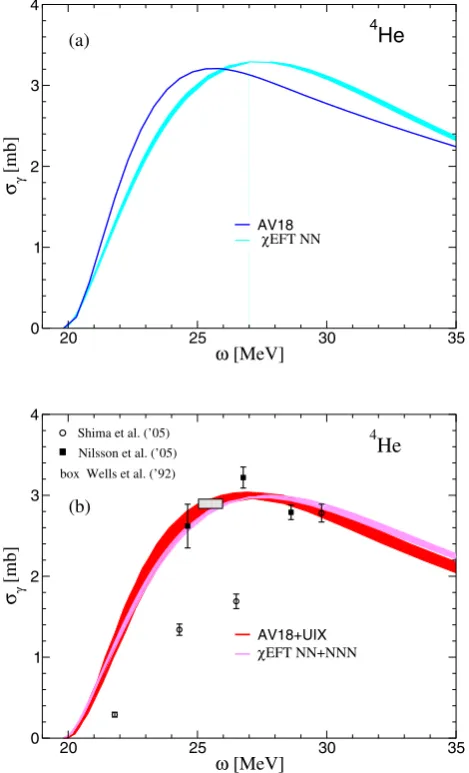
The first realistic calculation of the4He photo-absorption was performed with the LIT and EIHH method [17] using the ArgonneV18 (AV18) [18] potential augmented by an Urbana IX (UIX) [19] three-nucleon force. Later on, a sec-ond realistic calculation was performed with the LIT and
the no-core shell model (NCSM) [20] using chiral two-and three-body forces [1]. It is very interesting to com-pare these two calculations in the following way. First one can look at the predictions from two-body forces only. Fig-ure 2(a) shows in fact the result forσγ(ω) with the AV18 and theχEFT force at N3LO [1]. One observes that, even though both forces reproduce very well the nucleon-nucleon (NN) experimental phase shifts (with a χ2 per datum of about 1), the prediction of this many-body observable is different, due to the different off-shell properties of the two-potentials, which are not fixed by the NN phase-shifts. Figure 2(b) shows, instead,σγ(ω) calculated from Hamil-tonians that include a three nucleon force: in one case the UIX and in the other theχEFT force at N2LO. We observe that the two predictions are very similar, even though the 3NF have been constrained differently (the UIX on the tri-ton binding energy and on saturation properties of nuclear matter and the chiral N2LO ons- andp-shell nuclei [4]).
One should note that the theoretical error bands shown in Fig. 2 take into account the numerical error of the LIT inversion. Furthermore, the AV18+UIX curve has a larger width due to the fact that an extrapolation was done to an infinite model space for the LIT itself [17].
It is particularly interesting to observe the relevance of 3NFs. Due to 3NFs one observes a reduction of the peak height by less than 10% both for the more phenomenologi-cal potentials as well as in the chiral approach. One should note, though, that larger 3NF effects were found with the UIX in [17] at higher energies than those shown in Fig. 2.
In Fig. 2(b) we also compare to some selected exper-imental data (for more data see [17] and [20]): the box is from [21], where the peak cross section is determined from Compton scattering via dispersion relations; squares from [22] and dots from [23] show measurements of the cross section in a broader energy range. It is evident that the var-ious experimental cross sections are quite different exhibit-ing maximal deviations of about a factor of two. While the-ory is relatively accurate, considering the sum of the two theoretical bands in Fig. 2(b) as an estimate of the total the-oretical error, the experimental situation is unsatisfactory and does not allow one to draw any definitive conclusions on the importance of 3NFs to describe this observable.
3.2 Electron Scattering Reactions
The information about the nuclear dynamics that one can get from electron scattering processes is complementary to the one obtained with real photons and much richer. While the energy of the photon fixes the momentum transferred to the target, an electron can transfer energy ω and mo-mentum q independently. As q = |T| increases one can probe properties of the correlations among nucleons from the long- to short-range.
P
iP
fq = ( , )
ω
q
γ
∗ μμ μ
μ
μ μ
μ
k’
μ
k
q = k − k’
)LJ Feynman diagram of the electron scattering process at the one-photon exchange level.
We report on recent studies of the theinclusiveinelastic electron scattering reactions on light nuclei withA=4 and 3 on a broad energy range obtained using the LIT method. This is, in fact, the only way to allow investigations beyond the three- and four-body (forA=4) break up thresholds.
In the one-photon-exchange approximation (see Fig.3), the inclusive cross section for electron scattering offa nu-cleus is given in terms of two response functions,
d2σ dΩdω =σM
Q4
q4RL(ω,q)+
Q2 2q2 +tan
2 θ 2
RT(ω,q)
,
(7) whereσMdenotes the Mott cross section,Q2=−q2μ=q2− ω2, and θthe electron scattering angle. The longitudinal and transverse response functions,RL(ω,q) andRT(ω,q), are determined by the transition matrix elements of the Fourier transforms of the charge and the transverse cur-rent density operators, respectively. ExperimentallyRLand RT can be disentangled by using a Rosenbluth separation method.
We will start presenting a study of the longitudinal re-sponse function for4He and3H and then continue with the transverse response function for4He and theA=3 nuclei.
3.2.1 The Longitudinal Response Function
The longitudinal response function is given by
RL(ω,q)=
f
Ψf|ρ(T)|Ψ0 2
δ
Ef+ q2
2M −E0−ω
,
(8) whereMis the target mass. The charge density operatorρ is defined as
ρ(T)= k
ekexp [iT·Uk], (9)
whereekis the nucleon charge in unit of e1 andUkis the coordinate of thek-th particle in the center of mass frame. In order to take the finite size of the nucleon into account, form factors are introduced, such that the nucleon charge takes the following form
ek= 1+τ3
k
2 G
p E(Q
2)+1−τ 3 k
2 G
n E(Q
2), (10)
1 eis here factorized inσ
M.
whereGpE/n are the proton and neutron electric form fac-tors. We use the usual dipole fit for them [24].
40 60 80 100 120 140 160 180
ω [MeV] 0
5 10 15 20
R L
[10
-3 MeV
-1 ]
Full FSI PWIA
q
=300 MeV/c
(a)4
He
60 80 100 120 140 160 180 200 220 240
ω [MeV] 0
2 4 6 8 10
R L
[10
-3 MeV
-1 ]
Bates Saclay
q
=400 MeV/c
(b)4
He
50 100 150 200 250 300 350
ω [MeV] 0
1 2 3 4 5 6
R L
[10
-3 MeV -1 ]
q
=500 MeV/c
(c)
4
He
)LJ Longitudinal response function for 4He at various q:
Since the longitudinal responseRLis much less sensi-tive to meson exchange effects than the transverse response RT, the use of a simple one-body density operator allows one to concentrate on the nuclear dynamics generated by the potential. In fact, for lowq two-body operators inRL are only of fourth order in effective field theory counting (N3LO) [25], and their contribution is negligible up toq≈ 300 MeV/c. In recent works [26, 27] we have studied the longitudinal response function RL(ω,q) for 4He at con-stant momentum transfersq ≤500 MeV/c. We consider the non-relativistic charge density operator of Eq. (9), and decomposed it into isoscalar and isovector Coulomb mul-tipoles [27]. Each multipole is then used as source in the right-hand-side of Eq. (3) which is solved with the EIHH method. After inversion of each multipoles and a subse-quent sum of all of them, one obtains results that can be directly compared with experiment. The accuracy of the convergence for the LIT is found to be at a percentage level for all the results shown in the next paragraphs, including the numerical error of the inversion.
It is first interesting to investigate the role of the final state interaction (FSI) in the electron scattering reaction. In [28] it was found that the FSI is very important forRL in the quasi-elastic peak of4He. To investigate that we com-pare our LIT results using the AV18+UIX potential both in the initial and final state with a plane wave impulse approx-imation (PWIA) calculation. The PWIA result is obtained under the hypothesis of one outgoing free proton with mass mand a spectator (A-1)-system with massMs:
RPWIAL (ω,q)=
dpn(p)δ
ω−(p+q)2
2m −
p2 2Ms −
.
(11) Here n(p) represents the proton momentum distribution andthe proton separation energy. To obtain a PWIA curve we have used then(S) of [29]. In Fig. 4, the results of RL(ω,q) with the AV18+UIX potential at various q are shown and compared to data. In all cases one finds that the FSI effects are very large and essential for reaching agreement with experiment, confirming what was previ-ously found. One has to note, that the PWIA fails particu-larly in the q.e. peak and at lowω, while it is better on the tail.
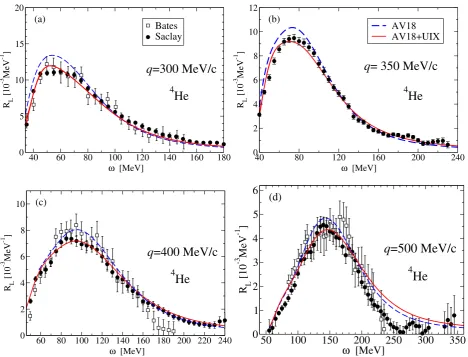
The second fact one can investigate is the role of three-nucleon forces on this observable. To this aim, we can for example compare calculations with a two-body force only, like the AV18 potential, with the one with AV18+UIX. In Fig. 5, we show this comparison for some values ofq to-gether with existing experimental data. One sees that the 3NF results are closer to experiment, this is particularly evident atq=300 and 350 MeV/c. The 3NF effect is gen-erally not very large, but always leads to a quenching of the strength. For someqvalues the 3NF quenching is compa-rable to the size of the experimental error bars, particularly for the data from Ref. [30]. The largest discrepancies with data are found atq=500 MeV/c. While the height of the peak is well reproduced by the result with 3NF, the width of the experimental peak seems to be somewhat narrower than the theoretical one. On the other hand one has to be aware that relativistic effects, which we are not including,
are not completely negligible at such momentum transfers (we will comment on that later).
It is worth looking at the 3NF effect when even lower momentum transfers are considered, even though for some kinematics there are no experimental data to compare to. In Fig. 6, we show RL at three momentum transfer 50 ≤ q ≤ 200 MeV/c. We find a large quenching effect due to 3NFs, which is strongest at lower q. We investigate it with two different 3NF models: the UIX and the Tucson Melbourne (TM’) [32], when starting from the same two-nucleon AV18 potential. While the UIX force contains a two-pion exchange and a short range phenomenological term, the TM’ force includes two-pion exchange terms where the coupling constants are taken from pion-nucleon scat-tering data consistently with chiral symmetry. The cutoff of the TM’ force has been calibrated on triton binding en-ergy, when used in conjunction with the AV18 NN force. Thus, the TM’ is not adjusted also to nuclear matter prop-erties as the UIX. With a cutoffΛ=4.77mπ, wheremπ is the pion mass, we obtain the following binding energies 8.47 MeV (3H) and 28.46 MeV (4He) for the AV18+TM’ potential. We would like to emphasize that the4He binding energy is practically the same as for the AV18+UIX case (as already found in [33]).
Figure 6 shows that the increase of 3NF effects with de-creasingqis found for both the UIX and TM’ force model. The quenching of the strength is rather strong, reaching 40% for q = 50 MeV/c. Moreover it becomes evident that the difference between the results obtained with the two 3NF models increases with decreasingq. One actually finds that the shift of the peak to higher energies in the case of UIX generates forRLa difference up to about 10% on the low energy sides of the peaks. This is very interesting, since it represents the case of an electromagnetic observ-able whose prediction depends on the choice of the 3NF. In light of these results it would be very interesting to repeat the calculation with EFT two-and three-body potentials [1, 2]. While to our knowledge there are not available mea-surements at the low momentum kinematics likeq = 50 and 100 MeV/c, recently some data have been taken at q 200 MeV/c [34]. They are shown in Fig.6. While one finds a satisfactory agreement between the AV18+UIX re-sult and data beyond the peak, one observes a non negligi-ble discrepancy at the peak itself. Moreover the error bars are quite large. It would be highly desirable to have precise measurements ofRLat lowq. This could serve either to fix the low-energy constants (LEC) of the effective field the-ory three-body force or to possibly discriminate between different nuclear force models. Here, it is worth mention-ing that our calculations have stimulated new experimental activity in Mainz [35]. More experiments on the same ob-servable also planned at Jefferson Laboratory (E05.110 at Hall A) at large momentum transfer.
α-40 60 80 100 120 140 160 180
ω [MeV] 0
5 10 15 20
RL
[10
-3 MeV
-1 ]
Bates Saclay
q
=300 MeV/c
(a)4
He
40 80 120 160 200 240
ω [MeV] 0
2 4 6 8 10 12
RL
[10
-3 MeV
-1 ]
AV18 AV18+UIX
q
= 350 MeV/c
(b)4
He
60 80 100 120 140 160 180 200 220 240
ω [MeV] 0
2 4 6 8 10
R L
[10
-3 MeV
-1 ]
q
=400 MeV/c
(c)4
He
50
100
150
200
250
300
350
ω
[MeV]
0
1
2
3
4
5
6
R
L[10
-3
MeV
-1]
q
=500 MeV/c
(d)
4
He
)LJ Longitudinal response function at variousq: Calculation with the AV18 (dashed) and with the AV18+UIX (solid) potential in comparison with experimental data from Bates [30] (squares), Saclay [31] (circles).
particle the 3NF force is quenching the quasi-elastic peak of about 20% for q = 200 MeV/c. For3H, instead, the quenching effect of 3NF was found to be of about 10% only at q = 174 MeV/c at energies between 10 and 20 MeV. This can be seen in Fig.7, where theoretical results with the same potentials used for4He are shown. In addi-tion, a calculation with the configuration space BonnA [37] potential augmented by the TM’ force was done. Compar-ing the three cases in Fig.7 where a 3NF was included, one finds that the result is very stable.
Summarizing, in case of4He two features are evident with respect to3H: (i) there is a larger effect of 3NFs and (ii) the two different three-body force models lead to two different curves. This shows that4He is a more interesting target to study 3NFs, since their effect is amplified. This is expected since it is a denser systems and the ratio be-tween the number of triplets and of pairs goes like (A-2)/3, therefore doubles from3H to4He.
Having the full response function at our disposal, we can also calculate some integral properties to compare with other calculations found in literature. The classical sum rule ofRL(ω,q), that has been much discussed in the lit-erature, is the Coulomb sum rule (CSR) [38]. It consists in
the integral of the inelastic longitudinal response function
CSR(q)= ∞
ωth
dω RL(ω,q) |GEp(Q2)|2
=Z+Z(Z−1)fpp(q)−Z2|F(q)|2, (12) that can be connected to the number of protonsZ and to fpp(q), which is the Fourier transform of ρpp(s), i.e the probability to find two protons at a distances. HereF(q) is the nuclear elastic form factor.
We can first look at the 3NF effects on the CSR. In Table 1, we show the CSR for different momentum trans-fers obtained with the AV18 and the AV18+UIX potential. Clearly, the UIX force leads to a quenching of the CSR, especially at low momentum transfer, consistent with what was observed in the response function. Atq =50 MeV/c the quenching on the overall strength is of about 20%.
30 40 50 60 70 80 90 100
ω [MeV] 0
5 10 15 20
R L
[10
-3 MeV -1 ]
Buki et al. (’06) AV18
AV18+UIX AV18+TM’
q
=200 MeV/c
(a)
4
He
30
40
50
60
70
ω
[MeV]
0
2
4
6
8
10
R
L[10
-3
MeV
-1]
q
=100 MeV/c
(b)
4
He
25 30 35 40 45 50
ω [MeV] 0
0.5 1 1.5 2 2.5 3
R L
[10
-3 MeV -1 ]
q
=50 MeV/c
(c)
4
He
)LJ Longitudinal response function for low-momentum trans-fer with the AV18 two-nucleon force only (dashed), and with the addition of the UIX (solid) or the TM’ (dashed-dotted) three-nucleon force.
charge is used. We can also see that the contributions of two-body terms, called meson exchange currents (MEC), to the charge density operator become negligible below q=300 MeV.
Besides the non relativistic expressionρ(T) ≡ρNR(T) of Eq. (9), the first contribution due to relativistic effects
5 10 15 20 25 30 35 40 45 50
ω [MeV] 0
4 8 12
R L
[10
-3 MeV -1 ]
AV18+UIX AV18+TM’ BonnRA+TM’ AV18
q=174 MeV/c
3
H
)LJ Longitudinal response function of3H forq=174 MeV/c
with the AV18 two-nucleon force only (dashed), and with the ad-dition of the UIX (solid) or the TM’ (dashed-dotted) and with the Bonn two-body potential with the TM’ 3NF (dotted). Calcu-lations are taken from [36].
7DEOH CSR of Eq. (12) for different momentum transfers ob-tained with the AV18 and the AV18+UIX potential.
q [MeV/c] CSR with AV18 CSR with AV18+UIX
50 0.064 0.053
100 0.239 0.211
150 0.516 0.460
200 0.839 0.771
250 1.163 1.072
300 1.437 1.350
350 1.634 1.562
400 1.771 1.717
450 1.842 1.816
500 1.884 1.871
0
100
200
300
400
500
q [ fm
-1]
-1
-0.8
-0.6
-0.4
-0.2
0
f
pp( q )
Our
Carlsonet al. no MEC Carlsonet al. with+MEC 4
He
leads to a one-body operator given by
ρRC(T)=− q2 8m2
k
ekexp [iT·Uk]+ (13)
−i k
ek−μk
4m2 σk·(T×Sk) exp [iT·Uk], where
μk= 1+τ3
k
2 G
p M(Q
2)+1−τ 3 k
2 G
n
M(Q2), (14) withGpM/nbeing the proton and neutron magnetic form fac-tors. Hereσk andSk are the spin and the momentum of thek−th particle, respectively, andmis the mass of the nu-cleon. The first part in Eq.(13) is called the Darwin-Foldy term, while the second is a spin-orbit one-body term. In all previous Figures for4He we have neglected relativistic contributions (RC).
60 80 100 120 140 160 180 200 220 240 260
ω [MeV] 0
1 2 3 4 5 6 7
RL
[10
-3 MeV
-1 ]
NR+RC NR
q= 450 MeV/c
(a)
4
He
100 150 200 250 300 350
ω [MeV] 0
1 2 3 4 5
RL
[10
-3 MeV
-1 ]
NR+RC NR
q= 500 MeV/c
(b)
4
He
)LJ Longitudinal response of 4He with the non relativistic
(NR) one-body current of Eq. (9) and with the Darwin-Foldy rel-ativistic correction (RC) (see text), forq=450 and 500 MeV/c.
While the inclusion of two-body currents in a realistic calculation of RL requires some labor, it is easier to in-clude first order relativistic corrections. We have inin-cluded
the Darwin-Foldy one body relativistic correction in Fig.9, where its effect atq = 450 and 500 is shown. It leads to a decrease of the cross section in the quasi-elastic peak by 5 or 6%. The spin-orbit correction was found to be small in the case ofA=3 [36], and is probably small in4He as well. Other relativistic effects, like wave function boosts have been found to be important in Ref. [36]. We plan to investigate their effect on4He in the near future.
3.2.2 The Transverse Response Function
The investigation of the transverse response function in the electron scattering reaction is more involved, as it re-quires the knowledge of the transverse current operator. The transverse response function is defined as
RT(ω,T)=
f
ΨfMT(T)|Ψ0 2
δ
Ef+ T2
2M −E0−ω
.
(15) The transverse electromagnetic current density of a nu-cleus can be decomposed in a superposition of one- and many-body operators
MT(T)=M(1)(T)+M(2)(T)+. . . . (16) The non-relativistic one-body current density consists of convection and spin currents
M(1)(T)=Mc (1)(T)+M
s
(1)(T), (17) with
Mc (1)(T)=
1 2m
k
ek{Sk,exp [iT·Uk]}, (18)
M(1)s (T)=i 1 2m
k
μk(σk×T) exp [iT·Uk],
whereekandμkare the same as in Eq. (10) and (14), re-spectively. Even in a non-relativistic approach, the two-body termM(2)does not vanish. In fact, a momentum and/or isospin dependent two-body interactionV requires the ex-istence of a two-body current operator, in order to satisfy the continuity equation, which in coordinate space, reads
∇·M(2)([)=−i[V, ρ([)], (19)
whereρis the Fourier transform of the one-body charge in Eq. (9). As is well known, this relation is not sufficient to determine uniquely the two-body current. Therefore one needs in principle a dynamic model for the nuclear poten-tial which reveals the underlying interaction mechanism. Such a model is supplied, for example, by the meson ex-change picture of the NN force. But even for a phenomeno-logical potential a consistent MEC can be constructed by expanding the potential in meson exchange-like terms.
q
=100 MeV/c
0 1 2 3
20 40 60 80 100
RR TT
]
[10
−3 MeV
−1
ω [MeV] (a)
MT
He
4
0
2
4
6
8
10
12
25
50
75
100
125
150
ω
[MeV]
Bates
q
=300 MeV/c
Saclay
R
T[10
−3
MeV
−1]
IA
IA+MEC
MT
He
4
(b)
)LJ Transverse response functionRT of4He atq=100 and
q=300 MeV/c calculated with the MT potential: one-body cur-rent (dashed curve) response and one- plus two-body curcur-rent re-sponse (solid curve) in comparison with experimental data from Bates [30] and Saclay [31].
show our main results forq = 100 andq = 300 MeV/c. We present a calculation where only the one-body cur-rent operator is used, called the impulse approximation (IA), in comparison to one where consistent MECs are included. Quite strong effects of the MEC are found at low-momentum transfer, where at energies of about 100 MeV, the two-body currents lead to an enhancement of the strength by a factor of 4 with respect to the IA. We also ob-served that at this low momentum transfer the spin current in Eq. (18) does not dominate strongly: it only leads to half of the total IA strength [40]. That is whyRTat lowqshows sensitivity to the convection current in Eq.(18) as well as to the MEC. Unfortunately, to the best of our knowledge, no experimental data are available for these kinematics. At larger momentum transfer, where data are found in liter-ature, only a small effect due to the MEC is found. Here we observe that the spin current strongly dominates the strength at these kinematics. Moreover, the weak MEC ef-fect is possibly due to the semi-realistic nature of both the potential and the consistent MEC, which included only fic-titious scalar meson exchanges and noπ- andρ-exchange currents.
Realistic calculations with the LIT have been done, in-stead, on the A =3 body systems (3H and3He) [42] and [43]. The interest of this kind of study is not only to inves-tigate the role of 3NFs. The electron scattering reaction on the3He nucleus, in fact, is of particular importance, since it can also serve as effective neutron target.
In [42] the BonnA [37] two-body potential was chosen, due to its meson-exchange character. In this way, meson exchange currents could be determined relatively uniquely. The Hamiltonian was also augmented by an additional three-nucleon force, the TM’. MEC of π- andρ-exchange na-ture have been used. In a subsequent calculation [43], the AV18+UIX force model was used, instead. In this case consistent MEC for the AV18 potential were introduced using the Arenh¨ovel and Schwamb model [44], where an expansion of the potential in terms of fictitious meson ex-change is done. Theoretical results were obtained for dif-ferent current operators. A one-body current as in Eq. (18) was used with the addition of one-body relativistic terms [43] and MECs. In Fig. 11, we compare theoretical results from the AV18+UIX potential with the experimental data from Retzlaffet al.[45]. Both the experimental data and the theoretical curves are plotted as a function of the in-trinsic energywint, i.e. the recoil energy T
2
2M written in the formula (15) has not been added. In the case of3He one has a rather good agreement of theoretical and experimen-tal results at the higherq values. The MEC contribution is essential to reach agreement with the experiment and is pretty large at the threshold. Atq =174 MeV/c the theo-retical prediction forRT underestimates the data below 11 MeV. In the case of3H the comparison of theory with re-spect to experiment looks worse, with a systematic under-estimation of data, which gets larger at the lowestq-value. Relativistic contributions are small, but visible already at q=323 MeV/c. In [43] it was also observed that different force models, like the BonnA+TM’ and the AV18+UIX lead to very similar result.
4 Weak Observables
0
2
4
6
8
R
T[10
-3
MeV
-1]
0
2
4
6
0
0.3
0.6
0.9
1.2
5
10
15
ω
int[MeV]
0
1
2
3
4
R
T[10
-3
MeV
-1]
5
10
15
ω
int[MeV]
0
1
2
3
5
10
15
ω
int[MeV]
0
0.2
0.4
0.6
q=174 MeV/c
q=323 MeV/c
q=487 MeV/c
3
He
3He
3He
3
H
3H
3H
(a)
(b)
(c)
(d)
(e)
(f)
)LJ Comparison of experimental [45] and theoretical results for the threshold3He (upper panels) and3H (lower panels) transverse
response functionRT with the AV18+UIX. Theoretical curves show different current operators: relativistic one-body current (dashed), relativistic one-body current+MEC (solid), non relativistic one-body current+MEC (dotted).
4.1 Neutrino Scattering
Core-collapse supernovae are believed to be neutrino driven explosions of massive stars. At the end of its life a massive star (M > 8 M, whereM is the solar mass) presents a typical onion-like structure with layers containing ashes of different burning stages, ending up with an iron core at the center. As the iron core grows and becomes grav-itationally unstable, it collapses until nuclear forces halt the collapse and an outgoing shock wave is created. The most likely scenario is that the shock wave that propagates in the outer layers is stopped at some point due to energy loss via the dissociation of nuclei into mainly free nucleons andα-particles. One mechanism that can trigger a revival of the shock is given by interactions of neutrinos coming out of the proto-neutron star (the remnant at the center of the iron core) with matter in the outer layers. In such a de-layed explosion scenario, the neutrino energy transfer oc-curs mainly via elastic scattering ofνs with matter (free nu-cleons and nuclei). Nevertheless, other reactions can take place and contribute to the energy transfer. One of them is the inelastic excitation of light nuclei, like2H,3He,3H, and 4He [49], [50]. The hot dilute gas above the proto-neutron star and the region below the accretion shock contains up to 70% of4He. That is why the inelastic excitation of4He
via neutrino scattering is an important process to study in such a context.
P
i
P
f
+/− 0
Z , W
q
μ
μ μ
μ
k’
k
ν
,l
ν
q = k − k’
μ μ μq = ( , )
μω
)LJ Feynman diagram of the inelastic neutrino scattering off a nucleus, where all neutrino flavors can be involved.
is the amount needed to dissociate4He via an inelastic neu-tral current interaction. Theνe and ¯νecan also contribute to a dissociation of theα-particle via a charged current in-teraction, but in a less important way due to their lower energy. Even though a number of studies have been done in the past to estimate these cross sections, the first ab-initio few-body result was obtained by Gazit and Barnea [46] using the LIT and EIHH methods. A calculation was done for the energy dependentinclusiveinelastic cross sec-tion for4He(ν
x,νx)42X,4He(¯νx, ¯νx)42X,4He(¯νe,e+)41X, and 4He(ν
e,e−)43X, wherex=e, μ, τandAZXis the final state of A-nucleons withZ-protons. The corresponding Feynman diagram is represented in Fig. 12.
20 30 40 50 60
ω [MeV] 0
0.2 0.4 0.6 0.8 1 1.2 1.4
R(
ω
)/q
2 [10 -2 MeV
-3 ]
AV18 AV18+UIX
E2 axial transition
4
He
)LJ Axial quadrupole transition in the neutral neutrino scat-tering off4He as a function of the excitation energyω.
Calcula-tions are performed with the AV18 and the AV18+UIX potential and are taken from Ref. [47].
After a multipole decomposition of the weak current, the cross section for the neutrino scattering process can be written as [46]
dσa
dkf
ν( ¯ν) = 2G2 2Ji+1
k2fF a
(Zf,kf) (20)
×
d π
0 sinθ δ
−ω+ q2
2M
×⎧⎪⎪⎨⎪⎪⎩∞ J=0
XCRCJ +XLRLJ −XCLReRC∗JL∗J
+∞ J=1
XMRMJ+XEREJ∓XEMReRE∗JM∗J ⎫⎪⎪⎬
⎪⎪⎭ , whereGis the Fermi weak coupling constant,Jiis the ini-tial angular momentum of the nucleus,kf is the momen-tum of the outgoing lepton,Zf is the charge of the residual system andFis the Coulomb function. The superscripta denotes the isospin component, witha =0 for the neutral current anda = ±1 for the charged current.XO1O2 is the lepton kinematical function [48] andRO1O2is the response function to the operators O1 andO1, where the notation CJ,LJ,MJandEJstands for Coulomb, longitudinal, mag-netic and electric multipoles of orderJ.
7DEOH Temperature averaged neutral current inclusive inelas-tic cross section per nucleon in case of4He as a function of the
neutrino temperature. Data in [10−42cm2] taken from [46].
T [MeV] AV18 AV18+UIX AV18+UIX+MEC
4 2.31 10−3 1.63 10−3 1.66 10−3
6 4.30 10−2 3.17 10−2 3.20 10−2
8 2.52 10−1 1.91 10−1 1.92 10−1
10 8.81 10−1 6.77 10−1 6.82 10−1
12 2.29 1.79 1.80
14 4.53 3.91 3.93
The calculation was done using the AV18 two-body force augmented by the UIX three nucleon forces. The effect of the 3NF on astrophysically relevant observables is an interesting one to investigate. In Figure 13, the re-sponse function of the dominant multipole (the axialE2) in Eq.(20) for the neutral interaction cross section is shown as a function of the transferred energyωfor the AV18 and AV18+UIX potential. The numerical accuracy of these cal-culations is of the order of 1%. It is interesting to note that also in this case one observes a quenching effect due to the UIX force. This is analogous to what was found for the electron scattering observable, even though we are dealing with two different current operators.
The effect of MEC was also investigated using an hy-brid approach: the weak current was constructed within EFT and then used with wave functions obtained from the traditional potentials AV18 and UIX. The axial current in-troduces a dependence of the MEC on a new low-energy constant, denoted with ˆdr, which was calibrated on the tri-ton half life. The effect of the 3NF and the MEC on the temperature averaged neutral cross section
σ0 xT=
1 2 1 Aσ
0 νx+σ
0 ¯
νxT (21)
is shown in Table 2. Here the. . .T symbol indicates the temperature average
σ0 T =
∞
wth dω
dkif(Tν,ki) dσ0 dkf
, (22)
which is obtained by integrating the cross section in energy and assuming that neutrino spectra are described by Fermi-Dirac distributions f with temperatureTν. Hereki is the initial momentum of the neutrino. One observes that the low-energy cross section is very sensitive to the nuclear force model, while MECs are contributing in a negligible way. This is explained by the fact that the multipole where MECs are expected to contribute the most is the Gamow-Teller, which is suppressed in4He.
1
2
4
6
T [MeV]
10
-910
-810
-710
-6dE
ν
/dx [MeV/cm]
total
α
3H
3
He
2
4
6
T [MeV]
2
4
6
T [MeV]
Y
p
=0.1
Y
p=0.3
Y
p=0.5
T
ν=6 MeV - 10
12g/cm
3)LJ Neutrino energy lossdEν/dxfor inelastic excitations ofA=3,4 nuclei as a function of the matter temperatureT and at density of 1012 g/cm3. Neutrino energy spectra are assumed to be Fermi-Dirac distributions with temperatureT
ν =6 MeV. Different proton fractions are shown. Figure taken from Ref. [49].
protons,α-particles and some representative heavy nuclei. In a recent study by O’Connoret al.[49] the virial EOS was extended to include also3H and3He nuclei and pre-dictA =3 mass fractions near the neutrino sphere in su-pernovae. Neutrino cross sections ofA=3 inelastic exci-tation were calculated with the LIT and EIHH, using the same potentials and MEC as done for theα-particle. An important fact was found: even though theα-particles are more abundant, the loosely boundA =3 nuclei dominate the energy transfer at low-density via inelastic reactions. MECs were also found to be important: they contribute up to 16% in the thermal averaged cross section at tempera-ture of 1 MeV. This is explained by the fact that the thresh-old cross section (which is dominant at lowTν) is largely influenced by the the axial dipole transition, where MECs are important.
In Figure 14, the neutrino energy losses, dEν
dx =nb
i=3H,3He,4He
xiωσ0i,Tν, (23)
are shown. HereEνis the neutrino energy,nbis the baryon density,xi= Aininb is the mass fraction andωσi,Tνis the en-ergy weighted temperature averaged cross section (same as in Eq. (22) with an energy weight). The neutrino en-ergy loss for inelastic excitations ofA = 3,4 nuclei was calculated as a function of the matter temperatureT ∼ 4 MeV and at density of about 1012 g/cm3, which are typ-ical conditions near the neutrino-sphere. Neutrino energy spectra are assumed to be Fermi-Dirac distributions with temperatureTν =6 MeV. Different proton fractionsYp = 0.1,0.3,0.5 were investigated. One observes thatA=3 nu-clei contribute significantly to the neutrino energy loss due
to inelastic excitations atT ≥4 MeV. As such, they should be included in supernovae simulations.
4.2 Neutrino-Antineutrino Bremsstrahlung
Neutrino processes involving two nucleons play a key role in the physics of core-collapse supernovae and neutron stars. In particular, neutrino-pair bremsstrahlung and absorption, NN ↔ NNνν, are important processes for the production of muon and tau neutrinos [51]. Due to the fact that
neu-Z
ν
ν
_
N
N
N
N
0
)LJ Feynman diagram of the neutrino-antineutrino bremsstrahlung process on two neutrons. The interaction between the two nucleons is here represented by a one-pion exchange term (pion denoted with the dashed line).
explosions are most sensitive to neutrino processes near the proto-neutron star, at subnuclear densitiesρ∼ ρ0/10, whereρ0 =2.8×10¹⁴g/cm3is the saturation density, and where matter is neutron rich.
The bremsstrahlung rate was calculated from NN phase shifts in Ref. [52]. Here, we report on our recent calcula-tion of the neutrino bremsstrahlung in pure neutron mat-ter, where we used chiral effective field theory (EFT) [53]. In Figure 15, a Feynman diagram for neutrino− antineu-trino bremsstrahlung is shown. Note that this is not the only Feymnam diagram involved, as theν ν¯ pair can be produced from the ingoing left or right neutron, or from the outgoing left neutron, as well. If one considers all the four possibility, as done explicitly in [54], one can observe that only non-central contributions to strong interactions are relevant in such process. Thus, in a chiral EFT lan-guage, tensor forces from pion exchanges and spin-orbit forces, are essential for the two-nucleon response.
In supernova and neutron star simulations, the stan-dard rates for bremsstrahlung and absorption are based on the one-pion exchange (OPE) approximation [54, 55] for the interaction between the neutrons, which is represented by the dashed line in Fig. 15. This is a reasonable start-ing point, since it represents the long-range part of nu-clear forces, and it is the leading-order contribution in chi-ral EFT [56]. However, sub-leading non-centchi-ral contribu-tions are crucial for reproducing NN scattering data [56] and might be relevant in neutrino bremsstrahlung as well. We systematically go beyond the OPE approximation and include contributions up to next-to-next-to-next-to-leading order (N3LO) in chiral EFT. We find that shorter-range non-central forces significantly reduce the neutrino rates for all relevant densities.
We follow the approach to neutrino processes in nu-cleon matter developed in Ref. [57], which is based on Landau’s theory of Fermi liquids. This is a good approx-imation since the energiesω and momentaT transferred to the neutrinos are small in comparison to the momenta of the neutrons. In addition, we consider degenerate con-ditions, where the temperature is small with respect to the Fermi energy. The rate for bremsstrahlung for the domi-nant axial current process is given by [51]
ΓNN↔NNνν=2πn G2CA2(3−cosθ)RA(ω,T), (24)
wherendenotes the neutron number density,Gthe Fermi coupling constant,CA=−ga/2=−1.26/2 the axial-vector coupling for neutrons, andθhere is the angle between the neutrino and antineutrino momenta. The spin or axial re-sponseRAis given by [58]
RA(ω,T)= 1 πn
1
1−e−ω/T Imχσ(ω,T), (25) whereχσ is the spin-density–spin-density response func-tion, and we use units with =c =kB =1. We use a re-laxation time approximation to solve the transport equation and obtain the response function [57]. Under this assump-tion, the bremsstrahlung neutrino ratesΓNN↔NNννdepend onCσ, a quantity connected to the spin relaxation rateτσ
by [57, 59] 1 τσ =Cσ
T2+(ω/2π)2, (26)
where
Cσ =π 3m∗
6k2 F
1
12
k=1,2,3
(27)
Tr
Aσ1,σ2(N,N
)σk 1
(σ1+σ2)k,Aσ1,σ2(−N,N
) .
Here m∗ is the effective mass andkF the Fermi momen-tum. Also,Aσ1,σ2(N,N) is the quasiparticle scattering am-plitude multiplied by N(0) = m∗kF
π2 , the number of states at the Fermi surface, N = S1 −S3 andN = S1−S4 are the nucleon momentum transfers, and the average. . .is over the Fermi surface (for details see [57]). The commu-tator with the two-body spin operator demonstrates that only non-central interactions contribute. The neutrino-pair bremsstrahlung and absorption ratesΓNN↔NNννare propor-tional toCσto a good approximation when|ω| 1/τσ. To calculateCσwe treat the strong interaction using the Born approximation and evaluate the spin trace in the two-body spin space|s msusing a partial-wave expansion. Fors=0 the spin trace vanishes, thus only s= 1 states contribute. We derived an expression (see Eq. (6) in Ref. [53]) forCσ in terms of partial-wave matrix elements of the strong in-teractionp|Vjs|p, which depend on the relative momenta p=|S1−S2|/2=|S3−S4|/2. For all results shown next, we found excellent convergence when using 7 partial waves. In addition, we checked that the spin relaxation rate for OPE expanded in partial waves reproduces the known an-alytical result (see Ref. [57]).
In Fig. 16, we show the spin relaxation rate calculated from chiral EFT interactions up to N3LO as a function of the Fermi momentum over a wide density range (kF = 1.4 fm−1
corresponds toρ=mk3F/(3π2)=1.6×1014g cm−3). The leading order (LO) contribution includes OPE, which provides the standard two-nucleon rates used in current su-pernova simulations. The contact terms appearing at LO are purely central, thus do not contribute toCσ. Our results based on chiral EFT interactions of successively higher or-ders from Epelbaumet al.(EGM) [2] show that OPE sig-nificantly overestimatesCσ for all relevant densities. The bands at next-to-leading order (NLO), N2LO, and N3LO provide an estimate of the theoretical uncertainty, gener-ated by varying the cutoffΛ as well as a spectral func-tion cutoffin the irreducible 2π-exchangeΛSF[56, 2]. Chi-ral EFT interactions at N3LO accurately reproduce low-energy NN scattering [2, 1], and at this order,Cσis practi-cally independent of the N3LO potential for these densities (see thin band at N3LO in Fig. 16). Most of the reduction ofCσoccurs at the NLO level, which includes the leading 2π-exchange tensor force and shorter range contact terms. We observe that at NLO the 2π-exchange added to the OPE enhances theCσ, but this is compensated by a further sup-pression due to the contact terms.
0 0.2 0.4 0.6 0.8 1 1.2 1.4
kF [fm-1] 0
0.05 0.1 0.15 0.2
C σ
[MeV
−
1 ]
LO (=one-pion exchange)
NLO
N2LO N3LO
)LJ Spin relaxation rate given byCσas a function of Fermi momentumkFobtained from chiral EFT interactions of successively
higher orders [2]. All results are form∗=m.
0 0.2 0.4 0.6 0.8 1 1.2 1.4
k
F [fm
-1
]
0 0.05 0.1 0.15
C σ
[MeV
−
1 ]
V
low kΛ=2.8 fm -1
Vlow kΛ=2.4 fm-1
Vlow kΛ=2.0 fm-1
Vlow kΛ=1.8 fm-1 phase shifts 0
0.05 0.1 0.15 0.2
C σ
[MeV
−
1 ]
N3LO EGM 450/500 MeV N3LO EGM 550/600 MeV N3LO EGM 600/600 MeV N3LO EGM 450/700 MeV N3LO EGM 600/700 MeV N3LO EM 500 MeV N3LO EM 600 MeV phase shifts
(a)
(b)
)LJ The spin relaxation rate given byCσas a function of Fermi momentumkFobtained from different chiral N3LO potentials (see
text) in comparison with the spin relaxation rate obtained from empirical phase shifts (upper panel). The same observable calculated with RG-evolved low-momentum interactionsVlowkobtained from the EM 500 MeV chiral potential is shown in the lower panel for varying cutoffΛ=1.8−2.8 fm−1. The thickness of the curve forΛ=2.0 fm−1is obtained evolving the seven different chiral N3LO shown in the
upper panel. The effective mass here ism∗=mn=939.656 MeV.
the N3LO potentials from [2] of Fig. 16, we also show re-sults for the Entem and Machleidt (EM) N3LO potentials withΛ=500 and 600 MeV [1]. The EM 500 MeV poten-tial gives results which overlap with the EGM N3LO band.
2.8 fm−1, to extend the cutoffvariation and estimate of the theoretical uncertainty. The results are shown in the lower panel of Fig. 17. The RG evolution preserves the long-range pion exchanges and includes sub-leading contact in-teractions, so that NN scattering data are reproduced. The thickness of the curve forΛ = 2.0 fm−1 is obtained af-ter evolving all seven N3LO potentials of the upper panel. This shows the universality ofVlowkand that, after high-momentum modes are integrated out, the particle-particle channel (for EM 600 MeV) is rendered more perturba-tive [60].
At low densities, two-nucleon collisions dominate and NN scattering observables provide a model-independent result for the spin relaxation rate. To study this we can re-place the strong potentialVby theT matrix, which is pa-rameterized in terms of empirical phase shifts and mixing angles [61], taken from the Nijmegen Partial Wave Analy-sis (nn-online.org). For all densities in Fig. 17, we find that the rates obtained in the Born approximation from chiral N3LO potentials andV
lowkinteractions are close to those from phase shifts. Combined with the RG insights, this demonstrates that the non-central part of the strong neu-tron −neutron amplitude is perturbative for these lower cutoffinteractions.
The relatively small sensitivity ofCσto the NN poten-tial used in input, allows us to fit a very simple analytical function
Cσ
MeV =
0.86 (kF/fm−1)3.6
1+10.9 (kF/fm−1)3.6, (28) that can be used in hydrodynamic simulations of super-novae explosions. In fact, our main finding is that two-pion exchange interactions and shorter-range non-central forces, included beyond the LO in EFT, reduce the neu-trino rates significantly, with respect to the standard rates used in supernovae simulations. Future work will include neutron-proton mixtures and charged currents, to system-atically improve the neutrino physics input for astrophysics. We also plan to investigate other many−body effects on collisions including 3NFs, which are expected to be im-portant at higher densities.
5 Conclusions and Outlook
The investigation of electroweak reactions involving light nuclei has entered a new era, due to new theoretical ad-vances and to the number of physical aspects one can study. It allows one to tackle a variety of questions, ranging from more fundamental ones on how nucleons interact with each other and spanning to astrophysics, where one can learn about the role of nuclear input in astrophysical objects.
Here, we have reported on the recent progress done in calculations of electroweak reactions on light nuclei, mainly using the LIT method in conjunction with EIHH expansions of the wave function. In such way, bound and scattering observables are treated on an equal footing. The use of the LIT method is so far the only viable procedure to access information on the inelastic response ofA > 3 nuclei for energies beyond the three-body disintegration
threshold. A direct calculation of all involved channels is in fact impossible. The LIT method, by circumventing the problem via an integral transform and turning it to the so-lution of a bound state equation, constitutes a very practi-cal and yet effective approach to obtain the exact response function for light nuclei.
6 Acknowledgment
It is a pleasure to thank the organizers of the conference for a very interesting workshop and providing a stimulat-ing environment. I would like to thank Winfried Leide-mann for providing the pictures about electron scattering offA=3 nuclei and Doron Gazit for making available the data on the inelastic neutrino cross section of4He. I am thankful also to Achim Schwenk for useful conversations. This work was supported in part by the Natural Sciences and Engineering Research Council (NSERC) and by the National Research Council of Canada.
References
1. D. R. Entem and R. Machleidt, Phys. Rev.&, (2003) 041001(R)
2. E. Epelbaum, W. Gl¨ockle and U. G. Meißner, Nucl. Phys.$, (2005) 362
3. S. C. Pieper, K. Varga, and R. B. Wiringa, Phys. Rev. C, (2002) 044310.
4. P. Navr`atil, V. G. Gueorguiev, J. P. Vary, W. E. Or-mand, and A. Nogga, Phys. Rev. Lett. , (2007) 042501
5. V. D. Efros, W. Leidemann, and G. Orlandini, Phys. Lett. B, (1994) 130
6. V. D. Efros, W. Leidemann, G. Orlandini, and N. Barnea, J. Phys. G: Nucl. Part. Phys., (2007) R459 7. N. Barnea and A. Novoselsky, Ann. Phys. (N.Y.),
(1997) 192
8. N. Barnea, W. Leidemann, and G. Orlandini, Phys. Rev. C, 054001 (2000); Nucl. Phys. A, (2001) 565
9. V. D. Efros, W. Leidemann, and G. Orlandini, Few-Body Syst., (1999) 251
10. D. Andreasi, W. Leidemann, C. Reiß, and M. Schwamb, Eur. Phys. J. A, (2005) 361
11. N. Barnea, V. D. Efros, W. Leidemann, and G. Orlan-dini, arXiv:0906.5421
12. S. Bacca, M. A. Marchisio, N. Barnea, W. Leidemann, and G. Orlandini, Phys. Rev. Lett., (2002) 052502; S. Bacca, N. Barnea, W. Leidemann, and G. Orlandini, Phys. Rev. C, (2004) 057001
13. S. Bacca, H. Arenh¨ovel, N. Barnea, W. Leidemann, and G. Orlandini, Phys. Lett. B, (2004) 159 14. S. Bacca, Phys. Rev. C, (2007) 044001
15. P. Grabmayr (spokesperson), np002 proposal at MAX-Lab, 2004
16. H. Arenh¨ovel and M. Sanzone, Few-Body Syst. Suppl. , (1991) 1
17. D. Gazit, S. Bacca, N. Barnea, W. Leidemann, and G. Orlandini, Phys. Rev. Lett., (2006) 112301 18. R. B. Wiringa, V. G. J. Stoks, and R. Schiavilla, Phys.
Rev. C, (1995) 38
19. B. S. Pudliner, V. R. Pandharipande, J. Carlson, S. C. Pieper, and R. B. Wiringa, Phys. Rev. C , (1997) 1720
20. S. Quaglioni and P. Navratil, Phys. Lett.%(2007) 370
21. D.P. Wells et al., Phys. Rev. C, (1992) 449 22. B. Nilsson et al., Phys. Lett. B, (2005) 65 23. T. Shima et al., Phys. Rev. C, (2005) 044004 24. S. Galsteret al., Nucl. Phys. B, 221 (1971). 25. T.-S. Parket al., Phys. Rev. C, (2003) 055206 26. S. Bacca, N. Barnea, W. Leidemann, G. Orlandini,
Phys. Rev. Lett., (2009) 162501
27. S. Bacca, N. Barnea, W. Leidemann, G. Orlandini, Phys. Rev. C., (2009) 064001
28. J. Carlson and R. Schiavilla, Rev. Mod. Phys. , (1998) 743
29. R. Schiavilla, V. R. Pandharipande, and R. B. Wiringa, Nucl. Phys.$, (1986) 219; R. B. Wiringa, Phys. Rev. C, (1991) 1585; A. Arriaga, V. R. Pandhari-pande, and R. B. Wiringa,ibid, (1995) 2362 30. S. A. Dytmanet al., Phys. Rev. C, (1988) 800 31. A. Zghicheet al., Nucl. Phys.$, (1994) 513 32. S. A. Coon and H. K. Hahn, Few-Body Syst. ,
(2001) 131
33. A. Nogga, H. Kamada, W. Gl¨ockle, B.R. Barrett, Phys. Rev. C, (2002) 054003
34. A. Yu. Buki, I. S. Timchenko, N. G. Shevchenko, and I. A. Nenko, Phys. Lett. B, (2006) 156
35. M. Distler (spokesperson for the 4He(e,e)X experi-ment in the A1 collaboration at MAMI), private com-munication
36. V. D. Efros, W. Leidemann, G. Orlandini, and E. L. Tomusiak, Phys. Rev. C, (2004) 044001
37. R. Machleidt, Adv. Nucl. Phys., (1989) 189 38. G. Orlandini and M. Traini, Rep. Prog. Phys. ,
(1991) 257
39. J. Carlson, J. Jourdan, R. Schiavilla, and I. Sick, Phys. Rev. C, (2002) 024002
40. S. Bacca, H. Arenh¨ovel, N. Barnea, W. Leidemann, and G. Orlandini, Phys. Rev. C, (2007) 014003 41. R. A. Malfliet and J. A. Tjon, Nucl. Phys. $,
(1969) 161
42. S. Della Monaca, V. D. Efros, A. Kughaev, W. Leide-mann, G. Orlandini, and L. P. Yuan Phys. Rev. C, (2008) 044007
43. W. Leidemann, V. D. Efros, G. Orlandini, and E. L. Tomusiak, arXiv:0906.0663, DOI 10.1007/ s00601-009-0078-8
44. H. Arenh¨ovel and M. Schwamb, Eur. Phys. J A , (2001) 207
45. G. A. Retzlaffet al., Phys. Rev. C, (1994) 1263 46. D. Gazit and N. Barnea, Phys. Rev. Lett. , (2007)
192501
47. D. Gazit, PhD thesis arXiv:0807.0216; D. Gazit, pri-vate communication
48. J. D. Walechka,Theoretical Nuclear and Subnuclear Physics, (Oxford University Press, 1995)
49. E. O’Connor, D. Gazit, C. J. Horowitz, A. Schwenk and N. Barnea, Phys. Rev. C, (2007) 055803 50. A. Arcones, G. Martinez-Pinedo, E. O’Connor,
A. Schwenk, H.-Th. Janka, C. J. Horowitz, K. Lan-ganke, Phys. Rev. C(2008) 015806
52. C. Hanhart, D. R. Philips, and S. Reddy, Phys. Lett. B , (2001) 9
53. S. Bacca, K. Hally, C.J. Pethick, A. Schwenk, Phys. Rev. C, (2009) 032802(R)
54. B. Friman and O. V. Maxwell, Astrophys. J. , (1979) 541
55. S. Hannestad and G. Raffelt, Astrophys. J., (1998) 339
56. E. Epelbaum, Prog. Part. Nucl. Phys., (2006) 654 57. G. I. Lykasov, C. J. Pethick, and A. Schwenk, Phys.
Rev. C, (2008) 045803
58. N. Iwamoto and C. J. Pethick, Phys. Rev. D, (1982) 313
59. G. I. Lykasov, E. Olsson, and C. J. Pethick, Phys. Rev. C, (2005) 025805
60. S. K. Bogner, T. T. S. Kuo, and A. Schwenk, Phys. Rep., 1 (2003); S. K. Bogner, R. J. Furnstahl, S. Ramanan, and A. Schwenk, Nucl. Phys. A, (2007) 79