Influence The Quality Of Accounting Information
On The Implementation Good Study Program
Governance
Azhar Susanto
Abstract:The purpose of this study was to determine the influence of quality of accounting information on the implementation good study program governance. The unit of analysis in this study is head of the study program, secretarial of the study program, accounting staff, lecturer and student of higher education in Bandung-Indonesia. The results showed that the quality of accounting information have a significant effect on the implementation of good study program governance. Furthermore it was found that the quality of accounting information has implication for good study program governance.
Keywords : Quality of Accounting Information, Implementation Good Study Program Governance
————————————————————
Introduction
Quality information is the right to use user information (Huang et al, 1999: 43). Quality accounting information can redirect the user to the expected actions (Hall, 2011), will also be of value to the wearer (O'Brien & Marakas, 1996: 365), to help users make decisions that are beneficial (Gellinas, 2012: 19 ). If the information is not qualified, then the accounting information becomes useless (Kieso et al, 2007: 41). Quality information to significantly improve decision-making better and directly increase profits for the organization, but the quality information is not automatically guarantee any decision made is better, because the decision makers are human beings, where no man is perfect (Paige Baltzan, 2012: 210). Criteria for quality information according to McLeod & Schell (2007: 43) is the information should be accurate, timely, relevant and complete. While Hall (2011: 14) says if the quality of information that is relevant, timely, accurate, complete, and concise.Information is the output generated by the information systems used (DeLone and McLean, 2003). Sacer et al (2006: 6) states that the quality of information obtained from the application of accounting information system quality. The fundamental role of accounting information systems in organizations are generating accounting information quality (Azhar Susanto, 2008: 374). Then Hall (2011: 19) confirms that the value of information to the user is determined by the reliability of the information, the reliability of the information is determined by the attributes of which are relevant, accurate, complete, concise and the right time. The company uses the accounting information system to generate reports specifically to meet the information needs of investors, creditors, government agencies (Jones and Rama, 2003: 7).
These reports covers financial statements, tax returns and reports required by the government agencies that regulate companies in the banking and manufacturing industries (Jones and Rama, 2003: 7).At a public organization, the quality of accounting information produced is still not good (Indra Bastian, 2010: 125), including the quality of accounting information of tax revenue (Anwar Nasution, 2009). Agus Martowardojo (2010) stated that the financial statements of the finance ministry 2005-2009 obtain disclamer opinion. Timescales indicated on the explanation can be said that in general the accounting information in financial institutions or government agencies is still bad. Agencies in the Government and higher education, an institution established to provide services to the public, thus the system is built to be adapted to the organization concerned, in accordance with the contingency theory that no model or system that applies generally accepted an organization, because the system design organization depends on factors that are relevant to the situation (Hoque, 2002: 12). As the purpose of information systems in organizations expressed Hall (2011: 14), which is to support the management functions of management, to support decision making and to support the organization's daily operations. So also expressed Wilkinson (1989: 5), which provides information for operational activities and needs legal rules in daily operations and provide information for decision making. In accordance with the description of the background that have been raised, this research theme under the title “influence the quality of accounting information on the implementation good study program governance”.
Review of Literature
Quality of Accounting Information
The information is relevant news (Hirsch, 1994: 4). Information is data that has been formed into shapes that are meaningful and useful to humans (Laudon and Laudon, 2012: 15). A similar opinion was expressed by McLeod & Schell (2007: 15) which says that information is data that has been formed into ___________________________
Azhar Susanto
something that is meaningful and useful for users. As according to Webster (2006: 26) information is meaningful: it has a subject. It is intelligence or instruction about something or someone. Further said Hall (2011: 5) that the information is a business resource that is essential for the survival of the organization. The information is the result of data processing that gives value or meaning and benefits for a person (Azhar Susanto, 2008: 38). While Stair and Reynolds (2010: 5) says that information is an organized collection of facts that have added value. According to Romney and Steinbart (2012: 24) information is the data that have been organized and processed to provide meaning and improve the decision making process. The same thing is said Gelinas et.al. (2012: 18) that the information is the data that is presented in a form that is useful for decision making. Then Clarke (2001: 9) says that information is a key element in decision making.Accounting information state by Clarke (2001: 9) that the accounting information is that a sub set of information that is Expressed mainly in financial terms. Accounting information to plan and control performance. The same thing is said Belkaoui (2004: 213) that the accounting information is perceived as essentially monetary and quantified. Accounting information as quantitatives, formal, structured, audited, numerical and past oriented. Accounting information produced by the accounting information system, in accordance with the main purpose of accounting information system is to provide information and accounting information systems ensure the quality of accounting information in support of planning, controlling, and analysis of the activity of the organization (Sacer et al, 2006: 61). Quality accounting information is used to assist the users of information to make decisions that are beneficial (Shipper and Vincent, 2003: 98). Beest et al (2009: 16) also said that the quality of accounting information is very important, because it will affect the capital providers, and other stakeholders in making decisions. From some of the above opinion can be interpreted that the accounting information is the financial data that is processed and molded into a more meaningful user that can be used as a basis for decision-making, so as to provide added value to an organization. Accounting information generated by the accounting information system in accordance with Financial Accounting Standards based on IFRS (international financial reporting standards) are:
1) The statement of financial position (balance sheet) at the end of the period.
2) Statement of comprehensive income for the period. 3) Statement of changes in equity during the period. 4) Statement of cash flows during the period.
5) Notes to the financial statements, contains a summary of significant accounting policies and other explanatory information.
Statements of financial position at the beginning of the earliest comparative period when an entity applies an accounting policy retrospectively or to make posts restatement of financial
statements, or when the entity reclassifies items in its financial statements.To generate information or report quality accounting, must meet certain criteria in order to provide useful information for users (Hans Kartikahadi, 2012: 49). According Bidgoli (2004: 164) quality of information is the user get the required information quickly when needed, and the information is presented objectively so that users can take actions/decisions. Next said information quality is the means by the which we measure and communicate economic events (Williams et al., 2010:5). Quality of accounting information is the accounting information has the quality characteristics required by the wearer in decision making valuable achieving organizational goals (O'Brein & Maracas, 2010). According Gelinas et.al. (2012: 19) quality of information is information that is useful for the decision to be made. Furthermore, it is said that the quality of information is information that is suitable for the user, wherein the information available has distinctive features that meet or even exceed the expectations of users (Kahn et al., 2002: 185). The same thing is said to be Strong et al (1997: 45) that the information is only of high quality if it meets the need of information consumers. Meanwhile Schiper and Vincent (2003: 99) explains that the quality of accounting information is a complex concept, containing the value relevance of accounting information, accounting conservatism and earnings management. From some sense it can be interpreted that the quality of accounting information is information that contains the value relevance of accounting in which the information is available when needed so as to meet the needs of users in the decision making.The criteria of quality information according to McLeod & Schell (2007: 43) and Romney and Steinbart (2012: 6) is the information should be accurate, timely, relevant and complete. Meanwhile, according to Hans Kartikahadi et al (2012: 49) the characteristics of accounting information is understandability, relevance, reliability and comparability. Furthermore, according to Hall (2011: 12) that the quality of accounting information which has the following characteristics:
1) Relevant, the contents of the report or document should serve a purpose
2) Timeliness, information must not be more than the time period required
3) Accurate, information should be free from material error. 4) Complete, information must prove all of the necessary,
clear and not ambiguous.
Summary, information should be collected in accordance with user needs. From some of these opinions can be said that the dimensions and indicators of quality information is accurate, relevant, timely and complete.
1) Accurate
costs because the users often provide a level of accuracy that is less than 100% (McLeod & Schell, 2007: 43) : (a) in accordance with the actual state (Hall, 2011: 12; Gelinas, 2012: 19-22); (b) the information is free from material error (Hall, 2011: 12; Gelinas, 2012: 19-22) 2) Timelines
Timely is the information should be available when needed, not tomorrow or in a few hours (Hall, 2011: 12; Porter and Norton, 2012; Gelinas, 2012: 19-22). Should the available information for decision making before a bad situation develops or loss of existing opportunities (McLeod & Schell, 2007: 43) : (a) Information is available when needed (Hall, 2011: 12; Porter and Norton, 2012; Gelinas, 2012: 19-22); (b) frequency of consistent reports (Hall, 2011: 12; Porter and Norton, 2012; Gelinas, 2012: 19-22).
3) Relevant
Relevant is the information provided must be in accordance with the required (Hall, 2011: 12; Porter and Norton, 2012; Gelinas, 2012: 19-22). Relevant information has the quality of economic decisions that can affect users by helping them evaluate past events, present or future (Hans Kartikahadi, 2012: 51). Relevant information is information that is capable of making a difference in the decisions that are made by capital providers (FASB, 2008: 35; Moehrle and Moehrle, 2008: 6), able to adjust the destination user (Obaidat et al, 2007: 27). In detail, that is to say with the relevant information, the summary statement McLeod (2007) and Romney & Steinbart (2011) are: (a) information in accordance with the needs of various levels (Hall, 2011: 12; Porter and Norton, 2012; Gelinas, 2012: 19-22); (b) information capable of influencing the decision to make a prediction, and improve earlier expectations (Hall, 2011: 12: Porter and Norton, 2012; Gelinas, 2012: 19-22)
4) Complete
Complete are to be given full information in accordance with the needs of users in an effort to make the decision (Hall, 2011: 12; Gelinas, 2012: 19-22). Information should be presented in full in the relevant constraints and costs can be accounted for, should be avoided negligence disclose any information that is relevant, whether due to negligence let alone intentionally (Hans Kartikahadi, 2012: 54); (a) detailed information is available (Hall, 2011: 12; Gelinas, 2012: 19-22); (b) information presented appropriately (Hall, 2011: 12; Gelinas, 2012: 19-22)
Implementation Good Study Program Governance
Corporate can be defined as a system implemented by the company to manage and control the company (Ching et al., 2002). Shleifer and Vishny (1997) suggests that corporate governance is a mechanism that can be used to ensure that the supplier's financial or capital owners obtain a refund or return of the activities undertaken by the manager, or in other words how the supplier exercise control over the company's
financialmanager.According to the World Bank (1994) governance as the way state power is used in managing economic and social resources for development of society. Governance is defined as the way the government manages the resources of social and economic development interests of society, while the United Nations Development Program (UNDP, 1997) defines governance is the exercise of economic, political, and administrative authority to manage a country's affairs at all levels, which means governance is the exercise of authority/power in economic, political, and administrative measures to manage the affairs of the state at all levels. This definition can be taken from an understanding that governance has three legs, namely:
1) Economic governance includes decision-making processes which facilitates to equity, poverty and quality of live.
2) Political governance is the process of decision for policy formulation.
3) Administrative governance is the system of implementation of the policy process.
citizens and service users, and operate effectively, efficiently and ethically. Good governance is a central issue that is most prominent in the management of today's public administration, public demands to the government to implement good governance in line with the increased level of knowledge and education, in addition to the influence of globalization (Sedarmayanti, 2012). Good governance is the basis for policy development and implementation of a democratic state in the era of globalization. The phenomenon of democracy characterized by strengthening community control over government administration, while the phenomenon of globalization is characterized by interdependence among nations, especially in the management of economic resources and activities of the business world (Krina, 2003).Conceptually of good governance contains two understandings, namely: 1). Values which uphold the desire/will of the people, and values that can improve the ability of people in the achievement of objectives (national, self-reliance, sustainable development and social justice); and 2). Functional aspects of government effective and efficient in the execution of their duties in order to achieve these objectives (Sedarmayanti, 2012). Furthermore Krina (2003) good governance is a matter of balance between the state, market and society. The basic function of good governance in the public sector is to ensure that the entities achieve the desired results and to act in the public interest at all times (IFAC & CIPFA, 2014). Good governance in the public sector to encourage information and long-term decisions better and make efficient use of resources, and this will strengthen accountability for accountability of resources (IFAC Public Sector Committee, 2001), IFAC and CIPFA (2014) said the purpose of good governance in the public sector is to encourage better service and improved accountability by establishing standards for aspects of good governance in the public sector. Law No. 32 of 2004 Section 25 (a) states that the head of the region has the duty and authority to lead the regional administration based on policies set together with Parliament. According to the law No. 32 of 2004 article 41 states that the Parliament has three functions, namely legislative, oversight and budget, in other words Parliament play an active role to make local regulations and approve the regional budget, oversee the implementation of government policy.Loina Lalolo Krina (2003), the main principles that underlie good governance, namely: accountability, transparency and public participation. Accountability is the embodiment of the obligation of a person or an organizational unit accountable for the management and control of resources and implementation of policies entrusted to him in order to achieve the goals set through periodic accounts of media (LAN and BPKP, 2000). Transparency is the principle which guarantees access or freedom for every person to obtain information about governance, the information about the policy, the process of making and implementation, as well as the results achieved (Bappenas and Ministry of Home Affairs, 2002). From the
definitions proposed by IFAC (2001), IFAC and CFPA, 2014, IIA (2012), the definition of governance that is both structures, policies, procedures, decision-making and behavior in the department of higher education in order to provide strategic direction, ensuring the expected results for the stakeholders can be achieved. According to the UNDP (1997) the principles of good governance include:
1) Participation
Each person or community members, both men and women have equal voting rights in the decision-making process, either directly, or through representative institutions, in accordance with the interests and aspirations of each.
2) Rule of law
Framework of the rule of law and legislation must be based on justice, enforced and obeyed as a whole, especially the rule of law on human rights.
3) Transparency
Transparency should be built within the framework of the freedom of information flow.
4) Responsiveness
Every institution and the process should be directed at efforts to serve various interested stakeholders.
5) Consensus orientation
Good governance will act as a mediator for different interests to reach consensus or opportunity in the best interests of each party.
6) Fair
Good governance will provide a good opportunity for men and women in their efforts to improve and maintain their quality of life.
7) Effectiveness and efficiency
Each process and institutional activity aimed to produce something that truly fit the needs through the best possible utilization of the various resources available. 8) Accountability
The decision makers in the organization of the public sector, private sector, and civil society have a responsibility to the public as well as to the owners. 9) Strategic Vision
Corporate governance framework should ensure the strategic guidance of the company, the effective monitoring of management by the Board, and the accountability of the Board of the company and shareholders.
According Sedarmayanti (2012) there are four (4) elements or primary principles of good governance are as follows:
1) Accountability
2) Transparency
Good governance will be transparent to the people, both at central and regional levels.
3) Openness
Requires opening up the opportunity for people to submit comments and criticism of the government is judged not transparent
4) Rule of Law
Has the characteristics of good governance in the form of legal certainty and sense of justice of any public policy that is pursued.
Meanwhile, according to IFAC (2001) the principles of good governance in the public sector consists of:
1) Transparency
Transparency is necessary to ensure that stakeholders can have confidence in the decision-making process and actions of public sector entities, in the management of their activities, and the individuals in it. Being open through meaningful consultation with stakeholders and communication of information is complete, accurate and clearly leads to action effective and timely and stand up to scrutiny needed
2) Integrity
Consist of direct transaction integrity and completeness. It is based on honesty and objectivity, and high standards of decency and honesty in the management of funds resources, and management of the affairs of the entity. 3) Accountability
Accountability is the process by which public sector entities, and individuals in them, responsible for their decisions and actions, including service of public funds and all aspects of performance, and submit themselves to appropriate external scrutiny Furthermore, according to IFAC and CIFPA (2014) the principles of good governance.
In addition to overall requirements to act in the public interest at any time in the principles, achieving good governance in the public sector also requires effective arrangements for:
1) Defining the results in terms of economic benefits, social, and environmental sustainability.
2) Determine the interventions needed to optimize the achievement of expected results.
3) Develop the ability of entities, including the ability to leadership and the individuals within it.
4) Managing risk and performance through strong internal controls and strong public financial management.
5) The implementation of good practice in transparency, reporting, and auditing, to provide effective accountability.
Theoretical Framework
Kevin Keasey et al (2005) states that good corporate governance is influenced by factors resulting information. The main objective of good corporate governance is to provide
adequate protection and treat the shareholders and other interested parties fairly (Suprayitno, et al., 2005). Governance regulate the division of duties, rights and obligations of the parties in the organization of the life of the company, including shareholders, board members, managers and all members of the stakeholders, non-shareholder (Adji Suratman, 2010). Information system designed to monitor and maintain the quality and security of the information to conduct surveillance activities undertaken management (Adji Suratman, 2010). By building an effective system in a computer-based accounting information system will help management's efforts to protect company assets from loss and embezzlement as well as to maintain the accuracy of financial data firm (Jones and Rama, 2003: 7). Adrian Suteja (2012) quality information serves as an important resource in corporate governance. Good corporate governance is necessary in order (GCG general guidelines of NCG).
a) Achieving sustainable growth of the company through manage based on the principles of transparency, accountability, responsibility, independence and equality and fairness.
b) Empowering the function namely the board of commissioner, board of directors and the general meeting of shareholders,
c) Encouraging shareholders, commissioners and members of the board of directors to take decisions and actions based on high moral values and compliance with laws and regulations.
d) Achieving emergence of awareness and corporate social responsibility towards society and the environment especially in company.
e) Optimizing the value of the company for shareholders with regard to other stakeholders.
f) Enhance the competitiveness of companies both nationally and internationally, thus enhancing market confidence which could encourage the flow of investment and national sustainable economic growth.
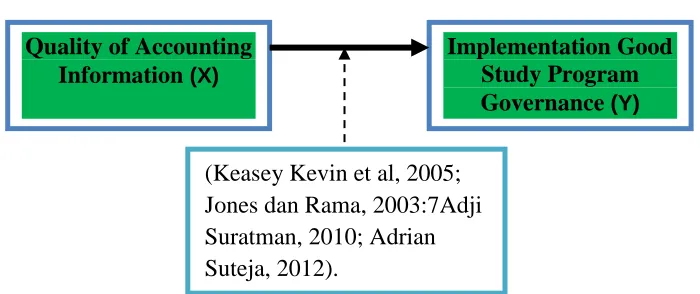
Study Model and Hypothesis
Based on the framework that has been stated above, the hypothesis proposed in this study is:
Quality of Accounting
Information
(X)
Implementation Good
Study Program
Governance
(Y)
(Keasey Kevin et al, 2005;
Jones dan Rama, 2003:7Adji
Suratman, 2010; Adrian
Suteja, 2012).
Figure :Theoretical Framework
Methodology
The research method is a method or technique used in the study. Research methods may be understood as all Reviews those methods/technique that are used for conduction of research (Kothari, 2004: 8), or a scientific method used to obtain the data with the purpose and specific uses (Sugiyono, 2011: 2). The following are the methods used in this study. Judging from the research objectives, the study included in the survey research. Sekaran and Bougie (2013: 102) describes the survey methods may be collected information from people who act as resources that can be described, compared and explained the facts relating to people, events or situations. Moh. Nazir (2005: 56) states that the survey method, the researchers not only provides a description of phenomena, but also explain the relationship, test hypotheses, make predictions, and get the meaning and implications of a problem to be solved. This study may provide an overview of phenomena related to the variables examined in this study is the quality of accounting information systems, the quality of accounting information and the implementation of good corporate governance. Furthermore Judging from this type of study (type of investigation), this kind of research is verificative research and explanatory research or causal study, because this research aims to find out what and how much the factors expected to affect a variable in order to test the hypothesis (Mudrajat Kuncoro 2007: 12). This research may explain how much influence the variable quality of accounting information systems, the quality of accounting information and the implementation of good corporate governance. This study chose this method because the researcher wants to get answers is fundamentally about causal analyze the causes of the phenomenon on the concept contained in this research that the phenomenon related to the problem and the practice of accounting information systems at higher education in Bandung-Indonesia.
Finding and Discussion
Based on the results of descriptive analysis and verification analyzes were then compared with the theory and the results of previous studies. In addition to using the results of the questionnaire answers, in response to problems in the study, an open information from the respondents is indispensable in
Then influence the quality of accounting information on the implementation of good corporate governance is high because it has the effect size value of 0.534 (f2 value above 0.35). Accountability factor loading value of 0.792 is higher than the value of the loading factor on transparency (0.606), accountability (0.7680), independence (0.664) and fairness (0.623) which means that the quality of accounting information will provide a change to the implementation of good program study governance when the variety and efficiency at high volume, can avoid mistakes, maintain data security, transparency of information/financial statements, information that is capable of legally defensible, capable of providing independent information according to user needs, information that is accountable and has a reasonable information. The research findings on the quality of accounting information system which shows that the implementation of good study program governance has been in the category of very adequate but not 100%.
Conclusion
Based on the phenomenon, the formulation of the problem, hypotheses and research results, the conclusions of the study are : study the implementation of good study program governance is influenced by the quality of accounting information. Implementation good study program governance has not been fully implemented because it is caused by the transparency that is not fully good, accountability has not been fully carried out, which is not appropriate accountability, independence and fairness that has not been well used is not appropriate.
References
[1] Adrian Sutedi. 2012. Good Corporate Governance. Publisher: Graphic Rays.
[2] Adji Suratman. 2010. Good Corporate Governance: Concepts and Issues. Publisher: PT.Tintamas Indonesia.
[3] Agus Martowardoyo. 2011.
http://nasional.kontan.co.id/news/pks-desak-
pemerintah-perbaiki-[4] sistem-pengendalian-internal-terkait-bpk (13/03/14, 12:58 pm)
[5] Anwar Nasution. Tangled Yarn 2009. Regional Financial Statements Accounting Indonesia.
[6] Issue No.18 / Year III / July, p 7.
[7] Arens. Alvin A, Elder, Randal J and Mark S. Beasley, 2008. Auditing and Assurance Services: An Integrated Approach. 12th Edition. Pearson / Printice Hall. Education. New Jersey.
[8] Arens. 2012. Auditing and Assurance Services: An Integrated Approach. 15th Edition. Pearson Education. New Jersey
[9] Azhar Susanto. 2008. Accounting Information Systems: Developing Risk Control Structure. First Edition. Badung: Lingga Jaya.
[10] Azhar Susanto. 2009. Management Information Systems: Developing Risk Structured Approach. Pertama.Bandung edition: Lingga Jaya.
[11] National Development Planning Agency and the Department of the Interior. Security Handbook 2002. Strengthening Regional Development Program.
[12] Beest, Ferdy Van. G. Braam, Boelens Suzane. Quality of Financial Reporting: measuring qualitative characteristics. Netherland: Nice Nijmegen Center for Economics Working Paper 09-108 April 2009 Institute for Management Research, Radboud University Nijmegen, Nijmegen HK
[13] Bentley, Lonnie D., & Whitten, Jeffrey L. 2007. Systems Analysis and Design For The Global Enterprise. 9th Edition. New York: McGraw-Hill. International Edition.
[14] Belkaoui, Ahmen Riahi. 2004. Accounting Theory 5 th Edition. High Holborn House 50-51 Bedford Row. London WCIR 4 LR: Thomson Learning.
[15] Bidgoli Hossein. 2004. The Internet Ensyclopedia Volume 2. Hobiken New Jersey: John Wiley & Sons Inc.
[16] Bodnar, George H. and William S. Hoopwood. 2004. Accounting Information Systems 9 th Edition. Upper Saddle River, New Jersey 07458: Pearson Education Inc.
[17] Bodnar, George H. and William S. Hoopwood. 2010.Accounting Information Systems, Tenth Edition. New York: Prentice Hall.
[18] Bollen, K. A & Long, S.J. 1993. Testing Structural Equation Models. A Sage Focus Edition.
[20] Cooper, Donald R and Pamela S. Schindler 2006. Business Research Methods Ninth Edition. McGraw Hill Companies, Inc.
[21] Cornnor, Peter. 2004. Using Computer in Hospitality 3 th Edition. High Holborn House 50-51 Bedford Row London WC1R4LR Cengage Learning EMEA.
[22] DeLone, William H. & McLean, Ephraim R. 1992. Information Systems Success: The Quest for the Dependent Variable. Information Systems Research. Volume 3, No. 2, p. 60-96
[23] DeLone, William H. & McLean, Ephraim R. 2003. The DeLone and McLean Model of Information Systems Success: A Ten-Year Update, Journal of Management Information Systems. Volume 19, No. 4, pp. 9-30
[24] Dennis, Alan. Wixon, Barbara Haley & Roth, Roberta M. 2009. System Analysis & Design. 4th Edition. John Wiley & Sons, Inc.
[25] Eppler, M .j. 2003. Managing Information Quality: Increasing the value of Information in Knowledge-Intensive Products and processes: Springer.
[26] Forum for corporate governance in Indonesia (fcgi). 2001 Series corporate governance, volume 1, issue 3, jakarta.
[27] Forum For Corporate Governance In Indonesia. 2006. Corporate Governance (Corporate Governance). Capital Market Education Foundation Sinergy Indonesia & Communication
[28] Hadi Purnomo. 2010. LKPP 2010 Fair With Exception. News CPC. 05-May edition Vol. It 12-13
[29] Hair et al. 2014. A Primer On Partial Least Squares Structural Equation Modeling (PLS-SEM). USA: SAGE Publications.
[30] Hans Kartikahadi. Rosita Uli Sinaga. Merliyana Syamsul and Sylvia Veronica Siregar. 2012. GAAP-based Financial Accounting Based on IFRS. Book 1. Salemba Four. Jakarta.
[31] Hirsch, Jr. Maurice L. 1994. Advanced Management Accounting. 2nd Edition. South Western Publishing Co.
[32] Hoque, Zahirul. 2002. Strategic Management Accounting. USA: Spiro Press
[33] Huang, K. T., Lee, et al. 1999 Quality information and knowledge. Prentice Hall, Upper Saddle River New Jersey
[34] I Made Wirartha. 2006. Economic Social Research. Andi Offset. Yogyakarta.
[35] Imam Ghozali. 2011. Applications Multivariate Analysis with SPSS Program. Publisher Agency UNDIP, Semarang.
[36] Indra Bastian. 2010. Public Sector Accounting: An Introduction. Issue 3. Erland. Jakarta. IFAC. 2001 Governance in the Public Sector: A Governing Body Perspective, IFAC Public Sector Committee.
[37] IFAC and CIFPA. 2014 International Framework of Good Governance in the Public Sector. IFAC and CIPFA
[38] Jackson and Sawyers. 2003. Managerial Accounting: A Focus on Decision Making. 2nd Edition. USA: Thomson
[39] Jones Frederick L and Dasaratha Rama V. 2003. Accounting Information Systems. A Business Process Approach. Thomson-South-Western
[40] Jonathan Sarwono. 2012. Path Analysis. Elex Media
Komputindo. Jakarta.
Kaplan, Robert S. & Atkinson, Anthony A. 1998. Advanced Management Accounting. 3rd Edition. Prentice Hall International
[41] Kaplan, R.M & Saccuzo, D.P. 2005. Psychological Testing, Principles, Aplications. And Issues. (6 th ed). Thomson Wadsworth, Belmont, USA.
[42] Kahn, BK, Strong, DM, & Wang, RY 2002. Information Quality Benchmarks: Product and Service Performance. Communications of the ACM, 45 (4ve), 185.
[43] Kerlinger, F.N.1992. Principles of Behavioral Research, Indonesia Edition, Second Matter. Yogyakarta: Gadjah Mada University Press.
[45] Kieso, Donald E., Weygandt, Jerry J. & Warfield, Terry D. 2007. Intermediate Accounting. 12th Edition. John Wiley & Sons, Inc.
[46] Kieso, Donald E., Weygandt, Jerry J. & Warfield, Terry D. 2011. Intermediate Accounting. 14th Edition. John Wiley & Sons, Inc.
[47] Krina. Loina Lalolo P. 2003. Principles, Accountability, Transparency and Participation. Good Public Governance Secretariat, National Development Planning Agency. Jakart
[48] Kothari, C.R. 2004. Research Methodology (Methods and Techniques, Second revised edition. New Age Internationa Publisheers.
[49] La Porta R., F. And Lopez-de Silanes. 1999. Corporate Ownership around the word. Journal of finance 54, 471-518.
[50] LAN-BPKP. 2000. Accountability and Good
Governance. Jakarta: LANRI
Moehrle, Stephen R. and Moehrle, Jennifer A. Reynolds. 2008. The purposed Conceptual Framework Semantics or Sea Change in Financial Reporting. CPA Journal / Inform Global.
[51] Moh. Nazir. 2005. Research Methods, Ghalia Indonesia
[52] Stephen R. Moehrle, and Moehrle, jennife A. Reynorld. 2008. The Proposed Conceptual Framework Semantics or Sea Change in Financial Reporting ?, November 2008 CPA Journal: 78. 11; ABI / INFORM Global.
[53] Mudjarat Kuncoro. 2007. Qualitative Methods, Theory and Applications for Business and Economics. Yogyakarta: UP STIM YKPN
[54] Moleong, Lexy J. 2008. Qualitative Research Methodology, PT. Teens Rosdakarya
[55] Norman Thomas. 2007. Integrated Security Systems Design: Concepts, Design and Implementation. 3D Corporate Drive, Suite 400 Burlington, MA d1803, USA Elsevier Inc. Jordan Hill, Oxport OX2 8DP, UK.
[56] Obaidat, Ahmad. 2007. Accounting Information Characteristics qualitative Gap: Evidence From Jordan. International Management Review. Vol. 3. No. 2007.
[57] OECD. 2004. The OECD Principles of Corporate Governance. The OECD
[58] Porter, Gary A and Norton, Curtis L. 2012. Using Financial Accounting Information: The Alternative to Debtor and Creditur. South Western 5191 Natorp Boulevard, Mason, OH 45040. USA.
[59] Salahi, Mahdi. Vahab Rostami & Abdolkarim Mogadam. 2000. Usefulness of Accounting Information in Emerging Economy: an empirical Evidence of Iran. Journal Revista de Contabilidad-Spanish Accounting Review. Pp.
[60] Salehi, Mahdi and Abdipour, Abdoreza. 2011. A Study of The Barriers Of Implementation Of Accounting Information System: Case of Listed Companies In Tehran Stock Exchange. Journal of Economics and Behavioral Studies Vol.2, No.2, pp. 76-85.
[61] Scott, George M. 1986. Principles of Management Information Systems. NY: McGraw-Hill. Have now, Uma. 2007. Research Methods For Business. Men Kwan Yon translation. Book Two. Third Edition. Publisher Salemba Four. Jakarta.
[62] Have now, Uma. 2009. Research Methods For Business. Men Kwan Yon translation. Book Two. Fourth Edition. Publisher Salemba Four. Jakarta.
[63] Have now, Uma and Bougie, Roger. 2013. Research Methods for Business: A Skill Building Approach Sixth Edition. United Kinddom: John Wiley & Sons Ltd.
[64] Sedarmayanti. 2013. Good Governance, "Good Governance". Part two. Revised edition. Publisher Mandar Maju
[65] Sri Mulyani. 2009. Methods of Analysis and Design System. Publisher: Abdi Systematics. Bandung.
[66] Shipper, K and Vincent, L. 2003. Earning Quality. Accounting Horizons.Supplemen pp. 97-110.
[67] Smith, Malcolm. Reserch 2003. In Accounting Methods. Sage Publication
[68] Stair, Ralph M. & Reynolds, George W. 2010. Principles of Information Systems. 9th Edition.Boston-USA: Course Technology
[70] Sugiama, A. Gima. 2008. Research Methods in Business and Management. First Edition. Bandung: Gurdaya Intimarta
[71] Sugiyono. 2009. Methods of Administrative penellitian Edition 14. Bandung: Publisher CV Alfabeta.
[72] Sugiyono. 2009. Methods penellitian Business Combination, Bandung: CV Alfabeta
[73] Sugiyono. 2011. Qualitative and Quantitative Methods penellitian R & D, Bandung: CV Alfabeta
[74] Suharsimi Arikunto. 2010. Procedure Research: A Practice Approach. Jakarta: Rineka Jaya
[75] Syafri Yuzal. 2010. Information System of Higher Education needs to be addressed. Via <http://kampus.okezone.com/read/2010/02/25/65/307 004/ system-integrated-information-education-higher-need-addressed> [11.09.2012]
[76] Usman Abdhali Watik. 2011. Data of state assets has not been well integrated. Via <http://www.bisnis.com/articles/data-aset-negara-belum-terintegrasi-baik> [4/7/2012
[77] UNDP. Suistainable 1997. Governance for Development Policy Document, New York: UNDP
[78] Weygandt, Jerry J, Kimmel, Paul D and Kieso, Donald E. 2010. Accounting Principle. Hoboiken New Jersey: John Wiley & Sons Inc.
[79] Frank Webster. 2006. The Theory of The Information socienty 3 th Edition. Routledge 2 Park Square, Milton Park, Abingdom Oxon, OX 14 4RN.
[80] Williams, JR, Haka Susan F, S and Better Mark Joseph V. Carcello 2010. Financial & Managerial Accounting: The Basis For Business Decisions, 15th edition. New York: McGraw-Hill Companies, Inc.
[81] World Bank. 1994. "Development in Practice, Governance: The World Bank Experience", World Bank Publication. Washington DC.