Licensed under Creative Common Page 60
http://ijecm.co.uk/
ISSN 2348 0386
OVERVIEW OF GROWTH HACKING: THE EVALUATION
OF IMPLEMENTATIONS ON UBER
Işıl Dalaman
Department of Business Management, Institute of Social Sciences Istanbul Aydin University, Istanbul, Turkey
Akın Marşap
Department of Business Management, Institute of Social Sciences Istanbul Aydin University, Istanbul, Turkey
Abstract
Growth hacking, which has its unique characteristics, emerged when startups were struggling
with challenges in the competitive startup ecosystem for achieving the rapid growth, customer
acquisition, and product market fit. This study focused on the examples of potential growth
hacking strategies that are applied by technology giants. As the transportation network
company, Uber pioneered the rapid growth and determined product development, it has been
chosen as a case study. The qualitative research was conducted with a cross-sectional design
by collecting general findings from several cases. The potential growth hacking strategies that
have been applied by Uber are evaluated through marketing and product development, which
forms the basis of growth hacking. The implementation of Uber's strategies that are referred as
growth accelerators are analyzed, and these applied disciplines based on marketing and
product development are evaluated. The methods such as customer acquisition, product market
fit (PMF), referral marketing, surge pricing, market expansion strategy, word of mouth marketing
(WOMM), early adopter advocacy, reputation system, disruptive innovation are demonstrated. It
is aimed to embody the subject in the minds by giving the successful real world examples and
create an information bridge between the world of economics and the academic world.
Keywords: Growth Hacking, Product Market Fit, Word of Mouth Marketing, Early Adopter
Licensed under Creative Common Page 61 INTRODUCTION
In the 21st century, the high technological developments and economic innovations continually emerge in the world. As a result, the people and companies contribute to their development by exploring the radical ways of adapting to this rapid change. Nowadays, as a consequence of these rapid changes, online marketing is regarded as one of the principal mechanisms for promoting services and marketing products. It is a kind of a marketing function that utilizes the internet as the primary source to introduce information about the product to consumers.
Startups must have achieved a high level of growth so that they can be transformed into an established business. Thus, growth hacking has become an inevitable solution and process in the startup ecosystem. It has developed its specific strategies and disciplines and has become an essential element of successful startups.
Growth hacking is one of the unique online-based marketing processes and primarily aims to achieve the accelerated and sustained growth of the company in a short period. This discipline produced skilled specialists called growth hacker in growth in their field. Growth hacking differences from traditional marketing, are applying radical strategies, taking risks and using low budget during the growth process.
The customer acquisition mindset focuses on customer orientation and creativity by encouraging more consumers to use their efficient product or services. The companies like Uber, Airbnb, Hotmail, Facebook, Linkedin, Dropbox, Twitter and Instagram all apply growth hacking as their main growth strategy, and the achievement of product-market-fit is one of the most important reasons for exponential growth.
The new competition has been created among the tech giants by the rise of sharing economy. Uber, one of the high-tech investment companies that have achieved great success in the technology world in a very short time and growing very fast, was preferred because it is a remarkable case study of growth hacking applications. Some of the startups that have struggled in such a challenging race in the economic world have achieved great success while some have failed and disappeared.
Licensed under Creative Common Page 62 HYPOTHESES
This study aimed to discover significant and essential relationships between prominent companies chosen as study case; Uber and Growth Hacking by evaluating and interpreting the hypotheses.
For this, the hypotheses are listed below:
H1: There is a relationship between Growth Hacking and Startups Success. H2: There is a relationship between Growth Hacking and Marketing.
H3: There is a relationship between Product Development and Startups Success. H4: There is a relationship between Product Market Fit and Startup Success.
H5: There is a relationship between regular acquiring, increasing and retaining users in short time between Startups Success.
H6: There is a relationship between Customer Acquisition between Growth Hacking.
THE EVALUATION OF GROWTH HACKING IMPLEMENTATIONS ON THE STUDY CASE: UBER
Customer Acquisition
Uber provided a solution to complete deficiencies for customers who were in search of new alternatives in the monopolistic cab market that give them the opportunity for improved private transportation. Hailing a cap experience through the app by using Google maps that include the drivers’ info gained many passengers who were interested in technology. The option of paying by card with the app without dealing with cash, change or tips was another product development that let Uber to achieve customer acquisition.
Market Expansion Strategy (City-by-City Expansion)
Licensed under Creative Common Page 63 Referral Marketing
When launching into a new city the strategy of largely referral-based Uber is to incentive early adopters with referral bonuses like the promotions “invite one friend and you both get a free
ride”. The foresight of Uber is “their revenue comes from repeat customers and customer
lifetime value rather than one-off transactions” they are willing to pay “initial revenue in the hopes that one free ride will translate into a lifetime of paid rides” for future investment. That is
why Uber creates a strategy with the aim of low risk trials on which the beneficiary will want to make use of it again. Viral / Referral Marketing is applied as marketing strategies for customer acquisition. The possibility of new riders becoming long-term costumer has increased through the encouraging experience that Uber offers to potential customers.
Early Adopter Advocacy
In Uber’s growth story the early adopter's tech community have a crucial role. Uber acquired the interaction always with the tech community who are permanently searching for new device and services that develop the quality of their life experience by driving in San Francisco. Tech events, providing free rides for referrals are provided with the aim of driving awareness among target audience. The early adopter who was displeased with the taxi situation in the city experienced Uber and published the new experiment to ride on blogs, social media by every possible method to their environment. The new riders impressed by their friend’s experience of being able to call a black car by phone app and became advocates. Acquiring the user accelerated the growth of Uber. Early adopters who had growth engine effect on the spread of Uber would affect their friends, environment who would become potential customers after the first Uber experience. By this method network will increase by accelerating the growth. One of the important methods that ensured the early adopters’ rolls was like an event sponsorship. Uber was extremely effective at local-area tech and venture capital cases where free rides were provided to participants.
This resulted in a strong word of mouth publicity for Uber, which in turn made it viral. Moreover, viral growth is one of the most important things for a growth hacker. This shows the importance of reaching right people for marketing. Uber gained a strong competitive superiority by being the first company to market.
Reputation System for Proving High Customer Trustworthy
Licensed under Creative Common Page 64 requested ride at the last minute or shortly before arrival. This system motivated Uber drivers to provide a better service for customer experience as they will be rated by every passenger at the end of each trip and encouraged the passengers to behave kindly as drivers will rate them too. The most effective method for assessment and evaluation of the potential outcome of any transaction between consumer and supplier are the trust and peer ratings.
Word of Mouth Marketing (WOMM)
Uber became a solution for the failing taxicab industry in San Francisco and was assimilated by early adopters in the tech community. The services sponsored the free rides and tech events. This promotional marketing approach encourages the tech community to begin to share with their environment and fans about Uber. This mindset provides a unique way to get a ride in the city and spread the news. The users shared their interests and quality experiences about taking part in services and how it stacked up better than its competition with friends and fans about Uber on social media like Twitter and blogs that provided success on growth. Uber achieved its most of the accelerated growth associated with the business through word of mouth by the users who participate in utilizing the services offered.
If the ads are guaranteed to reach even a very small audience, the guarantee is terminated as the ads are removed from publication. Satisfied customers from the service will continue to be brand advocates, and new customers they acquire into the company can become brand advocates. As long as startups improve their customer base and brand reputation, they will have the opportunity to capitalize on the highest potential of WOM marketing.
Stunt Marketing: Accelerants of Uber: Event Stunts
Uber has created efficient solutions for growth opportunities and has benefited from the real-life conditions that Uber Co-Founder and CEO Travis Kalanick regards as “accelerators” to accelerate and stimulate growth.
Licensed under Creative Common Page 65 Rides at SXSW and more standard promotional endeavors. Uber took an opportunity through special events & holidays to exhibit its model.
Surge Pricing Strategy Considering Customer Demand & Supply Balance for Drivers
Surge Pricing is one of the growth factors of Uber. When the demand for rides increase, the price for Uber services increases. Uber's prices are increasing for assuring a more reliable system if the demand can’t be met by the number of drivers operating on the road. The aim of this implementation is to provide users to connect to the drives when they want it safely. As the number of drivers is limited due to the high number of demand this system encourages more drivers to be become available by realizing the price increases. Therefore, when there is surge pricing, all users are informed by notification. It is ensured that users are aware of high ratios before connecting to the drives.
Uber's successful delivery of service in the short term can be successfully influenced by the significant findings of a positive labor supply elasticity. If the labor supply elasticity is negative and the drivers react to the wage increase by supplying fewer hours, the surge pricing will come to the contrary of the desired effect. This means that in the case of high demand, the surge price would decrease in addition to supply and there would be a greater gap between supply and demand.
Huge Growth Potential on Traditional Transportation Industry via Disruptive Innovation and Improvement Marketing Strategy
Today the old method of the market for taxi cabs and transportation is being disrupted by the sharing economy by transforming car ownership and transportation and re-inventing in a new way and directly linking producers with consumers, eliminating the need for an intermediary. The business method of taxi cabs is being innovated by Uber. Taxi drivers can start to provide services as independent contractors through mobile phone applications instead of working with a taxi company. Markets are discovering new boundaries of possibilities, disseminating information, lowering prices and creating new and unprecedented investment opportunities for entrepreneurs.
Licensed under Creative Common Page 66 encourages people to purchase daily necessities such as electricity and water, as well as to buy ride, rather than acquiring a vehicle, and in this sense Uber meets the demand and provides services.
Kalanick's marketing promotions, identified as accelerants, are testing methods for market demand and lead the company to potential growth. Google Ventures invested $258M into Uber Google Venture's big investment in Uber is a sign of what's coming in the future. Google put in a self-driving car, a very important innovation of company.
Product Development & Product Market Fit (PMF)
Product market fit is a priority in the intersection point of fields such as marketing, computer science, data-driven and statistical in growth hacking mindset. One of the distinct feature of Growth Hacking that difference from traditional marketing is taking the risk. The nature of this is due to the startup ecosystem where new firms are competing and they have to grow rapidly. In this competitive environment, there is a high probability of making mistakes and failing because they have to take risks in the growth hacking process to achieve their priority goals as customer acquisition and permanent growth. Failures are part of growth hacking, and mistakes lead to the acquisition of significant future experiences and success. Measurable and definite targets that can be tested for effective marketing and used for repetition should be aimed.
Because of the product market fit is an abstract concept of market harmony that precisely makes it harder to determine when Start-up succeeded. During the beginning startups' establishment, product market matching has to be achieved before proceeding in pyramid processes and scaling the business. That is why effective and efficient growth hacking requires analyzing the business and its consumers. Achieving product market fit must be the priority of the growth team and then focusing on growth.
Keeping burn rates low and focusing all resources on developing the ratio of customer loyalty, will be difficult unless the startup reached the product/market fit. Engaging the available and target users will help to determine how to build an essential product. After important product and vision revisions, highlighting a prominent property of your product will support the progress.
Licensed under Creative Common Page 67 Product Market Fit for Customers
Uber is a fast and practical problem solver primarily because it provides a ride for people who need taxi service at affordable prices. In the major cities, millions of consumers are benefiting from these services, and taxi service has been monopolized, developed and reinvented in every aspect. Uber's business model features, such as low prices and reduced transaction costs, contribute welfare interests of consumers.
Uber also organizes the substructure of the taxicab industry and makes the industry more esteemed by providing riders that offer clean and quality customer experiences and that accepts different forms of payment. They also made the experience more customer-focused because they allowed the customer to track the vehicle on their way to them. They also allowed customers to pay by credit card and through the vehicle.
Product Market Fit for Drivers (As It Is Expected for Their Satisfaction)
The vehicles and operators that are offered to riders do not belong to Uber. Instead of employing the drivers, Uber serves as a liaison and between people who need rides in a specific geographical area to qualified drivers who are in the region. Uber also creates jobs and opportunities for drivers and limousine companies that have difficulty finding jobs in the city. The company works with the existing licensed drivers and helps the vehicles that already provides the driving service to the customer, by its app and the connection between the driver and the passenger is created via the mediation of Uber. Another factor contributing to Uber's growth is the win-win for any interested party as any good service. More than $ 500 can be earned a day which amounts to a week of work time on average for some taxi drivers in this arrangement.
STUDY APPROACH
The ridesharing platform Uber was investigated in the framework by evaluation the implementation of Growth Hacking methods on the company. In the study, academic studies and models related to Uber's growth process and growth hacking applications were examined and also the internal expansion and the growth success of high-tech startups that aim to achieve rapid growth are evaluated by investigating the work principles and implementations on the important company, Uber.
A qualitative study was conducted by evaluating interviews of growth hacking experts, blogs and important growth experts’ articles to provide elements that are part of the growth hacking movement and handling the cases including the important company, Uber.
Licensed under Creative Common Page 68 data of the study. The purpose of applying qualitative approach is to explore and evaluate new areas to create a reasonable, appropriate theory. Explorative research is implemented to develop explanations to the ambiguous issues and to establish an integrated knowledge bridge between the economic world and the academic world.
This framework intended to explain and identify the term growth hacking that is an essential element for every aspect of startups and this new organizational culture’s role in Today’s marketing world. Growth hacking process, mindset and strategies that are implemented by growth hackers are handled and clarified with the excellent examples.
The keys are investigated that are applied during the implementing of growth hacking for achieving the growth in the organization of high tech startups. The main methods of growth hacking that are applied by Uber including are customer acquisition, product market fit (PMF), referral marketing, surge pricing, market expansion strategy, word of mouth marketing (WOMM), early adopter advocacy, reputation system, disruptive innovation demonstrated and evaluated by investigating the growth success of important companies.
The rise of Transportation Network Companies (TNCs) such as Uber has significant effects on taxi industry. Uber was selected as study case because of its accelerated growth in ecosystem implementing growth hacking methods. The sharing economy is expanding day by day where individuals utilize the Internet as a platform to be connected with other companies and individuals to share services in this echo- system.
DISCUSSIONS
Uber's rapid growth and accelerated populism show the effectiveness of the applied potential growth hacking methods that is a new and unique discipline on which its roots are based on the lean startup principles.
Growth Hacking differentiates from traditional marketing regarding the team that acts in an organization, product development, the use of marketing channels such as paid advertising or free & low-cost alternatives, the process of strategic implementations & defined funnels and promotional logic. Effective and efficient implementation of growth hacking provides accelerated and incremental growth in a short time to the established firm or startup.
Licensed under Creative Common Page 69 The meticulous selection of drivers who are employed by Uber and the rights offered to customers to rank the drivers develops the quality control and ensures for holding drivers responsible. This marketing method and the approach to product development enhances the quality of service provided to drivers, customer satisfaction, and brand loyalty more than traditional taxi industry.
Growth Hacking is a process, company culture, and mindset that needs to be applied and utilized at all levels of organizations, not just a discipline in which the marketing technique belongs only to the marketing department and team, as it is in traditional marketing.
Uber made a significant breakthrough and effect in the taxi industry. Uber can potentially be regarded as a growth machine about all measures. Accurately, the growth machine that has been built by the right and creative team and has the right strategy as a whole has achieved success with accelerants.
Public perception management, ensuring proper coordination between established taxi commissions and vehicle drives, public relations and perception management approach, lobbying, brand advocacy, brand loyalty, community management that enables the efficient operation of the world of mouth and its rapid spread, promotional marketing diversity and success are the primary elements that are the factors that trigger Uber's immense growth and play a crucial role in strengthening its foundations. Although growth hacking has emerged in the startup ecosystem, it also integrates the growth mindset to marketing strategies of established companies.
New-period growth marketing mindset will benefit from the techniques and implement the existing campaigns to ensure that regular advertising expenditures and digital marketing budgets fulfill their full potential.
Many major branding firms have limited their potential success and overlook the main potential growth elements as they are effective in this approach by focusing on a narrower area rather than advocating a growth mindset in every field in which they operate for continuous development.
Uber is phenomenal study case on the potential of growth that has redefined the transportation industry and created changes in the ideas and entrenched habits of users with disruptive innovations. Implementation of growth hacking is not for companies easy due to its disruptive characteristic but it is very effective in accelerating the growth rate and provides much better products and services.
Licensed under Creative Common Page 70 Growth Hacking is aimed at low-budget channels where data-driven can be implemented for quick and measurable attacks in metrics to achieve growth due to its nature. Because of these strategies that also have positive effects on service and product development, the competition conditions in the ecosystem are rebalanced.
As Uber has created, developing a pro-consumer product ensures sustainable growth and lasting business success. One of the most basic stones of success is that the product market fit (PMF) is conducted correctly even if Uber has to struggle with political and stationary private interests.
Good products and underdog brands that have not reached their target audience, will be able to raise, influence and be included in the competition market by assimilating growth hacking discipline.
Uber's growth story, in whatever sector and field the entrepreneur invests in, becomes a source of inspiration of achievement and guiding for growth requirements.
Growth hacking changes the perception that only major brands and companies in the traditional marketing world will be front-line because of the positioning of leaders and high-budget advertising projects.
Figure 1: Startup Competitors, The Y Combinator (YC) Companies
Source: (Friedman, 2016)
Licensed under Creative Common Page 71 accelerator that provides seed funding that is the earliest stage of venture funding for startups. All the expenses of early stage startups are paid by Y Combinator also called as the world's most powerful start-up incubator.
The technology giant companies like Airbnb, Hotmail, Facebook, LinkedIn, Dropbox, Twitter, and Instagram all also has applied growth hacking strategies as their main growth strategy. This approach let them achieve huge growth in a short time and reach to a very high number of people.
Figure 2: Uber Net Revenue 2013-2015 in Millions
Source: (Dogtiev, 2016)
In this table, it can be seen Uber's increasing periodic income values between 2013 and 2015. One of the market expansion strategy based on growth hacking mindset is city by city expansion that has started into the Asian section in 2013, with a launch in Sydney, Australia in winter of 2013 and the next was in Taiwan and Taipei in 2013. The net revenue curve of the global company services between Q1, 2013 till Q4, 2015 was about $25 million in Q1 of 2013 and it was more than $500 million in the last quarter of 2015. The highest spike of this season was at the start of 2015. This can be connected to the Uber launch in China and India in 2014. This strategy of Uber has provided company to gain very high profits and accelerated growth.
Licensed under Creative Common Page 72 Figure 3: Facebook & Uber Valuation at Their Early Stage (2011 – 2013)
Source: (Smith, 2014)
In the last three years, it has grown to $49.5 million in 2011, $258 million in 2013 and $1.2 billion in June. During this period, ridesharing service was provided in more than 200 cities in 45 countries around the world. The comparison of Uber and Facebook shows that Uber reached $35-40 billion valuation faster than Facebook achieved in its third year of fundraising. Facebook could reach this value within seven years.
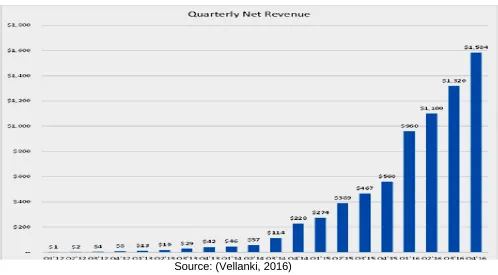
Figure 4: Quarterly Net Revenue of Uber 2012 – 2016
Licensed under Creative Common Page 73 As the net revenue of Uber is net of paying drivers, the GMV is 5x of the total amount (~20% net revenue margin). Uber's rapid growth has always been ongoing, and its growth with the international expansion strategy, especially between 2014 and 2015, has accelerated. Finally, in Q1 2016 Uber generated $ 960M net revenue, followed by a slight increase of 15% in the Q2 2016, reached $ 1.1B. Nevertheless, these impressive net income figures confronted Uber with considerable cost.
It is not easy to make an assessment for the future values, according to previous reports of companies that have been growing like accelerators like Uber. Not only the companies' giant growth, but also the efficiency and effectiveness of the long-term business will be taken into consideration in evaluations.
There are media channels around Uber that can adequately advertise and lure growth success and continue to attract the attention of many big investors. Uber's success story attracts not only the investors but also the startups. Uber will continue to increase its value as long as investors are always convinced that it will proceed in the direction of profitability. There are very important achievements, challenges, strategies and samples that startups need to patterns themselves on Uber's growth story.
As seen in the success story of Uber, when growth hacking strategies were applied by big industrial leaders and strong brands, it was possible to achieve accelerated growth, successful product development and customer acquisition by reaching a large number of the target audience in short time. One of Uber's important factors of success brings innovations to the market and convenience for its users, which is out of traditional marketing and mindset.
The growth hacking methods that have been applied have caused to strengthen Uber’s market presence and lead the race in the competitive industry where Uber struggle. Uber's success model in the sharing economy is parallel to Airbnb. Even if Uber struggled with difficulties and occasionally applied the wrong strategies, the company often created a powerful model that every startup founder has to sample. The stories of businesses that have gained tremendous success like Uber by implementing growth hacking strategies will continue to be the inspiration for startups at an early stage.
WAY FORWARD
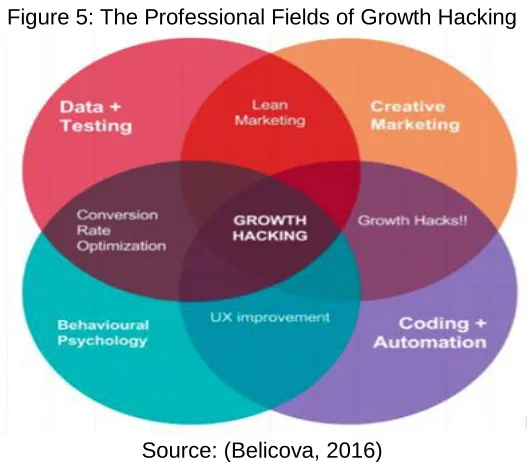
Licensed under Creative Common Page 74 Figure 5: The Professional Fields of Growth Hacking
Source: (Belicova, 2016)
The study focuses on the potential growth hacking strategies that are applied by case study so in the further research when the other applied growth hacking strategies are handled such as search engine optimization (SEO), A/B testing, website analytics, content marketing and data driven by evaluating together with the success stories of first-rate examples in the background of the technology giants, the phenomenon “growth hacking” and its operations will be embodied in the minds and clarify the interaction and close relationship between growth hacking and startups from the world of today's economy and will be better utility to realize the idea, logic, and purpose in the background of growth hacking.
Because of the lack of relevant academic literatures and resources to this new unique term “Growth Hacking” in the academic world, the evaluation, discussion, and conclusions were limited and this can be taken into consideration for future academic studies. When more researchers and writers pay attention to this subject, deeper content and resources will be published and clarified. This framework also can be guidance for companies & startups to get inspired for creating and developing their own growth hacking strategies appropriate for their own company infrastructures.
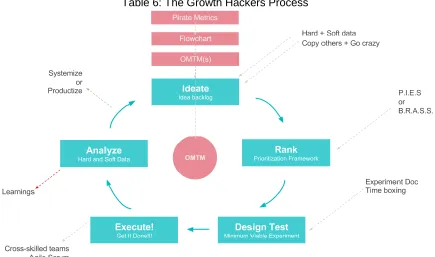
Licensed under Creative Common Page 75 Table 6: The Growth Hackers Process
Source: (Growth Tribe, 2016)
Figure 7: The Essential Skills of Growth Hackers
Source: (Growth Tribe, 2016)
The further research can aim to examine more fields about the skills of growth hackers as they apply technology-based solutions such as software, databases, APIs, and related tools to achieve growth that will be useful for the good products and underdog brands to reach the target audience and for startup founders and entrepreneurs to disrupt legacy marketplaces by discovering their specific growth strategy.
Licensed under Creative Common Page 76 REFERENCES
Andreesen, M. (2007). Product/Market Fit, Retrieved 5 August 2016, from http://web.stanford.edu/class/ee204/ProductMarketFit.html
Belicova, A. (2016). What Is Growth Hacking? Back to Basics, Retrieved 22 March 2016, from http://growthtribe.io/blog/what-is-growth-hacking-back-to-basics/
Brown, M. (2016). Uber What's Fueling Uber's Growth Engine? , Retrieved 12 December 2016, from https://growthhackers.com/growth-studies/uber
Carfi, C & Hermann, F. (2013). Beginner’s Guide to Growth Hacking, Retrieved 6 May 2015, from
http://www.slideshare.net/netzkobold/the-beginners-guide-to-growth-hacking?ref=http://www.frederikhermann.com/the-beginners-guide-growth-hacking/
Chaffey, D. (2016). What can established businesses learn from Growth Hacking?, Retrieved June 23 2016, from http://www.smartinsights.com/managing-digital-marketing/marketing-innovation/learn-growth-hacking/
Chafkin, M. (2015). The Y Combinator Chronicles, Retrieved 22 February 2017, <https://www.fastcompany.com/3044282/california-dreamin>.
Chandra, P. (2015). How did Uber get its first batch of users?, Retrieved 15 January 2016, from https://www.quora.com/How-did-Uber-get-its-first-batch-of-users
Chamorro-Premuzic, T. (2015). Reputation and The Rise of The 'Rating' Society, Retrieved 17 May 2016, from https://www.theguardian.com/media-network/2015/oct/26/reputation-rating-society-uber-airbnb Christensen, C. (2017). Disruptive Innovation, Retrieved 12 January 2017, from http://www.claytonchristensen.com/key-concepts/
DeBonis, M. (2012). Interview with Uber CEO Travis Kalanick, Retrieved 28 June 2016, from https://www.washingtonpost.com/blogs/mike-debonis/post/uber-ceo-travis-kalanick-talks-big-growth-and-regulatory-roadblocks-in dc/2012/07/27/gJQAAmS4DX_blog.html
Dogtiev, A. (2016). Uber Revenue Analysis, Retrieved 13 February 2017 from http://www.businessofapps.com/uber-revenue-analysis/
Ellis S. (2014). Uber's Extraordinary Growth Engine, Retrieved 21 May 2016, from http://www.slideshare.net/seanellis/ubers-extraordinary-growth-engine?qid=373c1efd-4a50-4ac2-aa76-7aadda63f9af&v=&b=&from_search=5
Given, C. (2015). Uber Economics: How markets are changing in the sharing economy, Retrieved 3 May 2016 from http://www.atlasnetwork.org/news/article/uber-economics-how-markets-are-changing-in-the-sharing-economy
GoDrive Inc. (2016). I drive with Uber, Retrieved 2 January 2017, from http://www.idrivewithuber.com/riders/uber-basics/what-is-uber-surge-pricing/
Google Trends. (2017b). Comparison of Uber, Lyft and Sidecar Terms, Retrieved 22 January 2017, from https://trends.google.com/trends/explore?q=uber,lyft,sidecar
Growthtribe. (2016). We Want To Turn You Into A “T-Shaped” Player, Retrieved 13 January 2017, from https://growthtribe.io/growth-hacking-academy/2-day-crash-course
Holiday, R. (2014). Growth Hacker Marketing, 2nd ed, Penguen Random House Company, London. John, R. (2014). Why Growth Hacking Could Be Killing Your Startup, Retrieved 22 May 2016, from
https://medium.com/@ramlijohn/why-growth-hacking-could-be-killing-your-startup-e9851151364a#.bmc45487l
Mangalindan, JP. (2014). The trials of Uber, Retrieved 3 March 2016 from http://fortune.com/2012/02/02/the-trials-of-uber/
Licensed under Creative Common Page 77 Ellis, S. (2007). What is Metrics Driven Marketing, Retrieved 21 July 2016, from http://www.startup-marketing.com/what-is-metrics-driven-marketing/
Friedman, J. (2016). The Startup Zeitgeist, Retrieved 22 June 2016, from http://blog.ycombinator.com/the-startup-zeitgeist/
Siu E. (2016). 10 Lessons Startups Can Learn from Uber’s Growth, Retrieved 3 January 2017, from https://www.singlegrain.com/blog-posts/business/10-lessons-startups-can-learn-ubers-growth/
Shankar, D. (2013). What is Uber's Marketing Strategy?, Retrieved 16 April 2016, from https://www.quora.com/What-is-Ubers-marketing-strategy
Shontell, A. (2014). Leaked: Internal Uber Deck Reveals Staggering Revenue and Growth Metrics, Retrieved 22 June 2016, from http://www.businessinsider.com/uber-revenue-rides-drivers-and-fares-2014-11
Smith, D. (2014). Uber Is Blowing up so Much Faster than Facebook Did, Retrieved 29 May 2016, from http://www.businessinsider.com/chart-of-the-day-uber-valuation-ahead-of-facebook-in-early-years-2014-11
Suslo, E. (2016). 6 Key Success Factors BehindUber Growth, Retrieved 19 December 2016, from https://taxistartup.com/blog/6-key-success-factors-behind-uber-growth/
Travis, K. (2011). Chicago - Uber’s biggest Launch to Date?, Retrieved 12 April 2016, from https://newsroom.uber.com/us-illinois/chicago-ubers-biggest-launch-to-date/
Vellanki, M. (2016). Here's What a 2017 Uber IPO Could Look Like, Retrieved 2 December 2016, from http://www.mahesh-vc.com/blog/heres-what-a-2017-uber-ipo-could-look-like