199
Analysis Of Hazy Images Based On K-Means
Ground Truth And Quick Shift Segmentation
Abdul Muqeet, Humera Tariq, Usman Amjad, Asia SamreenAbstract: Quick shift segmentation with optimal parameters claims for better edge visibility, improved color saturation and halo affects. The proposed method is based on grouping of hazy pixels such that it maximizes the similarity between a reference k-means and quick shift image. The objective of this paper is Qualitative and Quantative analysis of improved Quick shift segmentation based on super pixel segementation. Improved quick shift is based on super pixel based dark channel, K-Means based ground truth and having a fixed rectangular patch to determine dark channel image. The reference image helps in finding optimal quick shift parameters on fly instead of using fixed values for every image. Extensive quantitative (Mean Square Error, Structural similarity, Quality Index, Edge measurements) and qualitative evaluation were performed to show that the proposed method adheres the limitations of the state of the art fog removal methods.
Index Terms: dark channel, haze, superpixel, Edge Ratio, PSNR, UQI
————————————————————
1
Introduction
We implement two iterative algorithms to find optimal quick shift parameters for each image at run time which showed tendency to resolve colour saturation and halo effects problem [1]. The two proposed algorithms are named Primary and Secondary Quick Shift Segmentation respectively. In primary level ratio showing maximum similarity is chosen while keep-ing the kernel and threshold fixed. At advance level, the com-bination of all three parameters showing maximum similarity rate has been chosen for quick shift image segmentation. In Noh‘s work, the first segmentation parameter ‗ratio‘ is set to 0.5 indicating equal importance is given to both 5D feature space and 3D color space [2]. The standard deviation of par-zen window is fixed with kernel size 2. The third parameter Threshold represents the maximum distance in feature space at which pixels can be connected and its value is set to 10 for every [3]. We believe that more importance is given to 3D col-or space fcol-or natural foggy images while 5D spatial space be-come more important when images contain structural objects like buildings. Local standard deviation must be taken into ac-count as it affects the formation of super pixels. The distance also gets varied when background and foreground objects in foggy image are of different nature. The search for optimal parameters requires ground truth which is absent in most cas-es. Realizing the fact that availability of ground truth is crucial and it is difficult to find hazy and haze free images in pair, we propose that one can use k-means segmented image as ref-erence image with default k = 16 but is subject to change con-ditionally. In [4] authors generated a reference image by first removing the shadows and highlights using invariant illumina-tion method and then quantized the invariant image which is then taken as reference image. We present Qualitative Analy-sis to show that optimal parameters method improves edge visibility, overcomes saturation problem and reduces halo af-fects for typical images. Dehazing using novel Dark Channel Prior [5][6] continues to be a popular choice of researchers for improvement [7][8]. In [9] author proposed Generative Adver-sial Network (GAN) to solve this ill posed problem. AdverAdver-sial process mimics a two player min G max D game where the first player G learns distribution from input images and gener-ate sample from it. The job of second player D is to validgener-ate this generated sample by assigning correct label to both train-ing data and generated samples. Once Nash equilibrium is reached between G and D, the generated samples becomes indistinguishable from samples in the data set. [11] sums up various prior and learning based dehazing algorithms. Another
paradigm that is gaining popularity is the use of color lines observed by foggy image in RGB space [12] [13]. Our work is based on K-Means reference so it is important to have a look at some clustering based work as well for e.g. In [14], the au-thors presented a linear model for the depth map by showing the relationship between the brightness, saturation and depth map of single image to remove the haze. In [15], the authors used the clusters of Gaussian mixture models (GMM) and at-tenuation prior [14] for the depth map and hazy image. They used clusters to separate the sky and non-sky regions first. For both sky and non-sky regions, they used He‘s dark chan-nel prior to estimate the transmission map, however, dark channel method fails on sky regions. Therefore, they refined the transmission maps of sky regions. In [16], the authors also tried to remove out the sky region by using clustering algo-rithm, K-Means. They proposed that the scattering coefficient (β) in transmission map doesn‘t remain constant in all over the image, hence calculated the scattering coefficient differently for each segmented region. This work is mainly based on few selected fog removal methods [2][5][6] [16] [17] [18] and identi-fied three main problems namely color saturation, edge visibil-ity and halo affects presence. The rest of this paper is orga-nized as follows. In Sec. 2, we discuss the justification of ref-erence image along with brief review of image restoration pro-cess. Sec 3 discuss experimental setup along with comparison of various restored images using reference image and also presents the Comparison of Quick Shift Paramters which fol-lows comparision of State of Art Methods with our results in Sec. 5. Finally, Sec.6 attempts to quantify the results using standard metrics namely Mean Square Error, Structural simi-larity, Quality Index, Edge measurements. Sec. 6 concludes this paper.
200 L*a*b* colour space instead of RGB for better separation [19].
It has been observed that clustering with different k affects edge visibility as shown by highlighted red regions in trans-mission map of ‗forest‘ image, see Fig 2. Another such exam-ple is presented in the Fig 3 where most visible edges for ‗house‘ image belongs to transmission map which is obtained with k = 64. The highlighted red regions show clear and im-proved edge visibility. The worth mentioning are blue regions of ‗house‘ image where fog around grass has been removed making it completely visible. The magnified view of highlighted
blue regions is shown separately in Fig. 3 (a)- 3(d). By defini-tion ( ) is given as follows [5][6]:
( ) ( ( ) ( ( ))) Eq (1)
201 Input Forest Image
Fig. 2. (a) Refined trans-mission map of dark channel prior [5] (b) Refined transmission map with k=16 of proposed quick shift
method [1] (c) Magnified view of highlighted regions
202
Fig.4. Removal of fog using Dark Channel Prior and Guided Filter (a) Input foggy image, (b) Transmission map, (c) Restored
image using (c), (d) Refined Transmission map, (e) Restored image using Refined Transmission Map
Rrefinement of transmission map has been in practice using guided filter due to its faster nature [6]. Other alternative for transmission map refinement is bilateral filtering [20] [21] as shown in Fig 4. The reconstruction process will need estima-tion of Air light and transmission map ( ) as expressed in Eq(2) as follows:
Where ( ) is the restored fog free image from observed foggy image ( ). behaves as a lower bound to kept fog in the portions of restored image for its natural appearance. Usually, its value is set to 0.1.
3
E
XPERIMENTALS
ETUP ANDD
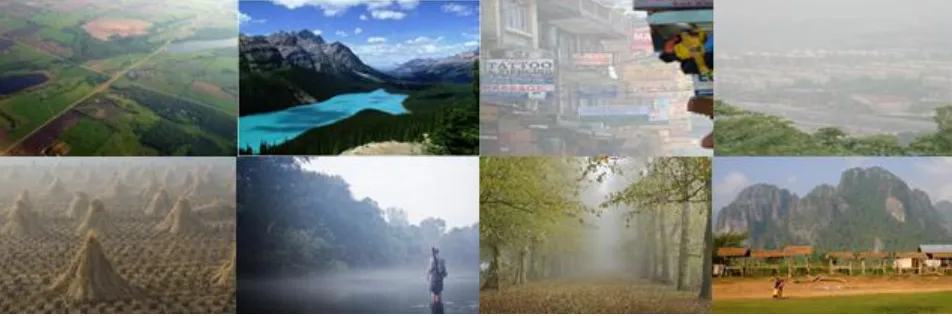
ISCUSSIONIn the previous sections, we discuss the need of reference image, K-Means analysis and review of restoration process by using proposed automatic quick shift method in [1]. Now in this section, we show the results of our proposed method and dis-cussion about it. We also compare our proposed method with mentioned state-of-the-art methods and show that how our results are better. For this study, more than 50 input images are used. The input images are taken from Fattal [18] and ran-domly selected from search engine (Google) and image host-ing website (Flickr.com) by ushost-ing keywords such as fog, mist, and haze. Some samples are shown in Fig. 5. For all experi-ments, we resized all input images to 640 x 480. We used MATLAB 2014b environment for development and for imple-mentation of quick shift algorithm we used VL Feat Library [22]. For dark channel prior method, we used patch size of 15x15. In Fig. 6, we restored the fog-free image by removing the fog from given degraded image. Authors in [5] [6] used fixed parameters in quick shift algorithm, we refer it supervised quick shift algorithm. However, it may not be true as every image has different structure i.e. different objects having dif-ferent shape and color.
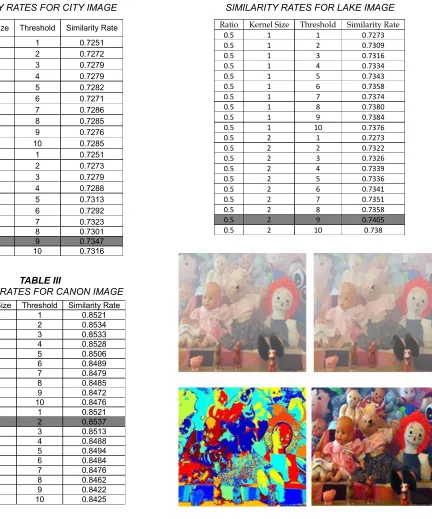
For the tree image, we got maximum similarity at ratio = 0.5, kernel size = 1, threshold=3 as shown in Table 1. Some other similarity rates are shown in Table 2, 3, and 4. We also exper-imented our proposed method on artificial images. There are some more results containing dense fog displayed in Fig. 7. All these results clearly indicate that our proposed method pro-duces quite effective results. In Fig. 8, we presented an artifi-cial lake image which is degraded by fog and results shows that our method is also effective for artificial images. We also experimented our method with artificial color image and the results (see Fig. 9) were very pleasant.
TABLE I
SIMILARITY RATES FOR TREE IMAGE ( ) ( )
( ( ))
(2)
Ratio Kernel Size Threshold Similarity Rate
0.5 1 1 0.9159
0.5 1 2 0.9162
0.5 1 3 0.9165
0.5 1 4 0.9161
0.5 1 5 0.9149
0.5 1 6 0.9130
0.5 1 7 0.9101
0.5 1 8 0.9069
0.5 1 9 0.9058
0.5 1 10 0.9020
0.5 2 1 0.9159
0.5 2 2 0.9162
0.5 2 3 0.9162
0.5 2 4 0.9142
0.5 2 5 0.9122
0.5 2 6 0.9103
0.5 2 7 0.9078
0.5 2 8 0.9050
0.5 2 9 0.9016
203
Fig. 5. Sample input images
Fig. 6. (a) Input cityscape image, (b) K-means clustering, (c) Segmented image, (d) Dark channel image, (e) Restored image.
Fig. 7. Top: Canon image, Bottom: City image. (a) Foggy images, (b) Reference image, (c) Segmented images using automatic
204
Fig. 8. (a) Lake images, (b) Reference image, (c) Segmented images using automatic quick shift, (d) dark channel images
ob-tained using (c), (e) transmission map(f) Final recovered images
TABLE II
SIMILARITY RATES FOR CITY IMAGE
TABLE III
SIMILARITY RATES FOR CANON IMAGE
Table IV
SIMILARITY RATES FOR LAKE IMAGE
Ratio Kernel Size Threshold Similarity Rate
0.5 1 1 0.7251
0.5 1 2 0.7272
0.5 1 3 0.7279
0.5 1 4 0.7279
0.5 1 5 0.7282
0.5 1 6 0.7271
0.5 1 7 0.7286
0.5 1 8 0.7285
0.5 1 9 0.7276
0.5 1 10 0.7285
0.5 2 1 0.7251
0.5 2 2 0.7273
0.5 2 3 0.7279
0.5 2 4 0.7288
0.5 2 5 0.7313
0.5 2 6 0.7292
0.5 2 7 0.7323
0.5 2 8 0.7301
0.5 2 9 0.7347
0.5 2 10 0.7316
Ratio Kernel Size Threshold Similarity Rate
0.5 1 1 0.8521
0.5 1 2 0.8534
0.5 1 3 0.8533
0.5 1 4 0.8528
0.5 1 5 0.8506
0.5 1 6 0.8489
0.5 1 7 0.8479
0.5 1 8 0.8485
0.5 1 9 0.8472
0.5 1 10 0.8476
0.5 2 1 0.8521
0.5 2 2 0.8537
0.5 2 3 0.8513
0.5 2 4 0.8488
0.5 2 5 0.8494
0.5 2 6 0.8484
0.5 2 7 0.8476
0.5 2 8 0.8462
0.5 2 9 0.8422
0.5 2 10 0.8425
Ratio Kernel Size Threshold Similarity Rate
0.5 1 1 0.7273
0.5 1 2 0.7309
0.5 1 3 0.7316
0.5 1 4 0.7334
0.5 1 5 0.7343
0.5 1 6 0.7358
0.5 1 7 0.7374
0.5 1 8 0.7380
0.5 1 9 0.7384
0.5 1 10 0.7376
0.5 2 1 0.7273
0.5 2 2 0.7322
0.5 2 3 0.7326
0.5 2 4 0.7339
0.5 2 5 0.7336
0.5 2 6 0.7341
0.5 2 7 0.7351
0.5 2 8 0.7358
0.5 2 9 0.7405
205 TABLE V
AUTOMATIC QUICK SHIFT PARAMETERS VALUES
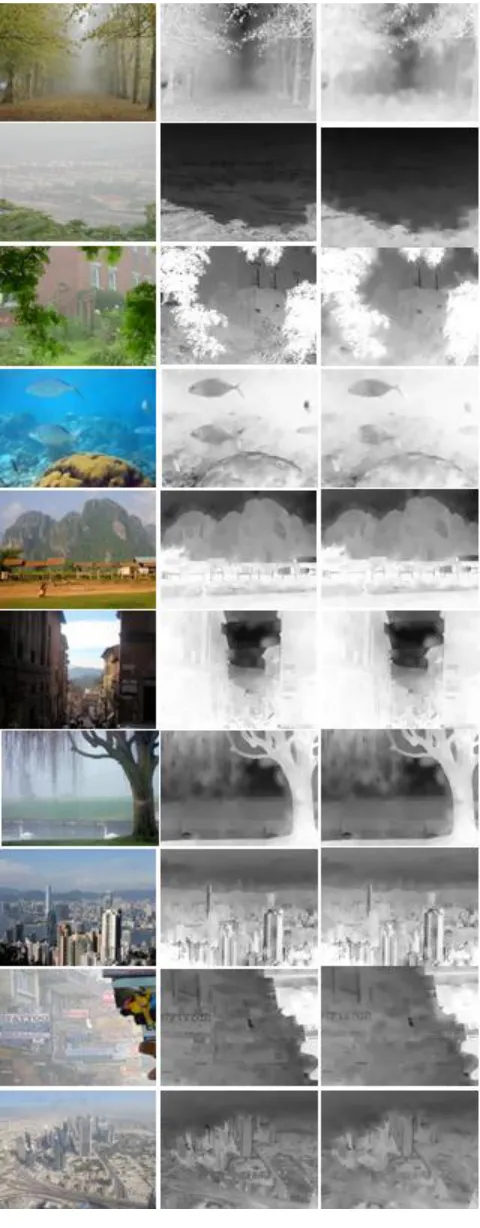
As we discussed before that we investigate the fog removal results achieved using automatic quick shift method and com-pared with the results obtained using dark channel and super-vised quick shift method. We observed that our results are more effective than supervised quick shift. It can be seen in Fig. 10 that transmission map obtained using supervised quick shift are not so good as it does not remove the fog from ob-jects which contain sharp edges such as trees, grass or bill-boards. The corresponding restored images of Fig. 10 are shown in Fig. 11. In Table 5, we can see that parameters for the quick shift are different from every image. It can also be seen from Table 5 that supervised quick shift can also be true for some images such as Urbino, Hong Kong, and Swan im-ages.
4
C
OMPARISON WITH EXISTING METHODSIn this section, we compare our results with the state-of-the-art fog removal methods. In Fig. 10, we have compared our pro-posed method with supervised quick shift method. Fig. 11b, shows there still remain some amount of fog on some part of restored images while our method removes the fog more ef-fectively as shown in Fig. 11c. The worth mentioning are blue regions in which we can see that in our results grasses are completely visible i.e. no fog in output results, which is not visible in other two results and these results show that fog is not removed from these regions. The magnified view of these highlighted blue regions are shown in Fig. 11d to witness the difference between all results which clearly show that our method is better than these both methods.
Fig. 10. (a) Input foggy images, (b) Refined transmission map
of our method, (c) Refined transmission map of supervised quick shift method.
Image Ratio Kernel Size Threshold
Tree 0.5 1 3
Cityscape 0.5 1 2
House 0.5 2 3
Underwater 0.5 2 5
Mountain 0.5 2 9
Urbino 0.5 2 10
Swan 0.5 2 10
Hongkong 0.5 2 10
Flags 0.5 2 6
206
Fig. 11. (a) Input foggy images, (b) Restored Image by
pro-posed method, (c) Restored image of supervised quick shift method.
Fig. 12. Refined transmission maps of house image. (a) Dark
channel result [5] (b) supervised quick shift result, (c) Our re-sults, (d) Magnified view of highlighted regions of (a), (b) and
(c) respectively.
Next we compare our method with Fattal‘s method [18] in Fig. 13, Fig. 14 and Fig. 15. In Fig. 13, we compare the output sults of foggy house image with Fattal‘s results. In Fattal‘s re-sults, we can see that the branches in highlighted regions are getting too dark while in our results there is no such color satu-ration. We can also observe that the color of all bricks in Fig. 13 is not same in Fattal‘s results. It may possible that fog might not be removed from all bricks while in our results all bricks have a same color showing that fog is equally removed from all bricks. The same problem also can be seen in Fig. 14 where most of the area of mountains are too dark.
Fig. 13. (a) Input House image (b) Restored Image by
207
Fig. 15. (a) Input underwater image, (b) Restored image by
Fattal, (c) Restored image by our method.
Fig. 14. (a) Input Mountain image, (b) Restored image by
Fat-tal, (c) Restored image by K-Means based Reference method.
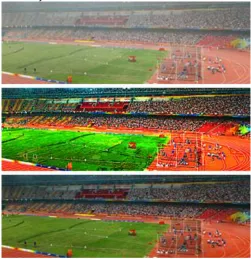
We have also tested our method on underwater image. In Fig. 15, we have compared our results with the Fattal‘s results for underwater image. In Fattal‘s result, the pixels of the most part of the image, particularly tail of upper fish, seems to be satu-rated while our results are quite pleasing. In Fig. 16 we com-pared our results with Tan‘s results and found that our results are quite better then Tan‘s results as it can be seen that there is loss of pixel information particularly in the greenery field of stadium. Therefore, we can say that our method is better than Tan‘s method for removal of the fog. We also compared pro-posed K-Means based quick shift method with some recent
State of the Art methods [14] [15] [16] for some typical images (See Fig. 17). Once again qualitative results show either im-provement or shows an equivalent amount of fog removal qualitatively.
Fig. 16. (a) Input image, (b) Restored image by Tan, (c)
Re-stored image by our method.
5
Q
UANTATIVEE
VALUATION209
6
C
ONCLUSIONIn this paper, we analyze K-Menas based automatic quick shift segementaiton method for removal of the fog from images instead of supervised quick method. The work is an extension of improved automatic quick shift method. Extensive qualita-tive analysis has been done to justify K-Means reference im-age and to compare it with other methods. We have shown that our results are quite better than selected methods. In fu-ture, we will work on quantitative analysis and will compare our work with other methods on the basis of that quantitative measurements. Future work will cover more recent methods and deep learning approach towards dehazing and compari-son.
R
EFERENCES[1]. H.Tariq, A.Samreen, U.Amjad, " Haze Removal Using Improved Automatic Quich Shift Segmentation," Ad-vances and Applications in Discrete Mathematics, vol.20, no. 2, pp.295-304,2018.
[2]. S.-W. Noh, B. Ahn and I. S. Kweon, "Haze removal on superpixel domain," in International Conference on Ubiquitous Robots and Ambient Intelligence (URAI), Jeju, 2013.
[3]. A. Vedaldi and S. Soatto, "Quick Shift and Kernel Methods for Mode Seeking," in Proceedings of the European Conference on Computer Vision, 2008.
[4]. M. Salem, A. Ibrahim and H. Ali, "Automatic quick-shift method for color image segmentation," in 8th Interna-tional Conference on Computer Engineering & Sys-tems (ICCES), 2013 , Cairo, 2013.
[5]. K. He, J. Sun and X. Tang, "Single image haze re-moval using dark channel prior," IEEE Transactions on Pattern Analysis and Machine Intelligence, vol. 33, no. 12, pp. 2341-2353, 2011.
[6]. K. He, J. Sun and X. Tang, "Guided Image Filtering," IEEE Transactions on Pattern Analysis and Machine Intelligence, vol. 35, no. 6, pp. 1397-1409, 2013.
[7]. T. Jacobs, "Underwater Image Haze Removal and Color Correction with an Underwater-ready Dark Channel Prior", July 2018.
[8]. L. Zhang, S. Wang and X.Wang, "Saliency-based dark channel prior model for single image haze re-moval," IET Image processing vol. 12, no. 6, p. 1049-1055, 2018.
[9]. R. Li, J. Pan, Z. Li and J. Tang, "Single Image Dehaz-ing via Conditional Generative Adversarial Network," CVPR 2018.
210 2016.
[14]. Q. Zhu, J. Mai, and L. Shao, ―A fast single image haze removal algorithm using color attenuation prior,‖ Im-age Processing, IEEE Transactions on, vol. 24, no. 11, p. 3522–3533, 2015.
[15]. F. Yu, C. Qing, X. Xu and B. Cai, " Image and video dehazing using view-based cluster segmentation," The International Conference on Visual Communica-tions and Image Processing (VCIP). 2016.
[16]. C. Qing, Y. Hu, X. Xu and W. Huang, ―Image Haze Re-moval Using Depth-Based Cluster and Self-Adaptive Parameters‖, IEEE International Conference on Internet of Things (iThings) and IEEE Green Com-puting and Communications (GreenCom) and IEEE Cyber, Physical and Social Computing (CPSCom) and IEEE Smart Data (SmartData), 2017.
[17]. R. T. Tan, ―Visibility in bad weather from a single im-age,‖ in Proc. IEEE CVPR, p. 1–8, 2008.
[18]. R. Fattal, "Single image dehazing," in International Conference on Computer Graphics and Interactive Techniques, 2008.
[19]. S.M. Burney, H. Tariq, "K-Means Cluster Analysis for Image Segmentation," International Journal of Com-puter Applications, vol 96, p:1-8, 2014.
[20]. H. Xu, J. Guo, Q. Liu and L. Ye, "Fast image dehazing using improved dark channel prior," in Information Science and Technology (ICIST), 2012 International Conference on IEEE, 2012.
[21]. S. Fang, J. Zhan, Y. Cao and R. Rao, "Improved Sin-gle Image Dehazing Using Segmentation," in IEEE In-ternational Conference on Image Processing (ICIP), 2010.
[22]. A. V. a. B. Fulkerson, "VLFeat: An Open and Portable
Library," 2008. [Online]. Available:
http://www.vlfeat.org.
ence (MCS) in 2001. She stands First Class First amongst the Evening batch of MCS 2001-2003. She joined MS leading to PhD program in 2009 and completed MS course work with CGPA 4.0. She started her PhD work in the field of image processing in 2011 under the supervision of Meritorious Professor Dr. S.M. Aqil Burney. Her research interest in recent times is Segmentation of Brain MR Axial Slices as a part of her PhD work.
Usman Amjad received BS. Degree in Computer Science from University of Karachi, in 2008. He recent-ly completed his PhD in Computer Science from University of Karachi. His research inter-ests include soft computing, machine learning, artificial intelligence and programming lan-guages. He was the recipient of the HEC In-digenous 5000 scholarship in 2013. Currently, he is working as AI solution architect at Datics.ai Solutions.
![Fig. 2. (a) Refined trans-mission map of dark channel prior [5] (b) Refined transmission map with k=16 of proposed quick shift method [1] (c) Magnified view of highlighted regions](https://thumb-us.123doks.com/thumbv2/123dok_us/8632311.1422019/3.612.50.568.503.705/refined-mission-refined-transmission-proposed-magnified-highlighted-regions.webp)

![Fig. 12. Refined transmission maps of house image. (a) Dark channel result [5] (b) supervised quick shift result, (c) Our re-sults, (d) Magnified view of highlighted regions of (a), (b) and (c) respectively](https://thumb-us.123doks.com/thumbv2/123dok_us/8632311.1422019/8.612.49.288.58.648/refined-transmission-channel-supervised-magnified-highlighted-regions-respectively.webp)