Efficacy of Breastfeeding Support Provided by Trained Clinicians During
an Early, Routine, Preventive Visit: A Prospective, Randomized, Open
Trial of 226 Mother-Infant Pairs
Jose Labarere, MD*; Nathalie Gelbert-Baudino, MD‡; Anne-Sophie Ayral, MD‡; Cathy Duc, MD‡; Martine Berchotteau, MD§; Nathalie Bouchon, MD§; Camille Schelstraete, MD‡; Jean-Philippe Vittoz, MSc*;
Patrice Francois, MD, PhD*㛳; and Jean-Claude Pons, MD, PhD¶
ABSTRACT. Background. Despite growing evidence of the benefits of prolonged breastfeeding for mother and infant health, the rate of breastfeeding at infant age of 6 months remains below the Healthy People 2010 goal. The greatest decrease in the breastfeeding rate occurs during the first 4 postpartum weeks. Mothers who dis-continue breastfeeding early are more likely to report lack of confidence in their ability to breastfeed, problems with the infant latching or suckling, and lack of individ-ualized encouragement from their clinicians in the early postdischarge period. Observational studies suggest that primary care physicians can increase breastfeeding rates through specific advice and practices during routine pre-ventive visits. However, robust scientific evidence based on randomized, controlled trials is currently lacking.
Objective. The purpose of this study was to deter-mine whether attending an early, routine, preventive, outpatient visit delivered in a primary care physician’s office would improve breastfeeding outcomes.
Design. The study was a prospective, randomized, parallel-group, open trial.
Setting. Participants were recruited at a level 3 mater-nity facility, with an average of 2000 births per year, in France.
Participants. A total of 231 mothers who had deliv-ered a healthy singleton infant (gestational age:>37 com-pleted weeks) and were breastfeeding on the day of discharge were recruited and randomized (116 were as-signed to the intervention group and 115 to the control group) between October 1, 2001, and May 31, 2002; 226 mother-infant pairs (112 in the intervention group and 114 in the control group) contributed data on outcomes. Intervention. Support for breastfeeding in the control group included the usual verbal encouragement pro-vided by the maternity ward staff members, a general health assessment and an evaluation for evidence of suc-cessful breastfeeding behavior by the pediatrician work-ing in the obstetrics department on the day of discharge,
provision of the telephone number of a peer support group, mandatory routine, preventive, outpatient visits at 1, 2, 3, 4, 5, and 6 months of infant age, and 10 weeks of paid maternity leave (extended to 18 weeks after the birth of the third child). In addition to the usual predischarge and postdischarge support, the mothers in the interven-tion group were invited to attend an individual, routine, preventive, outpatient visit in the office of 1 of the 17 participating primary care physicians (pediatricians or family physicians) within 2 weeks after the birth. The participating physicians received a 5-hour training pro-gram on breastfeeding, delivered in 2 parts in 1 month, before the beginning of the study.
Outcome Measures. The primary outcome was the prevalence of exclusive breastfeeding reported at 4 weeks (defined as giving maternal milk as the only food source, with no other foods or liquids, other than vita-mins or medications, being given). The secondary out-comes included any breastfeeding reported at 4 weeks, breastfeeding duration, breastfeeding difficulties, and satisfaction with breastfeeding experiences. Classifica-tion into breastfeeding categories reported at 4 weeks was based on 24-hour dietary recall.
Results. Ninety-two mothers (79.3%) assigned to the intervention group and 8 mothers (7.0%) assigned to the control group reported that they had attended the rou-tine, preventive, outpatient visit in the office of 1 of the 17 primary care physicians participating in the study. Mothers in the intervention group were more likely to report exclusive breastfeeding at 4 weeks (83.9% vs 71.9%; hazard ratio: 1.17; 95% confidence interval [CI]: 1.01–1.34) and longer breastfeeding duration (median: 18 weeks vs 13 weeks; hazard ratio: 1.40; 95% CI: 1.03-1.92). They were less likely to report any breastfeeding diffi-culties (55.3% vs 72.8%; hazard ratio: 0.76; 95% CI: 0.62-0.93). There was no significant difference between the 2 groups with respect to the rate of any breastfeeding at 4 weeks (89.3% vs 81.6%; hazard ratio: 1.09; 95% CI: 0.98-1.22) and the rate of mothers fairly or very satisfied with their breastfeeding experiences (91.1% vs 87.7%; hazard ratio: 1.04; 95% CI: 0.95-1.14).
Conclusions. Although we cannot exclude the possi-bility that findings might differ in other health care systems, this study provides preliminary evidence of the efficacy of breastfeeding support through an early, routine, preventive visit in the offices of trained primary care physicians. Our findings also suggest that a short training program for practicing physicians might con-tribute to improving breastfeeding outcomes. Multi-faceted interventions aiming to support breastfeeding should involve primary care physicians.Pediatrics2005; 115:e139–e146. URL: www.pediatrics.org/cgi/doi/10.1542/
From the *Quality of Care Unit and Departments of㛳Pediatrics and ¶Ob-stetrics, Gynecology, and Reproductive Medicine, Grenoble University Hospital, Grenoble, France; ‡Chambery, France; and §Department of Pedi-atrics, Chambery Teaching Hospital, Chambery, France.
Accepted for publication Sep 20, 2004. doi:10.1542/peds.2004-1362
Preliminary results from this study were presented at the French Society of Pediatrics meeting; June 2, 2004; Lille, France; and were printed in abstract form as part of the proceedings.
No conflict of interest declared.
Address correspondence to Jose Labarere, MD, Unite d’Evaluation Medi-cale, Pavillon Taillefer, CHU-BP 217, 38043 Grenoble Cedex 9, France. E-mail: [email protected]
peds.2004-1362; breastfeeding, counseling, primary care physicians, randomized, controlled trial.
ABBREVIATION. CI, confidence interval.
T
he benefits of prolonged breastfeeding for mother and infant health are documented in a vast scientific literature.1The AmericanAcad-emy of Pediatrics recommends exclusive breastfeed-ing for the first 6 months of life, continubreastfeed-ing to ⱖ1 year with the addition of complementary foods at⬃6 months of age.2 In its Healthy People 2010
recom-mendations, the US Department of Health and Hu-man Services sets goals of 75% of mothers breast-feeding exclusively in the early postpartum period and 50% continuing to breastfeed for at least 6 months.3
The hospital has been a particular focus of efforts to promote initiation of breastfeeding in the past decade.4 As a result, large-scale national surveys
indicated that the in-hospital breastfeeding rate reached the highest level recorded to date in the United States (69.5% in 2001) and would meet or exceed the Healthy People 2010 goal of 75% for the early postpartum period if increases in breastfeeding continued at the current rate (⬃2% per year).5
How-ever, the estimates of any breastfeeding at 6 months of age (from 27.0% to 32.5% in 2001) still fall signif-icantly short of the Healthy People 2010 goal.5,6The
largest decreases in breastfeeding rates occur during the first 4 postpartum weeks among different sub-groups of mother-infant pairs.7,8 Reasons for early
breastfeeding discontinuation are complicated. Mothers who discontinue breastfeeding early are more likely to report a lack of confidence in their ability to breastfeed,7,8 problems with the infant
latching or suckling,8,9breast pain or soreness,8,9
per-ceptions of insufficient milk supply,8,9 or a lack of
individualized encouragement from their clinicians8
in the early postdischarge period.
Many interventions directed at early preventable breastfeeding problems and relying on peer coun-selor or nurse follow-up visits at home or in the clinic have attempted to increase breastfeeding rates. These interventions occur as an adjunct to routine preven-tive visits, rather than within them, and have had generally limited success.10–13In contrast, the results
of observational studies suggest that support with breastfeeding problems and promotion of breast-feeding provided by clinicians during routine pre-ventive visits in office settings are associated with higher rates of exclusive breastfeeding.14 However,
randomized trials testing the efficacy of interven-tions delivered through existing primary health care services are currently lacking.8Such trials are
chal-lenging to conduct in the United States because mothers, health care providers, managed care orga-nizations, and insurance companies have vested in-terests in early discharge, home or clinic postpartum follow-up visits, and specific breastfeeding support. The French health care system differs to some extent from the US health care system.15In 2001, the
mean length of stay after normal vaginal delivery
was 4.8 days in France. Newborns benefit from rou-tine, preventive, outpatient visits delivered by a pe-diatrician or a family physician in an office setting during the first 6 months of life (ie, at 8 days, and 1, 2, 3, 4, 5, and 6 months of infant age). The period of paid maternity leave is 10 weeks after the birth, extended to 18 weeks after the birth of the third child. Despite these legal conditions, the prevalence of breastfeeding was 70.8% in our hospital and 58.1% at 1 month of infant age.16 The decrease in
breast-feeding rates during the first 1 month of life is likely to be related to a lack of early adequate breastfeeding support after discharge. Most mothers do not attend the mandatory preventive outpatient visit at 8 days of infant age, because it is usually anticipated in the maternity ward before discharge, for various practi-cal reasons.
The objective of this prospective, randomized, par-allel-group, open trial was to determine whether at-tending a routine, preventive, outpatient visit deliv-ered in a primary care physician’s office within 2 weeks after the infant’s birth would improve breast-feeding outcomes. Our primary hypothesis was that the exclusive breastfeeding rate at 4 weeks would be increased among mother-infant pairs attending the routine, preventive, outpatient visit (ie, the interven-tion group), in comparison with those receiving the usual postnatal support (ie, the control group). Our secondary hypotheses were that the rate of any breastfeeding at 4 weeks, breastfeeding duration, the proportion of mothers who experienced no breast-feeding difficulty, and the rate of satisfaction with the breastfeeding experience would be increased among mother-infant pairs in the intervention group, in comparison with those in the control group.
METHODS Setting
Mother-infant pairs were recruited in the maternity section of the department of obstetrics and gynecology of the Chambery Teaching Hospital (Chambery, France), a level 3 maternity facility where an average of 2000 deliveries per year have taken place in the past 5 years.
Participants
The study population consisted of mothers who had delivered a healthy singleton infant (gestational age:ⱖ37 completed weeks) and were breastfeeding on the day of discharge. Mother-infant pairs were considered ineligible and were not enrolled in the study if the infant was admitted to a neonatal unit or if the mother was transferred to an intensive care unit, wasⱕ18 years of age, was living outside Chambery and its suburbs, refused or was unable to give consent, was unable to speak French, or was un-likely to complete follow-up monitoring because of psychosocial problems such as homelessness.
Enrollment and Interventions
Control Group
The mothers in the control group received the usual verbal encouragement to maintain breastfeeding, provided by the mater-nity ward staff. On the day of discharge, the infant was examined by the pediatrician working in the department, for a general health assessment and an evaluation for evidence of successful breastfeeding behavior. The mothers were also provided with the telephone number of a peer support group that they could call to ask questions and request help. They were not required to attend the mandatory, preventive, outpatient visit at 8 days of infant age, because it was anticipated in the maternity ward before discharge. The postdischarge follow-up monitoring consisted of routine, pre-ventive, outpatient visits in a primary care physician’s office at 1, 2, 3, 4, 5, and 6 months of infant age.
Intervention Group
In addition to the usual predischarge and postdischarge sup-port, the mothers in the intervention group were invited to attend an individual, routine, preventive, outpatient visit in the office of 1 of the 17 participating primary care physicians, within 2 weeks after the birth. The participating physicians were pediatricians or family physicians practicing in Chambery and its suburbs. They had attended a 5-hour training program delivered in 2 parts in 1 month before the beginning of the study. We had developed the training program on the basis of guidelines and review
arti-cles.17–19It was intended to improve the physicians’
breastfeeding-related knowledge and counseling skills. The topics covered were general health assessment, lactation physiology, feeding position and latch-on assessment, management of common lactation prob-lems (nipple pain, nipple cracks, sore nipples, mastitis, and ma-ternal concern regarding low milk supply), management of infant problems (insufficient weight gain, breastfeeding jaundice, diar-rhea, and dehydration), maternal medication use while breast-feeding, and sources of support. The training program was deliv-ered through lectures, panel discussions, role-playing exercises, and printed educational materials. It was delivered as a stand-alone intervention and did not contain any postcourse measures to change health professionals’ performance.
Randomization
The allocation sequence was generated by the statistical adviser of the study with random permuted blocks with a block size of 8. The randomization assignments were unknown to any of the investigators and were concealed in consecutively numbered, sealed, opaque envelopes. The 2 residents opened the envelopes sequentially after the mothers signed the consent forms.
Data Collection
Baseline data on demographic characteristics, clinical variables, and in-hospital breastfeeding experiences were collected by the 2
residents through chart review and enrollment interviews. The participating physicians were asked to complete and return a questionnaire after each routine, preventive, outpatient visit within 2 weeks after the birth. The data included breastfeeding-related problems and management of those problems (counseling, prescribed medications, or additional visits). Mothers in the con-trol and intervention groups were sent a postal questionnaire when the infants reached 4 and 26 weeks of age, respectively. As described previously,20,21we used a postal questionnaire to assess
breastfeeding outcomes and satisfaction with breastfeeding expe-riences, to limit the risk of observer bias. A stamped addressed envelope was enclosed with a cover letter encouraging the mother to complete and return the questionnaire. A second questionnaire was sent to nonrespondents 10 days later. Nonrespondents to the second questionnaire were interviewed by telephone by 1 of the authors.
Outcome Measures
The primary outcome was the prevalence of exclusive breast-feeding reported at 4 weeks. Exclusive breastbreast-feeding was defined as giving maternal milk as the only food source, with no other liquids (other than vitamins or medications) or foods being giv-en.22 The secondary study outcomes were prevalence of any
breastfeeding reported at 4 weeks, median duration of breastfeed-ing, breastfeeding difficulties, and maternal satisfaction with the infant feeding experience, rated on a 4-point, single-item scale. Breastfeeding was defined as receipt by the infant of any breast milk. Classification into breastfeeding categories, as reported at 4 weeks, was based on 24-hour dietary recall. Breastfeeding dura-tion was equal to the infant age when the mother completely stopped breastfeeding and was censored at the time of 26 weeks for mothers who reported that they were still breastfeeding at that time.
Sample Size
On the basis of the results of a previous study,16we expected an
exclusive breastfeeding rate of 70% at 4 weeks among mother-infant pairs in the control group. We estimated that a sample of 108 mother-infant pairs in each group would have 85% power with a 2-tailed␣error of⬍.05 to detect a 25% relative increase in the rate of exclusive breastfeeding at 4 weeks (corresponding to a 17.5% absolute increase from 70% to 87.5%). We assumed that ⬃5% of mothers would be lost to follow-up monitoring; therefore, we planned to include 115 eligible mother-infant pairs in each group.
Statistical Analyses
Analyses were conducted according to the intention-to-treat principle. Comparisons were performed by using the Student’st test for continuous variables and the2test or Fisher’s exact test,
where appropriate, for categorical variables. In the multivariate analysis, we used a logistic regression model to estimate the odds ratio of exclusive breastfeeding at 4 weeks associated with the intervention, after adjustment for maternal age, white-collar em-ployment status, education status, smoking history, parity, prena-tal class attendance, epidural anesthesia, gestational age at deliv-ery, infant birth weight, breastfeeding within 1 hour after birth status, postpartum length of stay, and expected breastfeeding duration. The risks of breastfeeding continuation over time were estimated according to the Kaplan-Meier method and were com-pared between the 2 groups with the Cox proportional-hazards model. A 2-tailed P value of ⬍.05 was considered to indicate statistical significance. Hazard ratios were reported with 95% confidence intervals (CIs). All statistical analyses were performed with Stata 6.0 (Stata Corp, College Station, TX).
The study protocol was approved by the Grenoble University Hospital Institutional Review Board for the Protection of Human Subjects (Comite Consultatif de Protection des Personnes pour la Recherche Biomedicale), the French Data Protection Agency (Commission Nationale de l’Informatique et des Libertes), and the Medical Board of Savoie County (Conseil de l’Ordre des Medecins de Savoie). Written informed consent was obtained from all en-rolled mothers.
RESULTS Study Patients
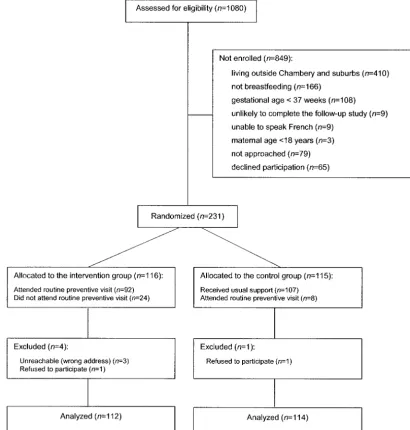
Between October 1, 2001, and May 31, 2002, a total of 1080 mother-infant pairs were assessed for eligi-bility; 231 were eligible, were approached, provided informed consent, and were randomized (Fig 1). Of these, 116 were assigned to the intervention group and 115 to the control group. The baseline character-istics of the 2 groups were similar (Table 1).
Attendance at the Routine, Preventive, Outpatient Visit Ninety-two mothers (79.3%) assigned to the inter-vention group and 8 mothers (7.0%) assigned to the control group reported that they had attended the routine, preventive, outpatient visit in the office of 1 of the 17 primary care physicians participating in the study (Fig 1). Eighty-seven questionnaires were com-pleted and returned by 13 physicians (range: 1–26 questionnaires per physician). The questionnaires in-volved 86 mothers in the intervention group and 1 mother in the control group. The mothers attended the physician’s office visit at 15.2 days of infant age,
TABLE 1. Baseline Characteristics of the Mother-Infant Pairs
Characteristics No. of Patients (%)
Intervention Group (n⫽116)
Control Group (n⫽115)
Age, y, mean (SD) 29.3 (4.1) 29.7 (4.8)
Education more than high school graduate 87 (75.0) 84 (73.0)
White-collar worker 92 (79.3) 87 (75.6)
Living with spouse/partner 114 (98.3) 112 (97.4)
Smoking history 27 (23.3) 22 (19.1)
Prenatal class attendance 84 (72.4) 88 (76.5)
Primiparity 58 (50.0) 63 (54.8)
Epidural anesthesia 69 (59.5) 73 (63.5)
Delivery through cesarean section 10 (8.6) 10 (8.7)
Female infant 56 (48.3) 53 (46.1)
Gestational age at delivery, wk, mean (SD) 39.7 (1.3) 39.8 (1.2) Infant birth weight, g, mean (SD) 3314 (441) 3325 (396)
Apgar score of⬍7 at 1 min 1 (0.9) 0
Breastfed within 1 h after birth 48 (41.4) 53 (46.1) Expected duration of breastfeeding, mo,
median (interquartile range)
4 (3–6) 4 (3–6)
on average (SD: 4.2 days). The most frequent breast-feeding-related problems reported by the physicians were breast pain or soreness (26 cases, 29.9%), jaun-dice (15 cases, 17.2%), nipple cracks (14 cases, 16.1%), latching difficulties (6 cases, 6.9%), desire to discon-tinue (5 cases, 5.7%), oral thrush (3 cases, 3.4%), mastitis (1 case, 1.1%), insufficient weight gain (1 case, 1.1%), and colic (1 case, 1.1%). The most fre-quent behaviors reported by the physicians were counseling (25 cases, 28.7%), providing information on a peer support group (15 cases, 17.2%), prescrib-ing medications (10 cases, 11.5%), schedulprescrib-ing a sub-sequent office visit (8 cases, 9.2%), and prescribing a breast pump (5 cases, 5.7%). No mother-infant pair was prescribed laboratory tests.
Outcomes
Outcomes were unknown for 4 mother-infant pairs in the intervention group and 1 mother-infant pair in the control group (Fig 1). Therefore, data for 112 mother-infant pairs in the intervention group and 114 in the control group were available for anal-ysis.
At 4 weeks of infant age, the rate of exclusive breastfeeding was significantly higher in the inter-vention group than in the control group (Table 2). In the multivariate analysis, the association between the intervention and exclusive breastfeeding at 4 weeks remained significant after adjustment for potential confounding (adjusted odds ratio: 2.44; 95% CI: 1.18 – 5.03) (Table 3). No first-order interaction terms for interactions between the intervention group and the predictors entered in the model were statistically significant. With the assumption that missing data were negative outcomes in the intervention group (n⫽ 4) and a positive outcome in the control group (n ⫽ 1) in the sensitivity analysis, the rate of exclu-sive breastfeeding at 4 weeks remained higher, al-though not significantly different, in the intervention group, compared with the control group (94 of 116 cases [81.0%] vs 83 of 115 cases [72.2%]; hazard ratio: 1.12; 95% CI: 0.97-1.30). There was no significant difference between the 2 study groups with respect to the rate of any breastfeeding at 4 weeks. The median breastfeeding duration was higher in the intervention group (18 weeks) than in the control group (13 weeks) (Fig 2). The mothers in the inter-vention group were less likely to report any breast-feeding difficulties (Table 2). The main breastbreast-feeding difficulties reported were breast pain or soreness (28.6% in the intervention group vs 31.6% in the control group), not enough milk (23.4% vs 37.7%), lack of motivation (20.5% vs 30.7%), infant refused
breast (4.5% vs 16.7%), mastitis (2.7% vs 2.6%), and other or unspecified difficulties (24.1% vs 38.6%). The rates of mothers reporting fair or high satisfac-tion with breastfeeding experiences did not differ significantly between the 2 groups.
DISCUSSION
This prospective randomized trial demonstrates that, compared with usual care, attending a routine, preventive, outpatient visit in the office of a primary care physician by 2 weeks of infant age is associated with a significant increase in the rate of exclusive breastfeeding at 4 weeks (83.9% vs 71.9%) and longer median breastfeeding duration (18 weeks vs 13 weeks). The benefits of exclusive breastfeeding for infant health are documented in a vast scientific lit-erature,23and exclusive breastfeeding is also widely
considered to be a strong predictor of longer breast-feeding duration. Our findings were robust, because the increase in the rate of exclusive breastfeeding persisted after controlling for potential confounding factors in the multivariate analysis (adjusted odds ratio: 2.44; 95% CI: 1.18 –5.03). The improvements in breastfeeding outcomes were logically paralleled by a decrease in the rate of mothers reporting any breastfeeding difficulties in the intervention group (55.3% vs 72.8%). This was likely related to the high level of attendance at the routine, preventive, outpa-tient visit in the intervention group (79.3%). This outpatient visit gave the physicians the opportunity to screen and manage early breastfeeding difficulties and to prevent early discontinuation. One surprising finding was that the satisfaction rates were equally high for the 2 groups, despite a significant difference in breastfeeding duration (18 weeks vs 13 weeks). Satisfaction with breastfeeding experiences is proba-bly not entirely determined by the discrepancy be-tween baseline expectations and final outcomes, and unmeasured psychologic factors may affect baseline expectations during breastfeeding experiences, a phenomenon that is called maturation bias.
Evidence-based data suggest that exclusive breast-feeding rates are increased by support for mother-infant pairs.24 Most interventions aiming to support
breastfeeding are time-intensive interventions that rely on specifically trained nurses or peer counselors and that occur as adjuncts to routine preventive vis-its.8However, offering support in addition to routine
preventive visits has a limited impact on breastfeed-ing outcomes in developed countries.12,13,25–27 In
contrast, our findings are in accordance with the results of prior observational studies showing that support provided by clinicians through specific
ad-TABLE 2. Univariate Analyses of Outcome Measures
Outcome No. of Patients (%) Hazard Ratio
(95% CI)
PValue
Intervention Group Control Group
Exclusive breastfeeding at 4 wk 94/112 (83.9) 82/114 (71.9) 1.17 (1.01–1.34) .03 Any breastfeeding at 4 wk 100/112 (89.3) 93/114 (81.6) 1.09 (0.98–1.22) .10
Duration of any breastfeeding, wk, median 18 13 1.40 (1.03–1.92) .03
Reporting any breastfeeding difficulties 62/112 (55.3) 83/114 (72.8) 0.76 (0.62–0.93) ⬍.01 Very or fairly satisfied with experience of
breastfeeding
vice and practices during routine preventive visits is associated with higher exclusive breastfeeding rates and increased breastfeeding duration.8,14
This study has broader clinical implications, in
that it demonstrates that common barriers to breast-feeding support by primary care physicians during routine preventive visits can be resolved. Practicing physicians have a considerable knowledge deficit
TABLE 3. Multivariate Analysis of Mother-Infant Pair Characteristics Associated With Exclusive Breastfeeding at 4 Weeks
Characteristics No. of Patients Adjusted
Odds Ratio (95% CI)
PValue
Exclusive Breastfeeding at 4 wk
(n⫽176)
Lack of Exclusive Breastfeeding at 4 wk
(n⫽50)
Intervention group 94 (53.4) 18 (36.0) 2.44 (1.18–5.03) .02
Age
⬍25 y 18 (10.2) 13 (26.0) 0.40 (0.14–1.14) .09
25–29 y 66 (37.5) 18 (36.0) 1.00
30–34 y 69 (39.2) 13 (26.0) 1.22 (0.50–2.98) .66
ⱖ35 y 23 (13.1) 6 (12.0) 0.75 (0.23–2.51) .65
Education more than high school graduate 132 (75.0) 36 (72.0) 0.90 (0.37–2.17) .80
White-collar worker 139 (79.0) 36 (72.0) 1.51 (0.63–3.66) .36
Smoking history 34 (19.3) 13 (26.0) 0.98 (0.41–2.33) .96
Prenatal class attendance 133 (75.6) 37 (74.0) 1.92 (0.76–4.84) .17
Primiparity 85 (48.3) 34 (68.0) 0.87 (0.32–2.41) .80
Epidural anesthesia 100 (56.8) 39 (78.0) 0.32 (0.13–0.76) .01
Gestational age at delivery
37–38 wk 35 (19.9) 11 (22.0) 0.84 (0.32–2.18) .72
39–40 wk 91 (51.7) 33 (66.0) 1.00
⬎40 wk 50 (28.4) 6 (12.0) 3.44 (1.20–9.82) .02
Infant birth weight
⬍3000 g 30 (17.0) 11 (22.0) 0.94 (0.36–2.48) .90
3000–3499 g 79 (44.9) 26 (52.0) 1.00
3500–3999 g 59 (33.5) 10 (20.0) 1.51 (0.62–3.70) .37
ⱖ4000 g 8 (4.6) 3 (6.0) 0.87 (0.15–4.85) .87
Breastfed within 1 h after birth 83 (47.2) 18 (36.0) 1.65 (0.75–3.61) .21 Postpartum length of stay of⬎4 d 81 (46.0) 33 (66.0) 0.66 (0.26–1.69) .39 Expected breastfeeding duration of⬎4 mo 83 (47.1) 17 (34.0) 2.49 (1.12–5.53) .02
regarding breastfeeding, a lack of confidence in their counseling skills, difficulties in advising mothers with lactation problems, and limited time to address breastfeeding issues during preventive visits.14,28
Moreover, substantial gaps in communication be-tween clinicians and mothers regarding breastfeed-ing may occur durbreastfeed-ing preventive visits.29Therefore,
we developed a training program on breastfeeding for pediatricians and family physicians who partici-pated in the study. The successful implementation of our training program depended on many factors, including the clinical content, the use of interactive techniques, and the limited amount of time required for its delivery within the constraints of busy prac-tices (5 hours, delivered in 2 parts).
Despite the encouraging findings of our study, it should be noted that the median duration of breast-feeding in the intervention group (18 weeks) was still less than the Healthy People 2010 goal. Breastfeeding support provided by the primary care physician dur-ing routine preventive visits is likely to have limited impact, compared with the effects of various barriers that affect breastfeeding duration negatively, such as psychologic factors, cultural factors, and return to work.30 By 18 weeks, only 33.8% of the mothers in
our study had returned to work or school, although maternity leave ranges from 10 to 18 weeks in France. This was in accordance with the results of a prior study conducted in the same area, which sug-gested that some mothers benefit from extended leave.20 Specific counseling regarding methods of
breastfeeding after the return to work has been rec-ommended,29although robust evidence of the effects
of such counseling on breastfeeding outcomes is cur-rently lacking.20Other approaches, such as part-time
work, are also thought to help mothers combine breastfeeding and employment.30
The findings of the current study need to be inter-preted in the context of its limitations. First, self-selection of motivated clinicians participating in this study was likely an important factor contributing to the improvements in breastfeeding outcomes in the intervention group. Although this trial demonstrates the efficacy of support for breastfeeding delivered by the primary care physician through an early, routine, preventive visit, the effectiveness of this type of sup-port is probably less in daily practice. This issue deserves additional study, although implementation trials of breastfeeding support during routine pre-ventive visits would be challenging to conduct in developed countries.
Second, it was not possible to blind observers in this randomized, open trial, because of interactions with mothers during the outpatient visit and assess-ment of breastfeeding outcomes. Therefore, we used a postal questionnaire to assess breastfeeding out-comes, to limit the risk of observer bias. Some moth-ers might have given erroneous information regard-ing their breastfeedregard-ing status at 4 weeks or the duration of breastfeeding. However, it was unlikely that misclassification bias in reporting breastfeeding outcomes differed according to the study group. The 4-week exclusive breastfeeding estimate was based on 24-hour dietary recall, as in most clinical trials.23
Some mothers who were exclusively breastfeeding at 4 weeks might not have maintained that status since birth.31 It is interesting to note that these mothers
who did not maintain exclusive breastfeeding since birth returned to exclusive breastfeeding at 4 weeks, which is a positive behavior change. Breastfeeding duration was assessed retrospectively, on the basis of data obtained at 26 weeks. It has been shown that reported breastfeeding duration can be considered accurate, with a long recall period.32 We did not
assess exclusive breastfeeding duration, however, because 6-month exclusive breastfeeding duration recall has been shown to be inaccurate.33
Third, our study was conducted in a single setting and focused on a socioeconomically low-risk popu-lation living in a medium-sized city. Moreover, the organization of health services has been recognized as a major factor contributing to breastfeeding initi-ation and continuiniti-ation.34 These facts may limit the
applicability of our results to other settings or health care systems. In addition, the mean length of stay after normal vaginal delivery is much longer in France than in other Western countries, including the United States. However, the mean postpartum length of stay did not differ between the control group and the intervention group in the current study, and the mothers enrolled in each group were still breastfeeding at discharge, a point that supports the effectiveness of our intervention in improving breastfeeding outcomes.
CONCLUSIONS
The current study provides preliminary evidence of the efficacy of breastfeeding support through an early, routine, preventive visit in the offices of trained primary care physicians. These findings sup-port the American Academy of Pediatrics policy statement calling for pediatricians to promote and support breastfeeding.2 Our findings also suggest
that a short training program for practicing physi-cians may contribute to improving breastfeeding outcomes. We recommend that multifaceted inter-ventions aiming to support breastfeeding involve pediatricians and family physicians in developed countries with low or intermediate breastfeeding prevalences.
ACKNOWLEDGMENTS
This study was supported in part by grants from the Union Professionnelle des Me´decins Libe´raux de la Region Rhone Alpes (Lyon, France) and by grants from the De´le´gation Re´gionale a la Recherche Clinique, Centre Hospitalier Universitaire (Grenoble, France). J.L. was supported by a grant from the Egide Foundation (Program Lavoisier).
We thank Linda Northrup for editorial assistance.
The following investigators participated in the study: Myriam Bell, Arnaud Buffin, and Nathalie Gelbert-Baudino (pediatricians); Corinne Chabert, Anne Chatriot, Marie-Lise Cressens, Christine Gomez, Frederique Rogeaux, Emmanuel Cussac, and Martine Sut-ter (pediatricians, Protection MaSut-ternelle et Infantile); and Emman-uelle Groult, Bernard Lanier, Christian Perrotte, Francis Ravier, Jean-Luc Vignoulle, Camille Schelstraete, and Jean-Louis Voyron (family physicians) (Chambery, France).
REFERENCES
2. American Academy of Pediatrics, Work Group on Breastfeeding. Breastfeeding and the use of human milk.Pediatrics.1997;100:1035–1039 3. US Department of Health and Human Services.Developing Objectives for Healthy People 2010. Washington, DC: US Department of Health and Human Services, Office of Disease Prevention and Health Promotion; 1997
4. Philipp BL, Merewood A, Miller LW, et al. Baby-friendly hospital initiative improves breastfeeding initiation rates in a US hospital set-ting.Pediatrics.2001;108:677– 681
5. Ryan AS, Wenjun Z, Acosta A. Breastfeeding continues to increase into the new millennium.Pediatrics.2002;110:1103–1109
6. Li R, Zhao Z, Mokdad A, Barker L, Grummer-Strawn L. Prevalence of breastfeeding in the United States: the 2001 National Immunization Survey.Pediatrics.2003;111:1198 –1201
7. Ertem IO, Votto N, Leventhal JM. The timing and predictors of the early termination of breastfeeding.Pediatrics.2001;107:543–548
8. Taveras EM, Capra AM, Braveman PA, Jensvold NG, Escobar GJ, Lieu TA. Clinician support and psychosocial risk factors associated with breastfeeding discontinuation.Pediatrics.2003;112:108 –115
9. Kuan LW, Britto M, Decolongon J, Schoettker PJ, Atherton HD, Kotagal UR. Health system factors contributing to breastfeeding success. Pedi-atrics.1999;104(3). Available at: www.pediatrics.org/cgi/content/full/ 104/3/e28
10. McKeever P, Stevens B, Miller KL, et al. Home versus hospital breast-feeding support for newborns: a randomized controlled trial. Birth. 2002;29:258 –265
11. Lieu TA, Braveman PA, Escobar GJ, Fischer AF, Jensvold NG, Capra AM. A randomized comparison of home and clinic follow-up visits after early postpartum hospital discharge. Pediatrics. 2000;105: 1058 –1065
12. Gagnon AJ, Dougherty G, Jimenez V, Leduc N. Randomized trial of postpartum care after hospital discharge.Pediatrics.2002;109:1074 –1080 13. Escobar GJ, Braveman PA, Ackerson L, et al. A randomized comparison of home visits and hospital-based group follow-up visits after early postpartum discharge.Pediatrics.2001;108:719 –727
14. Taveras EM, Li R, Grummer-Strawn L, et al. Opinions and practices of clinicians associated with continuation of exclusive breastfeeding. Pedi-atrics.2004;113(4). Available at: www.pediatrics.org/cgi/content/full/ 113/4/e283
15. Fielding JE, Lancry PJ. Lessons from France: “vive la difference”: the French health care system and US health system reform.JAMA.1993; 270:748 –756
16. Labarere J, Dalla-Lana C, Schelstraete C, et al. Initiation and duration of breastfeeeding in obstetric hospitals of Aix-Chambery (France) [in French].Arch Pediatr.2001;8:807– 815
17. Agence Nationale d’Accreditation et d’Evaluation en Sante. Breast feeding: implementation and continuation through the first six months of life: recommendations (May 2002) [in French].Gynecol Obstet Fertil. 2003;31:481– 490
18. Lawrence RA.Breastfeeding: A Guide for Medical Profession. 5th ed. St Louis, MO: Mosby; 1999
19. Beaufrere B, Bresson JL, Briend A, et al. Promotion of breast feeding: it’s the role of pediatricians [in French].Arch Pediatr.2000;7:1149 –1153 20. Labarere J, Bellin V, Fourny M, Gagnaire JC, Francois P, Pons JC.
Assessment of a structured in-hospital educational intervention ad-dressing breastfeeding: a prospective randomised open trial.BJOG. 2003;110:847– 852
21. Vittoz JP, Labarere J, Castell M, Durand M, Pons JC. Effect of a training program for maternity ward professionals on duration of breastfeeding. Birth. 2004;31:302–307
22. World Health Organization.Indicators for Assessing Breast-feeding Prac-tices. Geneva, Switzerland: World Health Organization; 1991 23. Bhandari N, Bahl R, Mazumdar S, Martines J, Black RE, Bhan MK. Effect
of community-based promotion of exclusive breastfeeding on diar-rhoeal illness and growth: a cluster randomised controlled trial.Lancet. 2003;361:1418 –1423
24. Sikorski J, Renfrew MJ. Support for breastfeeding mothers.Cochrane Database Syst Rev.2004;(4):CD001141
25. Graffy J, Taylor J, Williams A, Eldridge S. Randomised controlled trial of support from volunteer counsellors for mothers considering breast feeding.BMJ.2004;328:26
26. Dennis CL, Hodnett E, Gallop R, Chalmers B. The effect of peer support on breast-feeding duration among primiparous women: a randomized controlled trial.CMAJ.2002;166:21–28
27. Morrell CJ, Spiby H, Stewart P, Walters S, Morgan A. Costs and effec-tiveness of community postnatal support workers: randomised con-trolled trial.BMJ.2000;321:593–598
28. Freed GL, Clark SJ, Sorenson J, Lohr JA, Cefalo R, Curtis P. National assessment of physicians’ breast-feeding knowledge, attitudes, training, and experience.JAMA.1995;273:472– 476
29. Taveras EM, Li R, Grummer-Strawn L, et al. Mothers’ and clinicians’ perspectives on breastfeeding counseling during routine preventive visits. Pediatrics. 2004;113(5). Available at: www.pediatrics.org/cgi/ content/full/113/5/e405
30. Fein SB, Roe B. The effect of work status on initiation and duration of breast-feeding.Am J Public Health.1998;88:1042–1046
31. Cattaneo A, Davanzo R, Ronfani L. Are data on the prevalence and duration of breastfeeding reliable? The case of Italy.Acta Paediatr. 2000;89:88 –93
32. Launer LJ, Forman MR, Hundt G. Maternal recall of infant feeding events is accurate.J Epidemiol Community Health.1992;46:203–206 33. Bland RM, Rollins NC, Solarsh G, Van den Broeck J, Coovadia HM.
Maternal recall of exclusive breast feeding duration.Arch Dis Child. 2003;88:778 –783
DOI: 10.1542/peds.2004-1362
2005;115;e139
Pediatrics
Francois and Jean-Claude Pons
Berchotteau, Nathalie Bouchon, Camille Schelstraete, Jean-Philippe Vittoz, Patrice
Jose Labarere, Nathalie Gelbert-Baudino, Anne-Sophie Ayral, Cathy Duc, Martine
Mother-Infant Pairs
Early, Routine, Preventive Visit: A Prospective, Randomized, Open Trial of 226
Efficacy of Breastfeeding Support Provided by Trained Clinicians During an
Services
Updated Information &
http://pediatrics.aappublications.org/content/115/2/e139
including high resolution figures, can be found at:
References
http://pediatrics.aappublications.org/content/115/2/e139#BIBL
This article cites 28 articles, 13 of which you can access for free at:
Subspecialty Collections
http://www.aappublications.org/cgi/collection/breastfeeding_sub
Breastfeeding
http://www.aappublications.org/cgi/collection/nutrition_sub
Nutrition
sub
http://www.aappublications.org/cgi/collection/fetus:newborn_infant_
Fetus/Newborn Infant
following collection(s):
This article, along with others on similar topics, appears in the
Permissions & Licensing
http://www.aappublications.org/site/misc/Permissions.xhtml
in its entirety can be found online at:
Information about reproducing this article in parts (figures, tables) or
Reprints
http://www.aappublications.org/site/misc/reprints.xhtml
DOI: 10.1542/peds.2004-1362
2005;115;e139
Pediatrics
Francois and Jean-Claude Pons
Berchotteau, Nathalie Bouchon, Camille Schelstraete, Jean-Philippe Vittoz, Patrice
Jose Labarere, Nathalie Gelbert-Baudino, Anne-Sophie Ayral, Cathy Duc, Martine
Mother-Infant Pairs
Early, Routine, Preventive Visit: A Prospective, Randomized, Open Trial of 226
Efficacy of Breastfeeding Support Provided by Trained Clinicians During an
http://pediatrics.aappublications.org/content/115/2/e139
located on the World Wide Web at:
The online version of this article, along with updated information and services, is
by the American Academy of Pediatrics. All rights reserved. Print ISSN: 1073-0397.