University of Pennsylvania
ScholarlyCommons
Publicly Accessible Penn Dissertations
Fall 12-22-2010
Modeling Virus-Host Networks
James P. Evans
University of Pennsylvania, [email protected]
Follow this and additional works at:http://repository.upenn.edu/edissertations
Part of theBioinformatics Commons, and theComputational Biology Commons
This paper is posted at ScholarlyCommons.http://repository.upenn.edu/edissertations/260
For more information, please [email protected].
Recommended Citation
Modeling Virus-Host Networks
Abstract
Virus-host interactions are being cataloged at an increasing rate using protein interaction assays and small interfering RNA screens for host factors necessary for infection. These interactions can be viewed as a network, where genes or proteins are nodes, and edges correspond to associations between them. Virus-host interac- tion networks will eventually support the study and treatment of infection, but first require more data and better analysis techniques. This dissertation targets these goals with three aims. The first aim tackles the lack of data by providing a method for the computational prediction of virus-host protein interactions. We show that HIV-human protein interactions can be predicted using documented human peptide motifs found to be conserved on HIV proteins from different subtypes. We find that human proteins predicted to bind to HIV proteins are enriched in both documented HIV targeted proteins and pathways known to be utilized by HIV. The second aim seeks to improve peptide motif annotation on virus proteins, starting with the dock- ing site for protein kinases ERK1 and ERK2, which phosphorylate HIV proteins during infection. We find that the docking site motif, in spite of being suggestive of phosphorylation, is not present on all HIV subtypes for some HIV proteins, and we provide evidence that two variations of the docking site motif could explain phos-phorylation. In the third aim, we analyze virus-host networks and build on the observation that viruses target host hub proteins. We show that of the two hub types, date and party, HIV and influenza virus proteins prefer to interact with the latter. The methods presented here for prediction and motif refinement, as well as the analysis of virus targeted hubs, provide a useful set of tools and hypotheses for the study of virus-host interactions.
Degree Type Dissertation
Degree Name
Doctor of Philosophy (PhD)
Graduate Group
Genomics & Computational Biology
First Advisor Lyle Ungar
Keywords HIV, network
Subject Categories
MODELING VIRUS-HOST NETWORKS
James P. Evans
A DISSERTATION
in
Genomics and Computational Biology
Presented to the Faculties of the University of Pennsylvania
in Partial Fulfillment of the Requirements for the
Degree of Doctor of Philosophy
2010
Supervisor of Dissertation
Lyle Ungar, Associate Professor, CIS
Graduate Group Chairperson
Maja Bucan, Professor, Genetics
Dissertation Committee
Frederic Bushman, Professor of Microbiology
Sridhar Hannenhalli, Associate Professor of Genetics
Sara Cherry, Assistant Professor of Microbiology
Acknowledgements
I thank my mentors, Lyle and Aydin, for their support and guidance during my
graduate studies. Lyle taught me to focus on the main contributions of my work
and the work of others, and how to choose the right null hypothesis. Aydin provided
me with a deeper understanding of peer review, grant writing and reviewing, and
initiating collaborations with other researchers. Both mentors helped me learn to
translate projects into papers.
I thank my thesis committee members for their help with my dissertation and
other projects. I’m glad I worked with Sridhar during my first rotation, and I’m
thankful for his focus on controls. Rick and Sara’s focus on the biological importance
of computational projects will guide me during the rest of my research career.
I thank the students at Penn and Drexel for their friendship and research
dis-cussions. I enjoyed working with Greg while taking over his rotation project. I’m
thankful that I was able to talk to Rithun about HIV. I’m very glad that Will has
been around for scientific discussions.
I’m thankful that I found friends to accompany me during explorations of the
east coast. I’m glad I met Logan, Rumen, Ryan, Kathleen, Mahdi, Yichuan, Noor,
Adam, Mike, and Andrew. I’m glad Christin found me.
I thank my parents for their support during graduate school. They helped me
look for an apartment when I started school. They traveled to Philadelphia when I
had surgery, and stayed with me until I was back on my feet (literally). They came
I thank the Upenn hospital doctors for unraveling my intestines and finally
lo-cating and removing my appendix. Extreme abdominal pain has forced me to visit
three hospitals, and my Upenn hospital experience has been the most successful.
Finally, I thank my funding sources. This work was supported by National
In-stitutes of Health (NIH) grant # 232240, NIH training grant T32 HG000046, and
ABSTRACT
MODELING VIRUS-HOST NETWORKS
James P. Evans
Lyle Ungar
Virus-host interactions are being cataloged at an increasing rate using protein
interaction assays and small interfering RNA screens for host factors necessary for
infection. These interactions can be viewed as a network, where genes or proteins
are nodes, and edges correspond to associations between them. Virus-host
interac-tion networks will eventually support the study and treatment of infecinterac-tion, but first
require more data and better analysis techniques. This dissertation targets these
goals with three aims. The first aim tackles the lack of data by providing a method
for the computational prediction of virus-host protein interactions. We show that
HIV-human protein interactions can be predicted using documented human peptide
motifs found to be conserved on HIV proteins from different subtypes. We find that
human proteins predicted to bind to HIV proteins are enriched in both documented
HIV targeted proteins and pathways known to be utilized by HIV. The second aim
seeks to improve peptide motif annotation on virus proteins, starting with the
dock-ing site for protein kinases ERK1 and ERK2, which phosphorylate HIV proteins
during infection. We find that the docking site motif, in spite of being suggestive of
phosphorylation, is not present on all HIV subtypes for some HIV proteins, and we
provide evidence that two variations of the docking site motif could explain
phos-phorylation. In the third aim, we analyze virus-host networks and build on the
observation that viruses target host hub proteins. We show that of the two hub
types, date and party, HIV and influenza virus proteins prefer to interact with the
latter. The methods presented here for prediction and motif refinement, as well as
the analysis of virus targeted hubs, provide a useful set of tools and hypotheses for
Contents
Acknowledgements ii
Acronyms xii
1 Introduction 1
1.1 Motivation . . . 1
1.2 Organization . . . 2
1.3 Review of virus-host interactions . . . 5
1.3.1 Datasets . . . 7
1.4 Previous work with virus-host interactions . . . 10
1.4.1 Modeling virus-host interactions . . . 14
2 Prediction of HIV virus-host protein interactions using virus and host sequence motifs 16 2.1 Background . . . 16
2.1.1 Virus-host network use cases . . . 17
2.1.2 Reasons for predicting virus-host interactions . . . 18
2.1.3 Predicting virus-host interactions . . . 20
2.2 Methods . . . 23
2.2.1 Virus protein motif annotation and conservation . . . 23
2.2.2 Human protein peptide motif and domain annotation . . . 25
2.2.4 Validation using the NCBI HIV-Human Protein Interaction
Database . . . 28
2.3 Results . . . 31
2.3.1 Human peptide motifs were conserved on HIV proteins . . . . 31
2.3.2 Significant overlap of predicted and validated HIV-human in-teractions verifies our method . . . 33
2.3.3 Predicted and validated HIV-human interactions share similar Gene Ontology labels . . . 35
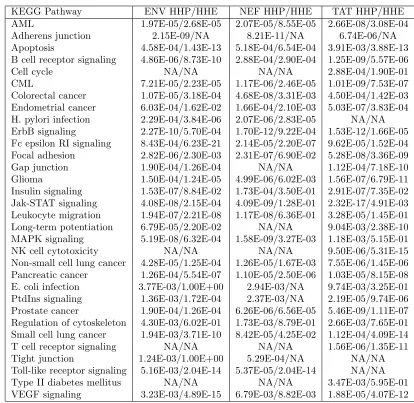
2.3.4 Predicted and validated HIV-human interactions occupy the same KEGG pathways . . . 37
2.3.5 Virus level comparison of predicted and verified HIV-human interactions . . . 43
2.3.6 Infrequent host peptide motifs did not improve prediction per-formance . . . 47
2.4 Discussion . . . 48
2.5 Conclusion . . . 52
3 A bioinformatics approach reveals possible MAPK docking motifs on HIV proteins 55 3.1 Background . . . 55
3.1.1 MAPK and HIV infection . . . 56
3.1.2 MAPK substrate docking . . . 56
3.1.3 Disrupting protein-protein interactions using small-molecule inhibitors . . . 57
3.2 Results . . . 59
3.2.1 Consensus MAPK docking sites on human proteins . . . 59
3.2.2 MAPK docking sites on HIV proteins . . . 60
3.2.4 Candidate docking motifs on the HIV protein matrix are
sup-ported by structures . . . 68
3.3 Discussion . . . 70
3.4 Conclusion . . . 73
3.5 Methods . . . 74
3.5.1 Human and HIV sequences and motifs . . . 74
3.5.2 Significance of proposed docking site motif conservation on HIV proteins . . . 74
3.5.3 Structure analysis . . . 75
3.5.4 Docking . . . 76
4 Modularity in protein interaction network hubs predicts viral host-pathogen interactions 77 4.1 Background . . . 77
4.1.1 Intermodular and intramodular hubs . . . 78
4.2 Results . . . 81
4.2.1 Hub classification . . . 81
4.2.2 Hub class properties . . . 84
4.2.3 Virus hub preference . . . 84
4.3 Discussion . . . 89
4.4 Conclusion . . . 91
4.5 Methods . . . 92
4.5.1 Human interaction networks . . . 92
4.5.2 Virus-host interaction networks . . . 93
4.5.3 Peptide motif and SMART domain annotations . . . 94
5 Reflections and perspectives 95 5.1 Review of our work . . . 96
List of Tables
1.1 Experimentally determined virus-host interactions . . . 6
2.1 Overlap between predicted and validated HIV-human interactions . . 34
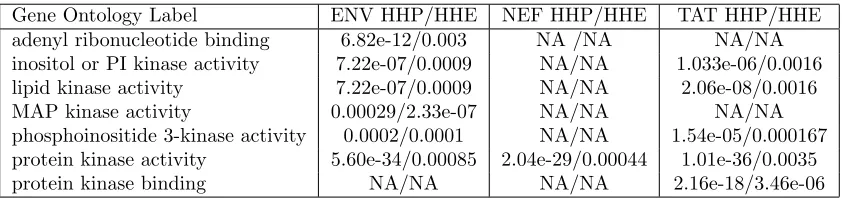
2.2 Gene Ontology molecular function enrichment for predicted and ex-perimentally verified HIV targeted human proteins . . . 36
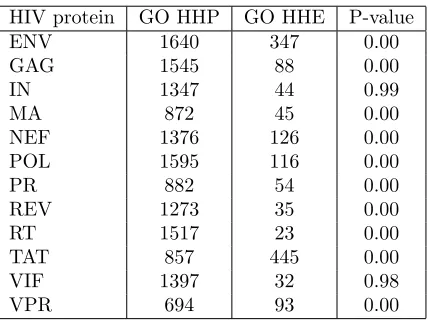
2.3 Validation of HIV-human predicted interactions using Gene Ontology biological process similarity . . . 37
2.4 KEGG pathway enrichment for predicted and experimentally verified HIV targeted human proteins . . . 38
3.1 MAPK docking pattern hits on human proteins . . . 59
3.2 MAPK docking pattern hits on HIV proteins . . . 61
4.1 Fisher’s test for virus hub preference . . . 85
4.2 Fisher’s test for virus hub dependency factor preference . . . 88
A.1 HIV protein sequence counts . . . 105
A.2 Counter domain/peptide motif relations and coverage . . . 106
A.3 Validation of direct HIV-human interaction predictions . . . 107
List of Figures
1.1 HIV genome . . . 7
1.2 HCV genome . . . 9
1.3 Host peptide motifs on HIV NEF . . . 12
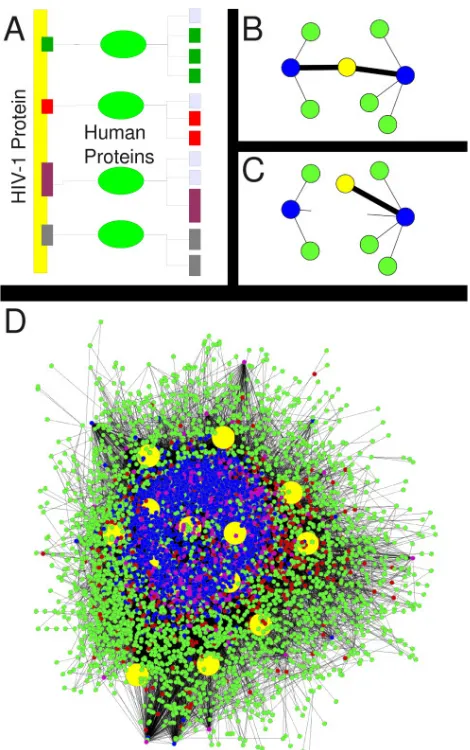
2.1 Network diagrams for HIV-human protein interactions . . . 27
2.2 Host peptide motif conservation on HIV NEF . . . 31
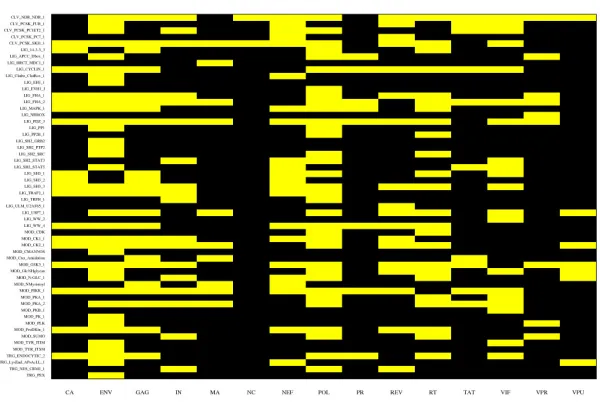
2.3 Host peptide motifs conserved on HIV proteins . . . 32
2.4 Evaluation of direct HIV-human interaction predictions . . . 35
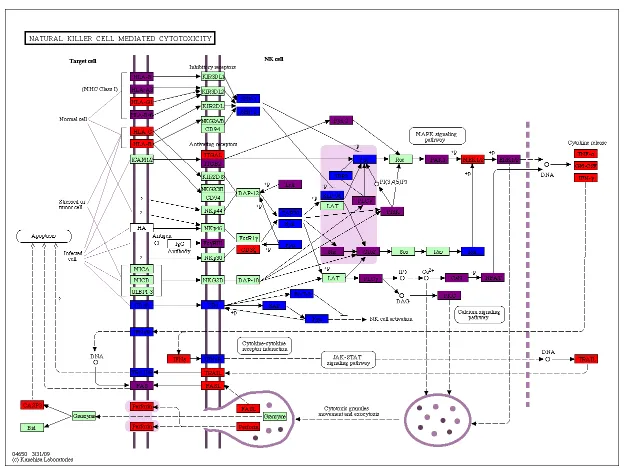
2.5 HIV TAT natural killer cell mediated cytotoxicity . . . 40
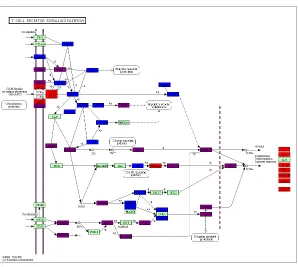
2.6 HIV TAT T cell receptor signaling pathway . . . 41
2.7 Comparison of predicted and validated virus-host interactions for host proteins in KEGG pathways . . . 44
2.8 Comparison of combined predicted and validated virus-host interactions 45 2.9 Evaluating the use of infrequent host peptide motifs for HIV-human interaction prediction . . . 46
3.1 MAPK docking site pattern hits on HIV proteins . . . 62
3.2 Docking between MAPK ERK1 and HIV Nef . . . 64
3.3 Human sequence logos for MAPK docking site hits . . . 66
3.4 HIV sequence logos for MAPK docking site hits . . . 67
3.5 MAPK substrate hierarchy . . . 69
4.1 Comparing hubs across human interaction networks . . . 81
4.2 Establishing inter/intramodular hubs . . . 83
4.3 Virus hub preference . . . 86
Acronyms
CD Counter domain
DAVID Database for annotation, visualization, and integrated discovery
DHHE Direct HIV-human experimental interactions
dPCC Distribution of Pearson correlation coefficients
EBV Epstein-Barr virus
ELM Eukaryotic linear motif
GO Gene ontology
H1 Human proteins that directly interact with a virus protein
H2 Human proteins that interact with virus targeted human proteins
HCV Hepatitis C virus
HHE HIV-human experimental interactions
HHP HIV-human predicted interactions
HIV Human immunodeficiency virus
HPRD Human protein reference database
KEGG Kyoto encyclopedia of genes and genomes
LANL Los Alamos national laboratory
MAPK Mitogen-activated protein kinase
NCBI National center for biotechnology information
PCC Pearson correlation coefficient
PPI Protein-protein interaction
siRNA Small interfering RNA
STRING Search tool for the retrieval of interacting genes/proteins
Chapter 1
Introduction
1.1
Motivation
Virus proteins interact with their host’s cellular machinery, and in doing so alter the
host cell to favor viral replication. It is important to identify and annotate
virus-host interactions for the discovery of new drug targets as well as for assessing the
efficiency of antiviral drug therapies on host subpopulations [19, 37]. Furthermore,
virus-host interactions can be used to suggest roles for virus proteins [26], and
in-vestigate common viral strategies for interacting with their hosts [116]. With this
in mind, many researchers have gathered data for virus-human interactions to
de-termine host factors necessary for the virus life cycle. These interactions take the
form of virus-human protein interactions, human gene expression responses to
in-fection, and genetic screens for human genes that are necessary for virus survival.
The genetic screens suggest that certain human genes play a role in infection, while
the protein interaction and gene expression data suggest what these roles might be.
To date, only three viruses, human immunodeficiency virus (HIV), hepatitis C virus
(HCV), and influenza A virus have extensive data for these interactions.
The experimental challenges of identifying virus-host protein interactions are
positive rates while ensuring that the number of real interactions that cannot pass
these stringent assays is kept to a minimum. Protein interactions are transient in
nature, and moreover such protein binding interactions may depend on the presence
of cofactors that are not necessarily present in binding assays. These difficulties
suggest supplementing experiments with a bioinformatic approach to predicting and
understanding virus-host interactions. This has been attempted for HIV by
pre-dicting HIV-human protein interactions, but it was found that the most predictive
human protein feature was the number of interacting partners a protein had [160],
which does not provide sites for drug targeting. Such findings indicate that more
analysis is needed to understand the underlying principles of interactions, and to
guide experimental studies.
The overall goal of this dissertation is to estimate and analyze virus-host
inter-actions. These interactions have been organized into networks, where proteins are
nodes and network edges represent interactions between proteins [67]. We begin this
thesis by predicting virus-host protein interactions using short peptide motifs that
have been shown to play a role in protein interactions [82]. We demonstrate the
validity of our predictions using HIV-human interactions. Next we investigate the
usage of mitogen-activated protein kinase docking motifs on HIV proteins. We then
compare HCV, HIV, and influenza virus-host networks to address the finding that
virus proteins prefer to interact with highly connected host proteins. We provide
evidence that this hub preference is a consequence of the requirement of viruses to
utilize host protein complexes during infection. We conclude this dissertation with
a discussion of how the work presented here aids virus-host network analysis.
1.2
Organization
This thesis has been organized into three specific aims: (1) the prediction of
and (3) the analysis of virus targeted host proteins.
This chapter serves as a background section. We will discuss two types of
virus-host interactions: protein interactions gathered from high throughput studies and
literature searches, and genetic screens searching for host factors required for the
viral life cycle. Next, we will cover previous studies of virus-host networks,
describ-ing network and gene analysis and the importance of peptide motifs in virus-host
protein interactions. We will then conclude with a description of methods for
pre-dicting protein interactions, and illustrate how they have been applied to virus-host
interactions.
Chapter 2 is devoted to the first aim, the prediction of virus-host protein
inter-actions, which are important for guiding experimental studies [79, 96]. We focus
this aim on interactions between HIV and human proteins and show that a list of
host proteins highly enriched with those targeted by HIV proteins can be obtained
by searching for host protein motifs along virus protein sequences. We find that
peptide motifs conserved across 70% of HIV protein sequence samples occur in
simi-lar positions on HIV proteins, and we document protein domains that interact with
these conserved motifs. We predict which human proteins may be targeted by HIV
by taking pairs of human proteins that may interact via a peptide motif conserved
in HIV and the corresponding interacting protein domain. Our predictions are
en-riched with host proteins known to interact with HIV proteins Env, Nef, and Tat
(p-value < 4.26e-21). Cellular pathways statistically enriched for our predictions
include the T cell receptor signaling, natural killer cell mediated cytotoxicity, cell
cycle, and apoptosis pathways. Molecular functions enriched with both predicted
and confirmed HIV targeted proteins include phosphorylation and adenyl
ribonu-cleotide binding. This study validates the role of peptide binding motifs in guiding
virus-host interactions and suggests new HIV targeted pathways and proteins in the
host cell.
course of HIV infection, virus replication is facilitated by the phosphorylation of HIV
proteins by human ERK1 and ERK2 mitogen-activated protein kinases (MAPKs).
MAPKs are known to phosphorylate their substrates by first binding with them at a
consensus docking site motif. Docking site interactions could be viable drug targets
because the sequences guiding them are more specific than phosphorylation
consen-sus sites. In this study we use multiple bioinformatics tools to discover candidate
MAPK docking site motifs on HIV proteins known to be phosphorylated by MAPKs,
and we discuss the possibility of targeting docking sites with drugs. Using alignments
of multiple HIV protein sequences taken from different patients, we show that the
consensus MAPK docking pattern previously described for human proteins is
miss-ing from a significant fraction of the sequences gathered for HIV proteins known to
be phosphorylated by ERK1 and ERK2. We revise the consensus MAPK docking
pattern in order to provide patterns that annotate that the majority of sequences
for all HIV proteins. One revision is based on a documented human variant of the
consensus MAPK docking motif, and the other reduces the number of required basic
amino acids in the consensus docking motif from two to one. The proposed patterns
are shown to be consistent with in silico docking between ERK1 and the HIV
ma-trix protein. The motif usage on HIV proteins is sufficiently different from human
proteins in amino acid sequence similarity to allow for HIV specific targeting using
small-molecule drugs.
We tackle the third aim, the analysis of virus targeted highly connected
hu-man proteins, in Chapter 4. HIV, influenza virus, and other huhu-man viruses
pref-erentially interact with highly connected proteins, or hubs, in the human protein
interaction network [26, 40, 50, 160]. Hub proteins have been classified into two
groups by co-expression with their interacting neighbors [162]. Intermodular, or
date, hubs are defined as being co-expressed with their neighbors in certain tissues,
while intramodular, or party, hubs are characterized by co-expression with their
debate [1, 12, 13, 67, 162]. Here we provide new evidence for this hub distinction,
and ask if hub proteins that interact with virus proteins have a significant
associa-tion with one of the hub classes. For HIV and influenza virus, we show that hubs
that directly interact with a virus protein are more likely to be intramodular than
intermodular. This preference is important because the features of intramodular
hubs that are different from intermodular hubs serve as hypotheses for features that
virus proteins target in host proteins. The virus intramodular hub preference is also
important for the study of biological networks because it is further evidence for the
existence of two hub classes.
The thesis concludes in Chapter 5 with a review of the material presented and a
discussion of future work for virus-host interactions. We will summarize our major
discoveries and testable hypothesis generated in Chapters 2, 3, and 4. Next, we
will discuss future work that stems from this dissertation. We will show how protein
structure and virus-host network patterns can be used jointly with the peptide motifs
from the first aim to arrive at a new set of virus-host interaction predictions. We
will cover how peptide motifs on virus proteins can be validated by constructing
a database of virus protein mutations and their effects on virus-host interactions,
and we will discuss a project to test the hypothesis that virus proteins serve as
intermodular hubs in virus-host networks. We will also propose a project to test
that hypothesis that influenza virus uses different versions of peptide motifs based
on which host it infects.
1.3
Review of virus-host interactions
While single species protein-protein interaction networks have been gathered in high
throughput screens and studied for ten years, virus-host networks are only recently
the subject of investigation [111]. Large scale studies of virus-host interactions have
Virus siRNA screen hits Protein interactions (Interacting human proteins)
HIV 850 2652 (887)
HCV 318 477 (414)
Influenza 295 339 (230)
Papillomavirus NA 229 (94)
EBV NA 173
KSHV NA 173
VZV NA 123
Table 1.1: For each virus, we show the number interactions that occur between virus
and human proteins, and count the number of host factors necessary for infection (siRNA screen hits). Of the viruses in the table, HCV, HIV, and influenza virus have the most experimentally determined virus-host interactions. siRNA screen hits describe interactions between a virus and a human gene. siRNA screens have only been conducted for HCV,
HIV, and the influenza virus. Protein interactions cover only direct interactions, like
protein binding or protein modifications, such as the phosphorylation of a virus protein by a host kinase. A single human protein can be involved in multiple interactions with different virus proteins, so the total number of unique human proteins involved in virus-human interactions is given in parentheses. While only direct interactions are listed here, HIV has a total of 3950 direct and indirect (e.g. regulatory, induced protein modification) interactions with 1439 human proteins [62].
for Epstein-Barr virus (EBV) [26], Kaposi sarcoma-associated herpesvirus (KSHV),
Varicella-Zoster virus (VZV) [171], and Papillomavirus [47]. Virus-host interaction
data have primarily been collected from small interfering RNA (siRNA) screens, high
throughput binding assays, and literature reviews. siRNA screens were performed
in infected cells to find host factors that could be knocked down without harmful
effects on the host, but would inhibit virus replication [63]. Table 1.1 enumerates
virus-host interactions gathered for different viruses.
We focus on HIV, HCV, and influenza virus for two reasons. First, unlike EBV,
VZV, and KSHV, all three viruses have small proteomes, making them more reliant
on host cell machinery during their life cycles. Second, the interactions of HCV, HIV,
and influenza virus with human proteins are well studied, and include both protein
interactions and siRNA data. The following section describes the interactions for
these three viruses in detail, and later we discuss principal findings from previous
Figure 1.1: HIV contains nine open reading frames and produces around twenty proteins. This image was taken from an HIV review article [98]. Permission to reuse this figure was granted by the publisher, copyright 2006 Nature Publishing Group.
1.3.1
Datasets
HIV-human interactions
HIV is an RNA virus of roughly nine kilobases encoding nine open reading frames
that produce around twenty proteins (Figure 1.1) [58]. There are different subtypes,
or strains, of HIV, and these are classified hierarchically, starting with three groups:
major (M), outlier (O), and non-major and non-outlier (N) [161]. Group M, which is
the most common, has been divided into nine subtypes, or clades: A, B, C, D, F, G,
H, J, and K. Sequences from the same subtype are more similar to each other than
to sequences in other subtypes. Some subtypes correspond to geographical locations.
Recombinant forms of group M subtypes have been identified. For instance, 01 AE
is a combination of subtypes A and E that is circulating in Southeast Asia [161].
Subtype E has not been found in a non recombinant form, so it is not listed in the
least 2.5% of the world population [161].
Interactions between human proteins and HIV proteins come mostly from
litera-ture curation rather than high throughput binding assays. Interactions between HIV
and human proteins have been cataloged in VirusMINT [29] the NCBI HIV-Human
Protein Interaction Database [130], and the pathogen interaction gateway (PIG) [47].
From these databases, it has been observed that HIV proteins interact with many of
the same host proteins [62]. HIV-human interactions come in two types, direct and
indirect. Direct interactions involve physical protein contact, and include binding
interactions, protein modifications, and cleavage interactions. Indirect interactions
involve gene expression regulation and indirect effects, such as inducing protein
mod-ifications or cleavage. In HIV-human interaction databases, the number of human
proteins involved in indirect virus-host interactions is roughly twice the number that
are involved in direct interactions [62].
Not all of these interactions will occur in vivo, or be relevant to HIV infection.
Direct interactions pertinent to infection can be found by comparing these protein
interaction databases to siRNA screens for host factors involved in HIV replication.
Four large such screens, each resulting in around two hundred host factors have
been conducted for HIV [19, 92, 181, 184]. There was little overlap between the four
screens [24, 181]. While this might be attributed to differences between the cell types
used, more than 90% of the genes deemed important for HIV infection were expressed
in all cell types [24]. Other explanations for different results include experimental
error, different filtering thresholds for deciding which host genes resulted in cell
lethality when knocked down, and differences in the infection time points analyzed
[24].
HCV-human interactions
HCV is a 9.6 kb positive-strand RNA virus that encodes a 3000 residue polyprotein,
Figure 1.2: (a) HCV genome and (b) HCV polyprotein. This image was taken from a review of HCV-human interactions [63]. Permission to reuse this figure was granted by the publisher, copyright 2010 Elsevier Ltd.
Chronic HCV infection leads to serious liver disease [63], with roughly three percent
of the world’s population infected [151]. In the last decade, several infectious model
systems have enabled the accumulation of HCV-human interactions [63].
The HCV-human protein interaction network has been constructed from
high-throughput screens augmented with a literature curation [40]. Unlike HIV, there
is little overlap between the host binding partners of HCV proteins, and all
HCV-human interactions are for direct protein binding. Several small siRNA screens have
been combined with a larger genome-wide screen to arrive at over three hundred
host factors required for HCV infection [102]. While the HIV genetic screens focused
on host dependency factors, some HCV siRNA screens looked for host factors that
when knocked down caused an increase in virus replication. These were likely host
genes that were part of the immune response. One such screen identified twenty five
Influenza-human interactions
Influenza A virus is a negative-strand RNA virus that encodes eleven proteins using
eight individual RNA segments [31]. An early influenza virus siRNA screen,
con-ducted in fly rather than human cells, identified 100 fly genes involved in influenza
virus replication [70]. Two recent studies have tried to pin down the human
path-ways and genes involved in influenza A infection. A genome-wide siRNA screen in
cells infected with influenza A virus identified 295 host factors required for influenza
replication [91]. A more detailed study extensively cataloged three types of
inter-actions between host and virus: protein-protein, host gene expression response, and
siRNA screens [146]. Like the HCV siRNA data, this study looked at both positive
and negative virus response to host gene knock down, providing lists of necessary
host factors and possible immune response genes. Analysis of the data revealed many
aspects of the host immune system to interact with the virus.
1.4
Previous work with virus-host interactions
It is important to study and model virus-host interaction networks at protein, the
pathway, and network levels to understand virus protein function [26], help design
antiviral therapies [19, 37], guide virus-host protein interaction experiments [79, 96],
and compare the ways in which viruses alter host cellular pathways [116]. Each
interaction abstraction has yielded important insights. Protein level studies often
describe binding sites on both virus and host proteins. Pathway level studies have
revealed subsets of human proteins that are likely to interact with virus proteins.
These studies can be used as a guide for more detailed experiments at the protein
level, and to compare virus-host protein interactions in terms of biological processes
instead of individual proteins. Network level studies have allowed viruses to be
Protein studies
At the protein level, studying the binding regions on virus and human proteins will
aid in finding small-molecule drugs to prevent virus-host interactions. A recent study
produced a number of U.S. Food and Drug Administration approved small-molecule
drugs that could inhibit certain protein interactions after screening these drugs for
their ability to disrupt protein complexes with known peptide binding sites and
available 3D structures [126]. Without knowledge of the protein binding sites, this
study would not have been possible.
The bulk of HIV protein interactions has come from collections of single protein
studies [29, 47, 111, 130]. In addition to helping to build the HIV-human protein
interaction network, these individual interaction studies have given insights into how
virus-host protein interactions occur. It is now proposed that binding between host
and virus proteins occurs between short peptide motifs on virus proteins, and protein
domains on human proteins [82, 149, 166]. Figure 1.3 shows selected motifs on the
HIV NEF protein. Each motif is associated with a domain or set of proteins that
interact with it. A database of host peptide motifs and the domains that interact
with them exists at the Eukaryotic Linear Motif (ELM) Resource [131]. The ELM
Resource has cataloged over 130 of these peptide motifs and constructed a pattern
that matches each one using documented motif instances from the literature. Work
with binding regions on virus and host proteins has been hampered by a disconnect
between the eukaryotic work done with peptide motifs and the study of virus-host
interactions. In this dissertation, we combine knowledge from the ELM Resource
with virus-host protein interactions to study the ability of peptide motifs to explain
interactions between virus and host proteins.
Pathway studies
Knowledge of which host cellular pathways are targeted by viruses helps to narrow
Figure 1.3: HIV and SIV NEF harbor short peptide motifs that enable them to interact with host cell proteins and alter host trafficking. This image was taken from a review of the effects of NEF on host cell trafficking [140]. Permission to reuse this figure was granted by the publisher, copyright 2006 American Society for Microbiology.
Experimental methods for determining protein interactions are costly and require
much time and effort, so methods to guide experiments are desirable [153]. Mapping
the yeast interaction network required several high throughput yeast two-hybrid
screens due to the false negative rates of these assays [33, 76]. Focusing on specific
pathways important for infection will reduce the cost and time required for such
experiments.
Pathways are also useful for comparing viruses, or multiple siRNA screens
inves-tigating host factors required by a virus. Comparing HIV siRNA screens at the gene
level showed little overlap between results, but at the pathway level results became
more consistent [181]. Some common HIV targeted pathways included NFκB
signal-ing, estrogen-receptor signalsignal-ing, peroxisome proliferator-activated receptor signalsignal-ing,
RAR activation, and caspase apoptosis routes [181]. Similarly, pathway analysis
of siRNA screens in HCV and other Flaviviridae viruses identified TGFβ, ErbB,
MAPK, focal adhesion, and ubiquitin-mediated proteolysis as common Flaviviridae
virus pathways [102]. Influenza virus, HIV, EBV, and KSHV, have also been found
to target similar immune response pathways [18, 146].
function [26], and the comparison of viral strategies for subverting the human type
I interferon response [116]. Investigations of virus targeted pathways have led to
hypotheses concerning virus protein function. Analyzing the pathways that were
found to interact with Epstein-Barr virus (EBV) proteins allowed investigators to
infer roles for unannotated EBV proteins [26]. Another pathway study of virus
protein interactions with host proteins involved in the human type I interferon
re-sponse revealed that virus proteins from four viral families (Flaviviridae,
Herpesviri-dae, PapillomaviriHerpesviri-dae, and Retroviridae) targeted different aspects of the response,
which consists of a four level cascade of interactions traveling from host receptors,
to adapters and mediators, and ending at transcription factors that initiate the
im-mune response [116]. Viruses in the Flaviviridae and Herpesviridae families targeted
host proteins with many host interactions in the interferon pathway, focusing on
protein adapters, mediators, and transcription factors. Viruses in the Retroviridae
and Papillomaviridae families mostly targeted transcription factors.
One issue holding back pathway level studies is the availability of experimental
data. High throughput yeast two-hybrid and siRNA screens have only been
con-ducted for a handful of viruses. It would be nice to compare viruses without such
datasets by only using sequence information, which is becoming easier to gather
[115]. In this dissertation, we address this problem by describing a way to use
pep-tide motifs on virus proteins to predict virus targeted pathways.
Network studies
While these pathway level studies are important, to understand infection as a
sys-tem, researchers began investigating the virus-host interaction network. One network
based analysis of virus-host networks searched for network motifs in the HIV-human
interaction network [172]. Network motifs are statistically over-represented
where a gene controls the expression of its regulator. Network motifs have been
iden-tified in yeast protein interaction networks [177], E. coli transcriptional regulation
networks [150], and synthetic genetic interaction networks [35]. In an initial study of
cross-species network motifs, the HIV-human network was searched for motifs that
might aid the virus in taking control of the host cell.
Virus-host networks have also been used to achieve a more biological
understand-ing of virus-host interactions. A combined study of HIV siRNA screens and the host
protein interaction network clustered the virus targeted host network into dense
network neighbor hoods. Analysis revealed these neighborhoods to represent
pro-teasome, mediator, RNA binding and splicing, and chaperone network components
[24]. With a similar goal in mind, an influenza virus-host network that included
virus-host protein interactions, siRNA screen results, and host expression response
to infection was analyzed to determine which interactions could be attributed to the
host immune system [146].
In a study of the network properties of pathogen targeted proteins it was
deter-mined that pathogens like HIV and EBV have proteins that prefer to interact with
human proteins with specific network properties. Hub proteins and bottleneck
pro-teins, i.e. proteins that separate large components of the host interaction network,
were found to be preferentially targeted by pathogen proteins [50]. A later
topo-logical analysis of the HCV-human interaction network revealed that HCV proteins
also preferred to interact with human hub and bottleneck proteins [40]. It has been
suggested that hubs are targeted by viruses because they provide an efficient way
to rewire the host network to favor virus production [26]. In this dissertation, we
address the virus hub preference, and suggest a biological reason behind it.
1.4.1
Modeling virus-host interactions
Just as single species protein interaction networks inspired methods to predict
protein features that model and predict virus-host protein interactions. One study
examined HIV-human interactions to determine what properties, or features, of
hu-man proteins made them more likely to interact with virus proteins [160]. The
features examined included Gene Ontology labels [7], global gene expression profiles,
human interaction partners, human protein domains, and HIV protein motifs, but
it was determined that the most predictive feature was host protein degree, i.e. the
number of host proteins that interact with a candidate host protein. This finding
was consistent with other work done with viruses and host hub proteins, but had
the unfortunate effect of predicting that all viruses will interact with the same host
proteins. Another HIV-human protein interaction prediction study used structural
similarity between host and virus proteins [46]. For each HIV protein with an
avail-able structure, the most structurally similar host proteins were found. The protein
interaction neighbors of these host proteins were predicted to bind to HIV proteins.
This method is limited to virus proteins with determined structures, and virus
pro-tein structures are hard to predict because so many of them are unstructured propro-teins
[165], so a sequence based approach is preferable.
The work presented in this dissertation continues the exploration of virus-host
interactions at the protein, pathway, and network level. First, we examine conserved
host peptide motifs on HIV proteins. We show that these motifs can be used to
predict HIV-human interactions, and we make an argument that some motifs should
be refined. Then we seek an explanation for the observation that virus proteins
Chapter 2
Prediction of HIV virus-host
protein interactions using virus
and host sequence motifs
2.1
Background
An important component of systems biology is the determination and study of
protein-protein interactions (PPIs) and the networks, or interactomes, that they
form. Previous work with single organism systems has revealed PPI networks to
be useful for annotating proteins of unknown function [86, 148], comparing
organ-isms [48, 87, 147], predicting other interaction types [175], investigating the peptide
regions guiding interactions [45, 105, 119], and identifying protein complexes [93].
The study of single organism networks has been extended to multiple organism
host-pathogen networks, where virus and cellular parasite proteins alter host
inter-action networks by competing with host proteins for interinter-actions in the host network
[36, 154, 168]. As experimental work with virus-host PPI networks has grown, the
single organisms have been transferred to virus-host systems to generate
hypothe-ses about virus protein function [26] and investigate common viral strategies for
countering the host immune system [116].
2.1.1
Virus-host network use cases
The study of virus-host networks has not only aided antiviral drug discovery and
treatment optimization using existing drugs [19], but furthered virology as well.
Here we outline two examples where the analysis of virus-host PPI networks yielded
new insights about viruses. The first case illustrates how virus-host networks can
be used to form hypotheses about the functions of Epstein-Barr virus proteins. The
second case describes a comparative study of viral mechanisms for dealing with the
host immune system that was facilitated by knowledge of virus-host interactions.
Epstein-Barr virus (EBV), which has been linked to several diseases, including
cancer, is a herpesvirus that has almost 90 proteins [26]. 43 of these proteins are
conserved across most herpes viruses, and their functions have been investigated.
However, the functions of the remaining 46 proteins are not as well understood [26].
Determining functions these proteins was made easier by generating and evaluating a
virus-host network to help formulate testable hypothesis about virus protein function
[26]. Using the EBV-human PPI network, some EBV proteins were hypothesized to
have roles in cell survival and apoptosis because the human proteins they interacted
with were known to have these functions [26]. The possible involvement of these EBV
proteins in promoting cell survival and suppressing apoptosis is important because
these activities may be aiding the progression of some cancers [182]. This transfer
of human protein function to virus proteins using virus-host PPI networks has laid
the ground work for future studies of virus proteins with unknown functions.
Virus-host PPI networks have also been utilized to compare viral strategies for
subverting the human type I interferon response, which consists of a four level
ending at transcription factors that initiate the immune response [116]. Navratil et
al. constructed a human type I interferon PPI network that included human proteins
involved in the type I interferon response, as well as human proteins that interacted
with these immune system proteins [116]. Then the interactions of proteins in this
immune response network with virus proteins from four viral families (Flaviviridae,
Herpesviridae, Papillomaviridae, and Retroviridae) were compared to find which of
the four levels of the type I interferon response were targeted differently between
viruses. All four virus groups were found to preferentially interact with the signaling
part of the immune system. Viruses in the Flaviviridae and Herpesviridae families
targeted host proteins with many host interactions in the interferon network, focusing
on protein adapters, mediators, and transcription factors. Viruses in the
Retroviri-dae and PapillomaviriRetroviri-dae families mostly targeted transcription factors. As more
virus interactions with host pathways are accumulated, this comparison of pathway
specific virus-host interactions can be extend to other host cellular processes, such
as apoptosis and autophagy.
2.1.2
Reasons for predicting virus-host interactions
For studies of virus-host networks to continue, and to ensure that the conclusions
drawn from such networks are accurate, more interaction data are needed. HIV has
nearly fifteen hundred host proteins that interact with its proteins [62, 130], but
other viruses with similarly sized proteomes, like hepatitis C virus (HCV), have less
than 500 virus-host interactions. This discrepancy in virus-host interactome size
is partially caused by the excessive study of HIV-human interactions in comparison
with other virus-host networks [111], but an additional contributor might be the way
in which virus-host interactions have been collected for HIV. With the exception of
HIV, virus-host interaction data have mostly been generated by yeast two-hybrid
screens. For instance, a recent study investigating interactions between influenza
that required interactions to be present in primary and secondary screens [146].
Such stringency in screening is required because of the significant false positive rates
for high throughput screens like yeast two-hybrid and tandem affinity purification
assays [72]. Stringent screens like the one used to identify human-influenza virus
interactions have low false discovery rates, with estimates less than 15% for yeast
and worm protein interactions [76], but they often rule out many true interactions,
with false negative rates above 40% for yeast and worm [76]. False negative rates
have been a problem for yeast and human networks, yielding incomplete networks
that caused revisions of network properties and debates over conclusions as networks
grew in size [1, 12, 13]. To make lasting conclusions from virus-host interactions, we
need nearly complete virus-host interactomes. Due to the high false negative rates
for high throughput screens, and based on the multiple screens required to construct
a high quality yeast PPI network, several large-scale experiments will be required
to accurately map a virus-host network [33], but making predictions for virus-host
interactions can aid in accomplishing this goal by reducing cost and labor.
Experimental methods for determining protein interactions are costly and require
much time and effort, so methods to guide experiments or replace them are desirable
[153]. Predicted interactions for yeast have helped to improve the accuracy, coverage,
and efficiency of PPI screens when used in combination with experiments [79, 96],
and this will likely translate to virus-host networks. There are two ways in which PPI
predictions can help in gathering additional virus-host interactions. First, predictions
can serve as an additional validation of two-hybrid results. In recent high throughput
influenza-human PPI assays, interactions were required to pass two screens [146].
This approach to PPI investigation has high false negative rates, but this could be
solved by combining the screens with predicted interactions. Instead of discarding
all primary screen interactions that failed to pass the secondary screen, only those
primary interactions with no prediction support would be thrown out. These saved
also help to focus experiments that are more thorough than two-hybrid screens,
such as luciferase complementation [112]. Computational approaches have helped
by reducing the number of host proteins to verify experimentally [96]. Predictions
could be used to find host pathways with which a virus interacts, and instead of using
the whole host proteome in assays, only host proteins appearing in the prediction
enriched pathways could be interrogated. In this study, we describe a new method
for how such predictions can be made for virus-human interactions.
2.1.3
Predicting virus-host interactions
Previous host-pathogen interaction prediction methods focused largely on finding
PPIs between human and cellular parasite proteins. One method found the
proba-bility that two protein domains interact given the human PPI network, and used this
probability to find the likelihood that pathogen and human proteins interact given
their domain profiles [49]. Another method used structures of human complexes as
templates to match possible host-pathogen interactions against, under the
hypoth-esis that a candidate host-pathogen interaction that resembles a host interaction is
likely to represent a real host-pathogen interaction [38]. Candidate interactions
con-sisting of a pathogen and host protein were matched against template host complexes
using structural and sequence similarity. Candidate interactions that were similar to
a template host complex were then subjected to a test that ensured that pathogen
and host protein were both expressed in the same tissue and at the correct time in
the pathogen’s life-cycle. Translating these methods to interactions between virus
and human proteins has been difficult because virus proteins have few domains and
their structures are either unsolved, or hard to find by comparative modeling. For
instance, to find structures for the N-terminal and C-terminal regions of HIV VIF,
two different protein structures were required for comparative modeling [107]. Due
to problems with missing domains and structures for virus proteins, in this chapter
instead of structures, and utilizes small virus peptide motifs that guide interactions
instead of domains.
A study of HIV-human interactions conducted by Tastan et al. tried to find
the most predictive feature of virus-host interactions [160]. In their method, each
interacting virus-host protein pair was associated with a feature vector composed of
parameters related to Gene Ontology (GO) [7], global gene expression profiles, the
human interaction network, human protein domains, and HIV protein motifs. Using
roughly one thousand direct human interactions taken from the NCBI
HIV-Human Protein Interaction Database [62, 130] as a training set, they determined
that the most predictive feature of virus-host interactions was the number of host
proteins with which the virus-host protein pair’s human protein interacted. The more
interactions a human protein had in the human interaction network, the more likely
it was to interact with a virus protein. While this is consistent with other results
from work with hepatitis C virus, Epstein-Barr virus, and other human viruses that
showed that virus targeted proteins had significantly more host interactions that
other proteins [26, 40, 50], it is not very useful for comparative studies of virus-host
interactions because it predicts that all viruses interact with the same host proteins.
For features that differ between viruses, like virus peptide motifs that guide protein
interactions [82, 149, 166], Tastan et al. estimated a relatively weak potential for
predicting virus-host interactions. Here we reevaluate this finding by using not only
the direct virus-host interactions evaluated by Tastan et al., but indirect, regulatory
interactions as well.
We focus this chapter on the computational identification of host proteins
tar-geted by an invading virus. We use HIV infection as a case study because extensive
study at the molecular level has yielded nearly fifteen hundred HIV targeted human
proteins, covering nearly four thousand experimentally determined HIV-human
We predict virus-host interactions based on PPIs mediated by short eukaryotic
lin-ear motifs (ELMs) [131] on HIV proteins and human protein counter domains (CDs)
known to interact with these ELMs. It has been estimated that 15% to 40% of
host protein interactions are mediated by interactions involving a peptide motif
[27, 121, 128]. The ELM Resource has cataloged over 130 of these peptide motifs
and constructed a pattern that matches each one using documented motif instances
from the literature [131]. The ELM Resource has also documented the protein CDs
that interact with each motif. We aim to obtain human protein sets enriched with
sets of known virus targeted proteins by annotating ELMs on HIV proteins, and
using CDs on human proteins to match them with HIV proteins based the ELM
Resource’s catalog of ELM and CD associations.
The potential functional roles of interactions mediated by ELMs and their CDs
in viral infection have been addressed in a number of recent articles [82, 149, 166].
The HIV literature contains at least ten examples of HIV-human PPIs that are
directly associated with motif and domain presence. The motif/domain basis of
such PPIs is not restricted to a single HIV protein, but is widely distributed across
the HIV proteome, including HIV NEF [140], ENV [25], TAT [169], REV [169], VIF
[110], and VPU [55]. This experimental evidence is the motivation for systematically
investigating the association of motif/domain pairs with PPIs between virus and
host proteins. Although Tastan et al. [160] estimated a relatively weak link between
binding motif presence and the actual virus-host PPIs, their work was restricted
to predicting direct binding between host and HIV proteins. In this study, we set
out to identify all virus-host interactions, both direct and indirect, that have been
documented between HIV and human proteins. Our hypothesis-based approach
requires no training data for virus-host interactions to predict interactions. We
only need virus and host protein sequences and the host interactome. As such, it
is directly applicable to identifying host protein sets enriched with virus targeted
calculate for the overlap between our predictions and experimentally verified
HIV-host protein interactions, and the statistically significant Gene Ontology similarity we
find between our predictions and experimentally validated interactions indicate the
potential value of our approach for guiding the experimental detection of virus-host
interactions and understanding the protein regions involved in these interactions.
2.2
Methods
2.2.1
Virus protein motif annotation and conservation
As a first step in predicting HIV-human interactions using relations between peptide
motifs on HIV proteins and domains on human proteins, we used 133 peptide
mo-tif patterns from the ELM Resource to annotate HIV protein sequences taken from
multiple patients and found peptide motifs that were conserved across patients,
as-suming that such conservation would be indicative of function. For each of nine HIV
open reading frames (ENV, GAG, NEF, POL, REV, VIF, VPR, TAT and VPU), we
downloaded the 2007 versions of alignments of hundreds of protein sequences
span-ning multiple patients and years from the Los Alamos National Laboratory (LANL)
HIV Sequence Database
(http://www.hiv.lanl.gov/content/sequence/NEWALIGN/align.html) and removed
all sequences except those labeled as subtypes B or C. We focused on subtype B
because it is most common in the industrialized world [75], and chose subtype C
because it is most common globally [74]. The HIV GAG and POL polyproteins are
cleaved by proteases to produce smaller proteins [58]. GAG is cleaved into proteins
CA, MA, NC, P1, P2, and P6, while POL cleavage produces proteins IN, PR, and
RT. The LANL database provides alignments of uncleaved GAG and POL proteins,
so to construct the full HIV proteome, we computationally split the GAG and POL
alignments into their respective cleaved products. We used [GenBank: NC 001802]
virus-host interaction prediction method for GAG and POL cleavage products, we
used GAG and POL in our analysis as well because many interactions in the NCBI
database of validated HIV-human interactions are between human proteins and GAG
or POL, rather than their cleavage products [62].
All protein sequences in the resulting 18 alignments, one for each HIV protein,
were annotated with 133 peptide motifs (ELMs) using the ELM Resource, accessed
December 2008 [131], with default settings except selecting human for the species
field. Any protein lacking an ELM was removed from the study, leaving at least 70
sequences in each multiple alignment (see Supplemental table A.1). We considered
an ELM to be conserved on an HIV protein if it was present on more than 70% of the
protein’s multiple sequence alignment. This cutoff was chosen for its stability. An
increase of 5% additional conversation did not alter the number of conserved ELMs
(data not shown). A total of 99 ELMs were found on at least one virus protein
sequence. The conservation threshold removed 43 of these, leaving 56 total.
To assess the significance of an ELM being annotated on 70% of the protein
sequences gathered for an HIV protein, we devised a control based on randomly
constructed HIV protein sequences. We chose to focus on the 22 ELMs found to be
conserved on the HIV Nef protein because Nef was better studied than some of the
other HIV proteins [32], and had more protein sequences in the LANL HIV Sequence
Database. Using our total set of 807 Nef subtype B and C protein sequences from
the LANL database, we estimated the probability of amino acid occurrence as well
as amino acid transition probabilities, i.e. the probability of seeing amino acid β
follow amino acid α in Nef protein sequences. We constructed one random Nef
protein sequence for every real Nef protein sequence by first sampling an initial
amino acid based on the single amino acid probabilities, and then using the amino
acid transition probabilities to sample subsequent amino acids and build the rest of
the random protein sequence until it was as long as the real one.
807 random Nef sequences, and matched all proteins in each set against the 133
peptide motifs from the ELM Resource. For each random protein set, we calculated
the conservation of all ELMs across random Nef protein sequences in the set, and
compared this conservation to the ELM conservation observed for real Nef protein
sequences from the LANL database. To obtain a p-value for the conservation of
an ELM on real Nef protein sequences, we recorded the number of random sets
where the conservation of the ELM was equal to or greater than the conservation
observed for real Nef protein sequences. We found that all of Nef’s 22 conserved
ELMs except the LIG PDZ 3 motif were significantly conserved compared to random
protein sequences (p-value < 0.05), i.e. all conserved ELMs but one had higher
conservation on real Nef protein sequences than on random protein sequences in
more than 95 of the random sequence sets. The verification that ELM conservation
on Nef protein sequences was not occurring by chance made it more likely that
conserved ELMs on HIV proteins were guiding interactions with human proteins.
2.2.2
Human protein peptide motif and domain annotation
Once we determined conserved peptide motifs (ELMs) for HIV proteins, we found
domains (CDs) associated with these ELMs, and used them to annotate human
proteins. We used the ELM Resource to find lists CDs or proteins known to interact
with ELMs. For each ELM conserved on a virus protein, we found the appropriate
CDs and mapped them to PROSITE domains [78]. When the ELM Resource listed
a set of interacting proteins instead of CDs, we assumed that all proteins had a
common unknown CD, and annotated them with that. We constructed a list of CDs
and interacting proteins for each HIV conserved ELM (see Supplemental table A.2).
We annotated PROSITE domains and ELMs on the 9446 human protein
se-quences in the Human Protein Reference Database (HPRD) protein interaction
were annotated with the PROSITE scan tool (release 20.31) using the default
pa-rameters [39]. We also annotated ELMs on human proteins using the ELM Resource,
accessed August 2008, selecting the same settings used for the HIV sequences. ELMs
have a tenancy to fall in regions of proteins that lack domains, and the ELM
Re-source uses this observation to rule out false positive ELM pattern hits on proteins
[51, 119, 131]. To keep false positive hits on human proteins to a minimum, any
protein lacking a PROSITE domain was removed from the study to ensure that the
ELM scanner would be able to rule out some protein domain regions. After further
limiting human proteins to those that interacted with one other protein in the human
HPRD protein network (see next section), we were left 5954 proteins in the study.
2.2.3
Predicting interactions between HIV and human
pro-teins
The prediction of HHP, the set of human proteins that might interact with HIV
proteins, was based on interactions mediated by peptide motifs (ELMs) on virus
proteins and domains (CDs) on human proteins. We built HHP from the union
of two sets of human proteins, H1 and H2 (Figure 2.1). H1 was the set of human
proteins predicted to directly interact with one or more HIV proteins via a human
CD and a virus ELM. H2 was the set of human proteins whose interactions with
proteins in H1 were potentially disrupted by competition with an HIV protein. An
H1 protein has a CD that it might use to interact with an ELM present on both
H2 and HIV proteins. For example, in the competition between an HIV and H2
protein for phosphorylation by an H1 kinase, the H1 protein has a kinase CD and
the competing proteins have ELMs for phosphorylation sites.
The virus-host interaction prediction algorithm was straightforward. For each
virus protein, we looked at all interactions documented in HPRD that could be
explained by an interaction between a virus protein’s conserved ELM and a CD
the protein with the ELM to H2. To ensure that an interaction between H1 and H2
proteins did not involve the same human protein, we removed all such self edges from
the network. Human proteins are involved in multiple protein interactions, so H1
and H2 were not mutually exclusive. H1 contained 600 proteins, H2 contained 2151,
and their intersection had 403 proteins. The total set of human proteins predicted
to interact with an HIV protein was the union of the HIV protein’s H1 and H2 sets,
and contained all host proteins that were predicted to either bind to, or compete
with, the HIV protein. Across all HIV proteins, we predicted 2348 human proteins
were involved in 23330 HIV-human interactions.
2.2.4
Validation using the NCBI HIV-Human Protein
In-teraction Database
We used the NCBI HIV-Human Protein Interaction Database (accessed August
2008), which has 3950 interactions between 19 HIV proteins and 1439 human
pro-teins, to evaluate our HIV-human interaction predictions. HIV proteins ENV, GAG,
and POL are cleaved into smaller functional proteins. The NCBI database maintains
different sets of HIV-human interactions for cleavage products and the polyproteins
from which they were made. For instance, HIV POL cleavage products IN, PR,
and RT have some HIV-human interactions that are not attributed to POL. This
distinction did not work for our evaluation purposes because under our interaction
prediction method, cleavage products had a subset of the interactions attributed to
their uncleaved progenitors because of the sequence overlap. For this reason, we
took all ENV, GAG, and POL cleavage product virus-host interactions and assigned
them to the polyprotein from which they came. When evaluating our HIV-human
interaction predictions for each HIV protein, we still looked at interactions for GAG
and POL cleavage products individually. However, we did not assess our predictions
for human interactions with ENV cleavage products GP41 and GP120 separately
We restricted the human proteins interacting with HIV proteins to those that
we could predict with our motif/domain prediction method, i.e. we only looked at
human proteins in the HPRD human network that had domains and interacted with
one human protein other than itself. These restrictions left a set of 5954 host
pro-teins that we could predict with our algorithm. The NCBI HIV-human interactions
are spread over 68 interaction types, such as ‘interacts with’, ‘phosphorylates’, and
‘upregulates’. We considered all interaction types, both direct and indirect. For each
HIV protein, we removed an interaction type if it described less than six interactions.
This resulted in a set of 1,687 verified interactions between 15 HIV proteins and 887
human proteins. We refer to this set as HHE, and used to investigate the usefulness
of our predictions. When we considered our predicted interactions for each HIV
protein individually, we only looked at HIV proteins with more than ten interactions
with human proteins in our restricted HPRD human network, leaving twelve HIV
proteins (ENV, GAG, IN, MA, NEF, POL, PR, REV, RT, TAT, VIF, and VPR)
to consider. We constructed a subset of HHE, DHHE, which had interaction types
deemed to be direct by Tastan et al. [160]. DHHE was used to evaluate the portion
of our predicted proteins that contained domains, as these proteins were more likely
to have direct interactions with HIV proteins.
Computations used for the comparison of predicted and validated HIV targeted human proteins
To compare our predicted set of interactions with the experimentally verified dataset
from NCBI, we focused on the overlap between the two sets, Gene Ontology (GO) [7]
molecular function enrichment, GO biological process similarity, and KEGG pathway
[85] enrichment. P-values for the overlap between sets of predicted and verified HIV
targeted proteins and their various subsets were calculated using the hypergeometric
test using a background set of 5954 possibly predicted human proteins. P-values for
set of 5954 possibly predicted human proteins were found using Bonferroni corrected
p-values from the Database for Annotation, Visualization, and Integrated Discovery
(DAVID) tool [43].
To statistically compare the GO biological process similarity between predicted
and validated virus targeted proteins, we devised a permutation test based on GO
similarity between proteins, as calculated by the GS2 tool [142]. GO is a hierarchy of
labels, with general biological processes at the first level, and more specific ones on
higher levels. The GS2 tool takes two proteins, finds where their GO labels are in the
GO hierarchy, and calculates a distance between all GO labels based on how far away
they are in the GO hierarchy. The GO similarity between two proteins is the average
GS2 distance between the GO labels that annotate the proteins. When we compared
predicted and validated virus targeted proteins, we limited the comparison to only
proteins with GO biological process labels in the fifth level of the GO hierarchy. We
chose this level because the biological process labels here are specific enough for a
meaningful comparison, yet general enough to annotate large numbers of proteins in
our predicted and validated protein sets.
We performed the test for significant GO similarity between predicted and
val-idated HIV targeted proteins for HIV proteins with at least ten targeted human
proteins with GO labels in the fifth level of the GO hierarchy. To find the GO
simi-larity between predicted and validated protein sets, we first found the GO simisimi-larity
between all protein pairs taken from the two sets, and then averaged the GO
similar-ity for all cross set comparisons. For the permutation test to assess the significance
of the GO similarity between predicted and validated virus targeted protein sets,
we constructed one hundred random sets of predicted human targets for each HIV
protein by sampling from a background set of 4501 human proteins that were both
considered in our study of HPRD human network proteins, and had GO biological
process labels in the fifth level of the GO hierarchy. For each HIV protein’s GO

![Figure 1.1: HIV contains nine open reading frames and produces around twenty proteins.This image was taken from an HIV review article [98]](https://thumb-us.123doks.com/thumbv2/123dok_us/9257395.1463555/22.612.119.530.89.243/figure-contains-reading-frames-produces-proteins-review-article.webp)
![Figure 1.2: (a) HCV genome and (b) HCV polyprotein. This image was taken from areview of HCV-human interactions [63]](https://thumb-us.123doks.com/thumbv2/123dok_us/9257395.1463555/24.612.126.517.86.290/figure-genome-polyprotein-image-taken-areview-human-interactions.webp)