O R I G I N A L R E S E A R C H
Evaluating Surgical Risk Using FMEA and
MULTIMOORA Methods under a Single-Valued
Trapezoidal Neutrosophic Environment
This article was published in the following Dove Press journal: Risk Management and Healthcare Policy
Peng-Fei Cheng 1,2 Dan-Ping Li1,* Ji-Qun He 3,4,* Xiang-Hong Zhou1,2 Jian-Qiang Wang2,5 Hong-Yu Zhang2,5
1School of Business, Hunan University of
Science and Technology, Xiangtan 411201, People’s Republic of China;
2Hunan Engineering Research Center of
Intelligent Decision Making and Big Data on Industrial Development, Xiangtan 411201, People’s Republic of China;
3Xiangya Hospital, Central South
University, Changsha 410008, People’s Republic of China;4Xiangya Nursing
School, Central South University, Changsha 410011, People’s Republic of China;5School of Business, Central South
University, Changsha 410083, People’s Republic of China
*These authors contributed equally to this work
Background:Human errors during operations may seriously threaten patient recovery and safety and affect the doctor–patient relationship. Therefore, risk evaluation of the surgical process is critical. Risk evaluation by failure mode and effect analysis (FMEA) is a prospective technology that can identify and evaluate potential failure modes in the surgical process to ensure surgical quality and patient safety. In this study, a hybrid surgical risk– evaluation model was proposed using FMEA and multiobjective optimization on the basis of ratio analysis plus full multiplicative form (MULTIMOORA) method under a single-valued trapezoidal neutrosophic environment. This work aimed to determine the most critical risk points during the surgical process and analyze corresponding solutions.
Methods: A team for FMEA was established from domain experts from different depart-ments in a hospital in Hunan Province. Single-valued trapezoidal neutrosophic numbers (SVTNNs) were used to evaluate potential risk factors in the surgical process. Cmprehensive weights combining subjective and objective weights were determined by the best–worst method and entropy method to differentiate the importance of risk factors. The SVTNN–MULTIMOORA method was utilized to calculate the risk-priority order of failure modes in a surgical process.
Results:The hybrid FMEA model under the SVTNN–MULTIMOORA method was used to calculate the ranking of severity of 21 failure modes in the surgical process. An unclear diagnosis is the most critical failure in the surgical process of a hospital in Hunan Province.
Conclusion: The proposed model can identify and evaluate the most critical potential failure modes of the surgical process effectively. In addition, such a model can help hospitals to reduce surgical risk and improve the safety of surgery.
Keywords:failure mode and effect analysis, surgical process, MULTIMOORA, best–worst method, single-valued trapezoidal neutrosophic numbers
Introduction
Surgical operations are a key health-care service and an important means to cure
patients effectively.1 In general, surgery comprises a series of processes, such as
diagnosis, preoperative preparation, surgical operation, and postoperative care.
However, any surgical procedure has risks,2 and various human errors, such as
diagnosis and clinical errors, may occur during operation. Certain human errors may
be unharmful to a patient, whereas other errors may lead to serious results or death.3
Ensuring surgical safety by risk assessment and reduction during the operation is
crucial for surgeons and patients.4–6Therefore, an effective risk-evaluation method
Correspondence: Ji-Qun He Xiangya Hospital, Central South University, Changsha, People’s Republic of China
Email [email protected]
Risk Management and Healthcare Policy
Dove
press
open access to scientific and medical research
Open Access Full Text Article
Risk Management and Healthcare Policy downloaded from https://www.dovepress.com/ by 118.70.13.36 on 28-Aug-2020
should be determined to identify the most critical risks in the surgical process, and measures must be taken to reduce surgical risk.
Failure mode and effect analysis (FMEA) was initially adopted to assess complex processes in the aerospace indus-try to identify possible causes of damage and determine
remedial measures.7 FMEA is an available and effective
instrument for identifying and evaluating potential or critical failures in a system. This analysis helps in developing
risk-management strategies,8 such as supplier selection9 and
yacht-system design.10FMEA is also used in medicalfields
to evaluate critical failures, such as surgical cancelation
factors11 and hazards in surgical wards12 and health-care
management,13,14and to take remedial measures before
sub-stantial damage or failure occurs, in order to improve patient
safety.15Traditional FMEA assesses and prioritizes the risk
of failure modes on the basis of the risk-priority number (RPN). RPNs can be computed by multiplying occurrence
(O), severity (S) and detection (D) (RPN=O×S×D).16
However, restricted to its practical application, FMEA has
numerous shortcomings.17–20Risk factors in FMEA are
esti-mated on the basis of their subjective quantification by the
crisp number scale of 1–10. However, practical applications
involve vague and uncertain information that cannot be
described by quantified crisp numbers accurately. In the
classical FMEA, risk factorsO,S, andDare assumed to be
equally important and discrepancies in relative weights among risk factors neglected, which is unreasonable in real life. Obtaining the risk-priority ranking by RPNs remains controversial.
Numerous researchers have incorporated the fuzzy the-ory into FMEA to express the vague and uncertain
informa-tion in risk evaluation accurately.21–23 In practical
applications, risk-evaluation information is expressed in
linguistic terms of a fuzzy set (FS),24 such as triangular
fuzzy numbers,25 trapezoidal fuzzy numbers,26,27
intuitio-nistic fuzzy numbers,28,29 and interval-valued intuitionistic
fuzzy numbers.30As the extension of traditional FSs31and
intuitionistic FSs,32 single-valued trapezoidal neutrosophic
fuzzy sets (SVTNFSs) can express additional uncertain information. Given the complexity of the surgical environ-ment, various experiences and expertise of experts, the assessment information provided by experts is usually uncertain and vague. The evaluation information provided by experts in a limited time may be neutral, uncertain or inconsistent because their knowledge, attention or
informa-tion processing capacities are distinctive.33 Using SVTN
numbers (SVTNNs) to express risk-evaluation information
for the surgical process is suitable, because SVTNFSs can
effectively describe uncertain and inconsistent
information.34–36
Several researchers have emphasized the importance of risk factors in risk ranking of failure modes to consider
discrepancies in risk factors in FMEA.18 By contrast,
FMEA is modified by calculating the weights of risk
factors in different ways.37,38 The analytic hierarchy
pro-cess is commonly used to determine the subjective
weight.39,40 A new method for calculating subjective
weight, ie, the best–worst method (BWM), has been
exam-ined by Rezaei.41 Compared with the analytic hierarchy–
process method, the BWM can provide more consistent
comparisons and requires less information and
computation.42–44Moreover, numerous studies have
deter-mined the comprehensive weights of risk factors by
inte-grating subjective and objective weights.45 In the FMEA
case, objective weights of risk factors can be determined by a powerful multicriteria decision-making (MCDM)
technique, ie, the entropy method.46 Therefore, on the
basis of the aforementioned discussion, the comprehensive weights of risk factors were obtained by the BWM and entropy method in this study.
Multiple risk factors should be considered, given the
difficulty and complexity of defining the risk of potential
failure modes by FMEA team members. Determining the risk priority of failure modes can be considered an MCDM
problem.42Numerous MCDM techniques have been adopted
to resolve risk-priority ranking. Examples of such techniques
include visekriterijumska optimizacija I kompromisno
resenje(VIKOR), preference-ranking organization methods for enrichment evaluations, and technique for order
prefer-ence by similarity to ideal solution (TOPSIS).37,42,47,48
Multiobjective optimization on the basis of ratio analysis
plus full multiplicative form (MULTIMOORA) method49,50
was derived from multiobjective optimization by ratio
ana-lysis (MOORA).51 MULTIMOORA determines ranking
results on the basis of the three perspectives (ie, the ratio
system, reference point, and full multiplicative form).52This
method can effectively solve multiobjective and MCDM problems. Compared with other methods, MULTIMOORA is simple, effective, and can easily compare and select
alternatives.49,51,53,54 The MULTIMOORA method has
been widely used in decision-making in such topics as climate,55economies,56and electronics,57due to itsfl
exibil-ity, simplicexibil-ity, and robustness.58,59 The risk-assessment
environment of the surgical process is complex. Risk evalua-tion of the surgical process by FMEA not only has multiple
Risk Management and Healthcare Policy downloaded from https://www.dovepress.com/ by 118.70.13.36 on 28-Aug-2020
criteria but also multiple objectives, including maximizing
OandSwhile minimisingD. As such, the MULTIMOORA
method can be used to obtain the risk-priority ranking of the surgical process to simplify the evaluation and enhance the robustness of ranking results.
This study investigated an effective surgical risk–
eva-luation method using the FMEA and MULTIMOORA methods under the SVTN environment. The most critical failures during a surgical process in a hospital were
sys-tematically identified and evaluated to reduce surgical risk
and ensure operational security, using a hospital in Hunan Province as an example. The extended MULTIMOORA method overcomes the drawbacks of traditional FMEA in evaluation information, differentiation in importance of risk factors, and priority of failure modes. This study included the following work to achieve the objectives mentioned previously. Firstly, the potential failure modes of surgical processes were listed, and the causes and potential effects of the listed failure modes were analyzed systematically. Secondly, given the complex sur-gical environment and the distinct experiences and exper-tise of experts, SVTNN was used to represent the uncertain or inconsistent linguistic evaluation of risk fac-tors provided by experts. Thirdly, comprehensive weights were obtained by combining the BWM with the entropy method to distinguish importance weights and deal with the same importance of risk factors in the classical FMEA. Finally, an extended MULTIMOORA method was applied
to obtain the risk priority of the identified failure modes in
FMEA.
Methods
At a hospital (denoted “X”) in Hunan Province, potential
risks in the surgical process were evaluated to improve the quality and safety of the operating room. A cross-functional team for FMEA was established from domain experts from different departments, including inpatient wards, operating rooms, and the anesthesiology department. The multidisci-plinary FMEA team comprised a surgeon, the head nurse of the operating room, an anesthesiologist, and a deputy head
nurse. The surgeon (TM1) is a professor who has worked in
thefield for nearly 30 years. The head nurse of the
operat-ing room (TM2) is an associate professor who has worked in
the field for 27 years. The anesthesiologist (TM3) is an
associate professor who has worked in the field for 20
years. The deputy head nurse (TM4) is an associate
profes-sor who has worked in thefield for 25 years. Given that the
surgeon has a deep understanding of the harm caused by
mistakes during an operation, he carried large weight in
assessing the O, S, and D of surgical failure modes.
Therefore, given the qualifications and distinct experience
of the four experts, the weight vector was assigned and denoted λ¼ð0:3;0:26;0:2;0:24Þ. All experts completed the questionnaire related to surgical risk assessment independently.
Potential failure modes and their causes and effects during operations in the hospital were listed on the basis of the literature and expert opinions. A questionnaire was sent to each expert to collect information related to the importance of each failure mode and the linguistic
evalua-tion of risk factors O, S, and D. Then, a hybrid FMEA
method using MULTIMOORA was used to determine the most likely contributors to severe surgical failure by the
ranking of failure modes. The specific steps involved in
such stages are described in the following sections.Figure
1 shows the flowchart of the proposed hybrid
risk-evaluation model.
Identifying and Evaluating Risk of Failure
Modes
In general, surgery comprises a series of processes, ie, diagnosis, preoperative preparation, surgical operation, and postoperative care. Various risks may occur in each phase of the surgical process. Risk assessment subjective and FMEA scope should be determined to evaluate the
risk of the surgical process. m potential failure modes
FMiði¼1;2;. . .;mÞ with respect to n risk factors
RFjðj¼1;2;. . .;nÞ in surgery should be evaluated by l
cross-functional expertsTMkðk¼1;2;. . .;lÞin the FMEA
team. The linguistic evaluation of risk factors provided by FMEA team members was transformed into SVTNNs, and
the decision matrix was obtained. The specific steps are
given as follows.
Identifying and Listing Risk of Failure Modes
Based on previous studies, failures that may occur during operations include infection, adverse reactions to anesthetics
and medicine used in surgical operations,2 laboratory-test
errors, delayed diagnosis,4improper scheduling, unrealistic
operating rooms, insufficient medicine, insufficient required
instruments and materials, insufficient staff, unavailable
equipment, facility malfunctions, unavailable instruments and materials, incorrect sterilization,11errors in disinfection, isolation of infection, vital signs, medication delivery, ward rounds, surgical-site marking, postoperative care,12,60–63and
missing information, nonexistent severity labels,64improper
Risk Management and Healthcare Policy downloaded from https://www.dovepress.com/ by 118.70.13.36 on 28-Aug-2020
transport of patients, poor intraoperative management of
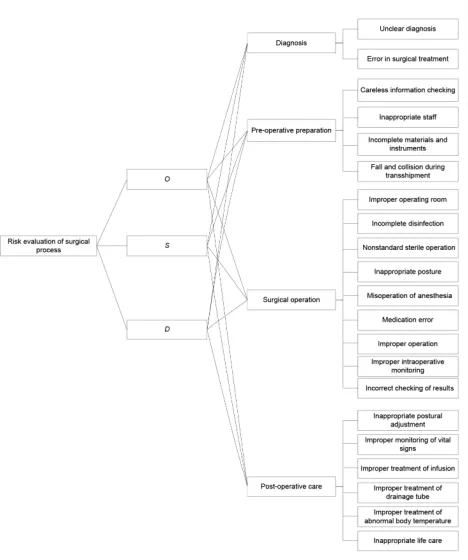
surgical tools, and poor surgical record-keeping.65Figure 2
shows the hierarchical structure of the surgical process risk–
analysis problem in accordance with the failures of the sur-gical process in previous studies and expert opinions of the
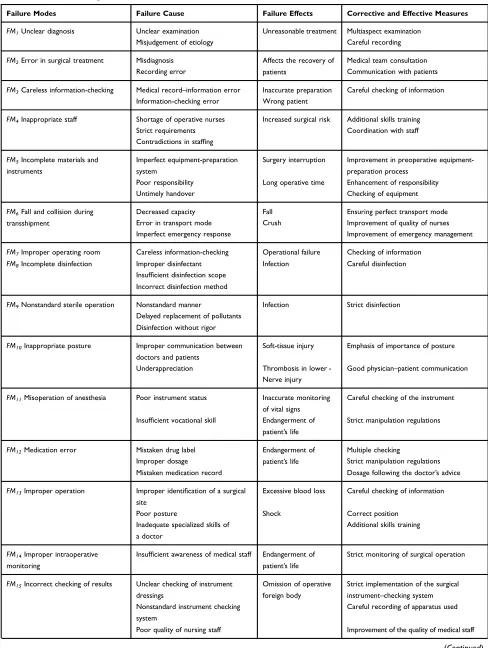
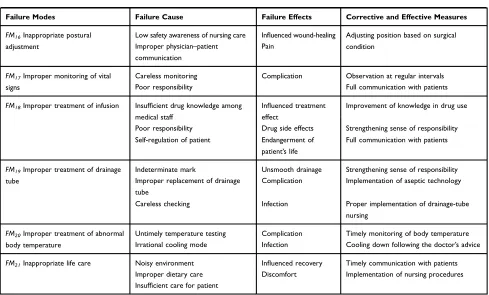
FMEA team. Table 1 shows the failure modes and their
relative failure causes and effects.
Evaluating Risk Factors of Failure Modes
In the traditional FMEA method, risk values of failure modes are evaluated by crisp numbers, which are
inade-quate or insufficient for assessing risks in real life.30FMEA
team members tend to use linguistic terms to express eva-luation information. SVTNNs can depict indeterminate and
inconsistent information well.34,35 As such, the proposed
model adopts linguistic variables expressed in SVTNNs to evaluate the ratings of failure modes with regard to various
risk factors. The definitions of neutrosophic set66,67 and
SVTNN68 are presented in Appendix A. Each FMEA
team member (TMk) should give their opinion on the
basis of a seven-point scale. Linguistic variables can be
represented by SVTNNs (Table 2). Individual evaluation
matrices are characterized byRð Þk ¼ ~aij mn.
Figure 1Flowchart of the proposed surgical risk evaluation model.
Figure 2Hierarchical structure of surgical process risk analysis.
Risk Management and Healthcare Policy downloaded from https://www.dovepress.com/ by 118.70.13.36 on 28-Aug-2020
Table 1FMEA of the Surgical Process
Failure Modes Failure Cause Failure Effects Corrective and Effective Measures
FM1Unclear diagnosis Unclear examination Unreasonable treatment Multiaspect examination
Misjudgement of etiology Careful recording
FM2Error in surgical treatment Misdiagnosis Affects the recovery of patients
Medical team consultation
Recording error Communication with patients
FM3Careless information-checking Medical record–information error Inaccurate preparation Careful checking of information Information-checking error Wrong patient
FM4Inappropriate staff Shortage of operative nurses Increased surgical risk Additional skills training
Strict requirements Coordination with staff
Contradictions in staffing
FM5Incomplete materials and instruments
Imperfect equipment-preparation system
Surgery interruption Improvement in preoperative equipment-preparation process
Poor responsibility Long operative time Enhancement of responsibility
Untimely handover Checking of equipment
FM6Fall and collision during transshipment
Decreased capacity Fall Ensuring perfect transport mode
Error in transport mode Crush Improvement of quality of nurses
Imperfect emergency response Improvement of emergency management
FM7Improper operating room Careless information-checking Operational failure Checking of information
FM8Incomplete disinfection Improper disinfectant Infection Careful disinfection Insufficient disinfection scope
Incorrect disinfection method
FM9Nonstandard sterile operation Nonstandard manner Infection Strict disinfection Delayed replacement of pollutants
Disinfection without rigor
FM10Inappropriate posture Improper communication between doctors and patients
Soft-tissue injury Emphasis of importance of posture
Underappreciation Thrombosis in lower - Good physician–patient communication Nerve injury
FM11Misoperation of anesthesia Poor instrument status Inaccurate monitoring of vital signs
Careful checking of the instrument
Insufficient vocational skill Endangerment of patient’s life
Strict manipulation regulations
FM12Medication error Mistaken drug label Endangerment of
patient’s life
Multiple checking
Improper dosage Strict manipulation regulations
Mistaken medication record Dosage following the doctor’s advice
FM13Improper operation Improper identification of a surgical site
Excessive blood loss Careful checking of information
Poor posture Shock Correct position
Inadequate specialized skills of a doctor
Additional skills training
FM14Improper intraoperative monitoring
Insufficient awareness of medical staff Endangerment of patient’s life
Strict monitoring of surgical operation
FM15Incorrect checking of results Unclear checking of instrument dressings
Omission of operative foreign body
Strict implementation of the surgical instrument–checking system Nonstandard instrument checking
system
Careful recording of apparatus used
Poor quality of nursing staff Improvement of the quality of medical staff
(Continued)
Risk Management and Healthcare Policy downloaded from https://www.dovepress.com/ by 118.70.13.36 on 28-Aug-2020
From the SVTNN evaluation of risk factors provided by the FMEA team, the weightλ¼ ðλ1;λ2;. . .;λlÞT vector
of team members can be utilized to aggregate all
indivi-dual evaluation matrices into the group-evaluation
matrixR¼ ð~rijÞmn.
Determining Comprehensive Weights of
Risk Factors
Without weighting information for risk factors, traditional FMEA risk assessment may lead to an inaccurate risk rank-ing of failure modes. Therefore, weights of risk factors should be calculated to obtain an accurate risk ranking.
Using a method proposed in a prior study,41weighting
infor-mation for risk factors from subjective and objective perspec-tives can be computed using the BWM and entropy method. Therefore, comprehensive weights can be determined.
Calculating Subjective Weights Using BWM
Step 1: Determine a set of decision criteria.
In this step, the criteriafc1;c2;. . .;cngis considered to
obtain a decision.
Table 1(Continued).
Failure Modes Failure Cause Failure Effects Corrective and Effective Measures
FM16Inappropriate postural adjustment
Low safety awareness of nursing care Influenced wound-healing Adjusting position based on surgical condition
Improper physician–patient communication
Pain
FM17Improper monitoring of vital signs
Careless monitoring Complication Observation at regular intervals
Poor responsibility Full communication with patients
FM18Improper treatment of infusion Insufficient drug knowledge among medical staff
Influenced treatment effect
Improvement of knowledge in drug use
Poor responsibility Drug side effects Strengthening sense of responsibility Self-regulation of patient Endangerment of
patient’s life
Full communication with patients
FM19Improper treatment of drainage tube
Indeterminate mark Unsmooth drainage Strengthening sense of responsibility Improper replacement of drainage
tube
Complication Implementation of aseptic technology
Careless checking Infection Proper implementation of drainage-tube nursing
FM20Improper treatment of abnormal body temperature
Untimely temperature testing Complication Timely monitoring of body temperature Irrational cooling mode Infection Cooling down following the doctor’s advice
FM21Inappropriate life care Noisy environment Influenced recovery Timely communication with patients Improper dietary care Discomfort Implementation of nursing procedures Insufficient care for patient
Table 2Linguistic Variables of SVTNNs for Linguistic Terms69
Linguistic Variables SVTNNs
Very low (VL) <[0.1,0.1,0.1,0.1],(0.5,0.3,0.3)> Low (L) <[0.2,0.2,0.4,0.5],(0.6,0.2,0.2)> Medium low (ML) <[0.3,0.4,0.5,0.6],(0.7,0.1,0.1)> Medium (M) <[0.4,0.5,0.6,0.7],(0.8,0.0,0.1)> Medium high (MH) <[0.5,0.6,0.7,0.8],(0.8,0.1,0.1)> High (H) <[0.7,0.8,0.9,1.0],(0.8,0.2,0.2)> Very high (VH) <[1.0,1.0,1.0,1.0],(0.9,0.1,0.1)>
R¼∑lk¼1λkRk¼ ð~rijÞmnRð Þkðk¼1;2;. . .;lÞ
¼
a1
11;a211;a311;a411
;ðT11;I11;F11Þ
. . . a1
1n;a21n;a31n;a41n
;ðT1n;I1n;F1nÞ
... ... ...
a1
m1;a2m1;a3m1;a4m1
;ðTm1;Im1;Fm1Þ
a1
mn;a2mn;a3mn;a4mn
;ðTmn;Imn;FmnÞ
2 6 6 4
3 7 7 5
(1)
Risk Management and Healthcare Policy downloaded from https://www.dovepress.com/ by 118.70.13.36 on 28-Aug-2020
Step 2: Determine the best (eg, most desirable, most important) and the worst (eg, least desirable, least impor-tant) criterion.
Step 3: Determine the preference of the best criterion over all other criteria using a number between 1 and 9. The
resulting best-to-others vector would be
AB¼ðaB1;aB2;. . .;aBnÞ, where aBj indicates the
prefer-ence of the best criterion B over criterion j. Therefore,
aBB= 1.
Step 4: Determine the preference of all criteria over the worst criterion by using a number between 1 and 9. The
resulting others-to-worst vector would be
AW¼ða1W;a2W;. . .;anWÞ, whereajW indicates the
prefer-ence of the criterion j over the worst criterion
W. Therefore, aWW = 1.
Step 5: Find the optimal weights ðw1;w2;. . .;wnÞ.
The optimal weight for the criteria is that which for each pair ofwB=wjandwj=wW, we havewB=wj¼aBj and
wj=wW¼ajW. A solution where the maximum absolute
differences wB
wjaBj
and wj
wwajw
for all j are minimal
should be sought to satisfy these conditions for allj. Given
the nonnegativity and condition for the weights, the pro-blem results are presented as:
minmaxj wwBjaBj
n
; wj
wwajw
o
s:t:
∑ j
wj¼1
wj0;forall j: (2)
Equation 2 is equivalent to:
min
s:t:
wB
wjaBj
;for all j
wj
wwajw
;for all j
∑ j
wj¼1
wj0;forall j: (3)
Solving Equation 2), the optimal weights
w1;w2;. . .;wn
ð Þ and ξ* are obtained.
Then, the consistency ratio (CR) is calculated usingξ*
and the corresponding consistency index:
CR ¼
Consistency Index (4)
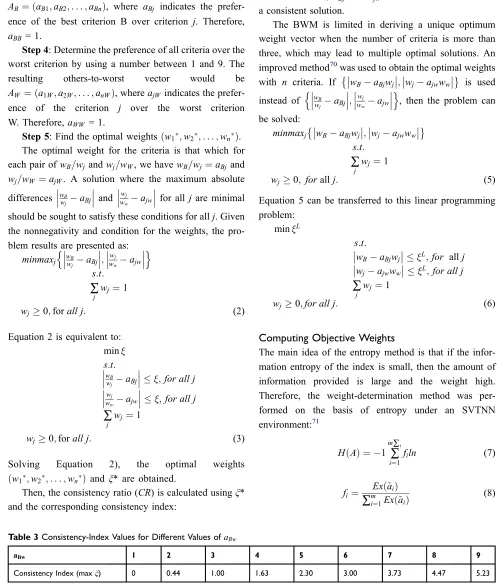
Table 3 shows the maximum values of ξ (consistency
index) for different values ofaBW.
IfCR is≤0.1, then the consistency is good and
accep-table. Otherwise, aBj and ajW can be revised to achieve
a consistent solution.
The BWM is limited in deriving a unique optimum weight vector when the number of criteria is more than three, which may lead to multiple optimal solutions. An
improved method70was used to obtain the optimal weights
with n criteria. If wBaBjwj;wjajwww is used
instead of wB
wj aBj
n
; wj
wwajw
o, then the problem can
be solved:
minmaxj wBaBjwj;wjajwww
s:t:
∑ j
wj¼1
wj0; forallj: (5)
Equation 5 can be transferred to this linear programming problem:
minL
s:t: wBaBjwj
L;for allj
wjajwww
L;for all j
∑ j
wj¼1
wj0;for all j: (6)
Computing Objective Weights
The main idea of the entropy method is that if the infor-mation entropy of the index is small, then the amount of information provided is large and the weight high. Therefore, the weight-determination method was per-formed on the basis of entropy under an SVTNN
environment:71
H Að Þ ¼ 1 ∑
m∑i
i¼1
filn (7)
fi¼
Exð Þ~ai
∑m
i¼1Exð Þ~ai
(8)
Table 3Consistency-Index Values for Different Values ofaBw
aBw 1 2 3 4 5 6 7 8 9
Consistency Index (maxξ) 0 0.44 1.00 1.63 2.30 3.00 3.73 4.47 5.23
Risk Management and Healthcare Policy downloaded from https://www.dovepress.com/ by 118.70.13.36 on 28-Aug-2020
Then, the entropy weight can be computed:
wj¼ ∑n
j¼1H Aj þ12H Aj ∑n
j¼1 ∑ n
j¼1H Aj þ12H Aj
(9)
Obtaining Comprehensive Weights of Risk Factors
From the subjective and objective weight vectors derived from the above two steps, the synthetic weight of each risk factor was calculated:
wj¼εwsjþð1εÞw o
j (10)
whereε(ε2½0;1) is the adjustment parameter.
Ranking of Failure Modes by SVTNN
–
MULTIMOORA
The classical MULTINOORA method consists of three parts: the ratio system, the reference-point model, and
the full multiplicative form.30,54 It was extended into
an SVTNN environment to rank failure modes in this study. The steps are:
Step 1: SVTNN ratio system.
The SVTNN group decision matrixRcan be translated
into the normalized decision matrixX~¼ ½~xijmn using the vector-normalization method:
~
xij¼ h a1ij;a2ij;a3ij;a4ij
; Tij;Iij;Fij
i
¼ wja1ij
dj ;
wja2ij
dj ;
wja3ij
dj ;
wja4ij
dj
; Tij;Iij;Fij
(11)
wheredj¼14
ffiffiffiffiffiffiffiffiffiffiffiffiffiffiffiffiffiffiffiffiffiffiffiffiffiffiffiffiffiffiffiffiffiffiffiffiffiffiffiffiffiffiffiffiffiffiffiffiffiffiffiffiffiffiffiffiffiffiffiffiffiffiffiffiffiffiffiffiffiffiffiffiffiffiffiffiffi
∑m i¼1ðða
1ijÞ2þ ða2ijÞ2þ ða3ijÞ2þa4ijÞ2
s
.
After standardization, the summarising ratio~yiof each
failure mode was computed.Normalized ratios were added or subtracted to optimize
~ yi¼∑
g
j¼1~xij ∑ n
j¼gþ1~xij (12)
whereg¼1;2;. . .;nstands for the number of risk factors
to be minimized and ~yi the normalised assessment of the
ith failure mode with respect to all risk factors. If the value
of~yi is small, then the risk ranking is high.
Step 2: SVTNN reference-point model.
The SVTNN maximal objective reference point (SVTNN–MORP) vector ~r¼ ~x1;~x2;. . .;~xn
was found in accordance with the normalised SVTNN decision
matrix X~¼ ½~xijmn. In consideration of the SVTNNs,
SVTNN–MORP was defined:
e
xj ¼
maxia1ij;maxia2ij;maxia3ij;maxia4ij
; maxiTij;miniIij;miniFij
; jg
minia1ij;minia2ij;minia3ij;minia4ij
; miniTij;maxiIij;maxiFij
; j>g
8 > > < > > : (13)
Then, the distance of each failure mode from the SVTNN-MORP can be calculated:
di¼max j d ~x
j;~xij
(14)
Therefore, the ranking orders of all failure modes can be determined in accordance with the deviation from the
reference point and the min–max metric of Tchebycheff.
If the value ofdiis large, then the risk ranking is high.
Step 3: SVTNN full multiplicative form.
The overall utility of the ith failure mode can be
expressed as an SVTNN using the formula:
Ui¼
~ Ai
~ Bi
(15)
where~Ai¼
Qg j¼1~
xijdenotes the product of factors of theith
failure mode to be minimized, with g¼1;2;. . .;nbeing
the number of factors to be minimized, B~i¼ Q
n
j¼gþ1~xij
denoting the product of factors of the ith failure mode to
be maximized, andn-gbeing the number of factors to be
maximized. If the value of Ui is small, then the risk
ranking is high.
Step 4:Determine the risk level of each failure mode. On the basis of the three ranking lists derived from the
previous steps of SVTNN–MULTIMOORA, thefinal ranking
of all failure modes was obtained by utilizing the dominance theory (for more details, please refer to Brauers et al49).
Results
Evaluation of Risk Factors
The FMEA team membersTMkðk¼1;2;3;4Þin hospital
X evaluated the ratings of failure modes for each risk
factor using the linguistic variables described in Table 2.
Then, the original evaluation information provided by the team members for these failure modes with respect to each
risk factor was obtained (Table 1inAppendix B).Table 2
shows that linguistic evaluations were converted into
SVTNNs. Then, the SVTNWAA operator35 was utilized
to aggregate the evaluation of the individual FMEA team members with the weight vector of the FMEA team mem-bers λ¼ð0:3;0:3;0:2;0:2Þ. The group-evaluation matrix
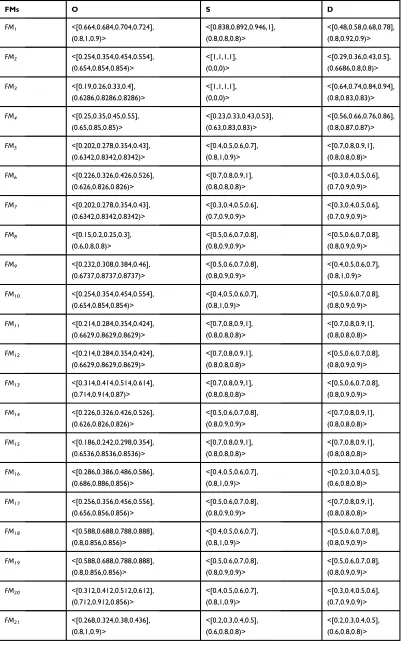
was obtained (Table 4).
Risk Management and Healthcare Policy downloaded from https://www.dovepress.com/ by 118.70.13.36 on 28-Aug-2020
Table 4Group-Evaluation Matrix
FMs O S D
FM1 <[0.664,0.684,0.704,0.724], (0.8,1,0.9)>
<[0.838,0.892,0.946,1], (0.8,0.8,0.8)>
<[0.48,0.58,0.68,0.78], (0.8,0.92,0.9)>
FM2 <[0.254,0.354,0.454,0.554], (0.654,0.854,0.854)>
<[1,1,1,1], (0,0,0)>
<[0.29,0.36,0.43,0.5], (0.6686,0.8,0.8)>
FM3 <[0.19,0.26,0.33,0.4], (0.6286,0.8286,0.8286)>
<[1,1,1,1], (0,0,0)>
<[0.64,0.74,0.84,0.94], (0.8,0.83,0.83)>
FM4 <[0.25,0.35,0.45,0.55], (0.65,0.85,0.85)>
<[0.23,0.33,0.43,0.53], (0.63,0.83,0.83)>
<[0.56,0.66,0.76,0.86], (0.8,0.87,0.87)>
FM5 <[0.202,0.278,0.354,0.43], (0.6342,0.8342,0.8342)>
<[0.4,0.5,0.6,0.7], (0.8,1,0.9)>
<[0.7,0.8,0.9,1], (0.8,0.8,0.8)>
FM6 <[0.226,0.326,0.426,0.526], (0.626,0.826,0.826)>
<[0.7,0.8,0.9,1], (0.8,0.8,0.8)>
<[0.3,0.4,0.5,0.6], (0.7,0.9,0.9)>
FM7 <[0.202,0.278,0.354,0.43], (0.6342,0.8342,0.8342)>
<[0.3,0.4,0.5,0.6], (0.7,0.9,0.9)>
<[0.3,0.4,0.5,0.6], (0.7,0.9,0.9)>
FM8 <[0.15,0.2,0.25,0.3], (0.6,0.8,0.8)>
<[0.5,0.6,0.7,0.8], (0.8,0.9,0.9)>
<[0.5,0.6,0.7,0.8], (0.8,0.9,0.9)>
FM9 <[0.232,0.308,0.384,0.46], (0.6737,0.8737,0.8737)>
<[0.5,0.6,0.7,0.8], (0.8,0.9,0.9)>
<[0.4,0.5,0.6,0.7], (0.8,1,0.9)>
FM10 <[0.254,0.354,0.454,0.554], (0.654,0.854,0.854)>
<[0.4,0.5,0.6,0.7], (0.8,1,0.9)>
<[0.5,0.6,0.7,0.8], (0.8,0.9,0.9)>
FM11 <[0.214,0.284,0.354,0.424], (0.6629,0.8629,0.8629)>
<[0.7,0.8,0.9,1], (0.8,0.8,0.8)>
<[0.7,0.8,0.9,1], (0.8,0.8,0.8)>
FM12 <[0.214,0.284,0.354,0.424], (0.6629,0.8629,0.8629)>
<[0.7,0.8,0.9,1], (0.8,0.8,0.8)>
<[0.5,0.6,0.7,0.8], (0.8,0.9,0.9)>
FM13 <[0.314,0.414,0.514,0.614], (0.714,0.914,0.87)>
<[0.7,0.8,0.9,1], (0.8,0.8,0.8)>
<[0.5,0.6,0.7,0.8], (0.8,0.9,0.9)>
FM14 <[0.226,0.326,0.426,0.526], (0.626,0.826,0.826)>
<[0.5,0.6,0.7,0.8], (0.8,0.9,0.9)>
<[0.7,0.8,0.9,1], (0.8,0.8,0.8)>
FM15 <[0.186,0.242,0.298,0.354], (0.6536,0.8536,0.8536)>
<[0.7,0.8,0.9,1], (0.8,0.8,0.8)>
<[0.7,0.8,0.9,1], (0.8,0.8,0.8)>
FM16 <[0.286,0.386,0.486,0.586], (0.686,0.886,0.856)>
<[0.4,0.5,0.6,0.7], (0.8,1,0.9)>
<[0.2,0.3,0.4,0.5], (0.6,0.8,0.8)>
FM17 <[0.256,0.356,0.456,0.556], (0.656,0.856,0.856)>
<[0.5,0.6,0.7,0.8], (0.8,0.9,0.9)>
<[0.7,0.8,0.9,1], (0.8,0.8,0.8)>
FM18 <[0.588,0.688,0.788,0.888], (0.8,0.856,0.856)>
<[0.4,0.5,0.6,0.7], (0.8,1,0.9)>
<[0.5,0.6,0.7,0.8], (0.8,0.9,0.9)>
FM19 <[0.588,0.688,0.788,0.888], (0.8,0.856,0.856)>
<[0.5,0.6,0.7,0.8], (0.8,0.9,0.9)>
<[0.5,0.6,0.7,0.8], (0.8,0.9,0.9)>
FM20 <[0.312,0.412,0.512,0.612], (0.712,0.912,0.856)>
<[0.4,0.5,0.6,0.7], (0.8,1,0.9)>
<[0.3,0.4,0.5,0.6], (0.7,0.9,0.9)>
FM21 <[0.268,0.324,0.38,0.436], (0.8,1,0.9)>
<[0.2,0.3,0.4,0.5], (0.6,0.8,0.8)>
<[0.2,0.3,0.4,0.5], (0.6,0.8,0.8)>
Risk Management and Healthcare Policy downloaded from https://www.dovepress.com/ by 118.70.13.36 on 28-Aug-2020
Comprehensive Weight Information on
Risk Factors
Rating vectors of the most and least important criteria were determined by FMEA team members in
accor-dance with the BWM (Table 2 in Appendix B).
Subjective weights provided by the team members
were determined using Equation 6. Synthetic
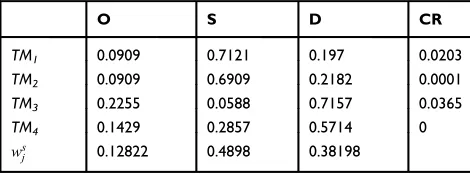
subjective weights of the risk factors were obtained by utilizing the weighted averaging operator with consid-eration of the importance weights of team members λ¼ð0:3;0:3;0:2;0:2Þ.Table 5 shows the optimal weight
and theCR of comparisons. The reliability of the BWM
can be indicated by checking the consistency of pairwise
comparisons.72 Table 5 shows that the CR values are
close to 0, indicating the consistency of comparisons provided by team members. As such, the consistency
results indicate the reliability of the subjective
weights calculated from the BWM.
The objective weights of risk factors can be determined
using Equation 7–Equation 9), as shown in
Table 6. Comprehensive weights of risk factors can be obtained using Equation 10 by combining the sub-jective and obsub-jective weights derived from the BWM and entropy method. Without losing the generality, we letε¼0:5. Table 6shows the comprehensive weights of risk factors.
Ranking of Failure Modes
The ranking of failure modes during the surgical process in
hospital X was determined using the SVTNN–
MULTIMOORA method in accordance with three perspec-tives: the ratio system, reference-point model, and full
multiplicative form. Firstly, the normalized SVTNN
evalua-tion matrix X~¼ ½~xij213 was computed using Equation 11
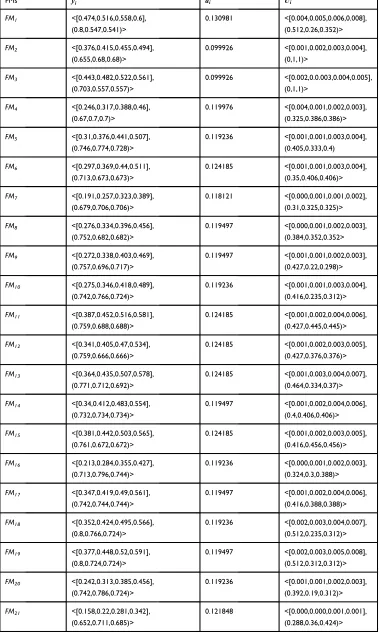
(Table 3inAppendix B). Then, the summarizing ratio~yi of
each failure mode was obtained utilising Equation 12. The SVTNN maximal objective reference point of each risk
factor was determined using Equation 13. The distance (di)
between the maximal objective reference point and each failure mode was calculated using Equation 14. The overall utility (Ui) of the i ið ¼1;2;. . .;21Þst failure mode can be
expressed as an SVTNN using Equation 15. Following the aforementioned steps, the results computed by the ratio sys-tem, reference-point approach, and full multiplicative form
are obtained, as shown inTable 7.
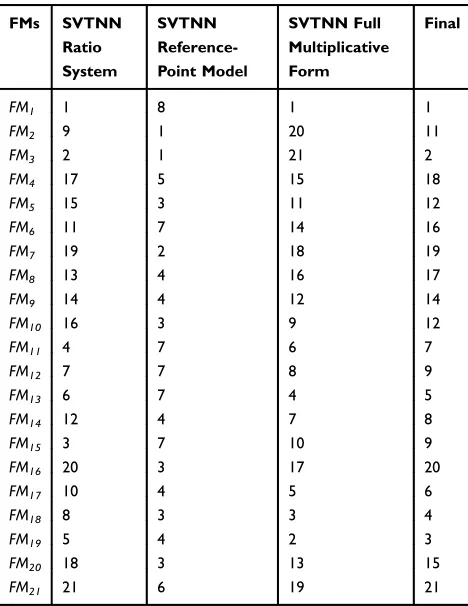
The final ranking was obtained by aggregating the
three ranking lists yielded by different parts of SVTNN–
MULTIMOORA in accordance with the dominance
the-ory. The last column inTable 8shows thefinal ranking of
the 21 failure modes acquired by the proposed FMEA
model. The results demonstrate that thefive most serious
failures of hospital X are unclear diagnosis, careless infor-mation-checking, improper treatment of drainage tubes, improper administration of infusions, and improper
opera-tions, which require urgent and corrective action.
Inappropriate life care is the least important failure during the surgical process in hospital X, and requires less improvement. Based on the ranking results, the hospital should adopt measures for the most serious failure modes to avoid surgical risk and improve the safety of operations. Analysis of causes, effects, and prevention methods showed that an unclear diagnosis results from unclear examination and misjudgement of etiology. An incorrect diagnosis may seriously affect the safety and healing of patients. The probability of diagnosis error was high, and should be emphatically improved. A suggested solution to the problem is to adopt the consultation model of multi-disciplinary teams to explore suitable treatment plans. The second most serious failure in the surgical process was error in information-matching, which leads to erro-neous preoperative preparation. As such, medical staff
should be required to check the patient’s medical records,
surgical treatments, surgical site, anesthesia methods, sur-gical instruments, and other information. This solution may be time-consuming and require improved personnel quality. Improper usage of drainage tubes and administra-tion of infusions is caused by the poor professional quality of medical staff. Promoting professional knowledge,
strong responsibility, sufficient communication, and strict
guidelines for procedures are suggested to solve these
Table 5Subjective Weights
O S D CR
TM1 0.0909 0.7121 0.197 0.0203
TM2 0.0909 0.6909 0.2182 0.0001
TM3 0.2255 0.0588 0.7157 0.0365
TM4 0.1429 0.2857 0.5714 0
ws
j 0.12822 0.4898 0.38198
Table 6Objective and Comprehensive Weights
O S D
Objective weights 0.3428 0.3304 0.3268
Comprehensive weights 0.2355 0.4101 0.3544
Risk Management and Healthcare Policy downloaded from https://www.dovepress.com/ by 118.70.13.36 on 28-Aug-2020
Table 7Ranking Indices~yi,diandUifor Failure Modes
FMs ~yi di Ui
FM1 <[0.474,0.516,0.558,0.6], (0.8,0.547,0.541)>
0.130981 <[0.004,0.005,0.006,0.008], (0.512,0.26,0.352)>
FM2 <[0.376,0.415,0.455,0.494], (0.655,0.68,0.68)>
0.099926 <[0.001,0.002,0.003,0.004], (0,1,1)>
FM3 <[0.443,0.482,0.522,0.561], (0.703,0.557,0.557)>
0.099926 <[0.002,0.0.003,0.004,0.005], (0,1,1)>
FM4 <[0.246,0.317,0.388,0.46], (0.67,0.7,0.7)>
0.119976 <[0.004,0.001,0.002,0.003], (0.325,0.386,0.386)>
FM5 <[0.31,0.376,0.441,0.507], (0.746,0.774,0.728)>
0.119236 <[0.001,0.001,0.003,0.004], (0.405,0.333,0.4)
FM6 <[0.297,0.369,0.44,0.511], (0.713,0.673,0.673)>
0.124185 <[0.001,0.001,0.003,0.004], (0.35,0.406,0.406)>
FM7 <[0.191,0.257,0.323,0.389], (0.679,0.706,0.706)>
0.118121 <[0.000,0.001,0.001,0.002], (0.31,0.325,0.325)>
FM8 <[0.276,0.334,0.396,0.456], (0.752,0.682,0.682)>
0.119497 <[0.000,0.001,0.002,0.003], (0.384,0.352,0.352>
FM9 <[0.272,0.338,0.403,0.469], (0.757,0.696,0.717)>
0.119497 <[0.001,0.001,0.002,0.003], (0.427,0.22,0.298)>
FM10 <[0.275,0.346,0.418,0.489], (0.742,0.766,0.724)>
0.119236 <[0.001,0.001,0.003,0.004], (0.416,0.235,0.312)>
FM11 <[0.387,0.452,0.516,0.581], (0.759,0.688,0.688)>
0.124185 <[0.001,0.002,0.004,0.006], (0.427,0.445,0.445)>
FM12 <[0.341,0.405,0.47,0.534], (0.759,0.666,0.666)>
0.124185 <[0.001,0.002,0.003,0.005], (0.427,0.376,0.376)>
FM13 <[0.364,0.435,0.507,0.578], (0.771,0.712,0.692)>
0.124185 <[0.001,0.003,0.004,0.007], (0.464,0.334,0.37)>
FM14 <[0.34,0.412,0.483,0.554], (0.732,0.734,0.734)>
0.119497 <[0.001,0.002,0.004,0.006], (0.4,0.406,0.406)>
FM15 <[0.381,0.442,0.503,0.565], (0.761,0.672,0.672)>
0.124185 <[0.001,0.002,0.003,0.005], (0.416,0.456,0.456)>
FM16 <[0.213,0.284,0.355,0.427], (0.713,0.796,0.744)>
0.119236 <[0.000,0.001,0.002,0.003], (0.324,0.3,0.388)>
FM17 <[0.347,0.419,0.49,0.561], (0.742,0.744,0.744)>
0.119497 <[0.001,0.002,0.004,0.006], (0.416,0.388,0.388)>
FM18 <[0.352,0.424,0.495,0.566], (0.8,0.766,0.724)>
0.119236 <[0.002,0.003,0.004,0.007], (0.512,0.235,0.312)>
FM19 <[0.377,0.448,0.52,0.591], (0.8,0.724,0.724)>
0.119497 <[0.002,0.003,0.005,0.008], (0.512,0.312,0.312)>
FM20 <[0.242,0.313,0.385,0.456], (0.742,0.786,0.724)>
0.119236 <[0.001,0.001,0.002,0.003], (0.392,0.19,0.312)>
FM21 <[0.158,0.22,0.281,0.342], (0.652,0.711,0.685)>
0.121848 <[0.000,0.000,0.001,0.001], (0.288,0.36,0.424)>
Risk Management and Healthcare Policy downloaded from https://www.dovepress.com/ by 118.70.13.36 on 28-Aug-2020
failures. Improper procedures may cause serious conse-quences, but the possibility of procedural errors in hospital X is small. The staff in the operating room should care-fully check information and correctly mark the operational siteto solve this problem.
Discussion
Surgery is one of the important methods of treating dis-eases and comprises a series of processes, including diag-nosis, preoperative preparation, surgical operation, and postoperative care. Each process has accompanying risks and may seriously affect operation quality and patient safety. Therefore, the risk assessment of each segment of the surgical process is critical for the safety and quality of
surgery, along with improvement in the physician–patient
relationship.
The International Organization for Standardization sug-gests that FMEA is a prospective risk-analysis technology
for high-risk processes.73,74 FMEA can be used
systemati-cally to define and evaluate potential risk-failure modes in
the surgical process, analyze the causes and effects of poten-tial failures, and implement effective measures to control them. However, the classical FMEA has limitations. The
proposed hybrid FMEA in this study overcomes these short-comings. The hybrid FMEA can identify several potential failures in the surgical process and consider linguistic eva-luation of information provided by experts, instead of crisp
ratings. Thefinal risk ranking of failure modes obtained by
the extended SVTNN–MULTIMOORA method helps the
hospital’s medical team to focus on major surgical-process
failures. Several critical failure modes that needed to be solved were obtained by evaluating the risk points in the surgical process of a hospital in Hunan Province.
Risk Factors
Among the MCDM techniques used in the proposed hybrid FMEA model, the BWM was used to determine
the subjective weights of risk factors. Table 5shows the
importance of risk-factor rankings obtained by four experts. Three experts believed that the severity-of-failure mode is the most important factor, whereas another expert believed that its detectability is the most important factor. After the opinions of four experts had been com-prehensively considered, the importance of risk factors
was ranked as S>D>O. Risk factor S with, a weight of
0.4898, was the most important factor. As such, theS of
failures is a concern in surgical-risk evaluation for
effec-tively improving operation quality and security. The Oof
failures was the least important among the three risk
factors. Experts agreed that theSof errors in the surgical
process was more important thanO. In generating
subjec-tive weights, inconsistencies may occur because of the
complex judgment of experts.43 All CR values were
close to 0, suggesting that the importance of risk factors provided by experts was consistent.
The basic principle of the entropy method is that if the information entropy of the index is small, the index may provide additional information and the weight should be high. The importance ranking of risk factors based on entropy weight wasO>S>Daccording to the evaluation of informa-tion provided by the experts. As such, the risk factor
Oprovides more information than the others, but small
differ-ences exist among the entropy weights of the three risk factors. The comprehensive importance of risk factors was ranked asS>D>Oon the basis of the principle of combin-ing the subjective and objective weights. Considercombin-ing the subjective judgment of experts and the amount of
informa-tion provided by risk factors,Sis more important than the
other risk factors. If the S of failure mode is high, then
additional attention should be given to this factor.
Table 8Final Ranking of Failure Modes
FMs SVTNN
Ratio System
SVTNN Reference-Point Model
SVTNN Full Multiplicative Form
Final
FM1 1 8 1 1
FM2 9 1 20 11
FM3 2 1 21 2
FM4 17 5 15 18
FM5 15 3 11 12
FM6 11 7 14 16
FM7 19 2 18 19
FM8 13 4 16 17
FM9 14 4 12 14
FM10 16 3 9 12
FM11 4 7 6 7
FM12 7 7 8 9
FM13 6 7 4 5
FM14 12 4 7 8
FM15 3 7 10 9
FM16 20 3 17 20
FM17 10 4 5 6
FM18 8 3 3 4
FM19 5 4 2 3
FM20 18 3 13 15
FM21 21 6 19 21
Risk Management and Healthcare Policy downloaded from https://www.dovepress.com/ by 118.70.13.36 on 28-Aug-2020
Failure-Mode Ranking
According to the proposed hybrid FMEA model, the
ranking result of failure modes was directly influenced
by the comprehensive weight information of risk factors. The ranking result depends considerably on the
propor-tion of ε for subjective and objective weights. ε is the
adjustment parameter and was set to 0.5 in this work, with a value range of [0, 1]. Different values of
ε, ie, ε¼ð0;0:1;0:2;0:3;0:4;0:5;0:6;0:7;0:8;0:9;1Þ,
were used to analyze the impact of ε on failure-modes
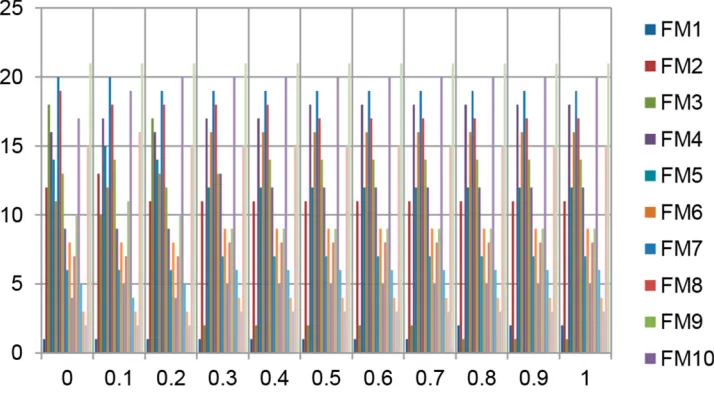
ranking. Figure 3 presents the influence of the ranking
of each failure mode with variousε values.
Figure 3shows that based on the variable value of ε, slight changes in the most critical failure modes can be
observed under various circumstances. Ifεis < 0.8, then
FM1is the most critical failure mode. Otherwise, FM3 is
deemed the most critical. Given that the weight of the risk
factorSwas considerably higher than the other risk factors
and the Sof FM3was higher than that ofFM1, FM3was
more critical than FM1 when subjective weights account
for a large proportion. When ε<0.3, all ranking results
changed slightly, and when ε was near 1, the ranking
results were stable. Conclusively, each failure mode
pro-duced a minor change in the risk ranking whenεchanged
from 0 to 1. A robust ranking result of failure modes was
obtained, and the five most severe failures in the hospital
comprised unclear diagnosis, careless
information-checking, improper treatment of drainage tubes and impro-per infusion procedures.
In summary, the professional skills and moral quality of the operating-room staff should be emphatically improved. Measures should be implemented, even given the high cost of manpower, money, and time. In modern society, medical
errors and doctor–patient relationship problems often occur
in hospitals. Highly professional and responsible staff should ensure that each patient and operation process is taken ser-iously to improve the quality and safety of operations and ease the relationship between doctors and patients.
Comparative Analysis with Other MCDM
Methods
The proposed FMEA method was compared with the classical FMEA method, the crisp MULTIMOORA
method,50 and the SVTNN–TOPSIS method75to
demon-strate its effectiveness and reliability further. Rankings are
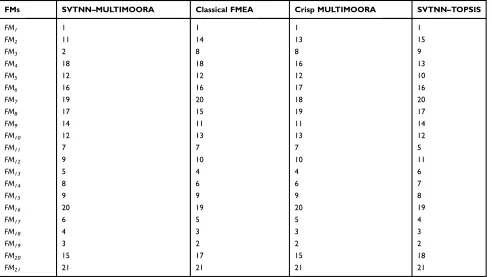
presented inTable 9andFigure 4.
Although the risk rankings of failure modes were uniden-tical, the most critical failure mode in all methods was
FM1and the least serious FM21. This finding is consistent
with the results of the proposed model. Therefore, the pro-posed model is effective in properly ranking the failure modes. However, the risk rankings among classical FMEA, crisp
MULTIMOORA, and SVTNN–TOPSIS and the proposed
method present several differences. Table 9 shows that the
ranking results of crisp MULTIMOORA were consistent
with those of the classical FMEA. The ranking order ofFM3,
FM9, FM10, FM12, FM13, FM14, FM17, FM18, and FM19
obtained using the two methods differed from those of the
Figure 3Ranking of failure modes for differentε-values.
Risk Management and Healthcare Policy downloaded from https://www.dovepress.com/ by 118.70.13.36 on 28-Aug-2020
proposed model. A deviation in ranking results was observed because the imprecise and uncertain information in failure-mode evaluation was not considered in the classical FMEA
or the crisp MULTIMOORA method. Therefore, the SVTNN–
MULTIMORA method can provide more information for
decision-makers than classical FMEA or crisp
MULTIMOORA.
In the classical FMEA, assuming that the weights of risk factors are equal is unreasonable. For example, the
evaluation information ofFM2under risk factorSis
con-siderably larger thanunder the other two risk factors.FM2
ranked 14 in the classical FMEA. Given that the weight of
Swas higher thanOin the proposed method,FM2ranked
11, three places above that in the classical FMEA. These results were caused by the same weight of risk factors assigned in classical FMEA. Therefore, comprehensive weighting of risk factors by the BWM and entropy method is reasonable and applicable.
Figure 4Ranking results of different methods.
Table 9Comparison of different methods
FMs SVTNN–MULTIMOORA Classical FMEA Crisp MULTIMOORA SVTNN–TOPSIS
FM1 1 1 1 1
FM2 11 14 13 15
FM3 2 8 8 9
FM4 18 18 16 13
FM5 12 12 12 10
FM6 16 16 17 16
FM7 19 20 18 20
FM8 17 15 19 17
FM9 14 11 11 14
FM10 12 13 13 12
FM11 7 7 7 5
FM12 9 10 10 11
FM13 5 4 4 6
FM14 8 6 6 7
FM15 9 9 9 8
FM16 20 19 20 19
FM17 6 5 5 4
FM18 4 3 3 3
FM19 3 2 2 2
FM20 15 17 15 18
FM21 21 21 21 21
Risk Management and Healthcare Policy downloaded from https://www.dovepress.com/ by 118.70.13.36 on 28-Aug-2020
Figure 4 shows that the risk ranking obtained by
SVTNN–TOPSIS differed from that acquired using the
method proposed in this paper. This result is attributed to the failure mode that is close to the positive ideal value in TOPSIS, but may also be close to the negative ideal value.
Moreover, the SVTNN–TOPSIS method considers only
objective entropy weight and disregards the effect of
experts’subjective opinions on ranking results. Therefore,
SVTNN–TOPSIS cannot fully reflect the risk of failure
modes, thus affecting the accuracy of decision-making
results. In the proposed SVTNN–MULTIMOORA method,
the ranking of failure modes was determined in accordance with ranking results obtained by three decision-making methods: the SVTNN ratio system, the SVTNN reference-point method, and the SVTNN full multiplication model. Compared with other MCDM methods, the proposed method exhibits better applicability, potential, and ease of implementation. The proposed method also integrates sub-jective and obsub-jective weights and can obtain reasonable risk
priority. The proposed hybrid SVTNN–MULTIMOORA
model can obtain effective rankings.
Future Research Orientation
The hybrid FMEA method was used to analyze risks in surgical processes of a hospital in Hunan Province system-atically, identify all potential failures, and determine the most critical failures. This method proposes corresponding solutions and is superior to other risk-assessment methods. Although the proposed FMEA model can effectively assess the risk of the surgical process, several points, such as changes in the surgical environment and certain risk factors not considered in this study, should be studied in future. In addition, through communication with hospi-tals, data on surgical errors before and after intervention measures should be collected and corresponding changes compared and analyzed.
Conclusion
A reliable and practical risk-assessment model can reduce risks during surgery and disease treatment. FMEA is widely used to evaluate failure modes in
many fields, although such a method has shortcomings.
However, few studies have systematically assessed the risk of the surgical process by FMEA. A hybrid risk-assessment model of the surgical procedure was pro-posed in this study on the basis of extended FMEA. The method was helpful in identifying high-risk failure
modes in the operation process and suggesting
corresponding measures in advance to prevent the occurrence of surgical errors. Improving the quality of surgery and safety management and alleviating the
doc-tor–patient relationship are conducive strategies.
Acknowledgments
This work was supported by the Human Philosophy Social Science Fund Projects (No. 18YBA150), the Key Project of Hunan Education Department (No. 18A201), Project of Hunan Federation of Social Sciences (No. XSP20YBC318), and the Hunan Provincial Natural Science Fund (Nos. 2018JJ5004, 2019JJ40088, and 2019JJ40479).
Disclosure
Peng-Fei Cheng reports grants and personal fees from the Department of Science and Technology of Hunan
Province, Social Science Planning Office of Hunan
Province, and the Department of Education of Hunan Province. Ji-Qun He reports grants and personal fees from the Hunan Provincial Natural Science Fund and Hunan Federation of Social Sciences during the study. The authors declare that they have no other possible
con-flicts of interest.
References
1. Li DP, He JQ, Cheng PF, Wang JQ, Zhang HY. A novel selection model of surgical treatments for early gastric cancer patients based on heterogeneous multicriteria group decision-making. Symmetry.
2018;10(6):223. doi:10.3390/sym10060223
2. Pomerantz RG, Lee DA, Siegel DM. Risk assessment in surgical patients: balancing iatrogenic risks and benefits. Clin Dermatol.
2011;29(6):669–677. doi:10.1016/j.clindermatol.2011.08.012 3. Thomas EJ, Studdert DM, Burstin HR, et al. Incidence and types of
adverse events and negligent care in Utah and Colorado.Med Care.
2000;38(3):261–271. doi:10.1097/00005650-200003000-00003 4. Maria Laura C, Clemente P. FMEA: a model for reducing medical
errors. Clinica Chimica Acta. 2009;404(1):75–78. doi:10.1016/j. cca.2009.03.015
5. Xie L, He JQ, Cheng PF, Xiao RS, Zhou XH. A multi-criteria 2-tuple linguistic group decision-making method based on TODIM for chole-cystitis treatments selection. IEEE Access. 2019;7:127967–127986. doi:10.1109/ACCESS.2019.2939211
6. Bilimoria KY, Liu Y, Paruch JL, et al. Development and evaluation of the universal ACS NSQIP surgical risk calculator: a decision aid and informed consent tool for patients and surgeons. J Am Coll Surg.
2013;217(5):833–842.e833. doi:10.1016/j.jamcollsurg.2013.07.385 7. Bowles JB, Peláez CE. Fuzzy logic prioritization of failures in
a system failure mode, effects and criticality analysis. Reliab Eng Syst Saf.1995;50(2):203–213. doi:10.1016/0951-8320(95)00068-D 8. Sharma RK, Kumar D, Kumar P. Systematic failure mode effect
analysis (FMEA) using fuzzy linguistic modelling.Int J Qual Reliab Manage.2005;22(9):986–1004. doi:10.1108/02656710510625248 9. Shan -M-M, Li P, Liu H-C. Interval 2-tuple linguistic distance
opera-tors and their applications to supplier evaluation and selection.
Mathematical Probl Eng.2016;2016:1–12. doi:10.1155/2016/9893214
Risk Management and Healthcare Policy downloaded from https://www.dovepress.com/ by 118.70.13.36 on 28-Aug-2020
10. Helvacioglu S. Ozen fuzzy based failure modes and effect analysis for yacht system design.Ocean Eng.2014;79(2):131–141. 11. Khasha R, Sepehri MM, Khatibi T. A fuzzy FMEA approach to
prioritizing surgical cancellation factors. Int J Hosp Res. 2013;2 (1):17–24.
12. Anderson O, Brodie A, Vincent CA, Hanna GB. A systematic proactive risk assessment of hazards in surgical wards: a quantitative study.Ann Surg.2012;255(6):1086–1092. doi:10.1097/SLA.0b013e31824f5f36 13. Liu HC, Li P, You JX, Chen YZ. A novel approach for FMEA:
combination of interval 2-Tuple linguistic variables and gray rela-tional analysis. Qual Reliab Eng Int. 2015;31(5):761–772. doi:10.1002/qre.1633
14. Dong SC, Chung JH, Fu CY. A novel approach for evaluating the risk of health care failure modes. J Med Syst. 2012;36(6):3967–3974. doi:10.1007/s10916-012-9868-5
15. Magnezi R, Hemi A, Hemi R. Using the failure mode and effects analysis model to improve parathyroid hormone and adrenocortico-tropic hormone testing.Risk Manag Healthc Policy.2016;9:271–274. doi:10.2147/RMHP.S117472
16. Liu H-C, You J-X, Duan C-Y. An integrated approach for failure mode and effect analysis under interval-valued intuitionistic fuzzy environment. Int J Prod Econ. 2019;207:163–172. doi:10.1016/j. ijpe.2017.03.008
17. Liu H-C, Wang L-E, You X-Y, Wu S-M. Failure mode and effect analysis with extended grey relational analysis method in cloud setting.Total Qual Manage Bus Excellence.2019;30(7–8):745–767. doi:10.1080/14783363.2017.1337506
18. Liu HC, Liu L, Liu N. Risk evaluation approaches in failure mode and effects analysis: a literature review.Expert Syst Appl.2013;40 (2):828–838. doi:10.1016/j.eswa.2012.08.010
19. Liu HC, You JX, Shan MM, Su Q. Systematic failure mode and effect analysis using a hybrid multiple criteria decision-making approach.
Total Qual Manage Bus Excellence. 2019;30(5–6):537–564. doi:10.1080/14783363.2017.1317585
20. Kahraman C, Kayaİ,Şenvar Ö. Healthcare failure mode and effects analysis under fuzziness. Human Ecol Risk Assess. 2013;19 (2):538–552. doi:10.1080/10807039.2012.737753
21. Safari H, Faraji Z, Majidian S. Identifying and evaluating enterprise architecture risks using FMEA and fuzzy VIKOR. J Intell Manuf.
2016;27(2):475–486. doi:10.1007/s10845-014-0880-0
22. Dağsuyu C, Göçmen E, NarlıM, Kokangül A. Classical and fuzzy FMEA risk analysis in a sterilization unit. Comp Ind Eng.
2016;101:286–294. doi:10.1016/j.cie.2016.09.015
23. Deng XY, Jiang W. Fuzzy risk evaluation in failure mode and effects analysis using a D numbers based multi-sensor information fusion method.Sensors.2017;17(9):2086. doi:10.3390/s17092086 24. Wang WZ, Liu XW, Chen XQ, Qin Y. Risk assessment based on
hybrid FMEA framework by considering decision maker’s psycholo-gical behavior character. Comp Ind Eng. 2019;136:516–527. doi:10.1016/j.cie.2019.07.051
25. Kumar AM, Rajakarunakaran S, Pitchipoo P, Vimalesan R. Fuzzy based risk prioritisation in an auto LPG dispensing station.Saf Sci.
2018;101:231–247. doi:10.1016/j.ssci.2017.09.011
26. Yazdi M, Daneshvar S, Setareh H. An extension to Fuzzy Developed Failure Mode and Effects Analysis (FDFMEA) application for aircraft landing system.Saf Sci.2017;98:113–123. doi:10.1016/j.ssci.2017.06.009 27. Lavasani SM, Ramzali N, Sabzalipour F, Akyuz E. Utilisation of fuzzy fault tree analysis (FFTA) for quantified risk analysis of leak-age in abandoned oil and natural-gas wells. Ocean Eng.
2015;108:729–737. doi:10.1016/j.oceaneng.2015.09.008
28. Tooranloo HS, Ayatollah AS. Pathology the internet banking service quality using failure mode and effect analysis in interval-valued intuitionistic fuzzy environment. Int J Fuzzy Syst. 2017;19 (1):109–123. doi:10.1007/s40815-016-0265-y
29. Qian W, Wang Z-J, Li K. Medical waste disposal method selection based on a hierarchical decision model with intuitionistic fuzzy relations. Int J Environ Res Public Health. 2016;13(9):896. doi:10.3390/ijerph13090896
30. Zhao H, You JX, Liu HC. Failure mode and effect analysis using MULTIMOORA method with continuous weighted entropy under interval-valued intuitionistic fuzzy environment. Soft Comp.
2017;21(18):5355–5367. doi:10.1007/s00500-016-2118-x
31. Zadeh LA. Fuzzy sets.Inf Control.1965;8(3):338–353. doi:10.1016/ S0019-9958(65)90241-X
32. Atanassov KT, Rangasamy P. Intuitionistic fuzzy sets. Fuzzy Sets Syst.1986;20(1):87–96. doi:10.1016/S0165-0114(86)80034-3 33. Ji P, Zhang HY, Wang JQ. A fuzzy decision support model with
sentiment analysis for items comparison in e-commerce: the case study of PConline.com.IEEE Trans Syst Man Cybernetics.2018;49 (10):1993–2004. doi:10.1109/TSMC.2018.2875163
34. Liang RX, Wang JQ, Lin L. Multi-criteria group decision-making method based on interdependent inputs of single-valued trapezoidal neutrosophic information.Neural Comput Appl.2018;30(1):241–260. doi:10.1007/s00521-016-2672-2
35. Liang RX, Wang JQ, Zhang HY. A multi-criteria decision-making method based on single-valued trapezoidal neutrosophic preference relations with complete weight information. Neural Comput Appl.
2018;30(11):3383–3398. doi:10.1007/s00521-017-2925-8
36. Liang RX, Wang JQ, Zhang HY. Evaluation of e-commerce websites: an integrated approach under a single-valued trapezoidal neutro-sophic environment. Knowledge Based Syst. 2017;135:44–59. doi:10.1016/j.knosys.2017.08.002
37. Wang LE, Liu HC, Quan MY. Evaluating the risk of failure modes with a hybrid MCDM model under interval-valued intuitionistic fuzzy environments. Comp Ind Eng. 2016;102:175–185. doi:10.1016/j.cie.2016.11.003
38. Liu HC, Liu L, Liu N, Mao LX. Risk evaluation in failure mode and effects analysis with extended VIKOR method under fuzzy environment. Expert Syst Appl. 2012;39(17):12926–12934. doi:10.1016/j.eswa.2012.05.031
39. Mangla SK, Kumar P, Barua MK. Risk analysis in green supply chain using fuzzy AHP approach: a case study. Resour Conservation Recycl. 2015;104:375–390. doi:10.1016/j. resconrec.2015.01.001
40. Liu H-C, You J-X, You X-Y, Shan -M-M. A novel approach for failure mode and effects analysis using combination weighting and fuzzy VIKOR method. Appl Soft Comput. 2015;28(C):579–588. doi:10.1016/j.asoc.2014.11.036
41. Rezaei J. Best-worst multi-criteria decision-making method.Omega.
2015;53:49–57. doi:10.1016/j.omega.2014.11.009
42. Tian ZP, Wang JQ, Zhang HY. An integrated approach for failure mode and effects analysis based on fuzzy best-worst, relative entropy and VIKOR methods. Appl Soft Comput. 2018;72:636–646. doi:10.1016/j.asoc.2018.03.037
43. Nie RX, Tian ZP, Wang JQ, Zhang HY, Wang TL. Water security sustainability evaluation: applying a multistage decision support fra-mework in industrial region. J Clean Prod. 2018;196:1681–1704. doi:10.1016/j.jclepro.2018.06.144
44. Li J, Wang JQ, Hu JH. Multi-criteria decision-making method based on dominance degree and BWM with probabilistic hesitant fuzzy information.Int J Mach Learn Cybernetics.2019;10(7):1671–1685. doi:10.1007/s13042-018-0845-2
45. Liu HC, You JX, Chen SM, Chen YZ. An integrated failure mode and effect analysis approach for accurate risk assessment under uncertainty. IIE Trans. 2016;48(11):1027–1042. doi:10.1080/ 0740817X.2016.1172742
46. Arabzad SM, Razmi J, Ghorbani M. Classify purchasing items based on risk and profitability attributes; using MCDM and FMEA techniques.Res J Int Stud.2011;1(21):80–85.
Risk Management and Healthcare Policy downloaded from https://www.dovepress.com/ by 118.70.13.36 on 28-Aug-2020
47. Lolli F, Ishizaka A, Gamberini R, Rimini B, Messori M. FlowSort-GDSS– a novel group multi-criteria decision support system for sorting problems with application to FMEA.Expert Syst Appl Int J. 2015;42(17–18):6342–6349. doi:10.1016/j.eswa. 2015.04.028
48. Shahin A, Khodadady Z, Shirouyehzad H. Ranking electronic custo-mer complaints by FMEA and TOPSIS with a case study in Isfahan Province Gas Company.Int J Proc Manage Benchmarking.2014;5 (1):19–36. doi:10.1504/IJPMB.2015.066027
49. Brauers WKM, Zavadskas EK. Multimoora optimization used to decide on a bank loan to buy property. Technol Econ Devel Econ.
2011;17(1):174–188. doi:10.3846/13928619.2011.560632
50. Brauers WKM, Zavadskas EK. Project management by MULTIMOORA as an instrument for transition economies.Technol Econ Devel Econ.2010;16(1):5–24. doi:10.3846/tede.2010.01 51. Brauers WKM, Zavadskas EK. The MOORA method and its
applica-tion to privatizaapplica-tion in a transiapplica-tion economy. Control Cybernetics.
2006;35(35):445–469.
52. Chen X, Zhao L, Liang H. A novel multi-attribute group decision-making method based on the MULTIMOORA with linguis-tic evaluations. Soft Comp. 2018;22(16):5347–5361. doi:10.1007/ s00500-018-3030-3
53. Brauers WKM, Baležentis A, Baležentis T. Multimoora for the EU member states updated with fuzzy number theory. Technol Econ Devel Econ. 2011;17(2):259–290. doi:10.3846/20294913.2011. 580566
54. Liu H-C, Fan X-J, Li P, Chen Y-Z. Evaluating the risk of failure modes with extended MULTIMOORA method under fuzzy environment.Eng Appl Artif Intell.2014;34:168–177. doi:10.1016/j. engappai.2014.04.011
55. Streimikiene D, Balezentis T. Multi-objective ranking of climate change mitigation policies and measures in Lithuania. Renewable Sustain Energy Rev. 2013;18:144–153. doi:10.1016/j.rser.2012.09. 040
56. Kracka M, Zavadskas EK. Panel building refurbishment elements effective selection by applying multiple-criteria methods.
Int J Strategic Prop Manage. 2013;17(2):210–219. doi:10.3846/ 1648715X.2013.808283
57. Baležentis T, Baležentis A. A survey on development and applica-tions of the multi-criteria decision making method MULTIMOORA.
J Multi Crit Dec Anal. 2014;21(3–4):209–222. doi:10.1002/ mcda.1501
58. Brauers WKM, Zavadskas EK. Robustness of MULTIMOORA: a method for multi-objective optimization. Informatica. 2012;23 (1):1–25. doi:10.15388/Informatica.2012.346
59. Tian ZP, Wang J, Wang JQ, Zhang HY. An improved MULTIMOORA approach for multi-criteria decision-making based on interdependent inputs of simplified neutrosophic linguistic information.Neural Comput Appl.2017;28(1):585–597. doi:10.100 7/s00521-016-2378-5
60. Julia N, Mills PD, Noel E, et al. Incorrect surgical procedures within and outside of the operating room: a follow-up report.Arch Surg.
2011;146(11):1235–1239. doi:10.1001/archsurg.2011.171
61. Bonfant G, Belfanti PG, Gabrielli D, et al. Clinical risk analysis with failure mode and effect analysis (FMEA) model in a dialysis unit.
J Nephrol.2010;23(1):111–118.
62. Siriphuwanun V, Punjasawadwong Y, Lapisatepun W, Charuluxananan S, Uerpairojkit K. Prognostic factors for death and survival with or without complications in cardiac arrest patients receiving CPR within 24 hours of anesthesia for emergency surgery.Risk Manag Healthc Policy.2014;7:199–210. doi:10.2147/ RMHP.S68797
63. Pikkel D, Sharabi-Nov A, Pikkel J. It is the left eye, right? Risk Manag Healthc Policy.2014;7:77–80. doi:10.2147/RMHP.S60728 64. Chanamool N, Naenna T. Fuzzy FMEA application to improve
decision-making process in an emergency department. Appl Soft Comput.2016;43:441–453. doi:10.1016/j.asoc.2016.01.007 65. Li G. Implementation of a risk management plan in a hospital
oper-ating room. Int J Nurs Sci. 2015;2(4):348–354. doi:10.1016/j. ijnss.2015.10.007
66. Wang HB, Smarandache F, Zhang YQ, Sunderraman R. Interval neutrosophic sets and logic: theory and applications in computing.
Comp Sci.2005;65(vi):87.
67. Wu XH, Wang JQ, Peng JJ, Qian J. A novel group decision-making method with probability hesitant interval neutrosphic set and its applica-tion in middle level manager’s selection.Int J Uncertain Quantif.2018;8 (4):291–319. doi:10.1615/Int.J.UncertaintyQuantification.2018020671 68. Deli I, Subas Y Single Valued Neutrosophic Numbers and Their
Applications to Multicriteria Decision Making Problem.2014. 69. Ye J. Some weighted aggregation operators of trapezoidal neutrosophic
numbers and their multiple attribute decision making method.
Informatica.2017;28(2):387–402. doi:10.15388/Informatica.2017.108 70. Rezaei J. Best-worst multi-criteria decision-making method: some
properties and a linear model. Omega. 2016;64:126–130. doi:10.1016/j.omega.2015.12.001
71. Ji P, Zhang HY, Wang JQ. Fuzzy decision-making framework for treatment selection based on the combined QUALIFLEX–TODIM method. Int J Syst Sci. 2017;48(14):3072–3086. doi:10.1080/ 00207721.2017.1365968
72. Nie RX, Tian ZP, Wang XK, Wang JQ, Wang TL. Risk evaluation by FMEA of supercritical water gasification system using multi-granular linguistic distribution assessment. Knowledge Based Syst.
2018;162:185–201. doi:10.1016/j.knosys.2018.05.030
73. Trucco P, Cavallin M. A quantitative approach to clinical risk assess-ment: the CREA method.Saf Sci.2006;44(6):491–513. doi:10.1016/j. ssci.2006.01.003
74. Asefzadeh S, Yarmohammadian MH, Nikpey A, Atighechian G. Clinical risk assessment in intensive care unit.2013;4(5):592–598. 75. Biswas P, Pramanik S, Giri BC. TOPSIS strategy for multi-attribute
decision making with trapezoidal neutrosophic numbers.Neutro Sets Syst.2018;19:29–39.
Risk Management and Healthcare Policy
Dove
press
Publish your work in this journal
Risk Management and Healthcare Policy is an international, peer-reviewed, open access journal focusing on all aspects of public health, policy, and preventative measures to promote good health and improve morbidity and mortality in the population. The journal welcomes submitted papers covering original research, basic science, clinical & epidemiological studies, reviews and evaluations,
guidelines, expert opinion and commentary, case reports and extended reports. The manuscript management system is completely online and includes a very quick and fair peer-review system, which is all easy to use. Visit http://www.dovepress.com/testimonials.php to read real quotes from published authors.
Submit your manuscript here:https://www.dovepress.com/risk-management-and-healthcare-policy-journal
Risk Management and Healthcare Policy downloaded from https://www.dovepress.com/ by 118.70.13.36 on 28-Aug-2020