RISK MANAGEMENT IN CONSTRUCTION
PROJECTS USING STATISTICAL ANALYSIS
K. Jayasudha
1,
Dr. B.Vidivelli
21
Research Scholar,
2Professor, Department of Civil and Structural Engineering
Annamalai University, Chidambaram, Tamil Nadu(India)
ABSTRACT
Risk management is an important step which should not be neglect or ignore in every project. Because of
various risk involved in construction, it is difficult to maintain time, cost and quality as planned. Project
undertaken in the construction sector are widely complex and have often significant budgets, and thus reducing
the risk associated should be a priority for each project manager. The main purpose of this paper is to identify
the key risk factors that affect construction project. Questionnaires has been prepared incorporating of 155
difference questions after which questionnaire survey was conducted where the questions has been focused
based on (component of questionnaire) the respondents were selected based on their susceptibility to the risk.
The data was analyzed using the Statistical package for social sciences (SPSS) version 21. The result shows that
the inadequate planning in construction project, poor adoption of site safety, supply and use of defective
materials and poor resources management in construction project are all among the forefront key risk factors
which affect construction project, meanwhile, effective recommendations have been developed to increases the
efficiency, speedy and minimises risk and abortive work in construction project.
Keywords: Construction Industries, Construction Projects, Risks Management,
SPSS
I. INTRODUCTION
Risk management is the systematic process of identifying, analyzing, and responding to project risk. It includes maximizing the probability and consequences of positive events and minimizing the probability and consequences of adverse events to meet the project objectives (PMI, 2000) [6]. The success or failure of any venture depends crucially on how we identify and deal with the risk factors which affect construction of our project. Every construction activity no matter what its size and complexity are, involves risks, which may vary in their final affect on deliverables (Dey 2002; [3], Poon et al, 2004) [5]. And “no construction project is risk free. Risk can be managed, minimized, shared, transferred or accepted. It can not be ignored” (Lutham, 1994)
suggest affective recommendations for successful constructions of projects. detailed analysis of various construction risks factors which affect construction project such as the inadequate planning, poor adoption of site safety, supply and use of defective materials and poor resources management in construction project as well as effective recommendations for a successful attainment of project objective have been adopted.
II. OBJECTIVE
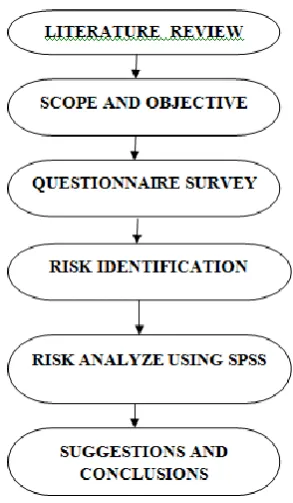
The objective of this paper is to identify the key risk factors which affect construction process and present an affective recommendation for adoption to avert the threat which causes severity effect to construction project.To spread awareness regarding risk management in the construction industry. It is needed to study risk management because its execution is very less in the construction industry compared to other industries due to lack of knowledge. The study begins with understanding the process of risk management. Afterwards the factors were identified for risk analysis. Then the questionnaires were prepared on impact of risk and probability of occurrence of risk. Then the data were collected from various personnel from the construction industry with ample amount of experience. After that, the data were analyzed with Statistical Package for Social Science (SPSS) software.
III. METHODOLOGY
Fig 1 Project Methodology Flowchart
for Social Sciences (SPSS). The responses of the questions have been coded as numerals which resulted in finding out the frequency and percentage using the cumulative percentage formula.
3.1 Risks involved in the Construction Industry
The following Table:1 shows the different types of Risks involved in the Construction Industry.
Table:1 Risks involved in the Construction Industry
1. TECHNICAL RISK 6. FINANCIAL RISK
Incomplete design Loss due to fluctuation of interest rate
Inadequate site investigation Loss due to rises in fuel prices Improper project planning and budgeting Price fluctuation
Inadequate specification Tax rate increase
Foreign currency exchange rate fluctuation
2. TIME RISK 7. POLICY AND POLITICAL RISK
Excessive approval procedures in administrative government departments
Changes in laws and regulations
The contractor does not pay worker wages in due time Restrictions on fund repatriations
Tight Project Schedule Requirement for permit and late approvals
Inappropriate time allocation Loss incurred due to Corruption and Bribery
3. CONSTRUCTION RISK 8. ENVIRONMENTAL RISK
Selection of material and equipments Natural Disaster (Floods, earthquakes,.. etc.) Equipment failure Difficulty to access the Site (Very far,
settlements)
Shortage of labours Adverse weather conditions
Shortage of equipment
Quality variations by the labours
New technology implemented
4. LEGAL RISK 9. SAFETY RISK
Breach of contract by project partner Accidents on workers
Improper verification of contract documents Unexpectedly falls of the floors
5. MANAGEMENT RISK Electrical fires occurred
Change of top management
No past experience in similar projects Internal management problems
IV. DATA COLLECTION & ANALYSIS
Table: 2 Stastical Analysis in Risk Factors
Sl.No Description of Risk Mean
TECHNICAL RISK
1 Incomplete Design 3.019
2 Inadequate site investigation 3.0129
3 Improper project planning and budgeting 3.0645
4 Inadequate specification 2.8839
TIME RISK
5 Excessive approval procedures in administrative government departments
2.7871
6 The contractor does not pay worker wages in due time
2.8581
7 Tight Project Schedule 3.0065
8 Inappropriate time allocation 2.8774
CONSTRUCTION RISK
9 Selection of material and equipments 2.8323
10 Equipment failure 3.0452
11 Shortage of labours 3.0516
12 Shortage of equipment 3.0710
13 Quality variations by the labours 2.9097
14 New technology implemented 2.8129
LEGAL RISK
15 Breach of contract by project partner 2.9355
16 Improper verification of contract documents 3.0581
MANAGEMENT RISK
17 Change of top management 2.9548
18 No past experience in similar projects 3.2258
19 Internal management problems 3.0774
FINANCIAL RISK
20 Loss due to fluctuation of interest rate 3.1419
21 Loss due to rises in fuel prices 3.1161
22 Price fluctuation 3.3806
24 Foreign currency exchange rate fluctuation 3.1548
POLICY AND POLITICAL RISK
25 Changes in laws and regulations 3.0903
26 Restrictions on fund repatriations 3.1484
27 Requirement for permit and late approvals 2.9935
28 Loss incurred due to Corruption and Bribery 3.1742
ENVIRONMENTAL RISK
29 Natural Disaster (Floods, earthquakes,.. etc.) 3.3484
30 Difficulty to access the Site (Very far, settlements) 3.2645
31 Adverse weather conditions 3.1355
SAFETY RISK
32 Accidents on workers 2.9613
33 Unexpectedly falls of the floors 3.3419
34 Electrical fires occurred 3.1161
Frequency Analysis
Frequency Analysis is used to find out the detailed information about each variable entered into a spreadsheet.
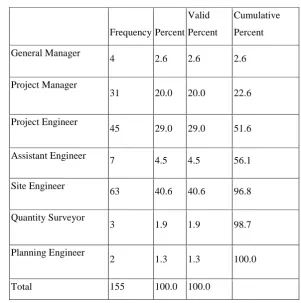
Table 3 Designation
Frequency Percent Valid Percent
Cumulative Percent
General Manager
4 2.6 2.6 2.6
Project Manager
31 20.0 20.0 22.6
Project Engineer
45 29.0 29.0 51.6
Assistant Engineer 7 4.5 4.5 56.1
Site Engineer
63 40.6 40.6 96.8
Quantity Surveyor
3 1.9 1.9 98.7
Planning Engineer
2 1.3 1.3 100.0
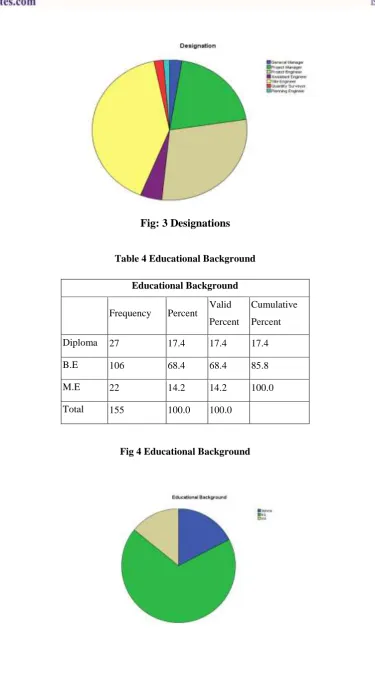
Fig: 3 Designations
Table 4 Educational Background
Fig 4 Educational Background Educational Background
Frequency Percent Valid Percent
Cumulative Percent
Diploma 27 17.4 17.4 17.4
B.E 106 68.4 68.4 85.8
M.E 22 14.2 14.2 100.0
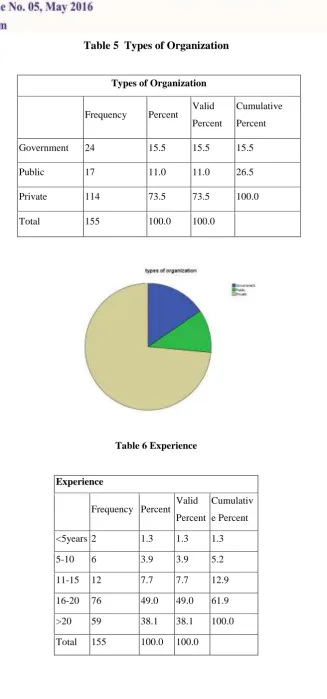
Table 5 Types of Organization
Table 6 Experience Types of Organization
Frequency Percent Valid Percent
Cumulative Percent
Government 24 15.5 15.5 15.5
Public 17 11.0 11.0 26.5
Private 114 73.5 73.5 100.0
Total 155 100.0 100.0
Experience
Frequency Percent Valid Percent
Cumulativ e Percent
<5years 2 1.3 1.3 1.3
5-10 6 3.9 3.9 5.2
11-15 12 7.7 7.7 12.9
16-20 76 49.0 49.0 61.9
>20 59 38.1 38.1 100.0
Figure 6 Experience
V. RESULTS AND DISCUSSION
Totally for 200 companies the questionnaires were given, out of which 155 had an effective reply. Thus the response rate is 78% which is considered a good response in this type of survey. All the questionnaire survey was done from project manager, project engineer, site engineer of the project at the construction site. In some cases, consultant gave the answers on behalf of their clients, both from the owner and the contractor side. Even email reply was accepted since it was difficult to get the direct one to one meeting with the Project managers. Risk management in construction of any project is very essential and a process to be giving priority by every construction company, larger, medium or smaller sized. The success of every construction project mostly is determined by the ability of the construction team to manage the risk and the process of implementing the project. it is conclusively identified that adequate planning, adoption of site safety, use of good and quality materials in construction as well as effective and efficient use of all the available resources are among the forefront factors for success that mitigate the amount of risk in construction project under the period of the study.
Therefore, to eliminate if not completely eradicate the number of risks usually encounter during construction of project one have to fully identify the factors that causes risk in construction of project and a possible process of mitigating them. For a project to be successful the following recommendations are hereby presented:
Adequate planning should be provided before the commencement of project construction.
Safety, rules and regulations in construction site should fully be maintained from the initial to final
stage of construction.
Durable and quality materials for construction should be supply and use properly.
Efficient and Economical use of all the available resources should be adopted by all members of
construction team.
Land, Materials, Machineries and all other needed equipment should be supply immediately for
Effective communications and corporations between all members of construction team should be
adopted.
Well trained and experienced workmen should be employed where necessary.
REFERENCES
[1]. Abdelgawad, M. and Fayek, A. R., 2010. Risk management in the construction industry using combined fuzzy FMEA and fuzzy AHP. Journal of Construction Engineering and Management, ASCE, Vol. 136, No. 9, pp. 10281036.
[2]. Akintoye, A.S. and MacLeod, M.J., 1997. Risk analysis and management in construction. International Journal of Project Management, Vol. 15, No.1, pp. 3138.
[3]. Dey, P.K., 2002. Project Risk Management: A Combined Analytic Hierarchy Process and Decision Tree Approach. Cost Engineering, Vol. 44, No. 3, pp. 1326.
[4]. Latham, M. (1994), “Constructing the team” HSMO.
[5]. Poon, S.W., Chen, H., and Hao, G.L., 2004. Cost Risk Management in West Rail Project of Hong Kong. AACE International Transactions, pp. 15.
[6]. Project Management Institute. (2004). A Guide to the Project Management Body of Knowledge. Newtown Square, Pennsylvania: PMI. ———. (2000). A Guide to the Project Management Body of Knowledge. Newtown Square, Pennsylvania: PMI.
[7]. Royer, P.S., 2000. Risk management: The undiscovered dimension of project management. Project Management Journal, Vol. 31, No.1, pp. 613.