University of Pennsylvania
ScholarlyCommons
Publicly Accessible Penn Dissertations
1985
Continuity and Change in English Morphology:
The Variable (ING)
Ann Celeste Houston
University of Pennsylvania
Follow this and additional works at:
http://repository.upenn.edu/edissertations
Part of the
Linguistics Commons
This paper is posted at ScholarlyCommons.http://repository.upenn.edu/edissertations/1183
For more information, please [email protected].
Recommended Citation
Houston, Ann Celeste, "Continuity and Change in English Morphology: The Variable (ING)" (1985).Publicly Accessible Penn Dissertations. 1183.
Continuity and Change in English Morphology: The Variable (ING)
Abstract
Past studies of the variable (ING) have demonstrated regular and stable social and stylistic conditions across
English speech communities around the world, factors which shape the patterns of variation between the /n/
and /ŋ/ variants of (ING). This dissertation is an inquiry into the conditions, both linguistic and social, which
gave rise to the evolution of modern (ING). The purpose is to demonstrate the existence of an observable
continuity between the past morphological history of (ING) and its present-day status as a sociolinguistic
variable, following Sturtevant's idea (1917) that the social evaluation of linguistic forms can be viewed as the
result of a competition between forms originally not in variation with each other, but which are later brought
together in a shared environment, becoming variants of a single form.
This study is based on a quantitative analysis of 7950 tokens of -ing, including synchronic data based on 68
speakers (60 British and 8 American) and diachronic data based on textual materials (letters and diaries) from
the 15th - 19th centuries, and a supplement of data from an earlier study (Irwin 1967) based on textual
materials from the 9th - 15th century.
A grammatical effect on modern (ING) is found, seen most clearly in the British data, showing that /ŋ/ is
correlated with nominal categories, and /n/ with verbal ones. This alignment does not pattern according to
discrete syntactic features, but aligns probabilistically along a linear continuum. This effect is interpreted as
the reflex of a partial merger between Old English morphemes ing and ind . There is an observed
correspondence between the synchronic British data and the Middle English isogloss c. 1450, which
established the replacement of the participial suffix ind with the verbal noun suffix ing in the south of England
(Moore, Meech and Whitehall 1935). The modern cities which show probability of /ŋ/ less than .5 fall
outside the isogloss, those with probability of /ŋ/ greater than .5 lie within it. The difference in probabilities is
consistent with the idea that the replacement of -ind with -ing c. 1450 occurred in southern England sooner
than in northern England because of a difference in the pronunciation of the two suffixes in these regions,
northern -and versus southern -ind. Evidence supports the view of a syncretism between verbal noun and
present participle subsequent to the replacement of -ind with -ing. (Abstract shortened with permission of
author.)
Degree Type
Dissertation
Degree Name
Doctor of Philosophy (PhD)
Graduate Group
Linguistics
First Advisor
William Labov
Subject Categories
Linguistics
PLEASE NOTE:
In all cases this material has been filmed in the best possible w ay from the available copy. Problems encountered with this document have been identified here with a check mark •/ .
1. Glossy photographs or pages______
2. Colored illustrations, paper or prin t_______
3. Photographs with dark background_____
4. Illustrations are poor copy_______
5. Pages with black marks, not original cop y______
6. Print shows through as there is text on both sides of p a g e _______
7. Indistinct, broken or small print on several pages ^
8. Print exceeds margin requirements______
9. Tightly bound copy with print lost in spine_______
10. Computer printout pages with indistinct print_______
11. Page(s)____________ lacking when material received, and not available from school or author.
12. Page(s)____________ seem to be missing in numbering only as text follows.
13. Two pages num bered . Text follows.
14. Curling and wrinkled pages______
15. Dissertation contains pages with print at a slant, filmed as received__________
16. Other__________ _________________ _______________________ ____________
University
Microfiims
International
CONTINUITY AND CHANGE IN ENGLISH MORPHOLOGY: THE VARIABLE
(ING)
Ann Celeste Houston
A DISSERTATION
in
Linguistics
Presented to the faculties of the University of Pennsylvania in Partial
Fulfillment of the Requirements for the Degree of Doctor of Philosophy
1985
Supervisor of Dissertation
Graduate Group Chairperson
COPYRIGHT
Ann Celeste Houston
19S5
To my Mother, Father, Sandra and Johnny
iii
Acknowledgements
I would like to express my deepest appreciation to William Labov, for his patience
and inspiring guidance as my advisor. I feel exceptionally priviledged to have had the
opportunity of working with him over these past years, and to have received the benefits of
his insight, criticism, humor, and astute observations of human nature. Every aspect of
this thesis is a reflection of the generosity he has shown m e in term s of his time, ideas and
resources. When I cam e to Penn, my views of language were shaped almost entirely by a
perspective from the philosophy of language. Through his teaching, I have com e to
appreciate the need and value of quantifiable data and of pursuing a research program
whose empirical basis can be replicated and built upon by others. Beyond this, he opened
my ears to the amazing, living language that surrounds us every day, and is the true target
of linguistic inquiry. This training is a debt I can never repay.
I am deeply grateful to Gillian Sankoff for serving on my com m ittee. Her criticisms
and observations were extremely valuable during the writing of this thesis, and her
encouragement kept m e going through the rough tim es. Her careful and thorough
com ments were appreciated very much, and her depth, both as a scholar and a human
being will continue to set the standards for m e.
I want to thank John Fought for his patience and support over the last two years,
for serving on my com m ittee, and for som e interesting and rewarding discussions on
morphology. I want to also thank him for the rigorous course I took with him in phonology
my first year, which introduced m e to the accomplishments of structural linguistics.
Because of his generosity, I have had access to sophisticated computing equipment on
which I have written and printed this thesis.
I would also like io thank a number of other professors who have contributed in
diverse ways to the ideas in this thesis, especially to Jam es Milroy from whom I received
extensive com ments on my proposal and portions of earlier drafts. I am grateful to Dell
Hymes for his com ments on my proposal, and also for the opportunity I had to work as a
iv
research assistant for him. Thanks also to Dr. Lisker for his comments on the phonetics
experiment, and to Dr. Hiz for his encouragement, and for referring m e to the work on -in g
by Zellig Harris. I'd like to thank Anthony Kroch and Richard Larson for their syntactic
insights into (ING). I am very grateful to Peter Trudgill, Ralph Fasold, John Ross, Lawrence
Carrington, and Lloyd Anderson for their interest and comments on m y work. Thanks also
to Professor Robert Gregg for sending me excerpts from his recent work on Canadian
-In g .
In conducting the experiments used in this study, a number of people contributed
in various ways. Franz Seitz, Colby Madden, Elizabeth Dayton and Elizabeth Campion gave
m e valuable feedback on experimental design. Chris Cieri, Franz Seitz, Sheila Stein,
Francis Stead and Chip Buchholtz ail gave their time in helping m e conduct these
experiments. The enthusiasm was an extra - thanks, guys. I benefitted from on-going
discussions about the syntactic and historical aspects of this dissertation with Fernando
Tarallo, Elizabeth Dayton, Deborah Schiffrin, John Myhill, David Graff, Dominique Estival,
Chris Cieri, Sara Kimball, Beatrice Santorini and Joe DiChicchis.
I would like to extend my appreciation to all the reference staff at Van Pelt for their
cooperation and help on so many occassions during the course of my research. I would
also like to thank Carol Connelly for her help over the years.
On the technical side of things, I couldn’t have made it without the various
computers, tape recorders and printers I have had access to in the course of analysis and
writing. The original copy of this thesis was formatted on an Apollo Domain 300 computer,
using the Interleaf document preparation system. The original copy was printed on an
Imagen laser printer. Thanks Bill and John, for the m uch-appreciated use of your labs,
where I spent all my midnight hours. Thanks to David Graff and Sharon Ash for cheerful and
patient service in maintaining the equipment at 3732, I hope no one ever takes for
granted what it takes to keep a computer lab running. Thanks to Dan Blumenfeld for his
maintenance of the lab at 440, and for getting m e through some low moments with high
v
tech. Also thanks to Dan for creating the digitized maps of England. Many thanks to Dana
Boatman for helping me with the other maps.
In my graduate years at Penn I have been fortunate to have developed friendships
with som e exceptional women, who have given m e intellectual and moral support, and
whom I consider it an honor to have as peers; Deborah Schiffrin, Elizabeth Dayton,
Catherine Barale, Colby Madden, Barbara Hoekje, Nadine O ’Connor, Robin Sabino and
Crawford Feagin. I have also appreciated the friendship of som e very supportive and
intellectually stimulating men; Fernando Tarallo, Mark Kuntz, Claude Paradis, Dick
Liebendorfer, Will Dowling, Franz Seitz, Dave Graff and Ron Wilburn.
I will always appreciate the support my family has given m e through this period of
m y life thanks to Lee and Sandra for much valuable advice, and to Catherine for her
sense of humor about it all. Thanks to my father for having faith in m e, and to Polly for
providing m e with some good reading. I will always be indebted to my brother John and my
mother for inspiring m e with wonder and curiosity about the world, their memories remain
with m e always.
I could not have written this dissertation without the support of Dan, my friend and
companion of these past four years, who knows all the ins and outs, ups and downs of this
dissertation. Thanks, too, to Blanche, Fred and Karen Blumenfeld for the care and
kindness they have shown m e in so many ways.
Last, but never least, I owe a big thanks to the gang at LAP, for their continual
com araderie through thick and thin. They have been with m e through the entire writing of
this, and more times than not, bore the brunt of my daily frustrations, and did it with more
compassion and understanding than I know I deserved. Thanks, Cathy, Dana, Dan, jJohn,
Chris, Nadine, Nada, George, Daryoush, Brian, Andy, Peter, Pam, Shiva, Cherie, Sheila,
Erika, Martin and Joe. I love youse all.
Table of Contents
1.0 Introduction 1
1.1 The Scope of the Present Study 1
1.2. Five Aspects of Language Change 2
1.3 General Remarks on Methodology 5
1.3.1 The Vernacular 5
1 .3 .2 Interviewing and the Observer’s Paradox 6
1 .3.3 Problems with Approaching Vernacular in Historical Data 7
1.4 Social Concepts and Language 8
1.4.1 The Speech Community 8
1 .4 .2 Inherent Linguistic Variation 10
1 .5 General Plan of the Study 11
Footnotes 14
2.0 Three Perspectives on -In g 15
2.1 Introduction 15
2 .2 The Sociolinguistic Variable (ING) 16
2.2.1 (ING) in Southern English and Black English 18
2 .2 .2 Phonological Conditioning on (ING) 19
2 .2 .3 Defining the Variable 23
2 .2 .4 Wyld's Hypothesis 25
2 .3 The Analysis of -in g Within Generative Grammar 28
2 .4 The Historical Approach to -In g 33
2.4.1 The Theory of Phonetic Leveling 33
2 .4 .2 The Theory of Functional Shift 36
2:5 Summary 42
Footnotes 44
vii
3.0 Description of the Data Base 46
3.1 Introduction 46
3 .2 Description of the Factor Groups 46
3 .3 Phonological Factors 48
3.3.1 Preceding and Following Environment 49
3 .3 .2 Vowel Preceding the Nasal Variant of (ING) 50
3 .3 .3 Stress 51
3 .3 .4 Syllabic Stem Stress Pattern 52
3 .3 .5 Orthography 53
3 .4 Syntactic Factors 56
3.4.1 Grammatical Category 56
3 .4 .1 .1 Present Participle [ + V - N ] 59
3 .4 .1 .2 Adjectives/Adverbs [V +N] 61
3 .4 .1 .3 Derived Nominate [ + N - V ] 61
3 .4 .1 .4 Prepositions 62
3 .4 .1 .5 Gerunds 62
3 .4 .1 .5 .1 Verbal Gerunds 64
3 .4 .1 .5 .2 Nominal Gerunds 64
3 .4 .1 .6 Gerund Complements to Noun Phrases 64
3 .4 .1 .7 A cc-lng 70
3 .4 .2 Modifier Type for Gerunds 71
3 .4 .3 Syntactic Control 72
3 .4 .4 Oblique Objects and Complements to Gerunds 73
3 .5 Abstract/Concrete Properties 75
3.5.1 Tangible Objects 75
3 .5 .2 Perceptible Simple Action 75
3 .5 .3 Perceptible Complex Action 76
3 .5 .4 Mental States and Events 76
3 .5 .5 Abstract Relations/Qualities 76
v iii
3 .5 .6 Time Words 77
3 .5 .7 Verbs of Communication 77
3 .6 Social and Geographical Factors 77
3.6.1 Etymology 77
3 .6 .2 Geographical Area 79
3 .6 .2 .1 Synchronic Data 79
3 .6 .2 .2 Diachronic Data 82
3 .6 .3 Social Class 84
3 .6 .4 Genre 85
3 .6 .5 Age 86
3 .6 .6 Sex 87
3 .6 .7 Era 87
Footnotes 89
4 .0 Historical Coninuity in Synchronic Variation 91
4.1 introduction 91
4 .2 The Interview Setting 91
4 .3 Profile of the British Speakers 92
4 .4 Regional Patterns 98
4.4.1 The Nominal-Verbal Continuum 110
4 .4 .2 Ross's Model and (ING) 121
4 .4 .3 Gerunds 122
4 .4 .4 Syntactic Control 129
4 .4 .5 Discussion 131
4 .5 The Grammatical Effect and Dialect 132
4 .6 The Vowel Preceding the Nasal of (ING) 140
4 .7 Comparing (ING) for Different Dialects 145
4.7.1 The Southern American Pattern 151
4 .8 Summary 158
Footnotes 159
ix
5.0 The Morphological History of -IN G 161
5.1 Introduction 161
5 .2 Morphological and Syntactic Distributions from an Historical Perspective 162
5 .3 Non-m orphem ic -In g 165
5.3.1 Everything 165
5 .3 .2 Anything 166
5 .3 .3 Nothing 166
5 .3 .4 Something 167
5 .4 The Masculine Derivational Suffix -In g 168
5.4.1 Proper Names 168
5 .4 .2 Forms Derived with -Ling 170
5 .4 .3 Common Nouns 171
5 .5 The Feminine Derivational Suffix -U ng 171
5.5.1 Words which are Monomorphemic in Modern English 171
5 .5 .1 .1 Evening/Morning 172
5 .5 .1 .2 Ceiling 172
5 .5 .2 Derived Concrete Nouns 173
5 .5 .2 .1 Building 175
5 .5 .2 .2 Roofing 175
5 .5 .2 .3 Tiling 175
5 .5 .2 .4 Caulking 175
5 .5 .2 .5 Railing 176
5 .5 .2 .6 Shelving 176
5 .5 .2 .7 Plumbing 176
.5.5.2.8 Clothing 176
5 .5 .2 .9 Lining 176
5 .5 .2 .1 0 Hemming 177
5 .5 .2 .1 1 Embroidering 177
5 .5 .2 .1 2 Stitching 177
5 .5 .2 .1 3 Sewing 177
x
5 .5 .3 Derived Forms in the Diachronic Data 178
5 .5 .4 Adjunct Modifiers 180
5 .5 .5 Nominal and Verbal Gerunds 182
5 .5 .6 The Acc-lng Construction 185
5 .5 .7 Gerunds as Noun Phrase Complements 186
5 .6 Constructions Historically Formed with either -In g or -Ind 188
5.6.1 Quasi-progressives 188
5 .6 .2 Verb Phrase Complements 191
5 .6 .2 .1 Verb Phrase Complem ents with Equi NP Deletion 191
5 .6 .2 .2 Verb Phrase Complem ents without Equi NP Deletion 192
5 .6 .3 Progressives 196
5 .7 The Present Participle Suffix -In d 201
5.7.1 Appositive Participles 201
5 .7 .2 Absolute Participles 203
5 .7 .3 Reduced Relative Clauses 204
5 .7 .4 Sentential Complements 208
5 .7 .5 Periphrastic Future 209
5 .7 .6 Adjunct Modifiers with -In d 210
5 .7 .7 Predicate Adjectives 212
5 .7 .8 Adverbs 213
5 .8 Prepositions 214
5 .9 Summary of Major Constructions in the Historical Data 216
Footnotes 218
6 .0 Establishing the Continuity between Past and Present M orphology 220
6.1 Historical Data Base 220
6.2 Distribution of External Factors 220
6.3 The Dependent Variable as Presence or Absence of Final <g> 223
6 .4 The Dependent Variable as Presence or Absence of Final <e> 228
6.4.1 Evidence from the Miracle Plays 237
x i
6 .4 .2 The Presence of Final <e> and Other Dimensions 239
6 .5 Final <e> and the Case System of Old and Middle English 241
6.5.1 Etymological Final <e> 242
6 .5 .2 Inflectional Final <e> 243
6 .5 .3 Inorganic Final <e> 244
6 .5 .4 Scribal Final <e> 245
6 .6 Data from Irwin’s Study of -In g 246
6 .6.1 The Presence of Final <e> in Irwin’s Data 252
6 .7 The Association of Nominal Traits with Syntactic Positions of Gerunds 255
6 .8 Case Marking and the Present Participle in Irwin’s Data 260
6.9 Stress and -In g 268
6 .9.1 Secondary Stress Patterns in Old and Middle English 269
6 .9 .2 Experimental Results on the Perception of a Nasal Stop
Following High Front and Mid Central Vowels 274
6 .10 The Relationship Between the Gerund, the Inflected Infinitive and
the Present Participle 280
6.11 Concluding Remarks 284
Footnotes 286
7.0 The Expanding Verbal Function of -In g 287
7.1 Introduction 287
7 .2 The Morphological Status of Synchronic -In g 287
7.2.1 Generative Models 288
7.3 Syntactic Syncretism and Verbalization of -In g 292
7.3.1 Syncretism Followoing Main Verb BE 295
7 .3 .2 Syncretism After Verbs of Motion 303
7 .3 .3 Syncretism and Verb Phrase Complements 305
7 .4 The Influence of Non-finite Participles on the Increasing Verbalization
of Gerunds 311
7 .5 The Limits of Discrete Models of Change 319
7.5.1 Discrete Models of Synchronic (ING) 320
x ii
7 .5 .2 Discrete Models of Diachronic Change 323
7 .5 .2 .1 Radical Re-analysis and Infinitives in English 324
7 .5 .2 .2 The Assumption of Gerunds as Discrete NPs 326
7 .6 The Replacement of Infinitives with Gerunds 329
Sum m ary on Verbalization of (ING) 331
Footnotes 333
8 .0 T h e Evaluative Function of (ING ): A Contrast to Gram m atical Function 336
6.1 Introduction 336
6 .2 Evidence of Social Evaluation in Prescriptive Grammars 337
6 .3 Appearance of the Apostrophe with -In g 339
6 .4 Intuitions and the Grammatical Conditioning on (ING) 350
8 .5 Functionalism and Social Evaluation 355
Footnotes 359
9 .0 Conclusions 360
9.1 General Summary 360
9 .2 Introspection versus the Quantitative Paradigm 364
9 .3 Topics for Further Exploration 366
Footnotes 369
Appendix A: Reliability Test 370
Appendix B: Editing Experiment 1 for (ING) 373
Editing Experiment 2 for (ING) 376
Appendix C : Experimental Procedure for Phonetics Experiment on the Perception of [n] and frj] following Vowels in Stressed and
Unstressed syllables 379
Appendix D: Sample Form for Morphology Experiment 391
Appendix E: Tapes used in the Synchronic Data Base 392
x i i i
Appendix F: Historical Texts used in the Diachronic Data Base 394
Bibliography 3 9 9
Index 409
xiv
List of Tables
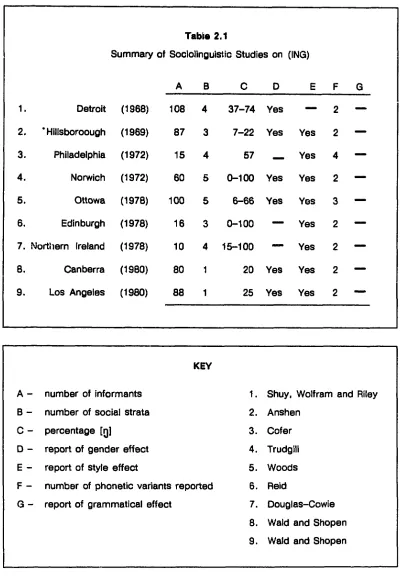
Table 2.1 Summary of Sociolinguistic Studies on (ING) 17
Table 2.2 Effects of Regressive Assimilation and Progressive Dissimilation
for British (ING) 20
Table 2.3 Distribution of the Variant [in] in British Speech for Men
and Women 21
Table 2 .4 Percentage of Velar Variant in American Southern Speech
according to something, nothing, everything, anything 22
Table 2 .5 Percentage of Velar Variant in British Speech according to
something, nothing, everything, anything 23
Table 2 .6 Percentage of Velar Variant for Philadelphia Speech according to
Grammatical Category 24
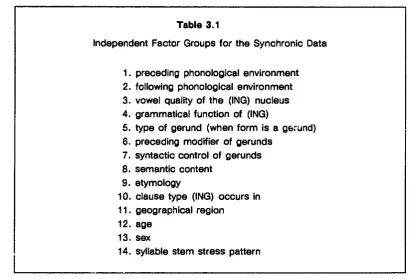
Table 3.1 Independent Factor Groups for the Synchronic Data 47
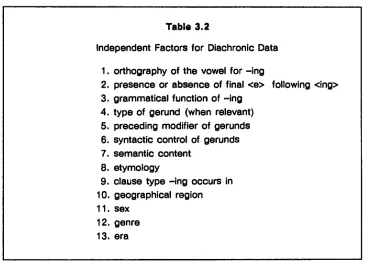
Table 3 .2 Independent Factor Groups for the Diachronic Data 48
Table 3 .3 Phonological Environments for (ING) 50
Table 3 .4 Vocalic Variants Preceding the Nasal of (ING) 51
Table 3 .5 Number of Syllables in Stem 52
Table 3 .6 Orthography of Vowel Preceding Nasal 53
Table 3 .7 Forms Occurring with or without Final <e> 54
Table 3 .8 Syntactic Feature Matrix 56
Table 3 .9 Classification of Data by Syntactic Features 58
Table 3 .1 0 Summary of Syntactic Tests for NP Complements 66
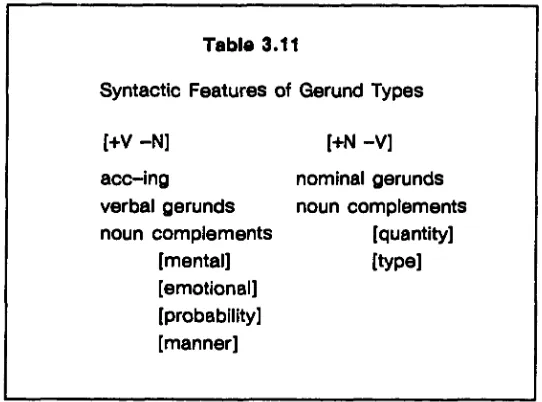
Table 3.11 Syntactic Features of Gerund Types 71
Table 3 .12 Etymological Origins of the Diachronic Data 78
Table 3 .13 Sources of the Diachronic Data 83
Table 3 .14 Dialects Represented in Irwin’s Sample 84
Table 3 .1 5 Social Strata 85
Table 3 .1 6 Genres 86
Table 3 .1 7 Age Groups 87
Table 3 .1 8 Summary of Dimensions 88
Table 4.1 Distribution of British (ING) according to Age and Sex 92
Table 4 .2 Distribution of British (ING) according to Number of Speakers
per Age Group 93
X V
Table Table Table Table Table Table Table Table Table Table Table Table Table Table Table Table Table Table Table Table Table Table
4 .3 Distribution of British (ING) according to Sex and Urban/Rural
Setting 95
4 .4 Distribution of British (ING) according to Geographical Region
and Number of Speakers for each Region 96
4 .5 Summary of Boundary Points for Isogloss between <ing> and <and>
c.1450 101
4 .6 Probability of Velar Application of (ING) according to Dialect and
Grammatical Category 103-104
4 .7 Groups of Non-significantly Different Categories 107
4 .8 Five Significant Regional Groupings for British Data 108
4 .9 Probabilities of Velar Application of (ING) in British Synchronic Data
according to Grammatical Category, Dialect Region and Age 109
4 .1 0 Probabilities of Velar Application of (ING) according to Chomsky's
Syntactic Feature Matrix 111
4.11 Significantly Different Categories not Shown in Table 4 .10 113
4 .1 2 Probabilities of Velar Application for Semantic Dimension
in British Data 114
4 .13 Probabilities of Velar Application for Etymology of Brit, ->h Data 116
4 .1 4 Probabilities of Velar Application according to Number of Stem
Syllables for British (ING) Data 118
4 .1 5 Probabilities of Velar Application according to Clause Type for
British Data 120
4 .1 6 Probabilities of Velar Application for Gerunds in British Data
according to Syntactic Position of Gerund 124
4 .1 7 Distribution of Control Type according to Syntactic Position
of Gerund 126
4 .1 8 Distribution of Determiner Type according to Syntactic Position
of Gerund 127
4 .1 9 Percentage of Velar Application for Gerunds according to Syntactic
Position and Dialect Region 129
4 .2 0 Distribution of Types of Syntactic Control according to
Grammatical Category 130
4.21 Percentage of Velar Application for Major Grammatical Categories
according to Inside and Outside Dialect Regions 133
4 .22 Chi Squares for Grammatical Groups shown in Table 4.21 134
4 .23 Distribution of Etymological Origins for (ING) according to
Grammatical Categories 136
4 .2 4 Comparison of Velar Applications according to Discrete Feature
Model for Inside and Outside Dialect Regions 138
xvi
Table 4 .2 5 Significance of Chi Square for Difference between Categories for Inside and Outside Dialects shown in Table 4 .2 4
Table 4 .2 6 Distribution of Vowel Variants in (ING) according to British Dialect
Table 4 .2 7 Velar Applications for Inside/Outside Dialects according to Height of Vowel Preceding Nasal
Table 4 .2 8 Distribution of Vowel Variants according to Grammatical Category of (ING) in British Data
Table 4 .2 9 Percentage of Velar Application for /I/ and /f/ for Two Major British Dialect Regions
Table 4 .3 0 Probability of Velar Appliction for the Vowel Variants /I/ and 11/ according to Grammatical Category
Table 4.31 Velar Application of (ING) for Inside Dialects
Table 4 .3 2 Velar Application of (ING) for Outside Dialects
Table 4 .3 3 Comparison of Probabilities of Velar Application according to Grammatical Category for Inside and Outside Dialect Regions
Table 4 .3 4 Comparison of Probabilities of Velar Application for Vowel Height for Inside and Outside Dialect Regions
Table 4 .3 5 Comparison of Probabilities of Velar Application for Preceding Phonological Environment for Inside and Outside Dialect Regions
Table 4 .3 6 Comparison of Probabilities of Velar Application for Following Phonological Environment for Inside and Outside Dialect Regions
Table 4 .3 7 Probabilities of Velar Application for American Southern Dialects according to Grammatical Category
Table 4 .3 8 Comparison of Velar Applications according to Grammatical Category for British and Southern American (ING) Data
Table 4 .3 9 Comparison of Velar Applications according to Vowel Height for British and Southern American (ING) Data
Table 4 .4 0 Comparison of Velar Applications according to Preceding
Phonological Environment for Southern American and British (ING)
Table 4.41 Ccmparison of Velar Applications for Following Phonological Environment for British and Southern American (ING) Data
Table 4 .4 2 Comparison of Velar Applications according to Syntactic Position of Gerunds for British and Southern American (ING) Data
Table 5.1 Relative Frequency of Proper Names with -In g : 15th-19th Centuries
Table 5 .2 Distribution of Monomorphemic Nouns with -Ing (15th -1 9 th Centuries)
Table 5 .3 Response of Twenty Subjects to Acceptability of Form Nouns, Plural Nouns, and Verbs Related to Concrete Nouns in -In g
x v ii
139 140 142 143 144 145 146 147 148 149 150 151 152 153 154 155 156 157 170 173 179
Table 5 .4 Distribution of Concrete Derived Nouns in -In g :
(15th -1 9 th Centuries) 180
Table 5 .5 Distribution of Prenominal Modifiers (Gerundive) 182
Table 5 .6 Distribution of Nominal and Verbal Gerunds 184
Table 5 .7 Distribution of Gerunds as Nominal, Verbal and Intermeditate Types 185
Table 5 .8 Distribution of A cc-ing (15th - 19th Centuries) 186
Table 5 .9 Distribution of -in g Complements to Noun Phrases 188
Table 5 .1 0 Distribution of Quasi-progressives (15th - 19th Centuries) 190
Table 5.11 Distribution of Verb Phrase Complements (+/-E q u i)
(15th - 19th Centuries) 196
Table 5 .1 2 Distribution of the Progressives (15th - 19th Centuries) 198
Table 5 .1 3 Distribution of A + Participle (15th - 19th Centuries) 199
Table 5 .1 4 Distribution of Appositive Participles (15th - 19th Centuries) 202
Table 5 .1 5 Distribution of Absolute Participles (15th - 19th Centuries) 204
Table 5 .1 6 Distribution of Pre-nominal and Post-nominal Modifiers
(15th - 19th Centuries) 205
Table 5 .1 7 Distribution of Reduced Relative Clauses (15th - 19th Centuries) 206
Table 5 .1 8 Distribution of Sentential Complements (15th - 19th Centuries) 209
Table 5 .1 9 Distribution of Periphrastic Future (15th - 19th Centuries) 210
Table 5 .2 0 Distribution of Adjunct Modifiers (+participle)
(15th - 19th Centuries) 211
Table 5.21 Distribution of Predicate Adjectives (15th - 19th Centuries) 212
Table 5 .2 2 Distribution of Adverbs (15th - 19th Centuries) 213
Table 5 .2 3 Distribution of Prepositions (15th - 19th Centuries) 215
Table 5 .2 4 Distribution for All Constructions with -In g (15th - 19th Centuries) 217
Table 6.1 Distribution of Historical Data by Age of Writer 221
Table 6 .2 Distribution of Historical Data by Genre 221
Table 6 .3 Distribution of Historical Data according to Gender 222
Table 6 .4 Distribution of Historical Data according to Geographical Region 222
Table 6 .5 Presence of Final <g> on Historical -Ing based on Morphological
Histories 224
Table 6 .6 Presence of Final <g> on Historical -Ing based on Modern
Nominal-Verbal Attributes 225
Table 6 .7 Percentage of Final <g> in Historical Data 227
Table 6 .8 Distribution of Three Vowel Variants preceding <ng> according to
Grammatical Groups 228
x v i ii
Table 6 .9 Percentage of Final <e> in Historical Data according to
Morphological History 229
Table 6 .10 Distribution of Final <e> for Historical Data according to Modern
Nominal-Verbal Attributes 229
Table 6.11 Percentage of Final <e> in Historical Data according to
Nominal-Verbal Attributes of Gerunds 230
Table 6.12 Percentage of Final <e> by Century according to Type of Gerund 231
Table 6.13 Percentage of Final <e> according to Syntactic Position of Gerund 231
Table 6.14 Percentage of Final <e> by Century according to Syntactic Position
of Gerund 232
Table 6 .15 Percentage of Final <e> on Gerunds according to Dialect Region 232
Table 6 .16 Distribution of Historical Data by Dialect (15th - 19th Centuries) 233
Table 6 .17 Applications of Final <e> for Historical Data according to Dialect,
Grammatical Category and Syntactic Position of Gerund 234
Table 6 .18 Percentage of Final <e> for London/Essex and Norfolk/Suffolk
according to Grammatical Category 236
Table 6.19 Comparison between Diachronic <e> and Synchronic In i 236
Table 6 .20 Applications of Final <e> in the Miracle Plays 238
Table 6.21 Applications of Final <e> according to Etymology, Clause Type
Grammatical Category and Era 240
Table 6.22 Distribution of Masculine Nouns, Feminine Nouns and Present
Participles in Old, Middle and early Modern English 247
Table 6.23 Range of Dialect Sample in Irwin’s Data (8th - 15th Centuries) 248
Table 6 .24 Major Spelling Variants for Feminine Nouns (8th - 12th Centuries) 248
Table 6.25 Major Spelling Variants for Masculine Nouns (8th - 12th Centuries) 249
Table 6.26 Spelling Variants for Masculine and Feminine Nouns
(13th - 15th Centuries) 249
Table 6 .27 Spelling Variants of the Present Participle (8th-15th Centuries) 250
Table 6 .28 Spelling Variants for the Verbal Noun (8th - 15th Centuries) 251
Table 6.29 Percentage of Final Case-m arking on Verbal Nouns according
to Syntactic Position (9th - 15th Centuries) 253
Table 6 .30 Distribution of Modifiers according to Syntactic Position of Gerund
(15th - 19th Centuries) 256
Tcble 8.31 Data Shown in Table 6.30 256
Table 6 .32 Distribution of Syntactic Control for Gerunds according to
Syntactic Position (15th - 19th Centuries) 258
Table 6.33 Summary of Adjectival Endings in Old English 261
x ix
Table 6.34 Distribution of case-m arking on Adjectival Present Participles
in Irwin’s Data (9th - 15th Centuries) 262
Table 6.35 Distribution of Final Case-marking versus No Case-m arking
on Present Participle in Irwin’s Data263 263
Table 6 .36 Percentage of Correct Guesses for Unstressed -In g Syllables for
Fifteen Listeners 275
Table 7.1 Complements to Be + V-Ing (+habitual) from Old to Modern English 296
Table 7 .2 Data Shown in Figure 7.3 299
Table 7 .3 Percentage of Direct Objects Following the Aspectual Verbs
F a ll and Keep 305
Table 7 .4 Relative Frequency of Diachronic and Synchronic -In g according
to Morphological History 308
Table 7 .5 Proportion of Participle Categories with Direct Objects occurring
in the Nineteenth Century 310
Table 7 .6 Functional Distribution of Verrbal Nouns and Appositive Participles 314
Table 7 .7 Distribution of Oblique Verbal Nouns and Appositive Participles
according to Adverbial Function 315
Table 7 .8 Distribution of Direct Objects following Verbal Nouns according to
Syntactic Position 316
Table 7 .9 Contact Points in the Grammar 318
Table 7 .1 0 Attested Examples of Gerunds with Determiners and Direct Objects
(15th - 19th Centuries) 327
Table 8.1 Orthographic Variants for -In g in 19th Century Vernacular Verse 343
Table 8 .2 Orthographic Variants in M r, Sprouts H is Opinions 344
Table 8 .3 Spelling Variants in Pickw ick Papers (1837 Edition) 345
Table 8 .4 Orthographic Variants in Two Cornish Minor Dialogues 347
Table 8 .5 Percentage of Nominal and Verbal Categories Edited as in '
from Experiment 1 352
Table 8 .6 Results of Editing Experiment 2 353
Table 8 .7 Velar Application for Youngest British Speakers according to
Grammatical Category and Sex 354
Appendices
Table A.1 Percentage of Agreement for Each of Twenty (ING) Tokens 370
Table C.1 The 30 Syllable Types used as Stimuli in Experiment 1 379
Table C .2 The 30 Word Types used as Stimuli for Experiment 2 380
Table C .3 Percentage of Correct Guesses for Stressed Syllables with Final
[n] and [rj] for Fifteen Speakers 382
xx
Table C .4 Percentage of Correct Guesses for Unstressed -In g Syllables
for Fifteen Listenerrs 384
Table C .5 Percentage of Correct Guesses for [in] and [a jj] for Five Words 386
Table C .6 Comparison of Percentage of 100% Agreement for
Phonetically-trained versus Phonetically-untrained Listeners 386
Figures
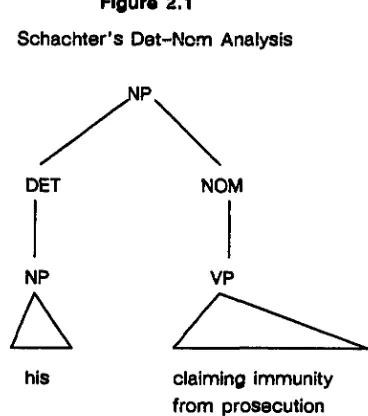
Figure 2.1 Schachter’s D et-N om Analysis 29
Figure 2.2 Horn’s Poss-lng Analysis 30
Figure 4.1 Discrete Feature Matrix 110
Figure 4 .2 Classification of Grammatical Categories by Discrete Feature Matrix (excluding Gerunds, A cc-ing and Gerunds as NP Complements 112
Figure 4 .3 Correspondence Between Ross’s Continuum (1972) and
British (ING) Data 122
Figure 4 .4 Correlation Between Ross’s Continuum (1973) and
British (ING) Data 123
Figure 4 .5 Grouping of Gerunds on the Basis of Co-occurrence with
Type of Determiner and Type of Control 128
Figure 4 .6 Graphic Representation of Table 4.21 135
Figure 4 .7 Graphic Representation of Data in Table 4 .23 137
Figure 4 .8 Graphic Representation of Data shown in Table 4 .2 4 139
Figure 4 .9 Distribution of Five Major Vowel Variants in (ING) for the Two
Major British Dialect Regions 141
Figure 5.1 The Morphological Origins of (ING) 164
Figure 5 .2 Verb Phrase Complements as Sentential Structures 193
Figure 5 .3 Verb Phrase Complements as NP Structures 194
Figure 6.1 Correspondence between Old English Morphemes and -In g and
Categories in Modern English 224
Figure 6.2 Comparison of Final <e> and /[}/ for Historical Data and Synchronic
Data 237
Figure 6 .3 Paradigms for Old English Nouns 246
Figure 6.4 Representation of Data from Table 6.29 254
Figure 6.5 Percentage of Final <e> across Time for Gerunds and Present
Participle according to Syntactic Position 265
Figure 6 .6 Difference in the Data Samples for the Fifteenth Century 267
Figure 6 .7 Percentage of Correct Guesses for Six Unstressed Variants of
(ING) for Fifteen Listeners 276
Figure 7.1 Expansion of Horn’s Poss-lng Analysis 290
Figure 7 .2 Auxiliary Expansion within Horn's Analysis 290
Figure 7 .3 Percentage of Appositive Participles, Progressives, and Oblique
Gerunds with Following Direct Object 299
Figure 7 .4 Distribution of Total Data Base according to Century 309
Figure 7 .5 Distribution of Gerunds in Subject/Object Positions versus
Oblique Position, by Century 312
Figure 7 .6 Graphic Representation of Data shown in Table 7 .8 317
Figure 7 .7 Schematization of Formal Identity of Three Suffixes 319
Appendices
Figure C.1 Graphic Representation of Data in Table C .3 383
Figure C .2 Graphic Representation of Data in Table C .4 385
Figure C .3 Percentage of Correct Guesses for Phonetically-trained
and Untrained Listeners for Unstressed [in] 387
Figure C .4 Percentage of Correct Guesses for Phonetically-trained versus
Untrained Listeners for Unstressed [a rj] 388
Maps
Map 3.1 Location of Urban Centers Represented in the Synchronic Data 80
Map 3 .2 Location of Regions within London Represented in the
Synchronic Data 81
Map 4.1 Location of Cities Representing British Synchronic Corpus for (ING) 97
Map 4 .2 Location of Regions within Greater London Area 99
Map 4 .3 Spread of <ing> Spelling for the English Present Participle c.1450 100
Map 4 .4 Probabilities of Velar Application for Modern British Data
by Speech Community 105
Map 6.1 Location of 15th - 17th Century Data Shown in Table 6.17 235
x x ii
1
1.0
Introduction
1.1 The Scope of the Present Study
This dissertation is an investigation into the origins of the modern sociolinguistic
variable in English, (ING). The central thesis is to demonstrate the existence of an
observable continuity between the past morphological history of (ING) and its present day
status as a sociolinguistic variable. In pursuing this hypothesis, I am investigating an idea
first expressed by Sturtevant (1917), which holds that the social evaluation of linguistic
variables can be viewed as the result of a competition between forms originally not in
variation with each other, but which are later brought together ir. a shared environment,
becoming variants of a single form.
The morphological history of (ING) is complex. Prior to the fourteenth century, the
present participle in English did not occur with the suffix - In g , but occurred with the suffix
- in d . (Moore, Meech and Whitehall 1935), (Brunner 1963), (Campbell 1959). The suffix
- in g occurred originally as a derivational suffix with Old English verbal nouns, e .g . luftung
’loving’ and masculine concrete nouns, e .g . farthing, ’farthing’ , (Moore 1963), (Irwin
1967).
The subsequent formal identity of the present participle and verbal noun has led to
a number of accounts regarding the mechanisms which brought such an identity about, as
well as the later consequences of this apparent merger.
Past studies of the history of modern - In g (Langenhove 1925), (Rooth 1941),
(Irwin 1967) have focused on possible causes for the present participle’s replacem ent of
original - In d with -In g . Those accounts, with the exception of Irwin (19 67 ), are not based
on systematically collected (controlled) samples of data.
Past studies on the variable (ING), (Labov 1966), (Shuy, Wolfram and Riley 1968),
(Anshen 1969), (Cofer 1972) have focused on the social factors which are correlated with
the apical and velar variants of modern (ING).
The present study attempts to unify findings relevant to the historical expansion of
- in g with what is known about the conditions influencing its current status as the linguistic
variable (ING). In defining this goal I am pursuing the methodology presented in Labov
(1978) of using the present to explain the past, as well as using the past to explain the
present. My aim is, within a quantitative paradigm (G. Sankoff 1980), to determine
whether present day factors conditioning (ING) can be located in an historically earlier time
and place.
1.2 Five Aspects of Linguistic Change
In Weinreich, Labov and Herzog (19 68 ), the authors outline five aspects to the
question of language change.
One aspect, the constraints on linguistic change, raises the question of what limits
exist constraining the types of language change which may occur in general. This
dissertation focuses on linguistic continuity as well as on linguistic change.
The question of constraints arises in reference to the question of why the change
in suffixes occurred in the direction it did, and not the other way around. It also arises with
reference to the issue of the apparently increasing verbal (as opposed to nominal )
function of (ING) in modern English. (See Chapter Seven). In addressing this question, I
hope to contribute towards building the empirical foundations upon which a more general
theory of constraints will eventually rest.
The aspect of tran sition refers to the problem of isolating the transitional point
between two stages in the history of a linguistic change. This is perceived as a linguistically
internal problem (Weinreich, Labov, Herzog 1968), but I would contend that it is a theory 2
dependent one as well. One way of representing linguistic transitions is to express them by
either the addition, deletion, or re-ordering of categorical linguistic rules.
Examples of this type of approach to describing syntactic changes for example,
are illustrated in recent generative work, (Traugott 1965), (Lightfoot 1979). This view
assumes the validity of generalizing linguistic facts by such types of representation. In
other words, characterizing changes in these term s, assumes the legitamacy of
characterizing linguistic facts as a set of discrete, categorical statements.
A different way of expressing change is to show non-random shifts in the
frequency of a linguistic element between separate tim e periods. Such shifts need not lead
to the conclusion that the inventory of linguistic rules has been altered, but this depends on
the model of language that is assumed. With respect to (IN G ), the problem is to show at
what point invariance gave way to variation.
This requires stating what the initial invariant form or forms are, stating what the
subsequent variant forms are, and providing evidence which shows a temporally situated
point of transition between invariant forms to variation.
The aspect of the embedding of a linguistic change is defined as twofold. A
linguistic change may be viewed in relation to other changes and other constants within the
linguistic system, (Weinreich, Labov, Herzog 1968). There is a social aspect to embedding
as well.
Linguistic changes occur within a social context which itself implies social
constants and changes. At present there is good understanding of the embedding of
modern (ING) within the social structure of diverse speech communities, (Labov 1966),
(Levine and Crockett 1966). (Shuy, Wolfram and Riley 1968), (Anshen 1969), (Trudgill
1972), (Cofer 1972), (Reid 1978), (Douglas-Cowie 1978), (Woods 1979), and (Wald and
Shopen 1981).
Less is known about the social embedding of this variable from an historical
perspective. One scholar, (Wyld 1936), proposes that the variation between the apical and
3
velar nasal of (ING) arose in the 1820s as a result of hypercorrection (1) of /In / to /Irj/
influenced by the standard spelling <ing>.
(Throughout th is dissertation I w ill make use o f a num ber o f bracketing notations.
The use o f [ ] indicates p honetic n ota tion , the use o f 11 indicates phonem ic n o ta tion , ( ) is
used to indicate a ling uistic variable, { } is used to represent morphemes, and < > is used to
indicate orthographic representations. A t times I w ill re fe r sim ply to -in g . In this case, I am
usually leaving open the question o f whether both spelling and m orphem ic status are being
referred to .)
The task of explaining the reaction of a speech community to a change in
progress, and the discovery of the expressive information it conveys, refer to the
evaluation of a linguistic change. In this dissertation I consider some evidence of social
evaluation of (ING) in an historical context, attempting to establish the origins of this
evaluation, and discussing the implications for (ING) as a so cia l in d ic a to r, social m arker and
social stereotype, (Labov 1972).
The a ctuation of a linguistic change addresses the question of why the change took
place when and where it did. As in the case of the problem of constraints, the solution to
the actuation problem will depend on the solution to many particular and situated
problems of language change, brought together by som e more abstract principles of
language change.
This study will address the actuation problem briefly in the context of wider
changes affecting the English language. Prior to the replacem ent of the present
participle's suffix - in d with - in g , there is evidence of the dissolution of the Old English case
system, (Moore 1927), (Campbell 1959), (Brunner 1963). Data used in this study (Chapter
Six, Section 6 .6 .8 ) show this to have been essentially com pleted by about 1250, the time
most scholars associate with the loss of Old English case marking, (Sievers 1903),
(Wright and Wright 1925), (Campbell 1959).
4
1.3 General Remarkd on Methodology
The orientation and methods used in this study fall within the domain of current
research in sociolinguistics (Labov 1966, 1972) and variation theory, (Labov and D.Sankoff
1979), (G. Sankoff 1980). The study m akes use of natural data, both recorded speech
samples, as well as samples of historical texts.
A total of about 30 hours of tape for the synchronic data was used, with 3309
tokens of (ING). A total of about 650 pages of historical text was used, with 2623 tokens of
- in g . In addition, data from another historical study on - In g were included, (Irwin 1967).
Irwin’s sample represents another 700 pages of text with 1801 tokens compiled from her
study. (For the details of Irwin’s data see Chapter Six, Section 6 .6 ).
1.3.1 The Vernacular
The concept of the vernacular has played an important role in sociolinguistics. It is
som etimes viewed as an absolute notion, (Bernstein 1964a), and in other cases as a
relative notion, (Hymes 1972). The latter implies that one person’s vernacular may be
another person’s Sunday-best.
Labov (1966) defines the vernacular as speech which is the least-m onitored by the
speaker. Labov (1972) argues that this type of language is best-suited to the study of
language change, since it is the most free from the interference of self-conscious
hypercorrection, and also reflects the language which the speaker uses most often.
This last assumption has relevance for the interview situation because the interview
does n o t represent the everyday speech setting for most speakers, but is a situation
conducive to creating self-conscious speech. The interviewer must therefore be
continually vigilant of this fact, always striving to find ways of decreasing
self-consciousness.
5
1.3.2 Interviewing and the Observer’s Paradox
The basic problem of obtaining natural, unmonitored speech in the presence of a
tape recorder has been formulated by Labov as the Observer's P a rad ox, (Labov 1972).
Because it is unethical to tape record speakers without their prior knowledge (all data in
this study are based on recordings of which the speakers had full knowledge and
agreem ent o f) , the interviewer is faced with the problem of how to minimize the effect the
tape recorder has on making the speaker self-conscious.
Labov and his collaborators have developed a set of techniques over a number of
years designed to reduce this problem. One method is the use of m odules designed to
move the speaker’s focus of attention away from speech and onto topics which have been
shown to be of interest to him or her. This of course will depend on the speaker and the
particular values of interest to the speech community involved.
In this study the topics included in the interviews for the British and American
speakers are: experiences with the family and neighborhood, growing up, dangerous
life-threatening experiences, fate and the supernatural, fashion, childhood games,
professional sports, life in the community, and schooling. Using such question modules not
only provides a partial means for controlling the contents of the interview, but also provides
a way for the interviewer to control the format of his or her own questions. Both of these
make the data across speakers more com parable. (See Chapter Four, Section 4.1 for
details on the synchronic data base).
Another way of lessening the impact of the tape recorder is to have group
interviews, thereby creating a social context more familiar to the speaker. The two types of
group interviews occurring in this study are (1) husband and wife, or family members
together, and (2) peer groups, either young children or adolescents. The group situation
provides an additional means for overcoming the tape recorder in that turn-taking among
participant interviewees becom es relevant, and, once initial shyness is overcom e, the
6
speakers often resort to conversational tactics designed to either maintain the turn, or take
it from another speaker. The effect is to turn the speakers' attention towards natural
conversational etiquette they use in everyday situations, and away from the more unique,
awkward etiquette prevalant in taped interviews.
1.3.3 Problems with Approaching Vernacular Language in Historical Data
The means for obtaining or for approaching vernacular speech in historical data
are considerably less precise than for the modern interview situation. The complete
dependency on written language is the first consideration. Although the problem of the
Observer’s Paradox is not of concern, the writing process provides the writer with greater
opportunities for controlling language than does spontaneous speech, because it is always
possible to go back and edit what has been written.
It is generally assumed that writing reflects greater formality in style than speech.
(Labov 1972), (Kroch and Hindle 1982). Vet if attention is paid to the genre of the writing
and the educational background of the writer, it is possible to locate written sources which
approximate the more vernacular spoken language than other sources, (Arnaud 1982),
(Dees 1971).
The historical data used in this study are drawn in large part from personal letters
and diaries, rather than religious and political writings. In addition, a small sample of
dialogue from plays is used. (See Chapter Five, Section 5.1 for details on the historical
data b as e). The evidence from occasional spellings is important for a topic such as the
development of the (ING) variable; locating mate ,als which reflect non-standarized
spelling form s, especially in the earliest materials is very useful. Toon (1983) provides an
excellent discussion of the problems and procedures for collecting historical materials
which approach the vernacular.
7
1.4 Social Concepts and Language
The hallmark of sociolinguistics has been its success in locating linguistic
structures, structures at various levels of abstraction, within a social setting, (Labov 1966),
(Gumperz 1964), (Hymes 1972), (Milroy and Milroy 1 978), and (G.Sankoff 1980). The
specific details of such settings have varied across studies, but in every case the aim has
been to associate the linguistic structures in question in a socially meaningful and real
world, whose speakers use the linguistic structures for purposeful interaction. Only in this
context is it believed that the relevance of social or external factors on linguistic (internal)
structures can be determined.
1.4.1 The Speech Community
The concept of speech co m m un ity has com e to play a central role in nearly all
sociolinguistic research. The definition of a speech community has varied somewhat
among linguists. Hymes (1972) defines it as as a community sharing rules for the conduct
and interpretation of speech, and rules for the interpretation of at least one linguistic
variety. Both conditions are necessary, (p. 54) Hymes goes on to discuss what he calls the
speech fie ld and the language fie ld. What is important here is the idea that shared
knowledge of linguistic varieties, rules and norms need not coincide with geographical
proximity, but rely on something more abstract - social relationships which are realized in
part through language use. To sum up, Hymes states that
"o n e 's speech com m unity may be, effectively, a single lo c a lity o r p o rtio n o f it ; one’s
language fie ld w ill be d elim ite d by one’s repertoire o f varieties, one’s speech fie ld by one’s
repertoire o f p atterns o f speaking. One’s speech network is the effective union o f these last
tw o .” (Hymes 1972, p .55)
8