Research Article
STUDY OF
PARAVATADI AGAD
STUDY
Chaitanya R. Baraskar1,Waghaye Ramesh
1Assistant Professor, Department of Agadtantra, Bhausaheb Mulal Ayurved Mahavidyalay, Nagpur,
Maharashtra, India
2Professor, Department of Agadtantra, Mahatma Gandhi Ayurved College, Wradha, Maharashtra, India
3Assistant Professor, Department of Kaumarbhrityatantra, Rajiv Gandhi Ayurved College, Bhopal,
Madhya Pradesh, India
Email: [email protected]
ABSTRACT
Scorpion sting is an endemic public health problem in some part of the India. medicinal preparations for the management of
agad comprised of parawat shakrut, Tagar, Haritaki, Shunthi, Bijpure swaras
aimed to standardize Paravatadi agada
studies like loss on drying at 105c, Total ash, Acid insoluble ash, water soluble ash, alc
water soluble extractive, HPTLC, were carried out as per WHO guidelines, Ayurvedic pharmacopoeia and Indian pharmacopoeia. Quality indicating physical
were recorded. Standardization test done on tion also in ensuring quality of the same.
Keywords: Scorpion Sting, Vrishchika damsha, Paravatadi
INTRODUCTION
In Maharashtra, particularly in Vidarbha region, sco pion sting is a major health hazard especially, during paddy harvesting season immediately after rainy se son leading to high mortality and morbidity rates.1There are around 1400 species of scorpions but only 46-50 of these are potentially lethal to humans Indian red Scorpion (Mesobuthus tamulus) belonging to Buthidae family is the most lethal amongst all the poisonous species of scorpions in India.
venom causes massive release of neurotransmitters, which result in various clinical featu
AYURVEDIC
MEDICAL JOURNAL
ISSN: 2320 5091
AGAD
WITH SPECIAL REFERENCE TO ITS ANALYTICAL
Waghaye Ramesh2 Khushal Nikode3
Assistant Professor, Department of Agadtantra, Bhausaheb Mulal Ayurved Mahavidyalay, Nagpur,
tra, Mahatma Gandhi Ayurved College, Wradha, Maharashtra, India Assistant Professor, Department of Kaumarbhrityatantra, Rajiv Gandhi Ayurved College, Bhopal,
an endemic public health problem in some part of the India. Ayurveda has e medicinal preparations for the management of vrishchika damsha paravatadi agad is one of them.
parawat shakrut, Tagar, Haritaki, Shunthi, Bijpure swaras. Keeping above facts in mind it is
Paravatadi agada employing standard testing protocol for Ayush drugs physio ike loss on drying at 105c, Total ash, Acid insoluble ash, water soluble ash, alco
tractive, HPTLC, were carried out as per WHO guidelines, Ayurvedic pharmacopoeia and Indian pharmacopoeia. Quality indicating physical and chemical test was done and standard values for
were recorded. Standardization test done on dushivishari agada helped in authenticating the polyherbal prepar tion also in ensuring quality of the same.
ka damsha, Paravatadi Agad,
In Maharashtra, particularly in Vidarbha region, scor-pion sting is a major health hazard especially, during
after rainy sea-son leading to high mortality and morbidity
There are around 1400 species of scorpions but tentially lethal to humans. 2 ed Scorpion (Mesobuthus tamulus) belonging family is the most lethal amongst all the poisonous species of scorpions in India.Red scorpion venom causes massive release of neurotransmitters, which result in various clinical features symptoms
such as profuse sweating, vomiting, increased s tion, bradycardia, cold extremities or transient h tension followed by development of severe cardiova cular manifestations.3 Morbidity and mortality are r sult due to acute refractory pulmonary edema, cardi genic shock and multi-organ failure
cases, it is necessary to give immediat
the patient cannot receive treatment immediately due to lack of transport facility and the Scorpion Anti venom used for Scorpion bite is not available easily in village. So the period between scorpi
Impact Factor: 4.018
WITH SPECIAL REFERENCE TO ITS ANALYTICAL
Assistant Professor, Department of Agadtantra, Bhausaheb Mulal Ayurved Mahavidyalay, Nagpur,
tra, Mahatma Gandhi Ayurved College, Wradha, Maharashtra, India Assistant Professor, Department of Kaumarbhrityatantra, Rajiv Gandhi Ayurved College, Bhopal,
has explained numerous is one of them. Paravatadi
. Keeping above facts in mind it is employing standard testing protocol for Ayush drugs physio - chemical ohol soluble extractive, tractive, HPTLC, were carried out as per WHO guidelines, Ayurvedic pharmacopoeia and Indian and chemical test was done and standard values for paravatadi agad
ing the polyherbal
prepara-such as profuse sweating, vomiting, increased saliva-cold extremities or transient hyper-tension followed by development of severe cardiovas-Morbidity and mortality are re-sult due to acute refractory pulmonary edema, cardio-organ failure. In Scorpion bite cases, it is necessary to give immediate treatment but not receive treatment immediately due to lack of transport facility and the Scorpion Anti-venom used for Scorpion bite is not available easily in
IAMJ: Volume 7, Issue 2, February - 2019 (www.iamj.in) Page 173
treatment increases. This may be one of the causes for poor prognosis in such circumstances. In Ayurved
many Agadas are indicated for scorpion bite, but ex-perimentally they are not proved. So now it is need of our science to introduce our medicines all over world with the help of research and experimental study.
Paravatadi Agada is one of the drug remedy men-tioned by Vaghbhatachrya in Astang Hridayam, 4for the treatment of scorpion bite poisoning, but its effica-cy has not been proved with the help of modern pa-rameter. Present research is conducted to evaluate Physico-chemical and Phyto-chemical analysis
Paravatadi Agada.
Aim: Study of the Paravatadi Agad on the basis of Physico-chemical and Phyto-chemical analysis
Objectives:
1. To assess the physico-chemical observations in
Paravatadi Agada.
2. To assess the phyto-chemical observations in
Paravatadi Agada.
Material and Methods
Study Design- It is an Analytical study.
Material
Collection of the drugs
Ingredients of Paravtdi Agada were collected from different regions. The samples were collected from Nagpur, Wardha, Kolhapur.
Identification and authentication of study mate-rial:-
The raw drugs were identified and authenticated from Dravyaguna department, Mahatma Gandhi Ayurveda College Hospital and Research Centre, Salod (H), Wardha.
Method
Place of Drug preparation:- Drug (Paravatadi Agada) is prepared in Dattatraya Rasshala MGACH & RC Salod (H), wardha.
Table 1: Ingredients of Paravatadi Agada:-
Sr. no. Sample Useful part Quantity
1. Parawat shakrut (fecal matter of pegion) fecal matter of pegion 150gm 2. Tagar (veleriana wallichi) Root 150gm 3. Haritaki (terminallia Chebula) Fruit 150gm 4. Vishwabhaishajyam (zingiber officinale) Root (rhizome ) 150gm 5. Bijpure Swaras (Juice of Citrus Medica) Fruit 1litre
Procedure:
Preparation of drug:-
Ingredients number 1 to 4 were med into fine powder and sieved through 80 number mesh. Bijapurak swarasa was extracted from Bijapurak
fruits.
Powdered ingredients were taken in iron Khalva Yanta and Bhavana of Bijapuraka swarasa was given till the obtaining uniform homogenous mix-ture.
Standardization of drug:- 1. Total Ash
Sample was taken in a weighted dish and was strongly heated in a muffle furnace at 550°C to 575°C for 3 hours. Continued heating was done until a constant weight was obtained.5
2. Acid insoluble Ash
Ash was taken with 25 ml dilute hydrochloric acid in a beaker of 100 ml capacity and boiled for few minutes and cooled. Then it was filtered through 41 number Whattman filter paper and washed with dis-tilled water repeatedly till it becomes chloride free. Then the filter paper along with residue in a glass fun-nel was kept for drying in the oven.
Later that dried paper along with the residue was shifted to pre-weighed crucible and kept in muffle furnace and heated upto 600°C. After cooling it was weighed and from the weight of residue obtained, acid insoluble ash was calculated.6
3. Water soluble Ash
IAMJ: Volume 7, Issue 2, February - 2019 (www.iamj.in) Page 174
an ash less filter paper, wash with hot water, and ig-nite to constant weight at a low temperature. Subtract the weight of insoluble matter from the weight of the ash; the difference in weight represents the water- sol-uble ash. Calculate the percentage of water- solsol-uble ash with reference to the air dried drug.7
4. PH value
The acidic or basic property of substances is measured in terms of pH. It is a measurement of the hydrogen ion concentration. pH is defined as the negative loga-rithm (base 10) of hydrogen ion concentration.
5. Water soluble extractive
About 5 g of accurately weighed coarsely powdered, air dried sample was transferred into a glass-stoppered, 250 mL reflux conical flask, followed by the addition of 50 mL of boiled water. The flask was well shaken, and allowed to stand for 10 minutes. It was cooled and filtered. Filtrate was transferred to an evaporating dish, which was 7.5 cm in diameter; the solvent was evaporated on water bath, allowed to dry for 30 minutes, finally dried in an oven and residue was weighed. Percentage of water-soluble extractives was calculated with reference to the air-dried drug.8 6. Alcohol soluble extractive
5 g of dried samples was macerated with 100 mL of alcohol in a closed flask, shaking frequently during the first 6 hours and allowed to stand for 18 hours separately. Thereafter, it was filtered rapidly taking precaution to minimize the loss of methanol. Evapo-rated 25 mL of filtrate to dryness in a tared flat bottom shallow dish dried at 105ºC and weighed. Percentage of Alcohol soluble extractive was calculated with ref-erence to the air dried samples.9
7. Menthol soluble extractive
5 g of dried samples was macerated with 100 mL of menthol (40-60oC) in a conical flask, shaking fre-quently during the first 6 hours and allowed to stand for 18 hours separately. Thereafter, it was filtered rap-idly taking precaution against loss of Menthol. Evapo-rated 25 mL of filtrate to dryness in a tared flat bottom shallow dish dried at 105ºC and weighed. Percentage of pet ether soluble extractive was calculated with ref-erence to the air-dried samples.
8. HPTLC
Advanced and sophisticated, optimized, instrument based and more or less automated technique in com-parison to simple chromatography that gives more reproducible and high resolution separations.
Principle of HPTLC
Principle remains the same as of TLC i.e. adsorption. One or more compounds are spotted in a thin layer of adsorbent coated on a chromatographic plate. The mobile phase solvent flows through because of capil-lary action (against gravitational force).
The components with more affinity towards stationary phase travels slower while those with lower affinity, moves faster. Thus the components are separated on a thin layer chromatographic plate based on the relative affinity of the components towards the stationary phase and mobile phase.
9. HPLC analysis Experimental
20 µl of freshly prepared stock solution of paravatadi-agada and paravat-shakrut were injected separately to the C18 column and eluted at the flow rate of 1.5 ml.min-1. Binary composition of methanol and water including additives such as trifluoroacetic acid and ammonium formate were employed throughout analy-sis. 254 nm UV wavelength and ambient temperature was considered for demonstrating better peak shape and peak area.
OBSERVATION AND RESULTS: Analysis of Paravatadi Agada
Quantity of sample taken –100gms
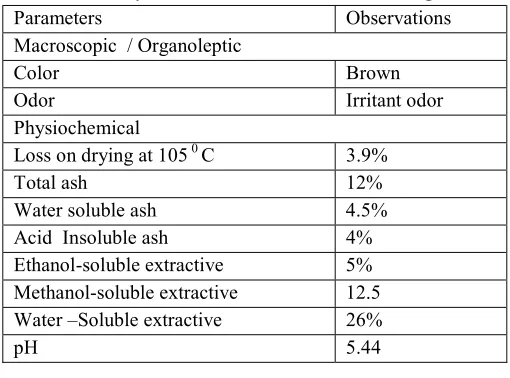
Table 2: Analytical observations of Paravatadi Agada
Parameters Observations
Macroscopic / Organoleptic
Color Brown
Odor Irritant odor
Physiochemical
Loss on drying at 105 0 C 3.9%
Total ash 12%
Water soluble ash 4.5%
Acid Insoluble ash 4%
Ethanol-soluble extractive 5%
Methanol-soluble extractive 12.5
Water –Soluble extractive 26%
IAMJ: Volume 7, Issue 2, February - 2019 (www.iamj.in) Page 175
Fig. 1: HPLC of Paravatadi Agada
Fig. 2: HPLC of Paravatadi Shakruta
DISCUSSION
Paravatadi Agad is one among such formulations mentioned in Ashtanga Sangraha. Therefore to stan-dardize this formulation present study has been con-ducted which includes physico-chemical and phyto-chemical analysis of Paravatadi Agad.
All ingredients of Paravatadi Agada were authenti-cated after procurement and then utilized for
Paravatadi Agada preparation. As the quantity of in-gredients is not mentioned in reference, all inin-gredients were taken in equal quantity according to principle of
Anukta mana grahan. Bhavana of Bijapuraka nimbu
was given by using edge runner as it facilitate for uni-form grinding with uniuni-form force and pressure. Both force and pressure are important for friction and ho-mogenous mixing of constitutes of ingredients. More-over using modern instrument for Bhavana facilitates
large scale production in future use. Obtained quantity of Paravatadi Agada is slightly higher than total weight of ingredients due to addition of few constitut-ed from Bijapuraka Swarasa Bhavana.
The residue remaining left after incineration of the crude drug is designated as ash. The residue obtained usually represents the inorganic salts naturally occur-ring in the drug and adheoccur-ring to it. It varies with in definite limits according to the soils. It may also in-clude inorganic matter deliberately added for the pur-pose of adulteration. Hence, an ash value determina-tion furnishes the basis for judging the identity and cleanliness of any drug and gives information relative to its adulteration/contamination with inorganic mat-ter, thus ash values are helpful in determining the quality and purity of drug. The total ash of a crude drug also reflects the care taken in its preparation. The acid insoluble ash is a part of the total ash that is in-soluble in dilute hydrochloric acid. A higher limit of acid-insoluble ash is imposed, especially in cases where silica may be present or when the calcium oxa-late content of the drug is higher. Total ash values of
Shunthi, Tagar and Haritaki are observed within limit prescribed in API. However such limit is not men-tioned for Paravatadi Shakrut and the observed total ash value of this sample is considered as standard.
Paravatadi Shakrut is an organic material which con-tain few minerals hence its total ash is higher than herbal drugs. The same reason is applicable to total ash value of Paravatadi agad as it contain Paravatadi Shakrut as a main ingredient.
Loss on drying at 105oC indicates presence of mois-ture content. If moismois-ture content is more than permis-sible limit then the formulation is more likely to get infected by fungal growth. Moreover unwanted changes can also occur due to presence of more mois-ture. In the prepared batches moisture content is much less i.e. this formulation has more stability. All sam-ples showed loss on drying values within standard limit which indicates all samples were authentic. Acid insoluble ash represents presence of inorganic content which is not expected in herbal formulation. The obtained value of Acid insoluble ash in all the batches is also within considerable range which
con-0.0 2.5 5.0 7.5 10.012.515.017.520.022.525.027.530.032.535.037.540.042.545.047.550.052.555.057.560.062.565.067.5 min -15 -10 -5 0 5 10 15 20 25 30 35 40 45 50 55 60 65 70 75 80 85 90 95 100 105 110mAU255nm4nm (1.00)
1 /2 .1 7 9 /1 9 9 2 /4 .7 09 /2 5 5 3 /6 .9 7 4 /2 5 0 4 /1 5.7 4 7 /2 7 2 5 /1 6 .7 8 4 /2 8 1 6/1 8 .9 76 /2 1 4 7/2 0 .1 65 /2 0 2 8 /2 2 .5 0 2/2 0 0 9 /2 3 .7 6 5/2 0 0 10 /2 5 .3 8 7 /2 00 11 /2 6 .8 7 3 /2 0 0 1 2 /2 7 .7 7 5 /2 00 1 3 /2 8 .1 6 2 /2 0 0 1 4/2 9 .6 43 /2 0 0 1 5 /3 1 .4 6 6/2 0 0 16 /3 2 .5 0 1 /2 00 1 7/3 4 .5 10 /2 0 0 1 8 /3 5 .7 8 1/2 0 0 1 9 /3 6 .3 0 0/2 0 0 2 0 /3 7 .0 5 2/2 0 0 21 /3 7 .5 3 7 /2 0 0 2 2 /3 9 .4 9 8 /2 0 0 23 /4 4 .7 8 4 /2 0 2 2 4 /4 6 .8 2 0/2 0 1 2 5 /5 1 .7 2 3/1 9 4 26 /5 2 .3 3 9 /1 96 2 7 /5 5 .4 2 9 /2 0 1 28 /5 7 .9 4 7 /2 0 1 2 9 /5 8 .8 9 1/2 0 1 3 0 /6 0.7 2 4 /2 0 1
0.0 2.55.0 7.510.012.515.017.520.022.525.027.530.032.535.037.540.042.545.047.550.052.555.057.560.062.565.067.5 min -40 -30 -20 -10 0 10 20 30 40 50 60 70 80 90 100 110 120 130 140 150 160 170 180 190 200 210 220 230 240 250 260mAU255nm4nm (1.00)
1 /0 .8 7 2 /1 9 7 2 /1 .9 2 0 /3 0 0 3 /2 3 .6 4 2/ 4 86 4 /3 0.4 5 6/ 253 5 /3 5.6 6 8/ 486 6 /3 6 .9 1 4/ 6 55 7/3 8 .8 56/ 6 55 8 /4 0 .9 0 3/ 6
55 9/44.71
IAMJ: Volume 7, Issue 2, February - 2019 (www.iamj.in) Page 176
firms the raw materials were standard. The physical parameter such as pH was determined to determine basic nature of sample as more or less value of pH is responsible for irritation of skin. Paravatadi shakruta
has maximum pH value i.e. 7.13 which is basic in na-ture. Paravatadi Agada is the final product and its pH value matters most. Observed pH of Paravatadi Agada is 5.44 which is acceptable for its therapeutic utilization.
As all the batches were prepared by taking required hygienic care and utilizing sterilized instruments, thus result of microbial content study showed absence of Enterobacteriaceae, fungus count, E-coli, Salmonella,
Staphyliococus aureus and Psudomonas aueruginosa. The pharmaceutical standards for Paravatadi Agada
are not available hence the analytical results of present study may prove exposure towards establishing ana-lytical standards for Paravatadi Agada.
In HPTLC analysis, after comparative studies per-formed for Paravatadi-agada and Paravat-shakrut, different chemical composition and nature of active principles were observed. Initially, the separation was carried out for Paravatadi-shakrut including TFA as mobile phase additives. It was displayed that most of its constituents were eluted with the solvent front, fol-lowed by emerge of small peak. This small peak could be the acid strength or very polar fraction of Paravat-shakrut. Furthermore, very small fragments were ob-served upto retention time 40 minutes. It represents very minute quantity of basic nitrogenous compounds as well as polyphenols like antioxidants present in the sample of Paravat-shakrut. Between 40 to 60 minutes run time many fraction were resolved. Presumably, all these fragments might be the neutral polar steroids or alternatively hydrophobic steroids which get metabo-lized into polar fragments by conjugation with polar fragments. Above all, except acid and polar steroidal constituents, no other ionic and phenolic molecules were detected.
Subsequently, keeping the same separation parame-ters, the fresh sample of Paravatadi-agada was ana-lyzed (Fig. 1). Similar to the Paravatadi-shukrut, first initial peak represents the un-adsorbed fragments in C18 column (Fig. 2). Surprisingly, no acid compound
was detected in Paravatadi-agada. Importantly, com-pared with Paravatadi-shakrut, one fraction of basic ionizable constituents was detected and its concentra-tion was maximum among all separated fracconcentra-tions. This basic compound was followed with many other polyphenols; however, their concentration is quite low. Even they were not resolved properly and their peak shapes were observed to be erratic and irrepro-ducible.
In spite of these, collectively, the chemical composi-tion of Paravatadi-Agada is quite different than that of Paravatadi-Shakrut and hence they might have dif-ferent biological activities on human body.
CONCLUSION
Authentication of raw drugs and standard preparation of Paravatadi Agada is most important as it is indicat-ed scorpion bite which is sever condition, however standard parameters for Paravat Shakrut are not found established. Hence the analytical result of Paravatadi Shakrut obtained in this study can be considered for future research. Paravatadi Agada prepared by fol-lowing standard operating procedure should have Loss on drying at 105 0 C, Total ash, Water Insoluble ash, Acid insoluble ash, Ethanol-soluble extractive, Meth-anol-soluble extractive, Water –Soluble extractive and pH value 3.9%, 12%, 4.5%, 4%, 5%, 12.5, 26% and 5.44 respectively. Present study has established ana-lytical specification of Paravatadi Agada and filled a gap between ancient and modern knowledge of
Paravatadi Agada. However to access the efficacy of this formulation, experimental studies on vivo, in-vitro and clinical grounds are necessary.
REFERENCES
1. Bawaskar HS and Bawaskar PH. Peripheral doctors
form backbone for management of acute life threaten-ing medical emergency evoked due to envenomthreaten-ing by Indian Red scorpion: Mesobuthus tamulus. Bombay Hospital Journal 1997; 39:71014.
2. Bawaskar HS and Bawaskar PH. Scorpion sting :
IAMJ: Volume 7, Issue 2, February - 2019 (www.iamj.in) Page 177 3. Bawaskar HS. Diagnostic cardiac premonitory sings
and symptoms of red scorpion sting Lancet 1982; ii: 552-54.
4. Brmhanad Tripathi, Vaghbhat, Ashtang Hrudaym,
Chaukhamba Sanskrit Pratishthan, Uttartantra 37/34, page no.1169.
5. Anonymous, The Ayurvedic Pharmacopoeia of India,
Central Council for Research in Ayurveda and Siddha, New Delhi, Appendix 2, p-143.
6. Anonymous, The Ayurvedic Pharmacopoeia of India,
Central Council for Research in Ayurveda and Siddha, New Delhi, Appendix 2, p-143.
7. Anonymous, The Ayurvedic Pharmacopoeia of India,
Central Council for Research in Ayurveda and Siddha, New Delhi, Appendix 2, p-191.
8. Anonymous, The Ayurvedic Pharmacopoeia of India,
Central Council for Research in Ayurveda and Siddha, New Delhi, Appendix 2, p-141.
9. Anonymous, The Ayurvedic Pharmacopoeia of India,
Central Council for Research in Ayurveda and Siddha, New Delhi, Appendix 2, p-141.
Source of Support: Nil
Conflict Of Interest: None Declared
How to cite this URL: Chaitanya R. Baraskar et al: Study Of Paravatadi Agad With Special Reference To Its Analytical Study. International Ayurvedic Medical Journal {online} 2019
{cited February, 2019} Available from: