University of New Orleans University of New Orleans
ScholarWorks@UNO
ScholarWorks@UNO
University of New Orleans Theses and
Dissertations Dissertations and Theses
8-8-2007
Automating Regression Test Selection for Web Services
Automating Regression Test Selection for Web Services
Michael Edward RuthUniversity of New Orleans
Follow this and additional works at: https://scholarworks.uno.edu/td
Recommended Citation Recommended Citation
Ruth, Michael Edward, "Automating Regression Test Selection for Web Services" (2007). University of New Orleans Theses and Dissertations. 587.
https://scholarworks.uno.edu/td/587
This Dissertation is protected by copyright and/or related rights. It has been brought to you by ScholarWorks@UNO with permission from the rights-holder(s). You are free to use this Dissertation in any way that is permitted by the copyright and related rights legislation that applies to your use. For other uses you need to obtain permission from the rights-holder(s) directly, unless additional rights are indicated by a Creative Commons license in the record and/ or on the work itself.
Automating Regression Test Selection for Web Services
A Dissertation
Submitted to the Graduate Faculty of the University of New Orleans in partial fulfillment of the requirements for the degree of
Doctor of Philosophy In
Engineering and Applied Science
By Michael Ruth
Copyright 2007, Michael Edward Ruth ii
This dissertation is dedicated to Rebecca, my family, and friends.
Acknowledgement
I would like to thank Dr. Shengru Tu, my advisor, for providing me with the guidance needed to see this research project through to its completion.
I would also like to thank Dr. Vassil Roussev, Dr. Nauman Chaudhry, Dr. Huimin Chen, and Dr. Mahdi Abdelguerfi for being a part of my dissertation committee.
I would also like to show my appreciation for the assistance of Feng Lin, Sehun Oh, Adam Loup, Olin Gallet, Brian Horton, and Marcel Mata.
I would also like to thank Rebecca, my wife, without whom I would still be wearing white socks with dress pants.
Also, my friends have my gratitude for helping me through both good times and bad, and allowing me to disappear for long periods of time to work on my dissertation.
Lastly, and most importantly, I would like to thank each and every member of my family for their support and understanding throughout.
Table of Contents
List of Figures ... vii
List of Tables ... ix
Abstract...x
Chapter 1: Introduction...1
1.1 General Introduction ...1
1.2 An Ideal Regression Test Selection Technique for Web Services ...2
1.3 Main Contributions ...4
1.4 Organization...8
Chapter 2: Background ...10
2.1 Web Services ...10
2.2 Software Testing, Types, and Levels...13
2.3 Regression Testing and Regression Test Selection ...16
2.4 Survey of Regression Test Selection Approaches ...19
2.5 Selected Regression Test Selection Approach...23
Chapter 3: Survey of Related Material ...30
3.1 Test Case Generation and Automated Test Execution ...30
3.2 Other Mediums to Support the Interoperability of Web Services ...33
3.3 Regression Test Selection Techniques for Web-based Systems...39
Chapter 4: Safe Regression Test Selection Approach for Web Services...48
4.1 Introduction...48
4.2 Initialization Phase...49
4.2.1 Simple Operation Initialization...50
4.2.2 Composite Operation Initialization...52
4.2.2.1 Composite Control-Flow Graph Construction...54
4.2.2.2 Composite Test Case Construction...61
4.2.2.3 Composite Coverage Information Construction ...62
4.3 Critical Phase ...63
Chapter 5: Automation of the Regression Test Selection Approach ...65
5.1 Approaches to Automate Regression Test Selection for Web Services ...65
5.2 Concurrency Challenges ...66
5.2.1 Coverage Conflict ...66
5.2.2 Test Consistency ...69
5.2.3 Communication Issues...70
5.3 Solutions in the Form of Agents ...70
5.4 Eventual Test Consistency Agent ...71
5.4.1 Data Structures and Methods ...71
5.4.2 Agent Operation...75
5.4.3 Correctness of the Agent Algorithms ...78
Chapter 6: Empirical Study of Proposed Regression Test Selection Technique ...86
6.1: Introduction...86
6.2: Purchase Order System...89
6.3: Loan Application System...93
6.4: Loan Brokerage System...96
6.5: Supply Chain Management System...99
6.6: Supply Chain Management System (revisited) ...102
6.7: Results of Empirical Study ...104
Chapter 7: Conclusion and Future Work ...109
References...112
Vita...117
List of Figures
Figure 2.1: Conceptual Web services stack ...11
Figure 2.2: Psuedocode for an ordering service...24
Figure 2.3: Control-flow graph for the psuedocode in Figure 2.2...25
Figure 2.4: Altered psuedocode for ordering service from Figure 2.2 ...26
Figure 2.5: CFGs for the psuedocode in Figure 2.2 (a) and Figure 2.4 (b) ...27
Figure 2.6: Three test cases and their coverage information for service A ...28
Figure 4.1: Terminal control-flow graph of B ...51
Figure 4.2: A call graph of a system ...53
Figure 4.3: Class diagram of “glue code” generated using Apache Axis...55
Figure 4.4: Client code using Axis “glue code” ...56
Figure 4.5: Non-terminal control-flow graph for A...57
Figure 4.6: Terminal control-flow graph for A...60
Figure 5.1: Tester.Test operation ...73
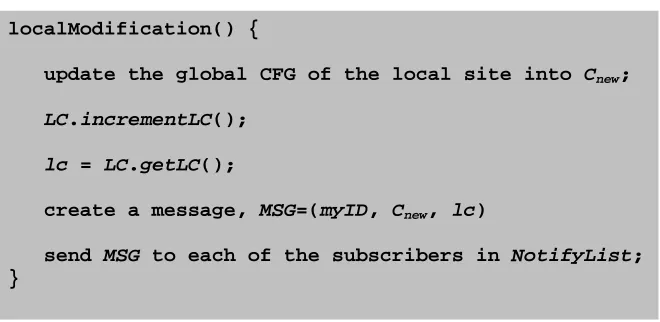
Figure 5.2: Agent localModification() operation...75
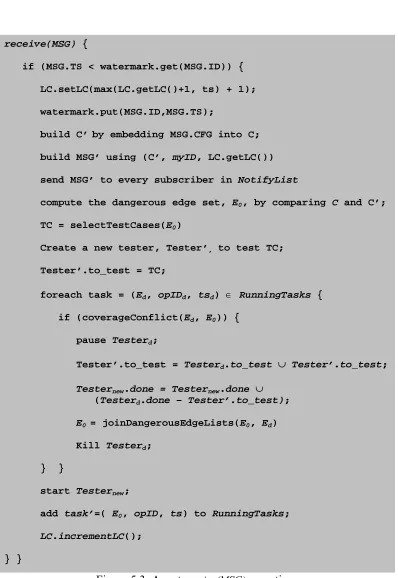
Figure 5.3: Agent receive(MSG) operation...77
Figure 6.1: A modified UML diagram of the purchase order system...90
Figure 6.2: Control-flow graph of hardware (a) and office supply (b) service...91
Figure 6.3: Control-flow graph of software service...92
Figure 6.4: Control-flow graph of composite purchase order service ...93
Figure 6.5: UML class diagram of loan application system ...94
Figure 6.6: Call graph of loan application system ...95
Figure 6.7: UML class diagram of loan brokerage system...97
Figure 6.8: Call graph of loan brokerage system...98
Figure 6.9: UML class diagram of supply chain management system...100
Figure 6.10: Call graph of supply chain management system ...101
Figure 6.11: UML class diagram of second supply chain management system...103
Figure 6.12: Call graph of Second Supply Chain Management System...103
Figure 6.13: Results of purchase order system ...105
Figure 6.14: Results of loan application system ...105
Figure 6.15: Results of loan brokerage system...106
Figure 6.16: Results of supply chain management system 1 ...106
Figure 6.17: Results of supply chain management system 2 ...107
List of Tables
Table 3.1: Regression test selection approaches comparison ...46
Table 6.1: Loan application system totals...96
Table 6.2: Loan brokerage system totals ...99
Table 6.3: Supply chain management system totals ...102
Table 6.4: Second supply chain management system totals ...104
Table 6.5: Aggregate totals for all systems...107
Abstract
As Web services grow in maturity and use, so do the methods which are being used to test and maintain them. Regression Testing is a major component of most major testing systems but has only begun to be applied to Web services. The majority of the tools and techniques applying regression test to Web services are focused on test-case generation, thus ignoring the potential savings of regression test selection. Regression test selection optimizes the regression testing process by selecting a subset of all tests, while still maintaining some level of confidence about the system performing no worse than the unmodified system. A safe regression test selection technique implies that after selection, the level of confidence is as high as it would be if no tests were removed. Since safe regression test selection techniques generally involve code-based (white-box) testing, they cannot be directly applied to Web services due to their loosely-coupled, standards-based, and distributed nature. A framework which automates both the regression test selection and regression testing processes for Web services in a decentralized, end-to-end manner is proposed. As part of this approach, special consideration is given to the concurrency issues which may occur in an autonomous and decentralized system. The resulting synchronization method will be presented along with a set of algorithms which manage the regression testing and regression test selection processes throughout the system. A set of empirical results demonstrate the feasibility and benefit of the approach.
Keywords: Regression Testing, Regression Test Selection, Safe Regression Test Selection, Web services, Concurrency, Coverage Conflict, Test Inconsistency
Chapter 1: Introduction
1.1 General Introduction
Web services have enabled business workflows to be extended beyond the boundaries of companies and organizations. A single business process can be realized by utilizing possibly many different Web services either directly or indirectly in workflows which may flow internally or externally in/out of the enterprise. Since the business world often involves very rapid change to keep up with current market conditions, the business processes inevitably need frequent adjustment, along with their supporting Web services. These rapid adjustments, or modifications, must also be supported by rapid verification in order to provide a desired level of quality assurance. Every time the system is modified, we must ensure that the modification does not have an adverse affect on any unmodified areas, or regions, of code (the modification does not introduce new problems into the code). Typically, this is done by running the test cases previously used to test the system prior to modification again. This processing of “retesting” is called regression testing and its goal is to determine whether or not the system has been made worse by the modification.
One of the key ideas associated with regression testing is to reduce the number of tests which has to be rerun to ensure that the system performs no worse than it did before the modification with some level of confidence. Reducing the number of tests to be rerun is called regression test selection. The need for regression test selection has been well established for traditional software systems [1]. Furthermore, a safe regression test selection technique which ensures that the level of confidence provided by the selection
mechanism is no worse than not removing any test cases, preventing any potentially modification-revealing and thus possibly fault-revealing, test cases from being left unselected in the regression test selection process.
Although there are several safe regression test selection techniques which have been proven effective for traditional software applications [2], there has been very little work on safe regression test selection for verifying Web service systems. This is a cause for concern especially considering that regression testing Web services can be much more costly than doing so for traditional software (all calls must be marshaled in and out of SOAP and sent over a network).
1.2 An Ideal Regression Test Selection Technique for Web Services
An ideal regression test selection technique for the verification of Web service systems would have the following properties: 1) safe, 2) interoperable, 3) composable, 4) decentralized, 5) end-to-end, and 6) automated. Hardly any safe regression test selection techniques are available for Web services because safe regression test selection techniques involve code-based, or white-box, testing which is unlikely for a number of reasons. There can be service interactions in which two or more of the services interacted are in different languages on different platforms or service providers who can never be counted on to share their source code due to copyright and other legal concerns.
Interoperability, or the ability of services to interact with other services which are in different languages on different platforms, was the catalyst for the sudden popularity of Web services. However, this particular benefit of Web services is a detriment to safe
regression techniques which require knowledge of the implementation of a system in order to ensure the safety of the technique.
Web services may be composed to form more complex services and this particular feature also presents a set of challenges. Since the explicit goal of regression testing is to ensure that a modification somewhere does not affect the system somewhere else it is important to know how the services are related to one another. Long call chains could exist and a modification in one subsystem may require testing in several other subsystems. If an entity is modified everything that depends on that entity must also be tested. It is important that testing occur at each and every end point along the way to ensure that all the dependencies of all modifications are tested. This is end-to-end testing and it gets its name because it tests from the point of view of every end point along the way. To facilitate this type of testing through composite services the regression testing and regression test selection technique must be as composable as the underlying services.
The autonomy and distributed nature of the Web services themselves, requires that the regression test selection and regression testing processes be decentralized because some service providers may wish to retain a desired level of control over the information they share. In general, not all services in an interaction will be developed by the same group and there may be interactions in which no central authority dictating the rules of engagement. This means that some service providers will be reluctant to provide any details of their service and cannot be forced to do so. In order to alleviate their concerns thus increase the likelihood of participation of more providers, the information which must be shared must be carefully considered. Therefore, a decentralized solution
which carefully considers what information must be shared and how this information should be protected is essential.
Finally, the regression testing and regression test selection processes which by definition must be repeatedly run should be automated to ensure timely feedback for all modifications. Automating the regression testing and regression test selection processes also ensures that no modification is left untested. If every modification in the system is not tested automatically, a careless operator could forget to test a modification which could lead to serious verification issues later on. However, if the processes are automated this problem is alleviated.
1.3 Main Contributions
The main contributions of my work are threefold: First, a new safe regression test selection technique was developed for the verification of Web services in an end-to-end manner. Second, a new framework was devised to monitor and synchronize the distributed modifications in order to automate the regression test selection and regressing testing processes. Third, the concurrency challenges which present themselves in a decentralized, automated framework for performing regression test selection and regression testing were recognized and a set of solutions in the form of algorithms for agents to follow to handle the synchronization issues. In addition, I have established a basis for experimental studies by providing a collection of Web services systems, the lack of which has hindered healthy comparison studies of regression testing and regression test selection research.
In this dissertation, an approach to perform safe regression test selection in an end-to-end manner for the verification of both intra- and inter-enterprise Web services is proposed. The approach is based on a safe regression test selection technique developed by Rothermel and Harrold for monolithic applications using control flow graphs [1]. The proposed approach successfully ensures that safety is maintained by carefully ensuring the transitions from the model do not affect the safety of the proposed approach.
A control-flow graph-based approach is ideal for performing safe regression test selection for Web services because control-flow graphs are an ideal medium for addressing the interoperability and composability concerns. Control-flow graphs can be generated from any program written in any modern programming language, especially those used to develop Web services and since control-flow graphs are a special case of finite state machines, they can be composed. Control-flow graphs are interoperable because if two control-flow graphs were generated for two systems each built on different platforms and in different languages the two control-flow graphs could be composed.
The proposed approach particularly observes the autonomous, decentralized nature of Web service systems. The approach only requires three elements from each participant: Control-flow graphs of each the operations the service provides, test cases for those flow graphs, and coverage information which maps the provided control-flow graphs to the provided test cases. Each of the participants will maintain control over the granularity of the control-flow graphs they provide which can vary from very detailed (statement level) to very abstract, depending on the need for security (someone who does not wish to share information will only share a operation level control-flow graph, whereas within an enterprise everyone can share statement level control-flow graphs). In
order to ensure higher levels of participation, the source code is shielded from the tester using hashes of the code. This allows the tester to determine if the underlying code was modified without being able to determine where or how the code was modified. These tactics to attract more independent participants is a novel approach in regression test selection.
This approach is designed to be automated by using a set of distributed agents, one each for every service and application in the system, which interact together to automatically perform both the regression testing and regression test selection processes over the entire enterprise. These agents perform their work by monitoring, exchanging, and updating the control-flow graphs of the participants in a publish-subscribe method. This allows this automated system to perform end-to-end testing because if any of the participating services are modified, each and every service or application which calls this service either directly or indirectly will be notified.
Automating the proposed approach presents an entirely new set of issues. More specifically, issues related to concurrent modifications become increasingly important. These issues are: 1) coverage conflict, 2) test inconsistency, and 3) communication issues. Coverage conflict issues arise from the manner in which the regression test selection technique is performed. More specifically, it is possible for one modification to conflict with another because of its location. Test consistency is related to the test cases having a consistent view of the system under test which implies that the system under test seen at the beginning of all the tests is the same system seen at the end of all the tests. These issues were carefully considered, recognized, and solved by synchronizing the modifications.
Since there was no preexisting benchmark for comparing regression test selection techniques for the verification of Web services, a group of systems was developed to perform an empirical study of the proposed approach. The benchmark was used to compare the proposed safe regression test selection technique with the select-all regression test selection technique. The select-all regression test selection technique is the technique in which the selection step is skipped and all tests are run every time. In order to be effective, a regression test selection technique must perform better than the select-all technique which means that the cost of performing the technique and executing the selected test cases must be less than executing all test cases without performing the selection step. The empirical study demonstrates that the proposed technique is feasible and can be effective. Also, observing the lack of a common benchmark for comparison studies of regression test selection techniques, this collection of systems can be a promising seed of future regression test selection benchmark models.
In summary, the proposed approach is unique in that it is the first safe regression test selection technique for the verification of Web service-based frameworks which is automated, decentralized, and end-to-end which manages the interoperability and composability of Web service frameworks. This approach is also novel because it is the first approach to use techniques to increase participation through information hiding. Also, the issues related to concurrent modifications were carefully considered and recognized for the first time. Lastly, a novel benchmark for comparing regression test selection techniques was developed and the first empirical study was performed on a regression test selection technique for the verification of Web services. The results of
this empirical study were used to demonstrate that the proposed approach is feasible and can be effective in reducing the cost of performing regression testing.
1.4 Organization
The rest of the dissertation will be organized as follows: In chapter 2, the background information regarding Web services, regression testing, regression test selection, and control-flow based regression test selection techniques will be discussed in detail. Chapter 3 will provide a survey of related literature including topics such as: test case generation frameworks, automated test execution frameworks, mediums used to bridge disparate services, and a variety of regression test selection frameworks for Web services. In chapter 4, the approach to perform regression test selection for the verification of Web service-based frameworks will be discussed in terms of construction of the three elements (control-flow graph, test cases, and coverage information) for the entire system and in terms of how the framework operates once constructed. The material was published at the International Conference on Internet Applications and Web Services (ICIW) in 2007 under the title “A Safe Regression Test Selection Technique for Web Services”. Chapter 5 will discuss the automation of the approach, the concurrency issues, and their solutions. The material is based on a recent paper, “Towards Automating Regression Test Selection for Web Services” which was accepted for publication at the Testing Emerging Software Technology (TEST) Workshop which was held in conjunction with IEEE Computer and Software Applications Conference (COMPSAC) 2007. The empirical study will be presented in chapter 6 including descriptions of the experiments, descriptions of the five systems developed for this
purpose, and the results of the empirical study. Finally, chapter 7 will conclude and provide avenues for future work on this subject.
Chapter 2: Background
In this chapter, an introduction to Web services, along with background information on regression testing techniques including safe regression test selection techniques, will be provided in detail.
2.1 Web Services
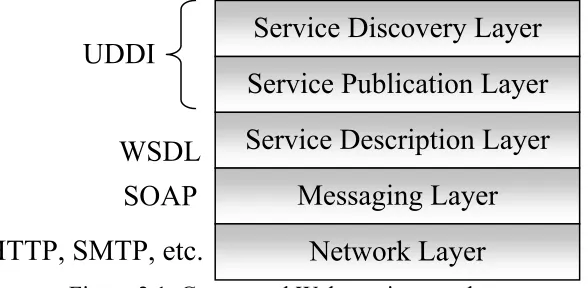
Broadly, Web services refer to self-contained web applications that are loosely coupled, distributed, capable of performing business activities, and possessing the ability to engage other web applications in order to complete higher-order business transactions, all programmatically accessible through standard internet protocols, such as HTTP (Hypertext Transport Protocol), JMS (Java Messaging Service), SMTP (Simple Mail Transfer Protocol), etc [3]. More specifically, Web services are Web applications built using a stack of emerging standards that form a service-oriented application architecture (SOA), an architectural style whose goal is to achieve loose coupling among interacting software components through the use of simple, well defined interfaces. In [3], a stack of emerging standards on which Web services are built were described. Figure 2.1 shows a conceptual overview of the Web Services stack.
Extensible Markup Language (XML) provides the basis for most of the standards that Web services are based on. XML is a standard that has been developed by the World Wide Web Consortium (W3C) [4]. XML is a text-based meta-language for describing data which is extensible and therefore used to define additional markup languages. The mechanism with which a markup language is defined in XML is termed a schema
definition. A schema definition is a set of rules that define the structure and content of an XML document. Since XML is text-based and extensible, it provides the standard on which other standards are built in the realm of Web services.
Figure 2.1: Conceptual Web services stack
Service Description Layer
Messaging Layer
Network Layer
Service Publication Layer
Service Discovery Layer
UDDI
SOAP
WSDL
HTTP, SMTP, etc.
The lowest layer of the Web services stack, the network layer, is defined since a Web service has to be network accessible in order to be invoked by its clients. Although Web services are typically thought of as operating over HTTP, they are also capable of operating over many different types of transport layers, such as HTTPS (Secure HTTP), JMS, and even SMTP, providing a great deal of flexibility to application developers. Although, just about any internet traversable transport layer can be used underneath Web services, HTTP is by far the most commonly used Web service transport.
The next logical layer in the stack is the messaging layer, and its related standard is SOAP [5]. SOAP defines a common message format for all Web services. SOAP is designed to be a lightweight protocol for information interchange among disparate systems in a distributed environment. The actual format consists of an envelope which define the contents of the messages and how to process those contents. In the envelope there are a number of standard headers, and a body. SOAP is entirely encoded in XML.
The minimum requirements of a service provider or consumer of Web services are to be able to build, process, and send (over the network layer) these SOAP messages.
The layer above the messaging layer is the description layer. Its specification is defined by the Web Service Definition Language (WSDL) [6]. It provides a mechanism for describing Web services in a standard way. The description provides an interface for using the Web services, in terms of available operations, their names, parameters and return types. The description binds a service, termed abstract endpoints in the specification, to concrete endpoints, which is a description of the service defined abstractly then bound to a concrete network protocol and message format. This description is represented using XML as well. This layer is the key element that gives Web services their loose coupling and allows for a new level of interoperability, platform and language neutrality [3].
The highest layer of the protocol stack is the discovery layer. It is modeled by the Universal Description, Discovery and Integration (UDDI) [7] specification. UDDI provides a means to locate and use Web Services programmatically. Service providers publish high level descriptions of their Web services into a UDDI repository, with which their services can be looked up and used. When an application wants to use a service published in the repository it downloads what the application needs to connect to and consume the Web services it found in the repository. These standards have addressed the connectivity, messaging, description, and discovery issues for Web services, providing the simple, well-defined interfaces required for the loosely coupled, interoperable building blocks known as Web services.
2.2 Software Testing, Types, and Levels
Software testing in general is the process of executing a given program P in an attempt to reveal possible failures in the program [8]. A test case is a set of inputs for P along with the expected output of program P when given said inputs. A test suite is a set of test cases, and a test run is the execution of P with respect to some test suite T. The adequacy of each test suite is normally determined by the level of coverage (normally a percentage) that the test suite covers the possible executions of P.
There are two basic types of software testing: Black-box testing and White-box testing [9]. The two types depend on the point of view of the tester when developing test cases. Black-box testing takes an external perspective of the test object to derive test cases, while white-box testing uses an internal perspective of the system. In black-box testing, the test designer selects valid and invalid input and determines the correct output using no knowledge of the test object's internal structure. While this method can uncover unimplemented parts of the specification, one cannot be sure that all existent paths are tested. White-box testing requires programming skills to identify all paths through the software. The tester would then choose test case inputs to exercise paths through the code and determine the appropriate outputs. Since the tests are based on the actual implementation, if the implementation is modified the tests will also need to be modified. Though this method can uncover an overwhelming number of test cases, it might not detect unimplemented parts of the specification or missing requirements. However, using white-box testing one can be sure that every path is exercised. The focus of this work is on using white-box testing largely because when the system is being regression tested, the system has usually been completely implemented.
There are several levels of testing, which refer to the level, or view, of the system being tested [8]. The level of the system under test refers to how the parts of the system are grouped together for testing, such as individually, or the entire system as a whole. The levels which will be discussed are as follows: unit, integration, system, scenario testing (also known as use-case testing), and end-to-end testing. Unit testing is a procedure used to validate that individual units of source code are working properly. A unit is the smallest testable part of an application. The goal of unit testing is to isolate each part of the program and show that the individual parts are correct. A unit test provides a strict, written contract that the piece of code must satisfy. As a result, it affords several benefits including: facilitating changes (making it easier to test modifications) and simplifying integration (helps to eliminate uncertainty in the units themselves, making bottom-up approaches simpler). However, unit testing will not catch every error in the program, since by definition it only tests the functionality of the units themselves. Thus, unit testing is only effective if it is used in conjunction with the other testing levels. In Web services testing, the smallest testable part of the system is testing each service independently of other services. If the service is a composite service, stub implementations would normally be used in the place of the composed services.
The next level of testing is integration testing in which individual software modules are combined and tested as a group. The purpose of integration testing is to verify functional, performance and reliability requirements placed on major design items. The general idea is a "building block" approach, in which verified assemblages are added to a verified base which is then used to support the integration testing of further assemblages. There are several different types of integration testing, but only the most
common two will be discussed, which are: big-bang and bottom-up. The big-bang approach is when all or most of the developed modules are coupled together to form a complete software system or major part of the system and then used for integration testing. This approach has one major benefit which is that it takes less time to design and test if everything goes well. However, if everything does not go well it may be harder to pinpoint those problems. This approach is most often used when the system was developed before the need for integration testing. In the bottom-up approach, all the bottom or low level modules, procedures or functions are integrated and then tested. After the integration testing of lower level integrated modules, the next level of modules will be formed and can be used for integration testing. This is the more common of the two approaches and is normally applied when the system was developed with testing in mind. However, this approach requires all or most of the software to be completed before testing can begin. The major issue with integration testing is that any conditions not stated in specified integration tests, outside of the confirmation of the execution of design items, will generally not be tested and integration tests can not include system-wide modification testing. In Web services testing, this implies that the composed systems are tested in terms of their interactions with other services. If the service is a composite service, the composed services would be called rather than using stubs.
The next level of testing, system testing occurs when the system is integrated together to form the entire system. One can think of this as the final stage of integration testing with the exception that the system is not just being tested to determine if the parts work together correctly, but also whether or not the system works as a whole. The goal of system testing is not only to determine whether or not the components play well
together, but also that the components work together to complete some goal. This implies that system testing is determining whether or not the functional requirements are met. It also determines whether or not the system meets its non-functional requirements as well, such as response times, etc. Testing the functional requirements of the system involves testing the system as it would actually be used, normally using either use-cases (black-box) or white-box approaches. This implies end-to-end testing, which simply means that the system end-points are being tested, using the actual components and control flows through the application from one end (the user) to the other (which completes the work). Scenario testing [10], a variation of system testing, uses the black-box approach which entails using design elements, such as use cases, to system test the application. In the realm of Web services, system testing refers to the testing of the services as they would be used by the various applications and services. This is precisely the testing level and approach which will be the focus of this work.
2.3 Regression Testing and Regression Test Selection
Regression testing is the process of validating modified software to provide confidence that the changed parts of the software behave as intended and that the unchanged parts have not been adversely affected by the modification [1]. Suppose there is program P, its modified version P’, and a test suite T. Suppose also that after testing program P has a total of X faults. After modifying P, resulting in P’, those same tests in T must be rerun on P’ to determine what effect the modifications had on P. In other words, the goal is to determine whether or not the system is made worse in terms of having not more than X faults. It is provably impossible to determine whether or not one
could make the system better even if the system determines that fewer than X faults were the result of the modification.
There are five basic problems associated with regression testing: 1) Test case revalidation problem; 2) Regression test selection problem; 3) Test suite execution problem; 4) Coverage identification problem; 5) Test suite maintenance problem. This section will briefly cover all of the problems in some detail, but this work is focused on solving the regression test selection problem in the realm of Web services, and therefore will only discuss the regression test selection problem in full detail.
The test case revalidation problem is focused on maintaining test suite T. Any framework attempting to solve this problem would be trying to identify and remove obsolete test cases from T when the specification of P is modified. Test cases become obsolete when the test case no longer corresponds to a part of the system. Suppose that there is a system S, which has feature F, and at some point later in time the developers of S remove feature F. A framework which solved this problem would be able to identify that the tests which cover the old, but removed, feature F are no longer. Although technically, regression test selection and execution are next on the list, they will be skipped for the time being so the other problems can be discussed first.
The coverage identification problem is also focused on maintaining the test suite T, but it is the opposite of the revalidation problem. Any framework attempting to solve it would be trying to identify when new test cases are necessary, and when they are it would create them. Supposing there is a system S, and we create feature F for it. A framework which solved this problem would be able to determine that there is a new feature F and create test cases for the new feature.
The next problem focuses on maintaining the test suite, but at the overall test suite level rather than adding or removing groups of test cases. This particular problem is more of a combination of problems rather than its own problem on its own. Specifically, the test suite maintenance problem takes the result of the revalidation problem solution (a set of test cases to remove), the result of the coverage identification problem solution (a set of test cases to add), and the old test suite and amalgamate them together to form a new test case suite for P’.
The test suite execution problem is focused on actually performing the tests in the test suite. There are solutions to this in the Web services world, and they will be discussed in the related works section. The goal of anyone solving this problem is to test P’ with T’ in order to establish the correctness of P’ with respect to T’. A basic solution to this problem must be solved in order to attempt to solve the regression test selection and show how effective regression test selection can be, so a solution to this will be provided at least basically in the sections detailing implementations.
Finally, the focus of this work will be discussed, which is the regression test selection problem. As mentioned earlier, regression test selection is a key component of most regression testing systems because it helps to reduce the cost of the testing effectively. The most straightforward method of regression test selection is simply to select all of the original test cases. However, this can be excessively costly for any thorough test case suite which must test large-scale systems. Regression test selection techniques attempt to reduce the cost of regression testing by selecting T’, a subset of T, and using T’ to test P’. If the original testing suite is more expensive to run than the reduced testing suite, along with the cost of performing the regression test selection
technique deployed, then measurable cost reduction has been achieved by performing the regression test selection technique. This equation is vital to determining whether or not performing the actual regression test selection mechanism was beneficial and will be calculated often in the empirical study sections.
A safe regression test selection technique is a regression test selection technique which guarantees that no modification-revealing, and thus potentially fault-revealing, test case is left unselected when the technique is finished. This establishes the same level of confidence that removing no test cases would. It does not guarantee that if there is a fault the tests will catch it; it simply guarantees that if a modification would have been caught by running all the test cases, it will be caught by running the test cases selected during a safe technique. Lastly, a regression test selection technique can only be safe if applied using controlled regression testing. Controlled regression testing implies that when one tests a modified version of a program, all factors which could influence the output of the modified version, except for the code, are kept constant.
2.4 Survey of Regression Test Selection Approaches
There are many regression test selection techniques available which were developed for traditional monolithic software and in this section some of them will be discussed. This particular work is focused only on safe regression test selection, and therefore this section will only cover those regression test selection mechanisms which are safe. In [2], the authors present a set of categories with which to compare regression test selection. These categories are: inclusiveness, precision, efficiency, and generality. Inclusiveness measures the extent to which a technique chooses tests that will cause the
modified program to produce different output that the original output, and therefore could expose faults caused by modifications. This property for the majority of the techniques will be safe, which implies that no modification revealing test case will be left unselected. Precision measures the ability of the technique to avoid choosing tests which will not cause the modified program to produce output different than that of the original. Efficiency measures the computational cost, and thus the practicality of the approach. The following techniques will be discussed: linear equation, firewall, cluster identification, and modified entity.
Using the linear equation regression test selection approach, the mechanism first analyzes the program and generates a set of matrices one each which represent the reachability, connectivity, test case dependency, and variable set/use of the software artifacts [11]. The connectivity matrix models the control flow of the program. The reachability matrix reflects the indirect and direct interconnections between segments (similar to data flow) which can be computed directly from the connectivity matrix. The test-case dependency matrix models the test coverage of the test cases. Finally, the variable set/use matrix reflects the use of variables throughout the segments. Note that the connectivity matrix is nothing more than a control-flow graph and the coverage matrix holds the coverage information. The selected approach is very similar since it uses the same two elements to perform its work. However, the algorithm they use to compute the set of test cases which need to be rerun is much different. The linear equation algorithm is based on a zero-one integer programming model with an objective function, which represents the minimum number of test cases that must be rerun after modifications. Zero-one integer programming is a special case of integer programming,
in which all variables are integers, where the variables are required to be either 0 or 1 (binary). This objective function only chooses a minimum number of test cases that must be rerun after modification and may miss a modification-revealing test if other test cases cover all of the paths the test case covers. However, if one were to remove the minimization requirement, the algorithm would be safe [2]. Even though this algorithm can be applied in a safe manner, this technique requires the use of algorithms to solve zero-one integer programming problems which may carry exponential in the worst-case time, and in fact, the underlying problem is NP-hard. Even though there have been some optimizations bringing the cost down to a reasonable time frame [12] (around an hour for some large systems) the cost is still far too high to apply to a system repeatedly.
Although the firewall technique is not completely safe, the technique and the conditions under which it is safe will be discussed. The firewall technique developed by Leung and White [13] determines where to place a firewall around modified code modules. Their technique selects unit tests for modified modules which lie inside the firewall and integration tests for groups of modules which interact with modules which lie inside the firewall. Their technique is safe if and only if the unit and integration tests used to test the system are reliable. Reliable test cases implies that correctness of modules exercised by those tests for the tested inputs implies correctness of those modules for all inputs, which was shown by Leung and White to never be the case in practice.
The next technique to be discussed is cluster identification which was developed by Laski and Szermer [14]. Their technique identifies single-entry, single-exit subgraphs of a control flow graph, called clusters, which have been modified from one version of a
program to the next. A control-flow graph is a graph in which each node represents a code entity and each edge represents the flow of control from one node to another. In the next section, control-flow graphs will be discussed in more detail. This approach computes control dependence information for a procedure and its changed version, and then computes the control scope of each decision statement in the procedure by taking the transitive closure of the control dependence relation. This technique uses this information to identify clusters and establish a correspondence between the control-flow graphs (old and new) and selects the tests which cover modified, new, and deleted clusters in the process. The downfall of this approach lies in its low efficiency. The running of time of this algorithm is bounded by the time required to compute the control scope of decision statements, which is O(n3) for a program with n statements. Additionally, the algorithm for establishing a correspondence between clusters is quadratic in the size of the larger of P and P’. Therefore, even though this algorithm is safe, it is excessively expensive compared to other approaches [2], especially considering that every time the system is modified, these algorithms must be performed.
Chen, Rosenblum, and Vo presented the modified entry technique which is a regression test selection technique which selects modified code entities [15]. Code entities are defined as executable portions of code such as functions, or as non-executable components, such as storage locations. Their technique selects all tests associated with modified entries. The authors implemented the technique as a software tool, called TestTube, which performs regression test selection for programs written in the C programming language. Program entities are kept in a database which facilitates the comparison of those entities to determine where modifications have occurred. This
approach is safe, and certainly efficient which at worse case is equivalent to the size of the program (must scan it once) multiplied by the number of tests (must scan the list once). However, since the approach uses a database to perform its work, which allows for some performance enhancements, the efficiency of this approach is the best approach in terms of performance. Even though distributing this approach would be possible, it is unpractical for companies not wishing to share database access with outsiders, especially outsiders whom it may never actually meet, which would be the case with some services.
2.5 Selected Regression Test Selection Approach
Most safe RTS techniques rely on information about the program’s source code. The technique which has been adopted by the approach presented in this work involves generating control-flow graphs from the involved code [1]. As mentioned earlier, they are graphs in which each node represents a code entity and each edge represents the flow of control from one node to another. An additional structure needed by this particular algorithm is a mapping of the test cases to the control-flow graphs. Since each test case covers a path through the system it also covers a path through the control-flow graph and the algorithm uses this information to determine which test cases to select and which ones to pass by.
The techniques involving control-flow graphs follow three basic steps, which will be covered in more detail: 1) It constructs a control-flow graph for P’; 2) Identifies dangerous edges by comparing the control-flow graph of P with the control-flow graph of P’; 3) Based on coverage information and the set of dangerous edges it selects from the test suite those tests that need to be rerun. The three steps require an initialization phase
as well, since before they can begin, a control-flow graph must be generated for P, along with the supplemental coverage information providing the mapping between paths through the control-flow graph and the test cases which cover them.
As mentioned earlier, a control-flow graph is a graph in which each node represents a code entity and each edge represents the flow of control from one node to another. They are constructed directly from code artifacts. These artifacts can either be source code, byte code, or machine instructions. The entities themselves can be statements, blocks of statements, methods, and operations. The choice of entity determines the granularity of the control-flow graph. The first phase of the regression test selection technique is constructing a control-flow graph for P’. This process is identical to the process of creating the original control-flow graphs. The process of creating flow graphs is a well established part of compiler theory since control-flow graphs are used in the optimization process of many compilers.
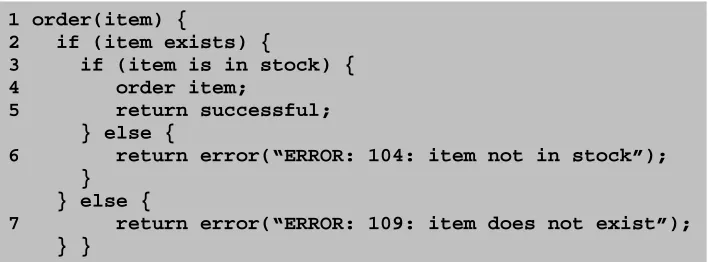
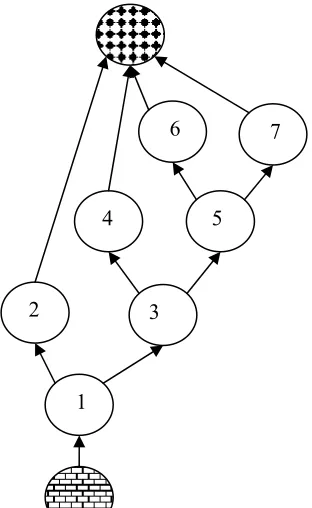
For example, suppose there is a method with psuedocode presented in figure 2.2, the control-flow graph for this method would look like the one in figure 2.3. Additionally, note the brick and checkerboard nodes which represent the starting node (which denotes the beginning of execution) and end nodes (which represent the end of execution).
Figure 2.2: Psuedocode for an ordering service
1 order(item) {
2 if (item exists) {
3 if (item is in stock) { 4 order item;
5 return successful; } else {
6 return error(“ERROR: 104: item not in stock”); }
} else {
7 return error(“ERROR: 109: item does not exist”); } }
Figure 2.3: Control-flow graph for the psuedocode in Figure 2.2 5
4
1 2 6
3 7
This particular control-flow graph is at statement level since each of the nodes corresponds to statements in the psuedocode. Although the control-flow graph presented in figure 2.3 does not have any cycles, control-flow graphs are allowed to have them. Cycles are generally caused by either looping or recursion constructs in the programming language. Since control-flow graphs are allowed to have cycles, all of the control-flow graphs in this work can be considered as directed graphs.
The process of identifying dangerous edges by comparing the control-flow graphs of P and P’ is one of the important parts of the process which will be discussed in detail. Dangerous edges correspond to program entities that may behave differently under a single test case due to differences between P and P’. The regression test selection algorithm compares the two control-flow graphs by traversing the two control-flow graphs simultaneously looking for differences between them. If the two nodes are
different in terms of their children or their values, the algorithm adds the node to the dangerous edge list. Since it compares the node and its children the algorithm is capable of finding both structural (new branches, i.e. new case clauses) and textual differences (altered lines of code, i.e. changing x < 3 to x < 5). The algorithm is recursive and stops either when it finds a difference in the control-flow graph, when it reaches a node it has already compared, or when it reaches an exit node without finding a difference. The recursive algorithm ensures that any modification in the graph will be found (since the entire graph is traversed) and that if one is found, it is added to the set of dangerous edges.
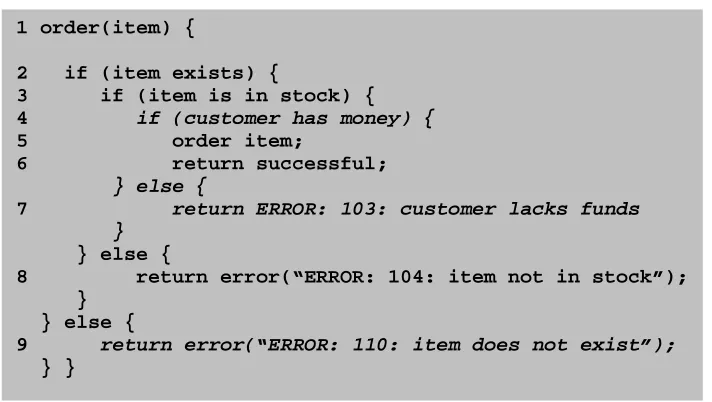
For example, suppose that service A is represented by the psuedocode and the control-flow graph presented above which was presented in figure 4.2 and 4.3 respectively. Suppose after some time, the developers of service A modify the psuedocode to what is shown in figure 2.4. The differences are shown in italics.
Figure 2.4: Altered psuedocode for ordering service from Figure 2.2
1 order(item) {
2 if (item exists) {
3 if (item is in stock) {
4 if (customer has money) { 5 order item;
6 return successful; } else {
7 return ERROR: 103: customer lacks funds
}
} else {
8 return error(“ERROR: 104: item not in stock”); }
} else {
9 return error(“ERROR: 110: item does not exist”); } }
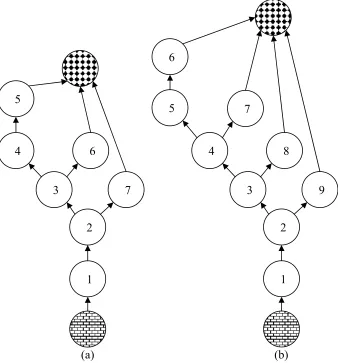
The regression test selection approach must build the control-flow graph for this new version of the order service and that is shown with the original one in figure 2.5.
(a) (b) 6
4
1 2 8
3 9
5 7
5
4
1 2 6
3 7
Figure 2.5: CFGs for the psuedocode in Figure 2.2 (a) and Figure 2.4 (b) The algorithm which determines the set of dangerous edges compares the two control-flow graphs by performing a traversal as described. The result of the dual-traversal marks the following edges dangerous: 1-2, 2-3, 2-7, and, 3-4. It selects these edges because the node corresponding to four is structurally different than the original and because the node corresponding to seven is textually different.
The last part of the process is very important, since it selects the test cases that will be actually run and completes the process of regression test selection. The algorithm uses the coverage information provided during the initialization step, which maps test cases to the original control-flow graph, along with the set of dangerous edges produced
by the second step to select the tests from the test suite which must be rerun. The process of actually performing this step is very straightforward. The coverage information can easily be thought of as a table and the process is simply a table lookup using that coverage information. The technique guarantees that any test case which does not cover a dangerous edge, or entity, will behave exactly the same in both P and P’, and thus can never expose a new fault in P’. Since it is guaranteed to only remove those tests which can never expose new faults in P’, this technique is safe because it minimizes the number of test cases while maintaining the same level of confidence provided by the selecting all test cases.
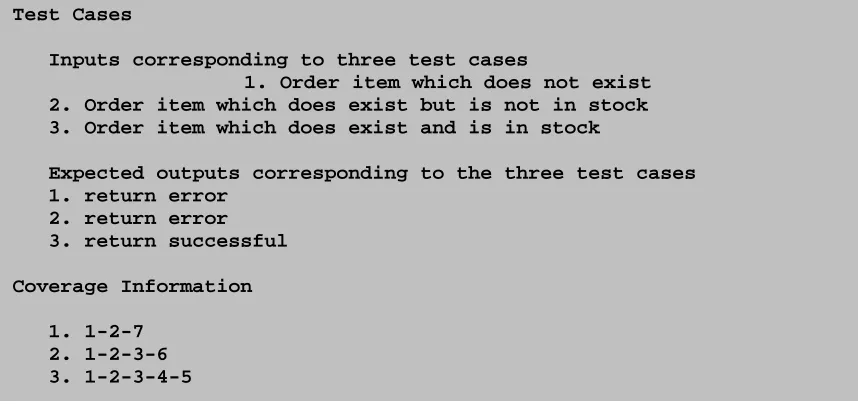
For example, suppose that the original service A was augmented with test cases and coverage information which are both shown in figure 2.6. Note that since the code shown is psuedocode, the test cases will follow suit.
Figure 2.6: Three test cases and their coverage information for service A
1. 1-2-7
2. 1-2-3-6
3. 1-2-3-4-5
Test Cases
Inputs corresponding to three test cases
1. Order item which does not exist
2. Order item which does exist but is not in stock
3. Order item which does exist and is in stock
Expected outputs corresponding to the three test cases
1. return error
2. return error
3. return successful
Coverage Information
Suppose that the modification described in figures 2.4 and 2.5 occur and the following edges are marked dangerous: 1-2, 2-3, 2-7, and, 3-4. The coverage table is
used as lookup table and tests numbered one and three are selected for retesting. These tests are selected because the dangerous edge list prefixes these two tests completely.
Another method is an extension of the selected approach by the one of the same authors, Mary Jean Harrold, and her research group which must be discussed in the context of this work [16]. This technique was developed to apply regression test selection to Java software. They develop a graph structure, an extension to control-flow graphs, which handles the features of the Java programming language, such as exception handling, non-complete programs (code which uses libraries), and polymorphism. The most important point of this work is that in their analysis they ignore libraries which do not change. Programmers often make use of these libraries, without access to the underlying code. However, since these libraries never change from release to release, they can be safely omitted from analysis.
Chapter 3: Survey of Related Literature
In this chapter, a survey of related works will be presented with special emphasis on how these works are related and how this work is differs from theirs. In terms of service-oriented architecture, most of the existing approaches focus either on test case generation or test execution. They ignore the potential cost reduction of regression test selection. There is also some research which delves into the use of other representative models to perform regression test selection, as well as automated frameworks for regression testing. Lastly, there have been some researchers working to perform regression test selection on Web based systems. Each of these items will be presented, along with a discussion of the techniques which have been proposed for regression test selection for Web services.
3.1 Test Case Generation and Automated Test Execution
Test case generation is related to this work because in order to provide some level of confidence that the system is fault-free the system must be tested using test cases. Offutt and Wu [17] designed an approach to generate test cases for Web services using data perturbation. Their proposal works at the messaging layer of the Web services protocol stack, SOAP. Existing XML messages are modified based on a set of rules defined on a set of message grammars, and then used as test cases. Their proposed approach uses both data value perturbation, which works as described, and interaction perturbation, which classifies communication messages into two broad categories: RPC communication and data communication. The data communication category is used for
those messages which would normally carry a payload of some type and RPC would normally simply be any other type of communication, such as requests and other control messages. Their approach can be considered a “black box” approach because it only perturbs the SOAP messages based on their modifications and make no use of internal implementation artifacts.
Another approach aimed at test case generation for Web services was developed by Siblini and Mansour [18]. Their approach uses mutation analysis, which is a fault-based testing method which measures the adequacy of a set of externally created test cases [19]. It works by inducing faults into software by creating many versions, called mutants, of the software each containing a fault. Mutants are limited to simple modifications to the original program on the basis of a coupling effect, which simply implies that there is a relationship between complex faults and simple faults in that a test data set that detects all simple faults will detect most complex faults. After creating the mutants, they are executed, and killed if necessary. A mutant is killed when the result is different than that of the original program. After executing all mutants, the test is left with two pieces of information: the number of dead mutants and the number of still living mutants. The still living mutants are compared to pre-existing test cases to determine equivalence based on input to produce a number of equivalent mutants. Along with the count of all mutants, a final mutant score is computed. This mutant score is the kill ratio, or number of dead mutants divided by the number of still living mutants, ignoring the equivalent mutants. However, mutation analysis can not be directly applied to Web services since the tester may not have all the requisite information, such as code, specification, etc. Their approach uses mutation analysis which is based on applying a
set of mutation operators to a given WSDL document in order to generate mutated Web service interfaces that will be used to test the given Web service. Their set of mutant operators is specific to WSDL documents. Finally, they presented a set of empirical analysis to show the usefulness of their approach. The two approaches to generating test cases are very interesting but are only relevant in the sense that test cases are required to perform regression test selection, and thus are only marginally related.
Researchers at North Carolina State University have developed a framework which automatically generates test cases and executes them [20]. Their approach relies on using a given WSDL document to generate a client for the given service, then leverage existing automated test case generation tools, and finally execute those test cases. Their approach is focused on unit testing, specifically the JUnit framework. The test cases are executed using the JUnit framework, which is a regression testing framework. However, JUnit itself provides no facility for determining when or how the system was modified. It simply executes the test cases when the developer tells it to execute them. The automation they have achieved is through the one time execution of the tests post-generation. This approach is related in that it focuses on automating the generation and execution of test cases for Web services, however, the approach is focused on unit testing and not at the system level, much less end-to-end testing. Additionally, the approach has no mechanism in place for the automation of determining when the tester needs to run.
Another approach, developed by Fu et al, is focused on testing the error recovery code of Web services using white-box def-use testing [21]. Some error recovery code may handle situations which occur with a very small frequency due to interactions with the computing environment and these situations cannot be tested simply by manipulating
program inputs. Their analysis techniques identify program points which are vulnerable to certain faults and the corresponding error recovery code for these specific system faults. Their techniques allow compiler-inserted instrumentation to inject appropriate faults as necessary and to gather recovery code coverage information, which enables a tester to systematically exercise the error recovery code. In their approach it is important to be able to precisely locate where an exception was thrown in response to an experienced fault, which is termed a def, and where that exception was handled, which is termed a use. A key concern of their use of def-use testing is to minimize the number of spurious def-uses reported in the analysis. They use exception-catch link analysis, which is performed at compile-time, to minimize them. This analysis is essentially an interprocedural def-use dataflow analysis calculation with two refinements: 1) it inlines constructer code, and uses the absence of data reachability through object references to confirm the infeasibility of links. Lastly, their approach automates the program instrumentation directed by the analysis. However, the services they discuss are simply Web applications which follow a client-server model, and they are focused solely on the server, ignoring the interaction between the two. Additionally, their approach also is not language neutral since it only works for servers built in Java.
3.2 Other Mediums to Support the Interoperability of Web Services
The use of a medium to handle the issues that arise as the result of the interoperability of Web services is a common theme. The mediums which have been discussed are interoperable containers for sharing test cases. However, there are approaches which use other means to determine what has changed in a system using other
models, such as UML (the Unified Modeling Language). While not many of these approaches have been applied to Web services, they merit mentioning because of the application of the medium to handle the issues related to interoperability.
Bernard Stepien at the University of Ottawa developed an interesting approach to automating the testing of Web services [22]. Their approach focuses on using the Testing and Test Control Notation (TTCN-3) [23] and mapping the XML data descriptions in SOAP and WSDL to TTCN-3. TTCN-3 is the third version of a programming language developed specifically for testing which is used to define test procedures to be used for black-box testing of distributed systems. TTCN-3 is also used as a test specification language since the system is capable of specifying test input as well as how the test should be executed. Stepien provided a means to translate SOAP messages into a format that TTCN-3 can understand and utilize to generate and execute test cases. A later work builds on this by noting that TTCN-3 forms an abstract test suite (ATS) which is language and platform neutral [24]. More importantly in the second work, the authors describe mechanisms for distributing the testing. On the server side, the testers would generate the ATS and publish it. On the client side, the testers would use the generated ATS from the server side to test the service. There is no mechanism for handling the composition aspect of Web services and no mechanism for composing the test suites so that test can be end-to-end. However, this approach is very interesting because it uses a specification language of TTCN-3 as a medium to handle the interoperability aspects of Web services. Additionally, their approach publishes test related meta-data for use in testing. Some of their colleagues worked on a very similar approach using an arbiter to manage the testing [25]. This works identifies an architecture which is almost identical
the one just presented with the additional of the arbiter to manage the ATS. This particular work is interesting only because it attempts to map the testing concepts in UML 2.0 to the TTCN-3 language in a standard way.
Another approach aiming to automate testing Web services which uses a medium for handling the interoperability concerns of Web services was developed by Dustdar and Haslinger [26]. Their approach uses a meta-language in XML to define test cases for services. Their framework, which is named Service Integration Test Tool (SITT), was developed to handle test case execution and monitoring to ensure correct behavior. The test execution for their approach is distributed, with one test agent per service running on the same machine as the service. These agents run the actual tests and log incoming and outgoing messages of every service in the system. They send the important items in the log to a master which parses the log and performs the testing. This master determines if the logged inputs match to correct outputs for each service endpoint in an interaction. This particular study is very interesting and related in that it handles composition using a medium for sharing test cases and that it uses a distributed scheme for testing even if the scheme uses a centralized controller to determine the results.
Yet another approach aimed at the execution of Web services testing is the work by the researchers at RCOST (Research Centre on Software Technology) at the University of Sannio [27]. This particular work aims to use test cases as a contract to ensure service compliance across releases. Specifically, they wish to annotate each service with test cases in a standard way, using an XML based medium, and provide this to the users of the service so they can test the service. The standardized test cases are called testing facets and are a mixture of JUnit tests and tests generated from static and
dynamic analysis of the source code. The testing facets are published along with the service so that users of the service can perform the testing of the service. Their work also presents a set of perspectives of who might wish to use such a framework and those are: providers, users, certifiers. This work is highly related to this because they share test cases using XML, but there is no attempt to perform regression test selection which is the central focus of this work.
Another of these approaches was developed by Heckel and Lohmann at the University of Paderborn [28]. The testing in this paper is focused on developing a means to test Web services by using Design of contract to add behavioral information to the specification of a Web service. They use graph transformation rules to describe the contracts at the level of UML models which allow for the simulation of the required service by accomplishing the contracts during the execution of a test case. It translates UML class diagrams into contract graphs which are represented by UML object diagrams. These contracts graphs are visual representations of the details required to correctly identify service assertions. For instance if an ordering service took only credit cards, the ordering service would be only be connected to that data type. Once the contracts are generated, a test case generation tool, specifically JUnit, is run to create the test cases and tester. This approach, as mentioned before, is important and related because the medium it uses to solve the issues related to interoperability, namely UML, is being used not to share, but as a major part of the approach.
Another approach related to the use of UML was developed by researchers at the Software Quality Engineering Laboratory at Carleton University [29]. The approach focuses on using the class and sequence diagrams in UML to perform impact analysis.