http://www.sciencepublishinggroup.com/j/se doi: 10.11648/j.se.20190701.11
ISSN: 2376-8029 (Print); ISSN: 2376-8037 (Online)
Human Digital Doubles with Technological Cognitive
Thinking and Adaptive Behaviour
Evgeniy Bryndin
Scientific Department, Research Center "Estestvoinformatika", Novosibirsk, Russia
Email address:
To cite this article:
Evgeniy Bryndin. Human Digital Doubles with Technological Cognitive Thinking and Adaptive Behaviour. Software Engineering.
Vol. 7, No. 1, 2019, pp. 1-9. doi: 10.11648/j.se.20190701.11
Received: June 4, 2019; Accepted: July 3, 2019; Published: July 13, 2019
Abstract:
Transdisciplinary paradigm of digital researches, acting as the basis of synthesis of knowledge of the person, the nature, society and production, supplements scientific rationality. She allows to create digital doubles of social services and production of production of products and technological process of operation of the equipment. Digital doubles by training of neural network systems on the basis of the saved-up big data relating to services sector or production for intellectual management of technological processes and the equipment are created. The digital double carries out activity automatically on the instructions of the person. Intellectual production management by digital doubles optimizes its work, increases labor productivity and competitiveness of products on quality and the price. Digital doubles of the person render services in the social sphere. Specialization of digital doubles to professional competences is carried out on the basis of communicative associative logic of technological thinking by cognitive methods. The international scientific and engineering society gradually moves to technical realization of the cognitive professional robot with retraining. The group of the University of California in Berkeley and Princeton investigating efficiency of methods of machine learning for forecasting of human behavior offered the new approach which is given rise on a joint of AI and cognitive psychology. Scientists presented the new concept providing preliminary training of neural networks at the synthetic data prepared by psychologists by means of the existing theoretical models. Approach can be used by other groups for a training of their own models of machine learning. Approach combines the existing scientific theories of behavior of the person with flexibility of neural networks for the best forecasting of the risky decisions made by the person. From the practical point of view it allows to save to researchers a lot of time which is spent usually on data collection for the knowledge base of human behavior.Keywords:
Technological Thinking, Communicative and Associative Logic, Digital Doubles, Communicative Associative Logic, Adaptive Behavior1. Introduction
Digital doubles execute tasks of the person. The task of people makes out in functional language in the marked type of information requirement. In language structural, functional and semantic attributes of elements of knowledge are coordinated. Use of words as a part of elements of
knowledge of information requirement is set by
communicative communications. In language there are grammatical rules of speciation of word forms for generation and expansion of families and generation of communities, communicative rules of formation of phrases, offers of judgments. At each rule the range of definition. For example, at the deductive rule of generalization a range of definition
are deductive sets. Deductive rules allow order the words of language on the generalized sets. The generalized set is presented by convergent sign. Private values of convergent sign are its specification. In language the accent in a word, in the offer, in judgment between offers is fixed sintaktiky. Shock words in the offer are highlighted in bold type. For example, Evgeniy was in China. Evgeniy was in China. Evgeniy was in China. Percussions of a syllable are highlighted in bold type. Communicative communications according to contents of offers have syntactic designations.
or behavioural action (to put cubes). For judgments the subject domain and a situation is specified. For offers the situational moment and signs of lexical meanings is specified. Reflection of semantics of subject knowledge is carried out by means of symbolical and language sign system on the basis of communicative and associative logic and in detail signs of situational the relations of entities of objects of a reality and abstraction with elements of knowledge of the intrinsic dictionary [1-7].
2. Intrinsic Dictionary
Psyche of the person since the birth in the course of language communication acquires entities in the form of sensual elements of knowledge. The intrinsic dictionary, defining semantic use of morphological words, is necessary for technological thinking of robot, which does not have psyche.
Let S - the spelling dictionary, where S = {Si}, Si - a morphological word. The word Si calls sign of Qij of the representative of Mij from a set of Mi where Mi = {Mij}. Will designate a lexical meaning of the word Si through {Mij, Qij, Si}. Will set communication of lexical meanings of words {Si} with elements of a set Mi set of the sign of relations of Qi where Qi= {Qij, (Mi, Mij)}.
The set of lexical meanings of the sign of relations with representatives connected by set is the intrinsic dictionary. Words in the dictionary are supplied with sign of indexes according to their sign of relations with representatives. The intrinsic dictionary fixes sign of entities of representatives. The dictionary helps to use words with the lexical meaning and to distinguish representatives whom they call at the symbolical level.
Words are used on the basis of sign of indexes. Each sign has three indexes. One index indicates subject domain of knowledge, the second a situation, the third for the situational moment. Words with several lexical meanings, have several sets of indexes. For example, flour and flour. The word the field is used in various subject domains. Each set of indexes defines a lexical meaning of a word.
3. Technological Cognitive Thinking
3.1. System of Realization of Information Requirement
The system of realization of information requirement contains the knowledge base, base of abilities, behavior model, environment model, programmable mekhatronny, navigation and other devices of realization of adaptive technological behavior. The knowledge base supports
associative communicative network of information
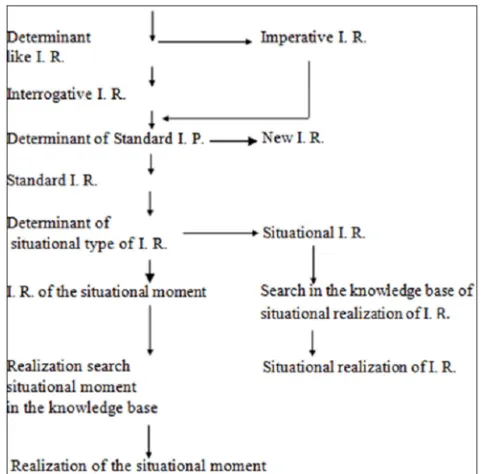
requirements and their realization. The base of abilities contains procedures of realization of technological thinking and adaptive technological behavior. Realization of information requirement undertakes or from the knowledge base, or is developed by a standard procedure of realization of base of abilities for the current information requirement
(Figure 1), or the network of step-by-step realization on the combined information requirement is formed (Figure 2).
Figure 1. Realization of standard information requirement (I. R.).
Figure 2. Realization of new information requirement (I. R.).
3.2. Imitative Thinking of the Digital Doubles
The technology of realization of communicative and associative logic allows create the symbolical conceiving digital doubles with imitative thinking. Information unit of communication between the robot and the interlocutor is information requirement either speech, or written in natural functional language [7]. The interlocutor uses information requirements which contain in the knowledge base of the digital doubles. He communicates with the digital doubles by means of combinations of the available information requirements, enriching, thereby, the digital doubles with new information requirements and their realization. The digital doubles receives basic information requirements and their realization during his training.
doubles realizes information requirement if the knowledge base contains a necessary set of elements of knowledge, the base of abilities contains a necessary set of elements of realization.
Imitation of symbolical language thinking is carried out on the basis of symbolical and language communicative logic over symbolical language elements of knowledge of subject domains. Subject domains of knowledge present to network communicatively and is associative coherent symbolical language elements with a sing of situational and a language marking.
Definition. The network G (Xt, Гt, Vt) is conceptual
representation of knowledge, if Xt = 1
t
x
U 2t
x
U 3t
x
, where1
t
x
– a set of tops of judgments with a situational and language marking, – a set of tops of the offers having language and situational признаковую a marking: { (alexical meaning, a look) }, (sign, a niche) }, 3
t
x
– a set of tops of phrases with a sing and language marking, Vt – a set of communicative communications of elements of a set of Xt, Gt – a set of associative communications of elements of a set of Xt, t – the discrete moments of emergence of new elements of knowledge, sign – the sign of the representative of a reality indicating the semantic use of a word in the speech and in writing a look – the grammatical characteristic of a set of words which morphological value is formed by the general rules of grammar a niche – uniform situational use of a set of words of different types in various syntactic sentence structures (the niche can be subject and object, procedural, a circumstance, attributive, additional.Associative communications connect tops which are information requirement and its realization. Communicative communications proceed from tops of communicative elements of knowledge in the general top.
Realization of information requirement is formed by procedures of the semantic syntactic and morphological analysis, merge and splitting of elements of information need of the user, the words of the intrinsic dictionary and elements of knowledge of subject domain and procedures of
realization of information actions of information
requirement. Procedures contain in base of abilities.
The digital doubles imitates imitative thinking. On new information requirements the digital doubles issues the version of realization if it enough available communicative and associative elements of knowledge and procedures has realization.
If information requirement or realization of information requirement contains information action, then the standard procedure of realization is started. The reference to the procedure of realization is specified in a marking of information action.
The compulsory provision of feasibility of information requirement is completeness of the knowledge base and base of abilities, that is existence of necessary and sufficient set of elements of knowledge and abilities of cross-disciplinary subject domain for training in a healthy lifestyle (Figure 3).
Figure 3. Communicative-associative network of healthy lifestyle.
The healthy lifestyle of the person is under construction on
the basis of high-quality regularities. High-quality
regularities are described by causes and effect relationships. The communicative and associative network of knowledge of the cross-disciplinary subject domain concerning a healthy lifestyle contains causes and effect relationships between elements of knowledge describing useful effects and the corresponding improving investigations generated by them. The realization of a healthy lifestyle is enabled by useful habits. Purity of an organism is reached by a habit of daily hygiene.
Consultation of the robot in communicative and associative network of elements of knowledge of subject domain is based as a chain of relationships of cause and effect. For example, in the mode short consultation: (a habitaily hygiene) – (purity of an organism). Realization of information requirement can be information requirement. In this case on a communicative tree of lexical meanings of the reason by their synthesis we reach associative top. Then we determine realization by associative communication.
The robot can train along with consultations in physical exercises [4]. To physical culture for normalization of a tone of an organism. To gymnastics for normalization of rhythms of functioning of an organism. To charging on normalization of a power system.
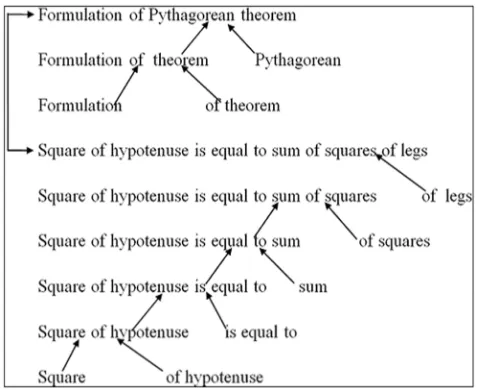
theorem". For example, let imperative information requirement "Is set to formulate Pythagorean theorem". On a lexical meaning of the word "formulation" we find through the intrinsic dictionary a representative phrase "wording of the theorem" in network of the subject domain of knowledge specified in a marking of information requirement. Then on a tree of communicative phrases with lexical meanings of information requirement by their synthesis we reach associative top "a formulation of Pythagorean theorem". Further on associative communication from associative top of information requirement we pass to associative top of realization "the square of a hypotenuse is equal to the sum of squares of legs"(Figure 4).
Figure 4. Associative communicative network of Pythagorean Theorem.
The digital doubles with communicative and associative logic of imitative thinking, having remote communication with the person, is capable to carry out cognitive information needs of the person for many spheres of activity [8-15].
4. The Adaptive Behavior Digital Robots
The adaptive behavior goes imitative thinking on the instructions of the person and is carried out on models of a surrounding medium and behavior. Cognitive management of behavior is more reliable, than telecommunication. Programming of adaptive behavior of robots is carried out via the program interface.
The robot component realizing adaptive behavior in the external environment includes touch, operating, executive motor systems and the system of diagnostics [5].
The touch system is intended for perception and transformation of information on a condition of the external environment. It turns on television and optiko-laser devices, ultrasonic range finders, tactile and contact sensors, situation sensors, neural network devices of a pattern recognition of the external environment, etc. Robotic perception is a process during which robots display results of touch measurements on internal structures of representation of the environment.
On the robot it is possible to assign a problem of
maintaining in tolerance limits of the parameters of heat and cold, vital for the person. Ability of the robot, the equivalent to perception of a tone of the person, can warn about an overload. Perception of pressure is function without which the manipulator of the robot cannot do. This function can be entered in the robot by various methods depending on purpose of the robot. It is especially important when fingers of the robot have to take various, sometimes friable, objects. Taction sensors at the person are very sensitive and numerous that allows to use them for distinguishing of a form. Now this task is already not really difficult.
Various elements, including chloride and lithium (Danmor sensor), carbon, elements on the basis of polyelectrolytic resistance, ceramic elements, capacitor devices and elements on the basis of alumina are applied to perception of humidity. These developments can be used in robotics.
In certain cases the robot it is necessary to allocate with ability to measurement of level of temperature either in itself, or in a surrounding medium. For this purpose use any of
well-known methods of electric determination of
temperature.
The method of precise indication of position of the robot is implemented by navigation technique, based on comparison of provisional regulations of impulses with provisional regulations of reference impulses. Indication of position of the robot is important for its orientation in space. Mapping and localization of an image of an object is carried out with use of the scanning laser ranging sensors. For measurement of distance use ultrasonic sonars, infrared sensors, laser sensors. Achievement of an object is carried out on the received coordinates. Procedures of realization of behavior are performed by the movements of parts of motor mechanisms of the robot according to a route of movement and the sequence of motive acts of parts of motor mechanisms of the robot. The route of driving of the robot is under construction in classes of patch and polyrated functions.
The system of diagnostics exercises control of execution of simple movements of parts of motor system of the robot on each step of realization of behavior, transfer of necessary information of the managing director to system on a condition of motor system for its correlation with information from touch system in real time and also reports about the end of the simple movements.
The executive motor system realizes procedures of behavior of the robot in the external environment carrying out the various movements. The motor system has
mechanical hands (manipulators), mechanical legs
(pedipulyator). The manipulator can take, turn, transfer, collect, bend around obstacles etc. The walking robot can move on the unfamiliar area with the composite relief, overcoming obstacles.
The robot determines model of the external environment by informational need of the person and touch information. It determines behavior model by model of the external environment and informational need of the person. Then it determines the sequence of the behavioural acts of motor system in the external environment on type a situation action realized from the point of view of the functional and touch opportunities by models of the external environment and behavior.
For the particular external environment at the robot the model of the external environment, behavior model and procedures of realization of behavior are set. In the particular external environment the robot on the informational need of the person (INP), models of the external environment, behavior model realizes informational need of the person procedures of realization of behavior. On IPCh the robot forms network of bit-by-bit realization of informational requirement for subject domain. If the network is built, then imitative thinking starts procedures of realization of IPCh. In the course of realization of IPCh the robot via touch devices controls a condition of the external environment. If the condition of the external environment on any circumstances does not correspond to a condition of model of the external environment, then the robot gives the message that it cannot realize IPCh in connection with change of the external environment and waits for the following informational requirement from the person. After realization of IPCh the robot reports to the person about the termination and results of the activity.
In the acritical external environment the robot according to touch information forms model of the external environment (EE), selects standard behavior model for IPCh and sequentially realizes IPCh procedures of realization of behavior: lays a safe route of movement of the robot on the VS model, on behavior model the standard procedure builds the serial-parallel movements of manipulators, pedipulyator and other motor mechanisms of the robot.
The robot for work with the acritical external environment has many various touch devices. The behavior model of the robot forms the procedure of realization of IPCh of a set of standard procedures. The behavior of the robot is implemented along a route of driving and the sequence of the intermediate configurations of the motive acts leading to realization of IPCh. The sequence of configurations of motive acts is built according to a route and IPCh.
The behavior model builds the movements of motor mechanisms of the robot on the law of change of their generalized coordinates guaranteeing realization of IPCh. Driving is defined by the vector of the generalized coordinates defining the current provision of degrees of mobility of its mechanical part. Working parts of motor mechanisms make rotations on the trajectory determined by a vector of phase coordinates.
Interaction with the external environment and its perception carries out the robot by means of different sensors and touch systems. Actual situations are described in memory of the robot by means of a set of indications of touch
sensors. Touch information can be photographic, scanned, dalnometrichesky from optical and ultrasonic systems of technical vision.
In terms of indications of touch sensors primary description of model of the external environment is formed. The analysis and processing of this information lead to the generalized description of a situation with the help of concepts. According to the generalized description of a situation and IPCh the behavior model of the robot and a set of standard procedures of realization of IPCh are selected.
In behavior model the functional properties of the robot, mobile opportunities of the robot are reflected in the external environment. Thanks to it the robot can render services in IPCh, according to mobile opportunities, the VS model and behavior model in the unfamiliar external environment.
The task of the analysis of touch information, discernment and the description of a situation is relevant for interaction of the robot with the acritical environment. This problem by tutoring of the robot to distinguish objects of the external environment through the systems of a discernment of three-dimensional objects, to describe in a natural language elements of three-dimensional scenes on the basis of touch information by means of a totality of the partial situational signs is solved. For example: further, more to the left, below, are disconnected, areas of different color, etc. The description of the external environment is set in a natural language by means of a totality of the partial situational signs.
The robot, analyzing a situation of the external environment on standard model of the external environment, touch information, to the description of a scene of the external environment selects for IPCh behavior model, procedures of realization of behavior, builds a route of movement and sequentially forms motive acts of parts of motor mechanisms of the robot for requirement realization. Distinguish the cyclic and positional systems of coordination of motive acts. In the cyclic systems of a trajectory of motive acts are limited to 2-4 points of positioning on each of mobility degrees, and in positional systems the number of these points can make several tens that allows to realize are difficult" е motive operations.
Cyclic and positional management provides movement of an action on a broken trajectory from a point to a point. The concept of the relative relative frame of reference of coordinates is central. The relative relative frames of reference of coordinates are bound to each positional point of a part of the motor mechanism.
For each positional point on each step is defined sequentially at what size and in what direction to move it from the current situation to the given. For each part of motor mechanisms, the bound to a positional point, is defined in what direction and on what corner it is necessary to turn.
Simultaneous turn and transfer of a part of motor system concerning the generalized frame are calculated on formulas [5].
of behavior are defined by the field of professional activity in which the robot has to realize IPCh.
Direction cosines of part P1P2 of motor system of the robot in characteristic relative frame it is calculated on formulas [5].
The behavior model contains algorithms of adaptive integrated management of the movements, a route of movement of the robot and the sequence of motive acts of parts of motor mechanisms of the robot.
Procedures of realization of behavior are performed by the movements of parts of motor mechanisms of the robot according to a route of movement and the sequence of motive acts of parts of motor mechanisms of the robot. The route of driving of the robot is under construction in classes of patch and polyrated functions.
Let the area represent the plane, obstacles by polygonal lines and coordinates of an initial point of the robot and target where the robot has to move are set.
It is necessary to construct an optimum route as a polygonal line from an initial point in target which does not cross obstacles and has the least length.
This problem is solved by a classical method of a dynamic programming of successive approximations in the function space, using the recurrence relation of function f, defining length of a route from an initial point in target. The strategy of finding of a minimum route is defined by a successive approximation of the constructed arbitrariest route to minimum.
After the optimum, safe route is constructed, by methods of the generalized, relative and phase coordinates motive acts of motor parts of the robot are under construction. Coordination of motive acts is serial – information coordinator of behavior model which is in the field of an attention of memory of the robot in parallel carries out.
5. Management of Behavior of the Robot
Behavior of the created robot the multifunctional hierarchical system of controllers, similar to a control system of behavior of a human body operates. The behavior arises under the influence of informational requirement which causes orientation in a situation on models of the external environment and behavior. Orientation comes to the end with the choice of the corresponding line-up of programs of hierarchical system of controllers as instructions to actions which realization leads to realization of behavior. Advantage of the organization such consists in development of behavior of the robot on the basis of expansion of hierarchy of the subprogrammes setting acts of behavior.
The controller is a computer on a chip. It is intended for control of various electronic devices. The controller of the robot is the diminutivest computer. It contains the processor and peripheral devices: FLASH memory, timers, interfaces for communication with peripheral equipments and a set of other useful schemes. The controller operates according to the given program which is loaded into it from the potent computer. It is loaded by means of a programmator (in the
simplest look is an express cable) into the microcontroller. The robot has bodies for interaction with a surrounding medium. Bodies which obtain information from a surrounding medium are called receptors (or sensors). And bodies which influence a surrounding medium – effectors: engines, loudspeakers, light-emitting diodes and so forth. The controller has a quantity of entrances and exits. To entrances receptors, and join exits effectors. Microcontrollers can process information from entrances and create electric signals at the exits how we will program behavior of the robot [6].
6. Programming of Behavior of the
Robot
The behavior of the robot is set in programming languages. Many programs for the generalizing architecture were realized in behavior language which was defined by Brooks. This language represents language of management in real time on the basis of rules which result of compilation are AFSM controllers. The separate rules of this language set by means of syntax, similar to Lisp are compiled in the AFSM submachine guns, and groups of the AFSM submachine guns unite with the help of set of mechanisms of transfer of local and global messages.
As well as the generalizing architecture, language of behavior is restricted as it is aimed at creation of the simple AFSM submachine guns with rather narrow definition of a stream of communication between modules. But recently on the basis of this idea new researches which led to creation of a number of the programming languages similar on the spirit to behavior language, but more potent and providing faster realization are conducted.
One of such languages is the universal robotic language, or in abbreviated form GRL (Generic Robot Language). GRL is a functional programming language for creation of larger modular control systems. As well as in behavior language, in GRL as the main design units finite-state automations are used. But as control over these automatic machines the GRL language offers much wider list of designs for definition of a communication stream and synchronization of restrictions between various modules, than behavior language. Programs in the GRL language are compiled in efficient programs in such languages of teams as Page.
One more important programming language (and the related architecture) for the parallel robotic software is the system of scheduling of jet actions, or in abbreviated form RAPS (Reactive Action Plan System). The RAPS system allows programmers to set the purposes, plans, the bound to these purposes (or partially to define policy) and also to set conditions under which these plans most probably will be implemented successfully.
and provide the procedure of elimination of an exclusive situation for each type of refusal. In three-level architecture the RAPS system is often used at the executive level that allows to cope with the unexpected situations which are not demanding rescheduling successfully.
There are also several other languages which provide use in robots of means of formation of reasonings and tutorials. For example, Golog represents the programming language allowing to provide perfect interaction of means of algorithmic problem solving (scheduling) and the means of jet management set immediately by means of the specification.
Programs in the Golog language are formulated in terms of situational calculation taking into account a padding possibility of application of operators of nondeterministic actions. Except the specification of a time schedule control
with opportunities of nondeterministic actions, the
programmer has to provide also the complete model of the robot and its environment.
As soon as the time schedule control reaches a point of the nondeterministic choice, the scheduler (the given in a form of the program of the theorem proving) for definition of what to do next is called. Thus, the programmer can partially define the given controllers and rely on use of the firmware schedulers for acceptance of the final choice of the management plan.
The main attractive feature of the Golog language is the perfect integration of means of jet management and algorithmic management provided in it. In spite of the fact that when using the Golog language it is necessary to keep rigorous requirements (the complete observability, discrete states, the complete model), by means of this language high-level controlling means for a number of the mobile robots intended for application in rooms were created.
Language "JSk CES (reduction from C ++ for embedded systems — C ++ for the firmware systems) is a language expansion C ++ in which probability tools and tutorials unite. Probability distributions are among types of data of CES that allows the programmer to carry out calculations with use of acritical information, without spending those efforts which are usually bound to realization of probability methods.
Even more important the fact that the CES language provides setting up the robotic software by means of training at the basis of examples, in many respects similar to what is carried out in tutoring algorithms. The CES language allows programmers to leave in the intervals code which are filled with the training functions; usually such intervals are differentiable parametrical representations, such as neuronic networks. Further at separate grade levels for which the teacher has to set the required output behavior there is the inductive tutoring by means of these functions. Practice showed that the CES language can successfully be applied in problem areas, the characteristic of partially observed and continuous environment.
The ALisp language represents expansion of the Lisp language. The ALisp language allows programmers to set the nondeterministic points of the choice similar to choice points
in the Golog language. But in the ALisp language not the program of the theorem proving, but means of definition of the exact action by means of the inductive tutoring in which tutoring with a reinforcement is used is applied to a decision making. Therefore the ALisp language can be considered as a convenient way of introduction of knowledge of problem area in the procedure of tutoring with a reinforcement,
especially knowledge of hierarchical structure of
"procedures" of desirable behavior. Still the ALisp language was applied to problem solving of robotics only in imitating researches. It can be finished for programming of robots with imitative thinking and adaptive behavior, capable to tutoring as a result of interaction with the environment.
Cognitive robots with imitative thinking and adaptive behavior have the prospect of broad practical application as digital clever robots of lecturers and consultants in educational activity of the digital universities for tutoring of students on the basis of online courses. Cognitive robots with imitative thinking and the program interface it is possible to use managers and to program on management of robotic clever factories [4, 7-8].
Hierarchical approach to realization of actions of behavior of the cognitive mobile robot allows it to perform the useful effect and to provide the movement. Hierarchical algorithms of actions of behavior are divided on agglomerative and divizimny. Agglomerative algorithms begin the realization with the fact that each action is brought in the corresponding cluster and in process of realization unite clusters until at the end does not receive one cluster including all actions of behavior. Divizimny algorithms, on the contrary, at first refer all actions in one cluster and then divide this cluster until each effect is not had in a sootvetstvushchy cluster. Representation of result of a hierarchical algorithm is the dendrogramma - the scheme showing in what sequence there was a merge of actions in a cluster or division of actions into clusters.
Such approach allows to formalize requirements to mobility of behavior of the robot and to develop all possible algorithms of reaction to change of a condition of an environmental situation. For example, when moving on the street applying technology of satellite navigation, and environmental objects, finding by means of cameras or range finders. That is approach allows to project independent robotic systems under realization of a set of the production and social spheres of activity.
7. Specialization of Cognitive Adaptive
Professional Robot
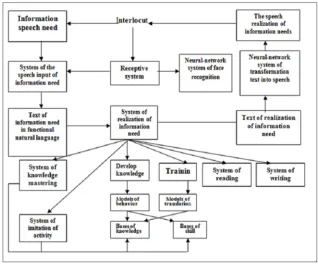
The functional structure of specialization of the cognitive adaptive professional robot with retraining consists of various systems with artificial intelligence (Figure 5).
Figure 5. Functional structure of the cognitive professional digital doubles.
Figure 6. Russian robot astronaut FEDOR.
Figure 7. Russian robot guide.
Figure 8. Japanese robot lecturer.
Figure 9. Japanese robot-Android volunteer ASIMO.
Figure 11. Japanese robot-administrator of hotel Henn-na Hotel.
8. Conclusion
The cognitive adaptive professional robots with
communicative and associative logic of thinking having the systems of machine retraining of realization of information requirements will be able quickly to change professional qualification and competences.
The international scientific and engineering society gradually moves to technical realization of the cognitive professional robot with retraining. The group of the University of California in Berkeley and Princeton investigating efficiency of methods of machine learning for forecasting of human behavior offered the new approach which is given rise on a joint of AI and cognitive psychology. Scientists presented the new concept providing preliminary training of neural networks at the synthetic data prepared by psychologists by means of the existing theoretical models. Approach can be used by other groups for a training of their own models of machine learning. Approach combines the existing scientific theories of behavior of the person with flexibility of neural networks for the best forecasting of the risky decisions made by the person. From the practical point of view it allows to save to researchers a lot of time which is spent usually on data collection for the knowledge base of human behavior.
The automated system of retraining can retrain the cognitive robot on other specialization. The expert has to prepare the knowledge base, base of abilities, behavior model and model of the environment. Degree of accuracy of the description of the external environment, behavior model and realization of information requirement defines correctness of performance of human tasks by robot.
In the future in labor market cognitive robots with retraining will perform professional works, and the person will occupy a niche of scientific research of creative innovative activity.
Robots become independent subjects of social
environment. Social cognitive smart robots are used as guide, seller, lecturer, vacuum cleaner, nurse, volunteer, security guard, administrator of hotel, astronaut.
References
[1] Evgeniy G. Bryndin The Robot with imitative thinking. "PNIPU bulletin: Electrical equipment, Information technologies, Control systems", N. 14. Perm: PNIPU. Pages 5-36. 2015.
[2] David Vernon. Artificial Cognitive Systems. MIT Press, Cambridge, Massachusetts. London, England. 2014. 70 pages. [3] Hooman Samani. Cognitive Robotics. CRC Press. 2015. 220
Pages.
[4] Evgeniy G. Bryndin, Cognitive robot consultant for a healthy lifestyle. III International scientific conference "Information Technologies in Science, Management, the Social Sphere and Medicine". TPU. Pages 484-488. 2016.
[5] Bryndin E. G. Cognitive robots. Inter. Conf. "Management of development of large-scale systems (MLSD’2016). M.: IPM RAS. Pages 285-294. 2016.
[6] Evgeniy Bryndin. Cognitive Robots with Imitative Thinking for Digital Libraries, Banks, Universities and Smart Factories. International Journal of Management and Fuzzy Systems. V. 3, N. 5, 2017, pp 57-66.
[7] Evgeniy Bryndin. Technological Thinking, Communication and Behavior of Androids. Communications. Vol. 6, No. 1, 2018. Pages: 13-19.
[8] Stefan Wermter, Günther Palm, Mark Elshaw. Biomimetic Neural Learning for Intelligent Robots: Intelligent Systems, Cognitive Robotics, and Neuroscience. Springer-Verlag Berlin Heidelberg. 2005. 389 pages.
[9] Ahmed S. Al-Araji, M. Sc. Khulood E. Dagher. Cognitive Neural Controller for Mobile Robot. IJCCCE Vol. 15, No. 1, 2015. P. 46-60.
[10] Evgeniy Bryndin. Program Hierarchical Realization of Adaptation Behavior of the Cognitive Mobile Robot with Imitative Thinking. International Journal of Engineering Management. Volume 1, Issue 4. 2017, pp. 74-79.
[11] Evgeniy Bryndin. Technological, Economic and Social Aspects of Management by Development of the Digital Industry 4.0. International Journal of Managerial Studies and Research (IJMSR), vol 6, no. 4, 2018, pp. 19-30.
[12] Evgeniy Bryndin. Directions of Development of Industry 4.0, Digital Technology and Social Economy. American Journal of Information Science and Technology. V 2, Issue 1. 2018. P. 9-17.
[13] Evgeniy Bryndin. Social Cognitive Smart Robots: Guide, Seller, Lecturer, Vacuum Cleaner, Nurse, Volunteer, Security Guard, Administrator. Communications. Volume 7, Issue 1. 2019. Pages: 6-12.
[14] Evgeniy Bryndin. Cognitive smart robots with technological thinking and behavior for industry and social sphere. /Science, Technology and Life: Proceedings of articles the V International scientific conference. - Czech Republic, Karlovy Vary. 2019. ISBN 978-80-7534-195-2.