A “smart” trap device for detection of crawling insects and other arthropods in urban environments.
Panagiotis Eliopoulos1, Nikolaos-Alexandros Tatlas2, Iraklis Rigakis3, Ilyas Potamitis2*
1 Dept. of Agriculture Technologists, Technological Educational Institute of Thessaly, Larissa 41110, Greece; [email protected]
2 Department of Electronics Engineering, Piraeus University of Applied Sciences, Athens 12244, Athens, Greece; [email protected]
3 Dept. of Electronics, Technological Educational Institute of Crete, Chania, 73133, Greece; [email protected]
* Author to whom correspondence should be addressed; E-Mail: [email protected]; Tel.: +30 28310 21900; Fax: +30 28310 21913
Abstract
We introduce a device for automatic detection and reporting of crawling insects in urban environments. It is a monitoring device for urban pests that complies with the context of smart homes, smart cities and is compatible with the emerging discipline of the Internet of Things (IoT). We believe it can find its place to every room of a hotel, hospital, military camp and residence. This box-shaped device attracts targeted insect pests, senses the entering insect and takes automatically a picture of the internal space of the box. The picture is communicated through the Wi-Fi commonly found in such establishments to an authorized person/stakeholder receiving the picture to take proper action. The e-trap includes strong attractants (pheromone and/or food) to increase capture efficiency. The insect is trapped on the sticky floor of the device. The device carries the necessary optoelectronic sensors to guard all entrances of the trap. As the insect enters it interrupts the infrared light source. This triggers a detection event; a picture is taken, and a time-stamp is set before reporting the event through the Wi-Fi. The device can be integrated seamlessly in urban environments and operates unobtrusively to human activities. We report results on various insect pests and depending on the insect species, can reach a detection accuracy ranging from 96-99%.
Introduction
The quality of life for most people in the future will be represented in the cities’ quality of life index. The European Commission has, in recent years, been increasing its focus on urban issues, as a response to the fact that by 2020 it is estimated that almost 80% of EU citizens will be living in cities [1]. Cities provide development and growth, and generally a better life than in rural areas. Apart from quality of living, houses, buildings, roads, schools, hospitals, markets and other features, that characterize the urban environment, provide habitats for a special group of insects and other arthropods, some of which attained pest status, the so-called "urban insects" [2-4].
Contrarily to agroecosystems, pest status in the urban environment may not be based on a measurable feature. The damage and the control treatments costs cannot always be determined. Structural damage, sanitary problems, health threats, or simple annoyance only by the insect presence, have been developed to common cases in urban environments. A decision to apply control measures maybe based on potential damage or personal injury, or solely or in part on emotion. Arthropods in the urban environment are completely unacceptable, whether their populations are low or high. Pest management and control strategies are based on early detection and pest identification before application of effective chemical and nonchemical control treatments.
Early pest detection is crucial for effective and affordable control in urban environments. For this purpose, various trap types (mainly sticky) are frequently used by homeowners, pest management professionals and urban entomologist researchers for detecting infestations of crawling insects like ants, termites, bedbugs, cockroaches, earwigs, beetles, moth larvae etc. as well as other crawling arthropods such as spiders, millipedes, centipedes etc [2,5,6]. These devices provide consistent estimates not only of insects' presence (detection) and relative abundance (monitoring) but they are also useful for evaluating insecticide treatment efficacy (post-treatment analysis) and control purposes (population reduction) [7-9].
As a detection tool, sticky traps provide information on distribution and population density, thereby assisting in properly targeting insecticide applications. Because of their safety, ease of use, and non-toxicity, sticky traps are considered to be a valuable tool in integrated pest management (IPM) programs especially in urban environments.
A. Cockroaches (order Blattodea). They are cosmopolitan insects, occurring in nearly all over the world. Although, most of the approximately 4000 described species live in
small populations in forest habitats, their association with decaying organic matter and
humid conditions maintains some species (nearly 30) in the urban environment. They
may become very serious pests given that they can passively transport pathogenic
microbes on their body surfaces, particularly in environments such as hospitals [10,11],
they are often linked with allergic reactions in humans [12] and asthma [13]. These
allergens are heat-stable and persistent in the living space. Approximately 20-50% of
homes with no visible sign of cockroaches have detectable cockroach allergens in dust
[14].
B. Ants (Hymenoptera: Formicidae). The pest status of ants is based on their nesting
and foraging habits. The urban environment provides a variety of soil types and
conditions, suitable for a large number of ant species [2, 15]. Nesting along building
foundations can result in damage to structural members of buildings, and to exterior
faces. Ants usually enter the buildings to find food, demonstrating remarkable
persistence foraging inside and establishing satellite nests indoors. The habit of
foraging ants to visit a variety of food sources increases their potential to acquire
pathogenic and food decay microbes. A large number of pathogens have been
recorded from ant species, including bacteria (Burkholderia, Clostridium, Enterobacter,
Salmonella etc) and fungi (Aspergillus, Penicillium etc), [2,15,16]. Pest ants in the
urban environment have a significant economic impact both on the pest control
industry and the general public. Many times, ants have been ranked as the number
one pest problem of households, even surpassing cockroaches [17]. Most important
and well studied species are the fire ants (Solenopsis sp.), because of their medical
and agricultural impact [18]; the Pharaoh ants (Monomorium pharaonis), which are
major household pests and can act as disease vectors in hospitals [19]; and carpenter
ants (Camponotus spp.), which are important wood-destroying organisms [20].
C. Beetle pests of stored food (order Coleoptera). Beetle pests are often recorded in
urban environments searching for food (cereals, grains, packaged food, flour etc).
Their presence may become a serious problem in certain cases like in residences,
markets, hospitals, bakeries, restaurants etc. There is a plethora of beetle species
(Sitophilus, Rhyzoperta, Tribolium, Cryptolestes, Oryzaephilus, Stegobium,
Lasioderma etc) invading abovementioned urban environments searching for food
[21,22].
Recently, we observe an upsurge of interest on shifting sophisticated, high-tech
procedures to insect sensing that are normally encountered in other research fields
sensing of termites [24], Potamitis for electronic e-traps for flying insects [25-28],
Zhong on applying deep learning to insects trapped on sticky traps [29]). This study
belongs to this general trend but is different to its aim and cause. Our study aims to
introduce a novel trap-device that can be hidden conveniently under a bed or fixed to
the wall that can become a useful tool for the automated early detection of crawling
insects and other arthropods in urban environments. Though we have tested three
widely encountered cases the applicability can be directly extended to other cases as
well, namely: The presence mainly of Bed Bugs (Hemiptera: Cimicidae) and Cloth
Moths that feed on stored fabrics (Lepidoptera: Tineidae) can be devastating for the
reputation and prospect of a hotel or hospital in the era of TripAdvisor, Instagram and
Facebook. The proposed device will curtail the cost of Integrated Pest Management
(IPM) applied to hotels as it will limit the application of IPM from a prescheduled basis
(i.e. once a year) to an on-time, localized (i.e. per room) application of IPM. More on,
it allows the hotel to advertise that it takes best action to protect its customers and their
children by applying surveillance control on insects.
Materials & Methods
Trap Design & Function
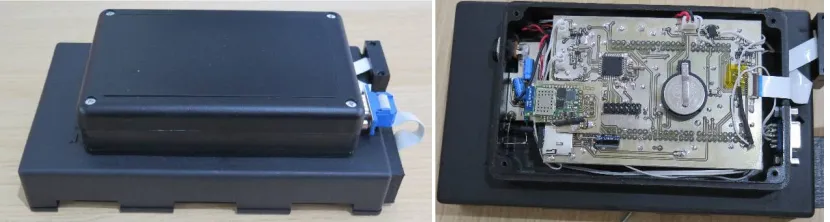
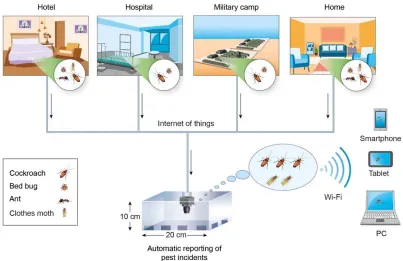
This box-shaped device having the size of a shoe (Fig.1), attracts insect pests, senses the entrance of the insect and takes automatically a picture of the internal space of the box. The picture is communicated through the WiFi commonly found in such establishments to an authorized person/stakeholder receiving the picture to take proper action. In this way, continuous, accurate and real – time detection is achieved, without the need for human intervention. It is a monitoring device for urban pests in the context of smart homes, smart cities and is compatible with the emerging discipline of the Internet of Things (IoT) (Fig. 2).
Our smart trap functions like a classic floor trap. Traps may differ greatly in design features (shape, size, surface material etc) and the presence of attractants (food, pheromone). All these factors along with placement method influence dramatically the trap efficacy [30].
The box includes a strong attractant to attract the insects and maximize
captures. The insect is trapped on a sticky surface that is inside the device, basically
a cardboard coated with special insect glue (Tanglefoot® Tangle-Trap® Sticky
Coatings) that lasts (remains sticky) for 4-6 months. The sticky floor provides the
means for immediate verification of reported results. Captured insects release additional pheromone by themselves and increase the attractiveness. The presence of multiple attractants targeting different insect species simultaneously is also possible and recommended.
The concept presented in this work does not depend on a specific trap configuration and many types are compatible with it. In this work, we modified a well-known trap for crawling insects (TRAPPER Pest Monitor, Bell Labs, US) on which we added the electronic components (see Fig 1-left). This trap has multiple entrances that are all monitored simultaneously by a single laser beam (infrared laser PN: 980MD-30-1230-CAB/NANMA). Any entering point will interrupt the laser beam and this triggers a time counter.
After 20 seconds a photograph (Omnivision, Camera OV2640, cmos sensor camera module) of the internal volume of the trap is taken (Fig.3), time-stamped and delivered to prestored mail addresses while a copy of the picture is stored internally in the SD card of the device. The time delay ensures that is given enough time to the insect that follows the chemical signals of the bait to crawl inside. Several time constraints are applied to ensure that the device is not reporting a false alarm. The processor that handles all tasks is a STM32F767 ARM Microcontroller (see Fig 1-right).
Fig. 3: Photograph from the internal of the trap, automatically taken 20 seconds after insect’s entrance (an adult beetle is depicted in the down right corner).
Evaluation
For the purposes of our study, a prototype of this trap was tested under real conditions
in three cases. Our trap was placed:
a) in an old food warehouse with an increased presence of cockroaches in Agrinio,
Central Greece. Trap placement lasted from early to mid May 2018.
b) in a livestock unit with large ant populations in Larissa, Central Greece. Trap
placement lasted from early to mid April 2018.
c) in an old-style granary (horizontal type) with a heavy insect infestation in stored
wheat mass in Farsala, Central Greece. Trap placement lasted from early to mid March
2018.
Trap placement lasted about two weeks in all cases. The trap was manually checked
on a daily basis, and the number of captured insect individuals was recorded. These
manual records were compared with the data that were automatically recorded by the
trap and sent wirelessly. Non-target insects or other arthropods that may enter the trap
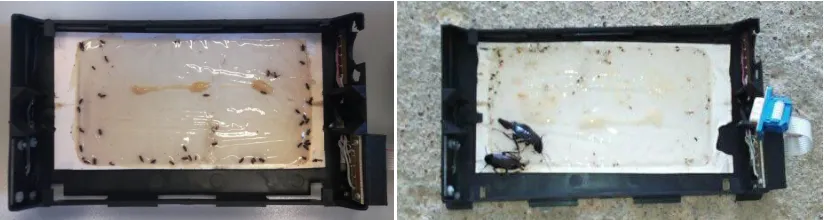
accidentally were not included in the results. During each manual inspection the sticky
surface with captured insects was removed for examination in the lab (Fig.4) and
replaced by an identical one clean sticky cardboard surface. In all cases special
attractant was placed in the centre of sticky surface in order to achieve sufficient
UK) for stored food beetles, 25% sugar solution for ants, and Trapper roach attractant
(Bell Laboratories, USA) for cockroaches.
Fig. 4. Evaluation of reported results. Sticky surface inside the trap after 2 days of placement in (left) a cereal grain storage facility with serious insect infestations, (right) in an old food warehouse with an increased presence of cockroaches.
Results & Discussion
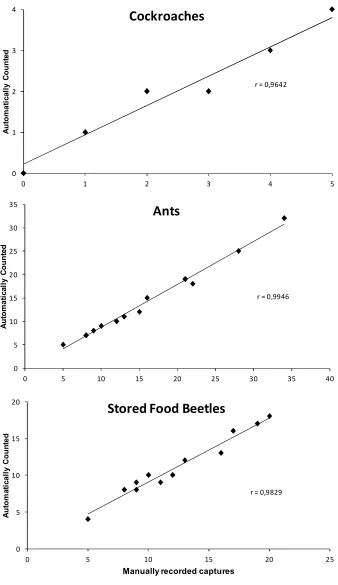
Results from the evaluation of the prototype trap are presented in Fig 5. As it is clearly
depicted, our smart trap is very accurate, achieving 96-99% accuracy on automatic
counts compared with manually counted numbers of captured insects. The accuracy
of our system in detecting insect presence is also shown by the very high correlation
(r > 0.96 in all cases) between the generated signals and actual numbers of insects
Fig. 5. Accuracy of the automatic counting in comparison with actual detection, each species target insect. The values of the correlation coefficient r prove that our system is >96% accurate (when detected and counted values are the same then r equals to 1)
r = 0,9642
0 1 2 3 4
0 1 2 3 4 5
A u to m a ti c a ll y C o u n te d
Cockroaches
r = 0,9946
0 5 10 15 20 25 30 35
0 5 10 15 20 25 30 35 40
A u to m a ti c a ll y C o u n te d
Ants
r = 0,9829
0 5 10 15 20
0 5 10 15 20 25
A u to m a ti c a ll y C o u n te d
Manually recorded captures
To the best of our knowledge, it is the first time that an automated remote
system is evaluated under real conditions in detecting insect pests in urban
environments. A few lab studies have been carried out on the development of similar
systems for the detection of urban insects [31, 32]. The accuracy of our system is
higher than all of the abovementioned monitoring systems.
Our study aims to introduce a novel trap-device that we believe it can find its
place to every urban environment such as houses, hotel rooms, hospitals, military
camps and food markets and storages. Such a device will curtail the cost of Integrated
Pest Management (IPM) applied to hotels as it will limit the application of IPM from a
prescheduled basis (i.e. once a year) to an on-time, localized (i.e. per room) application
of IPM. More on, it allows the hotel to advertise that it takes best action to protect its
customers and its children by applying surveillance control on insects. Hospitals can
be equipped with such a device per room that can be hidden conveniently under a bed
or fixed to the wall.
It has been well documented that insects may act as a "pathogen reservoir", which
especially in a hospital environment, may cause serious health hazards [33-35]. Insect
problems can be detrimental for the financial prospect of a private hospital
establishment or for the managemental capability of the head of the hotel and finally
of the Ministry of Health [36].
Again, the presence of Ants, Cockroaches, Bed Bugs or stored food insects in
home residencies, schools or even in Military Camps may become a serious problem
with unforeseen consequences [2,37]. With a cost of a good alarm clock the device
has the prospect to be widely accepted by typical residencies at least to one device
per house.
The suggested product conforms with the concept of the smart house and
through the emerging trend of IoT it can connect the concept of a smart house to a
smart city that keeps an eye-watch on the insects.
Conclusions
With the recent advancements in wireless communications, networks and
integrated sensors, the ability to use Wireless Sensor Networks (WSNs) to cover large
areas with a network of IoT nodes that collectively transmit information to a central
server in real-time has become available. WSNs have been demonstrated to exhibit
the potential of being used in massive scale for environmental parameter monitoring.
While they are constantly evolving to the point of a widely used technology, the
limitations to the use of off-the-shelf solutions, thus leading to the design and
development of custom hardware. This is due to the type of sensor (imaging and
presence), the application field, the need for low power operation, adaptable size to
match the trap, robustness to environmental conditions, the need for spatial coverage
and the existence of isolated or remote monitoring spots. The main concept is to hide
a small, affordable device for insect surveillance of urban crawling insects and forget
its existence until the user receives a picture in his/her mobile.
The smart trap presented in this work was developed following the above
requirements, for fully automated operation. The cost and size will allow multiple traps
to be installed in possibly concealed locations such as under beds, as instructed by
the IPM strategy with a sole technical requirement of sufficient Wi-Fi coverage, which
is nowadays taken for granted in most indoor environments.
As the events are relayed via wireless networking, following the IoT
architecture, these traps may be integrated to any smart-building infrastructure. This
may allow the establishment of applications ranging from end-user notification/alerting
in order to take appropriate measures, to condition based insect management
depending on set business rules. Moreover, as insect infestation may not be localized
on a building basis but be widespread, by centralizing the server infrastructure and
providing geolocational information for each smart trap, an interactive infestation map
may be created, adding the system to the smart city concept. Future work relates
detection of urban insects and deep learning as in the paradigm of Zhong [29], where
the device automatically counts the insects and reports their identity and Sadegh et all [30] on wild animals.
References
1. European Commission (2010). Making Our Cities Attractive and Sustainable: How the EU Contributes to Improving the Urban Environment. Publications Office of the European Union
2. Robinson, W. H. (2005). Urban insects and arachnids: a handbook of urban entomology. Cambridge University Press.
3. McIntyre, N. E. (2000). Ecology of urban arthropods: a review and a call to action.
Annals of the Entomological Society of America, 93(4), 825-835.
4. Bonnefoy, X., Kampen, H., & Sweeney, K. (2008). Public health significance of urban pests. World Health Organization.
5. Dhang, P. (Ed.). (2011). Urban pest management: An environmental perspective. CABI.
6. Dhang, P. (Ed.). (2014). Urban Insect Pests: Sustainable Management Strategies. CABI.
8. Kaakeh, W., & Bennett, G. W. (1997). Evaluation of trapping and vacuuming compared with low-impact insecticide tactics for managing German cockroaches in residences. Journal of economic entomology, 90(4), 976-982.
9. Ballard, J. B., & Gold, R. E. (1983). Field evaluation of two trap designs used for control of German cockroach populations. Journal of the Kansas Entomological Society, 506-510.
10. Rivault, C., Cloarec, A., & Le Guyader, A. (1993). Bacterial load of cockroaches in relation to urban environment. Epidemiology & Infection, 110(2), 317-325.
11. Elgderi, R. M., Ghenghesh, K. S., & Berbash, N. (2006). Carriage by the German cockroach (Blattella germanica) of multiple-antibiotic-resistant bacteria that are potentially pathogenic to humans, in hospitals and households in Tripoli, Libya.
Annals of Tropical Medicine & Parasitology, 100(1), 55-62.
12. Kutrup, B. (2002). Cockroach infestation in some hospitals in Trabzon, Turkey.
Turkish Journal of Zoology, 27(1), 73-77.
13. Kang, B., Vellody, D., Homburger, H., & Yunginger, J. W. (1979). Cockroach cause of allergic asthma: its specificity and immunologic profile. Journal of Allergy and Clinical Immunology, 63(2), 80-86.
14. Eggleston, P. A., & Arruda, L. K. (2001). Ecology and elimination of cockroaches and allergens in the home. Journal of Allergy and Clinical Immunology, 107(3), S422-S429.
15. Rust, M. K., & Su, N. Y. (2012). Managing social insects of urban importance.
Annual review of entomology, 57, 355-375.
16. Máximo, H. J., Felizatti, H. L., Ceccato, M., Cintra-Socolowski, P., & Beretta, A. L. R. Z. (2014). Ants as vectors of pathogenic microorganisms in a hospital in São Paulo county, Brazil. BMC research notes, 7(1), 554.
17. Whitmore, R. W., Kelly, J. E., & Reading, P. L. (1992). National home and garden pesticide use survey, final report. Volume I: executive summary, results, and recommendations.
18. Jemal, A., & Hugh-Jones, M. (1993). A review of the red imported fire ant (Solenopsis invicta Buren) and its impacts on plant, animal, and human health.
Preventive Veterinary Medicine, 17(1-2), 19-32.
19. Wetterer, J. K. (2010). Worldwide spread of the pharaoh ant, Monomorium pharaonis (Hymenoptera: For-micidae). Myrmecological News 13:115-129
20. Hansen, L. D., Akre, R. D., Wildey, K., & Robinson, W. (1993). Urban pest management of carpenter ants. In Proceedings of the first International Conference on Urban Pests. (pp. 271-279).
21. Rees, D. P. (2004). Insects of stored products. Csiro Publishing.
22. Subramanyam, B. (Ed.). (1995). Integrated management of insects in stored products. CRC Press.
23. Jansson S., Brydegaard M., Passive kHz lidar for the quantification of insect
activity and dispersal, Animal Biotelemetry, 20186:6,
https://doi.org/10.1186/s40317-018-0151-5
24. Perles, A.; Mercado, R.; Capella, J.V.; Serrano, J.J. Ultra-Low Power Optical Sensor for Xylophagous Insect Detection in Wood. Sensors 2016, 16, 1977. 25. Potamitis I, Rigakis I, Fysarakis K (2015) Insect Biometrics: Optoacoustic Signal
Processing and Its Applications to Remote Monitoring of McPhail Type Traps. PLoS ONE 10(11): e0140474. doi:10.1371/journal.pone.0140474
26. Potamitis I., Rigakis I., Tatlas N-A., Automated Surveillance of Fruit Flies.Sensors2017,17, 110.
27. Potamitis I., Rigakis I. Large Aperture Optoelectronic Devices to Record and Time-stamp Insects’ Wingbeats, IEEE Sensors Journal, Volume: 16, Issue: 15, Aug.1, pp. 6053-6061, 2016.
29. Zhong, Y.; Gao, J.; Lei, Q.; Zhou, Y. A Vision-Based Counting and Recognition System for Flying Insects in Intelligent Agriculture. Sensors 2018, 18, 1489 30. Wang, C., & Bennett, G. W. (2006). Comparative study of integrated pest
management and baiting for German cockroach management in public housing.
Journal of economic entomology, 99(3), 879-885.
31. Mankin, R. W., Hodges, R. D., Nagle, H. T., Schal, C., Pereira, R. M., & Koehler, P. G. (2010). Acoustic indicators for targeted detection of stored product and urban insect pests by inexpensive infrared, acoustic, and vibrational detection of movement. Journal of economic entomology, 103(5), 1636-1646.
32. Oliver-Villanueva, J. V., & Abián-Pérez, M. A. (2013). Advanced wireless sensors for termite detection in wood constructions. Wood science and technology, 47(2), 269-280.
33. Fakoorziba, M. R., Eghbal, F., Hassanzadeh, J., & Moemenbellah-Fard, M. D. (2010). Cockroaches (Periplaneta americana and Blattella germanica) as potential vectors of the pathogenic bacteria found in nosocomial infections. Annals of Tropical Medicine & Parasitology, 104(6), 521-528.
34. Feizhaddad, M. H., Kassiri, H., Sepand, M. R., & Ghasemi, F. (2012). Bacteriological survey of American cockroaches in hospitals. Middle East J Sci Res, 12(7), 985-9.
35. Garcia, F. R. M., & Lise, F. (2013). Ants associated with pathogenic microorganisms in brazilian hospitals: attention to a silent vector. Acta Scientiarum. Health Sciences, 35(1).
36. Owens, K., & Pesticides, B. (2003). Healthy hospitals controlling pests without harmful pesticides. In Healthy hospitals controlling pests without harmful pesticides. HCWH.
37. Daar, S., Drlik, T., Olkowski, H., & Olkowski, W. (1997). IPM for Schools: A How-To Manual. United States Environmental Protection Agency.