_____________________________________________________________________________________________________
*Corresponding author: E-mail: [email protected];
Chemical and Minerals Composition of Dried
Ruminal Fluid with Spray Drying Method with
Various Hydrocolloids
Fariba Rezai-Sarteshnizi
1*, Hossein Abdi-Benemar
1and Jamal Seifdavati
11
Department of Animal Science, University of Mohaghegh Ardabili, Ardabil, Iran.
Authors’ contributions
This work was carried out in collaboration among all authors. Author FRS designed the study, performed the statistical analysis, wrote the protocol and wrote the first draft of the manuscript. Authors HAB and JS managed the analyses of the study. Author FRS managed the literature searches. All authors read and approved the final manuscript.
Article Information
Editor(s): (1)Dr. Fabio da Costa Henry, Associate Professor, Technology of Animal Products, State University of Northern of Rio de Janeiro, UENF, Brasil. (2)Dr. Hazem Mohammed Ebraheem Shaheen, Professor, Department of Pharmacology, Faculty of Veterinary Medicine, Damanhour University, Egypt. Reviewers: (1) Luis Chel-Guerrero, Universidad Autónoma de Yucatán, México. (2)Lucian Ioniță, Romania. (3)Aminu Muhammad Sakaba, College of Agriculture, Zuru, Nigeria. (4)Shittu M. Daniel, Ladoke Akintola University of Technology, (LAUTECH), Nigeria. Complete Peer review History:http://www.sdiarticle3.com/review-history/46134
Received 12 November 2018 Accepted 22 January 2019 Published 17 April 2019
ABSTRACT
This study was conducted to determine the chemical and minerals composition of dried ruminal fluid with spray drying method with various hydrocolloids. Rumen contents were taken from the slaughterhouse and powdered by spray drying with different hydrocolloids including sodium alginate (RA), guar gum (RG), chitosan (RC) and maltodextrin (RM) in two ratios (0.5 and 1% (w/v)). Samples were analyzed with a completely randomized design. The results of mean percentages showed the samples contained moisture (617 ± 0.60 to 7.29 ± 0.03%), crude protein (9.96 ± 0.06 to 13.02 ± 0.04%), ether extract (1.82 ± 0.11 to 3.43 ± 0.13%), Ash (16.25 ± 0.21 to 22.67 ± 0.15%), NDF (24.18 ± 0.12 to 27.90 ± 0.10%), and carbohydrates (36.84 ± 0.05 to 44.54 ± 0.56%). The minerals were sodium (1.98 ± 0.12 to 4.02 ± 0.17%), potassium (0.46 ± 0.07 to 0.76 ± 0.10%), magnesium (0.69 ± 0.05 to 1.02 ± 0.07%), calcium (0.33 ± 0.02 to 0.70±0.05%) and
phosphorous (1.22 ± 0.07 to 1.87± 0.01%). The results indicated that dried ruminal fluid with spray drying method with various hydrocolloids has nutrition values that could provide nutrients and minerals for livestock. It is recommended in the diet of animals.
Keywords: Proximate composition; ruminal fluid; spray drying; hydrocolloids; mineral.
1. INTRODUCTION
The global shortage of animal feed increases the share of livestock feed costs and the income generated by the production of livestock products has been affected. In order to compensate for this shortage, the utilization and optimal use of agricultural waste and agricultural products as feed in ruminants is inevitable to improve livestock production [1]. Large amounts of rumen content are produced daily as a byproduct in slaughterhouses [2]. These pollutants pollute the environment by releasing toxic gases, including methane, nitrogen dioxide and other gases in the atmosphere [3]. Also, the rumen fluid contains high levels of ammonia and phosphorus [4]. Therefore, rumen fluid is a serious environmental
contaminant in most slaughterhouses in
developing countries [5]. The contents of the rumen are rich in raw microbial protein and contains forage materials digested in different stages of fermentation, saliva, amino acids, group B vitamins and end products of ruminal fermentation [6], rich in minerals [7]. As well as antiphysiological factor [5]. Sun-dried rumen digesta has been reported to contain 11.18% crude protein, 22.99% crude fiber, 1.22% ether extract, 21.54% ash, 0.20% calcium and 0.45% phosphorous [8]. Sakaba et al. [9] also reported the composition of rumen digesta from sheep slaughtered in Zuru Abattoir was 5.83% moisture, 15.52% crude protein, 5.17% lipids, 48.17% fiber, 11.00% ash, 19.98% soluble
carbohydrate, 19.98% Sodium, 4.37%
Potassium, 0.42% magnasium, 0.45% calcium and 4.37% phosphprous from sun-dried rumen digesta. The benefits of recycling ruminal liquid as slaughter waste reduces environmental pollution, also, it is a source of feed for ruminants [3]. With proper processing, the rumen content can provide a large supply of nutrients when it enters the ration [10]. And the protein needs of high-producing animals [11]. Drying can be used as a solvent reduction, which is usually water, to produce a stable and saveable product [12]. Spray drying is one of the encapsulation methods used to dry the heat-sensitive materials and a simple, quick, and economical technique for obtaining a powder from a solution or a liquid suspenson (such as an enzyme suspension)
[13]. Some Binding agents, such as
disaccharides, are added to the protein and improve sustainability during the build and save process. Many studies have shown the protective effects of connective materials for denaturation [14]. Therefore, some carbohydrates (such as starch, maltodextrin and dextrose), gums (such as Arabic gum, acacia gum, sodium alginate and carrageenans), proteins (such as milk or whey protein, gelatin) and chitosan are used in spray drying methods [15]. So far, no research has been done on the approximate compounds of dried ruminal fluid by spray drying method with different hydrocolloids. This study was conducted to determine the composition of this substances.
2. MATERIALS AND METHODS
2.1 Sample Preparation and Spray Drying
The rumen contents were taken from the slaughterhouse and was transferred to a lab inside a pre-warmed containers. Then, the ruminal fluid containing digestive material was mixed with a blender for 2 minutes while injected with carbon dioxide gas. In order to separate rumen fluid from rumen solid materials filtration through four-layers cheesecloth was used. Then, The collected rumen fluid were spray dried by using different hydrocolloids including sodium alginate (Sigma-Aldrich, CAS Number, 9005-38-3, chemical Book), guar gum (Sigma-Aldrich, CAS Number, 9003-30-0), chitosan
(Sigma-Aldrich, CAS Number, 9012-76-4, Tokyo
two-fluid nozzles (inner diameter: 0.5 mm) was used for spray drying. The system was operated in a co-current manner with an inlet and outlet air temperature of 120°C and 50°C, respectively. Feed rate change in 240e640 mL/h was
necessary to achieve a constant outlet
temperature. A spray flow rate of 500 mL/h was used and the aspiration rate was 70%. The powdered samples were stored in two layers polyester bags and kept in the refrigerator (5°C) until analysis.
2.2 Chemical Analysis
The samples of dried ruminal fluid with spray
drying method with various hydrocolloids
analysised for dry matte, ash, ether extract and crud protein according to AOAC [16]. The nitrogen-free extract was calculated by reducing samples % ash, % NDF, % Ether Extract, % crude protein, crude fat from 100 to the following formula.
NFE = 100 − (%ash + %NDF + % Ether Extract + % crude protein).
2.3 Determination of Minerals
The minerals of samples were determined according to AOAC [16]. Sodium and potassium were determined by photometric method using FP 640, Jeumeay and phosphorous was measured through Vonado molybdate Yellow method using spectrometer Jenway 1315 UK (UV-visible). The amount of calcium and magnesium were determined using Atomic Absorption Spectrometer (Buck 210, AAS).
2.4 Data Collection and Statistical
Analysis
Data were analyzed by the GLM procedure of SAS [17] according to the randomized complete design as following model: Yij= µ + Ti + eij, where
y was the dependent variable, µ was overall mean, Ti was the effect of of spray drying method
with different hydrocolloids. Comparison between different hydrocolloids added was done Tukey test and the significant differences were declared at P<0.05.
3. RESULTS AND DISCUSSION
The amount of moisture has a range of 6.17 ± 0.60 % to 7.29 ± 0.0.3% and is the highest in RA1 and the lowest in RC1 (Table 1). The values for moisture are lower than 14.64% and 17.48%
reported by Gebrehawariat et al. [8] and
Agbabiaka, Madubuike and Amadi [18]. The
variation in the moisture content of the samples in this study could be attributed to the processing method. Because in this method, rumen fluid samples are dried with spray drying method
samples can be exposed to extreme
temperatures for a few seconds [19], which can lead to a decrease in moisture. The spray drying method produces a stable and storeable product that can be stored for a long time [19]. Among the tested hydrocolloids sodium alginatewas more successful in reducing the ruminal fluid moisture content. The crude protein content of this material ranged from 9.98 ± 0.09% to 13.02 ± 0.04% and the highest was RC0.5, and the lowest was RG1 (Table 1). These values were lower than the 18.58 percent reported by Agbabiaka, Anukam and Nwachukwu [20] and in the study of Gebrehawariat et al. [8]. was 11.80 and in Sakaba et al. [21] study, it was reported at 15.35%. Spray drying technique may alter the 3D protein structure similar to denaturation [22]. The cutting forces that occur in the nozzle of the device also cause the protein to be denatured [23]. Protective effects of hydrocolloids have been reported in relation to the denaturation of heat [24] and the change in the 3D structure of the protein decreases in the presence of compounds such as polysaccharides, proteins or salts [22]. 0.5% chitosan during the spray drying method maintained the percentage of rumen fluid protein. Also the variation in the amount of crude protein is related to the variety and quality of forage consumed by the animal and the soil from which the forage is grown. It can be due to the population and activity of microorganisms during the pre-killing period [25,26]. And the ruminal liquid dried with spray drying with this percentage of the protein recommended in the ration of the animal.
the least amount between RA1. RA0.05 and RC1.The NDF content has a range of 27.90 ± 0.10 % to 24.18 ± 0.12%. And its highest value in RC1 and its lowest value in RM0.5. There is no
statistically significant difference between
RM0.05, RA1 and RA 0.05 (Table 1). These values were greater than 11.00%, 18.44% and 22.99% reported by Sakaba et al. [9]. Sakaba et al. [21] and Gebrehawariat et al. [8] and less than of the 34.91 percent reported by Agbabiaka, Madubuike and Amadi [18]. In this study, the chitosan itself has been used as a fiber and has been effective in increasing NDF content. Also, the variation in the amount of NDF depends on the stage of maturity and the degree of fibrillation
of the forage used in the livestock. The amount of carbohydrates (36.84 ± 0.05% to 44.54 ± 0.56%) in this study (Table 1) was more than 19.98 reported by Sakaba et al. [9] and with amount 40.8 of and 38.13 reported by Dairo et al. [24], Agbabiaka Madubuike and Amadi [18] almost equal. This is attributed to the sparing effect of carbohydrate. The chemical analysis of ruminal liquid dried with spray drying method and various hydrocolloids have shown that these materials are active after spray drying and can be used as an additive in the diet of animals. Compared to the drying method in the sun, this
method does not reduce the chemical
composition of these contents.
Table 1. Approximate analysis of ruminal liquid dried with the spray drying method to various hydrocolloids
Item Moistre (%) CP (%) EE (%) Ash (%) NDF (%) NFE (%)
RM0.5 6.6±0.10bc 12.54±0.03d 2.94±0.18b 20.20±0.75c 24.18±0.12f 39.26±0.23d
RM1 6.23±0.17cd 12.70±0.06c 2.59±0.07d 21.89±0.28b 24.45±0.18f 38.48±0.26d
RC0.5 6.29±0.03cd 13.02±0.04a 2.80±0.07bc 17.33±0.32d 27.29±0.26b 39.43±0.09cd
RC1 6.17±0.60d 12.57±0.05d 3.43±0.13a 16.85±0.33e 27.90±0.10a 36.84±0.05e
RG0.5 6.80±0.05b 10.51±0.07e 2.28±0.12e 22.67±0.15 a 26.58±0.33c 38.42±0.27d
RG1 6.24±0.05cd 9.96±0.09f 2.61±0.15cd 20.15±0.40c 27.51±0.17b 40.30±0.63c
RA0.5 6.80±0.05b 12.92±0.20b 2.77±0.07bcd 16.66±0.25e 24.46±0.39f 42.37±1.02b
RA1 7.29±0.03a 12.30±0.12d 1.82±0.11f 16.25±0.21e 25.45±0.16d 44.54±0.56a
RN 6.25±0.06cd 10.6±0.17e 2.83±0.09bc 20.14±0.09c 25.02±0.11e 44.14±0.92a
P-value <.0001 <.0001 <.0001 <.0001 <.0001 <.0001
SEM 0.08 0.22 0.01 0.11 0.07 0.19
Spray dried rumen fluid with 0.5% (RM0.5) and 1% (RM1) maltodextrin, with 0.5% (RC0.5) and 1% (RC1) chitosan, with 0.5% (RG0.5) and 1% (RG1) guar gum, with 0.5% (RA0.5) and 1% (RA1) sodium alginate, and
with no hydrocolloids added (RN).
The Chemical analysis % are given as mean ± slandered error. Different superscripts indicate significant differences in a column.
Significance level was considered at P < 0.05
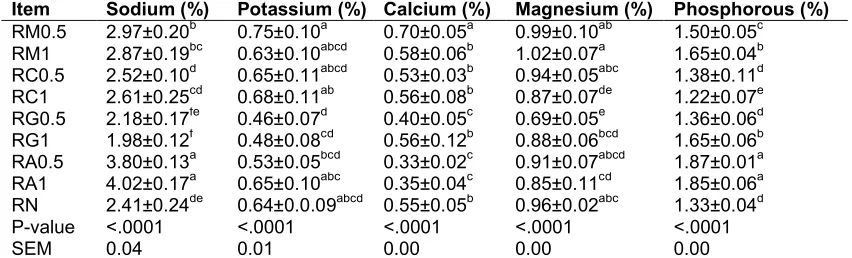
Table 2. Mineral composition of ruminal liquid dried with the spray drying method with various hydrocolloids
Item Sodium (%) Potassium (%) Calcium (%) Magnesium (%) Phosphorous (%)
RM0.5 2.97±0.20b 0.75±0.10a 0.70±0.05a 0.99±0.10ab 1.50±0.05c
RM1 2.87±0.19bc 0.63±0.10abcd 0.58±0.06b 1.02±0.07a 1.65±0.04b
RC0.5 2.52±0.10d 0.65±0.11abcd 0.53±0.03b 0.94±0.05abc 1.38±0.11d
RC1 2.61±0.25cd 0.68±0.11ab 0.56±0.08b 0.87±0.07de 1.22±0.07e
RG0.5 2.18±0.17fe 0.46±0.07d 0.40±0.05c 0.69±0.05e 1.36±0.06d
RG1 1.98±0.12f 0.48±0.08cd 0.56±0.12b 0.88±0.06bcd 1.65±0.06b
RA0.5 3.80±0.13a 0.53±0.05bcd 0.33±0.02c 0.91±0.07abcd 1.87±0.01a
RA1 4.02±0.17a 0.65±0.10abc 0.35±0.04c 0.85±0.11cd 1.85±0.06a
RN 2.41±0.24de 0.64±0.0.09abcd 0.55±0.05b 0.96±0.02abc 1.33±0.04d
P-value <.0001 <.0001 <.0001 <.0001 <.0001
SEM 0.04 0.01 0.00 0.00 0.00
Spray dried rumen fluid with 0.5% (RM0.5) and 1% (RM1) maltodextrin, with 0.5% (RC0.5) and 1% (RC1) chitosan, with 0.5% (RG0.5) and 1% (RG1) guar gum, with 0.5% (RA0.5) and 1% (RA1) sodium alginate, and
with no hydrocolloids added (RN).
The mineral % are given as mean ± slandered error. Different superscripts indicate significant differences in a column.
As shown in Table 2 the amount of sodium has a range of 1.98 ± 0.12 % to 4.20 ± 0.17% percent in this study, with the highest value of RA1 being the lowest in RG1. There is no statistically significant difference between RA1and RA0.05. That this amount of sodium was less than 19.98 percent reported by Sankaba et al. [9]. In the Sakaba et al. [9] study was 2.46 percent. In this study, hydrocolloid sodium alginate has a sodium element and has been effective in increasing sodium content. The amount of potassium in this study ranged from 0.46 ± 0.07 % to 0.75 ± 0.10%. The amount of potassium in the Sakaba et al. [9] study was 0.64%. The amount of calcium had a range of 0.33 ± 0.02 % to 0.70 ± 0.05 % in this study. The amount of magnesium was 0.69 ± 0.05 % to 1.02 ± 0.07 % and the phosphorus content was 1.22 ± 0.07 % to 1.87 ± 0.01% percent. This study showed that the ruminal fluid dried with spray drying method with different hydrocolloids had minerals.
4. CONCLUSION AND RECOMMENDA-TIONS
The ruminal fluid, in addition to microorganisms, vitamins containing microbial protein, enzymes and Minerals. By using a drying method, it can be converted to a dry, storageable, portable material. The values for chemical and minerals composition obtained from the dried ruminal fluid
with spray drying method with various
hydrocolloids indicated the ability of the materal to provide the nutrients particularly protein required by animals for normal physiological activities. The material is however deficient
mineral for livestock nutrition; Therefore,
supplementation is required. From the above conclusion, farmers can use the dried ruminal fluid with spray drying method with various hydrocolloids for livestock feeding trials. More research is needed on the use of these materials in domestic animals.
ETHICAL APPROVAL
As per international standard or university standard written ethical approval has been collected and preserved by the author(s).
COMPETING INTERESTS
Authors have declared that no competing interests exist.
REFERENCES
1. Negesse T, Patra AK, Dawson LJ, Tolera
A, Merkel RC, Sahlu T Goetsch AL.
Performance of Spanish and boer×spanish doelings consuming diets with different levels of broiler litter. Small Ruminant
Research. 2007;69(1-3):187-197.
2. Said IF, Elkhair RMA, Shawky SM,
Abdelrahman HA, Elfeki MA. Impact of feeding dried rumen content and olive pulp with or without enzymes on growth performance, carcass characteristics and some blood parameters of Molar ducks. International Journal Agricultyral Reserch.
2015;4:2319-2473.
3. Mondal S, Haldar S, Samanta I, Samanta
G, Ghosh TK. Exploring nutritive potential of undigested rumen contents as an ingredient in feeding of goats. Animal Nutrition and Feed Technology (India). 2013;13:79-88.
4. Tritt WP, Schuchardt F. Materials flow and
possibilities of treating liquid and solid wastes from slaughterhouses in Germany.
A review. Bioresource Technology.
1992;41(3):235-245.
5. Cherdthong A, Wanapat M. Manipulation
of in vitro ruminal fermentatation and
digestibility by dried rumen digesta.
Livestock Science. 2013;153(1-3):49-
100.
6. Cherdthong A, Wanapat M, Seankamorsn
A, Sopapong C, Anantasook N, Gunun P. Improving rumen ecology and microbial population by dried rumen digesta in beef
cattle. Tropical Animal Health and
Production. 2015;47(5):921–926.
7. Elfaki MOA, Abdelatti KA. Nutritive
evaluation of rumen content from cattle, camel, sheep and goats. Global Journal of Animal Scientific Research. 2015;3(3):617-621.
8. Gebrehawariat E, Animut G, Urge M,
Mekasha Y. Sun Dried Bovine Rumen Content (SBRC) as an ingredient of a ration for white leghorn layers. East African Journal of Science. 2016;10(1):29-40.
9. Sakaba AM, Hassan AU, Harande IS,
Isgogo MS, Maiyama FA, Danbare BM. Proximate composition of rumen digesta from sheep slaughtered in Zuru Abattoir, Kebbi State, Nigeria. Journal of Agriultural Science and Practice. 2017;2:86-89.
10. Okpanachi U, Aribido SO, Daikwo IS.
11. Boorman KN, Ellis GM. Maximum nutritional response to poor quality and amino acid utilization. British Poultry Science. 1996;37(1):145-156.
12. Namaldi A, Calik P, Uludag Y. Effects of spray drying temperature and additives on the stability of serine alkaline protease powders. Drying Technology. 2006;24(11): 1495–1500.
13. Bajsic I, Kranjcevic E. Automation of
industrial spray dryer. Instrumentation
Science and Technology.
2001;29(1):41-52.
14. Jalalipour M, Gilani K, Tajerzadeh H,
Najafabadi AR, Barghi M. Characterization and aerodynamic evaluation of spray dried recombinant human growth hormone using protein stabilizing agents. International Journal of Pharmaceutics. 2008;352(1-2): 209-216.
15. Gharsallaoui A, Roudaut G, Chmbin O,
Voilley A, Saurel R. Applications of spray-drying in microencapsulation of food ingredients: An overview. Food
Research International.
2007;40(9):1107-1121.
16. AOAC. Official methods of analysis 18th
Ed. Association of Official Analytical Chemist, Washington, DC; 2005.
17. SAS Institute, SAS User’s Guide:
Statistics, Release 9.1. SAS Institute. Inc, Cary, NC; 2003.
18. Agbabiaka LA, Madubuike FN, Amadi SA.
Studies on nutrients and anti-nurients of
rumen digesta from three most
domesticated ruminants in Nigeria.
Pakistan Journal of Nutrition. 2012;11(7): 580-582.
19. Namaldi A, Calik P, Uludag Y. Effects of spray drying temperature and additives on the stability of serine alkaline protease
powders.Drying Technology. 2006;24(11):
1495–1500.
20. Agbabiaka LA, Anukam KU, Nwachukw
VN. Nutritive value of dried rumen digesta as replacement for soybean in diets of Nile Tilapia (Oreochromis niloticus) fingerlings. Pakistan Journal of Nutrition. 2011;10(6): 568-571.
21. Sakaba AM, Isgogo SM, Hassan AU,
Sanchi UZ. Proximate composition of sun-dried rumen digesta from goat slaughtered in Zuru Central Slaughterhouse, Kebbi State, Nigeria. Asian Journal Research in Animal Veterinary Sciences. 2018;1(3):1-5.
22. Alloue WA, Destain MJ, Amighi K, Thonart
P. Storage of Yarrowia lipolytica lipase after spray-drying in the presence of
additives. Process Biochemistry. 2007;
42(9):1357-1361.
23. Gharsallaoui A, Roudaut G, Chambin O,
Voilley A, Saurel R. Applications of spray-drying in microencapsulation of food ingredients: An overview. Food Research International. 2007;40(9):1107-1121.
24. Schüle S, Schulz-Fademrecht T, Garidel P,
Bechtold-Peters K, Frieß W. Stabilization of Igg1 in spray-dried powders for
inhalation. European Journal of
Pharmaceutics and Biopharmaceutics.
2008;69(3):793-807.
25. Dairo FA, Aina SOO, Asafa AR.
Performance evaluation of growing rabbits fed varying levels of rumen content and blood rumen content mixture. Nigerian Journal of Animal Production. 2005;32:67-72.
26. Abouheif MA, Kraidees MS, Al-Sebood BA.
The utilization of rumen content-barley meal in diets of growing lambs. Asian-Australian Journal of Animal Science. 1999;12(8):1234-1240.
_________________________________________________________________________________
© 2019 Rezai-Sarteshnizi et al.; This is an Open Access article distributed under the terms of the Creative Commons Attribution License (http://creativecommons.org/licenses/by/4.0), which permits unrestricted use, distribution, and reproduction in any medium, provided the original work is properly cited.
Peer-review history: