https://doi.org/10.5194/npg-26-163-2019 © Author(s) 2019. This work is distributed under the Creative Commons Attribution 4.0 License.
The adaptive particle swarm optimization technique for solving
microseismic source location parameters
Hong-Mei Sun1,2, Jian-Zhi Yu1,2, Xing-Li Zhang1,2, Bin-Guo Wang1,2, and Rui-Sheng Jia1,2
1College of Computer Science and Engineering, Shandong University of Science and Technology, Qingdao 266590, China 2Shandong Province Key Laboratory of Wisdom Mine Information Technology, Shandong University of Science and Technology, Qingdao 266590, China
Correspondence:Rui-Sheng Jia ([email protected]) Received: 22 March 2019 – Discussion started: 2 April 2019
Revised: 23 June 2019 – Accepted: 25 June 2019 – Published: 15 July 2019
Abstract. An intelligent method is presented for locating a microseismic source based on the particle swarm optimiza-tion (PSO) concept. It eliminates microseismic source locat-ing errors caused by the inaccurate velocity model of the earth medium. The method uses, as the target of PSO, a global minimum of the sum of squared discrepancies be-tween differences of modeled arrival times and differences of measured arrival times. The discrepancies are calculated for all pairs of detectors of a seismic monitoring system. Then, the adaptive PSO algorithm is applied to locate the micro-seismic source and obtain optimal value of the P-wave ve-locity. The PSO algorithm adjusts inertia weight, accelerat-ing constants, the maximum flight velocity of particles, and other parameters to avoid the PSO algorithm trapping by lo-cal optima during the solution process. The origin time of the microseismic event is estimated by minimizing the sum of squared discrepancies between the modeled arrival times and the measured arrival times. This sum is calculated us-ing the obtained estimates of the microseismic source coor-dinates and P-wave velocity. The effectiveness of the PSO al-gorithm was verified through inversion of a theoretical model and two analyses of actual data from mine blasts in different locations. Compared with the classic least squares method (LSM), the PSO algorithm displays faster convergence and higher accuracy of microseismic source location. Moreover, there is no need to measure the microseismic wave velocity in advance: the PSO algorithm eliminates the adverse effects caused by error in the P-wave velocity when locating a mi-croseismic source using traditional methods.
1 Introduction
Microseismic monitoring technology can be used for effec-tively locating rock ruptures caused by rock burst, coal and gas outbursts, water inrush, and other coal mine disasters. In recent years it was also used in early warning systems (Li et al., 2016; Pastén et al., 2015; Jia et al., 2015). The spa-tial coordinates of monitoring stations and the arrival times of the first seismic wave are used to determine the coordi-nates of the microseismic source, origin time, and other at-tributes. The accuracy of microseismic source location has been an important research topic in microseismic monitoring technology for a long time.
math-ematical algorithms of microseismic source location where there is no need to predict velocity in advance. The algo-rithms overcome location errors caused by errors of velocity measurement inherent in traditional location methods. Lin et al. (2010) analyzed the characteristics of the linear loca-tion method and Geiger method and proposed a joint method to address the problem of low precision in estimation of source coordinates inherent in the linear location method. Feng et al. (2015) proposed stratified methods for microseis-mic source location based on particle swarm optimization to obtain correlations among the source position, origin time, and microseismic propagation speed for a non-unique solu-tion.
In conclusion we note that the microseismic source loca-tion accuracy is influenced by many factors, such as the lo-cation method, the layout of the microseismic network, the velocity model, and the accuracy of the arrival-time mea-surement (Dong and Li, 2013). Among these, the key factor influencing the stability of the location algorithm and the lo-cation accuracy is precision of the velocity model (Prange et al., 2015; Li et al., 2014; Usher et al., 2013). In this paper, an adaptive particle swarm optimization algorithm is proposed for microseismic source location, which is based on average flying velocity of the particles. It uses, as the particle swarm optimization (PSO) target function, the least squares sum of measured arrival-time differences for all pairs of seismic sen-sors and uses the PSO algorithm to identify the source co-ordinates and microseismic wave velocity. Then, the origin time of the microseismic event is calculated according to the source location just determined and the wave velocity. Pa-rameters of the PSO algorithm, such as the inertia weight, the acceleration constants, and the flight velocities of parti-cles, are adaptively adjusted to avoid the algorithm failure caused by the improper selection of these parameters. Care-ful dynamic adjusting of the PSO parameters improves the robustness of the PSO algorithm, reduces the number of iter-ations, and improves estimation of the microseismic source coordinates and the seismic wave velocity.
2 Microseismic source location principle
Suppose that there arengeophones in the microseismic mon-itoring system. Set the microseismic source location point to
r0=(x0, y0, z0), the coordinates of each geophone to ri= (xi, yi, zi)and(i=1, . . ., n), the time of P-wave arrival to
theith geophone of the microseismic monitoring system toti,
and the origin time of the microseismic event tot0. Assuming that the rock layers between the microseismic sources and the geophone are uniform (i.e., uniform velocity model), the equivalent average propagation velocity of the P wave in the medium isV. Then, the theoretical (regression) arrival-time differences foriandj geophones are
1ti,j=ti−tj= li−lj
V , i, j=(1, . . ., n) , (1)
where
li=
q
(xi−x0)2+(yi−y0)2+(zi−z0)2
lj=
q
xj−x02+ yj−y02+ zj−z02
.
The differences between the difference of regression arrival times 1ti,j(r0)and the difference of the measured arrival times1ti,j0 are analogous to the double-difference concept introduced by Waldhauser and Ellsworth (2000). The sum of their squares reflect the degree of discrepancies between regression and observed arrival times. The equation for esti-mation of the microseismic source position has the form
Q (r0, V )=
n
X
i,j=1
1ti,j0 −li(r0)−lj(r0) V
2 =min
r0,V
. (2)
The estimates of microseismic source coordinates rˆ0=
ˆ
x0,yˆ0,zˆ0 and equivalent P-wave velocity in the medium
ˆ
V correspond to those values ofr0=(x0, y0, z0)andV in Eq. (1) and Eq. (2), for which the functionQ (r0, V )reaches a global minimum in the ranges of possible values of the mi-croseismic source coordinates and medium equivalent veloc-ity.
According to time-difference location principles, the equa-tion for calculaequa-tion of the source origin timet0 has the fol-lowing form:
min
t0
F (t0)=min
t0
n
X
i=1
ti0−t0−
li rˆ0
ˆ V
!2
. (3)
In the equation,ti0 denotes the measured travel times; for a case where signal-to-noise ratios in observed signals from microseismic source are sufficiently high and the earth medium between the source and geophones is homogeneous to min
r0
F (t0)≈0, the estimate of the microseism origin time can be calculated as
ˆ t0≈
1
n n
X
i=1
ti0−li rˆ0
ˆ V
!
. (4)
In solving for the seismic source location and origin time, the estimates of source coordinatesrˆ0= xˆ0,yˆ0,zˆ0and the equivalent wave velocityVˆ are obtained first, according to Eq. (2). Then, the estimate of the origin time is determined by substituting the estimated valuesrˆ0andVˆ into Eq. (3) (or in Eq. 4 for the case where min
r0
F (t0)≈0). Because Eq. (2) is a nonnegative function of (x0,y0,z0)andV, a minimum min
r0,V
Q (r0, V )always exists and can be found by the nonlin-ear fitting methods. The classic method is the minimum least squares solution. However, in this solution the source loca-tion estimaterˆ0 correlates with the origin-time estimatetˆ0, and the algorithm has a slow convergence for the velocity
2009). To overcome these problems, this paper introduces an adaptive PSO algorithm to optimize the solution process.
Source location based on the time-difference principle is a multi-extremum nonlinear problem. The most popular method is the classical method proposed by Geiger (1912) and various improvements thereafter. This kind of method is a solution method in the linear category. According to Tay-lor’s formula, the nonlinear problem is transformed into a lin-ear problem, and then different strategies are adopted to solve the linear equation system. In many cases, such as those of a second order or more, this will appear. Problems such as in appropriate omitting of terms, unreasonable selection of initial values, and trapping solutions into local minima will occur (Lee and Stewart, 1981). The particle swarm optimiza-tion (PSO) method is simple to operate and easy to use, and it is easy to get the global optimal solution for multi-extremum nonlinear problems. Therefore, the improved PSO method is introduced to solve the above problems.
3 Adaptive PSO algorithm for solving location parameters
3.1 PSO principle
The PSO is an evolutionary computation technique devel-oped by Eberhart and Kennedy (1995). It is an evolutionary algorithm similar to a simulated annealing optimization algo-rithm for a problem of iterative improvement of a candidate for the solution with regards to a given measure of quality. PSO is an intelligent computational algorithm for analyzing the dynamic behavior of a swarm of particles. In comparison with other similar algorithms, PSO has such advantages as simple implementation, high accuracy, and fast convergence. It has been successfully applied in the field of optimization in recent years (Fong et al., 2016; Renaudineau et al., 2015; Sudheeret al., 2014). The basic PSO principles are as fol-lows: PSO randomly initializes a set of particles in the so-lution space. Each particle flies through the soso-lution space with a certain speed by following the current optimum parti-cle, and the optimal solution is found through the search in successive generations. In each generation, the particles up-date themselves by tracking two types of extreme values: lo-cal optimums and global optimums. The first extreme values are the optimal values for every particle itself in a set of po-sitions of this particle in the sequence of generations that al-ready exist. They are denoted aspBest. The second optimum is the optimal value found in the all existing generations of the whole swarm of particles. It is denoted asgBest. After the two sorts of the optimal values are found, the particles update their speed and positions according to Eq. (5):
(
v(ki,d+1)=w(k)v(k) i,d+c
(k) 1 r1
p(k)i,d−xi,d(k)+c(k)2 r2
p(k)g,d−x(k)i,d xi,d(k+1)=x(k)i,d+vi,d(k+1), i=(1, . . ., n) , d=(1, . . ., m)
, (5)
wheremis the dimension of the particle space,nis a number of particles in the swarm,kis a number of the current evolu-tionary particle generation,r1andr2are independent random values within [0, 1],w(k)is the inertia weight at thekth
parti-cle generation,c(k)1 andc2(k)are acceleration constants at the
kth particle generation,v(k)i,d is the current flight speed for the
dth component of theith particle at thekth generation,xi,d(k)
is thedth component of theith particle’s current location at thekth generation,p(k)i,d is thedth coordinate of the current optimal value for theith particle itself at thekth generation, andpg,d(k) is thedth component of the current optimal value for the total particle population up to thekth generation.
3.2 The algorithm for solving source location parameters
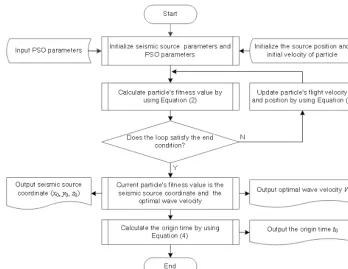
Equation (2) concerns a nonlinear optimization problem with multiple local extrema. The PSO algorithm was developed for solving such problems and can be applied to search for the optimal value in four-dimensional solution space com-posed of (x,y,z, andv), that is, to solve for the source lo-cation and the equivalent seismic velocity.x,y,z, andvare the first, second, third, and fourth component of particles, re-spectively. The flow chart for the PSO algorithm is shown in Fig. 1.
The procedure for the source location parameter evalua-tion based on the PSO algorithm is described as follows.
Step 1. Initialize the model parameters for microseismic source location and the PSO parameters. Randomly initial-ize the source position and wave velocity of the PSO algo-rithm. Initialization of the PSO parameters mainly includes the population sizem, acceleration constantsc1andc2, in-ertia weightw, computational accuracyε, largest number of evolutionary generationsTmax, initial velocity and positions of the particles, and maximum particle flight speed vmax. Then, initialize the iterative counterk.
Step 2. Calculate the particle (microseismic source coor-dinate and velocity model) fitness value by using Eq. (2). The calculated values here are the source’s 3-D coordinates
x0(k), y0(k), z(k)0
and equivalent velocityV(k), wherekis the evolutionary generation number.
Step 3. Judge whether the current parameters of the par-ticles meet the presupposed flight times and positioning ac-curacy or not. If they do, then go to Step 5; otherwise, go to Step 4.
Step 4. Update the flight velocity and particle positions ac-cording to Eq. (5), and then go back to Step 2.
Step 5. Output the estimated source’s 3-D coordinates
ˆ
x0,yˆ0,zˆ0and equivalent wave velocityV .ˆ
Step 6. Calculate and output the origin-time estimate tˆ0
by substituting estimated values of the source coordinates
ˆ x0,yˆ0,zˆ0
Figure 1.Flow chart for the microseismic source location algorithm based on adaptive particle swarm optimization.
3.3 Discussion of PSO algorithm parameters
The parameter values for the PSO algorithm are the keys to influencing the algorithm performance and efficiency. This paper proposes guiding principles for adjusting parameters of the PSO algorithm based on the practical approach for solv-ing for the seismic source parameters.
3.3.1 Inertia weightw(k)
Generally, optimization problems are divided into local and global problems. The former consists of looking for the min-imum in a finite area of function value space; the latter is for finding the minimum in the whole area of function value space. As early as 1998, Shi and Eberhart (1998) found that when the value of inertia weight w is relatively large, the global optimization ability of the PSO algorithm is strong, while the local optimization ability is weak. On the other hand, when the value of inertia weightwis relatively small, the local optimization ability of the PSO algorithm is strong, while the global optimization ability is weak. To avoid par-ticles being stuck in a local optimum at the wrong time or missing the global optimal solution, this study uses the strat-egy of self-adaptive inertia weight to determine the proper value ofw(Zhang and Liao, 2009). The strategy is the fol-lowing.
In order to enhance the exploring competence of the PSO algorithm, the population average velocity should be main-tained to be rather high at the initial stages of evolution, while
in the late stage of evolution a smaller population average ve-locity should be maintained in order to strengthen the devel-opment capabilities of the algorithm. We assume that evo-lution of the average particle flying velocity with changing number of generationskshould be close to the function de-fined by Eq. (6):
v(k)avg=ve(k)=v0e
−
2k Tmax−T1
2
, (6)
wherev0represents the initial average velocity of population,
Tmaxis the largest number of evolutionary generations, and
T1is the number of evolved generations.
We will callv(k)e the expected value of the average flying velocity for a particle population at thekth generation. The actual average velocity of the particle swarm at thekth gen-eration is given by Eq. (7):
vavg(k)= 1 m
m
X
i=1 v u u t
4 X
d=1
vi,d(k)2, (7)
wherev(k)i,d represents the velocity of thedth component of theith particle at thekth generation.
w(k+1)for the (k+l)th generation is determined by Eq. (8):
if v(k)avg> ve(k) then w (k+1)=w (k) /p if v(k)avg< ve(k) then w (k+1)=w (k)·p if v(k)avg=ve(k) thenw (k+1)=w (k) if w (k+1) > wmax then w (k+1)=wmax if w (k+1) < wmin then w (k+1)=wmin
, (8)
wherepis a some constant. Practice has proved that the best value ofpis 1.05 (Zhang and Liao, 2009).
Substitution ofw(k) given by Eq. (8) into Eq. (5) ensures that average velocity v(k)avgwill reduce to zero in the process of population evolution.
3.3.2 Acceleration constantsc(k)1 andc(k)2
Gao and Liao noted that the position xi,d(k) of each particle in the population eventually converges to
c1pi,d+c2pg,d/ (c1+c2) (Gao and Liao, 2012). This means that the position of the particles for a large k will stay close to the lines that connect the global optimum point with the local optimum point. Therefore, in the first stage of particle swarm optimization, the optimum value of the particle itself is an important parameter for making all particles converge to global optimum.
However, if c(k)1 would be high for all kvalues, then the optimum position of the particle swarm would, generally, not coincide with the global optimum of the target function (2). Therefore, at the first stage of PSO,c(k)1 should take a larger value, whilec(k)2 should take a smaller value to promote the local optimization speed. When particle swarm optimization is near its end, the role of the global optimal value should be highlighted. At this stage, c1(k) should take a smaller value, while c(k)2 should take a larger value to help the particle swarm converge to the global optimum. Therefore, the ac-celeration constantsc(k)1 andc2(k) should be designed based on the average velocity of the particle swarm:
c(k)1 =Cv (k)
avg
vmax
, c2(k)=C 1− v (k)
avg
vmax !
. (9)
Cis a positive integer, usually in the range [2, 5]. 3.3.3 The maximum flight velocity of particlesvmax
The selection and analysis of the maximum flight velocity of particles should proceed as follows: if vmaxis too small, then the particle movement will be restricted. In this situa-tion, the algorithm cannot converge fast enough and may not even be able to achieve the optimal solution. On the other hand, ifvmaxis too large, then the optimal solution may be missed (Eslami et al., 2014; Abido, 2002). Therefore, it is very important to dynamically adjust thevmaxvalue. To en-sure uniform velocity through all dimensions, the maximum
Table 1.Coordinates of sensors and microseismic sources.
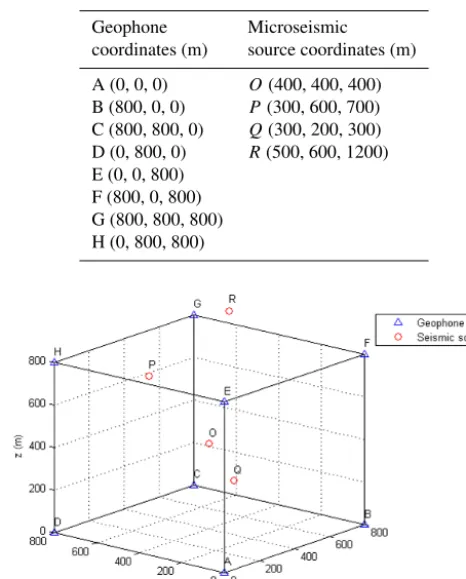
Geophone Microseismic coordinates (m) source coordinates (m)
A (0, 0, 0) O(400, 400, 400) B (800, 0, 0) P (300, 600, 700) C (800, 800, 0) Q(300, 200, 300) D (0, 800, 0) R(500, 600, 1200) E (0, 0, 800)
F (800, 0, 800) G (800, 800, 800) H (0, 800, 800)
Figure 2.The locations of geophones and microseismic sources.
velocity in thedth dimension is proposed as
vmax,d=
xmax,d−xmin,d
N , (10)
wherexmax,d andxmin,d, respectively, stand for the largest
and smallest values in thedth dimension of the possible par-ticle positions, andNis a chosen number of intervals (Abido, 2002), usually in the range [1, 10].
4 Simulation and case study
4.1 Simulation analysis and discussion
For the simulation, eight sensors comprising a microseismic localization system are located on the eight vertices of a cube. Four microseismic sources,O,P, andQ, are located inside the cube, andR is located outside of the cube. The coor-dinates of the geophones and the microseismic sources are shown in Table 1, and the relative locations of the geophones and microseismic sources are shown in Fig. 2.
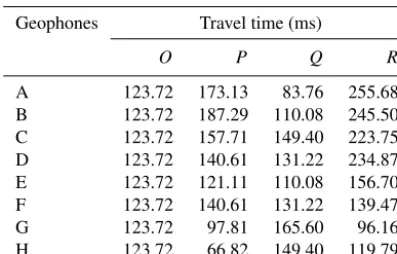
Table 2.Travel time of a microseismic wave.
Geophones Travel time (ms)
O P Q R
A 123.72 173.13 83.76 255.68 B 123.72 187.29 110.08 245.50 C 123.72 157.71 149.40 223.75 D 123.72 140.61 131.22 234.87 E 123.72 121.11 110.08 156.70 F 123.72 140.61 131.22 139.47 G 123.72 97.81 165.60 96.16 H 123.72 66.82 149.40 119.79
carried out by the least squares method (LSM; Dong et al., 2013) and the PSO proposed in this paper. The microseismic source location, equivalent wave velocity, and origin time are obtained. Then, the results calculated using the two different methods are compared using error analysis, the algorithm ex-ecution time, and the number of iterations.
Suppose a microseismic velocity ofv=5.60 m ms−1. Ac-cording to the coordinate information in Table 1, the trigger time of the microseismic waves recorded by the geophones triggered can be calculated, as shown in Table 2. The method in this paper is PSO. The computational accuracy of the LSM algorithm isε=1.0×10⁻¹⁰. The parameters for the PSO al-gorithm are as follows: population size is m=50,w0=1, and Tmax=3000. The inertia weight w, acceleration con-stants c1 andc2, and maximum flight velocity of particles
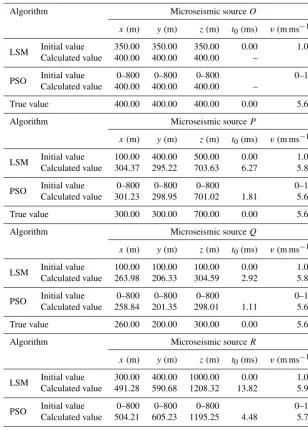
vavg are determined by Eqs. (6)–(10). MATLAB program-ming was used to implement the LSM and PSO algorithms to obtain solutions at four points,O,P,Q, andR. The calcu-lated results are shown in Table 3. The results of convergence are different when different initial values are selected for the LSM. When the initial value is far from the true value, the LSM satisfies the end condition, but it does not get the true value of the microseismic source. By repeatedly adjusting the initial value, the algorithm converges to the correct re-sult. The corresponding initial values of the LSM in Table 3 are obtained after several adjustments. The PSO method can converge to the true value only by randomly selecting a set of initial values within a specified range.
Based on the results shown in Table 3, the LSM algorithm has different convergent results for different initial values. When the initial value is far from the true value, the required calculation accuracyεcan be met, but the result does not ap-proach the true value. In some cases, there are multi-group results, so the initial values need to be repeatedly adjusted in order to make the LSM algorithm approach the true value. For the PSO algorithm, a wide range of initial values was used for the microseismic source location parameters. The only variables that need to be solved for are the 3-D co-ordinates of the arbitrary point inside the space surrounded by the seismic detection equipment. Thus, the calculated
re-sults can better approach the true value, and the solution is unique. This occurs because by improving the parameter se-lection rules, the condition where particles are trapped in lo-cal optima or fly over the global optimum during the process of searching is avoided; thus, the optimization ability of the PSO algorithm is improved.
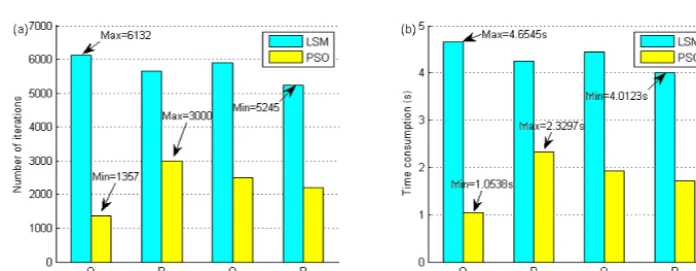
Comparisons of the errors in the microseismic source loca-tion parameters obtained using the LSM and PSO algorithms are shown in Fig. 3, and the comparison of iterations between the two algorithms is shown in Fig. 4.
The selection of initial values for parameters in the LSM algorithm is comparatively complex, so the basic principle of parameter selection is to approach the desired value as near as possible. The selection of different initial values for pa-rameters in the LSM algorithm has a greater influence on the accuracy of the solution location compared to PSO and re-sults in a large difference in the number of iterations between the two methods. The improved PSO algorithm only needs to provide a value range for the initial parameters. Then, it automatically selects parameter values to iterate, and the al-gorithm runs for a maximum number of 3000 iterations. As is shown in Table 3, Fig. 3, and Fig. 4, compared with the LSM algorithm, the PSO algorithm not only improves the computational accuracy of the desired value of microseismic source parameters but also increases the computational ef-ficiency and determines the microseismic source’s real time location.
The following is a discussion of some special conditions. (1) Since sourceOis located at the cube’s center of gravity, the distance betweenO and each geophone is the same. As a result, both the LSM and PSO algorithms can converge to the true value when solving for the seismic source coordi-nates (x0,y0,z0) but cannot solve the origin timet0because regardless of which value of wave velocityvis selected, the value ofQin Eq. (2) tends to be zero. Because of the random-ness of the wave velocity, the origin timet0cannot be solved according to Eq. (3). (2) Since sourceR is located outside of the cube, the average distance from this point to each sen-sor is larger than that from other points in the cube, such as
P andQpoints, to each sensor. The error in the equivalent wave velocity, which is solved by iteration, causes greater location error forR than for other points in the cube, so the layout of the seismic detection equipment should ensure that the microseismic source is within the detection array.
4.2 Case study
Table 3.Comparison of the LSM and PSO algorithms.
Algorithm Microseismic sourceO
x(m) y(m) z(m) t0(ms) v(m ms−1)
LSM Initial value 350.00 350.00 350.00 0.00 1.00 Calculated value 400.00 400.00 400.00 – –
PSO Initial value 0–800 0–800 0–800 0–10 Calculated value 400.00 400.00 400.00 – –
True value 400.00 400.00 400.00 0.00 5.60
Algorithm Microseismic sourceP
x(m) y(m) z(m) t0(ms) v(m ms−1)
LSM Initial value 100.00 400.00 500.00 0.00 1.00 Calculated value 304.37 295.22 703.63 6.27 5.85
PSO Initial value 0–800 0–800 0–800 0–10 Calculated value 301.23 298.95 701.02 1.81 5.67
True value 300.00 300.00 700.00 0.00 5.60
Algorithm Microseismic sourceQ
x(m) y(m) z(m) t0(ms) v(m ms−1)
LSM Initial value 100.00 100.00 100.00 0.00 1.00 Calculated value 263.98 206.33 304.59 2.92 5.81
PSO Initial value 0–800 0–800 0–800 0–10 Calculated value 258.84 201.35 298.01 1.11 5.68
True value 260.00 200.00 300.00 0.00 5.60
Algorithm Microseismic sourceR
x(m) y(m) z(m) t0(ms) v(m ms−1)
LSM Initial value 300.00 400.00 1000.00 0.00 1.00 Calculated value 491.28 590.68 1208.32 13.82 5.92
PSO Initial value 0–800 0–800 0–800 0–10 Calculated value 504.21 605.23 1195.25 4.48 5.70
True value 500.00 600.00 1200.00 0.00 5.60
Note: “–” means that the value cannot be obtained directly. The calculated value from the PSO is the average value obtained after running the PSO algorithm 20 times.
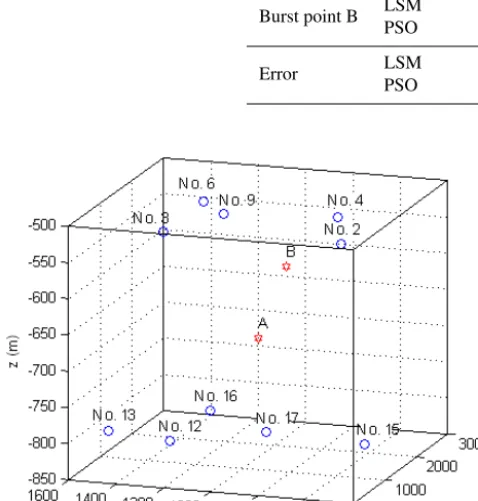
Ten seismic detection devices detected microseismic signals during the blasting operation. Pretreatments of the data, such as denoising and filtering, were performed on the detected signals in order to obtain a high SNR. Then, two blast points that showed an obvious rising waveform trend, making it easy to capture the trigger time, were selected and analyzed. The position coordinates of the two points are A (1495.60, 998.50, −685.10) and B (1298.70, 855.30, −576.20). The coordinates of the 10 seismic detection devices and the trig-ger times detected are shown in Table 4. The relative posi-tion of the 10 geophones and the two burst points is shown in Fig. 5. The seismic waveform data received by the geophone are shown in Fig. 6.
The experiment was carried out on the advanced roadway of the coal mine working face. The diameter of the borehole is 42 mm, the depth of the borehole is 1.2 m, and the length of the filled explosive is one-fourth of the borehole depth. We approximate the blasting point to a spherical blasting point without considering the error caused by the assump-tion. Based on the data presented in Table 4, the PSO algo-rithm and LSM algoalgo-rithm were used to solve for the seismic source location parameters and origin time. A comparison of the error is shown in Table 5.
According to Table 5, the accuracy of the LSM algorithm is relatively poor. Its average deviation in theX,Y, andZ
re-Figure 3.Comparisons of the errors in the source location parameters between the LSM and PSO algorithms.(a)Comparisons of thex-axis locating error.(b)Comparisons of they-axis locating error.(c)Comparisons of thez-axis locating error.(d)Comparisons of the errors in the origin-time estimation.
Figure 4. (a)Comparison of the number of iterations between the LSM and PSO algorithms, where the max and min markers highlight the maximum and minimum number of iterations for each algorithm.(b)Comparison of the computing time between the LSM and PSO algorithms, where the max and min markers highlight the maximum and minimum amount of computing time for each algorithm.
sults were obtained after repeated adjustment of the initial location parameters for the seismic source and the wave ve-locity. The PSO algorithm can automatically approach the true values according to the given initial parameter range. Its average deviation in theX,Y, andZdirections is 6.37, 5.78, and 9.03 m, respectively, with errors that are less than 5 %. Therefore, the PSO can achieve high positioning accuracy in the geophone range.
The simulation example and blasting experiment dis-cussed above clearly demonstrate that the PSO optimization algorithm is better than the LSM when solving for the micro-seismic positioning parameters and the micro-seismic origin time. The algorithm has high positioning accuracy and fast conver-gence speed, and it is easy to set the initial parameters. This is because the adaptive PSO algorithm is more accurate in fit-ting the relationship between each coordinate for the seismic detection equipment and the time difference. It can
dynami-cally adjust the velocity value in an iterative process until the value approximates the optimal average velocity, which can account for the nonlinear relationship between each coordi-nate of the seismic detection equipment and the time differ-ence and can greatly reduce the impact of the velocity error on the positioning precision.
4.3 Discussion
Table 4.Geophone coordinates and travel time from the burst point.
Geophone no. Geophone coordinates (m) Travel time (ms)
x y z Burst point A Burst point B
No. 2 751.26 549.55 −520.51 157.39 112.01 No. 3 755.40 1302.64 −523.35 146.02 146.02 No. 4 1752.37 700.70 −519.43 76.08 86.03 No. 6 2005.65 1298.72 −521.35 109.69 149.34 No. 9 1512.59 1149.63 −519.15 39.98 65.41 No. 12 995.87 1305.66 −820.20 107.27 106.07 No. 13 1248.20 1597.85 −821.95 118.96 140.72 No. 15 1500.46 550.75 −819.87 82.76 77.72 No. 16 2254.38 1303.22 −818.35 146.92 192.00 No. 17 1750.34 998.48 −822.73 52.20 96.23
Table 5.Error comparison for the LSM algorithm and PSO algorithm.
Xerr(m) Yerr(m) Zerr(m) Terr(ms)
Burst point A LSM 9.65 10.39 13.05 18.63 PSO 6.78 5.27 9.79 10.33
Burst point B LSM 8.28 11.22 12.74 27.24 PSO 5.96 6.29 8.26 15.95
Error LSM 8.97 10.81 12.90 22.94 PSO 6.37 5.78 9.03 13.14
Figure 5.Schematic diagram of the relative position of the 10 geo-phones and the two burst points.
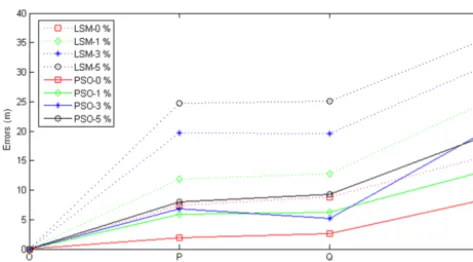
LSM; in other words, when the wave velocity is 5.544, 5.432, and 5.320 m ms−1, two methods are used to locate the micro-seismic source. (3) Step 1 and Step 2 are used to locate the microseismic source, and the absolute distance error is calcu-lated by comparing the locating results with the real values.
Figure 6. (a)Seismic waveform of burst point A received by geo-phone no. 2.(b)Seismic waveform of burst point B received by geophone no. 2.
veloc-Figure 7.Comparison of locating errors between PSO method and LSM at different wave velocities.
ity value when solving the seismic location parameters. The LSM needs accurate velocity to solve the seismic location parameters, and the disturbance of velocity has a great influ-ence on the results. That is to say, in the case of wave velocity disturbance, even if there is a small error in the value of wave velocity, there will be a large error in the location result of the LSM. Because of the complexity of rock media, the average velocity of each region is not necessarily the same, and due to the influence of construction technology, it is very difficult to determine the velocity of anisotropic media; this is the main reason for the low positioning accuracy of the LSM. In ad-dition, when the source is outside of the sensor array (such as seismic sourceR), the errors of the two methods are very large, but the LSM has greater locating errors than the PSO method, which shows that the sensor arrangement should en-sure that the seismic source is within the array as far as pos-sible.
5 Conclusions
1. An adaptive PSO optimization method is proposed based on the average population velocity in order to solve for location parameters of the seismic source in a location model. This method takes the minimum resid-ual sum of squares between the time-difference regres-sion values and the time-difference measured values for two seismic detection devices, and the PSO algorithm is designed to solve for the seismic source coordinates and the equivalent wave velocity and then solve for the seismic source origin time.
2. Combined with the actual need to solve for seismic source parameters, the model constraints of inertia weight, accelerating constants, the maximum flight ve-locity of particles, and other parameters are discussed in order to improve the optimization capacity of the PSO algorithm and avoid being trapped in a local optimum. 3. Comparative analysis shows that when solving for the
seismic source location parameters, compared with the
classic least squares method, the adaptive PSO algo-rithm has high positioning accuracy and fast conver-gence, and it is easy to set the initial parameter values.
Data availability. Data and results of calculations are available by e-mail request.
Author contributions. HMS designed the study, performed the re-search, analyzed data, and wrote the paper. JZY performed the anal-ysis with constructive discussions. XLZ helped performed the data analyzes. BGW contributed to the collection and analysis of the data. RSJ contributed to refining the ideas, carrying out additional analyses, and finalizing this paper.
Competing interests. The authors declare that they have no conflict of interest.
Acknowledgements. The authors wish to thank the two anony-mous reviewers and editor for their suggestions for improving the paper. They are also grateful for collaborative funding sup-port from the Key Research and Development Program of Shan-dong Province (grant nos. 2017GSF20115 and 2018GGX109013), the Natural Science Foundation of Shandong Province (grant no. ZR2018MEE008), and the project of the Shandong Province High Educational Science and Technology Program (grant no. J18KA307).
Financial support. This research has been supported by the Key Research and Development Program of Shandong Province (grant nos. 2017GSF20115 and 2018GGX109013), the Natural Science Foundation of Shandong Province (grant no. ZR2018MEE008), and the project of the Shandong Province High Educational Science and Technology Program (grant no. J18KA307).
Review statement. This paper was edited by Luciano Telesca and reviewed by two anonymous referees.
References
Abido, M. A.: Optimal power flow using particle swarm optimiza-tion, Int. J. Electr. Power Energy Syst., 24, 563–571, 2002. Anikiev, D., Valenta, J., Stanˇek, F., and Eisner, L.: Joint location
and source mechanism inversion of microseismic events: bench-marking on seismicity induced by hydraulic fracturing, Geophys. J. Int., 198, 249–258, 2014.
Chen, B., Feng, X., Li, S., Yuan, J., and Xu, S.: Microseism source location with hierarchical strategy based on particle swarm opti-mization, Chin. J. Rock Mech. Eng., 28, 740–749, 2009. Dong, L. and Li, X.: A microseismic/acoustic emission source
Dong, L., Sun, D., Li, X., and Du, K.: Theoretical and experimen-tal studies of localization methodology for ae and microseismic sources without pre-measured wave velocity in mines, IEEE Ac-cess, 99, 16818–16828, 2017.
Eberhart, R. C. and Kennedy, J.: A new optimizer using particle swarm theory, Proceedings of the Sixth International Symposium on Micro Machine and Human Science, 4–6 October, Nagora, Japan, 39–43, 1995.
Eslami, M., Shareef, H., Taha, M. R., and Khajehzadeh, M.: Adap-tive particle swarm optimization for simultaneous design of upfc damping controllers, Int. J. Electr. Power Energy Syst., 57, 116– 128, 2014.
Feng, G. L., Feng, X. T., Chen, B. R., Xiao, Y. X., and Jiang, Q.: Sectional velocity model for microseismic source location in tun-nels, Tunn. Undergr. Sp. Tech., 45, 73–83, 2015.
Fong S., Wong R., and Vasilakos A.: Accelerated PSO swarm search feature selection for data stream mining big data, IEEE Trans. Serv. Comput., 9, 33–45, 2016.
Gao, Z. and Liao, X. Z.: Hybrid adaptive particle swarm optimiza-tion based on average velocity, Control Decis., 27, 376–381, 2012.
Geiger, L.: Probability method for the determination of earthquake epicenters from arrival time only, Bull. St. Louis. Univ., 8, 60–71, 1912.
Gong, S. Y., Dou, L. M., Ma, X. P., Mou, Z. L., He, H., and He, J.: Study on the construction and solution technique of anisotropic velocity model in the location of coal mine tremor, Chinese J. Geophys.-Chinese Ed., 55, 1757–1763, 2012.
Lee, W. H. K. and Stewart, S. W.: Principles and applications of microearthquake networks, Academic Press, New York, 1981. Jia, R. S., Liu, C., Sun, H. M., and Yan, X. H.: A situation
assess-ment method for rock burst based on multi-agent information fu-sion, Comput. Electr. Eng., 45, 22–32, 2015.
Li, N., Wang, E., Ge, M., and Sun, Z.: A nonlinear microseismic source location method based on simplex method and its residual analysis, Arab. J. Geosci., 7, 4477–4486, 2014.
Li, X., Wang, E., Li, Z., Liu, Z., Song, D., and Qiu, L.: Rock burst monitoring by integrated microseismic and electromagnetic radi-ation methods, Rock Mech. Rock Eng., 49, 1–14, 2016. Lienert, B. R., Berge, E., and Frazer, L. N.: Hypocenter: an
earth-quake location method using centered, scaled, and adaptively damped least squares, Bull. Seismol. Soc. Amer., 6, 771–783, 1986.
Lin, F., Li, S. L., Xue, Y. L., and Xu, H. B.: Microseismic sources location methods based on different initial values, Chin. J. Rock Mech. Eng., 29, 996–1002, 2010.
Lomax, A., Virieux, J., Volant, P. and Berge, C.: Probabilistic earth-quake location in 3-D and layered models: Introduction of a Metropolis-Gibbs method and comparison with linear locations, in: Advances in Seismic Event Location, edited by: Thurber, C. H. and Rabinowitz, N., Kluwer, Amsterdam, 101–134, 2000. Lomax, A., Zollo, A., Capuano, P., and Virieux, J.: Precise, absolute
earthquake location under Somma-Vesuvius volcano using a new 3-D velocity model, Geophys. J. Int., 146, 313–331, 2001. Nelson, G. D. and Vidale, J. E.: Earthquake locations by 3-D finite
difference travel times, Bull. Seismol. Soc. Amer., 80, 395–410, 1990.
Pastén, D., Estay, R., Comte, D., and Vallejos, J.: Multifractal anal-ysis in mining microseismicity and its application to seismic haz-ard in mine, Int. J. Rock Mech. Min. Sci., 78, 74–78, 2015. Prange, M. D., Bose, S., Kodio, O., and Djikpesse, H. A.: An
information-theoretic approach to microseismic source location, Geophys. J. Int., 201, 193–206, 2015.
Renaudineau, H., Donatantonio, F., Fontchastagner, J., Petrone, G., Spagnuolo, G., Martin, J., and Pierfederici, S.: A PSO-based global mppt technique for distributed PV power generation, IEEE Trans. Ind. Electron., 62, 1047–1058, 2015.
Shi, Y. and Eberhart, R. C.: Parameter selection in particle swarm optimization, Evolutionary Programming VII, Springer, Berlin Heidelberg, 1998.
Sudheer, C., Maheswaran, R., Panigrahi, B. K., and Marthur, S.: A hybrid SVM-PSO model for forecasting monthly streamflow, Neural Comput. Appl., 24, 1381–1389, 2014.
Sun, H. M., Jia, R. S., Du, Q. Q., and Fu, Y.: Cross-correlation anal-ysis and time delay estimation of a homologous micro-seismic signal based on the Hilbert-Huang transform, Comput. Geosci., 91, 98–104, 2016.
Usher, P. J., Angus, D. A., and Verdon, J. P.: Influence of a velocity model and source frequency on microseismic waveforms: some implications for microseismic locations, Geophys. Prospect., 61, 334–345, 2013.
Waldhauser, F. and Ellsworth, W. L.: A double-difference earth-quake location algorithm: method and application to the northern Hayward fault, California, Bull. Seismol. Soc. Amer., 90, 1353– 1368, 2000.