the Creative Commons Attribution 4.0 License.
Quantifying changes in spatial patterns of surface
air temperature dynamics over several decades
Dario A. Zappalà1, Marcelo Barreiro2, and Cristina Masoller1 1Departament de Física, Universitat Politècnica de Catalunya,
Rambla St. Nebridi 22, Terrassa, 08222 Barcelona, Spain
2Departamento de Ciencias de la Atmósfera, Universidad
de la República, Iguá 4225, 11400 Montevideo, Uruguay
Correspondence:Cristina Masoller ([email protected])
Received: 4 September 2017 – Discussion started: 13 September 2017 Revised: 20 December 2017 – Accepted: 27 March 2018 – Published: 18 April 2018
Abstract. We study daily surface air temperature (SAT) reanalysis in a grid over the Earth’s surface to
iden-tify and quaniden-tify changes in SAT dynamics during the period 1979–2016. By analysing the Hilbert amplitude and frequency we identify the regions where relative variations are most pronounced (larger than±50 % for the amplitude and±100 % for the frequency). Amplitude variations are interpreted as due to changes in precipita-tion or ice melting, while frequency variaprecipita-tions are interpreted as due to a northward shift of the inter-tropical convergence zone (ITCZ) and to a widening of the rainfall band in the western Pacific Ocean. The ITCZ is the ascending branch of the Hadley cell, and thus by affecting the tropical atmospheric circulation, ITCZ migration has far-reaching climatic consequences. As the methodology proposed here can be applied to many other geo-physical time series, our work will stimulate new research that will advance the understanding of climate change impacts.
1 Introduction
The unprecedented intensification of weather extremes is motivating research aimed at understanding long-term cli-matic variations (Barreiro et al., 2008; Coumou and Rahm-storf, 2012; England et al., 2014; Cai et al., 2014; Turco et al., 2015) that can have profound socio-economic impacts (Ghil et al., 2011) and trigger complex ecological adaptation mech-anisms (Lejeune et al., 2002; Beaumont et al., 2011; Got-tfried et al., 2012; Bordeu et al., 2016).
Quantifying variations in surface air temperature (SAT) dynamics over several decades is a challenging problem be-cause of non-stationarity and the presence of trends, mea-surement noise, multiple timescales, memory, and correla-tions in the data (Franzke, 2012; Massah and Kantz, 2016); in addition, reanalysis data can be unreliable (due to the lack of observational constraints in many geographical regions), and reanalysis time series are insufficiently long (as reanal-ysis starts at the beginning of the satellite era). These chal-lenges have motivated the use, for climate data analysis, of
-90 -60 -30 0 30 60 90
0 90 180 270
0.9 1 1.1 1.2 1.3 1.4 1.5 1.6
(a)
(a) -90
-60 -30 0 30 60 90
0 90 180 270
0.9 1 1.1 1.2 1.3 1.4 1.5 1.6
(b)
(b)
-90 -60 -30 0 30 60 90
0 90 180 270 (c)
-0.4 -0.2 0 0.2 0.4
(c) -90
-60 -30 0 30 60 90
0 90 180 270 (d)
-0.6 -0.4 -0.2 0 0.2 0.4 0.6 0.8
(d)
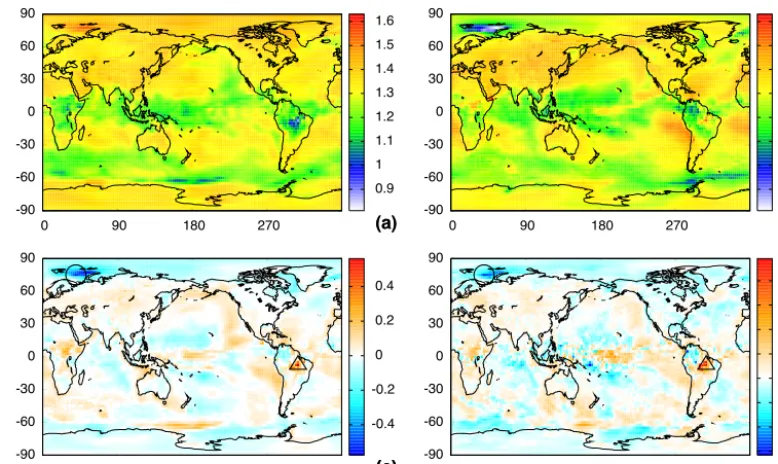
Figure 1.Relative change in the time-averaged Hilbert amplitude.(a)Amplitude averaged over the first 10 years (January 1979 to Decem-ber 1988).(b)Amplitude averaged over the last 10 years (July 2007 to June 2016).(c)Relative change in the Hilbert amplitude,1a/ < a >. (d)Relative change in amplitude of the seasonal cycle computed from the amplitude of the climatology,1a(clim)/a(clim). A good qualitative
agreement is seen in the spatial structures in(c)and(d). Importantly, the structures uncovered by the Hilbert amplitude are well defined in comparison with those uncovered by the analysis of the climatology amplitude, which look noisier.
over several decades (such as those observed in Fig. 1) have not yet been investigated at a global scale. In order to fill this gap, we use Hilbert analysis (described in the Supplement) to investigate SAT time series with daily resolution (reanal-ysis covering the Earth’s surface in the period 1979–2016). Our goal is to detect the most sensitive regions (“hotspots”) where variations in SAT dynamics over the last decades are more pronounced.
The Hilbert transform (HT) provides, for a real oscilla-tory time series, x(t) witht∈[1, T], an instantaneous
am-plitude,a(t), and an instantaneous frequency,ω(t), for each
data point of the time series and thus allows us to charac-terise how the amplitude and the frequency of a signal vary in time. If a signal does not have a sufficiently narrow fre-quency band, a(t) andω(t) will not have a clear physical
meaning (Pikovsky et al., 2001). The usual solution is based on band-pass filtering to isolate a narrow frequency band; however, HT directly applied to the signal can still yield useful information. An alternative solution is based on the Hilbert–Huang transform (Huang et al., 1998) that combines Hilbert analysis with empirical mode decomposition that de-composes an arbitrary real time series into components, each having the physical meaning of a rotation in the complex plane.
Because many natural geophysical time series have a sea-sonal periodicity, this has motivated the use of Hilbert analy-sis to characterise the time-varying oscillation amplitude and
to investigate phase shifts and phase–amplitude couplings. Applications in various geophysical fields are discussed in Huang and Wu (2008). As more recent examples, Massei and Fournier (2012) used Hilbert analysis to characterise the daily variability of the Seine river flow from 1950 to 2008, uncovering linkages between river flow variability and global climate oscillations (the North Atlantic Oscillation and the Madden–Julian Oscillation). Sun (2015) used Hilbert analy-sis to compute the daily phase shift between temperature sig-nals recorded at the ground surface and at a depth of 5 m in two meteorology stations in Taiwan from 1952 to 2008. Sig-nificant reductions in the phase shift from the 1980s to 1990s were found, which was interpreted to be related to the warm-ing of the Pacific Decadal Oscillation. Reddy and Adarsh (2016) applied Hilbert analysis to rainfall time series in India and found that the multi-scale components of rainfall series have a similar periodic structure as global climate oscilla-tions (the Quasi-biennial Oscillation, El Niño Southern Os-cillation, etc.).
We have recently applied the Hilbert transform to unfil-tered daily SAT reanalysis (Zappalà et al., 2016). We have shown that the maps of time-averaged Hilbert frequency,
< ω >, and standard deviation, σω, revealed well-defined
large-scale structures which were consistent with known dy-namical processes.
Here we usea(t) andω(t) to quantify SAT variations. Our
informa-tion about variainforma-tions in SAT dynamics. Specifically, we are interested in addressing the following questions: which prop-erties ofa(t) andω(t) display relevant variations? Where are
the regions in which these variations are more pronounced? Which processes can be responsible for these variations? Can these variations be used as a quantitative measure of regional climate change?
2 Data
In the main text we present results from an ERA-Interim daily SAT reanalysis (Dee et al., 2011) that covers the pe-riod from January 1979 to June 2016 with a spatial resolu-tion of 2.5◦, both in latitude and in longitude. Thus, there
are N=73×144=10 512 geographical sites and in each site the SAT time series hasT =13696 days. In the Supple-ment we compare ERA-Interim with NCEP-DOE sis 2, which is an improved version of the NCEP Reanaly-sis I model (Kistler et al., 2001). It covers a longer time in-terval and has 94×192=18 048 geographical sites. In order to perform a precise comparison between the results of the two datasets, in the NCEP-DOE Reanalysis 2 we consider the same time interval as the ERA-Interim dataset.
3 Methods
3.1 Hilbert analysis
To apply the Hilbert transform (described in the Sup-plement) we first pre-process each raw SAT time series,
rj(t) (where j∈[1, N] represents the geographical site
and t∈[1, T] represents the day): we eliminate the
lin-ear trend and normalise to zero mean and unit variance, obtaining xj(t). The Hilbert transform is then applied
toxj(t), obtainingyj(t)=HT[xj(t)]. Fromxj(t) andyj(t),
the amplitude aj(t) and the phaseϕj(t) were calculated as aj(t)=
q
[xj(t)]2+ [yj(t)]2andϕj(t)=arctan[yj(t)/xj(t)].
Taking into account the signs of xj(t) andyj(t), the phase
is constrained to the interval [−π,π). Whenever an extreme
value of the interval is reached, the phase jumps to the other end of the interval. By eliminating these sudden jumps (us-ing a standard library function that appropriately adds±2π)
we “unwrapped” the phase obtaining a continuous variation in time from which the frequency time series,ωj(t), was
ob-tained by calculating the derivative. Since the Hilbert algo-rithm (Bilato et al., 2014) gives deviations from the true val-ues of the amplitude, phase, and frequency near the extremes, in each time series (aj(t),ϕj(t), andωj(t)) we disregarded
the initial and final 5% (see the Supplement). This way, we have time series of lengthT =12 328.
3.2 Measures used to quantify variations in SAT dynamics
Variations in the Hilbert amplitude were quantified by the relative change,1a/ < a >=(< a>l−< a>f)/ < a >,
where < a>f is the average value of the amplitude
dur-ing the first 10 years of the time series (January 1979 to December 1988), and < a>l during the last 10 years
(July 2007 to June 2016). Analogously, we calculated the rel-ative change in amplitude variance,1σa2/σa2, of average
fre-quency,1ω/ < ω >, and of frequency variance,1σω2/σω2. In
the Supplement we analyse how the spatial structures uncov-ered depend on the time intervals used to calculate the rel-ative variations: we compare with relrel-ative variations during the first and final 5 years of the reanalysis and also during the first half-period and the second half-period of the reanalysis. While the values of the relative variations vary with the time interval considered, the spatial maps are remarkably robust as the same structures are found with the three time intervals considered.
A similar analysis was performed to detect changes di-rectly from the raw SAT time series,rj(t), by computing the
amplitude of the climatology (or seasonal cycle),cj(t), and
the variance of anomaly time series,zj(t).
Specifically, the amplitude of the climatology was calcu-lated asa(clim)j (I)=max[cIj(t)]−min[cIj(t)], wherecjI(t) is
the climatology series calculated only in the time intervalI.
We remark that the climatology amplitude aj(clim)(I) is a
scalar number that depends on the choice of the time in-terval I. We calculated the climatology amplitude in the
first and last decade, as well as in the whole series. As be-fore, we used these values to calculate the relative change
1a(clim)/a(clim). Also, the variance of the anomaly time
se-rieszj(t) was calculated and then used to find the relative
change,1σz2/σz2.
With the goal of relating changes in Hilbert frequency with changes in the statistical properties of SAT time series, an analysis of the number of zero crossings was performed: for eachxj(t) we counted the number of crossings through the
mean value,x=0. As with other quantities, we then calcu-lated the relative change.
3.3 Significance analysis
A statistical significance analysis was performed by surro-gating Hilbert series. For each amplitude time series (i.e. in each grid point) 100 shuffle surrogates were generated and for each surrogate the relative change, 1as/ < as>,
was calculated. Then, the average over the 100 surrogates,
< 1as/ < as>>s, and its standard deviation,σs, were used
to define the significance threshold: the relative change com-puted from the original data was considered significant if it was higher than < 1as/ < as>>s+2σs or lower than < 1as/ < as>>s−2σs. In the colour maps, regions where
20 22 24 26 28 30 32 34
1985 1990 1995 2000 2005 2010
(a)
Temperature [C]
Time [year]
-30 -20 -10 0 10
1985 1990 1995 2000 2005 2010
(b)
Temperature [C]
Time [year]
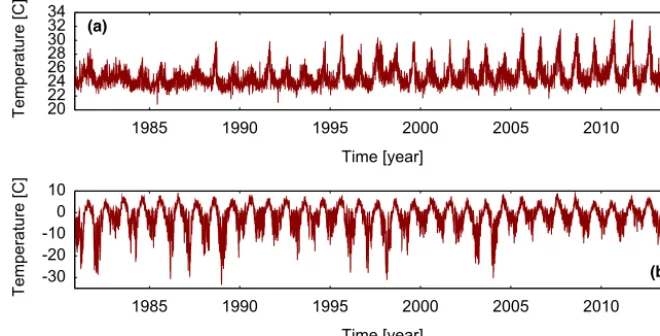
Figure 2. Surface air temperature in two regions where a clear change in the oscillation amplitude in the last ten years, with respect to the first ten years, is observed. (a) Site of coordinates (7.5 S, 307.5 E), marked with a triangle in Fig. 1(c). (b) Site of coordinates (75 N, 40 E), marked with a circle in Fig. 1(c).
we expect its amplitude change to give similar indications as the Hilbert amplitude change. On the other hand, the anomaly term contains all the rapid variability, so we expect its variance to give similar results as the variance of Hilbert amplitude.
Figures 1(c) and 1(d), which display respectibely the relative change of Hilbert amplitude and of climatology amplitude, and Figs. 3(a) and 3(b), which display respectively the relative change of Hilbert amplitude variance and of anomaly variance, confirm these expectations.
5
The good qualitative agreement seen in the spatial structures in these maps confirms that Hilbert analysis directly applied to unfiltered SAT indeed gives a physically meaningful instantaneous amplitude, with average and variance values that are consistent with those computed from SAT.
In Figs. 3(a) and 3(b), however, there is a difference in the eastern Pacific Ocean, in the area marked with a circle. In particular, in Fig. 3(b) there is an area with large decrease of variance (deep blue, around -100%), while in (a) the decrease is 10
less pronounced (light blue, around -65%) and extended over a smaller area. In addition, in Fig. 3(a) there is an orange-red area that indicates a moderate increase of variance (around 45%), while in (b) such area is absent. The reasons underlying these differences will be discussed later.
6
Figure 2.Surface air temperature in two regions where a clear change in the oscillation amplitude in the last 10 years is observed with respect to the first 10 years.(a)Site of coordinates (7.5◦S, 307.5◦E) marked with a triangle in Fig. 1c.(b)Site of coordinates (75◦N, 40◦E) marked with a circle in Fig. 1c.
same test was applied to frequency variations and the other quantities, except for the climatology for which a surrogate test is not applicable. In the Supplement various thresholds are considered and, in addition, a non-parametric signifi-cance test is used. Here we present only the maps obtained with threshold ±2σ because it is a compromise between
uncovering the spatial regions where SAT changes are pro-nounced and disregarding the areas where the variations are small.
4 Results
We analyse the maps of < ω >,< a >, σω2, and σa2 in the
first 10 years and in the last 10 years of the period covered by the reanalysis, as well as the relative change between the two decades.
4.1 Analysis of amplitude variations
Figure 1a and b display < a > in the first and in the last
10 years, respectively, and Fig. 1c displays the relative dif-ference (see Sect. 3 for details). In Fig. 1c we see an area of large increase (more than 50 %) in average amplitude located in South America (red spot marked by a triangle) and an area of large decrease (again, more than 50 %) located in the Arc-tic (blue spot marked by a circle). The raw SAT time series in these regions are displayed in Fig. 2.
In both time series we clearly observe a change in the am-plitude of the oscillations in the last 10 years with respect to the first 10 years, having a visual confirmation of the changes detected by the Hilbert amplitude. The red spot in Amazonia, whose SAT series shown in Fig. 2a has an increasing ampli-tude, can be interpreted in terms of changes in precipitation. In particular, the increase in the Hilbert amplitude is linked
to the decrease in precipitation and to the lengthening of the dry season (as reported in Gu et al., 2016; Liebmann et al., 2004; Fu et al., 2013). This is due to the fact that when pre-cipitation decreases, the fraction of solar radiation that is not used for evaporation is used to heat the ground, which in turn heats the surface air. This leads to higher extreme tempera-tures during the dry seasons, as can be observed in Fig. 2a. Regarding the blue spot in the Arctic region where the SAT series shown in Fig. 2b has a decreasing amplitude, it can be interpreted as due to the melting of sea ice. In fact, when ice is present at the surface of the sea, it acts as an insulator preventing heat exchange between sea and air. This causes a large amplitude in the SAT cycle. On the other hand, if the ice melts, the air–sea heat exchange reduces the amplitude of the cycle. In particular, during winter the air temperature is mitigated by the sea and tends to have more moderated val-ues. It is important to take into account that this blue spot is in a region for which the observational constraints from satel-lites on the reanalysis are scarce, which decreases the quality of the reanalysis in the region. Therefore, in order to check whether the detected changes are robust, we performed the same analysis using the NCEP-DOE reanalysis dataset. The results, presented in the Supplement, confirm the presence of the blue spot in the Arctic.
-90 -60 -30 0 30 60 90
0 90 180 270 (a)
-0.8 -0.6 -0.4 -0.2 0 0.2 0.4 0.6 0.8 (a) -90 -60 -30 0 30 60 90
0 90 180 270 (b)
-1 -0.8 -0.6 -0.4 -0.2 0 0.2 0.4 (b)
Figure 3.Relative change of amplitude fluctuations computed from the variance of (a) Hilbert amplitude, 2
a/a2; (b) the anomaly time
series, 2
z/ z2.
4.2 Analysis of Frequency Variations
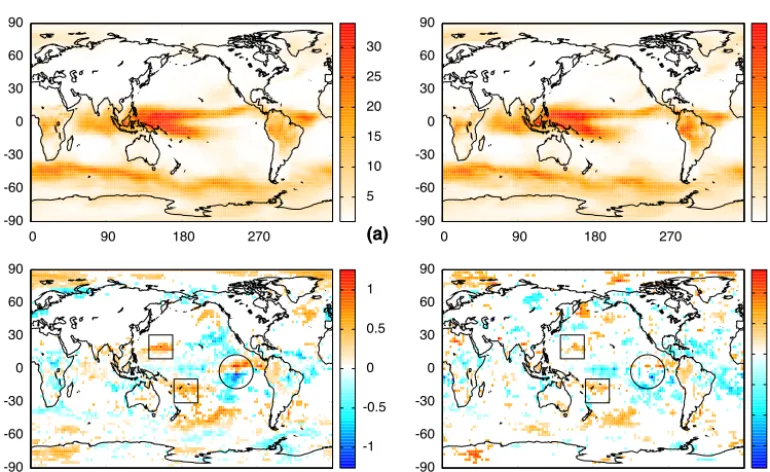
Figure 4(a) displays the average frequencyh!iin the first ten years, Fig. 4(b) in the last ten years, and Fig. 4(c) displays the relative change, !/h!i. In Fig. 4(c) we note that in the eastern Pacific Ocean there are two small areas, enclosed by the circle, of intense increase (red) and decrease (blue) of frequency. They both represent frequency changes whose absolute values are larger than 100% and correspond to the same region where differences were detected in Fig. 3.
5
These two areas of opposite signs suggest that, between the initial and the final decade, there is a shift of the inter-tropical convergence zone (ITCZ) toward the north. The ITCZ involves strong convective activity, which causes rapid fluctuations of SAT, thus giving high values of instantaneous frequency, as shown in Figs. 4(a,b). Therefore, in the relative change of frequency, in regions corresponding to the initial position of the ITCZ we see a decrease, while in regions corresponding to the present position of the ITCZ we see an increase. For the same reason, the two red areas in the western Pacific Ocean (indicated by
10
two squares) suggest an expansion of the tropical convective regions. This interpretation is in agreement with previous works that have related a northward shift of ITCZ to an inter-hemispheric temperature gradient, as the one experienced during the last decades (Yoshimori and Broccoli, 2008; Kang et al., 2009; Frierson and Hwang, 2012; Schneider et al., 2014; Talento and Barreiro, 2016). Regarding the red areas in the north Atlantic, in the north Pacific and in the south Pacific, they are consistent with an increase in the occurrence of fronts which cause large daily fluctuations of temperature and thus an increase of Hilbert
15
frequency.
To gain insight into the physical meaning of the changes that are captured by Hilbert frequency, we use an alternative approach to estimate frequency variations: we define as “events” the zero crossings of SAT time series (Pikovsky et al., 2001) (detrended and normalised to zero-mean as described inMethods). Then, we count the number of events in the first ten years, in the last ten years, and calculate the relative variation.
20
Figure 4(d) displays the map of relative change of zero-crossings. We see that there is a qualitative good agreement with the spatial structures seen in Fig. 4(c), thus providing a physical interpretation for the observed variation of Hilbert frequency: the
7
Figure 3.Relative change in amplitude fluctuations computed from the variance of the(a)Hilbert amplitude,1σa2/σa2;(b)the anomaly time
series,1σz2/σz2.
-90 -60 -30 0 30 60 90
0 90 180 270
5 10 15 20 25 30 (a) (a) -90 -60 -30 0 30 60 90
0 90 180 270
5 10 15 20 25 30 (b) (b) -90 -60 -30 0 30 60 90
0 90 180 270 (c)
-1 -0.5 0 0.5 1 (c) -90 -60 -30 0 30 60 90
0 90 180 270 (d)
-0.6 -0.4 -0.2 0 0.2 0.4 (d)
Figure 4.Relative change of time-averaged Hilbert frequency (in units of oscillations/year). (a) Average in the first ten years (1979–1988). (b) Average in the last ten years (2007–2016). (c) Relative change of Hilbert frequency, !/h!i. (d) Relative change of the number of zero-crossings of the normalised SAT time series. In (a) and (b) the colour scale is adjusted to represent in white the regions where the average frequency is one oscillation per year. In (c) and (d), a good qualitative agreement of spatial structures is seen; however, we note that Hilbert frequency detects stronger variations than those measured by the number of zero-crossings.
areas where the frequency increases (decreases) correspond to areas where the number of zero-crossings increases (decreases). We note that the relative variations in Hilbert frequency are more pronounced than those in the number of crossings, and this specifically holds in the regions where frequency variations are interpreted in terms of ITCZ migration.
Figures 5(a) and 5(b) display SAT time series in the dipole region indicated with the circle in Fig. 4(c), and also indicate (in red) the zero-crossings. We can understand the difference that was detected in this region between the variance of Hilbert
5
amplitude (Fig. 3a) and the variance of anomaly (Fig. 3b). This difference is explained in the following terms: in the first decade the seasonal cycle is more irregular than in the last decade, probably a consequence of an El Niño event in 1982–1983. The anomaly series contains these slow fluctuations as well as the rapid ones, and thus its variance is affected by both effects. In contrast, the Hilbert amplitude is less affected by the slow fluctuations as its variance captures mainly the rapid fluctuations of SAT.
10
8
Figure 4.Relative change in the time-averaged Hilbert frequency (in units of oscillations per year).(a)Average in the first 10 years (1979– 1988).(b)Average in the last 10 years (2007–2016).(c)Relative change in Hilbert frequency,1ω/ < ω >.(d)Relative change in the number
of zero crossings of the normalised SAT time series. In(a)and(b)the colour scale is adjusted to represent in white the regions where the average frequency is one oscillation per year. In(c)and(d), a good qualitative agreement of spatial structures is seen; however, we note that the Hilbert frequency detects stronger variations than those measured by the number of zero crossings.
Figure 1c and d, which respectively display the relative change in Hilbert amplitude and in climatology amplitude, and Fig. 3a and b, which respectively display the relative change in Hilbert amplitude variance and in anomaly vari-ance, confirm these expectations.
The good qualitative agreement seen in the spatial struc-tures in these maps confirms that Hilbert analysis directly ap-plied to unfiltered SAT indeed gives a physically meaningful instantaneous amplitude, with average and variance values that are consistent with those computed from SAT.
In Fig. 3a and b, however, there is a difference in the east-ern Pacific Ocean in the area marked with a circle. In
particu-lar, in Fig. 3b there is an area with large decrease in variance (dark blue, around−100 %), while in Fig. 3a the decrease is less pronounced (light blue, around−65 %) and extended over a smaller area. In addition, in Fig. 3a there is a reddish orange area that indicates a moderate increase in variance (around 45 %), while in Fig. 3b such an area is absent. The reasons underlying these differences will be discussed later.
4.2 Analysis of frequency variations
Figure 4a displays the average frequency< ω >in the first
-4 -3 -2 -1 0 1 2 3
1985 1990 1995 2000 2005 2010
(a)
Temp. [norm. units]
Time [year]
n. crosses = 202 n. crosses = 289
-3 -2 -1 0 1 2 3 4
1985 1990 1995 2000 2005 2010
(b)
Temp. [norm. units]
Time [year]
n. crosses = 258 n. crosses = 128
Figure 5. Normalised SAT time series and number of zero-crossings in the regions indicated with a circle in Fig. 4(c). In the red region (2.5 N, 245 E), panel (a), the number of zero-crossings increases in the last ten years with respect to the first ten years (289/202 respectively), while in the blue region (7.5 S, 250 E), panel (b), it decreases (128/258 in the last/first ten years).
To demonstrate the robustness of our findings, in theSupporting Informationwe compare the results obtained from ERA-Interim with those obtained from another reanalysis dataset, NCEP-DOE. We find a good qualitative agreement in the spatial structures in the maps ofh! i , hai , 2
! and 2a, but we discuss also some relevant differences. In addition, to further understand the relationship between statistical properties of SAT and those of Hilbert amplitude and frequency, in theSupporting Infor-mationwe apply Hilbert analysis to synthetic data generated by an autoregressive AR(1) process. We chose an AR(1) process 5
because it is commonly used in the literature to model climate data. We find that, when increasing the noise intensity in the synthetic series, the Hilbert amplitude decreases while the frequency increases and show that this trend is also observed in real SAT time series.
5 Conclusions
We have used Hilbert analysis to quantify the changes in SAT dynamics, in a global scale, that have occurred over the last 10
three decades. From the SAT time series with daily resolution we derived the amplitude and the frequency time series, and then calculated the relative change (between the first and the last decade) of average and variance of these series.Large variations of Hilbert amplitude (more than 50%) in the Arctic and in Amazonia were interpreted respectively as due to ice melting and
9
Figure 5.Normalised SAT time series and number of zero crossings in the regions indicated with a circle in Fig. 4c. In the red region (2.5◦N, 245◦E)(a), the number of zero crossings increases in the last 10 years with respect to the first 10 years (289 and 202, respectively), while in the blue region (7.5◦S, 250◦E)(b), it decreases (128 and 258 in the last and first 10 years).
the eastern Pacific Ocean there are two small areas, enclosed by the circle, of intense increase (red) and decrease (blue) in frequency. They both represent frequency changes whose absolute values are larger than 100 % and correspond to the same region where differences were detected in Fig. 3.
These two areas of opposite signs suggest that, between the initial and the final decade, there is a shift of the inter-tropical convergence zone (ITCZ) toward the north. The ITCZ involves strong convective activity, which causes rapid fluctuations of SAT, thus giving high values of instantaneous frequency, as shown in Fig. 4a and b. Therefore, in the rel-ative change in frequency, in regions corresponding to the initial position of the ITCZ we see a decrease, while in re-gions corresponding to the present position of the ITCZ we see an increase. For the same reason, the two red areas in the western Pacific Ocean (indicated by two squares) suggest an expansion of the tropical convective regions. This interpre-tation is in agreement with previous works that have related a northward shift of the ITCZ to an inter-hemispheric tem-perature gradient, such as the one experienced during the last decades (Yoshimori and Broccoli, 2008; Kang et al., 2009; Frierson and Hwang, 2012; Schneider et al., 2014; Talento and Barreiro, 2016). Regarding the red areas in the north At-lantic, the north Pacific, and the south Pacific, they are con-sistent with an increase in the occurrence of fronts, which cause large daily fluctuations of temperature and thus an in-crease in the Hilbert frequency.
To gain insight into the physical meaning of the changes that are captured by the Hilbert frequency, we use an alter-native approach to estimate frequency variations: we define “events” as the zero crossings of SAT time series (Pikovsky et al., 2001) (detrended and normalised to zero mean as de-scribed in Sect. 3). Then, we count the number of events in
the first 10 years and in the last 10 years and calculate the relative variation.
Figure 4d displays the map of relative change in zero crossings. We see that there is a qualitative good agree-ment with the spatial structures seen in Fig. 4c, thus pro-viding a physical interpretation for the observed variation in the Hilbert frequency: the areas where the frequency in-creases (dein-creases) correspond to areas where the number of zero crossings increases (decreases). We note that the relative variations in the Hilbert frequency are more pronounced than those in the number of crossings, and this specifically holds in the regions where frequency variations are interpreted in terms of ITCZ migration.
Figure 5a and b display SAT time series in the dipole re-gion indicated with the circle in Fig. 4c and also indicate (in red) the zero crossings. We can understand the difference that was detected in this region between the variance of the Hilbert amplitude (Fig. 3a) and the variance of the anomaly (Fig. 3b). This difference is explained in the following terms: in the first decade the seasonal cycle is more irregular than in the last decade, probably a consequence of an El Niño event in 1982–1983. The anomaly series contains these slow fluc-tuations as well as the rapid ones, and thus its variance is affected by both effects. In contrast, the Hilbert amplitude is less affected by the slow fluctuations as its variance captures mainly the rapid fluctuations of SAT.
To demonstrate the robustness of our findings, in the Sup-plement we compare the results obtained from ERA-Interim with those obtained from another reanalysis dataset, NCEP-DOE. We find a good qualitative agreement in the spatial structures in the maps of< ω >,< a >,σω2, andσa2, but we
the Supplement we apply Hilbert analysis to synthetic data generated by an autoregressive AR(1) process. We chose an AR(1) process because it is commonly used in the litera-ture to model climate data. We find that, when increasing the noise intensity in the synthetic series, the Hilbert amplitude decreases while the frequency increases, which shows that this trend is also observed in real SAT time series.
5 Conclusions
We have used Hilbert analysis to quantify the changes in SAT dynamics, on a global scale, that have occurred over the last 3 decades. From the SAT time series with daily resolu-tion we derived the amplitude and the frequency time series and then calculated the relative change (between the first and the last decade) in the average and variance of these series. Large variations in the Hilbert amplitude (more than 50 %) in the Arctic and in Amazonia were respectively interpreted as due to ice melting and precipitation decrease. The anal-ysis of the Hilbert frequency also uncovered areas of large changes. In particular, two areas of opposite changes in the eastern Pacific Ocean and two areas of increase in the west-ern Pacific Ocean suggest a shift towards the north and a widening of the ITCZ. While there is evidence that the ITCZ has moved north–south in the past, to the best of our knowl-edge our work is the first to confirm this migration in the last decades. Our findings have important implications because, as the ITCZ is the ascending branch of the Hadley cell, its migration affects both the Earth’s radiative balance and the release of latent heat that drives the tropical atmospheric cir-culation. Taken together, these effects have not only local but also far-reaching climatic consequences. Additional analysis provided in the Supplement confirms the robustness of these observations.
As the methodology used here can be applied to many other climatological time series that exhibit well-defined os-cillatory behaviour, we believe that our work will stimulate new research to identify and quantify the impacts of climate change directly from observed data.
Code and data availability. The Hilbert algorithm used is avail-able in Bilato et al. (2014); the datasets used are the ERA-Interim Reanalysis provided by the European Centre For Medium-Range Weather Forecasts (ECMWF), Reading, UK, from their website (https://www.ecmwf.int, Dee et al., 2011) and the NCEP-DOE Re-analysis 2 provided by NOAA, Boulder, Colorado, USA, from their website (http://www.esrl.noaa.gov/psd/, Kanamitsu et al., 2002).
Supplement. The supplement related to this article is available online at: https://doi.org/10.5194/esd-9-383-2018-supplement.
Competing interests. The authors declare that they have no con-flict of interest.
Acknowledgements. This work was supported in part by the LINC project (EU-FP7-289447), ICREA ACADEMIA (Generalitat de Catalunya, Spain), and by the Spanish MINECO/FEDER (FIS2015-66503-C3-2-P). Dario A. Zappalà also thanks the European Social Fund and the Generalitat de Catalunya for the FI-AGAUR scholarship.
Edited by: Sagnik Dey
Reviewed by: two anonymous referees
References
Barreiro, M., Fedorov, A., Pacanowski, R., and Philander, S. G.: Abrupt climate changes: How freshening of the northern Atlantic affects the thermohaline and wind-driven oceanic circulations, Annu. Rev. Earth Planet. Sci., 36, 33–58, 2008.
Barreiro, M., Marti, A. C., and Masoller, C.: Inferring long mem-ory processes in the climate network via ordinal pattern analysis, Chaos, 21, 013101, https://doi.org/10.1063/1.3545273, 2011. Beaumont, L. J., Pitman, A., Perkins, S., Zimmermann, N. E.,
Yoc-coz, N. G., and Thuiller, W.: Impacts of climate change on the world’s most exceptional ecoregions, P. Natl. Acad. Sci. USA, 108, 2306–2311, 2011.
Bilato, R., Maj, O., and Brambilla, M.: An algorithm for fast Hilbert transform of real functions, Adv. Comput. Math., 40, 1159–1168, https://doi.org/10.1007/s10444-014-9345-4, 2014.
Bordeu, I., Clerc, M. G., Couteron, P., Lefever, R., and Tlidi, M.: Self-replication of localized vegetation patches in scarce environ-ments, Sci. Rep., 6, 33703, https://doi.org/10.1038/srep33703, 2016.
Cai, W., Borlace, S., Lengaigne, M., van Rensch, P., Collins, M., Vecchi, G., Timmermann, A., Santoso, A., McPhaden, M. J., Wu, L., England, M. H., Wang, G., Guilyardi, E., and Jin, F.-F.: In-creasing frequency of extreme El Niño events due to greenhouse warming, Nat. Clim. Change, 4, 111–116, 2014.
Chambers, L. E., Altwegg, R., Barbraud, C., Barnard, P., Beaumont, L. J., Crawford, R. J. M., Durant, J. M., Hughes, L., Keatley, M. R., Low, M., Morellato, P. C., Poloczanska, E. S., Ruoppolo, V., Vanstreels, R. E. T., Woehler, E. J., and Wolfaardt, A. C.: Phenological changes in the southern hemisphere, PLoS ONE, 8, e75514, https://doi.org/10.1371/journal.pone.0075514, 2013. Coumou, D. and Rahmstorf, S.: A decade of weather extremes, Nat.
Clim. Change, 2, 491–496, 2012.
Donges, J. F., Zou, Y., Marwan, N., and Kurths, J.: The back-bone of the climate network, Europhys. Lett., 87, 48007, https://doi.org/10.1209/0295-5075/87/48007, 2009.
Duan, J., Esper, J., Büntgen, U., Li, L., Xoplaki, E., Zhang, H., Wang, L., Fang, Y., and Luterbacher, J.: Weakening of annual temperature cycle over the tibetan plateau since the 1870s, Nat. Comm., 8, 14008, https://doi.org/10.1038/ncomms14008, 2017. Dwyer, J., Biasutti, M., and Sobel, A.: Projected changes in the sea-sonal cycle of surface temperature, J. Climate, 25, 6359–6374, 2012.
England, M. H., McGregor, S., Spence, P., Meehl, G. A., Timmer-mann, A., Cai, W., Gupta, A. S., McPhaden, M. J., Purich, A., and Santoso, A.: Recent intensification of wind-driven circula-tion in the pacific and the ongoing warming hiatus, Nat. Clim. Change, 4, 222–227, 2014.
Franzke, C.: Nonlinear trends, long-range dependence, and climate noise properties of surface temperature, J. Climate, 25, 4172– 4183, 2012.
Frierson, D. M. W., and Hwang, Y. T.: Extratropical influence on ITCZ shifts in slab ocean simulations of global warming, J. Cli-mate, 25, 720–733, 2012.
Fu, R., Yin, L., Li, W., Arias, P. A., Dickinson, R. E., Huang, L., Chakraborty, S., Fernandes, K., Liebmann, B., Fisher, R., and Myneni, R. B.: Increased dry-season length over southern ama-zonia in recent decades and its implication for future climate pro-jection, P. Natl. Acad. Sci. USA, 110, 18110–18115, 2013. Ghil, M., Yiou, P., Hallegatte, S., Malamud, B. D., Naveau, P.,
Soloviev, A., Friederichs, P., Keilis-Borok, V., Kondrashov, D., Kossobokov, V., Mestre, O., Nicolis, C., Rust, H. W., Shebalin, P., Vrac, M., Witt, A., and Zaliapin, I.: Extreme events: dynam-ics, statistics and prediction, Nonlin. Processes Geophys., 18, 295–350, https://doi.org/10.5194/npg-18-295-2011, 2011. Gottfried, M., Pauli, H., Futschik, A., Akhalkatsi, M., Baranˇcok,
P., Alonso, J. L. B., Coldea, G., Dick, J., Erschbamer, B., Fer-nández Calzado, M. R., Kazakis, G., Krajˇci, J., Larsson, P., Mallaun, M., Michelsen, O., Moiseev, D., Moiseev, P., Molau, U., Merzouki, A., Nagy, L., Nakhutsrishvili, G., Pedersen, B., Pelino, G., Puscas, M., Rossi, G., Stanisci, A., Theurillat, J.-P., Tomaselli, M., Villar, L., Vittoz, P., Vogiatzakis, I., and Grabherr, G.: Continent-wide response of mountain vegetation to climate change, Nat. Clim. Change, 2, 111–115, 2012.
Gu, G., Adler, R. F., and Huffman, G. J.: Long-term changes/trends in surface temperature and precipitation during the satellite era (1979–2012), Clim. Dynam., 46, 1091–1105, 2016. Huang, N. E., Shen, Z., Long, S. R., Wu, M. C., Shih, H. H., Zheng,
Q., Yen, N.-C., Tung, C. C., and Liu, H. H.: The empirical mode decomposition and the Hilbert spectrum for nonlinear and non-stationary time series analysis, P. Roy. Soc. Lond. A, 454, 903– 995, 1998.
Huang, N. E., and Wu, Z.: A review on Hilbert-Huang transform: Method and its applications to geophysical studies, Rev. Geo-phys., 46, 8755–1209, 2008.
Kanamitsu, M., Ebisuzaki, W., Woollen, J., Yang, S.-K., Hnilo, J. J., Fiorino, M., and Potter, G. L.: NCEP-DOE AMIP-II Reanalysis (R-2), B. Am. Meteorol. Soc., 83, 1631–1643, https://doi.org/10.1175/BAMS-83-11-1631, 2002.
Kang, S. M., Frierson, D. M. W., and Held, I.: The tropical response to extratropical thermal forcing in an idealized GCM: The
impor-tance of radiative feedbacks and convective parameterization, J. Atmos. Sci., 66, 2812–2827, 2009.
Kistler, R., Kalnay, E., Collins, W., Saha, S., White, G., Woollen, J., Chelliah, M., Ebisuzaki, W., Kanamitsu, M., Kousky, V., van den Dool, H., Jenne, R., and Fiorino, M.: The NCEP-NCAR 50-year reanalysis: Monthly means CD-ROM and documentation, B. Am. Meteorol. Soc., 82, 247–268, 2001.
Lejeune, O., Tlidi, M., and Couteron, P.:
Local-ized vegetation patches: A self-organized response
to resource scarcity, Phys. Rev. E, 66, 010901,
https://doi.org/10.1103/PhysRevE.66.010901, 2002.
Liebmann, B., Vera, C. S., Carvalho, L. M. V., Camilloni, I. A., Ho-erling, M. P., Allured, D., Barros, V. R., Báez, J., and Bidegain, M.: An observed trend in central south american precipitation, J. Climate, 17, 4357–4367, 2004.
Massah, M. and Kantz, H.: Confidence intervals for time averages in the presence of long-range correlations, a case study on earth surface temperature anomalies, Geophys. Res. Lett., 43, 9243– 9249, 2016.
Massei, N. and Fournier, M.: Assessing the expression of large-scale climatic fluctuations in the hydrological variability of daily seine river flow (France) between 1950 and 2008 using Hilbert– Huang transform, J. Hydrol., 448, 119–128, 2012.
Pikovsky, A., Rosenblum, M., and Kurths, J.: Synchronization: A universal concept in nonlinear sciences, Cambridge University Press, Cambridge, 2001.
Qian, C., Fu, C., and Wu, Z.: Changes in the amplitude of the tem-perature annual cycle in china and their implication for climate change research, J. Climate, 24, 5292–5302, 2011.
Reddy, M. J. and Adarsh, S.: Time-frequency characterization of sub-divisional scale seasonal rainfall in India using the Hilbert– Huang transform, Stoch. Environ. Res. Risk A., 30, 1063–1085, 2016.
Schneider, T., Bischoff, T., and Haug, G. H.: Migrations and dy-namics of the intertropical convergence zone, Nature, 513, 45– 53, 2014.
Stine, A. and Huybers, P.: Changes in the seasonal cycle of tem-perature and atmospheric circulation, J. Climate, 25, 7362–7380, 2012.
Stine, A. R., Huybers, P., and Fung, I. Y.: Changes in the phase of the annual cycle of surface temperature, Nature, 457, 435–440, 2009.
Sun, Y.-Y.: Instantaneous phase shift of annual subsurface tempera-ture cycles derived by the Hilbert-Huang transform, J. Geophys. Res.-Atmos., 120, 1670–1677, 2015.
Talento, S. and Barreiro, M.: Simulated sensitivity of the tropi-cal climate to extratropitropi-cal thermal forcing: tropitropi-cal SSTs and African land surface, Clim. Dynam., 47, 1091–1110, 2016. Tirabassi, G. and Masoller, C.: Unravelling the community
struc-ture of the climate system by using lags and symbolic time-series analysis, Sci. Rep., 6, 29804, https://doi.org/10.1038/srep29804, 2016.
Tsonis, A. and Swanson, K.: Topology and predictability of El Niño and La Niña networks, Phys. Rev. Lett., 100, 228502, https://doi.org/10.1103/PhysRevLett.100.228502, 2008. Turco, M., Palazzi, E., von Hardenberg, J., and Provenzale, A.:
Wang, G. and Dillon, M.: Recent geographic convergence in diurnal and annual temperature cycling flattens global thermal profiles, Nat. Clim. Change, 4, 988–992, 2014.
Yoshimori, M. and Broccoli, A. J.: Equilibrium response of an atmosphere-mixed layer ocean model to different radiative forc-ing agents: Global and zonal mean response, J. Climate, 21, 4399–4423, 2008.