Commerce Division
Discussion Paper No. 75
COMPLEX DYNAMICS AND
ELEMENTARY ECONOMIC
THEORY
Amal Sanyal
Russel J McAuliffe
September 1999
Commerce Division PO Box 84 Lincoln University
CANTERBURY
Telephone No: (64) (3) 325 2811 Fax No: (64) (3) 325 3847 E-mail: [email protected]
Abstract
Contrary to the view that complex dynamical systems are curiosities at a safe distance from
core tenets of economics, it is shown that they undermine a few fundamental constructs and
models. The long-run macroeconomic equilibrium defined as the limit of a sequence of short
run equilibria is shown to be a problematic construct in simple aggregate models. The
demonstration also undermines the very notion of the long run as used in mainstream
Contents
List of Tables i
1. Introduction 1
2. A Text-Book Model of Transition to the Long-Run 1
3. Characterising the Dynamics 4
4. Conclusions: Price Flexibility, Short-Runs and the Long-Run 8
List of Figures
1
1.
Introduction
Over the last decade and a half, a number of authors have explored the application of
complex dynamic systems in economics. Initially the focus was on business cycles and
finance literature, for example Benhabib and Day (1981), (1982), Boldrin (1988), Brock
(1988), Grandmont (1985), Rosser, Jr.(1990). More recently a number of other areas,
including the basic Walrasian exchange system have been subjected to analysis in works like
Chiarella and Flaschel (1998); Dechert (1996); Majumdar and Mitra (1994),(1997); Montoro,
Paz and Roig (1998), and Mukherji (1997). These works have been useful in illuminating
some little-understood issues, and also in exposing the vulnerability of many traditional
constructs.
The effect of this literature on the ‘modal’ economist is quite interesting. There is a general
awareness that non-linear systems are curious, and they can explain many interesting natural
phenomena. But in economics, they are thought to be somewhat contrived applications in
specialised areas removed from the core tenets of the subject. The latter, comprising the basic
models in micro and macro theory are considered robust in this respect. The purpose of this
paper is to argue that even some of the simplest models of economic theory, the so-called
robust ideas, are not as secure as they are thought to be. We analyse below a simplest
one-sector macro model, used in 200-level textbooks as a basic description of the relation
between the short run and the long run. We demonstrate that even with the well-behaved
textbook assumptions, the relation between the short run and the long run contains problems
serious enough to threaten this area of mainstream conceptualisation.
2.
A Text-Book Model of Transition to the Long-Run
The following model is widely used in elementary textbooks to explain why short-run macro
propositions are at variance with their long-run counterparts (see for example, Mankiw, 1997,
Ch.12, Gordon, 1998, Ch.7). Short-run propositions are derived from a system with
Keynesian features, capable of equilibrium unemployment and responsive to policy activism.
Long run equilibrium on the other hand is classical, where equilibrium output (and
employment) do not respond to policy. This contradiction is reconciled by imagining the long
2
Short-run equilibria are generated from the interaction of the aggregate demand function and
a short-run aggregate supply function. These equilibria may or may not coincide with the
long-run equilibrium. In general they are expected to display Keynesian features. In that
event, the short-run supply curve would not remain stable, but would start shifting over time.
This generates a sequence of short-run equilibria expected to converge to the long-run
equilibrium. Eventual convergence to the long run equilibrium implies that prices are flexible
in the long run, even though they may be sticky in each single short-run period. The model
also reconciles the possibility of short-run policy activism with its futility in the long run.
We will formalise this model, and then argue that (i) the long-run price dynamics converges
to the long-run equilibrium only under very restrictive conditions. (ii) this restriction has no
ready economic interpretation, and therefore it is impossible to judge if a real system is likely
to satisfy it, and (iii) failing this restriction, the system shows complex dynamics and chaos.
The model consists of:
(i) a long-run aggregate supply function (LAS), vertical at the ‘natural rate of output’ Yn:
Yl = Yn (1)
where Yl is long-run supply and Ynthe ‘natural rate of output’.
(ii) a short-run aggregate supply function (SAS), increasing in price level, P,
0 , >
+ =a bP b
YS (2)
where Ysdenotes short-run aggregate supply.
(iii) an aggregate demand function (AD), falling in P. For simplicity it is taken to be unit
elastic:
P
3
The long-run equilibrium price level for this model is
n
Y
P*= α , given by equating (1) and
(3). Suppose the short-run equilibrium in some period t is not on the LAS, so that output and
price level, respectively, Ys,t and Pt, differ from their long-run equilibrium values:
n t t t s Y P bP a
Y, = + = α ≠ , and Pt ≠P*.
These inequalities start off an inter-period price adjustment of the following form:
) ( 1 N t t t Y P P
P+ = +λ α − , λ > 0, (4)
Following the usual tradition of price adjustment equations, (4) suggests that adjustment per
period is proportional to the gap between current demand and Yn.
Equations (1) through (4) formalise a wide variety of traditions in macroeconomics (see
Mankiw, 1997, 333-342). The short-run supply equation (2) for example can be rationalised
by sticky nominal wages (Gray, 1976; Fischer, 1977), sticky product prices (Ball, Mankiw
and Romer, 1988), misperception of workers about their real wage (Friedman,1968) or
imperfect information (Lucas, 1977). Starting with different premises, all of them derive a a
short-run supply function that fails to be vertical.
These traditions also posit an independent long-run vertical supply, and suggest a price
adjustment like (4) as a transition mechanism from the short-run equilibrium to the long run.
Equation (4) will occupy our attention in the rest of the paper. We rewrite (4) in terms of an
iterate function: ) a ( ) ( where , ) (
1 t N
t Y P P P f P f
P+ = = +λ − , (5)
The function f(.) has a minimum at P = λα . To ensure that all iterates of Pt are positive,
we impose the restriction f(P)=2 λα −λYN >0, ie
( )
α
λ 2
4> YN
4
expression on the right hand side of this inequality plays a crucial role in the dynamics (4),
and for easy reference we will denote it by c. Note that by definition 0 ≤ c.
Finally we get the equilibrium for the iterate function by putting f(P) = P in (4), which gives
P = α / Yn. We denote this by P*.
3.
Characterising the Dynamics
We will first characterise the dynamics of equation (4) for values of c in the permissible
range, 0 ≤ c≤ 4.
Proposition 1: c < 2 ⇒ P* is locally stable for process (4); P* is locally stable for process (4) ⇒ c ≤ 2.
This proposition follows from the fact that at P* the absolute value of the slope of the iterate
function is less than unity (see Proposition 1, Saari,1991).
c
P P
f′ = − =1− * 1 *)
( λα2 . Therefore, c < 2 implies f′(P*). <1
Proposition 2: For 2< c <2.5, the path (4) is characterised by a stable 2-cycle.
2-cycles (stable or unstable) appear if there are P1and P2 in the domain of P such that f(P1) =
P2 and f(P2) = P1, implying that P iterates endlessly between P1 and P2 if it once attains
either of these values. Such a pair P1 and P2 exist if
) (
and ) (
1 1
2 2
1 n Yn
P P
P Y
P P
5
Further, if P1 and P2 are attractors, then prices sooner or later are drawn to one of the values
and the endless iteration ensues giving a stable 2-cycle. This situation arises if
2. n Propositio Hence 2.5. < c < 2 if cycle -2 stable a to attracted be l output wil and price that follows it 2.5, < c < 2 if only and if 1 < 4 -9 Since 4 9 1 4 5 4 5 4 4 1 gives this g, simplifyin and above from P and of in values Putting 1 1 1 1 1 ) ( ) ( But, . 1 ) ( ) ( 2 2 2 2 2 2 2 2 2 2 2 2 1 2 1 2 2 2 2 2 2 2 2 1 2 2 2 1 2 1 2 1 c c Y Y Y P P P P P P P P P P f P f P f P f n n n a − = ⎟⎟ ⎠ ⎞ ⎜⎜ ⎝ ⎛ − − = ⎟⎟ ⎠ ⎞ ⎜⎜ ⎝ ⎛ − − = + ⎟⎟ ⎠ ⎞ ⎜⎜ ⎝ ⎛ − − + + ⎟⎟ ⎠ ⎞ ⎜⎜ ⎝ ⎛ + − = ⎟⎟ ⎠ ⎞ ⎜⎜ ⎝ ⎛ − ⎟⎟ ⎠ ⎞ ⎜⎜ ⎝ ⎛ − = ′ ′ < ′ ′ α λ λα λα λ α λ α λ α λ λα λ λα α λ λα λα λα
It should be clear from above that as c equals and then increases beyond 2.5, the qualitative
nature of the dynamics should again change. In fact as c increases beyond 2.5, initially a
stable 22-cycle is born. Subsequently as it increases beyond another critical value, a stable 23
-cycle appears and so on. The distance between successive critical values of c falls rapidly.
Proposition 3: As λ increases in the range 2 < λ < 2.636, the dynamics of (4) is characterised by stable 2n-cycles of higher and higher order.
For an illustrative demonstration, we will fix the value of all parameters except λ. We choose
output units such that Yn = 1 and assume α =1. Then c = λ. Since we have already seen
(proposition 1) that P* is locally stable for c ≤ 2, and c has an upper bound at 4 for our
problem, we will examine the range: 2 < λ < 4.
Let λn denote the value of λ where a 2n –cycle appears for the first time. We have already
seen that λ0 = 2, and λ1 = 2.5. It is a well-known result (see Lauwerier, 1986) that (1) the
sequence λn converges to λ∞ as n becomes large, and (2) for a one-dimensional iterate with a
single parameter, there exists a constant F (the Feigenbaum constant = 4.669202…) which
allows us to approximate the value ofλ∞ with the following relation:
λ∞ ≈ λ + −λ
− F
F
6 It follows from the above that λ∞ ≈2.636269412259
Thus as λ increases in the range 2 < λ < 2.636…., the dynamics of (4) is characterised by
stable 2n-cycles of higher and higher order, implying that P and Y make endless iterations
over a number of values that become infinitely large as λ approaches 2.636.
The interval beyond this value, ie 2.636…. < λ< 4 contains an infinity of values of λ for
which the corresponding dynamics is characterised by a stable m-cycle. First such cycles to
appear are of even periods. Next appear odd period stable cycles.(see Lauwerier,1986, p 45).
This range of stable cycles soon end, and beyond it there are no stable periodic orbits but
there are an infinite number of unstable cycles. It can be shown that for values of λ past, but
very close to, 3 the dynamics enters a chaotic phase.
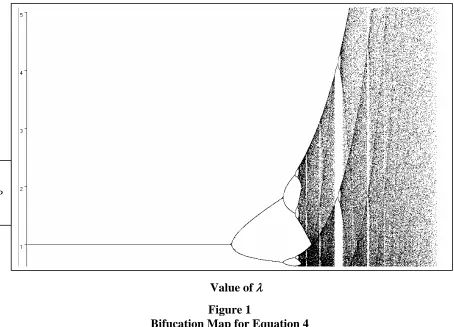
Proposition 4: For λ = 3.002, the solution to (4) is chaotic.
We don’t attempt to prove this proposition or discuss it heuristically. It can be established as
an application of the theorem of Li-Yorke triple, due to Li and Yorke (1975). In stead we will
illustrate the range of possible dynamics by referring to the bifurcation map for equation (4)
7
Figure 1
Bifucation Map for Equation 4
On this diagram we have the values of λon the x-axis. On the y-axis are plotted the iterates
fn(P) for n = 201 to 300, starting, for each λ, with a price chosen at random from the range:
))}]
(
(
,
{
Max
),
(
[
f
p
p
f
f
p
1
The map shows stable equilibria for λ ≤2, stable 2-cycles between 2< λ≤ 2.5. At 2.5, stable
4-cycles appear, and stable 8-cycles appear approximately around 2.6070 and so on. When λ
reaches around 2.636.., we still have stable cycles but with an infinite number of values (2∞
-cycles) shown by the grey patch starting around this value of λ.
Beyond this value, we encounter the diffused area of the map with small windows. The
windows represent stable cycles of various order. About the diffused areas the possible
conclusions are that either there are no stable cycles or there are stable cycles of such a long
period that our iterations do not capture them.
1
We do this because f(p) for any p belonging to this closed interval also belongs to this interval.
Value of λ
8
4.
Conclusions: Price Flexibility, Short-Runs and the
Long-Run
Propositions of Section 3 produce serious difficulties not only for class-room discourses but
also for mainstream macro theory.
First of all convergence to long-run classical equilibrium (P*, Yn) is conditional. This
challenges the general belief that equilibrium at less than the natural rate is only a short-run
phenomenon. It also undermines the idea of long-run price flexibility, which is a major
assumption in all models of growth and long-run behaviour. At the same time it opens up the
possibility that empirical time series data may not always come from an exponential
growth-plus-shocks type of data generation process. The data generation process may be far more
complex, and current econometric practices may be widely misleading.
Secondly, the condition for convergence depends not only on the (family of) supply functions
but also on the demand function. P changes from one period to the next because of a shift in
the short-run supply function. This shift produces a price change, whose extent also depends
on the parameters of the AD function. λ captures the overall effect on P of an inter-period
shift of the short-run supply function, and thus incorporates features of the supply as well as
the demand side. For example, it can be checked that if the aggregate demand elasticity is e,
ie equation (3) is replaced with Yd Pe
= α , then the restriction for convergence is 0< λ < 2/e.
This runs counter to the intuitive notion of price flexibility, which is considered a feature of
the supply side. Because λ does not have an interpretation involving either demand or supply
alone, it is difficult to weave a simple economic story around the condition of convergence
and long-run price flexibility.
Thirdly, if we propose λ as a measure of price flexibility we run counter to an established
usage. In this case, flexibility greater than a critical value implies that the system would not
converge to the long-run equilibrium. This goes against the normal use of phrases like
flexibility and rigidity in economics, which would have us expect that the stickier the prices,
9
We may conclude by noting that the notion of the long run as a limit of a sequence relies on
the convergence of the defined sequence. While this convergence is taken for granted, it is
actually conditional on parameters not understood very well. At least two sets of so-called
robust constructs are in threat here. The first is the intuition that prices are flexible in the long
run, and its corollary that even though we observe Keynesian outcomes in the short run, the
system is inexorably travelling towards a classical equilibrium. The second is the very
construct of the long run as it is used in mainstream economics. If it can not be defined before
10
References
Ball, L., Mankiw, G., and Romer, D. (1988) The New Keynesian Economics and the Output Inflation Tradeoff, Brookings Papers on Economic Activity (1988:1), 1-65.
Dechert, W. Davis (1996) ed. Chaos theory in economics: Methods, models and evidence, Elgar Reference Collection, International Library of Critical Writings in Economics, no. 66. Cheltenham, U.K, Elgar.
Fischer, S. (1977) Long-term Contracts, Rational Expectations, and the Optimal Money Supply Rule, Journal of Political economy, 85, 191-205.
Friedman, M. (1968) The Role of Monetary Policy, American Economic Review, 58, 1-17.
Gordon, R. J. (1998) Macroeconomics, Seventh Edition, Addison-Wesley Longman Inc., Reading, MA.
Gray, A. J. (1976) Wage Indexation: A Macroeconomic Approach, Journal of Monetary Economics, 2, 221-235.
Lauwerier, H.A. (1986) One Dimensional Iterative Maps, in Chaos, (Ed) A.V. Holden, Manchester University Press, 39-57.
Li, T., and Yorke, J.A. (1975) Period Three implies Chaos, American Mathematical Monthly, 82, 985-992.
Lucas, R. E, Jr. (1977) Understanding Business Cycles, in Stabilisation of the Domestic and the International Economy, vol 5 of Carnegie-Rochester Conference on Public Policy, Amsterdam, North Holland Publishing Company.
Majumdar, M and Mitra, T. (1994) Periodic and Chaotic Programs of Optimal Intertemporal Allocation in an Aggregative Model with Wealth Effects, Economic Theory; V4 N5, 649-76.
Majumdar, M and Mitra, T. (1997) Complexities of Concrete Walrasian Systems in Issues in Economic Theory and Policy, Essays in Honour of Professor Tapas Majumdar, (Eds) A. Bose, et al, Oxford University Press, Delhi, 41-63.
Mankiw, G. N. (1997) Macroeconomics, Third Edition, Worth Publishers, New York.
Mukherji, A. (1997) Discrete Processes, DSA Working paper, Centre for Economic Studies and Planning, Jawaharlal Nehru University.