DEVELOPMENT OF NEURO FUZZY
CONTROLLER ALGORITHM FOR AIR
CONDITIONING SYSTEM
ARSHDEEP KAUR
University College of Engineering, Punjabi University, Patiala, Punjab- 147002, India
AMRIT KAUR
University College of Engineering, Punjabi University, Patiala, Punjab- 147002, India
Abstract :
The paper presents the neuro-fuzzy controller algorithm for air conditioning system. Neuro-fuzzy control combines the learning capabilities of neural networks and control capabilities of fuzzy logic control. The neuro-fuzzy controller for air conditioning system takes two inputs from temperature and humidity sensors and controls the compressor speed. The experimental results of the developed system are also shown.
Keywords: air conditioning system; fuzzy logic; neuro-fuzzy.
1. Introduction
Air conditioners and air conditioning systems are integral part of almost every institution. These are used at locations like auditorium, indoor stadiums and conference halls, even in homes and offices [1].Air conditioning system is difficult to model mathematically due to complex interactions of multiple inputs and outputs. A conventional control design method requires the development of mathematical model of the control system [2]. This being the advantage of fuzzy logic control which does not require mathematical modeling for the design of the controller. It has the ability to deal with non linear systems [3]. Fuzzy logic controller (FLC) uses the qualitative knowledge of a system to design a controller. FLC deals with the uncertainties in the process of control by collecting both human knowledge and expertise [4].
The rest of the paper is organized as follows: Section 2 provides literature survey, section 3 gives overview of neuro-fuzzy control, section 4 shows the development of neuro-fuzzy control algorithm with results in section 5, and section 6 reports the conclusion of the paper.
2. Literature Survey
Md. Shabiul Islam et al (2006) [4], proposed a fuzzy logic controlled air conditioning system, which uses two inputs from temperature and humidity sensors which are in the range 0˚C to 40˚C and 0% to 100% respectively and has one output that controls the fan speed, each have five triangular membership functions.
The air conditioning system can even have an input that considers the user’s preference of temperature. As shown by Amiya Patnaik, a design which takes inputs that are user’s preference temperature, temperature difference, and room dew point temperature. The outputs are to control compressor speed, fan speed, mode of operation and fin direction. Mode of operation allows air conditioner to work normally until target temperature is reached, after which it functions like dehumidifier [1].
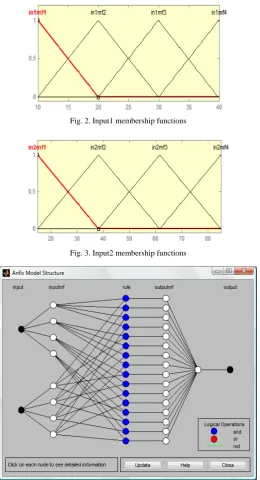
One of the major problems of the fuzzy logic control is the difficulty of choice and design of membership functions for a given problem [6]. Therefore, tuning of membership functions becomes an important issue in fuzzy modeling. Since this tuning task can be viewed as an optimization problem. Neural networks offer a possibility to solve this problem [7]. Hence, combining the adaptive neural networks and fuzzy logic control forms a system called neuro-fuzzy system. Neural networks are well known for its ability to learn and adapt to unknown or changing environment to achieve better performance. On the other hand, fuzzy logic by its effectiveness in handling linguistic information, incorporate human knowledge, deal with imprecision and uncertainty. Neuro-fuzzy system combines the learning capabilities of the neural networks and control capabilities of a fuzzy logic control system. It is a system that uses a learning algorithm to determine its parameters by processing data samples. Fig. 1. shows architecture of neuro-fuzzy system. First layer of neurons represents the input variables, second layer represents the input membership functions, third layer represents the rule base, fourth layer represents the output membership functions and fifth layer represents the output variables [8].
Fig. 1. Architecture of neuro-fuzzy system [8]
4. Neuro-fuzzy Controller Algorithm
Fig. 2. Input1 membership functions
Fig. 3. Input2 membership functions
6. Low Comfortable Off
7. Low Humid Low
8. Low Sticky Medium
9. High Dry Low
10. High Comfortable Medium
11. High Humid Fast
12. High Sticky Fast
13. Very High Dry Medium
14. Very High Comfortable Fast
15. Very High Humid Fast
16. Very High Sticky Fast
5. Experimental Results
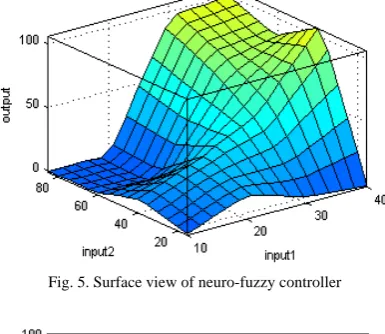
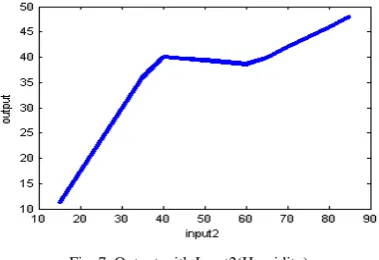
The neuro-fuzzy controller for air conditioning system is simulated using MATLAB. Following are the curves obtained (as shown in Figs.5,6, 7):
Fig. 5. Surface view of neuro-fuzzy controller
Fig. 7. Output with Input2(Humidity)
From these experimental results it can be deduced that using neuro-fuzzy algorithm to design the controller for air conditioning system gives an efficient control. The smoother the results move across the control surface the better is the controller. Hence, as can be seen from the surface view in Fig. 5 the results of the air conditioning system are quite smoother across the control surface. Also from the curves in Fig. 6 and Fig. 7 it is evident that compressor speed almost increases linearly with temperature and humidity. Hence, the system can be easily and efficiently controlled with the usage of neuro-fuzzy controller.
6. Conclusion
In this paper, it is shown that neuro-fuzzy contoller algorithm provides an efficient control for air conditioning system. Neuro-fuzzy algorithm is definitely superior to fuzzy logic algorithm as it inherits adaptibility and learning . By using neuro-fuzzy algorithm the system becomes adaptive to individual user, environment and weather.
References
[1] aptnk.in/wp-content/fuzzy-logic-control-of-air-conditioners.pdf [2] Passino, K. M. ; Yurkovich, S. (1998): Fuzzy Control, Addison Wesley.
[3] Batayneh, W.; Al-Araidah, O.; Bataneh,K. (2010):Fuzzy logic approach to provide safe and comfortable indoor environment. International Journal of Engineering Science and Technology, vol. 2.
[4] Islam, M. S.; Sarker, M. S. Z.; Rafi, K. A. A.; Othman, M. (2006) :Development of a fuzzy logic controller algorithm for air conditioning system. ICSE Proceedings.
[5] Abbas, M.; Khan, M. S.; Zafar, F. (2011): Autonomous room air cooler using fuzzy logic control system. International Journal of Scientific and Engineering Research, vol. 2.
[6] Mohandas, K. P.; Karimulla, S. (2001): Fuzzy and Neuro-fuzzy modeling and control of non linear systems. Second International Conference on Electrical and Electronics.
[7] Kaur, A. ; Kaur, A. (2012): Comparison of fuzzy logic and neuro fuzzy algorithms for air conditioning system. International Journal of Soft Computing and Engineering, vol. 2.
![Fig. 1. Architecture of neuro-fuzzy system [8]](https://thumb-us.123doks.com/thumbv2/123dok_us/9649631.1492834/2.595.192.407.375.535/fig-architecture-of-neuro-fuzzy-system.webp)