GSJ: Volume 6, Issue 11, November 2018, Online: ISSN 2320-9186
www.globalscientificjournal.com
NURSES’
ATTITUDES
TOWARDS
NURSING
RESEARCH
John Mark Lingcon, RN, MAN 1
1 Hemodialysis Department, Calamba Doctors’ Hospital; College of Nursing, Calamba Doctors’ College
B40 L2 Hong Kong Village, Banay-banay, Cabuyao City, Laguna 4025; [email protected]; (049)544-2637 / (+63) 929-721-3098
ABSTRACT
The main problem of this study was to examine the nurses’ attitudes towards nursing
research in selected hospitals in Laguna. The study is anchored on the Donabedian’s
structure-process-outcome framework. A convenience sample of (93) staff nurses and a
purposive sample of (7) expert nurses answered Boothe’s Attitudes on Nursing Research
Scale. This study made use of a mixed method. Researcher used frequency count and
weighted mean to assess degree of nurses’ attitudes towards nursing research, ANOVA
was used to note significant deifference among the ratings of the staff nurses, additionaly,
thematic analysis was employed to identify areas that will increase nurses engagement to
nursing research. Also, frequency count and percentage agreement at 85% were used to
The results showed that the most positive attitudes of the nurses are related to subscale
payoffs and benefits described as “Strongly Agree” which entails that nurses are to
engross in research if time time permits and if there are monetary and promotion benefits.
Meanwhile, subscale interest and environmental support was described as “Agree” and
subscale barriers to conducting research was described as “Uncertain”. Moreover, out of
46 items in Booth Scale, 10 items were identified as structure, 3 items as process, and 2
items for outcome. This study revealed no significant difference among the ratings of the
staff nurses. Thematic analysis uncovered three emerging themes namely, time, financial
support, and reward. Staff nurses agreed that their workplace should provide them time,
financial support, and reward with their research endeavour.
The findings of this study recommend that hospital management should provide ample
time, such as sabbatical leave or any leave of equivalence, to staff nurses wish to
participate in research activities. Also, hospital management should plan/support
programs leading nurses to participate in research activities, such as utilization of
evidence-based practice. Also, if possible, PRC-BON should outline policies that will
strengthen the structure and process of the research infrastructure supporting staff nurses
in doing research. Specifically, policies should focus on time, continuing education
programs, opportunities to conduct research, and comprehensive assistance for nurses
engaging in research.
INTRODUCTION
Nursing profession has long recognized the importance of research as an indispensable
foundation for its development. More recently, the movement supporting evidence-based
practice has brought this aim into focal point. Nurse involvement in research is essential to
the expansion of nursing science and improved care for patients. Nurses must provide
care and intervention based on up-to-date knowledge and research that supports the
delivery of the highest standards of care possible.
Preceded, are few heavy-weighted reasons for nurses to appreciate research. However,
as policies and professional developments over the last fifteen years placed increasing
pressure on nurses to be more accountable for their actions. Nursing has seen a shift
away from the heavily theoretical work of nursing academics to stronger emphasis on
practice. Nurses, nowadays, are more concern on what is than how it is to be done.
Research is an essential part of fast pacing health environment; it is a must to deliver
effective and efficient quality health care services to patients. Further, research is
significant in today’s nurses’ professional role and responsibility intertwined with concepts
of efficiency, effectiveness and quality improvement in delivering care to patients. Nurses
develop their own professional knowledge out from strong foundations built on research.
Consequently, nurses have a responsibility in some way to contribute to the development
of the profession’s knowledge through research.
The on-going change in the field of nursing strengthened the standpoint of research as a
international, are focus in uplifting nurses’ desire to indulge in research activities. There is
a felt need to understand the grounds of dissension between research as fundamental to
the nursing profession and the narrow application and utilization of nursing research in the
hospital setting, an appreciation of the staff nurses’ attitudes in nursing research is
warranted.
The studies performed over the last two decades cannot be generalized on their own but
when combined several themes emerge. An article compiled the common barriers to
research as reported by researchers using the BARRIERS scale, these include: (a) lack of
time; (b) lack of confidence in critical appraisal skills, (c) lack of authority; (d)
organizational infrastructure; (e) lack of support; (f) lack of access; and (g) lack of
evidence. [15, 16]
The researcher, a nurse by profession working in a private hospital, was motivated to
conduct this study to determine nurses’ attitudes towards nursing research and to exude
out and initiate discussions to nurses’ attitude in nursing research, as there is dearth of
studies of this matter in the Philippines. Result of this study aimed to encourage fellow
nurses to indulge in the world of nursing research.
METHODS
This study made use of a mixed method. Mixed method approach is one in which the
researcher tends to base knowledge claims on pragmatic grounds. It employs strategies
understand research problems. The data collection also involves gathering both numeric
information as well as text information so that the final database represents both
quantitative and qualitative information. [11]
Participants of the study consisted of (93) staff nurses, chosen using a convenience
sampling technique, employed in selected hospitals in Laguna from any nursing setting
and (7) expert nurses, selected using purposive sampling technique and were limited to
those who have masters and/or doctorate degree and with experience in nursing
administration, to categorize nurses’ attitudes into research infrastructure (structure,
process, and outcome). Staff nurses when characterized by gender: 83.87% (78) were
females and 16.13% (15) were males. Also, when group by age: 32.26% (30) were 21-25
years old, 21.51% (20) were 31-35 years old, 19.35% (18) were 26-30 years old, 13.98%
(13) were 36-40 years old, 7.53% (7) were 41-45 years old, and 5.38% (5) were 46-50
years old. Furthermore, staff nurses were distributed according to professional levels:
80.65% (75) were RNs, 11.83% (11) were RNs with specialization and 7.53% (7) were
RNs with masters units.
The main tool of the study was a questionnaire lifted from Dr. Patricia Boothe (Boothe’s
Attitude on Nursing Research Scale). The scale was developed by Boothe in 1981 as part
of her dissertation [7] and used by Dr. Bostrom and colleagues in 1989, [8] later by Dr.
Hofmeister in 2007. [14] The original survey consisted of 46 was items designed to
determine attitudes related to nursing research. All items in the questionnaire have been
environmental support, 0.80 for subscale payoff and benefits, and 0.64 for subscale
barriers to research. The survey questionnaire was answerable by a five-point Likert scale
from “1” indicates strongly disagree (SD) to “5” specifies strongly agree (SA). Added to the
lifted questionnaire is an open-ended question and a comment aimed to yield emerging
themes to support quantitative findings. Attached to the questionnaire is a cover letter
discussing the purpose of the study and assuring the anonymity of the nurse respondent.
The researcher secured a permit to conduct a study through Hospital
Administrator/Medical Director of selected hospitals. Upon approval, the researcher
personally administered the survey questionnaire to the participants. Researcher handed
the questionnaire in person to promptly answer any questions regarding the study. Data
were collected by a self-reporting method. The study started on the last week of August
2016 and ended on second week of October 2016.
Subsequently, questionnaires were retrieved. Data collected were summarized and
analyzed using various statistical treatment: frequency count and weighted mean to
assess degree of nurses’ attitudes towards nursing research; frequency count and
percentage agreement at 85% were used to categorize nurses’ attitudes into research
infrastructure (structure, process, and outcome), it was done to better understand which
procedure in research do staff nurses needs reinforcements; ANOVA was used to note
significant deifference among the ratings of the staff nurses; and thematic analysis was
RESULTS
Tables under present the analysis and interpretation to data gathered in this study. Note
that the higher weighted mean signifies more positive nurse’s attitudes towards nursing
research; legend in the table is a guide for interpretation of computed weighted means.
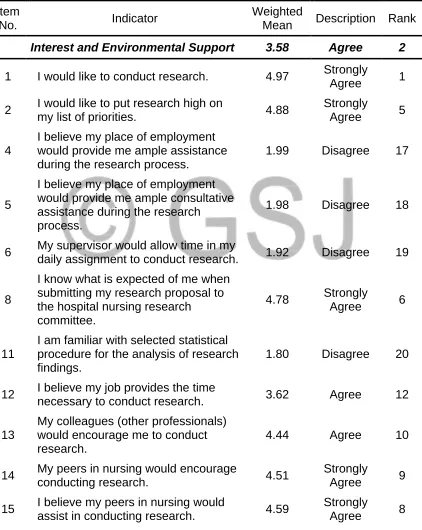
Table 1 recaps computed mean ratings of nurses’ attitudes towards nursing research. As
shown, subscale payoffs and benefits ranked first with general weighted mean of 4.51
followed by subscale interest and environmental support with general weighted mean of
3.58, and last is the subscale barriers to conducting research with 3.27 as general
weighted mean.
Results express that staff nurses strongly agree that they are likely to engage in nursing
research when there is positive enticement. Enticement were not limited to promotion and
salary increase only, rather, results suggest that staff nurses will be entice to join in
nursing research if they are rewarded with time to participate, evident as item numbers 38
and 39 – under subscale payoffs and benefits – both got weighted mean of 5 and
interpreted as strongly agree. Also, staff nurses conveyed that they have strong desire to
indulge in nursing research, manifested by a mean rating of 4.97 interpreted as strongly
agree for item number 1 under subscale interest and environmental support, if chance will
permit them. However, staff nurses voiced that they get little to no support from their
workplace in conducting or participating in research, shown in 1.26 mean rating of item
barriers to conducting research was seen uncertain as a factor for staff nurses to be
reluctant in participating research.
Table 1
Mean Ratings of Nurses’ Attitudes towards Nursing Research
Item
No. Indicator
Weighted
Mean Description Rank
Interest and Environmental Support 3.58 Agree 2
1 I would like to conduct research. 4.97 Strongly
Agree 1
2 I would like to put research high on
my list of priorities. 4.88
Strongly
Agree 5
4
I believe my place of employment would provide me ample assistance during the research process.
1.99 Disagree 17
5
I believe my place of employment would provide me ample consultative assistance during the research process.
1.98 Disagree 18
6 My supervisor would allow time in my
daily assignment to conduct research. 1.92 Disagree 19
8
I know what is expected of me when submitting my research proposal to the hospital nursing research committee.
4.78 Strongly
Agree 6
11
I am familiar with selected statistical procedure for the analysis of research findings.
1.80 Disagree 20
12 I believe my job provides the time
necessary to conduct research. 3.62 Agree 12
13
My colleagues (other professionals) would encourage me to conduct research.
4.44 Agree 10
14 My peers in nursing would encourage
conducting research. 4.51
Strongly
Agree 9
15 I believe my peers in nursing would
assist in conducting research. 4.59
Strongly
16
My job provides ongoing professional programs in order to conduct
research.
1.26 Strongly
Disagree 21
18
I believe my working environment provides ample opportunity to conduct research.
2.98 Uncertain 13
19
I believe my place of employment has ample secretarial assistance for anyone wishing to conduct research.
2.92 Uncertain 14.5
20
I believe my place of employment has ample statistical assistance for
anyone wishing to conduct research.
2.92 Uncertain 14.5
21
I believe my place of employment has ample assistance for anyone for the analysis of results and findings of the research that is conducted.
2.01 Disagree 16
27 Nursing research requires more from
me than I am willing to give to my job. 4.20 Agree 11
31
Nursing research is more essential in the medical setting than in the
psychiatric setting.
4.95 Strongly
Agree 2
35
Time spent giving patient care is more important than time spent conducting research.
4.63 Strongly
Agree 7
36 I am interested in conducting
research. 4.90
Strongly
Agree 3.5
45 Nursing research should be initiated
by nurse researchers. 4.90
Strongly
Agree 3.5
Payoffs and Benefits 4.51 Strongly
Agree 1
3
Nursing research is conducted because it allows nurses to be promoted.
4.74 Strongly
Agree 8.5
9
The informed consent necessary for employee participation in research prevents me from conducting research in my work areas.
2.84 Uncertain 17
time. Agree
23
I would conduct research if I knew how to write the proposal, conduct and analyze the results and findings.
4.71 Strongly
Agree 10
24
Research findings that are
advantageous to good patient care can be implemented in my working
environment.
4.94 Strongly
Agree 4
25
Nursing research is the means whereby the theoretical basis for nursing practice is derived.
4.89 Strongly
Agree 6
26
Members of the treatment team other than nurses should conduct research relative to patient.
4.43 Agree 12
29 I would like to conduct a study of a
problem in patient care. 4.49 Agree 11
30 I would conduct research if patient
assignments were lightened. 4.81
Strongly
Agree 7
32 Nursing research should be initiated by
nurses in the clinical area. 4.96
Strongly
Agree 3
34
Nurses would conduct more research if more funds were available for them to use for this purpose.
4.00 Agree 15
37
Nurses receive praise from their peers and colleagues when they conduct research.
4.32 Agree 14
38 Nurses would conduct research if they
were provided time for research. 5.00
Strongly
Agree 1.5
39 Nurses would conduct research if relief
time were given to conduct research. 5.00
Strongly
Agree 1.5
41 I would do research if I knew more
42 Nurses criticized too much by their
peers when they conduct research. 3.74 Agree 16
44
I believe that I would conduct research if someone more knowledgeable would help me in the process.
4.74 Strongly
Agree 8.5
Barriers to Conducting Research 3.27 Uncertain 3
7
The process of submission of the research proposal to the hospital nursing research committee is too detailed.
4.27 Agree 3
10
The informed consent necessary for patient participation in research
prevents me from conducting research in my work areas.
1.98 Disagree 8
17 I have the skills and knowledge
necessary for me to conduct research. 3.55 Agree 5
28 Nursing research should be conducted
by nurses with baccalaureate degree. 4.72
Strongly
Agree 1
33 Nursing research should be initiated by
nurses in education. 2.20 Disagree 7
40 Nursing research should be conducted
by nurses with a doctorate. 2.71 Uncertain 6
43 Nursing research should be conducted by nurses with a master’s degree. 4.28 Agree 2
46 Patient participation in nursing
research is difficult to obtain. 4.01 Agree 4
Legend: 1.00 – 1.49 1.50 – 2.49 2.50 – 3.49
Never
Rarely
Sometimes
3.50 – 4.49 4.50 – 5.00
Very Often
Always
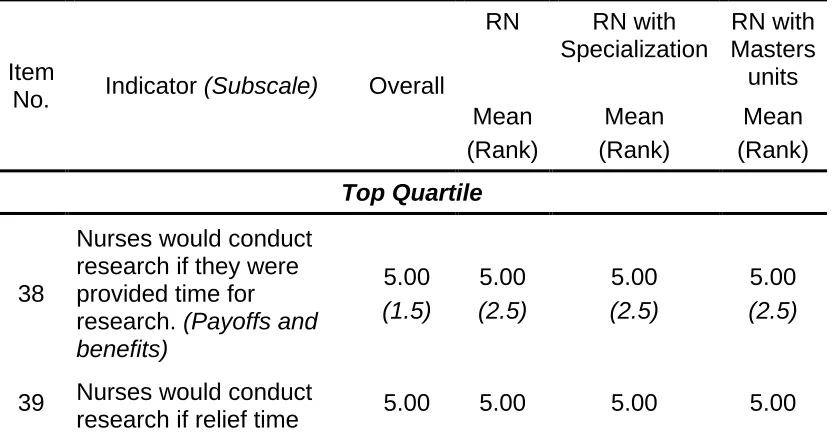
To better examine which nurses’ attitudes plays positive motivation for staff nurses to
indulge in nursing research, researcher noted top and bottom quartile of nurses’ attitudes
Shown in Table 2 are the top and bottom quartile of nurses’ attitudes towards nursing
research. Top quartile suggests staff nurses are willing and motivated to participate in
nursing research activities as they understand its importance in the evolution of quality
care to patients, thus, agree that research should be initiated by those in the clinical area.
However, time and nursing assignments are factors that halt them from doing so. Staff
nurses pointed out that if hospital management will give them time and lessen their
nursing assignments, they will put research high on their list of priorities.
Meanwhile, bottom quartile express that staff nurses see their workplace press them no
support to participate in nursing research acivities. They believe that their workplace lacks
technical assistance to back them. Also, statistical comprehension is a concern.
Table 2
Top and Bottom Quartile of Nurses’ Attitudes towards Nursing Research Compared across the Identified Professional Levels
Item
No. Indicator (Subscale) Overall
RN RN with
Specialization
RN with Masters units
Mean (Rank)
Mean (Rank)
Mean (Rank)
Top Quartile
38
Nurses would conduct research if they were provided time for research. (Payoffs and benefits)
5.00
(1.5)
5.00
(2.5)
5.00
(2.5)
5.00
(2.5)
39 Nurses would conduct
were given to conduct research. (Payoffs and benefits)
(1.5) (2.5) (2.5) (2.5)
1
I would like to conduct research. (Interest and Environmental Support) 4.97 (3) 4.97 (7) 4.91 (6) 5.00 (2.5) 32
Nursing research should be initiated by nurses in the clinical area. (Payoffs and benefits) 4.96 (4) 5.00 (2.5) 5.00 (2.5) 4.43 (16) 31
Nursing research is more essential in the medical setting than in the psychiatric setting. (Interest and Environmental Support) 4.95 (5) 5.00 (2.5) 4.91 (6) 4.43 (16) 24
Research findings that are advantageous to good patient care can be implemented in my working environment.
(Payoffs and benefits)
4.94 (6) 4.99 (5.5) 4.73 (11) 4.71 (8.5) 22
I would conduct research if I had the time. (Payoffs and benefits) 4.92 (7) 4.93 (9.5) 4.91 (6) 4.86 (5.5) 36
I am interested in conducting research. (Interest and Environmental Support) 4.90 (8.5) 4.92 (11) 4.73 (11) 5.00 (2.5) 45
Nursing research should be initiated by nurse researchers. (Interest and Environmental Support) 4.90 (8.5) 4.96 (8) 4.64 (13.5) 4.71 (8.5) 25
Nursing research is the means whereby the theoretical basis for nursing practice is derived. (Payoffs and benefits) 4.89 (10) 4.89 (12.5) 5.00 (2.5) 4.71 (8.5) 2
I would like to put
research high on my list of priorities. (Interest and
Environmental Support)
30
I would conduct research if patient assignments were lightened. (Payoffs and benefits) 4.81 (12) 4.99 (5.5) 4.00 (24.5) 4.14 (22) Bottom Quartile 19
I believe my place of employment has ample secretarial assistance for anyone wishing to
conduct research. (Interest and Environmental Support) 2.92 (35.5) 3.00 (34) 2.64 (37.5) 2.57 (39) 20
I believe my place of employment has ample statistical assistance for anyone wishing to conduct research. (Interest and Environmental Support) 2.92 (35.5) 2.97 (36) 2.55 (39) 3.00 (34.5) 9
The informed consent necessary for employee participation in research prevents me from
conducting research in my work areas. (Interest and Environmental Support) 2.84 (37) 2.81 (37) 2.91 (36) 3.00 (34.5) 40
Nursing research should be conducted by nurses with a doctorate.
(Barriers to conducting Research) 2.71 (38) 2.67 (38) 2.64 (37.5) 3.29 (31) 33
Nursing research should be initiated by nurses in education. (Barriers to conducting Research) 2.20 (39) 1.89 (44) 3.64 (29) 3.29 (31) 21
I believe my place of employment has ample assistance for anyone for the analysis of results and findings of the research that is
conducted. (Interest and Environmental Support)
4
I believe my place of employment would provide me ample assistance during the research process. (Interest and Environmental Support) 1.99 (41) 2.00 (40) 2.00 (41.5) 1.86 (42.5) 5
I believe my place of employment would provide me ample consultative assistance during the research process. (Interest and Environmental Support) 1.98 (42.5) 1.99 (41.5) 1.91 (43) 2.00 (40.5) 10
The informed consent necessary for patient participation in research prevents me from
conducting research in my work areas. (Barriers to conducting Research)
1.98 (42.5) 1.97 (43) 2.09 (40) 1.86 (42.5) 6
My supervisor would allow time in my daily assignment to conduct research. (Interest and Environmental Support) 1.92 (44) 1.99 (41.5) 1.64 (46) 1.71 (44.5) 11
I am familiar with selected statistical procedure for the analysis of research findings. (Interest and Environmental Support) 1.80 (45) 1.83 (45) 1.73 (44.5) 1.57 (46) 16
My job provides ongoing professional programs in order to conduct
Nurses attitudes were categorizaed according to Donabedian’s structure-process-outcome
framework, it was done to assess areas of research infrastructure [12] which need
intervention or plan to increase satff nurses engagment to nursing resrearch.
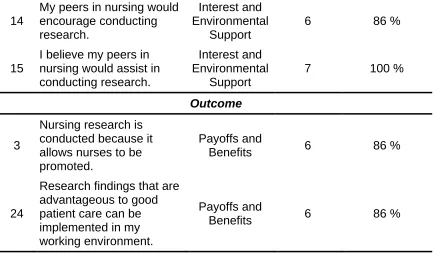
Table 3 outlines the how nurses’ attitudes were identified, by expert nurses, in terms of the
research infrastructure (structure, process, and outcome). Nurses’ attitudes which focused
on the support of the the management/workplace were seen areas to review in improving
structure of research engagement of staff nurses. Meanwhile, nurses’ attitudes concerning
support from collegaues were perceived vital in the process of doing research. Lastly,
nurses’ attitudes that project benefits of nursing research associated with outcome as
factor for staff nurses to participate, conduct, and implemet nursing research.
Table 3
Nurses’ Attitudes identified as Research Infrastructure by Expert Nurses
Item
No. Indicator Scale Frequency
Percentage of Agreement
Structure
4
I believe my place of employment would provide me ample assistance during the research process.
Interest and Environmental
Support
7 100 %
5
I believe my place of employment would provide me ample consultative assistance during the research process.
Interest and Environmental
Support
6
My supervisor would allow time in my daily
assignment to conduct research.
Interest and Environmental
Support
6 86 %
16
My job provides ongoing professional programs in order to conduct research.
Interest and Environmental
Support
6 86 %
18
I believe my working environment provides ample opportunity to conduct research.
Interest and Environmental
Support
6 86 %
19
I believe my place of employment has ample secretarial assistance for anyone wishing to conduct research.
Interest and Environmental
Support
7 100 %
20
I believe my place of employment has ample statistical assistance for anyone wishing to conduct research.
Interest and Environmental
Support
7 100 %
21
I believe my place of employment has ample assistance for anyone for the analysis of results and findings of the research that is conducted.
Interest and Environmental
Support
7 100 %
28
Nursing research should be conducted by nurses with baccalaureate degree.
Barriers to Conducting
Research
6 86 %
34
Nurses would conduct more research if more funds were available for them to use for this purpose.
Payoffs and
Benefits 7 100 %
Process
13
My colleagues (other professionals) would encourage me to conduct research.
Interest and Environmental
Support
14
My peers in nursing would encourage conducting research.
Interest and Environmental
Support
6 86 %
15
I believe my peers in nursing would assist in conducting research.
Interest and Environmental
Support
7 100 %
Outcome
3
Nursing research is conducted because it allows nurses to be promoted.
Payoffs and
Benefits 6 86 %
24
Research findings that are advantageous to good patient care can be implemented in my working environment.
Payoffs and
Benefits 6 86 %
Table 4 outlines the computed ANOVA for nurses’ attitudes towards nursing research. As
presented, computed p values of subscales are greater than the set level of significance
(α = 0.05). Thus, researcher accepted the null hypothesis (Ho) there is no significant
difference among the mean ratings of nurses’ attitudes towards nursing research.
Accepting the null hypothesis was reinforced by computed F-crits of subscales greater
than F-statistics.
Results prove that staff nurses were unanimous in their attitudes towards nursing
research. Regardless of professional levels, staff nurses share same sentiments and
Table 4
ANOVA for Nurses’ Attitudes towards Nursing Research
p value F F crit
Interest and Environmental Support 0.87 0.14 3.15
Payoffs and Benefits 0.14 2.07 3.19
Barriers to Conducting Research 0.97 0.03 3.47
Legend: α = 0.05
Thematic analysis was employed to identify any emerging themes from the open-ended
question and comment of the questionnaire.
Thirty-seven (37) comments were about time, staff nurses need administrative time in the
outset of their tasks to fulfill desire for professional growth. A study was conducted that
aimed to determine clinical nurses' interest in and motivation for research and foud out
that clinical nurses emphasized that lack of designated time is one of the reasons why
they fail to engage to research activities. [3] Time constraints were previously identified as
barrier to conducting research. [15, 16, 21] Consequently, increasing available time will help
increase research participation. [16, 20]
Fourteen (14) comments focused on expanding financial support hoped to be given by
the state and employers, to the nurses when they conduct research studies. Funding
mechanisms are needed to support coherent programs of research. [4] Financial support
and a strong value for generating as well as disseminating knowledge must be present
level. This study and that of Dr. Hofmeister’s both found time and support as emerging
themes. [14] However, in this study specific type of support was identified, financial
support.
Also, fourteen (14) comments desire to have enticing reward in exchange of nurses’ effort
to professional growth and development. This result supports the finding that most of the
nurses’ positive attitudes are related to the subscale payoffs and benefits. Positive
reinforcements (rewards) increase nusrses participation and utilization of research. [26]
DISCUSSION
This study was not set to find significant differences in the attitudes of nurses related to
research compared to other studies. Instead, this study was initiated to describe and
explore the relationship among nurses’ attitudes towards research and the supporting
infrastructure. In general, the study shows no significant difference among nurses’
attitudes towards nursing research. This suggests that staff nurses share consistent
attitudes towards nursing research.
Nurses’ attitudes are generally positive and interested to engage in research activities.
The most positive attitudes of the staff nurses were related to the subscale payoffs and
benefits. Goals for conducting research include the improvement of nursing care,
credibility of the nursing profession, accountability for nursing practice and documentation
of the cost effectiveness of nursing care. [22] Research engagement has several benefits:
knowledge generation, occasional cost savings (e.g. healthier workforce), better
research is important in preparing the next generation of nurse leaders which should start
at the baccalaureate level and continue to the doctoral or postdoctoral levels. [6] Staff
nurses’ positive attitudes signifies that nursing profession understands and appreciates
the implication of nursing research. These significant contributions over recent years
include, but are not limited to: (a) health services research that demonstrated the
importance of nursing services and how such services are designed/organized to ensure
safety and quality of care; [13] (b) clinical research that has demonstrated the value of
specific nursing interventions to improve health outcomes, including enhanced survival,
reduced morbidity, and improved quality of life and consumer engagement; [19] (c) basic
science research that has advanced discoveries in terms of understanding the biological
mechanisms underpinning nursing interventions; [18] (d) epidemiological research that has
advanced understanding about how individuals and populations respond to health
problems; [9] and (e) qualitative research that has advanced understanding about
experiences of and responses to health and illness and the processes of care that are
important to optimal outcomes. [24] However, staff nurses feel that they get little to no
support from their job. A study suggest that there is an urgent need for nurse
administrators/hospital management to implement in-service educational programs for
nurses in conducting and utilization of nursing research. [26] Working environment should
provide ample time, such as sabbatical leave or any leave of equivalence, to nurses
wish to participate in research activities. Also, working environment should plan/support
programs leading nurses to participate in research activities, such as utilization of
enculturate the practice environment but evidence-based practice should be included in
the framework for nursing administrative decision-making. [25]
Staff nurses’ attitudes were categorized into research infrastructures and was noted that
subscale interest and environmental support dominated the structure and process aspect
of research enagement. This means that structure (materials, facilities, and resources to
do research) and the process (day-to-day activities in doing research) need to be
reviewed and initiate plan of intervention to enhance staff nurses motivation to indulge in
research activities. A good supporting structure and process of research infrastructure has
the ability to achieve several outcomes related to nursing research. These include: (a)
increasing nursing research knowledge; (b) increasing support for nursing research
through mentoring; and (c) development of a nursing research education program. [23]
Meanwhile, subscale payoffs and benefits dictated the outcome research infrastructure
and suggests that providing enticement or incentive to staff nurses will help them be
drawn to research activities. Hospital managements should facilitate conditions of career
advancement through indulgence in research activities on the basis of changing
technology and knowledge, staff expectations, the necessity of decreasing cost and
increasing productivity.[1, 2] In addition to providing high quality services, these career
advncement are making attempt to provide opportunities for staff nurses development. [10]
Furhermore, the study identified three emeging themes: time, financial support, and
reward. Staff nurses expressed that time, financial support, and reward are concepts that
barrier for nurses to engage in research activities. [3] Funding mechanisms are needed to
support coherent programs of research. [4] Financial support and a strong value for
generating as well as disseminating knowledge must be present within departments and
schools, in the larger academic institution, and at the national level. [14] Positive
reinforcements (rewards) increase nusrses participation and utilization of research. [26]
Previous studies identified several actions that may contribute to overcoming barriers of
nursing research participation and utilization, such as providing resources, increasing
release time for participation in research, continuing education on the research process
and creating positions for nurse researchers in clinical settings. [17, 19, 20]
PRC-BON, if possible, should outline policies that will strengthen the structure and
process of the research infrastructure supporting nurses in doing research. Specifically,
policies should focus on time, continuing education programs, opportunities to conduct
research, and comprehensive assistance for nurses engaging in research. In the United
States, the American Nurses Credentialing Center (ANCC), a subsidiary of the American
Nurses Association, oversees the Magnet Recognition Program, a program that
recognizes nursing excellence where continuing education/research is a requirement.
Research on hospitals who have achieved Magnet status shows several benefits. The
benefits of achieving Magnet status include improved patient outcomes, expanded
recruitment and retention of nurses and other healthcare personnel, and enhanced
nursing staff satisfaction and productivity. [5] Assimilating, disseminating and enculturating
essential force of magnetism and must be present in an organization to achieve magnet
status. [25]
This study is first in the Philippines setting. It is a must for us to produce more adept
nurses to meet global competence. Also, to assure that we provide the best possble care
and service to our patients. Emerging themes lead the researcher to suggest actions to be
undertaken, such us role promotion, incentives, and sabbatical leave for nurses who wish
to engage in nursing research. Further research may conduct similar study in rural
hospitals to assess whether there is difference in attitudes to research of nurses with
modest known resources. Also, furher research may give focused on time, financial
support, and reward to establish baseline data needed in planning programs addressing
Reference
[1] Adeniran, RK., Bhattacharya, A., & Adeniran, AA. (2012). Professional excellence and
career advancement in nursing: a conceptual framework for clinical leadership
development. Nursing Administration Quarterly. 36(1): 41-51.
[2] Adeniran, RK., Smith-Glasgow, ME., & Bhattacharya, A. (2013). Career advancement and
professional development in nursing. Nursing Outlook.
[3] Akerjordet, K., Lode, K. & Severinsson, E. (2012). Clinical nurses' attitudes towards
research, management and organisational resources in a university hospital. PubMed.
[4] American Association of Colleges of Nursing (AACN) (2006). Position Statement nursing
research. Washington, DC: American Association of Colleges of Nursing.
[5] American Nurses Credentialing Center (ANCC) (2005). The Magnet Recognition Program
®, Recognizing excellence in nursing service, Application manual. Silver Springs:
author.
[6] Blenskinsop, C. (2008). Research: an essential skill of a graduate nurse? Nurse Education Today 23(2): 83–88.
[7] Boothe, P. A. (1981). A study to determine the attitude o f professional nurses toward
nursing research. Unpublished doctoral dissertation, University of Alabama,
Tuscaloosa.
[8] Bostrom, A., Malnight, M., MacDougall, J., & Hargis, D. (1989). Staff nurses’ attitudes
toward nursing research: A descriptive survey. Journal of Advanced Nursing, 14,
915-922.
[9] Carrington, M., Jain, A., & Stewart, S. (2012). Pressure points in primary care: A study of
blood pressure in 532, 050 patients in Australia from 2005 to 2010. Baker IDI Heart and
[10] Coventry, TH., Maslin-Prothero, SE., & Smith, G. (2015). Organizational impact of nurse
supply and workload on nurses continuing professional development opportunities: an
integrative review. Journal of Advanced Nursing.
[11] Creswell J. (2003). Research Design: Qualitative, quantitative, and mixed methods
approaches, 2nd ed. University of Nebraska, Lincoln.
[12] Donabedian, A. (1988). The quality of care: How can it be assessed? Journal of American
Medical Association, 260, 1743-1748.
[13] Duffield, C., Diers, D., O'Brien-Pallas, L., Aisbett, C., Roche, M., & King, M. (2011).
Nursing staffing, nursing workload, the work environment and patient outcomes.
Application Nursing Research. 24(4): 244-55.
[14] Hofmeister, N. (2007). Attitudes of nurses toward research. Grand Valley State
University.
[15] Hutchinson AM, Johnston L. (2004). Bridging the divide: A survey of nurses' opinions
regarding barriers to, and facilitators of, research utilization in the practice setting.
Journal of Clinical Nursing.
[16] Hutchinson, A., & Johnston, L. (2006). Beyond the BARRIERS Scale; Commonly
reported barriers to research use. The Journal o f Nursing Administration, 36, 189-199.
[17] Kajermo, K., Nordstrom, G., Krusebrant, A., & Bjorvell, H. (2010). Perceptions of research
utilization: Comparisons between health care professionals, nursing students and
reference group of nurse clinicians. Journal of Advanced Nursing, 31, 99-109.
[18] Kim, HJ., Barsevick, AM., Fang, CY., & Miaskowski, C. (2012). Common biological
pathways underlying the psychoneurological symptom cluster in cancer patients.
Cancer Nursing. 35(6): E1-E20.
[19] Kitson, A., Marshall, A., Bassett, K., & Zeitz K. (2013). What are the core elements of
patient-centred care? A narrative review and synthesis of the literature from health
[20] Mattila, L., & Eriksson, E. (2007). Nursing students learning to utilize nursing research in clinical practice. Nurse Education Today 27: 568–576.
[21] McKenna, H., Ashton, S., & Keeney, S. (2004). Barriers to evidence-based practice in
primary care. Journal o f Advanced Nursing, 45, 178-189.
[22] Nieswiadomy, RM. (2008). Foundations of Nursing Research, 5th edn. Upper Saddle
River, NJ: Prentice Hall.
[23] Redfeam, M., Lacey, L., Cox, K., & Teasley, S. (2004). An infrastructure for organizational
support for research. Journal of Nursing Administration, 34, 346-353.
[24] Scott, JA., Lasch, KE., Barsevick, AM., & Piault-Louis, E. (2011). Patients' experiences
with cancer-related fatigue: a review and synthesis of qualitative research. Oncology
Nursing Forum. 38(3): E191-203.
[25] Turkel, M., Reidinger, G., Ferket, K., & Reno, K. (2005). An essential component of the
magnet journey: Fostering an environment for evidence-based practice and nursing
research. Nursing Administration Quarterly, 29, 254-262.
[26] Vijayalakshmi, P., Pashupu, DR., Nagarajaiah, Thimmaiah, T. and Math, SB. (2014).
Nurses attitudes and perceptions of nursing research: an indian perspective. Asian