©2015 JNAS Journal-2015-4-6/732-738 ISSN 2322-5149 ©2015 JNAS
The study relation of organization commitment
and individual characteristic of the personnel of
Ardabil Health organization
Nasser rezayi and Samad Jabbari Asl
*Department of management, Astara branch, Islamic Azad University Astara, Iran
Corresponding author: Samad Jabbari Asl
ABSTRACT: The present study aimed at considering the relation of organization commitment and individual characteristic of the personnel of Ardabil Health organization. It is a correlation descriptive study, sample population of the study include total personnel of Ardabil health organization in 2014. 60presons were selected as samples through random selection. Data accumulation was done by using an organization commitment questionnaire (OCQ) and a researcher- made questionnaire on individual characteristics, then collected data were analyzed by Pearson correlation coefficient and software spss. Obtained results show that there is a meaningful relationship among organization commitment, gender, education and salary level (p<0.05). Also the results indicated that. There is a meaningful relationship among organization interest, gender, employment condition, education and salary level and among trend to stay, employment condition. Marriage condition and education, and among membership honor, gender and education (p<0.05). Along with obtained results, individual characteristic was considered as one of factors influencing on personnel’s organization.
Keywords: organization commitment; individual characteristics; personnel.
INTRODUCTION
in the present challenging era in which the organizations more towards specialization and operate competitively, despite tools and equipment’s for survival, there is aneed to commited human force as the most important element. Growing of organizations and their performances cause the need for motivated and committed human forces to increase. Thus, this qualified investment of human sources will lead to high probability of success. Survival and promotion of the organization.
There are a number of studied which indicate organization commitment is, indeed, an emotional dependency on the organization, so that, highly committed personnel take their identities from organization, contribute to organization, and enjoy membership of organization; and organization commitment can have a number of positive consequences. On the other hand, human sources, committed to the values and goals of organization, is considered, not only as an element of dominance of an organization over other others, but as of consistent competitive advantage for many organization.
733
When organization have enough committed human sources, employed individuals, as loyal members of organization and values and goals, try their best to achieve organization purposes and promote organization efficiency.In the present study, we have tried to identify the factors influencing on personnel’s organization commitment. And them we have tried to answer the following research question: what is the relationship between individual characteristics (e.g. age, gender, education, marriage, income and years of employment) and the level of organization commitment of personnel?
Review of literature Individual characteristics
1-Age: Given broad variation through individual’s evolution process, there are identified common aspects of phases of life, so these phases are classified into six:
1- Sucking period and in fancy; 2-Maturity and adolescence 3-Youth,
4-Middle- aged period 5-Disabled period and 6- old age period
There is no scientific reasoning for the suppose that evolution stopped after the phase of adolescence; because every phase of life, from sucking period to the end of life, is companied with some special, evolutionary skills and abilities (khosravi, 2006). Successful evolution makes ready individual to enter the next phase of his life, the problems of acquiring these skills can increase danger of psychic, social abnormalities, and even health problems. It might be supposed that evolution is the various stages of liner progress, while some scholars believe that evolution progresses linearly, but its effect is spiral, hence, family should be attended as a care unit (khosravi, 2006).
2- Gender: what todays considered as one of the most basic problems in the field of organization. is organization managers. Various attitudes towards gender. While sex refers o the physical differences of human bodies, gender refers to psychological. Social and. Cultural differences of males and females. There are few studies on considering gender differences in the field of managing mini- organization, and in particular, managing human sources (verhool, 2001).
Unfortunately, management literature has not provide sufficient document on the question that whether males and females are different managers? Lowden,1985. Both scientific and public management state males and females choose different styles of management (Tabarsa, 2008). Hafsted’s (1976).Evidences illustrated that males. Currently, prefer consultation style; and another scholar in 2002 found that female managers prefer auto critic style. (verhool, 2003).
Males control production process, directly; and observing any deviation through production program, they program, they perform needed reforms and corrections; while females usually employ indirect control methods, they try to control organization process through motivating personnel to create commitment towards organization goals (verhool, 2003).
3- Education : organization individuals’ education is considered as One of the most significant element in success and efficiency of organization. Governments always try to encourage people to acquire knowledge through allocating a large amount of budget to training and education.
4-employment years: employment years is the number of years for which, one is working for an organization. There are a number of studies on the influence of employment years on management affairs, whose results show that there is a meaningful relationship between organization commitment and employment years personnel, in the sense that, individuals with long years of employment within organization have high levels of organization commitment. Aged employees, those who have long employment years and those who have high level of outcomes. Have more trends towards high levels of organization commitment (strawn, 1995)
734
Organization commitment
One of the basic principles and concepts for governing organization is to take account amount of employed individual’s interest and commitment in the other depending of individual on his work environment (ilziver & koslovaski, 2001:594)
In particular, managers within larger organizations must pay more attention to this key point, in order to solve the problems of involved human sources in proper manner, and employ them to meet the goals and interests of heir organization commitment imply that an individual offers some things to organization. Beyond what is needed for that organization (van-ma-annen, 1972, 26). Scholars consider organization commitment as an important variable for understanding personnel’s behaviors; they believe that commitment is a kind of one’s internal emotion or insight toward organization, job or group, which in judgment is considered as his loyality and performance towards organization; depending on nature or identity of an organization. Loyality of its member can influence on its survive and success. The significance of employee’s organization commitment will be doubled if that organization, due to its identity, deals with human, financial or such other problems. Trusting in employees. On the one hand and competition among organization , on the other hand, make necessary for organization to have committed employees, commitment creates inclination for doing considerable efforts for improvement of organization conditions and accepting its goals and values (Eangersaul et.al. 2000): according to Angle and perri (1938). It is influenced by individual and organization elements (chan, 2006).
The concept organization commitment was first developed by white and then extended by such scholars as proter , moodi, steeres, alen, miyer and baker (Demirai & krabay, 2008).
Literature of organization behavior provides more evident explanation about organization commitment: commitment bestows power o people and stablished their behaviours under various condition ; consequently , it can be said that commitment refers to high level of individuals’. Social and psychological dependence on some individuals or objects within social life (Alexander & tiri, 1996) and includes expectations, private interests , moral components, Generosity and faithfulness (lio, 2008).
According to clipe, organization commitment explaines indivdual’s behaviours towards organization goals and values, regarding legal and normal expectations of organization about their members (demirai & krabay, 2008:140) Vinz (1982) believed that organization commitment causes success of organization through its member’s insisency and generosity, and represents member’s infatuations and trends towards organization (lio, 2008:118).
Factors influencing on organization commitment:
Factors influencing on organization commitment are classified as follows:
1-individual features, 2-emploment features. 3-leader- group relationship, 4-organizational features, and 5-rolecondition (mathew & zack, 1990).
Dimension of organization commitment:
although there are various definitions in literature provided for organization commitment all of them reflect there general issues: emotional attachment (emotional commitment), understand costs (continued commitment) and duty feeling (norm commitment).
Emotional commitment: it refers to emotional dependence individual simulation and attachment of employees towards Organization. Emotional commitment is defined as emotional attachment and satisfaction for dong something and having desire to maintain employment position within organization continued commitment: it refers to the advantages and concessions which would be lost after employee’s leaving his organization.
Continued commitment is based on the costs resulted from leaving the organization; so the possibility of employees’ leaving will be reduced. If the investment on personnel be increased.
Norm commitment: it refers to the necessity of employees’ staying in his job within organization. Through his dimension of commitment, individuals consider doing their jobs within organization as their duties and responsibilities by which they can performance their debts toward organization.
Research hypotheses:
The primary hypothesis of this study is:
there is a relationship between individual characteristics of Ardabil health organization personnel and their organization commitment. But there are some other secondary ones:
735
5-there is a meaningful relationship between personnel’s employment years and organization commitment.6-There is a meaningful relationship between personnel’s salary or wage and organization commitment.
MATERIALS AND METHODS
Regarding its goal, the present study is a functional one; it is a descriptive, field study.
Sample population:
sample population of the study was the personnel of Ardabil health organization. Sample size was 200 which determined by creasy and moorgan’s (1970) sampling method; it reliability level and allowed error were 0.95 and 0.05. repectively. From mentioned population, 60 were selected randomly.
Data collection:
the tool used for data gathering in the study was questionnaire (organization commitment questionnaire). The questionnaire consisted of two parts. He first part was related to personal and job features of participants, while the second one was questionnaire commitment which was developed by moodi, Porter and steeres (1979) and translated by moghimi (2006). The questionnaire was mode of 15 questions for each of which, there were seven possible answers, from “I strongly agreed to I strongly disagreed”. There are a number of studies (e.g. bartch & davines, 1998: moodi, porter & steeres, 1982; potion & davines, 1991) which have demonstrated its duration and currency (varouna, 1996).
collected data in present study were analyzed in three parts of population cognition including age gender,… then, obtained data , by the use of Pearson correlation test, were analyzed at two levels of descriptive like mean. Standard deviation,… and perrcetional, in order to analyze the data. Software SPSS was used.
Table 1. mean and standard deviation of scores of organization commitment personnel of Ardabil health organization Variables
Standard deviation Mean
8.41 55.36
Organizational Commitment
5.63 15.71
Organizational trend
5.25 14.53
willingness to stay within organization
4.73 13.33
membership honor
4.05 11.78
determination individual goal
According to table (1), mean (std deviation) of scores of organization commitment was 55.36(8.41), of organization trend was 15.71 (5.63), of willingness to stay within organization was 14.53(5.25), of membership honor was 13.13(4.73 ) and of determination individual goal was 11.78(4.05) .
(1) There is a meaningful relationship between personnels’ age and organization commitment.
Table 2. Results of Pearson test for scores of organization commitment related to individual characteristics
Variables organization commitment
Pearson correlation coefficient Significant level.
Gender -0.27 0.008
Employment Type 0.13 0.15
Marital status -0.08 0.26
education -0.39 0.001
Age 0.12 0.17
salary level -0.30 0.009
Work experience 0.10 0.22
736
Table 3. Results of Pearson test for scored of organization trend related to individual characteristicsVariables organization commitment Pearson correlation coefficient Significant level.
Gender -0.28 0.01
Employment Type 0.24 0.02
Marital status -0.11 0.18
education -0.28 0.01
Age -0.06 0.31
salary level -0.40 0.001
Work experience -0.15 0.12
According to table (3) and given to meaningfulness level of test- error for organization trend, having reliability of 0.95, is more than 0.05 , thus, we can demonstrate e that there are meaningful relationship between organization trend and gender (r=-0.28), employment condition (r=0.24) education (r=-0.28) and salary level(r-0.40), but no meaningful relation was found for other variables.
Table 4. Results of Pearson test for scores of willingness to staying within organization related to individual characteristic
Variables organization commitment
Pearson correlation coefficient Significant level.
Gender 0.03 0.38
Employment Type 0.32 0.005
Marital status -0.29 0.04
education -0.24 0.02
Age 0.08 0.25
salary level -0.10 0.20
Work experience -0.28 0.01
According to table (4) and given to meaningfulness level of test- error for willingness to more than 0.05 , it can be said that , there are negative meaningful relationship between willingness to staying within organization and employment condition (r=-0.24) marriage (r=-0.29) and education (r=-0.24), but no meaningful relationship was found for other variables.
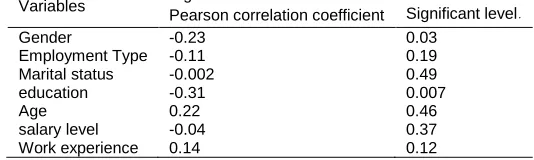
Table 5. Result of person test for scores of membership honor related to individual characteristic
Variables organization commitment
Pearson correlation coefficient Significant level.
Gender -0.23 0.03
Employment Type -0.11 0.19
Marital status -0.002 0.49
education -0.31 0.007
Age 0.22 0.46
salary level -0.04 0.37
Work experience 0.14 0.12
According to results of table (5) and given to meaningfulness level of test- error for membership, with reliability of 0.95, meaningful relationship between organization trend and gender (r=-0.23) and education(r=-0.31) while no meaningful relationship was found for other variables.
Table 6. Results of Pearson test for scores of membership honor related to individual characteristic
Variables organization commitment
Pearson correlation coefficient Significant level.
Gender 0.06 0.31
Employment Type -0.02 0.42
Marital status -0.03 0.47
education -0.16 0.10
Age 0.002 0.49
salary level -0.16 0.11
Work experience 0.04 -0.37
737
RESULTS AND DISCUSSIONResult:
hypothesis1: there is a meaningful relationship between peersonnels’ age and organization commitment. Results of pearsons’ correlation coefficient reject this hypothesis (p>0.05). In the other words. There is no meaningful relationship between personnels’ age organization commitment this result is contrary to the results obtained by moe’en for (2002), baroni (2007), and hamidi and keshtidar (2003), while is in a line with mathiue and zack’s (1990). Hypothesis2: there is a meaningful relationship between personnels’ gender and organization commitment. Results of Pearson’s’ correlation coefficient confirm this hypothesis (p<0.05). In the other words, there is a relationship between gender and organization commitment, According to gender theory which considers females’ organization commitment females can be said that pay attention to their family roles. And perform that perfectly. This will leads to a trend toward organization commitment which is perfectly different from males’ (cooklo, 1990). Also another research has demonstrated that females have less organization commitment than males (hawkinz, 1998).
Hypothesis3: there is a meaningful relationship between personnel’s education and organization commitment. Results of Pearson’s’ correlation coefficient confirm this hypothesis (p>0.05). in the other words, there is a meaningful relationship between personnels’ education and organization commitment. Given conducted studies, it has been indicated that there is a negative relationship between education and organization commitment (rooden, 2000). Also, the relationship between organization commitment and education is very weak and negative, because of educated individuals’ high – leveled expectations for employment opportunities (ismaeeli, 2001).
Hypothesis4: there is no meaningful relationship between personnels’ marriage and organization commitment. results of person’s’ correlation coefficient reject this hypothesis (p<0.05). in the other words, there is no meaningful relationship between personnels’ marriage and organization commitment some researches have demonstrated that marriage can relate o and influence on commitment. Comparing married women with single ones (houai, 2003). Has indicated that married women due to their married life responsibilities and possibility of losing their jobs and positions. Don’t risk’ thus they are more commitment than single women (plala et.al.2008) hypothesis5: there is a meaningful relationship between presonnels’ employment years and organization commitment. Results of Pearson’s correlation coefficient reject this hypothesis (p<0.05) in the other words, there is no meaningful relationship between years of employment and organization commitment. According to conducted researches, elder employees and those who have long history of employment and have high outcomes, more trend towards organization commitment than others (strawn, 1995).
Hypothesis 6: there is a meaningful relationship between personnels’ salary or wage and organization commitment results of Pearson’s’ correlation coefficient confirm this hypothesis (p>0.05). In the other words, there is a meaningful relationship between salary or wage and organization commitment. Conducted studies have demonstrated that salary or wage cause individual to feel self-respect, and it is considered as an opportunity for his, which will be lost if he gives up the organization . A number of studies have demonstrated a positive, but weak correlation between the two variables. (ismaeeli, 2001). Organization commitment has a mean of 55.36% ; and of the variables considered through the present study, organization commitment trend has a mean of 15.71%, willingness to staying 14.53% membership honor 13.33% and determination of individual goal 11.78%.
Summary:
Organization commitment is considered as one of the most important issues within organization of every country which can make organization to progress through crating employment security now, we encounter increasing variation within organization and creation of new organization which compete others by offering novel qualified services to their personnels’ and increasing their personnels’ organization commitment. If an organization fails in offering qualified service to its personnel, it will lost is personnels’ trust, and likely will encounter crisis. There are a number of factors related to the failure of servicing and lowering organization commitment of employees. And numerous studies are conducted on the issue, annually Regarding this issue. The present study was going to consider the relationship between individual features and Ardabil health organization personnels’ organization commitment. Obtained results show that of six hypotheses, just three had negative meaningful relation which was: organization commitment and gender (r=-0.27), education (r=-0.039) and salary (r=-0.30), whole no meaningful relationship was found for other variables.
Suggestion:
- Since sampling of this study was limited to Ardabil, so we propose that, in order to generalize obtained results reliably, another studies be conducted in other cities.
- Family, environ mental factors and other components which can influence on employees’ understanding of organization commitment. Are suggested to be considered.
738
- It is proposed that the relationship between individual features and organization commitment be consideredwithin other organization.
- In order to evaluate influence of individual characteristics on organization commitment, using interviews in addition questionnaire is proposed in future studies.
Interested researcher are proposed to consider the relationship between organization commitment and other elements of individual features.
REFERENCES
Allen Nj & Meyer JP. 1990. The Measurement & Antecedents of Affective,Continuance and Normative Cimmitment to the organizayion. Jornal of Occapational Psychology,Vol.63.
Baroni M. 2007. rabth between organizational commitment and perceptions of political behavior in organizations, education administrators LARESTAN towns, golden plains, Darab and Fasa (MA thesis) .danshgah Economic and Administrative Sciences, University of Isfahan, Iran.
Chan SH. 2006. Organizational identification and commitment of members of a human development organization. Journal of Management Development, Vol. 25 No.3.
Demiray E & Curabay S. 2008. Organizational Commitment of Anadolu University Open Education Faculty Students. International Journal of Social Sciences, Vol. 3, Issue 2.
Edwin J & Boezeman E. 2008. Pride and Respect in Volunteers’ Organizational Commitment.European Journal of Social Psychology, Vol. 38 Issue 1.
Elizur D & Koslowsky M. 2001. Values and Organizational Commitment. International. Journal of Manpower, Vol. 22 No. 7. Estrone H. 1998. organizational commitment, management education, fifth round, Serial No. 17.
Griffin M & Hepburn J. 2005. Side-Bets and Reciprocity as Determinants of Organizational Commitment Among Correctional. Hamidi M & Keshdidar M. 2003. organizational structure and commitment to physical education in schools, publications, motion,
No. 15.
Hawkins WD. 1998. Predictors of Affective Organizational Commitment Among High School Principals, Virginia Polytechnic Institute and State University, Unpublished Doctoral Dissertation.
Ismaili K. 2001. "organizational commitment" of policy. 112, p. 68.
Liou SR. 2008. An Analysis of the Concept of Organizational Commitment .Nursing Forum, Vol. 43 Issue 3. Loden M. 1985. "Feminine Leadership”, New York: Times Book.
Piercy NF. 2001. “Sales manager behavior control strategy and its consequences: the impact of gender differences”, Journal of Personal Selling and Sales Management, Vol.21, p.44.
Loden M. 1985. "Feminine Leadership”, New York: Times Book.
Piercy NF. 2001. “Sales manager behavior control strategy and its consequences: the impact of gender differences”, Journal of Personal Selling and Sales Management, Vol.21, p.44.
Lok P & Crawford J. 1999. the Relationship Between Commitment and Organizational Culture, Subـculture, Leadership Style and Job Satisfection in Organizational Change and Development. Leadership Style and Development Journal, Vol. 20, Isswe 7.
Mathieu JE & Zajac DM. 1990. A Review and Meta-Analysis of The Antecedents, Correlates and Consequences of Organizational Commitment. Psychological Bulletin, Vol.108.
Moini far A. 2002. sociological factors of organizational commitment in Iran. 1. V2,3-22 Journal.
neili M & Nafisi S. 2005. estimates of human capital based on the average years of schooling of the labor force in Iran (1345-1379) Economic Research .fslnamh Iran, the seventh year, No. 25.
Pala F, Eker S & Eker MISG. 2008. The Effects of Demographic Characteristics on Organizational Commitment and Job Satisfaction: An Emprical Study on Turkish Health Care Staff. The Journal of Industrial Relations & Human Resources, Vol. 10.
Tabarsa GA. 2008. the effects of gender on patterns of human resource management, management Monthly, Vol. XIX, No. 196. Van Maanen J. 1972. Pledging the Police: a Study of Selected Aspects of Recruit Socialization in A Large, Urban Police
Department. University of California, Irvine, CA& Unpublished Doctoral Dissertation.
Varona F. 1996. Relationship Between Communication Satisfaction and Organizational Commitment in Three Guatemalan Organizations. Journal of Business Communication, Vol. 33, No.2.
Verheul I and Thurik AR. 2001. "does gender matters?”, Small Business Economics, Vol. 16, pp. 332-337.
Verheul I. 2003. “Human resource management practices in female and male-led businesses” , Small Business Economics, pp. 1-13.
Verheul I, Risseeuw PA and Barteles G. 2002. "Gender differences in strategy and human resource management: the case of the Dutch real estate brokerage", International Small Business Journal, Vol. 20, pp. 439-48.