(PLATE 50)
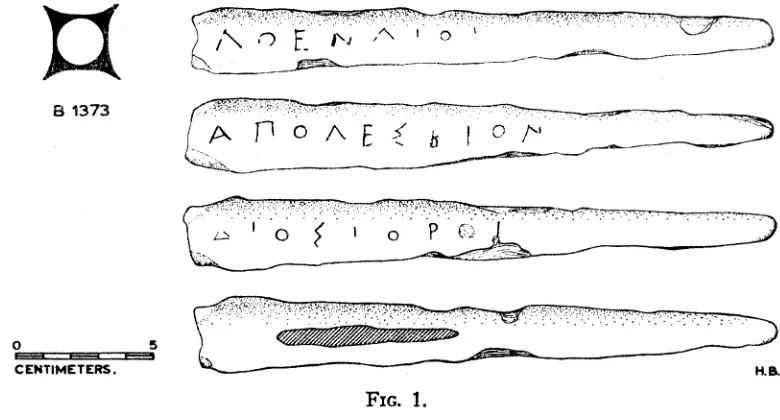
IN THE SUMMER of 1971 a bronze spear butt was recovered from a well in the northwest corner of the Athenian Agora.' It is of a common type, pyramidal in shape, with four concave sides. It has been broken at the upper end and is missing the necking ring and perhaps an elongated collar. One side has partially disintegrated; the other three sides bear an incised inscription:
AQENAIOI AlTO AEMBION
A10E KOPOI [ N]
The preserved traces of the letters, confirmed by J. Kroll and S. Rotroff, have been drawn by H. Besi (Fig. 1). The old Attic alphabet is used throughout, except for the lambda of the Lesbians.
Spear butts were a standard piece of Greek armor and served a variety of functions: to anchor the spear in the ground, as an auxiliary weapon, and as a counterweight for the heavy metal head.2 They were used both by hoplites on thrusting spears and by peltasts on javelins.3 The new example from the Agora is closely paralleled by other spear butts, one from Arkadia, also dedicated to the Dioskouroi, and several taken by the Tarentines from the Thurians and dedicated to Zeus at Olympia.4
The occasion of the dedication must surely be the quelling of the revolt of
1 B 1373. Found July 26, 1971, at a depth of 11.80-12.35 m. in well J 5: 1. Preserved length
0.216 mi., width 0.027 m. Hollow socket at upper end for attachment to wooden shaft 0.017-0.018 m. in diameter. I am indebted to T. L. Shear, Jr., Director of the Agora Excavations, for guidance as well as permission to publish the piece, and to A. Snodgrass for several useful suggestions.
2 For spear butts generally see Darenberg and Saglio, Dictionnaire des antiquites, s.v. hasta,
and G. Richter, AJA 43, 1939, pp. 194-201; also A. Snodgrass, Arms and Armour of the Greeks, London 1967, p. 80. Spear butts in antiquity went by a variety of names: orptacxa, Iliad XIII. 443,
Pal. Anth. VI. 3, Ap. Rh. 3. 1253; urtpae, Xen., IHell. VI. 2. 19, Thuc., II. 4. 3. (Pap. Oxy. 853 v 30),
Plato, Laches 184a; and uavpwT'p, Polybios, VI. 25. 6, 9 and XI. 18. 4, Herodotos, VII. 41, Iliad X. 153, Pal. Anth., VI. 110.
3 On the difficulties of distinguishing between thrusting and throwing spears: A. Snodgrass,
Early Greek Armour and Weapons, Edinburgh 1964, pp. 136-139. For a spear butt on a peltast's spear: Daremberg and Saglio, s.v. clipeus, fig. 1664.
4 For the spear butt from Arkadia: G. Richter, AJA 43, 1939, pp. 194-201, figs. 4 and 5, dated
early 5th century B.C. and dedicated to the Tyndaridai. For examples from Olympia: A. Furt- wangler, Oly0pia,, IV, Die Bronzen, Berlin 1890, nos. 1052 and 1058, pp. 175-176, pl. 64; also Olympische Forschungen I, p. 156, pl. 63: b and Olympia V, Die Inschrif ten vons Olympia, Amsterdam 1966, nos. 254-256. These are to be dated soon after 444/3 B.C.: Dio. Sic., XII. 23. 2.
American School of Classical Studies at Athens is collaborating with JSTOR to digitize, preserve, and extend access to Hesperia
A SPEAR BUTT FROM THE LESBIANS 193
Mytilene in 428/7 B.C., an event described in some detail by Thucydides in his account of the Peloponnesian war.5 At first the Athenians attacked only with their fleet, but later they brought in one thousand hoplites and besieged the city from land and sea. In a desperate move the people of Mytilene were issued hoplite arms and imme- diately turned against their leaders and demanded that peace be made with Athens. The campaign is noted largely for its aftermath, when the Athenians voted to put to death all the men and to sell all the women and children into slavery, a decision rescinded the following day and never carried out. The walls of the city were pulled down, the fleet was confiscated, and all the territory of the island except that of Methymna, which had remained loyal, was divided up and given over to cleruchs. In short, it was a significant military campaign and a fitting occasion for the dedication of armor taken from the enemy.
_\
E.
Cv / '-a 1373
0 5 5 CENTIMETERS, K.
FIG. 1.
The dedication to the Dioskouroi is somewhat surprising, despite their military character. The knights gathered in their sanctuary, the Anakeion, after the mutila- tion of the Herms in 415 B.C. (Andokides, I. 45), and the hoplites mustered there during the revolution of 411 B.C. (Thuc., VIII. 93. 1). But hitherto these heroes, so honored at Sparta, have not been found to have been greatly worshipped at Athens; when they are it is usually as the Anakes rather than as the Dioskouroi.6
r Thucydides, III. 2-6, 18-19, 27-28, and 35-50. Also Dio. Sic., XII, 55. The only other known occasion, the revolt of 412 B.c. (Thuc., VIII. 23-24) was a far less significant campaign. In addition, the parallels cited above (footnote 4) favor the earlier date.
6 For the Dioskouroi at Athens see B. Hemberg, Anax, Anassa,. Anakes, Uppsala 1955, esp.
The site of the dedication is also problematical. As noted, the piece was found in a public well at the northwest corner of the Agora, about twenty meters east of the Royal Stoa. Because the piece was dedicated to the Dioskouroi, the natural assumption is that it was set up in the Anakeion. The sanctuary has not yet been excavated, though it must lie to the southeast of the Agora, on the north slopes of the Acropolis, several hundred meters from the well. The object is readily portable and may well have come originally from the sanctuary,' though other proveniences are possible. Two stoas in the area are known to have been the repository of other dedications of armor. Just to the north lies the Stoa Poikile, where Pausanias reports having seen the shields of the Spartans from Pylos; one example has been recovered in the excavations.8 To the west lies the Stoa of Zeus, where Pausanias saw the shield of Leokritos, a hero in the recovery of the Mouseion in 286 B.C.; the shield of Kydias, who fell in battle against the Gauls in 279 B.C., was also dedicated in the stoa.9 Another possibility is suggested by the material found with the spear butt. From the same level in the well came a series of ten lead tablets apparently used in the annual assessment of the cavalry, as well as seven clay sealings of Pheidon, the hipparch in Lemnos."0 This material, supplemented by other finds, suggests that the office of the cavalry commanders, the hipparcheion, should in all probability be sought somewhere in the vicinity of the northwest corner of the Agora.1" It has been supposed that the tablets and clay sealings were discarded as unwanted material from the hipparcheion, and the possibility should be considered that the spear butt was discarded from there also. An objection to such a suggestion is that there is nothing
7Note also a boundary stone for a sanctuary of the Dioskouroi (Anakeion) dated mid-5th century B.C. found in late fill in the Agora square: Agora I 2080, B. D. Meritt, Hesperia 8, 1939,
p. 48, no. 14.
8 Pausanias, I. 15. 4. B 262, a bronze shield taken from the Spartans at Pylos in 425/4 B.C.,
found in a cistern (D-E 8-9: 1) on Kolonos Agoraios: T. L. Shear, Hesperia 6, 1937, pp. 346-348. Since the cistern went out of use and was filled in the early 3rd centuny B.C., this particular shield
could not have been seen by Pausanias. Note that the shield was not dedicated to any specific deity. For the Stoa Poikile: Agora III, nos. 47-98, and H. A. Thompson and R. E. Wycherley, The Athenian Agora, XIV, The Agora of Athens, Princeton 1972, pp. 90-94.
9 For the shield of Leokritos: Pausanias, I. 26. 2. For the shield of Kydias: Pausanias, X. 21. 3. In both instances the armor was that of Athenians who fell in defense of Athens or Greece and was dedicated to Zeus Eleutherios. The dedication from Lesbos would seem inappropriate here.
10 T. L. Shear, Jr., Hesperia 42, 1973, pp. 176-179, and J. Kroll, Hesperia 46, 1977, pp. 83-140.
The specific pieces found with the spear butt are lead tablets IL 1655-IL 1664, and clay sealings MC 1164-MC 1166 and MC 1174-MC 1177.
A SPEAR BUTT FROM THE LESBIANS 195
to indicate that the Athenian cavalry played any part in the campaign on Lesbos. How the spear butt came to reside in the headquarters of the cavalry is not clear, unless there was a small shrine of the heroes in the building. Another possibility would be that enough armor was captured or confiscated to permit its distribution among several of the military headquarters of the city.
Wherever the piece was dedicated, it cannot have remained there for very long. The level in which it was found in the well was dated by the excavator to the middle years of the 4th century B.C., and earlier. It may well be that it was simply discarded
when the place of its dedication became overcrowded with offerings, or there may have been some political cause for its removal. Already by 377 Mytilene was a firm Athenian ally and one of the earliest signatories of the second Athenian con- federacy."2 The spear butt from the Lesbians may have proved an unwelcome remin- der of a chapter in Athenian history best forgotten.
JOHN McK. CAMP II
ATHENIAN AGORA EXCAVATIONS
12 IG II2, 40 and, for the Athenian confederacy, IG II2, 43, line 81. See the commentary in
4"-A
Face A Face B Face C
JOHN McK. CAMP II: A SPEAR BUTT FROM THE LESBIANS
I 7475