(PLATES 85-90)
I[NVESTIGATION
of the site at Ayia Irini and of other ancient remains in the immediate vicinity was continued in the campaign of 1964 from early in May till the beginning of August. In 1965 excavation was suspended owing to the volume of pottery and other materials that had accumulated, and a full season from the begin- ning of June to the end of August was devoted to sorting, mending and study in the workrooms.'As in previous years,2 this work was sponsored by the American School of Classical Studies at Athens and was staffed and supported by the University of Cincinnati. Financial backing was supplied by the university's Classics Fund, a gift of the late Mrs. Louise Semple in memory of her father, Charles Phelps Taft. An additional grant was made by the Wallace K. Harrison Architectural Foundation. Our debt to the officers and trustees of these institutions is acknowledged with grati-
1 This is a preliminary report; no attempt is made to record all the activities of the two cam-
paigns. As Field Director I must thank my colleagues and assistants for their cooperative efforts and for their careful accounts of the discoveries, some of which are summarized in the following pages. Supervisors of the digging in 1964 were Mrs. Caskey, John Coleman, William Kittredge and Alfred Osborne. Roger Holzen was the surveyor and drew plans. Mrs. Kittredge and Mrs. Osborne kept the inventories and performed a multitude of tasks in the workrooms. Study of the terracotta statues was carried on by Mrs. Miriam Ervin and of certain large groups of pottery by Miss Elizabeth Milburn.
In 1965 Mrs. Caskey, Mr. Coleman and Mr. Kittredge gave most of their time to sorting and recording pottery from the sectors where they had directed the excavation. Mrs. Ervin continued her work on the sculpture; Miss Katherine Abramovitz began an examination of the frescoes; J. L. Angel worked through the human skeletal remains; Jennie P. Coy with the assistance of Miss L. Radcliffe recorded all the animal bones; Professor Frederick R. Matson made a technical examination of the local pottery and potter's clay; Piet dejong made restored drawings of pots in watercolor and Mrs. A. Bikaki drew a number of profiles. Charles K. Williams in both seasons and Lloyd Cotsen in 1965 assisted in recording the architectural remains.
Demetrios Papaioannou of Corinth was foreman in 1964; during his absence in 1965 the reduced activities were managed competently by Panayiotis Kallios of Myloi. Sotiris Maras of Corinth served both years as vase mender, assisted by a local apprentice, Ioannis Lavdas.
2 Reports of previous campaigns appear in Hesperia, XXXI, 1962, pp. 263-283, and XXXIII,
1964, pp. 314-335 (hereafter cited respectively as Keos 1960-61 and Keos 1963). In the former see p. 263, note 1. Other notices: Archaeology, XV, 1962, pp. 223-226; XVI, 1963, pp. 284-285; XVII, 1964, pp. 277-280; A.J.A., LXIX, 1965, p. 167 (J. E. Coleman); LXX, 1966, pp. 188-189
(M. Ervin), pp. 192-193 (E. Milburn); Classical Journal, LXI, 1965-66, pp. 2-4 (J. E. Coleman); The American Philosophical Society Year Book 1962, 1963, pp. 498-499; Archaeological Reports, 1960-61, pp. 20-21; 1961-62, pp. 19-21; 1962-63, p. 25; 1964-65, pp. 22-23; B.C.H., LXXXV, 1961, pp. 837-839; LXXXVI, 1962, pp. 845-853; LXXXVIII, 1964, pp. 821-830; LXXXIX, 1965,
pp. 849-858; AEVr., XVI, 1960, pp. 251-252; XVII, 1961-62, pp. 275-278; E7reeTfpcs Tvs 'ETatpEcas
KVKAatKWXv MEXETWv, III, 1963, pp. 863-878; IV, 1964, pp. 353-368.
American School of Classical Studies at Athens is collaborating with JSTOR to digitize, preserve, and extend access to
Hesperia
364 JOHN L. CASKEY
tude. Warm thanks are offered also to the Greek Archaeological Service and especi- ally to the Ephor (now Director) Mr. Zapheiropoulos and his assistant Miss E. Lazaridou, to the Michalinos Company for its generous cooperation, and to the many volunteers who helped us immeasurably in the course of these two campaigns.
KEPHALA
Early remains at Kephala on the north coast (Keos 1963, pp. 314-317) were re-examined in 1964 by Mr. Coleman, who has undertaken to study and publish the results of our investigations in that region. We had supposed that all the graves in the cemetery had been found in preceding seasons, but when the ground just north of the main group was cleaned several others came to light. The total number recorded has now reached 35, and it is probable that still more exist, both in this plot and elsewhere on the headland. In size and type the new graves are like those described in earlier reports. Few contain any offerings.
Whole or partial skeletons of 56 individuals from these graves were examined in 1965 by Mr. Angel. He notes that the greater number of skulls show Basic Mediterranean or Aegean-Alpine characteristics or a blend of these. The people tended to be short and slight of build; they had excellent teeth and showed few traces of arthritis; but they died young, men around 36 at an average and women around 27. Further exploration of the promontory made it clear that the settlement was also more extensive than we had thought at first. Poor remains of house walls can be observed all along the ridge above the cemetery. Part of a kitchen was found at one place (Area K); in it were signs of burning, fragments of large jars and bits of shaped clay or coarse plaster. A great store of carbonized vegetable matter was recovered. This consisted chiefly of a variety of beans, according to the report of Mrs. Colin Renfrew who gave the material a preliminary inspection in 1965. Samples have been submitted to the University Museum in Philadelphia for C-14 analysis.
The date and duration of the settlement are still uncertain. Pockets in a few places contain habitation deposits where strata can be distinguished, but evolution in the character of the pottery has not been observed. The shapes and stroke-burnished decoration are of Neolithic types. Numerous fragments of scooplike vessels (cf. Keos 1963, pl. 46, e, f) have been recognized. There are a few stone cups and celts, and several very small bits of copper have come to light, usually on or near the surface of the ground.
Although the whole site is severely eroded it may still be possible to learn some- thing more of its history, and we intend to pursue the investigation by testing other areas.
TIIE FORTIFICATIONS AT AYIA IRINI
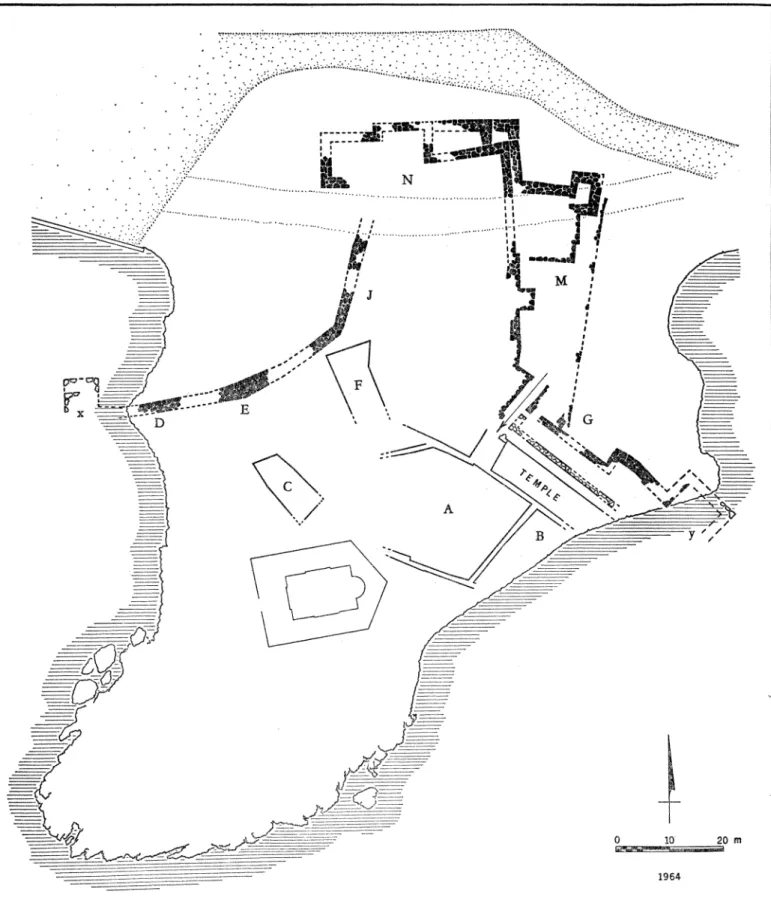
revealed further in 1964, especially along the northern and eastern sides of the site (Fig. 1). In Area N, where the native rock rises and ancient deposits are relatively thin, nearly all the remnants of the wall have now been uncovered and it is clear that two or more periods of construction are represented. Successive rebuildings may be seen also in the northeastern area, where the lines of the circuit turn south- ward: a continuous system of walls on the western side of our Area M (see the plan) is the earlier, while the northeast tower and adjoining structures are almost certainly later additions. A straight line of wall further east in Area M, which was traced in 1963 and seemed possibly to be a part of the fortifications (Keos 1963, p. 318, fig. 1), must now be recognized as a retaining wall, built to support a broad terrace after the defensive circuit had been demolished and given up altogether.
Precise dating of these architectural stages will have to await Mr. Kittredge's further study of the pottery and objects from the associated strata. Owing to the disturbance of the ground in ancient times and much recent denudation it is not easy to determine the sequence of the deposits, but a considerable amount of useful evi- dence has been collected, for example pieces like the Cycladic panel-cup from Area N that is shown on Plate 86, b. At present it appears probable that the whole complex system is to be assigned to a period before the time of Mycenaean domination in the Aegean. The first phase is certainly not later than the time of Middle Minoan III and the northeast tower perhaps corresponds in date with the important development of the settlement in Late Minoan I. Outside the fortifications, and clearly of later
date, some deposits of Mycenaean IIIB have been discovered.
Following the line of the earlier fortifications southward from Mr. Coleman's sector in Area M, Mr. Osborne in 1964 came upon a broad passageway that led through the walls to a small rectangular open space behind the Temple. Here evi- dently was the chief gate of the settlement (see Area G on the plan). The passage had continued to be used down to Graeco-Roman times, but in its original form it must go back at least to the Late Bronze Age. To the southeast the fortifications run onward in an irregular course to the present shoreline, and stones visible under water indicate that there may have been a tower at the place marked y on the plan, corresponding with Tower x on the west. Excavation of this region has only begun. Just inside the main gateway a road branched off to the left, running south- eastward along the side of the Temple. It was approached through a carefully con- structed portal with a big stone threshold (near the point of the arrow, Fig. 1). One guesses that a continuation of the street may have run northwestward, but this is not certain.
INSCRIPTIONS IN LINEAR A
* *, ' ___ _ * l - n i _ s3 ;D ' * ' ' e!es
-, g :Dqq O ... .. . . *
'. ,.',.- '''''"'"'''"''""'''"tWE*+ss*i-*vii ... ,,,,,,,,,,,,,,,,,,,,,,,,,,, ... -w 1 "''> %3<4'';;"
,,, I I i t @ e u ?
+ d * t SX I | t /3 J + + * w w ffi ffi >
_ v * * + * < < 2 * * t < * e + t > *t + **t + ) * J 2 * + v i w * I | * $ * * * w * S * | r * | + a } ;
_t * z + w w *s * + + s M ++ , *z * *s * w w Wo s t1*s I F s
- X B s * ; I # * _g
====_=<_* ,*+' .^. * 11 i w .SI q
w i s X
# * r t
_ _ +,. Jak | r1 t A _
? / 9ffi3 Z_ iC
oF - \ 1 w S
s
=
__\ t * w st /
. i u .
\ S S LTs , /
s J tx ,
. #Xi X I _
= ff e # .
_ f j f t . -
|
.
e
.. .l ,
__ < F # sa
2 # G d s
_ w J \ # __
__/ oS 8 \ t 0 \
_/ . F #R \ f \
F*m f g sE#o \ r >/ t
}r -##-- wfo \ \
6 ' Y -*-- s E a/4 \ X ^ 2? r / x r } 1 m==\ ==, \8 D s * sA o s-F%t u z . - .
} t wEs w
= =R / G wsss s s > =
t# / 's_ ^^s
__\ w / \ ' 8
___ , \ -. . _ _ _ /
_R \ \ so \ s sv s L /*s _
t' \ C \ q#S \ s s o'S \\. _._
so, z X w s Y F \ -t oui s _ os, s s
? >, e 3\ \ ) s & =" 7
\ w A _
f X /
__\ s # Aw _e X s ,{ /
__o
. i ^ r_-
_ __ f \ \ os s .Af AX
__ 1 x _ f { r
\ X vfX : =r
.?-_ \ S \
it \ } f _
t t 1 f ,, _
_ { 1 t w /
_t \ \ /
r l S ./
__ } \ / J-r>----
__ X t / / _
__ __ { I v /
,>-i I .Z /
__s*__t >o \ v _
____r {s s \ _
_9_ \ o A 1 . ' /
,, { ' K
--r t V' J _ __1.
--f i rt Z--
o l I I J _._
_- d we t _
D l
__ e
__ / , , _
=; W / } M
{ D _
__ f f f _
1 ! _
__ %,. % _
__ f ft 8
_ } s
_ { At __,
__} t_
f tw
r a=_
_ f o _/ {
_ wr r t _
_,_,.r X =
__y X
-
__ ,e J i S Sr ,,
_> t 7__ ...
=f r. _ . v ... _ _
r gg t S :.S __
(t * s f_
_: _r <
., \ .. t _ tv-&.= ...
3
tv
k.}
== fJer
?
. = .N_o__
___
.
- 0 ea ro 20 m< = -^ .
__ - <
= l964
=L== __
probably of local manufacture, with three signs on its rim, and a rough lentoid terracotta counter with a single sign on either face. One of the signs on the lamp finds no close parallel as yet, but all the others are from the Linear A syllabary (cf. the incised monogram on a sherd recovered in 1963, Keos 1963, pp. 325-326). Else- where we have found a dozen or more bases of pots with simple marks of the sort known at Phylakopi, Aegina, Eleusis, Lerna and other contemporary settlements. Thus the evidence for literacy at Ayia Irini, though not yet conclusive, is moderately strong.
Professor E. L. Bennett, who visited the site in 1965, examined all the inscribed pieces that had been found up to then and gave us his valuable comments. The subject will be dealt with in a later report. We should mention here that a terracotta object with scratches resembling those of a linear inscription, found near the Temple, was very closely scrutinized by Professor Bennett and shown not to have been a written document.
GRAVES AT AYIA IRINI
Excavation outside the main walls of the town in Areas J and M uncovered a few graves of infants and children. Some are cists built of upright slabs or with walls of small stones, others pithos burials. Since deep levels were reached in only a few places we may assume that other graves are to be found in this region generally, on either side of the narrow northern part of the settlement.
One of the jars from Area J is shown on Plate 86, a in a photograph of a water- color by Piet dejong. The richest grave was on the east, in Area M. It contained teeth and bits of bones of a child, probably a girl about 12 years old, and as offerings seven small pots, a gold diadem with cut-out triangles and rows of repousse dots, and 91 beads of gold, carnelian and amethyst, which we have assembled as a necklace.3 Two of the pots are illustrated on Plate 86, a kantharos of Minyan shape (f) and a keftit cup (c) which seems originally to have had a pattern of concentric circles in light paint on a dark ground.
None of the pottery from these graves is later than Middle Minoan III; some pieces are probably earlier. Burials of the main period of occupation, L.M. IB/L.H. II, have not yet been discovered.
THE TEMPLE
At the end of May in 1964 sea-level in the bay was a bit lower than usual and we took the occasion to test strata below the floors in various parts of the Temple, Rooms IV, XI, and XIII (Fig. 2). Water flowed in quickly, finding passage through the loose masonry of the walls, but by means of a light pumping engine we were able to keep small areas drained and to dig iout the mud in arbitrary horizontal cuts.
368 JOHN L. CASKEY
The walls of the Temple were found to be bedded deeper than we had pre- viously supposed. In part at least, Walls A and L rest firmly on bedrock some 0.80 m. to 0.90 m. below present sea-level (our datum zero). Several of the doorways have stone thresholds, at varying heights but all apparently belonging to an early stage of the building. In Room IV there are remains of a flagstone paving at levels
7
: ' :
t ,*\
~~~~~~~~~~~~~.u i .9 F.AL KVR _
z-0~~~-A
~~~Loo 196'i~~~~~~~~5/6 1AE T
I~~~ _
ie. 2. Plan and Section of the Northeast End of the Temple.-
between -0.50 m. and - -0.60 in.; along the wall is a stone bench rising to -0.30 in.
From the area of Room IV one approached the door to Room XI by a step of fine
white marble (surface at -0.40 in.) .'4 The threshold was 0.)18 m. higher, and thence
another rise took one to a small landing at +0.0)5 mn. inside the adyton. Here one
could turn to the left and step up- again into the interior of Room XI or to the right
and enter Roomn XII. Tlhe space in Room XI was largely occupied by stone plat:forms.
All these structures lie below the floor-level of Room XI on which the many
fragments of terracotta statues were found in 1963 (Keos 1963, pp. 327-331). It was a firm floor, made of a thick layer of clay, which at that time we took to be a part of the original building. As reported then, pottery found in the debris with the sculpture was of styles not later than L.M. IB, a few pieces being perhaps a little earlier; but small soundings beneath the floor, which produced Middle Helladic sherds, had led us to think that the underlying deposits were not related to the Temple.
The investigations of 1964 make a revision necessary. The architectural scheme of Room XI with its peculiar orientation and its elaborate stepped entranceway suggest that this may have been a shrine or small temple from the beginning, and it is now clear that the construction goes back at least to the Middle Bronze Age (probably not earlier). Room XII was presumably a part of this most ancient building, its walls also having a slightly divergent orientation from that of the later stages. Here too there was gray Minyan pottery, for example the kantharos shown on Plate 86, e.
In Room IV it has not been possible to find a floor corresponding with that of the L.M. IB period in Room XI; almost certainly it was dug away during the remodel- ling of the central part of the Temple in Mycenaean times (L.H. III) after the great earthquake. In this period a rough stone base was set in the floor of Room IV, no doubt to hold a wooden column (see Fig. 2). In the earth and debris between water- level (zero) and +0.25 m. there were sherds of Mycenaean III A and III B pots, a few tiny scraps of gold leaf, two bronze blades and parts of several small terracotta figurines.
THE TERRACOTTA STATUES
Sorting and cataloguing of the hundreds of fragments of statues from the Temple, begun by Miss E. B. Harrison in 1963, was carried on in the seasons of 1964 and 1965 by Mrs. Miriam Ervin, who is preparing a detailed analysis and commentary on this body of material.
Attention was paid particularly to the manner in which the figures were formed and put together, in order that the evidence of the internal structure might be fully recorded before it was concealed by gluing and plastering. These observations led to better understanding of the fabric and therefore to the joining of many pieces that might otherwise have remained isolated. In 1965 considerable parts of three statues were made up and half a dozen others began to be intelligible entities. As a result, it is now certain that at least 19 are represented in the collection and probable
that the number was 24 or more. Further work of reconstruction renmains to be done,
but it has become evident that no rnore whole statues can be put together unless many new pieces are found unexpectedly outside the Temple.
370 JOHN L. CASKEY
Although the statues are all of the same general type there are many small variations in their form and structure. As a rule the skirts were built up by addition of successive strips of clay, in the same manner as pithoi. When the top of the skirt was reached a central wooden post was set vertically and the torso was formed around it. The girdle was probably fashioned at this stage. Very rarely were the upper and lower parts of the figure made separately and then joined together; the big
statue K3.61 1 5 does seem to have been assembled in that way, since there are wedges
at the waist where the position of the two parts was adjusted.
A wooden cross bar, smaller than the vertical post, was often inserted horizontally to hold the weight of the shoulders. Then other pieces of wood, still smaller, were used to strengthen the fabric of the arms. In some cases the main upright post may have run up into the head; in others there was a separate piece of wood or merely a cylindrical hollow space within. There is no evidence that the wooden supports were bound together or erected in advance as a complete armature; they were set, rather, as the construction proceeded. Usually the posts remained in the clay and were burned out in the kiln.
How the firing was done is not known. To bake so large a mass of thick clay was no small accomplishment. Very few cracks are seen in the pieces that have been preserved. Some were imperfectly fired, it is true, and the fabric has crumbled as it lay in the damp ground. Insofar as possible we have solidified the pieces that are in this state by an application of vinyl plastic.
The photograph on Plate 88, c, shows the interior of a large figure, Kl. 465, at the waist. A fragment rising vertically retains impressions of the central post. One can see that the girdle was lower at the front of the statue (to the right in the picture) than at the back. It was made of two thick rolls of clay that were pressed into place against the top of the skirt. This was a very heavy statue; marks on the inner surface show that extra wooden supports were set temporarily inside the skirt to hold the weight during the construction. Most of the skirts are open at the bottom. A few are closed with platforms of clay; on the inner surface of K3.620 and K3.625 there are marks which probably indicate where the lower ends of the vertical posts were imbedded.
Proportions of the parts of the bodies and the manner in which they were fashioned vary more or less from statue to statue. Nos. K3.618 (P1. 89, a, b) and 1?3.619
(P1. 87, b) belong to one group and may have been made by the same sculptor. Their shoulders, which were formed on cross bars, are broad and angular. The waists are short; the skirt of K3.619 is long from the girdle to the ground. In both figures the breasts, which are firmly rounded and high, were fashioned over conical cups. To show how these cups were placed we chose one of these common little vessels that
fitted the impressions in the fabric and photographed the fragments of K3.619 (P1. 88, a, b) before they were incorporated with the remaining pieces.
Other figures lacked the straight cross bar at the shoulders. Their arms descend in a curve from the neck to the elbow. Arms of this shape regularly contained thin supple pieces of wood, probably osiers, which ran from the shoulder to the hand and were imbedded in the skirt at the hip where the hand rested. Torsos of this type are seen for example in KO.30 and K3.617 (P1. 89, c-f). The breasts of these are full, more pendulous and more widely separated than in the former group. In still others the large breasts stand out forward, as in K3.620, the statue which was coated at some time with stucco (P1. 87, a), and in K3.626, a long-waisted ungainly figure without hips (P1. 87, c).
Traces of colors have been observed on parts of a few statues. The surfaces in most cases have been lost altogether, but from one example, K3.690 (not illustrated), it appears that the bare flesh was coated with white, the cloth of the bodice with yellow ochre, and the necklace with red. In K3.690 the hems at the edges of the garment are not marked by plastic bands of the sort that occur in many others. This raises the question whether colored surfaces may not have marked the clothed and unclothed parts of several torsos which we had taken to be quite nude (e.g. K3.613
and K3.611, Keos 1963, pls. 57, 58, 61).
In 1965 two more pieces of the fine head K3.614 were recognized and joined to the parts known in 1963 (P1. 88, d, e). One sees now that this head did not wear the usual dress or coiffure of two horizontal torus bands (cf. K3.613) but rather wore a cap or-this is not quite certain-had the hair piled up to a peaked dome, possibly with an indication of wavy surfaces.
Our search for neck fragments which might join this and other heads to existing shoulders has been disappointingly unsuccessful up to now.
HousEs
Area A
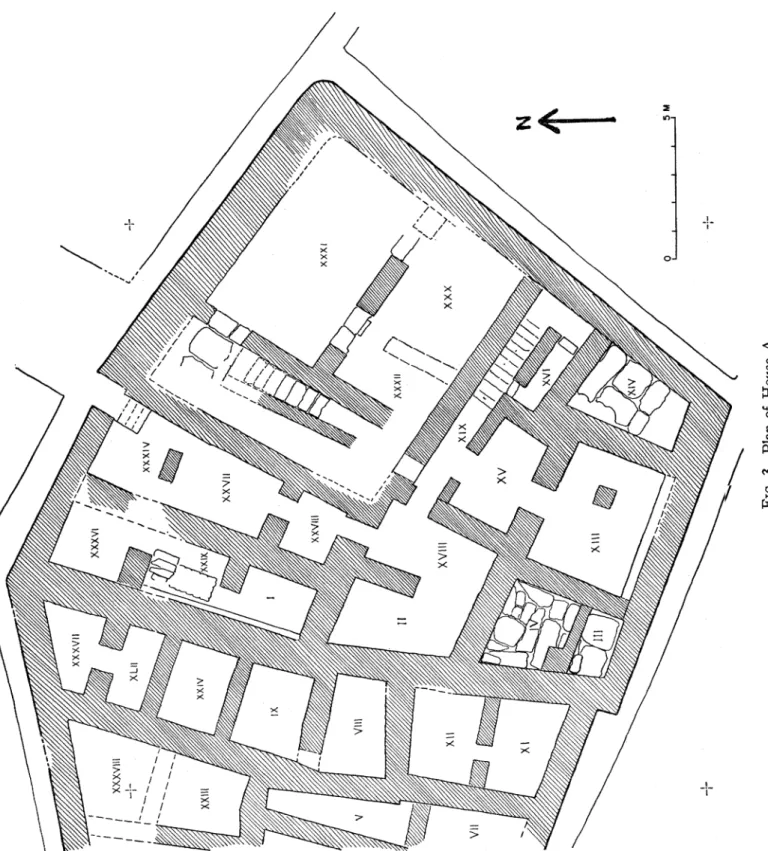
The complex of rooms in Area A (Figs. 1, 3), exposed successively in each campaign since 1960 under the supervision of Mrs. Caskey, appears now to make up one single establishment, which we have come to call House A. In 1964 several of the northern rooms were cleared and only the western side remains untouched. There are narrow streets with covered drains on all sides excavated so far. On the north, two of these converge under the open square behind the Temple, whence the drainage may have been carried out below the main roadway toward the northeast.
XLII~~~~~~~~~~~~~~~~~~~~~~~~~~~~~~~~~~~~~~~~~~~~~~~N
ol~~~~~~~~~~~l
all built at one time. Some of the older architectural elements were examined in 1964 far below the level of the latest floor in Room XXX. They go back to an early phase of L.M. I/L.H. I, or possibly still earlier, and represent initial stages in the successive alterations of the building. Their remains had all been covered over by the time of the final occupation.
For help in clarifying the sequence of some of these architectural changes we would thank Mr. C. K. Williams, who visited the site in 1964 and 1965 and made a valuable series of notes on the exceedingly tangled evidence of the successive phases.
During the season of 1964 Miss E. Milburn, Olivia James Fellow of the Archae- ological Institute of America, made a catalogue and thorough study of the pottery from Room I. This and other ceramic material which she treated in detail in a doctoral thesis at the University of Cincinnati (1965) is to be published in a separate article. Room I held, in addition to much local ware, pots imported from the mainland
(chiefly L.H. IIA), from Crete (chiefly L.M. IB), and from other Cycladic islands.
This group is an index of the wide connections that were maintained by the people of our settlement in the time before the great earthquake. Similar pottery has been found in large quantities at Ayia Irini, especially in the rooms of House A but also in debris of neighboring houses. As examples we present a restored drawing of a Cycladic jar in watercolor by Piet dejong (Color Plate A); photographs of two other
restorations by Mr. dejong, a Late Minoan IB stirrup-jar and a Mycenaean IIA
alabastron (P1. 85); and a fragment of a very large Cycladic basin (P1. 86, d).
House F
House F (Fig. 1) is made up of a series of rooms, each occupying the full width of the building. The three northernmost were cleared by Mr. Osborne in 1964, and at least one more is to be found at the south. These are basement rooms, like those of Houses A and C, and they were filled with debris from above when House F was destroyed by earthquakes. Room I, at the north, was a separate compartment, approached by a descending staircase. Rooms II, III and IV are connected to each other by doorways.
The pottery from these rooms has been given only a preliminary inspection. Much of it is local but there are some imported pieces like those from House A. Some others are decorated with spiral ornaments that belong clearly to the repertory
of Late Helladic IIIA1. A similar occurrence of earlier and later styles was observed
in the pottery from House C, recorded by Miss Milburn. We are not sure how
these facts should be explained. It seems unlikely that pottery of IIIA reached
374 JOHN L. CASKEY
re-used in a reconstruction, perhaps at the beginniing of the fourteenth century, and that they were demolished again (by still another earthquake?) in the time of My- cenaean IIIA. This not unimportant problem remains to be solved.
FRESCOES
In each season of excavation since the outset in 1960 fragments of wall plaster with fresco painting have been found in various areas of the site. Only a few pieces had been cleaned and examined up to 1965, when Miss Katherine Abramovitz (now Mrs. John Coleman) spent three weeks at the task, beginning a systematic study of the considerable body of material. Mrs. Emily Vermeule gave valuable help and suggestions.
It is clear that the plastered walls were in the upper storeys and that fragments fell into the basement rooms along with other debris when the buildings were destroyed. The pieces in general are very small but most of them are firm, having smooth surfaces that can be cleaned easily with water. Enough joins were found in 1965 to give a notion of some of the patterns.
Room XXX in House A had fragments of panels in red and white with border- ing bands of blue, red and yellow, as well as certain other pieces showing splashed stippling of red, yellow and white on dark blue. Room II of the " Long House," partly preserved at the water's edge in Area B, held examples of panels in solid colors and broad bands in series, black-white-yellow, red-yellow-white and red-white-black. Here too there were large bits of plaster in irregular shapes that may have come from door or window frames or pieces of furniture, and four fragments preserving partial representations of men, done in red, larger than figures in the standard miniature style.
Two rooms in Area M at the eastern end of the modern road-cutting have yielded frescoes in quantity. Besides plain colors and bands of white, red and dark blue, there are examples of floral decoration, serrated blue and orange-brown leaves on red stems, orange-brown myrtle leaves, blue and white blossoms, and beds of brown reeds or grasses on tan and blue backgrounds. More elaborate are the scenes with architectural elements, walls and piers in ashlar masonry, a window, conical or mastoid objects at the tops of buildings, and representations of at least three human figures at small scale. A few examples are illustrated on Plate 90, a. In general the frescoes are reminiscent of those found in Crete (M. M. III-L.M. I).
ANIMAL BONES FROM THE SETTLEMENT
sortect and records were made of the species, the minimum number of individuals of each, and evidences of butchery and disease. Species noted include sheep and goat (the bones of which, thanks to the work of Boessneck, can now frequently be dis- tinguished), pig, cattle, domestic dog and cat, deer, birds, fishes and about 40 types of mollusc shells, chiefly cockles, limpets, oysters and murex. No trace of horses has been found as yet. Over 5000 bones were separately numbered and have been sent to the Department of Natural History in the Colchester and Essex Museum for further study.
DRAXVING OF A WARRIOR
An unexpected discovery was made in 1964 when a modern enclosure wall was being removed from the north edge of Area J. Among the stones were some frag- ments of marble, a few of which showed traces of use. The foreman, D. Papaioannou, observed one especially, part of a flat slab which proved to have an incised drawing on one side (P1. 90, b). It is of white island marble, 0.035 m. to 0.038 m. thick, now 0.17 m. high by 0.28 m. wide. The fairly straight vertical edge at the left is probably original, though worn; that at the top may possibly be original. The front surface is moderately smooth, slightly incrusted. On it is a linear representation of the head of a warrior facing to the right, wearing a helmet with curving pointed cheekpiece and waving plume. The eye and the profile in front of it, namely the curve from the forehead to the bridge of the nose, are preserved; the nose itself and most of the mouth and chin, if not all, have been lost. Outlines of the back of the head and neck are visible. The helmet rises in tiers to a rounded-conical top, where the plume springs from an ovoid knob. No traces of color are now to be seen.
Neither the original dimensions of the slab nor the purpose for which it was designed can be determined. It may have been a free-standing stele or it may have been fastened against a wall. Representations of men at this scale and in this manner are rare, whether in Crete or on the mainland, though there are obvious parallels with figures in frescoes and in small ivories and metalwork. It is my impression that the soldier is a Mycenaean Greek, rather than a Minoan, and if that is the case one may suppose that the monument was set up in the later period (after the great earth- quake) when pottery of L.H. IIIA or L.H. IIIB styles was being imported, not in the preceding time when commercial and cultural associations with Crete were so very firmly established. These are speculations, however, and other interpretations may prevail. The fragment and its connotations will receive further careful examination.
A WATCHTOWER ON TEIE COAST
376 JOHN L. CASKEY
whether friendly or hostile, and it was possibly for this reason that a square structure, about 13 m. on a side, was built on the top of a rounded hill to the northwest. The height is now called by some local people the Troullos (or " Tourlos ") of Treis Am- moudies (or " Treis Boukes "), a small triple bay just below it. It commands a fine view of the whole channel from Sounion to southern Euboea and is in clear sight and easy signalling distance from Ayia Irini. Stone foundations of the square building or enclosure are partly exposed. At its center are traces of a circular structure about 5 m. in diameter, and next to this a modern cairn. Only a few potsherds are found near it, all apparently of the local coarse ware, including bits of conical cups that are characteristic of the great period of the settlement. Near by are some outcroppings which may possibly mark the places of graves. We intend to investigate this region by excavation.
CONSERVATION
At Ayia Irini the ancient walls in general are thick and well built, of flat stones, and they stand firm after being exposed. This is fortunate, since the houses with their deep basements, corridors, and staircases will make an interesting and instructive showing for visitors when the archaeological investigation has been completed and paths through the town have been laid out. In some places, however, the walls have been damaged severely, not only by earthquakes but by the digging of pits in modern times when attempts were made to plant orchards on the promontory. In 1964 we began a program of improvements and conservation. Many of the workmen, local farmers, are good practical masons, and in using the same stones as the ancients they can make strong unobtrusive repairs and buttresses. These additions so closely re- semble the originals, however, that one might soon forget which parts were new. Therefore we have made a practice of marking each stone of every repair with white- wash and photographing each addition of this kind for the permanent record. The whitewash wvill of course disappear shortly in the winter rains. In no case have we made restorations where doubt existed about the form of the original structure.
Although we have no intention of excavating the entire site, considerable further digging will be needed if the history and general scheme of the successive settlements are to be determined. We plan to resume the investigation in 1966.
JOHN L. CASKEY
a. Stirrup-jar K.2324, H. 0.233. L.M.IB. (watercolor by Piet dejong)
b. Alabastron K.25 37, H. 0.155. L.H.IIA. ( obwate b d
PLATE 86
a. Burial jar K.2630, H. 0.305.
d. Fragment of Cycladic Basin K.2682.
b. Cycladic Cup K.2692, H. 0.09.
e. Gray Minyan Kantharos K.2647, H. to rim 0.035.
c. Keftiu Cup K.2632, H. 0.08. f. Kantharos K.2633, H. to rim 0.04.
^~~~~~ Hs
a. Shoulder of Statue K3.619. b. Shoulder and Breast of Statue K3.619.
c. Waist of Statue K1.465 (interior). d, e. Head K3.614, H. 0.187.
L.tiffaX~~~~~~~~~~~~~~~~~~~~.
_ ';l 11~~~~00 ,0
00,'
LE~~~~~~~~A
PLATE 89
a, b. Torso of Statue K3.618, H. 0.263.
41
s
c, d. Torso of Statue KO.30, H. 0.30.
e, f. Torso of Statue K3.617, H. 0.253.
a. Fragments of Frescoes. (Scale ca. 3:5)
j.~~~~~~~~~~~~~~~~~~~~~~~~~~~~~~~~~~~~~~~~~~~
.;~~~~A
b. Fragment of White Marble Slab K4.94, H. 0.17.