Querying Object-Oriented Databases Based on Signature
Graph and n-ary Tree
Tran Minh Bao1,*, Truong Cong Tuan1, Huynh Trong Duc2
1
College of Sciences, Hue University, Vietnam.
2 Ho Chi Minh City Industry and Trade College, Vietnam.
Abstract
In this paper, we suggest a new technique to create index helping for querying almost identical similarities with keywords in case there is no correct match found. It’s based on a signature graph and n-ary tree helping to query related information when there is no correct match. Main idea is a signature graph structure, created based on signature file, created for a layer and signature files are arranged as a hierarchical system according to nested structure of layers. This technique helps to decrease effectively search space, so therefore it will improve effectively complexity of query time. More than that, we develop query algorithm on signature graph based on Chen and partners method [3] suggested, thereby helping to improve query time on signature graph better.
Keywords: Object-oriented query, object signature, signature file, signature graph.
Received on 21 December 2015, accepted on 11 January 2016, published on 12 February 2016
Copyright © 2016Tran Minh Baoet al., licensed to EAI. This is an open access article distributed under the terms of the Creative Commons Attribution licence (http://creativecommons.org/licenses/by/3.0/), which permits unlimited use, distribution and reproduction in any medium so long as the original work is properly cited.
doi: 10.4108/eai.12-2-2016.151087
*
Corresponding author. Email:[email protected]
1. Introduction
Study of indexing technique is always an important issue in effective information searching from databases. For object-oriented databases, direct query on objects has a large time cost. There are many database indexing techniques to process query on object-oriented databases in which signature file approach has been widely acknowledged and been an effective approach in processing query on object-oriented databases. For this approach, objects of a class are coded into object signatures by using hash function and stored in a signature file. However, query on signature file has a disadvantage which is high cost due to scanning the whole file. Some other indexing methods try to overcome this and can be found in many researches [2, 3, 4, 9, 10].
Various indexing techniques for object oriented databases specifically for aggregation hierarchy are summarized in [1] and it is shown that indexing technique based on signature file has the best performance for the retrieval operation.
Signature tree [2, 3] and signature graph [3, 4] are improved indexing techniques based on signature files. Signature tree which is based on signature file arranges all signatures in a tree form, which leads to less comparison and improves query evaluation. Signature graph is an indexing technique built for a class and in addition arranges signature files in aggregation hierarchy and improves the search of a signature file. In this paper, we propose improvement of query algorithm on signature graph which can be used to improve query time. Firstly, we organize sequential signature files in nested signature file hierarchy to reduce searching space during querying. Then we store each signature file in signature graph or n-ary tree to speed up signature file scanning. The larger signature file is, the more time can be saved by using this approach.
This paper is organized as follows. In part 2, we provide background. Part 3 proposes indexing technique. Part 4 proposes an approach combining signature file hierarchy and signature graph. Finally, part 5 gives out a conclusion.
2. Background
2.1. Attribute Signature
In an object-oriented database, each object is presented by a set of attribute values. Signature of an attribute value is a sequence of hashed-code bits. Given an attribute value, for example the word “student”, we decompose it into a string of three-letter sets as follow: “stu”, “tud”, “ude”, “den” and “ent”. Then, using hash function h, we map a triplet to an integer k which means kth bit in a string assigned value 1. For example, assuming that we have h(stu) = 2, h(tud) = 7, h(ude) = 10, h(den) = 5 and h(ent) = 11. Then we create a bit string: 010 010 100 110 which is signature of the word.
2.2. Attribute Signature, Signature file
Object signature is constructed by logical OR algorithm for all signatures of attribute values of the object. Below is an example of an attribute signature:
Example 1. Consider an object which has attribute values of “student”, “12345678”, “professor”. Suppose that signature of these attributes is:
010 010 100 110 100 010 010 100 110 100 011 000
In this case, object signature is 110 110 111 110, generated from attribute signatures by using logical OR algorithm. Object signatures of a class are stored in a file, called object signature file.
2.3. Query Signature
An object query will be encoded into a query signature together with hash function applied to objects. When a query needs to be executed, object signatures will be scanned and unmatched objects will be excluded. Then query signature is compared with object signatures of signature file. There are three possibilities:
(i) The object matches with the query, i.e., for every bit in query signature sq, corresponding bit in
object signature s is the same, i.e, sq˄s = sq, a real
object of query.
(ii) The object does not match with the query, i.e., sq˄s ≠ sq;
(iii)Signatures are compared and matching one is found but its object does not match with searching condition of the query. To eliminate this case, objects must be checked after object signatures are matched.
Example 2. This example illustrates the query for object signature in example 1:
Query: Query signature: Result: student 010 000 100 110 successful john 011 000 100 100 unsuccessful 11223344 110 100 100 000 false drop
Comment: comparing query signature sq object signature
s is incorrect comparison. That means, query signature sq
matches with signature s if for any 1 bit in sq, the
corresponding bit in s is also 1 bit. However, for any 0 bit in sq, the corresponding bit in s can be 0 or 1.
2.4. Querying Object-Oriented Databases
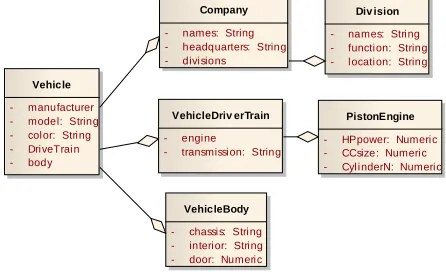
In object-oriented database systems, an entity is represented as an object, which consists of methods and attributes. Objects having the same set of attributes and methods are grouped into the same class. Since a class C may have a complex attribute with domain C’, a relationship can be established between C and C’. The relationship is called the aggregation relationship. When arrows connecting classes are used to represent the aggregation relationship, an aggregation hierarchy can be constructed to show the nested structure of the classes. Example 3. An example of a nested object hierarchy:
Vehicle - manufacturer - model: String - col or: Stri ng - Dri veTrai n - body
Company - names: String - headquarters: String - divi sions
Div ision - names: Stri ng - functi on: String - l ocati on: String
VehicleDriv erTrain - engi ne - transmissi on: String
VehicleBody - chassi s: Stri ng - interi or: Stri ng - door: Numeri c
PistonEngine - HPpower: Numeri c - CCsize: Numeri c - Cyl i nderN: Numeri c
Figure 1. An example of a nested object hierarchy
If an object o is referenced as an attribute of object o’, then o is said to be nested in o’, and o’ is referred as the parent object of o.
In object-oriented databases, the search condition in a query is expressed as a combination of attribute. The attribute may be a nested attribute of the target class. Example 4. The query “retrieve all red vehicles manufactured by a company with a division located in Ann Arbor” can be expressed as:
select vehicle
where Vehicle.color = “red”
2.5. Signature File Hierarchy and Query
Algorithm
Signature File Hierarchy
The purpose of using a signature file is to screen out most of the nonqualifying objects. A signature failing to match the query signature guarantees that the corresponding object can be ignored. Therefore, unnecessary object accesses are prevented. In terms of an aggregation hierarchy, a signature file hierarchy can be constructed as follows:
(i) The signature of an object is generated by superimposing the signatures of all its primitive and complex attributes.
(ii) The signature of a primitive attribute is obtained by hashing on the attribute values; the signature of a complex attribute is the signature of the object it references.
(iii)Let C be a class, and let o1, ...,ol be its objects;
there exists a signature file S such that each oi(i=
1, ..., l) has an entry <osig, oid> in S.
(iv) Let Si and Sj be two signature files associated
with classes Ci and Cj, respectively. If there
exists an arrow from Ci to Cj, then there is
implicitly an arrow from Si to Sj.
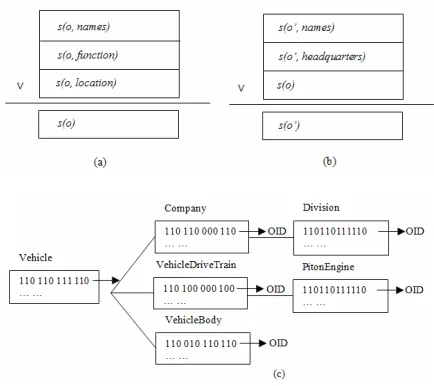
Example 5. Signature and signature file hierarchy:
Figure 2. Signature and signature file hierarchy
Consider the class “Division” in the class hierarchy shown in figure 1, which contains no complex attributes. The signature of an object o of this class can be
constructed as shown in figure 2 (a), where each s(o, x) stands for the signature produced for the attribute value x of o and s(o) for the signature of o. For a class containing complex attributes, the signature of its objects can be generated in the same way as for a class containing only primitive attributes. The only difference is that the signature of a complex attribute is the signature of the object it references. See figure 2 (b) for an illustration. In figure 2 (b), o’ stands for an object of class “Company”, and object o of class “Division” is the attribute value of “division” of o’. Signature file hierarchy may be constructed for a database with the schema shown in fig 1 for an illustration in fig 2(c).
Query Algorithm Based on Signature File
Definition 1. (Query tree) [3] Let p1˄p2…˄pk be the
search condition in query Q, where each pi is a predicate
of the form: <attribute operator value>. Then, all the paths appearing in the search condition constitute a query tree, denoted as Qt.
Example 6. Query tree:
Figure 3. Query tree
Definition 2. (Query signature tree) [3] Let p1.p2 ... .pn be
a path in a query tree Qt (from the root to some leaves).
Let <pi... .pn operator value> be a predicate appearing in
the search condition of Q. Then pn’s signature is svalue. The
signature of a non-leaf node in Qt can be obtained by
superimposing the signatures of its child nodes. The query signature tree is denoted as Q(s,t).
Example 7. The query signature tree:
Use the query signature tree to reduce searching space. For this purpose, two stack structures are needed to control depth-first traversal of tree structures: stackq for
Q(s,t) and stackc for the class hierarchy. In stackq, each
element is a signature, while in stackc, each element is a
set of objects belonging to the same class reached during class hierarchy traversal.
Algorithm 1. [3] top-down-hierarchy-retrieval;
Input: an object query Q;
Output: a set of OIDs whose texts satisfy the query.
Method:
Step 1. Compute the query signature hierarchy Q(s,t) for
the query Q.
Step 2. Push the root signature of Q(s,t) into stackq; push
the set of object OID of the target class into stackc.
Step 3. If stackq is not empty, sqpop stackq; else go to
(7).
Step 4. Spop stackc; for each oidi E S, if its signature
osigi does not compare sq, remove it from S; put S in
Sresult.
Step 5. Let C be the class to which the objects of S belong; let C1, ..., Ck be the subclasses of C; then partition
the OID set of the objects referenced by the objects of S into S1, ..., Sk such that Si belongs to Ci; push S1, ..., Sk
into stackc; push the child nodes of sq into stackq.
Step 6. Go to (3).
Step 7. For each leaf object, check false drops.
In this technique, optimization is achieved by executing step (4). In this step, some objects are filtered using the corresponding signature in the query signature tree. In step (5), the referenced objects and the signatures of the child nodes of the query signature tree are put in stackc
and stackq, respectively. In step (7), the checking of false
drops is performed.
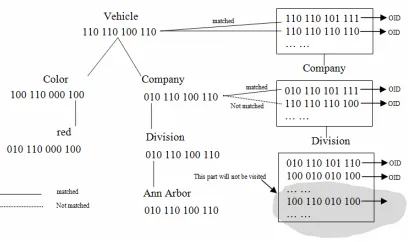
Example 8. Assume that a part of the signature file hierarchy constructed for a database with the schema shown in Figure 1 is of the form shown in the upper part of Figure 5:
Figure 5. Illustration of query evaluation
Since both the top two signatures in the signature file for Vehicle match the corresponding signature in the query signature tree, the signatures referenced by them in the signature file for Company are further checked. Assume that the first signature in Company is referenced by the first signature in Vehicle while the second one in Company is referenced by the second one in Vehicle. We can see that the second signature in Company does not match the corresponding signature in the query signature tree. Thus, all those Division object signatures referenced by it will not be checked further (see the grey part of Fig 5 for an illustration). This is optimal compared to “top-down-retrieval” since by means of “top-“top-down-retrieval”, checking against all Division object signatures has to be performed.
2.6. Signature Graph
Construction of Signature Graph
To find a matching signature, a signature file has to be scanned. If it is large, the amount of time elapsed for searching such a file becomes significant. The first idea to improve this process is to sort the signature file and then employ a binary searching. Unfortunately, this does not work due to the fact that a signature file is only an inexact filter. The following example helps for illustration. Example 9. Consider a sorted signature file containing only three signatures:
010 000 100 110 010 100 011 000 100 010 010 100
Assume that the query signature sq is equal to 000 010
010 100. It matches 100 010 010 100. However, if we use a binary search, 100 010 010 100 cannot be found. On the other side, there might be the same signatures in the signature file that match with objects having the same content, query processing needs to find out all locations of suitable objects. Due to this reason, we will organize signature file in a graph, called signature graph, to store signature list and allow reverse query for location of corresponding data. We have the following definition: Definition 3. (signature graph) [4] A signature graph G for a signature file S = s1.s2... .sn, where si≠ sj for i ≠ j and
|sk| = m for k = 1, ..., n, is a graph G= (V, E) such that
1. Each node v ∈ V is of the form (p, skip), where p is a
pointer to a signature s in S, and skip is a non-negative integer i. If i > 0, it tells that the ith bit of sq will be
2. Let e= (u, v) ∈ E. Then, e is labeled with 0 or 1 and
skip(u) > 0. Let skip(u) = i. If e is labeled with 0 and i > 0, the ith bit of the signature pointed to by p(v) is 0. If e is labeled with 1 and i> 0, the ith bit of the signature pointed to by p(v) is 1. A node v with skip(u) = 0 does not have any children.
Example 10. Consider the signature file and signature graph:
Figure 6. Signature file and signature graph
Algorithm 2 [4] signature-graphs-search
Input: a query signature sq ;
Output: set of signatures which survive the checking; Method:
Step 1. Set ←
Step 2. Push the root of the signature tree into stackp.
Step 3. If stackp is not empty, then v ← pop(stackp); else
return(S).
Step 4. If v is not a market node and skip(v)≠ 0, i← skip(v); mark v;
Step 5. Compare sq with the signature pointed to by p(v).
(*p(v) – pointer to signature*)
If sq matches, then S← S {p(v)}.
Step 6. Go to(3)
3. PROPOSED INDEXING TECHNIQUE
3.1. Improved Algorithm for Signature
Graph Search
In this part, we propose improvement of query algorithm on signature graph [4] which can be used to improve query time as follows:
Algorithm 3 signature-graphs-search
Input: a query signature Sq;
Output: set of signatures which survive the checking;
Method:
Step 1. Compute the Signature weight for the query signature.
Step 2. Set←Ø
Step 3. Push the root of the signature tree into stackp.
Step 4. If stackp is not empty, v←pop(stackp); else return
(Set).
Step 5. If v is not a marked node and skip ≠ 0, i←skip(v); mark v;
If Sq=0, push Cr and Cl into stackp; (where Cr and Cl are
v’s right and left child, respectively) otherwise, put only Cr into stackp.
Step 6. If signature weight is smaller than 50% then search the query signature in the signature nodes for the unset bits.
Step 7. Else search the query signature in the signature nodes for the set bits
Step 8. Compare Sq with the signature pointed by p(v).
(p(v) pointer to a signature)
If Sq matches, Set ← Set ᴗ {p(v)}.
Step 9. Go to (3).
3.2. Time Complexity
From [4], query time complexity on signature graph is
O(N/2l), where N is the number of signatures in the signature file and l is the number of bit 1 put in query signature Sq.
If query signature weight is higher than 50% then the number of bit 1 is larger than the number of bit 0 in Sq.
Let k be the number of bit 0 put in query signature Sq,
then we have O(N/2l) > O(N/2k). Otherwise, O(N/2l) <
O(N/2k).
The above analysis shows that if signature weight is higher than 50%, comparison between query signature and signature of signature file will be based on bit 1. Otherwise, it will be based on bit 0, this way can improve query time on signature graph.
3.3. Clustering Algorithm
similar objects are arranged together to create cluster. Because similar cluster objects will be suitable with any requirements (if any). This thing will increase search speed. This process included 2 step. First of all is cluster and the second is cluster searching. In hierarchical clustering, objects is linked with each other. In here, data structure of n-ary tree is used for creating cluster.
Algorithm 4. Clustering algorithm Input: Condition collections.
Output: Qualified object is embedded in n-ary tree Method:
Step 1. Creating new node and inserting into graph. Step 2. Seeking object that being content with available condition and attaching new condition.
Step 3. Inserting new node with graph that being content with new condition.
For searching almost identical similarities, locating position of condition collections is provided in hierarchy system and seeking father node of it. For locating position of node, using Level Order Tree Traversal. Algorithm to find father node such as follows: Algorithm 5. Parent node
Input: Object Condition collections. Output: Parent node.
Method:
Step 1. Searching nodes are suitable with conditions. Step 2. Returning qualified nodes to father node.
After gaining closest match, query is edited and information is retrieved. So therefore hierarchical tree helps for searching almost identical match.
4. Approach Combining Signature File
Hierarchy and Signature Graph
4.1. Query Data Structure Model
To improve query time on databases, we need to describe data structure in a more simple way and build a corresponding data structure to reduce searching space during implementing query while ensuring query of necessary objects by using signature graph. From [4], to make query more optimized, we need to combine signature file hierarchy and signature graph, this issue has been proved to improve query time better. From algorithm 3, query time complexity on signature graph is smaller than query time complexity of algorithm 2. Thus, we still use signature file hierarchy as in [4], but replace algorithm 2 with algorithm 3 to improve query time better.
Base on theoretical basis and suggested algorithm, the paper proposes improved approach for query algorithm on signature graph combining signature file hierarchy as follows: (1) Each signature file is stored in signature graph structure to speed up signature file scanning; (2) All of signature files are organized in hierarchy to facilitate implementing step by step filter technique.
Example 11
.
Construction of signature graph is illustrated as below:Figure 7. Construction signature graph
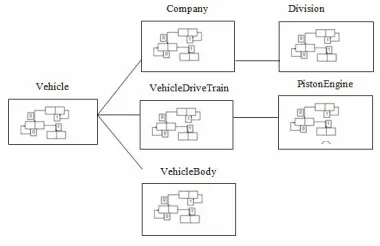
Example 12.Combination of signature file hierarchy and signature graph is illustrated as follow:
Figure 8. Signature file hierarchy and signature graph
Data structure is totally stored in the main memory, in this case, inserting or deleting a signature on a signature graph can be done easily. However, files are very large in databases, so database structure cannot store in the main memory but in the external memory. For object-oriented databases, they will be stored and implemented on the external memory. An object-oriented database has many classes, each class has many objects. There is a signature graph structure corresponding with each class, also each object will form an object signature. The entire object-oriented database is partitioned in a hash table structure including object’s signatures to implement query process.
4.2. Object-Oriented Query Processing
Step 1. Attribute of the object is hashed into binary signatures and attributes which form object signatures. Step 2. Object signatures in a same layer will form signature graphs.
Step 3. Create signature file hierarchy where each file is a signature graph.
After having data structure for query, we execute object query process on object-oriented databases as follow: Step 1. Encode key words which need to be retrieved into binary signature.
Step 2. Execute key word signature query to determine classes which need to be searched.
Step 3. Execute key word signature query on signature graphs corresponding with determined classes.
Step 4. In case exact match is unavailable we change to step 5. Opposite, turning to step 6.
Step 5. Finding closest match.
Step 5.1. Using Clustering Algorithms on n-ary tree to create new requirement.
Step 5.2. Finding out information is suitable with new requirement.
Step 5.3. Seeking match of son node and returning corresponding father node.
Step 6. Updating information in database.
5. Conclusion
In this paper, we suggest to improve query algorithm on signature graph. Signature graph is created based on signature file for a layer and helping to improve effectively for searching on signature file. Plus, in case exact match is unavailable, n-ary tree is used for locating corresponding coincident position. Signature files are created as a hierarchical system according to nested structures of layers in Object-oriented database system helping to improve effectively for query time.
References
[1] S. Sung and J. Fu, (1996), Access Methods on Aggregation of Object-Oriented Database. IEEE International Conference, Vol (2), pp.977-982.
[2] Yangjun Chen, Yibin Chen (2006), On the Signature Tree Construction and Analysis, IEEE Trans Knowl Data Eng, 18(9), pp.1207-1224.
[3] Yangjun Chen (2004), Building Signature Trees into OODBs, Journal of Information Science and Engineering, 20(2), pp.275-304.
[4] Yangjun Chen, Yibin Chen (2004), Signature File Hierarchies and Signature Graphs: a New Index Method for Object-Oriented Databases, Proceedings of the 2004 ACM symposium on Applied computing, Nicosia, Cyprus, pp.724-728.
[5] D. Dervos, Y. Manolopulos and P. Linardis (1998), Comparison of signature file models with superimposed coding, J. of Information Processing Letters 65, pp.101 - 106.
[6] C. Faloutsos, (1985), Signature Files: Design and Performance Comparaison of Some Signature Extraction Methods, ACM Sigmod Record, Volume 14, Issue 4, pp. 63 – 82.
[7] D. L. Lee, Y. M. Kim, G. Patel, (1995), Efficient Signature File Methods for Text Retrieval, IEEE Tran Knowl Data Eng, 7(3), pp.423-435.
[8] W. C. Lee, D. L. Lee, (1992), Signature File Methods for Indexing Object-Oriented Database systems, Proceedings of the 2nd International Computer Science Conference, Hong Kong, pp.616-622.
[9] P. Mahatthanapiwat, (2010), Flexible Searching for Graph Aggregation Hierarchy, Proceedings of the World Congress on Engineering, London, UK, pp.405-409. [10] E. Tousidoua, P. Bozanis, Y. Manolopoulos, (2002),