_____________________________________________________________________________________________________ *Corresponding author: E-mail: [email protected];
Cuckoo Search Algorithm Optimization Approaches
for Solving Economic Load Dispatch: A Review
Ganiyu Adedayo Ajenikoko
1*, Olusoji Simeon Olaniyan
1and John Oludayo Adeniran
11Department of Electronic and Electrical Engineering, Ladoke Akintola University of Technology,
P.M.B. 4000, Ogbomoso, Nigeria.
Authors’ contributions
This work was carried out in collaboration between all authors. Author GAA designed the study, performed the statistical analysis, wrote the protocol, and wrote the first draft of the manuscript. Authors OSO and JOA managed the analyses of the study. Author JOA managed the literature searches. All authors read and approved the final manuscript.
Article Information
DOI: 10.9734/JENRR/2018/v1i29794 Editor(s): (1)Dr. Huan-Liang Tsai, Professor, Department of Electric Engineering, Da-Yeh University, Taiwan. (2)Dr. Ismaila Badmus, Department of Mechanical Engineering, Yaba College of Technology, Yaba Lagos, Nigeria. Reviewers: (1) Himanshu Dehra, Canada. (2)Trinh Trong Chuong, Hanoi University of Industry, Vietnam. (3)Ong Pauline, Universiti Tun Hussein Onn Malaysia, Malaysia. Complete Peer review History:http://prh.sdiarticle3.com/review-history/25531
Received 27th April 2018 Accepted 6th July 2018 Published 13th July 2018
ABSTRACT
Cuckoo search algorithm (CSA) is an effective and highly reliable swarm intelligence based optimization approach. It is a technique of determining the most efficient, low cost and reliable operation of a power system by dispatching the available electricity generation resources to supply the load on the system. This paper presents a comprehensive review of CSA application in Economic Load Dispatch (ELD) problem. This review will assist power system engineerswith a view to enhancing the optimal operation of available thermal plants in electrical power systems.
Keywords: Cuckoo search algorithm; swarm intelligence; economic load dispatch; electrical power system; thermal plants; optimization approach.
1. INTRODUCTION
The benefits of electricity to mankind nowadays cannot be over-emphasized. Its continual availability has the capability to foster socio-economic development of nations across the world. The energy mix of many nations is hydro-thermal, until recently that penetration of
renewable energy sources is bringing
progressive diversification from the conventional hydro-thermal power plants. Thermal power plants use fossil fuel to generate electricity, the cost of this fossil fuel is exorbitantly high; hence the need to minimize it without violating system constraints becomes a crucial issue that needs to be addressed in the electric power system. One of the ways to bring about a significant saving in cost of fossil fuel is economic dispatch [1]. ELD is concerned with finding the optimum generation among the existing units, in such a way that the total fuel cost of generating units decrease as minimally as possible without violating power units and system constraints [2,3]. ELD is a crucial tool in energy management system and for any given load demand, it provides power output of each unit in MW and it also evaluates the overall fuel cost of generating units [4].
The objective function of ELD problem can be modeled to capture loss minimization, fuel-cost minimization, profit maximization (fuel costs/load tariffs) [5]. These objective functions can be achieved either jointly or singly. The former is referred to as multi- objective while the latter is called single objective. The multi-objective functions have to be converted into single objective function using either weighted sum of individual objective or using price penalty function [6,7]. The ELD that takes into consideration practical characteristics of thermal plant such as ramp rate limits, emission of gases, valve-point loading effects, multi-fuel options,
spinning reserve requirement, prohibited
operating zones and security constraints is known as Convex ELD problem [8-12]. A simplified form of ELD problem is non-convex in which the fuel-cost curves of the generating units are piece-wise linear and increase monotonically. It is modelled in such a way that the power generated with the plants’ constant coefficients are represented using quadratic polynomial function [13]. The fuel cost curve of non-convex ELD is smooth convex while convex ELD has non-smooth (non-linear cost curves)fuel cost due to the inclusion of the above peculiar characteristics of a thermal generator [14,15].
ELD problem can be solved either by ignoring transmission loss or inclusion of transmission losses [16-18].
ELD, optimal power flow (OPF), unit commitment (UC) and load forecasting (LF) are crucial optimization problems in modern power system [19]. The solution methodologies for solving ELD problem can be broadly grouped into two; deterministic and non-deterministic optimization. The deterministic can otherwise be referred to as conventional or mathematical optimization technique while non-deterministic can be heuristics or meta-heuristic. The deterministic solution methodologies so far in used for solving ELD problem includes Lambda iteration method,
dynamic programming method, Lagrange
relaxation approach, decomposition and
coordination method, mixed integer programming and Newton’s method. Artificial intelligence techniques form the basis of non-deterministic approach. It includes evolutionary programming, genetic algorithm, differential evolution, artificial immune system, Hopfield neural network, particle swarm optimization, artificial bee colony algorithm, firefly algorithm, harmony search algorithm and cuckoo search algorithm among others. Cuckoo search algorithm (CSA) is one of the latest metaheuristic natured inspired algorithms which came to existence through Yang and Deb in 2009. The algorithm is enhanced with levy flight search approach than normal isotropic random walks and by far efficient than PSO and GA. CSA is an hybridized version of differential evolution (DE), particle
swarm optimization (PSO) and simulated
annealing (SA). It has fewer parameters and very good convergence characteristics [18-22].
2. MATHEMATICAL FORMULATIONS OF ECONOMIC LOAD DISPATCH
The objective functions for ELD problem could be single or multi-objective depending on the objectives to be achieved. A simplified fuel cost model for ELD is given as;
C = a P + b P + c (1)
where;
C = the fuel cost of generator i (Naira/ hours), P =the power generated at generator i , P =the power generated at generator i ,
a , b and c = constant fuel cost coefficients for
For a power system with N number of generators, the total fuel is the sum of the cost model for each generator given by;
F = ∑ (a P + b P + c ) (2)
The objective function for convex ELD minimizes equation (2) given as;
Min. F = ∑ (a P + b P + c ) (3)
The inclusion of valve point loading effect which introduces ripple in generating units with multi-valve steam turbine transformed equation (1) into equation (3) thus;
C = a P + b P + c + abs e sin f P, − P
(4) where;
eand f are the constant coefficients of unit i due to inclusion of valve point loading effect.
A pictorial representation of effect of valve point loading effect is as shown in Fig. 1;
Equation (1) can be extended with inclusion of multiple fuels option and is represented as;
C =
a P + b P + c if P, ≤ P ≤ P,
a P + b P + c if P, ≤ P ≤ P,
a P + b P + c if P, ≤ P ≤ P,
(5)
A pictorial illustration of multiple-fuel option is as shown in the Fig. 2 below
Generally, CO , SO and NO are the major
contaminants of fuel, to show the total emission in ELD problem formulation; it is
expressed as;
E , = ∑ αP +βP +γ +δ × eθ× (6)
where;α[kg/MW − h], β[kg/MWh] and γ[kg/h] are the gas emission coefficients.
The reactive power has nothing to do with fuel cost of generation; the fuel cost is solely a function of real power generated. The main constraints are the real power generated and limits on physical devices (such as generators, tap changing transformers and phase shifting transformers etc.) [24].
Equality Constraint:-
∑ P = P + P (7)
where;
= real power generated at generator i, =
Total real power demand and = Power
transmission loss
Fig. 1. Incremental fuel cost curve for 5 valve steam turbine units [22]
= ∑ ∑ + ∑ + (8)
where;
n= number of generation buses, = active power delivered at bus i,
= active power delivered at bus j,
= loss coefficients with the units of reciprocal of Watt/Mwatt,
and = generalized loss coefficients.
Inequality Constraint:-
The limit on the generator output is expressed as:
≤ ≤ (9)
Security range of bus voltage is given by:
≤ ≤ (10)
where;
and = lower and upper limits for active power generation,
and = minimal and maximal acceptable
voltage levels at each bus.
Generator ramp rate limit is given as;
( , − ) ≤ < ( , P + UR )(11)
where;
P =previous operating point of the ith generator, DR= Down ramp limit
UR= Up ramp limit
The prohibited operating zone constraint is given as;
P ∈
P ≤ P < P
P ≤ P < P
P ≤ P < P
(12)
where;
Z= no. of prohibited zones in the ith generator, k= index of prohibited zones of the ith generator, P, =lower limit of the kth prohibited zone,
P =upper limit of the kth prohibited zone of the ith generator.
3. CUCKOO SEARCH ALGORITHM
One of the latest metaheuristic optimization algorithm is cuckoo search algorithm, Its birth was credited to [25]. It needs to be emphasized that CSA revolved around the obligatory brooding parasitic behavior of some cuckoo species in cunjuction with the Lévy flight behavior of some birds and fruit flies [26]. Its efficiency in
solving complex engineering optimization
problems is not unconnected with the fact that it is a hybrid of three different powerful optimization algorithms. The algorithms are DE, PSO and SA [27]. The essential attributes of CSA are global convergence characteristics, it combines both the local and global in exploration and exploitation of search space and its global search technique use levy flight approach than normal isotropic random process used by many other metaheuristic algorithms [28,29]. Understanding CSA better, three basic idealized rules were formulated [30-33];
Each cuckoo lays one egg (a design solution) at a time and dumps its egg in a randomly chosen nest among the fixed number of available host nests.
The best nests with a high quality of egg (better solution) will be carried over to the next generation.
The number of available host nests is fixed and a host can discover an alien egg with a probability pa∈ [0, 1]. In this case, the host bird can either throw the egg away or abandon the nest so as to build a completely new nest in a new location.
CSA uses fewer parameters and these
parameters are; the number of nests (N ), maximum number of iterations (Iter ) and the probability of an alien egg to be discovered (pa) can have its value chosen in the range [0, 1]. These parameters have to be predetermined; the stopping criterion for the algorithm is the maximum number of iterations. In addition, solution quality of the algorithm depends largely on the number of nests and the higher number of N is chosen as higher probability for a better optimal solution to be obtained [34-37].
x( )= x +α⊕ Levy(⋋) (13)
where;
α= step size (usuallyα> 0) ⊕=entry wise multiplications.
4. ADVANTAGES OF THE COCKOO SEARCH ALGORITHM (CSA)
Cockoo search algorithm is very efficient when compared with performance of other optimization methods such as Differential Evolution (DE) and Particle Swarm Optimization (PSO) [39]. In addition, cuckoo search algorithm has proved to satisfy the global convergence requirements and
thus has guaranteed global convergence
properties [40].
Additionally, cuckoo search algorithm consists of two components: local and global. The local component component is projected for improving the best solution via directed random walk and it is very intensive with about 1/4 of the search time, while the global component maintains the diversity of population via Lévy flights rather than standard random walks and it takes about 3/4 of the total search time. This allows that the search space to be explored more efficiently on the global scale and consequently the global optimality can be found with a higher probability [41].
These advantages make cuckoo search
algorithm to be very effective and efficient. Therefore, cuckoo search algorithm can be characterized by the following features:
It satisfies the global convergence
requirements
It supports local and global search capabilities
It uses Lévy flights as a global search strategy.
5. APPLICATIONS OF CUCKOO SEARCH ALGORITHM IN SCIENCE AND TECHNOLOGY
Cuckoo search algorithm has been applied in
many areas of optimization and computational intelligence with promising
efficiency including Neural Network, finding optimization cluster centers, job
scheduling and many more in the different domains including industry, health sector,
wireless sensor network and image processing [42].
In the engineering design applications, cuckoo search has superior performance over other algorithms for a range of continuous optimization problems such as spring design and welded beam design problems [43]. In addition, CSA has demonstrated to be very efficient for solving nonlinear problems such as mesh generation, optimized semantic web service composition processes, optimal design for reliable embedded system and design of steel frames.
In addition, cuckoo search algorithm has been used to solve many scheduling problems, to
generate independent paths for software testing and test data generation. Cuckoo search
algorithm has been shown to be very efficient in the context of data fusion and
wireless sensor network [44].
Furthermore, a variant of cuckoo search algorithm combined with quantum-based approach has can be used to
solve Knapsack problems efficiently. In addition,
CSA offers a reliable method for solving thermodynamic calculations and for
designing engineering applications (Yang and Deb, 2014).
6. REVIEW OF CSA IN ELD PROBLEM
Tran et al. [45] proposed an efficient oppositional-CSA (OCSA) for solving economic power dispatch (EPD). OCSA is a variant of CSA with good exploitation strategy compared to original CSA, to overcome the shortcoming of original CSA which lacks intensification phase on the exploited search space, OCSA was
proposed. The proposed algorithm was
evaluated on 10, 13 and 40 power system in order to prove the efficiency of OCSA. For validating the performance of OCSA, different variants of CS and some of the novel evolutionary algorithms were tested under the same simulation environment. The results showed that the proposed OCSA outperforms existing algorithms and other variants of CS in terms of fuel cost consumption. In addition, convergence of OCSA towards optimal solution was found to be higher as compared to other algorithms.
approach handled efficiently, the non-smoothness of cost function caused by the use of valve point effects. Penalty factor was used to convert the multi-objective function into single objective function. MATLAB optimization tool box
was used as implementation tool. The
performance of the algorithm was evaluated by comparing the result obtained with other heuristic methods found in the literatures using fuel cost minimization as performance metric. Based on the findings, the work established that the method outperforms the existing techniques, and can be a promising alternative approach for solving practical power system ELD problems.
Yang and Deb [47] presented CSA for solving non-convex ELD problems of fossil fuel fired generators considering transmission losses and valve point loading effect. The proposed approach was tested and validated on the standard IEEE 14-bus, 26-bus and 30-bus system with several heuristic load patterns. The results obtained were compared to those of FA, PSO and harmony search algorithm (HSA). The authors concluded that the performance of the proposed approach appears to be a powerful and efficient optimization technique to solve highly nonlinear discontinuous cost functions of ELD problem and to achieve globally better optimum solution.
Yang [48] proposed and implemented CSA on combined economic-emission load dispatch problem using six thermal generators as test case system. Penalty factor was used to convert the bi-objective function into single objective problem. It was implemented using MATLAB optimization toolbox. The result obtained using the proposed approach was compared to that of GA; it was revealed that CSA is more effective than GA. In similar vein, the work concluded that
cost at the minimum condition produced high emission and minimum cost and vice- versa.
Yang and Deb [49] applied CSA to address both ELD and OPF incorporating FACTS devices. The proposed algorithm was tested on IEEE 9 bus
test power system to demonstrate its
effectiveness. The simulation results indicated the robustness of the CSA in solving OPF problem of power systems with and without FACTS. The results obtained revealed that STATCOM and SVC used reduced both the transmission losses, system voltage deviation and minimized the total fuel cost of generation. The work suggested scope expansion by
incorporating other FACTS devices such as unified power flow controller (UPFC) and thyristor controlled series capacitor (TCSC).
Yang and Deb [50] proposed application of a One Rank-CSA (ORCSA) to bi-objective ELD problem. ORCSA is a variant of CSA that has an improvement over original CSA in terms of exploration of search space. The two objective functions formulated are fuel and emission of gas fossil fired power plants. The performance of the proposed ORCSA was validated by using a three-unit system with one load case and a six-unit system with three load cases. The obtained results were compared with other methods that were used before. The work concluded that the ORCSA was very efficient for the problem in that it offered better solution and faster simulation time as compared to others.
Ajenikoko et al. [1] presented application of modified-CSA (MCSA) for solving ELD problems. MCSA was proposed to improve the search ability and solution quality of the conventional CSA. The proposed method was tested on 13-unit system with valve point loading effects having a total load demand of 1800 MW and 2520 MW, 20-unit system with quadratic cost function and transmission losses and systems with multiple fuel options and valve point loading effects. The minimum cost and computational time were used as performance metrics and based on the analysis carried out MCSA method outperforms conventional-GA, (CGA) in terms of the stated performance metrics.
Arul and Rengarajan [2] presented a solution for ELD problem considering valve point loading on fuel cost function using cuckoo search algorithm (CSA). The work aimed mainly to minimize the fuel cost for meeting the power demand considering constraints such as valve loading effect, generator limits, power balance constraint without exclusion of transmission losses. The proposed approach was tested on 3, 6 and 13 thermal units having a power demand of 850MW,
800MW and 1800MW respectively. The
Balamurugn and Subramanian [3] presented an outline nine swarm intelligence-based algorithm and the modifications applied to them in order to solve the ELD problem and its variants. The reviewed algorithms were ant colony optimization (ACO), particle swarm optimization (PSO), bacterial foraging optimization algorithm (BFOA), shuffled frog leaping algorithm (SFLA), artificial bee colony (ABC), firefly algorithm (FA), cuckoo search algorithm (CSA), bat algorithm (BA), grey
wolf optimization (GWO). Theoretical
implementation of ACO was somewhat difficult. The computational time was comparatively large and its application is limited to discrete problems. The highlighted shortcomings of PSO were limited local/global searching capabilities, solution updating without considering both the quality of solutions and the distance between solutions. BFOA has swarming effect on complex ELD problem most especially for large multi-dimensional space with constraints. SFLA solution got trapped at local optimal and it had poor convergence characteristics. ABC, though very good optimizer with fewer parameters, suffered large computational time. FFA has fixed parameters which did not change during the iteration and improper setting of these parameters result in solution getting trapped in local optimal. CSA had fewer parameters; improper choice of its parameter can also result in solution getting trapped at local optimal. BA, though very simple, flexible and easy to implement, if rapidly switched from exploration to exploitation stage, it may lead to stagnation. GWO is simple to implement with fewer parameters and faster convergence. The work concluded that although these algorithms have successfully solved the ELD problem, yet further improvements to the algorithms were needed.
Basu and Chowdhury [4] presented an adaptive- Cuckoo Search Algorithm (ACSA) for solving economic emission load dispatch (EELD) problem with quadratic fuel function. ACSA was proposed to enhance the convergence speed and quality solution of the conventional CSA. It was developed by performing two adaptive updated step size parameters on conventional CSA. Weighted function was used to transform the multi-objective into single objective function. The proposed approach was assessed using electricity generation fuel cost and emission released as performance metrics. The test case systems used one load case and a six unit system with three load cases which are 800, 1200 and 1800 MW. It was discovered that the ACSA gave better solution and faster simulation
time than TS, FCGA, CGA, NSGA –II and BBO. The work recommended that the proposed approach should be applied to economic emission dispatch where multi -thermal units and multi -pollutants are considered.
Chellappan and Kavitha [5] proposed adaptive Cuckoo Search Algorithm (ACSA) for solving ELD problem on thermal units with inclusion of multiple fuel options and valve point loading effect. The updated step-size in ACSA at the first new solution generation via lévy was adaptive at each iteration with careful choice of other parameters of CSA. The proposed approach was tested on a ten-unit system with load demands of 2,400 MW to 2,700 MW in steps of 100 MW. The performance metrics used were the fuel cost minimization and programing execution time. The results obtained were compared to Enhanced Lagrangian neural network (ELANN), adaptive
differential evolution (ADE), augmented
Lagrange Hopfield network (ALHN) and multi-PSO (Mmulti-PSO). The comparison showed that ACSA was very efficient for solving ELD problem with multiple fuel options considering either quadratic or non-convex fuel cost.
Chowdhury [6] solved ELD problem in power system operation with wind farm (WF) connected using CSA. The test case system used IEEE 30 buses system with a total load demand of 289.3 MW and WF power of 100 MVA and 189.3 MW with the power of 16 MVA. The main constrains considered were power balance, power loss and generator limits. The implementation tool was MATPOWER 4.1 Toolbox and the performance metrics were the total fuel cost minimization and program execution time. Based on the analysis CSA is capable of solving ED problem with WF connected within shortest CPU time. The author inferred that CSA was a best method when power system was connected since it gave exact results. The work recommended that future work should focus more on cost optimization that need mathematical methods to solve ED problem with big power system.
Civicioglu Besdok [7] presented optimization of ELD using CSA. The proposed approach was used for ELD with and without considering transmission losses. A non-convex ELD problem was proposed which took into consideration, both valve point effect and emission constraints. The work stated the three norms that needed to be
captured in practical ELD which were
approach was tested on 3, 6 and 10 unit systems for ELD without valve point effect on 3 and 13 unit systems for ELD with valve point effect and on 3 unit system for emission dispatch. The load demand on 3, 6, 10 and 13 thermal units were 850 MW, 283.4 MW, 1036 MW and 2520 MW
respectively. The results obtained were
compared to that obtained via PSO,
conventional-PSO (CPSO), Differential evolution (DE) and Evolution Programming (EP). Both total fuel and emission cost obtained using the proposed approach was found to be less as compared to PSO, CPSO, DE and EP. The
execution time was comparatively better
compared to other techniques. The work concluded that CSA had ability to provide global solution and high convergence rate for both small and large scale systems. Thus, CSA was found to be more proficient, robust and finds real word applications nowadays.
Nguyen et al. [32] presented two modified versions of CSA. In their work, new solutions were generated with the aid of Gaussian and
Cauchy distributions alongside with ELD
optimization constraints. Convex ELD
considering multiple fuel options were solved. CSA-Cauchy and CSA-Gauss were tested on10-unit and two on10-unit system respectively considering multiple fuel options and valve point effect on thermal units. Several load cases were used to validate the effectiveness of the proposed approach. The performance metrics were the CPU computational time and total fuel cost of generation. The simulation results obtained were compared to CSA- Lévy, conventional genetic algorithm (CGA) with multiplier updating (CGA-MU) and new particle swarm optimization with a simple local random search (NPSO-LRS). The computational time obtained with the proposed methods was faster and lightly slower than CGA-MU, NPSO-LRS, CSA- Lévy and NPSO-LRS. The work concluded that the proposed methods were more efficient and faster than most of the methods for solving ELD problem with multiple fuel options.
Pentapalli and Varma [35] evaluated and demonstrated ELD with inclusion of transmission losses using GA, PSO and CSA. A comparative analysis of the three methods was done using 62-bus Indian utility system with a total load demand of 2300MW. The performance metrics used were total fuel cost and power losses reduction. Based on the comparative analysis carried out, CSA emerged best not only for faster convergence but also for better economy; and as
the system size increased, CSO provided the vast economic difference. The work concluded that CSA yielded less transmission losses and appreciable minimized fuel cost compared to other techniques.
Sahoo et al. [36] presented solution to economic load dispatch problem using cuckoo search algorithm on 3, 6, 10 and 13 thermal unit
systems. A multi-objective function was
formulated which captured minimization of fuel cost and emission constraints. The results of the proposed approach were compared to GSA,
genetic algorithm (GA), evolutionary
programming (EP), Differential evolution (DE) and particle swarm optimization (PSO). Based on the analysis, the total fuel cost and emission cost obtained by CSA was found to be less when compared to other methods. The computational time was comparatively lesser compared to other approaches. The work concluded that CSA had ability to provide global solution and high convergence rate both for small and large scale systems.
Sapra [38] presented CSA for solving
environmental-ELD problem with quadratic fuel function. The effectiveness and feasibility of the proposed method was tested on 3 and 6 thermal units having a total load demand of 800 MW, 1200 MW and 1800 MW. The performance metrics were fuel cost, emission and computation time. The results obtained were compared to Non-dominated Sorting Genetic Algorithm - II (NSGA-II), Tabu Search (TS), fuzzy logic
controlled genetic algorithm (FCGA) and
conventional-GA (CGA). The comparison result indicated that the proposed method was very efficient for solving EELD problem. The work suggested that future work should consider non-smooth fuel cost function of thermal units by dividing the emission objectives into three emission objectives, to determine the best compromise solution for two, three and four objectives.
Sharma and Mahor [40] presented an
MW, 49,342 MW and 86,400 MW. The results obtained were compared with GA and PSO. The work concluded that CSA converged better than PSO and GA and generated cheapest generation schedule, thus making it quite an efficient algorithm and less time consuming for online applications.
Sinha et al. [41] presented solution to convex ELD problem using CSA. The proposed approach was implemented on three and six-generating units with a total load demand of 150 MW and 700 MW respectively. The simulation results obtained for the proposed approach was compared to PSO, Shuffled Frog Leaping
Algorithm (SFLA), Bacterial Foraging
Optimization (BFO), Artificial Bee Colony (ABC), Harmony Search (HS) and Firefly Algorithm (FA). Results of the comparison revealed the superiority of the CSA convergence and efficiency in solving ELD problem .
Thang et al. [42] presented CSA for solving convex and nonconvex ELD problems of fossil fuel fired generators in single and multiple areas considering transmission losses, multiple fuels, valve-point loading, prohibited operating zones and tie line power flow. The effectiveness and feasibility of the proposed algorithm was verified on four different single areas based test systems and three different multiple area based test systems, both small and large, involving varying degree of complexity. The result obtained was compared to ABCO, DE and EP. The quality of the solution obtained was superior with the proposed algorithm producing minimal fuel cost and lesser computational time than other techniques. The work concluded that the proposed approach seemed to be a promising
alternative approach for solving ELD problems in practical power system.
Yang and Deb [49] introduced a solution to ELD problem using CSA. The proposed approach was tested on 3 and 6 thermal units and the results of LIM and CSA were compared using total fuel cost and computational time as performance evaluation metrics. CSA outperformed LIM giving
minimal fuel cost and lesser value of
computational time was recorded.
Yang and Deb [50] presented CSA for solving both convex and non-convex ELD problems of fossil fuel fired generators. The constraints were transmission losses, multiple fuels, valve point loading and prohibited operating zones. The work covered dispatch of power on microgrid. The effectiveness and feasibility of the proposed algorithm was verified on 6, 10 and 20- generator system and their respective total load demands were 1263 MW, 2700MW and 2500 MW. The simulation results obtained with the proposed
approach implemented in MATLAB was
compared to PSO, biogeography based
optimization (BBO), new particle swarm
optimization-local random search (NPSO-LRS), new particle swarm optimization (NPSO), and improved genetic algorithm (IGA). Number of iteration was used as the stopping criteria for the algorithm. The work concluded that the proposed algorithm was a promising alternative approach for solving the ED problems in practical power system and micro grid power dispatch problem.
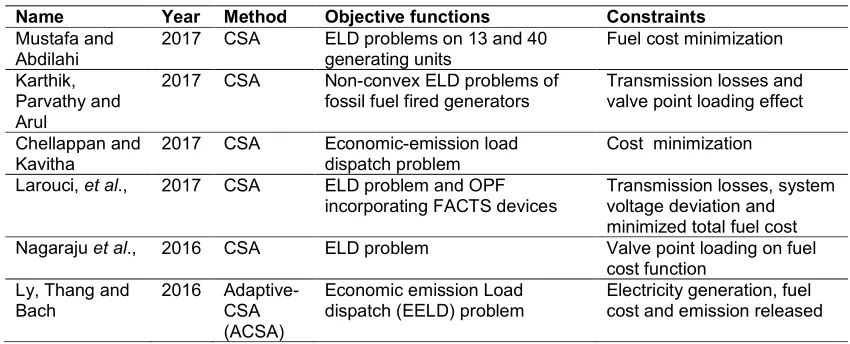
Table 1 gives a summary of CSA in ELD problem. It reflects the most important decision variables, ELD optimization problem, the most common objective function and the most common constraints.
Table 1. Summary of CSA in ELD problem
Name Year Method Objective functions Constraints
Mustafa and Abdilahi
2017 CSA ELD problems on 13 and 40
generating units
Fuel cost minimization
Karthik, Parvathy and Arul
2017 CSA Non-convex ELD problems of
fossil fuel fired generators
Transmission losses and valve point loading effect
Chellappan and Kavitha
2017 CSA Economic-emission load
dispatch problem
Cost minimization
Larouci, et al., 2017 CSA ELD problem and OPF
incorporating FACTS devices
Transmission losses, system voltage deviation and minimized total fuel cost
Nagaraju et al., 2016 CSA ELD problem Valve point loading on fuel
cost function Ly, Thang and
Bach
2016 Adaptive-
CSA (ACSA)
Economic emission Load dispatch (EELD) problem
Name Year Method Objective functions Constraints
Ly et al., 2016 Adaptive
Cuckoo Search Algorithm (ACSA)
ELD problem on thermal units Fuel cost minimization and
programing execution time.
Le and Vo 2016 CSA ELD problem in power system
operation with wind farm (WF)
Power balance, power loss and generator limits. Kumar and
Kumar
2016 CSA Optimization of ELD Minimization of fuel cost,
emission cost and
scheduling generator units.
Kaur and Gill 2015 CSA ELD problem Minimization of fuel cost and
emission cost Thao and
Thang
2014 CSA ELD problem Fuel cost, emission and
computation time.
Chowdhury 2013 CSA Convex and non-convex ELD
problems
Transmission losses, multiple fuels, valve-point loading, prohibited operating zones and tie line power flow.
Basu and Chowdhury
2013 CSA Convex and non-convex ELD
problems
Transmission losses, multiple fuels, valve point loading.
7. REVIEW OF CSA
Demirel and Demiroren [8] presented a paper on nature-inspired optimization algorithms. It was highlighted that CSA was a more efficient algorithm when compared to PSO, DE and SA. Then, some studies carried out to improve the CS efficiency were reviewed. It was found that most CS efficiency improvement strategies were
based on applying different probability
distribution functions (Cauchy, Gauss and Gamma) to determine the random walk step sizes. Three CS algorithms using linear,
exponential and power increasing switching parameters were developed and tested against the constant and linearly
decreasing CS algorithms. The CSA using exponential increasing switching parameter was found to be more efficient than other CS algorithms.
Dutt and Dhamand [9] presented a brief review on CSA, its areas of application in Engineering and its hybridized version. The identified areas of application of CSA were traveling salesman problem (TSP), speech reorganization (SR), job scheduling (JS), and economic load dispatch (ELD) among others. Based on the review, the work concluded that CS was the best search algorithm.
Gigras et al. [12] proposed a CSA using Lévy Distribution, Cauchy Distribution and Gaussian
distributions for solving the short-term hydrothermal scheduling (ST-HTS) problem with reservoir storage constraint on hydropower plants. The proposed techniques were tested on two different test systems with different power demand. The results obtained with the proposed approach were compared to EP, CEP, FEP, IFEP and RIFEP. The result obtained with three versions of the proposed method (CSA-Lévy, CSA-Cauchy, and CSA-Gauss) were faster than all methods. The work showed that among the three versions of CSA proposed in the paper, CSA-Lévy was the best producing the lowest minimum for the test systems. The work concluded that the proposed CSA methods, especially the CSA with Lévy distribution, were very favourable and powerful methods for solving short-term hydrothermal scheduling problem with reservoir volume constraint.
PSO using minimization fuel cost and emission as performance metrics. The work concluded that based on the comparison made, CSA was very efficient for the problem since it was able to obtain better fuel cost for economic dispatch and better emission for emission dispatch. The results indicated that CSA was a very efficient method for solving the practical problem of MO-OPFHTS.
Kamat and Karegowda [16] optimized total operation cost in microgrid cuckoo search algorithm. A microgrid is a localized group of
electricity generation, energy storage connected to a centralized grid. The two main
costs that constituted total fuel cost identified were the generation cost of local
resources and cost of energy from main grid. The proposed approach was implemented on test case system having 3, 6 and 40 thermal generator units respectively. The simulation result from MATLAB for the proposed approach was compared to that obtained with ABC. CSA outperformed ABC based on the performance metric used.
Kaur and Gill [17] proposed CSA for solving short-term fixed-head hydrothermal scheduling (HTS) problem taking into consideration, both the power losses in transmission systems and valve point loading effects in fuel cost function of thermal units. The proposed approach was tested on 4 and 5 hydrothermal systems using different fuel cost functions of thermal units. MATLAB platform was used as implementation tool and ran on a 2 GHz PC with 2 GB of RAM. The work emphasized that different values of the probability led to the same optimal solution and that the best value of probability of alien egg being discovered (Pa) had to be tuned in its range [0, 1]. The work suggested that value of distribution factor should be in the range [0.3, 1.99] as it had significant impact on solution quality of CSA. The results obtained were compared to optimal gamma based genetic algorithm (OGB-GA), existing GA (EGA), artificial immune system (AIS), EP, PSO and DE. It was concluded based on the analysis that the proposed approach was a favorable method for solving the short-term hydrothermal scheduling problem, especially for non-smooth fuel cost function of thermal units.
Kumar and Kumar [18] proposed Gaussian distribution (CSA-Gauss) and Cauchy distribution (CSA-Cauchy) approach against Lévy flights random walk in original CSA to improve on the
exploration and exploitation of original CSA. The proposed approach was tested on one test system consisting of ten generating units using 2400 MW, 2500MW, 2600 MW and 2700 MW as total load demand. Weighted sum was used to transform the multi-objective function into single objective function. The simulation results were compared to Hopfield Lagrange network (HLN) and lambda iterative method (LIM) using emission, total fuel cost and computational time as performance metrics. Both CSA-Gauss and CSA-Cauchy competed favorably and were very efficient for solving economic emission load dispatch with multiple fuel option.
Le and Vo [20] proposed CSA for solving OPF problem on practical IEEE-62 bus Indian utility system. The performance of the proposed approach was compared to the PSO and GA using fuel cost and execution time as performance metrics. The proposed approach was coded in MATLAB. Based on the results obtained, the following conclusion was drawn; GA required more number of iteration and convergence time, PSO needed more time but less reliability while CSA performed better in solution time and reliability.
8. ANALYSIS OF THE REVIEWED PAPERS
The analysis of the papers reviewed in this research paper is illustrated in Figure 3. The Figure shows the trends of the reviewed papers for a period of five years (2013-2017). In 2013, four prominent papers were reviewed. Each of the papers discussed the concept of Cuckoo search algorithm and the method used.
In 2014, five research papers were reviewed with the model developed clearly explained and the results analyzed. The drawbacks of each approach were clearly pointed out. In 2015, four papers were reviewed on Cuckoo search algorithm while in 2016, eleven research papers were reviewed. This shows that the number of papers reviewed in 2016 was about three times the number of papers reviewed in 2015. In 2017, six papers were reviewed which was about 45.5% in reduction from the number of papers reviewed in 2016.
Fig. 3. Frequencies of the review papers
9. CONTRIBUTION TO KNOWLEDGE AND RECOMMENDATION
A comprehensive analysis of the various CSA optimization approaches that will assist system engineers in recommending the most appropriate optimization technique in solving ELD problem has been presented. In addition, future research will focus on CSA optimization techniques to solve various ELD problems.
10. CONCLUSION
This work presented an extensive review of the application of cuckoo search algorithm to economic load dispatch on hydro-thermal power plants. Samples of openly accessible literatures were reviewed from 2013 to 2017. It was discovered that CSA is a hybrid of PSO, DE and SA. Several attempts have been made by researchers to enhance the performance of original cuckoo search algorithm includes adaptive turning/switching of parameters of CSA at each iteration run as against initial static fixing of these parameters prior to iteration. Other researchers made wholistic efforts to improve the efficiency of CSA by applying different probability distribution functions (Cauchy, Gauss and Gamma) to determine the random walk step sizes as against using levy flight approach. The identified variants of CSA were adaptive cuckoo search algorithm (ACSA), modified cuckoo search algorithm (MCSA), oppositional-CSA (OCSA) and one rank-CSA (ORCSA). CSA can be applied to large dimensional ELD problems as well as complex problems of ELD. However,
variants of CSA demonstrated greater and better capacity with excellent performance to solve ELD problems with smooth and non-smooth fuel cost. Based on the reviewed papers, CSA is yet to be employed to solve Nigerian economic load dispatch problems.
COMPETING INTERESTS
Authors have declared that no competing interests exist.
REFERENCES
1. Ajenikoko GA, Olabode OE, Olayanju OW.
Distributed generation (DG) integration on utilities distribution system: A survey.
International Journal of Advanced
Engineering and Technology. 2017;1(4): 01-10.
2. Arul P, Rengarajan N. Optimal power flow solution using cuckoo search algorithm. ARPN Journal of Engineering and Applied Sciences. 2014;9(12):2687-2691.
3. Balamurugn R, Subramanian S. A
simplified recursive approach to combined economic emission dispatch. Electrical Power Components and Systems. 2007; 36(1):17-27.
4. Basu M and Chowdhury A. Cuckoo search
algorithm for economic dispatch. Applied Energy. 2013;60:99-108.
5. Chellappan R, Kavitha D. Economic and emission load dispatch using cuckoo search algorithm. International Conference on Innovations in Power and Advanced Computing Technologies. 2017;1-7.
0 2 4 6 8 10 12
2013 2014 2015 2016 2017
Years
F
re
q
u
en
c
6. Chowdhury A. Economic load dispatch for single-area and multi-area systems using
cuckoo search algorithm. A thesis
submitted to Faculty of Engineering and Technology Jadavpur University, Kolkata-700032. 2013;23-25.
7. Civicioglu P, Besdok E. A conceptual
comparison of the cuckoo search
algorithm, particle swarm optimization, differential evolution and artificial bee colony algorithm. Artif. Intell. Rev. 2011; 92760.
DOI: 10.1007/s10462-011
8. Demirel Y, Demiroren A. Economic and
minimum emission dispatch. Applied
Energy. 2004;2(1):12-28.
9. Dutt A, Dhamand A. Classical approach to solve economic load dispatch problem of thermal generating unit using MATLAB programming. IJERT. 2013;2(10):1384-1389.
10. Ettaouil M, Loqman C. Constraint
satisfaction problems solved by semi- definite relaxations. WSEAS Transactions on Computers. 2008;7(9):951-961. 11. Fister Jr I, Fister D, Fister I. A
comprehensive review of cuckoo search: variants and hybrids. Int. J. Mathematical Modelling and Numerical Optimisation. 2013;4(4):387-409.
12. Gigras Y, Kusum Gupta K, Vandana P, Choudhary K. A comparison between Bat algorithm and Cuckoo search for path
planning. International Journal of
Innovative Research in Computer and Communication Engineering. 2015;3(5): 4459-4466.
13. Hadi S. Power system solution manual. Tata McGrawhill, New Delhi. 2002;1-10.
14. Ho SD Vo VS, Le TM, Nguyen TT.
Economic emission load dispatch with multiple fuel options using cuckoo search algorithm with gaussian and cauchy distributions. International Journal of Energy, Information and Communications. 2014;5(5):39-54.
15. Karthik N, Parvathy AK, Arul R. Non-convex economic load dispatch using cuckoo search algorithm. Indonesian Journal of Electrical Engineering and Computer Science. 2017;5(1):48-57. 16. Kamat S, Karegowda AS. A brief survey on
Cuckoo search applications. International
Journal of Innovative Research in
Computer and Communication
Engineering (An ISO 3297: 2007 Certified Organization). 2014;2(2):7-14.
17. Kaur R, Gill GK. Solution to economic load dispatch problem using cuckoo search algorithm. International Journal of Electrical and Electronics Research. 2015; 3(2):362-369.
18. Kumar A, Kumar S. Optimization of
economic emission problem using cuckoo search method. International Journal of Research Review in Engineering Science & Technology. 2016;5(2):1-7.
19. Larouci B, Benasla L, Belmadani A, Rahli M. Cuckoo search algorithm for solving economic power dispatch problem with consideration of facts devices. U.P.B. Sci. Bull., Series C. 2017;79:43-54.
20. Le DA, Vo DN. Cuckoo search algorithm application for economic dispatch with wind farm in power systems. Global Journal of Technology Optimization. 2016; 7(204).
DOI: 10.4172/2229-8711.1000204
21. Liao G. A novel evolutionary algorithm for dynamic economic dispatch with energy saving and emission reduction in power system integrated wind power. Applied Energy. 2011;36(2):1018-1029.
22. Lingala R, Bethina A, Rao PVR, Sumanth K. Economic load dispatch using heuristic algorithms. IEEE Publication. 2015;12-23. 23. Liu D, Cai Y. Taguchi method for solving
the economic dispatch problem with non-smooth cost functions. Power Systems. IEEE Transactions on Energy. 2005;20(4): 2006-2014.
24. Ly HP, Nguyen TT, Vo DN, Tran CD. Adaptive cuckoo search algorithm based method for economic load dispatch with multiple fuel options and valve point effect. International Journal of Hybrid Information Technology. 2016;9(1):41-50.
25. Ly HP, Thang TN, Bach HD. Adaptive cuckoo search algorithm for economic
emission load dispatch problem.
International Journal on Electrical Engineering and Informatics. 2016;8(1): 76-92
26. Mareli M, Twala B. An adaptive Cuckoo search algorithm for optimization. Applied Computing and Informatics; 2017.
DOI:http://dx.doi.org/10.1016/j.aci.2017.09. 001
27. Moustafa FS, Badra NM, Abdelaziz AY. Solution of economic load dispatch using
recent swarm-based meta-heuristic
28. Murugan MB, Gilda SJ. Economic dispatch on microgrid by using cuckoo search algorithm. International Journal for Scientific Research & Development. 2015; 3(4):594-597.
29. Mustafa MW, Abdullahi AM. A cuckoo search optimization scheme for non-convex Economic load dispatch. ARPN Journal of Engineering and Applied Sciences. 2017;12(4):1014- 1024.
30. Nagaraju S, Mani Sankar M, Ashok G, Srinivasareddy A. Economic load dispatch considering valve point loading using cuckoo search algorithm. International Journal of Scientific Development and Research. 2016;1(7):225-229.
31. Nguyen TT, Vo DN, Truong AV. Cuckoo
search algorithm for short-term
hydrothermal scheduling. Applied Energy. 2014;132:276–287.
32. Nguyen TT, Vo DN, Dinh BH. Cuckoo
search algorithm using different
distributions for short-term hydrothermal
scheduling with reservoir volume
constraint. International Journal on Electrical Engineering and Informatics. 2016;8(1):76-92.
33. Nguyen TT, Vo DN, Truong AV, Ho LD. Meta-heuristic algorithms for solving hydrothermal system scheduling problem considering constraints in transmission lines. Global Journal of Technology & Optimization, Global J Technol Optim, 2016;7:1.
Available:http://dx.doi.org/10.4172/2229-8711.1000192
34. Olabode OE, Arowolo OA, Arowolo MP. A comparative application of shunt capacitor and load tap – changing transformer (LTCT) to the optimal economic dispatch of generation on Nigerian 330kV, 24-bus grid system. International Journal of Scientific & Engineering Research. 2017;8(6):1017-1023.
35. Pentapalli GVV, Varma RK. Cuckoo
search optimization and its applications: A review. International Journal of Advanced
Research in Computer and
Communication Engineering. 2016;5(11): 556-562.
36. Sahoo S, Dash KM, Prusty RC, Barisal AK. Comparative analysis of optimal load dispatch through evolutionary algorithms. In Shams Engineering Journal. 2015;6: 107–120.
37. Sahoo S, Dash KM, Prusty RC, Barisal AK. Comparative analysis of optimal load
dispatch through evolutionary algorithms. Ain Shams Engineering Journal. 2014; 6:107-120.
38. Sapra U. Solving combined economic and emission dispatch using cuckoo search. International Journal of Engineering Research and Applications. 2013;3(4): 498-502.
39. Serapião ABS. Cuckoo search for solving
economic dispatch load problem.
Intelligent Control and Automation. DOI: 10.4236/ica.2013: 1-8
40. Sharma J, Mahor A. Particle swarm
optimization approach for economic load dispatch: A review. International Journal of Engineering Research and Applications, 2013;3(1):013-022.
41. Sinha N, Chakrabarti R, Chattopadhyay PK. Evolutionary programming techniques
for economic load dispatch. IEEE
Transactions Evolutionary Computation, 2003;7(1):83–94.
42. Thang NT, Dieu VN, Bach D, Ly P. Modified cuckoo search algorithm for solving nonconvex economic load dispatch problems. Advances in Power Engineering and Electrical Engineering. 2016;14(3): 236-245.
43. Thao NTP, Thang NT. Environmental
economic load dispatch with quadratic fuel
cost function using cuckoo search
algorithm. International Journal of u- and e- Service, Science and Technology. 2014; 7(2):199-210.
44. Thirugnanasambandam K, Amudhavel J,
Pothula S. Oppositional cuckoo search for solving economic power dispatch. IIOABJ, 2017;8(2):199-207.
45. Tran CD, Dao TT, Vo VS, Nguyen TT. Economic load dispatch with multiple fuel options and valve point effect using cuckoo
search algorithm with different
distributions. International Journal of Hybrid Information Technology. 2015;8(1): 305-316.
46. Tran CD, Nguyen TT, Hoang HM, Nguyen
BQ. One rank cuckoo search algorithm for bi-objective load dispatch problem.
International Journal of Grid and
Distributed Computing. 2016;9(4):13-26. 47. Yang X, Deb S. Engineering optimization
by cuckoo search. International Journal of Mathematical Modeling and Numerical Optimization. 2010;1-9.
intelligence. Springer International Publishing Switzerland. 2014;1-26. 49. Yang XS, Deb S. Cuckoo search: Recent
advances and applications. Neural
Computing and Applications. 2014;24(1): 69-174.
50. Yang XS, Deb S. Cuckoo search by levy flight; in-proceeding of world
congress on nature and biologically inspired computing. IEEE publication, 2009;210-214.
_________________________________________________________________________________ © 2018 Ajenikoko et al.; This is an Open Access article distributed under the terms of the Creative Commons Attribution License (http://creativecommons.org/licenses/by/4.0), which permits unrestricted use, distribution, and reproduction in any medium, provided the original work is properly cited.
Peer-review history:
![Fig. 2. Piecewise quadratic and incremental fuel cost function [23]](https://thumb-us.123doks.com/thumbv2/123dok_us/8413849.1691710/3.612.94.446.401.573/fig-piecewise-quadratic-incremental-fuel-cost-function.webp)