GSJ: Volume 6, Issue 10, October 2018, Online: ISSN 2320-9186
www.globalscientificjournal.com
P
ROBLEMATIC
S
OILS
M
ODIFICATION
U
SING
C
OSTACEAE
L
ACERUS
B
AGASSE
F
IBRE AS
S
OIL
S
TABILIZER
Letam Leelee Prince1,Gbinu Samuel Kabari2,Charles Kennedy3,
1,2,3
School of Engineering, Department of Civil Engineering, Kenule Beeson Saro-Wiwa Polytechnic, Bori, Rivers State, Nigeria.
Authors E-mail: 1[email protected], 2[email protected], 3[email protected].
ABSTRACT
Niger Deltaic soils are known with unique attributes of swelling and shrinkage potentials that have resulted to poor life span of road pavement. This study investigated the effective use of costaceae lacerus bagasse fibre (CLBF) as soil stabilizer/ reinforcement. Results of preliminary investigations of soils at natural state are percentage (%) passing BS sieves #200 are 28.35%, 40.55%, 36.85%, 33.45% and 39.25% (laterite), and soils classified as A-2-6 SC and A-2-4 SM on the AASHTO classification schemes / Unified Soil Classification System and CBR values of 8.7%,8.5%, 7.8%, 9.4% and 10.6% (unsoaked) and 8.3%, 7.8%, 7.2%, 8.5% and 9.8 %, (unsoaked) and fell below minimum requirement for such application and needs stabilization to improve its properties. Results showed the potential of using fibre bagasse (CLBF) as admixtures in lateritic soil stabilization with 0.2%, 0.4%, 0.6%, 0.8% and 1.0% inclusion. Swelling potential of treated soils decreased with the inclusion of fibre bagasse up to 0.75% for soils The plastic index of the stabilized soil showed continuous decreased with increased in fibre percentages. Compaction test results recorded decreased values of MDD with increased values while OMC increases with increased in fibre percentages. An optimum values percentage inclusion at 0.75% was recorded of CBR at both unsoaked and soaked, beyond this value, a decreased recorded which indicated maximum inclusion, crack was formed which resulted to potential failure state.The entire results showed good potential of using Bush sugarcane bagasse fibre as soil stabilizer.
Key Words: Lateritic soils, Costaceae Lacerus, CBR, UCS, Consistency, Compaction
1.0 Introduction
Soils in the Niger delta region of Nigeria are mainly lateritic and clayey and are known to posses deceptive
characteristics of swelling and shrinkage potentials during rainy and dry seasons, which are in terms of
construction, do not conform to FMW Specifications ([1]). To achieve the required standards, soils have to be
improved before use. Stabilization is an obvious option and could be mechanical (if simply compacted with or
without the addition of sand addition), chemical (if compacted with controlled proportions of stabilizing
agents, including bitumen, lime and cement), thermal (which could produce dehydrated hard-pans) and even
Charles et al. [2] investigated the effectiveness of natural fibre, costus afer bagasse (Bush sugarcane bagasse fibre (BSBF) as soil stabilizer / reinforcement in clay and lateritic soils with fibre inclusion of 0.25%, 0.50%,
0.75% and 1.0%. They concluded that both soils decreased in MDD and OMC with inclusion of fibre
percentage, CRB values increased tremendously with optimum values percentage inclusion at 0.75%, beyond
this value, crack was formed which resulted to potential failure state.
Prabakar and Sridhar [3] studied on soil specimens reinforced with sisal fibres showed that both fibre content
and aspect ratio have important influences in shear strength parameters (c, ∅). They observed that an optimum
value for the fibre content exists such that the shear strength decreases with increasing fibre content above this
optimum value
Sharma et al. [4] studied the geotechnical behavior of remoulded expansive clay mixed with lime, calcium
chloride, and rice-husk ash (RHA). The effect of additives on California bearing ratio (CBR) was reported.
They observed the optimum CBR value at 12% RHA content in the presence of either lime (4 %) or calcium
chloride (1%).
Bouhicha et al. [5] used the shear box test method to evaluate the strength of compacted earth reinforced with
barley straw. Their work was part of a wider study of the physical and mechanical properties of
fibre-reinforced compressed earth blocks. Their test results are showed that a 1.5 and 3.5 % (by weight of soil)
addition of straw increased the apparent cohesion by up to 50 % (from 330 to 493 kPa), but decreased the
angle of internal friction.
Sabat [6] studied the effects of polypropylene fiber on engineering properties of RHA-lime stabilized
expansive soil. Polypropylene fiber added were 0.5 % to 2 % at an increment of 0.5 %.The properties
determined were compaction, UCS, soaked CBR, hydraulic conductivity and P effect of 0 day, 7 days and 28
days of curing ware also studied on UCS, soaked CBR, hydraulic conductivity and swelling pressure. The
optimum proportion of Soil: RHA: lime: fiber was found to be 84.5:10:4:1.5.
Mesbah et al. [7]carried out tensile tests on soil specimens reinforced with sisal fibres and concluded that the
fibres, length and their tensile strength are the most important factors affecting the tensile strength of the soil
composite.
Ramakrishna and Pradeep [8] studied combined effects of RHA and cement on engineering properties of black
cotton soil. From strength characteristics point of view they had recommended 8 % cement and 10 % RHA as
2.0 Materials and Methods 2.1 Materials
2.1.1 Soil
The soils used for the study were collected from Ubie, Upata and Igbuduya Districts of Ekpeye, Ahoada- East
and Ahoada-West Local Government of Rivers State, beside the at failed sections of the Unity linked roads at
1.5 m depth, at Odiokwu Town Road(CH 0+950), Oyigba Town Road(CH 4+225), Anakpo Town
Road(CH6+950) , Upatabo Town Road (CH8+650), Ihubuluko Town Road, all of Rivers State, Niger Delta,
Nigeria. It lies on the recent coastal plain of the North-Western of Rivers state of Niger Delta.
2.1.2 Costaceae Lacerus Bagasse Fibre
The Costaceae Lacerus bagasse fibre are wide plants, medicinally used in the local areas, abundant in Rivers
State farmlands / bushes, they covers larger areas, collected from at Oyigba Town Farmland / Bush, Ubie Clan,
Ahoada-West, Rivers State, Nigeria.
2.2 Method
2.2.1 Sampling Locality
The soil sample used in this study were collected along Odioku Town, (latitude 5.07° 14„N and longitude 6.65°
80„E), Oyigba Town, ( latitude 7.33° 24„S and longitude 3.95° 48„E), Oshika Town, latitude 4.05° 03„N and longitude 5.02° 50„E), Upatabo Town, (latitude 5.35° 34„N and longitude 6.59° 80„E) and Ihubujuko Town,
latitude 5.37° 18„S and longitude 7.91° 20„E) all in Rivers State, Nigeria.
2.2.2 Test Conducted
Test conducted were (1) Moisture Content Determination (2) Consistency limits test (3) Particle size
distribution (sieve analysis) and (4) Standard Proctor Compaction test, California Bearing Ratio test (CBR)
and Unconfined compressive strength (UCS) tests;
2.2.3 Moisture Content Determination
The natural moisture content of the soil as obtained from the site was determined in accordance with BS 1377
(1990) Part 2.The sample as freshly collected was crumbled and placed loosely in the containers and the
containers with the samples were weighed together to the nearest 0.01g.
2.2.4 Grain Size Analysis (Sieve Analysis)
This test is performed to determine the percentage of different grain sizes contained within a soil. The
2.2.5 Consistency Limits
The liquid limit (LL) is arbitrarily defined as the water content, in percent, at which a part of soil in a standard
cup and cut by a groove of standard dimensions will flow together at the base of the groove for a distance of 13
mm (1/2in.) when subjected to 25 shocks from the cup being dropped 10 mm in a standard liquid limit
apparatus operated at a rate of two shocks per second.
2.2.6 Moisture – Density (Compaction) Test
This laboratory test is performed to determine the relationship between the moisture content and the dry
density of a soil for a specified compactive effort.
2.2.7 Unconfined Compression (UC) Test
The unconfined compressive strength is taken as the maximum load attained per unit area, or the load per unit
area at 15% axial strain, whichever occurs first during the performance of a test. The primary purpose of this
test is to determine the unconfined compressive strength, which is then used to calculate the unconsolidated
undrained shear strength of the clay under unconfined conditions
2.2.8 California Bearing Ratio (CBR) Test
The California Bearing Ratio (CBR) test was developed by the California Division of Highways as a method
of relegating and evaluating soil- subgrade and base course materials for flexible pavements.
3.0 Results and Discussions
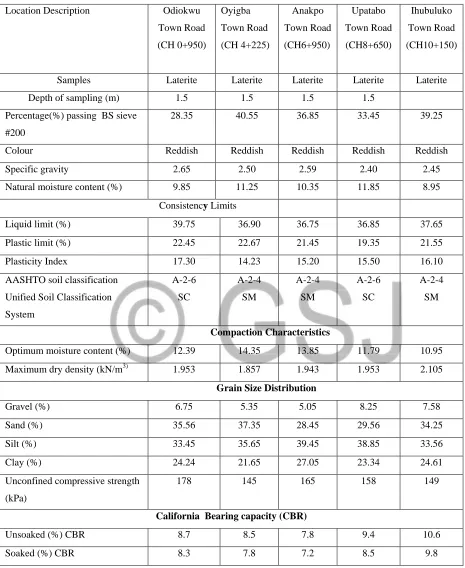
Preliminary results on lateritic soils as seen in detailed test results given in Tables: 5 showed that the physical
and engineering properties fall below the minimum requirement for such application and needs stabilization to
improve its properties. The soils classified as A-2-6 SC and A-2-4 SM on the AASHTO classification schemes
/ Unified Soil Classification System as shown in table 3.1 and are less matured in the soils vertical profile and
probably much more sensitive to all forms of manipulation that other deltaic lateritic soils are known for (Ola
[9]; Allam and Sridharan [10]; Omotosho and Akinmusuru [11]; Omotosho [12]). The soils are reddish brown
and dark grey in colour (from wet to dry states) plasticity index of 17.30%, 14.23%, 15.20%, 15.50%, and
16.10% respectively for Odiokwu, Oyigba, Anakpo, Upatabo, Ihubuluko Town Roads. The soil has unsoaked
CBR values of 8.7%,8.5%, 7.8%, 9.4%, and 10.6% and soaked CBR values of 8.3%, 7.8%, 7.2%, 8.5% and
9.8 %, unconfined compressive strength (UCS) values of 178kPa, 145kPa, 165kPa , 158kPa and 149kPa when
compacted with British Standard light (BSL), respectively.
3.1 Compaction Test Results
The results of lateritic soils of Odiokwu, Oyigba, Anakpo, Upatabo, Ihubuluko Town Roads at 100% of
maximum dry density (MDD) at preliminary test were 1.954KN/m3,1.857KN/m
3
,1.943KN/m
3
,1.758KN/m
and 2.105KN/m3 with costaceae lacerus bagasse fibre (CLBF) at 0.25%, 0.50%, 0.75%, and 1.0% inclusion
decreased to 1.725KN/m3, 1.685KN/m3,1.811KN/m3,1.525KN/m3 and 1.845KN/m3respectively. Optimum
moisture content of lateritic soils were 12.39%, 14.35%, 13.85%, 11.79 and 10.95% at 100% soils (ie no
additives), increased to 14.85%, 16.55%, 18.45%, 15.98% and 14.85% correspondingly.
3.2 California Bearing Ratio (CBR) Test
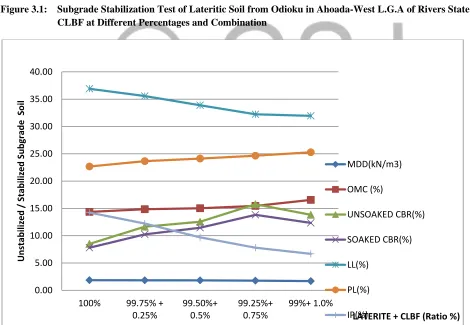
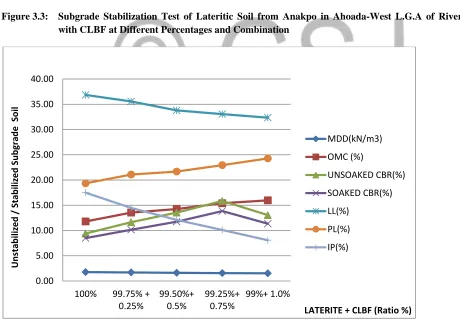
Table 3.5 and figures 3.1 – 3.4 enumerated the results of lateritic soils at 100% and of fibre bagasse inclusion
as 8.7%,8.5%, 7.8%, 9.4% and 10.6% unsoaked and 8.3%, 7.8%, 7.2%, 8.5% and 9.8 %, unsoaked and with
fibre inclusion of 0.25%, 0.50%, 0.75% and 1.0% increased to 16.25%. 15.75%, 15.25%, 15.40% and 17.11%
(unsoaked) and 13.58%, 13.82%, 13.57%, 13.85% and 15.85% (soaked) respectively, with an optimum
values percentage inclusion at 0.75%, beyond this value, crack was formed which resulted potential failure
state.
3.3 Unconfined Compressive Strength Test
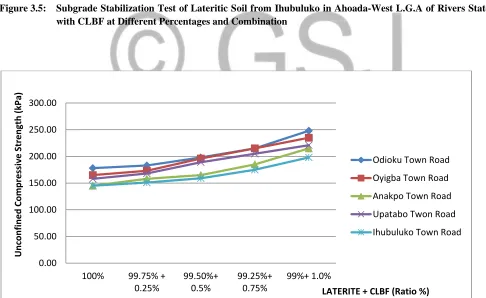
Table 3.1, 3.4 and figures 3.6 showed the Preliminary and final unconfined compressive strength results of
engineering properties of soils from Odiokwu, Oyigba, Anakpo, Upatabo, Ihubuluko Town Roads at 100% and
fibre bagasse as 178kPa, 145kPa, 165kPa , 158kPa and 149kPa are and with fibre inclusion increased to
248kPa, 215kPa, 235kPa, 221kPa and 198kPa respectively. Results showed increased in unconfined
compressive strength with increased in fibre percentages.
3.4 Consistency Limits Test
Table 3.1: Engineering Properties of Soil Samples
Location Description Odiokwu
Town Road
(CH 0+950)
Oyigba
Town Road
(CH 4+225)
Anakpo
Town Road
(CH6+950)
Upatabo
Town Road
(CH8+650)
Ihubuluko
Town Road
(CH10+150)
Samples Laterite Laterite Laterite Laterite Laterite
Depth of sampling (m) 1.5 1.5 1.5 1.5
Percentage(%) passing BS sieve
#200
28.35 40.55 36.85 33.45 39.25
Colour Reddish Reddish Reddish Reddish Reddish
Specific gravity 2.65 2.50 2.59 2.40 2.45
Natural moisture content (%) 9.85 11.25 10.35 11.85 8.95
Consistency Limits
Liquid limit (%) 39.75 36.90 36.75 36.85 37.65
Plastic limit (%) 22.45 22.67 21.45 19.35 21.55
Plasticity Index 17.30 14.23 15.20 15.50 16.10
AASHTO soil classification
Unified Soil Classification
System
A-2-6
SC
A-2-4
SM
A-2-4
SM
A-2-6
SC
A-2-4
SM
Compaction Characteristics
Optimum moisture content (%) 12.39 14.35 13.85 11.79 10.95
Maximum dry density (kN/m3) 1.953 1.857 1.943 1.953 2.105
Grain Size Distribution
Gravel (%) 6.75 5.35 5.05 8.25 7.58
Sand (%) 35.56 37.35 28.45 29.56 34.25
Silt (%) 33.45 35.65 39.45 38.85 33.56
Clay (%) 24.24 21.65 27.05 23.34 24.61
Unconfined compressive strength
(kPa)
178 145 165 158 149
California Bearing capacity (CBR)
Unsoaked (%) CBR 8.7 8.5 7.8 9.4 10.6
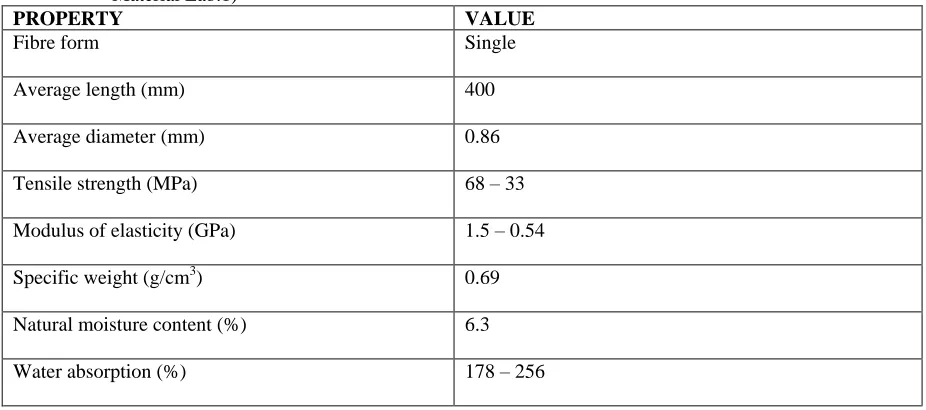
Table 3.2: Properties of Coataceae Lacerus bagasse fibre. (University of Uyo, Chemical Engineering Department, Material Lab.1)
PROPERTY VALUE
Fibre form Single
Average length (mm) 400
Average diameter (mm) 0.86
Tensile strength (MPa) 68 – 33
Modulus of elasticity (GPa) 1.5 – 0.54
Specific weight (g/cm3) 0.69
Natural moisture content (%) 6.3
Water absorption (%) 178 – 256
Source, 2018
Table 3.3: Composition of Bagasse. (University of Uyo, Chemical Engineering Department, Material Lab.1)
ITEM %
Moisture 49.0
Soluble Solids 2.3
Fiber 48.7
Cellulose 41.8
Hemicelluloses 28
Lignin 21.8
Table 3.4: Results of Subgrade Soil (laterite) Test Stabilization with Fibre Bagasse Products at Different Percentages
SAMPLE LOCATION
RATIO SOIL + FIBRE M D D (kN/m 3) OM C ( % ) UCS (KP a) LL(% ) PL(% ) PI (% ) SI E VE # 200 AASHT O / US CS (Cla ssific at io n) NO T ES
LATERITE + COSTACEAE LACERUS BAGASSE FIBRE (CLBF)
Odiokwu
Town Road
(CH (0+950)
100% 1.954 12.39 8.70 8.30 178 39.75 22.45 17.30 28.35 A-2-6/SC POOR
99.75% + 0.25% 1.938 12.87 10.48 10.25 183 37.45 23.05 14.40 28.35 A-2-6/SC GOOD 99.50%+ 0.5% 1.925 13.05 13.45 11.82 198 37.15 23.55 13.60 28.35 A-2-6/SC GOOD 99.25%+ 0.75% 1.886 13.50 16.25 13.58 215 36.85 23.95 12.90 28.35 A-2-6/SC GOOD 99%+ 1.0% 1.725 14.85 14.35 12.55 248 36.75 24.55 12.20 28.35 A-2-6/SC GOOD
Oyigba
Town Road
(CH 4+225)
100% 1.857 14.35 8.50 7.80 145 36.90 22.67 14.23 40.55 A-2-4/SM POOR
99.75% + 0.25% 1.834 14.85 11.65 10.25 158 35.57 23.65 12.22 40.55 A-2-4/SM GOOD 99.50%+ 0.5% 1.815 15.03 12.55 11.45 165 33.88 24.12 9.7 40.55 A-2-4/SM GOOD 99.25%+ 0.75% 1.768 15.45 15.75 13.82 185 32.23 24.65 7.80 40.55 A-2-6/SC GOOD 99%+ 1.0% 1.685 16.55 13.83 12.35 215 31.95 25.28 6.67 40.55 A-2-4/SM GOOD
Anakpo
Town Road
(CH6+950)
100% 1.943 13.85 7.80 7.20 165 36.75 21.45 15.30 36.85 A-2-4/SM POOR
99.75% + 0.25% 1.905 14.65 9.50 8.70 173 36.23 22.23 14.00 36.85 A-2-4/SM POOR 99.50%+ 0.5% 1.882 15.22 12.44 11.95 196 35.65 22.75 12.90 36.85 A-2-4/SM GOOD 99.25%+ 0.75% 1.855 17.25 15.25 13.57 215 33.95 23.71 10.24 36.85 A-2-4/SM GOOD
99%+ 1.0% 1.811 18.45 13.35 12.35 235 33.15 24.25 8.9 36.85 A-2-4/SM GOOD
Upatabo
Town Road
(CH8+650)
100% 1.758 11.79 9.40 8.50 158 36.85 19.35 17.50 33.45 A-2-6/SC POOR
99.75% + 0.25% 1.689 13.55 11.65 10.15 168 35.55 21.08 14.47 33.45 A-2-4/SM GOOD 99.50%+ 0.5% 1.621 14.25 13.55 11.75 189 33.78 21.68 12.1 33.45 A-2-4/SM GOOD 99.25%+ 0.75% 1.562 15.40 15.85 13.85 205 33.05 22.95 10.10 33.45 A-2-6/SC GOOD 99%+ 1.0% 1.525 15.98 13.05 11.35 221 32.35 24.28 8.07 33.45 A-2-4/SM GOOD
Ihubuluko
Town Road
(CH10+150)
100% 2.105 10.95 10.60 9.80 145 37.65 21.55 16.10 39.25 A-2-6/SC GOOD
Figure 3.1: Subgrade Stabilization Test of Lateritic Soil from Odioku in Ahoada-West L.G.A of Rivers State with CLBF at Different Percentages and Combination
Figure 3.2: Subgrade Stabilization Test of Lateritic Soil from Oyigba in Ahoada-West L.G.A of Rivers State with CLBF at Different Percentages and Combination
0.00 5.00 10.00 15.00 20.00 25.00 30.00 35.00 40.00 45.00
100% 99.75% +
0.25% 99.50%+ 0.5% 99.25%+ 0.75% 99%+ 1.0% Uns tabliz ed / St abiili zed Sub gra de Soil
LATERITE + CLBF (Ratio %) MDD(kN/m3) OMC (%) UNSOAKED CBR(%) SOAKED CBR(%) LL(%) PL(%) IP(%) 0.00 5.00 10.00 15.00 20.00 25.00 30.00 35.00 40.00
100% 99.75% +
0.25% 99.50%+ 0.5% 99.25%+ 0.75% 99%+ 1.0% Uns tabiliz ed / Stabiliz ed Subgra de Soil
Figure 3.3: Subgrade Stabilization Test of Lateritic Soil from Anakpo in Ahoada-West L.G.A of Rivers State with CLBF at Different Percentages and Combination
Figure 3.4: Subgrade Stabilization Test of Lateritic Soil from Upatabo in Ahoada-West L.G.A of Rivers State with CLBF at Different Percentages and Combination
0.00 5.00 10.00 15.00 20.00 25.00 30.00 35.00 40.00
100% 99.75% +
0.25% 99.50%+ 0.5% 99.25%+ 0.75% 99%+ 1.0% Uns tabiliz ed / Stabiliz ed Subgra de Soil
LATERITE + CLBF (Ratio %) MDD(kN/m3) OMC (%) UNSOAKED CBR(%) SOAKED CBR(%) LL(%) PL(%) IP(%) 0.00 5.00 10.00 15.00 20.00 25.00 30.00 35.00 40.00
100% 99.75% +
0.25% 99.50%+ 0.5% 99.25%+ 0.75% 99%+ 1.0% Uns tabiliz ed / Stabiliz ed Subgra de Soil
Figure 3.5: Subgrade Stabilization Test of Lateritic Soil from Ihubuluko in Ahoada-West L.G.A of Rivers State with CLBF at Different Percentages and Combination
Figure 3.6: Unconfined Compressive Strength (UCS) of Niger Deltaic Laterite Soils Subgrade with CLBF of ( Odioku, Oyigba, Anakpo, Upatabo and Ihubuluko Towns), Ahoad-West L.G.A, Rivers State
0.00 5.00 10.00 15.00 20.00 25.00 30.00 35.00 40.00
100% 99.75% +
0.25%
99.50%+ 0.5% 99.25%+
0.75% 99%+ 1.0% Uns tabiliz ed / Stabiliz ed Subgra de Soil MDD(kN/m3) OMC (%) UNSOAKED CBR(%) SOAKED CBR(%) LL(%) PL(%) IP(%) 0.00 50.00 100.00 150.00 200.00 250.00 300.00
100% 99.75% +
0.25% 99.50%+ 0.5% 99.25%+ 0.75% 99%+ 1.0% Unco nf ined Compress ive Strength (kPa )
LATERITE + CLBF (Ratio %) Odioku Town Road
Oyigba Town Road
Anakpo Town Road
Upatabo Twon Road
Plate i.
Costaceae Lacerus
plant Plate ii.
Costaceae Lacerus
stem
Plate vi. Bush sugarcanedry fibre bagasses Plate vii. Bush sugarcane wet bagasses/fibre at day 3
4.0 Conclusions
The following conclusions were made from the experimental research results.
i. Preliminary investigations of the engineering Properties of soils at natural state are percentage (%)
passing BS sieves #200 are 28.35%, 40.55%, 36.85%, 33.45% and 39.25% (laterite), and soils
classified as A-2-6 SC and A-2-4 SM on the AASHTO classification schemes / Unified Soil
Classification System as shown in table 3.1.
ii. Results showed the potential of using fibre bagasse (CLBF) as admixtures in lateritic soil stabilization
iii. Swelling potential of treated soil decreased with the inclusion of fibre bagasse up to 0.75% for soils
iv. The plastic index of the stabilized soil showed continuous decreased with increased in fibre
percentages
v. Compaction test results recorded a decreased values of MDD with increased while OMC increases
with increased with fibre percentages
vi. An optimum values percentage inclusion at 0.75% was recorded of CBR at both unsoaked and soaked,
beyond this value a decreased recorded which indicated maximum inclusion, crack was formed which
resulted to potential failure state
REFERENCES
[1] FMW (Federal Ministry of Works) General Specifications (Roads and Bridges), Vol II, Federal Ministry of Works and Housing, Lagos, Nigeria, 1997
[2]K. Charles, O. A. Tamunokuro, T. T. W. Terence,”Comparative Evaluation of Effectiveness of Cement/Lime and
Costus Afer Bagasse Fiber Stabilization of Expansive Soil”, Global Scientific Journal, vol. 6, no.5, pp. 97-110, 2018.
[3] J. Prabakar, and R.S. Sridhar, “Effect of Random Inclusion of Sisal Fibre on Strength Behavior of Soil. Construction and Building Materials, no. 16, pp. 123–131, 2002.
[4] R.S. Sharma, B. R. Phanikumar, and B.V Rao, “Engineering Behaviour of a Remolded Expansive Clay Blended with Lime, Calcium Chloride and Rice-Husk Ash”, Journal of Materials in Civil Engineering, vol.20, no.8, pp. 509-515, 2008
[5] M. Bouhicha, F. Aouissi, and S. Kenai,” Performance of Composite Soil Reinforced with Barley Straw”, Cement and Concrete Composites vol.27, no.5, pp. 617–621, 2005.
[6]A. K. Sabat, “Effect of Polypropylene Fiber on Engineering Properties of Rice Husk Ash – Lime Stabilized Expansive Soil”, Electronic Journal of Geotechnical Engineering, no. 17(E), pp. 651-660, 2012.
[7] A. Mesbah, J. C. Morel, P. Walker, K. H. Ghavami, “Development of a Direct Tensile test for compacted earth blocks Reinforced with Natural Fibers”, Journal ofmaterials in Civil Engineering ,vol.16, no. 1, pp. 95–98, 2004
[8]A.N. Ramakrishna, and A.V. Pradeepkumar, “Stabilization of Black Cotton Soil using Rice Husk Ash and Cement, Proc. of National Conference”, Civil Engineering Meeting the Challenges of Tomorrow, pp. 215-220, 2006.
[9]S. A. Ola, “Need for Estimated Cement Requirements for Stabilizing Lateritic Soils”, Journal of Transportation
Engineering, ASCE, vo.100, no. 2, 379–388, 1974.
[10]M. M. Allam, and A. Sridharan, “Effect of Repeated Wetting and Drying on Shear Strength”, Journal of
Geotechnical Engineering, ASCE, vol.107, no.4, pp. 421–438, 1981.
[11] P. O. Omotosho, “Multi-Cyclic Influence on Standard Laboratory Compaction of Residual Soils”, Engineering
Geology, no .36, pp.109–115, 1993.
[12]P .O. Omotosho, and J .O. Akinmusuru, “Behaviour of Soils (Lateritic) Subjected Multi -Cyclic Compaction”, Engineering Geology, no.32, pp. 53–58, 1992