Research Article
Impact of gamma radiations on wheat
(Triticum aestivum L.) varieties (Batoor
and Janbaz)
Sajjad Ahmed
1, Wisal Muhammad Khan
1*, Muhammad Saleem Khan
1,
Naveed Akhtar
1, Nosheen Umar
2, Sajjad Ali
3, Saddam Hussain
1and
Syed Sadaqat Shah
11. Department of Botany, Islamia College Peshawar-Pakistan 2. Department of Botany, University of Peshawar-Pakistan
3. Department of Botany, Bacha Khan University, Charsadda-Pakistan
*Corresponding author’s email: [email protected]
Citation
Sajjad Ahmed, Wisal Muhammad Khan, Muhammad Saleem Khan, Naveed Akhtar, Nosheen Umar, Sajjad Ali, Saddam Hussain and Syed Sadaqat Shah. Impact of gamma radiations on wheat (Triticum aestivum L.) varieties (Batoor and Janbaz). Pure and Applied Biology. Vol. 6, Issue 1, pp218-225.
http://dx.doi.org/10.19045/bspab.2017.60017
Received: 04/11/2016 Revised: 25/01/2017 Accepted: 06/02/2017 Online First: 11/02/2017
Abstract
The present investigation was carried out to evaluate the effect of different doses of gamma rays (15, 25, 35 and 45 Krad) on various morphological and biochemical parameters of two wheat varieties (Batoor and Janbaz). A comparison of the results of different doses with control showed that gamma irradiations significantly affected various parameters. Days to germination were non-significantly delayed in Batoor while significantly decreased at 45 Krad in Janbaz. Germination percentage decreased significantly at 15 Krad in both varieties. Days to spike initiation significantly decreased at 45 Krad in Batoor but increased significantly at 45 Krad in Janbaz variety. Days to spike maturation were increased significantly at 45 Krad in both varieties. Plant height increased significantly at 15 Krad but decreased expressively at 25 Krad and 35 Krad in Batoor. In Janbaz plant height increased significantly at 45 Krad but decreased at 35 Krad. Number of nodes/plant decreased significantly at various doses in Batoor. While in Janbaz number of nodes/plant increased significantly at 15 Krad. Gamma radiation significantly increased number of fertile tillers/plant at 15 Krad in Batoor and at 45 Krad in Janbaz. Number of spikes/plant increased significantly at 15 Krad in Batoor and at 45 Krad in Janbaz. Number of spikelets/spike increased at 15 Krad in Batoor while a decreasing trend was seen in Janbaz with increasing doses. Spike length was non-significantly affected by gamma radiation in Batoor variety. However spike length was non-significantly increased at 45 Krad in Janbaz. Number of grains/spike increased significantly at 15 Krad in Batoor but decreased significantly at higher doses in both varieties. 1000 grain weight significantly increased at 45 Krad in Batoor and at 15 Krad and 25 Krad in Janbaz. Biochemical analysis revealed that gamma irradiation decreased the ash contents significantly at all the doses in both varieties. Moisture contents decreased significantly in Batoor through gamma irradiation except at 45 Krad which showed non-significant effect. However, in Janbaz moisture contents increased non-significantly at 25 Krad. Proteins contents were non-significantly decreased in Batoor, while in Janbaz, proteins contents decreased significantly at 35 Krad.
Introduction
Triticum aestivum is a cultivated wheat species, also known as common wheat or bread wheat and is a member of family Poaceae. Wheat is the major source of food in Pakistan. Pakistan ranks 6th in terms of wheat production, 8th in terms of area but 59th in terms of yield. It adds 12.5% to the value added in agriculture and 2.9% to GDP [1]. Wheat is nutritious food which provides proteins, minerals, B-group vitamins and dietary fibers more in quantity than other cereal crop and help in preparation of different types of foods. In general, 70% carbohydrates, 12% water, 2% fat, 12% protein, 1.8% minerals and 2.2% crude fiber are found in the wheat grain kernel. The history of wheat (Triticum aestivum L.) improvement by acclimatization, selection and hybridization dates back to the remote past. Nowadays, mutation induction has become an established tool in plant breeding to supplement existing germplasm and to improve cultivars in definite traits [2]. Plants created using mutagenesis are known as mutagenic plants or mutagenic seeds. Mutation breeding has made an official release of over 2700 newly developed crop cultivars in about 170 species [3]. Most of the mutant varieties (64%) are developed using physical mutagens such as Gamma rays [4]. [5] obtained three high grain yielding and early maturing mutants by treating seeds of Brassica juncea L.cv.S-9 with the combine effect of gamma rays and chemical mutagen i.e., Ethyl methane sulphonate (EMS). [6] developed a new oil seed Brassica napus L.cv ABASIN-95 by induced mutation using gamma rays. [7] Studied the effect of higher doses (30 and 35 Krad) of gamma irradiation on different wheat varieties which created some abnormalities in plant for example, a tiller having two ears attached with each and/or prevalence of sterile ears etc.
Materials and methods
The M2 seeds of two wheat varieties i.e. Batoor and Janbaz were selected for the research project. These seeds were obtained from M1 plants in 2013-14. Gamma irradiation used was generated from the Cobalt-60 source, at Nuclear Institute for Food and Agriculture (NIFA) Peshawar, Pakistan. Wheat seeds (M0) were irradiated with 15, 25, 35 and 45 Krad while non-irradiated seeds of each variety were kept as control. An experiment was executed in 2013-2014; M0 plants resulted in M1 seeds which were subjected to experiment in the present study. This study aimed to evaluate the effect of gamma rays in M2 generation. Field experiment
A field experiment was carried out in botanical garden, Department of Botany, Islamia College Peshawar, during 2014-2015. M2 Seeds of each dose were sown on 24 November 2014 in pots; all pots were equally spaced with equal soil contents in each pot. The experimental design was completely random with each dose having 5 replicates. Equal numbers of seeds were sown in all pots.
Parameters
The parameters i.e., days to germination, germination percentage, days to spike initiation, days to spike maturation, plant height, number of nodes per plant, number of fertile tillers per plant, number of spikes per plant, number of spikelets per spike, spike length, grains per spike, 1000 grain weight, ash percentage, moisture percentage and proteins percentage were studied during this experiment.
Statistical analysis
Proximate analysis
Proximate analysis of seeds was carried out at Nuclear Institute for Food and Agriculture (NIFA), Peshawar, Pakistan.
Results and discussion
Gamma irradiation, being known for its mutagenic effect also showed pronounced effect on M2 generation of wheat varieties. Both varieties responded to gamma rays in M2 generation. However, the response was non-conventional; following results explore the findings of present investigation.
Days to germination
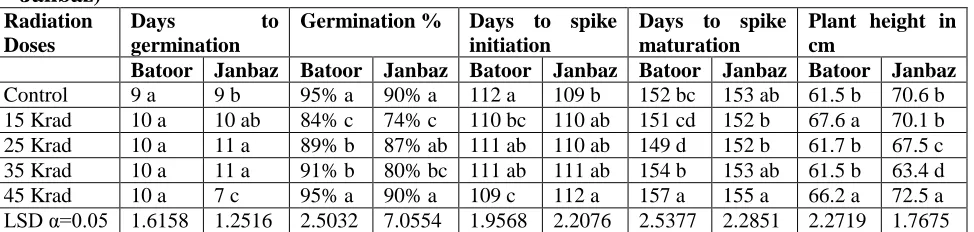
It is noticeable from Table 1 that days to germination were non-significantly affected by gamma irradiation in Batoor while in Janbaz, days to germination increased from control (9 days) at 25 and 35 Krad (11 days in both) and decreased significantly at 45 Krad (7 days). An early germination was obtained in Janbaz at 45 Krad as compared to control. Similar results were observed by [8], [9] in Zea mays L. and [7] in Triticum aestivum L.
Germination percentage
Table 1 show that the lowest germination percentage was recorded at 15 Krad in Batoor and Janbaz (84% and 74%) as compared to control (90% in both). Germination percentage was non-significantly affected at 45 Krad in both varieties as compared to control [10] as well observed decrease in germination percentage at radiation doses. [11] find that germination percentage decrease at higher irradiation doses. These results also confirm the finding of [12]. Similarly, [13, 14] obtained low germination percentage at irradiation doses. Plant height (cm)
Table 1 show that in M2 generation of Batoor verity, the highest height was
obtained at 15 Krad (67.6 cm) followed by 45 Krad (66.2 cm) as compared to control (61.5 cm). [15] observed the same trend. These results are in agreement with the finding of [16]. In Janbaz, plant height decreased with higher doses of irradiation i.e., 15 Krad (70.1 cm), 25 Krad (67.5 cm), and 35 Krad (63.4 cm). The highest height was obtained at 45 Krad (72.5 cm) as compared to control (70.6 cm). [14, 17] have already shown that irradiation doses decrease plant height.
Days to spike initiation
Table 1 shows that in Batoor, an early initiation at 45 Krad (109 days) was observed as compared to control (112 days). [17] likewise observed an early heading in wheat mutants. Janbaz showed a slight delay in days taken to initiation of spike with increasing radiation i.e., at 35 Krad (111 days), and 45 Krad (112 days) as compared to control (109 days). [7] observed the same trend. [18] observed that increasing irradiation doses delay initiation. These results also confirm the finding of [3]. Days to spike maturation
Table 1. Effect of gamma irradiation on different parameters of wheat verities (Batoor and Janbaz)
Radiation Doses
Days to
germination
Germination % Days to spike
initiation
Days to spike maturation
Plant height in cm
Batoor Janbaz Batoor Janbaz Batoor Janbaz Batoor Janbaz Batoor Janbaz Control 9 a 9 b 95% a 90% a 112 a 109 b 152 bc 153 ab 61.5 b 70.6 b 15 Krad 10 a 10 ab 84% c 74% c 110 bc 110 ab 151 cd 152 b 67.6 a 70.1 b 25 Krad 10 a 11 a 89% b 87% ab 111 ab 110 ab 149 d 152 b 61.7 b 67.5 c 35 Krad 10 a 11 a 91% b 80% bc 111 ab 111 ab 154 b 153 ab 61.5 b 63.4 d 45 Krad 10 a 7 c 95% a 90% a 109 c 112 a 157 a 155 a 66.2 a 72.5 a LSD α=0.05 1.6158 1.2516 2.5032 7.0554 1.9568 2.2076 2.5377 2.2851 2.2719 1.7675
Data are represented as Mean (n = 05). Means followed by different letter within the column are significantly different (P < 0.05). (ANOVA followed by Tukey LSD test)
Number of nodes/plant
Data in Table 2 show that in Batoor, the number of nodes/plant decreased significantly with maximum decrease at 45 Krad (5.9 nodes/plant) as compared to control (6.46 nodes/plant). [21] also observed a decreasing tendency in the number of nodes/plant with increasing radiation doses. In Janbaz, the number of nodes/plant improved significantly at 15 Krad (5.93 nodes/plant) as compared to control (4.43 nodes/plant). The number of nodes/plant decreased at higher doses i.e., 35 Krad (4.01 nodes/plant) and 45 Krad (4 nodes/plant) in Janbaz.
Number of fertile tillers/plant
Table 2 shows that in Batoor, the highest number of tillers/plant was obtained at 15 Krad (4.18 tillers/plant) as compared to control (3.08 tillers/plant). Lowest number of tillers was recorded at 45 Krad (3.05 tiller/plant). In Janbaz, the highest number of tillers was obtained at 45 Krad (8 tillers/plant) as compared to control (3.18 tillers/plant). [14] observed the stimulatory effect of all the doses of gamma rays on the number of fertile tillers/plant. Similar results were observed by [15].
Number of spikes/plant
Data in Table 2 shows that in Batoor, the trait was improved at 15 Krad (4.14 spikes/plant) but inhibited significantly at 45 Krad (3.05 spikes/plant) as compared to
observed an improvement in the number of spikes/plant at 15 Krad. In Janbaz, the efficient dose was 45 Krad (8 spikes/plant) as compared to control (3.18 spikes/plant). [13] obtained mutants that produce higher number of spikes/plant through irradiation doses. [19] already concluded that gamma irradiation up to 30 Krad has little or no Inhibitory effect on number of spikes/plant. [22] also observed variation in number of spikes/plant at different radiation doses. Number of spikelets/spike
Table 2 indicate that in Batoor, radiation doses increased number of spikelets/spike with maximum at 15 Krad (55.12 spikelets/spike) as compared to control (47.38 spikelets/spike). However in Janbaz, number of spikelets/spike decreased significantly at 15 Krad (55.55 spikelets/spike) as compared to control (63.02 spikelets/spike). Number of spikelets/spike decreased at all doses in Janbaz. Janbaz variety shows co-linearity with the studies of various workers including [15, 19, 23] and in which they observed significant decrease of spikelet number in nearly all the radiation doses. Denotation: B = Batoor J = Janbaz Spike length (cm)
significance at 45 Krad (10.60 cm) in comparison with control (8.69 cm). [20] also observed variation in this trait at different doses. These results are in agreement with the findings of [22]. [19] also observed
variation in spike length at different doses. However, [23] observed that gamma rays decreased the average spike length with respect to the control.
Table 2. Effect of gamma irradiation on different parameters of wheat verities (Batoor and Janbaz)
Radiation Doses
Number of nodes/plant
Number of fertile tillers/plant
Number of spikelets/spike
Spike length in cm
Batoor Janbaz Batoor Janbaz Batoor Janbaz Batoor Janbaz
Control 6.46 a 4.43 c 3.08 c 3.18 b 17.70 cd 21.15 a 9.13 a 8.69 c 15 Krad 6.15 ab 5.93 a 4.18 a 3.29 b 21.33 a 19.18 b 9.18 a 9.69 b 25 Krad 5.95 b 5.06 b 3.21 c 3.10 b 19.80 b 15.25 c 8.52 a 9.03 c 35 Krad 6.21 ab 4.0 c 3.54 b 3.47 b 18.45 c 16.02 c 8.58 a 9.00 c 45 Krad 5.9 b 4 c 3.05 c 8 a 17.30 d 14.10 d 9.53 a 10.60 a LSD α=0.05 0.5086 0.6009 0.2388 0.5325 0.8797 0.9598 0.9585 0.3681 Data are represented as Mean (n = 05). Means followed by different letter within the column are significantly different (P < 0.05). (ANOVA followed by Tukey LSD test)
Number of grains/spike
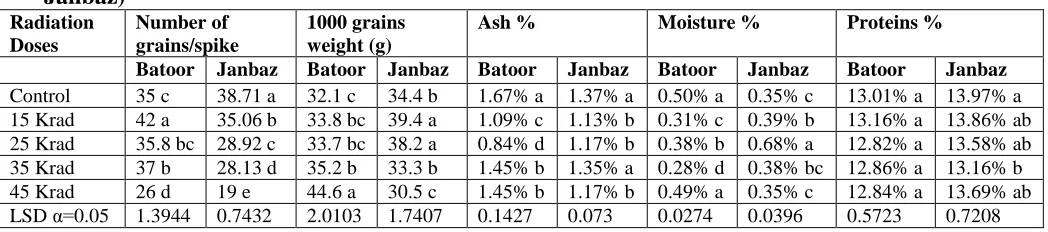
Table 3 shows that in Batoor as compared to control (35 grains/spike) the number of grains increased significantly at 15 Krad (42 grains/spike) but decreased significantly in 45 Krad (26 grains/spike). While in Janbaz number of grains decreased at highest dose of 45 Krad (19 grains/spike) as compared to control (38.71 grains/spike). Higher irradiation doses decreased grain yield/spike in both varieties. The present findings are in agreement with the studies of [15, 19, 23] and who observed a regular decrease in this trait with the increasing intensity of gamma radiations.
Ash contents (%)
As shown in Table 3 irradiation doses significantly decreased ash contents (%) in Batoor; maximum mean value was for control (1.67%). Similarly in Janbaz, ash contents (%) decreased at 15 Krad (1.13%), 25 Krad (1.17%), 35 Krad (1.35%), and 45 Krad (1.17%) as compared to control (1.37%). [24] observed a decrease in ash contents (%) due to irradiation doses in
Pigeon pea. [25] reported a decrease in ash content (%) of velvet bean seed
Moisture contents (%)
In Batoor, as shown in Table 3, highest mean value for moisture contents (%) was obtained in control (0.50%) while a significant decrease was observed at 35 Krad (0.28%). [26] also observed a decrease in moisture contents (%) with higher doses. In Janbaz a significant increase in moisture contents was obtained at 25 Krad (0.68%) as compared to control (0.35%). [24] observed the same trend.
Proteins contents (%)
Table 3. Effect of gamma irradiation on different parameters of wheat verities (Batoor and Janbaz)
Radiation Doses
Number of grains/spike
1000 grains weight (g)
Ash % Moisture % Proteins %
Batoor Janbaz Batoor Janbaz Batoor Janbaz Batoor Janbaz Batoor Janbaz
Control 35 c 38.71 a 32.1 c 34.4 b 1.67% a 1.37% a 0.50% a 0.35% c 13.01% a 13.97% a
15 Krad 42 a 35.06 b 33.8 bc 39.4 a 1.09% c 1.13% b 0.31% c 0.39% b 13.16% a 13.86% ab
25 Krad 35.8 bc 28.92 c 33.7 bc 38.2 a 0.84% d 1.17% b 0.38% b 0.68% a 12.82% a 13.58% ab
35 Krad 37 b 28.13 d 35.2 b 33.3 b 1.45% b 1.35% a 0.28% d 0.38% bc 12.86% a 13.16% b
45 Krad 26 d 19 e 44.6 a 30.5 c 1.45% b 1.17% b 0.49% a 0.35% c 12.84% a 13.69% ab
LSD α=0.05 1.3944 0.7432 2.0103 1.7407 0.1427 0.073 0.0274 0.0396 0.5723 0.7208
Data are represented as Mean (n = 05). Means followed by different letter within the column are significantly different (P < 0.05). (ANOVA followed by Tukey LSD test)
Conclusion
The present study concludes that gamma irradiation significantly affected various morphological parameters while biochemical attributes were non-significantly affected in M2 generation. The most significant dose was 15 Krad as it improved various morphological and biochemical parameters while the most inhabitant dose was 45 Krad due to its negative effect on various parameters in both verities. It is concluded that lower doses can be used for agricultural purposes to improve yield attributes of wheat.
Authors’ contributions
Conceived and designed the experiment: WM Khan, Performed the experiment: S Ahmed, S Hussain & SS Shah, Analyzed the data: WM Khan, N Umar & S Ali, Contributed reagents/ materials/ analysis tools: MS Khan & N Akhtar, Wrote the paper: S Ahmed & WM Khan.
References
1. Muhammad A, Rehman M & Zafar Y (2005). DNA finger printing studies of some wheat (Triticum aestivum L.) genotypes using Random Amplified Polymorphic DNA (RAPD) analysis. Pakistan Journal of Botany 37(2): 271-277.
2. Ashraf M, Cheema AA, Rashid M & Qamar Z (2003). Effect of gamma rays on M1 generation in Basmati rice.
Pakistan Journal of Botany 35(5): 791-795.
3. Emrani A, Razavi A & Rahimi MF (2012). Assessment of gamma ray irradiation effects on germination and some morphological characters in two corn cultivars. International Journal of Agriculture and Crop Sciences 5: 1235-1244.
4. Ghirija M & Dhanavel D (2009). Mutagenic effectiveness and efficiency of gamma rays, ethyl methane sulphonate and their combined treatments in cowpea (Vigna unguiculata L. Walp). International Journal of Molecular Sciences 4: 68–75.
5. Khatri A, Khan IA, Siddiqui MA, Raza R & Nizamani GS (2005). Evaluation of high yielding mutants of Brassica jancea cv. s-9 developed through gamma rays and EMS. Pakistan Journal of Botany 37(2): 279-284.
6. Shah TM, Ali I & Rahman K (2001). Abasin-95 a new oil seed rape cultivar developed through induced mutations. Mutation Breeding Newsletter 45: 3-4. 7. Din R, Khan MM, Qasim M, Jehan S &
8. Ilyas S & Naz S (2014). Effect of gamma irradiation on morphological characteristics and isolation of Curcuminoids and Oleoresins of Curcuma longa L. Journal of Animal and Plant Sciences 24(5): 1396-1404.
9. Ahmad S & Qureshi S (1992). Comparative study of two cultivars of Zea mays L. after seed irradiation. Sarhad Journal of Agriculture 8: 441-447.
10. Aynehband A & Afsharinafar K (2012). Effect of gamma irradiation on germination characters of Amaranth seeds. European Journal of Experimental Biology 2(4): 995-999. 11. Songsri P, Suriharn B, Sanitchon J,
Srisawangwong S & Kesmala T (2011). Effect of gamma radiation on germination and growth characterstics of physic nut (Jatropha curcas L.). International Journal of Biological Sciences 11(3): 268- 274.
12. Marcu D, Grigore D, Cosma C & Cristea V (2013). Gamma radiation effects on seed germination, growth and pigment content, and ESR study of induced free radicals in maize (Zea mays). Journal of Biological Physics 39(4): 625–634.
13. Singh NK & Balyan HS (2009). Induced mutations in bread wheat (Triticum aetivum L.) CV. ‘Kharchia 65’ for reduced plant height and improved grain quality traits. Advance Biology Research 3(5-6): 215-221 14. Irfaq M & Nawab K (2001). Effects of
gamma irradiation on some morphological characteristics of three wheat cultivars. International Journal of Biological Sciences 1(10): 935-937. 15. Khah M & Verma ARC (2000).
Assessment of the effects of gamma radiations on various morphological and agronomic traits of common wheat (Triticum aestivum L.) var. WH-147.
European Journal of Experimental Biology 5(7): 6-11.
16. Naik SI & Nadaf HL (1997b). Induced variability for quantitative characters in groundnut (Arachis hypogaea L.). Journal of Crop Improvement 24(2): 226-230.
17. Laghary KA, Sial MA & Afzal MA (2012). Effect of high temperature stress on grain yield and yield components of wheat (Triticum aestivum L.) Science Technology and Development 31(2): 83-90.
18. Khan AS & Malik MA (1999). Effect of gamma irradiation on morphological characters of three wheat varieties. Pakistan Journal of Biological Sciences 2(3): 903-905.
19. Khan M, Din MR, Qasim M, Jehan S & Iqbal MM (2003). Induced mutability studies for yield and yield related characters in three wheat (Triticum aestivum L.) varieties. Asian J Plant Sci 2(17-24): 1183-1187.
20. Animasaun DA, Morakinyo JA & Mustapha OT (2014). Assessment of the effects of gamma irradiation on the growth and yield of Digitaria exilis (Haller). Journal of Applied Biosciences 75: 6164-6172.
21. Mohamed WM & El-Shimi I (2014). The effect of gamma rays on the pharmaceutical products of essential oils for peppermint (Mentha piperita L.). International Journal of Farming and Allied Sciences 3(8): 884-894. 22. Albokari M (2014). Induction of
mutants in durum wheat (Triticum durum desf cv. samra) using gamma irradiation. Pakistan Journal of Botany 46(1): 317-324.
aestivum L.). Asian Journal of Plant Sciences 2(13): 999-1003.
24. Bamidele OP & Akanbi C (2013). Effect of gamma irradiation on physicochemical properties of stored pigeon pea (Cajanus cajan) flour. Food Science Nutrition 1(5): 377–383.
25. Bhat R, Sridhar KR, Alias AK, Young CC & Arun BA (2009). Influence of gamma radiation on the nutritional and functional qualities of lotus seed flour. Journal of Agricultural and Food Chemistry 57: 9524–9531.
26. Rao VS, Shrirangarajan AN, Kamat AS, Adhikari HR & Nair PM (1994). Studies on extension of shelf-life of rawa by gamma irradiation. Journal of Food Science and Technology 3(1): 311-315.