© 2017 IJSRSET | Volume 3 | Issue 2 | Print ISSN: 2395-1990 | Online ISSN : 2394-4099 Themed Section: Engineering and Technology
Image Searching Algorithm Based On 3D Histogram
Garima Verma
1, Pooja Gupta
1,Usha Gautam
1.1,Eram Fatima
21
Students, Computer Science and Engineering ,S.I.T.M., Bbk ,Uttar Pradesh, India
1.1
Student, Imformation Technology ,S.I.T.M., Bbk , Uttar Pradesh, India
2
Assistant Professor, Computer Science and Engineering,S.I.T.M.,Bbk, Uttar Pradesh, India
ABSTRACT
In the present scenario, There is a great need of using an efficient method for the retrieval of images from the large databases as today people are using the digital images on a very large scale. Content Based Image Retrieval is one of the very important and famous approach which helps in finding the images from huge databases. Hence, the CBIR technique provides an effective approach to find the better outputs on the basis of some components of image like shape, color and texture[1].
Keywords: Retrieval,3D Histogram, Euclidean Distance, Precision, Recall
I.
INTRODUCTION
Digital images have several applications like face recognition system, biometrics, computer vision etc. The major aim of CBIR is to find the images and then to retrieve the images from the large databases. In past few years, the images were retrieved by the query formats called as text based systems. Since the passing of multimedia data has been expanded widely, therefore, CBIR is one of the very important and advanced topic which should be discussed in present scenario. The semantic gap should be reduced so that the retrieval of images can become easy . For obtaining the efficient outputs, CBIR approach should be used in effective manner and the algorithm should be precisely implemented.
1.1 Content Based Image Retrieval
Content Based Image Retrieval was initially started in 1990’s with the aim of searching and retrieving the images from the large set of databases. This technique focuses on the real contents of any image. The word content involves color, textures and shapes. Content Based image retrieval is an interesting research field that is ever incrementing for the systematic and effective retrieval of images. Over the past few years, the research has tremendously increased in several
fields like in medical sciences, remote sensing, multimedia etc. The main objective of CBIR is to avoid the usage of text based retrieval. Computer vision is also an important application of this technique.
1.2 Objective of Research
In this research work, we aim to reduce the time to retrieve an image and then to obtain the high precision value. This is done using the 3D Histogram which helps in finding the image in less time and also reduce the semantic gap.
1.3 Applications of CBIR
CBIR technique is widely used in many applications like in investigations, shapes identification, medical diagnosis, face recognition system, remote sensing etc.
1.4 Dataset Used
II.
METHODS AND MATERIAL
2. Digital Image Fundamentals
A. Image
It consists of a rectangular grid made of pixels which has a definite height and width. Each pixel consist of a color which is a 32-bit integer.
B. Digital Image
It is a binary representation of a 2D image with a finite set of values called pixels. These are like the electronic snapshots of a scene like photograph, texts etc.
C. Image Domain Processing
These are basically of two kinds, Spatial domain methods and Frequency domain methods. Fourier Transform is also used to represent any image in this processing.
D. Query
Various types of query systems are being used in different type of research work of CBIR. In this proposed system, we used query by image technique.
3. Feature Extraction
The main features or properties of an image which are being extracted are color, shape and texture. In the CBIR systems, feature is denoted as a property of an image.
A. Color
This is one of the most important feature of the CBIR for the recognition of any image by the human. Colors are mainly defined in three dimensional color spaces. They may be RGB(Red, Green and Blue) and HSV (Hue, Saturation and Value).
B. RGB
Different ways are there to specify several colors. RGB is one of the most comman method of one of them[5]. This model gives intensity level of red, green and blue colour which mix together to form a pixel. The intensity of each colour varies from 0 to 255 that gives 16,777,216 colours.
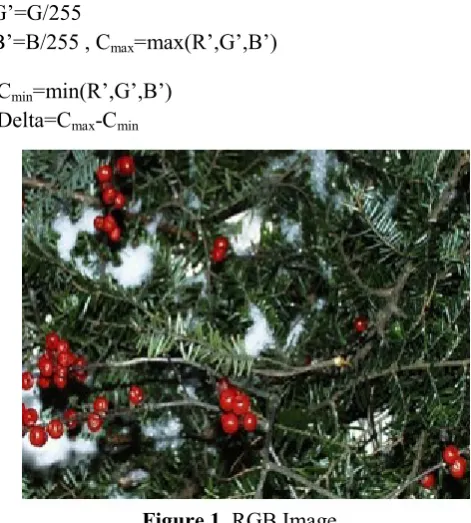
RGB to HSV Calculation R’=R/255
G’=G/255
B’=B/255 , Cmax=max(R’,G’,B’)
Cmin=min(R’,G’,B’)
Delta=Cmax-Cmin
Figure 1. RGB Image
2. HSV
The color space is given by HSV which has three parts- Hue, Saturation and Value. For any picture, it provides different color[4]. The range of angle of hue lies from 0 to 360 of saturation.
4. Histogram
It is method of representing the information about the images in the CBIR which is done through color histogram. In the color histogram[3], the set of data of images is being arranged and represented in a predefined manner. Color histogram is a type of bar graph in which every bar denotes the color space.
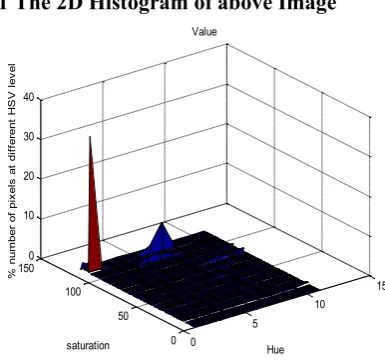
The 2D histogram refers to the pixels in y image processing system. The 2D histogram represents the individual graphs or histograms for the red, blue and green colors individually called as 2D histogram. In the 3D Histogram, there are three axis that denotes the red, blue and green channels. The exact output in this method is dependent on the implementation that may be a simple picture or any data file.
A. Histogram
In the given research work, we will use the 3D histogram for the purpose of feature extraction which has not been used previously. A 3D Histogram basically counts the number occurrences of data of the images from two columns in a grid. The grid is defined by two variables that denotes the data of two columns.
Figure
3
.4.1 A 3D Histogram of an Image
Figure 5. HSV Image
5. Comparison between 2D and 3D Histogram
The comparison between both the histograms is given below:-
5.1 The 2D Histogram of above Image
Figure 6. HSV Image
The 3D Histogram of above Image
6. Similarity Matching
The similarity between any two images can be done using the distance measure like Euclidian distance, histogram intersection.
6.1 Euclidian Distance
Euclidian distance can be defined as a straight line distance between any two points in the Euclidian space which afterwards becomes a metric space. It is very difficult to determine the distance between two images.
0 5000 10000
0 100 200 0 5000 10000
0 100 200 0 5000 10000
0 100 200
0 5000 10000
0 0.5 1
0 5000 10000
0 0.5 1
0 5000 10000
0 0.5 1
It is hard to combine the metric with some effective recognition techniques like SVM, LDA etc.
6.2 Retrieval
After the Euclidian distance of images has been calculated then the distance of the image is sorted in the descending order. After the sorting is done, sequence of images with the minimum distance is given to the user. For the effective result, precision rate is calculated.
7. Implementation
In this research, the concept of 3D histogram is used for the feature extraction from the images. The 3D histogram is being used as it gives better results than the 2D histogram.
The following steps involved in this research
STEP 1. Image database collection of different contents and subject.
STEP 2. Generation of 3D histogram of images.
STEP 3. Develop a code to find similarity between two images based on 3D histogram of HSV image formats.
STEP 4. Develop a code for sorting and addressing of similar images.
STEP 5. Result Generation.
STEP 6. Result Analysis on the basis of percentage.
8. Simulation Tool- MATLAB:
The name MATLAB stands for Matrix Laboratory which is an interactive program for numerical computation. It is multi a paradigm numerical computing programming languages.
III.
RESULT AND DISCUSSION
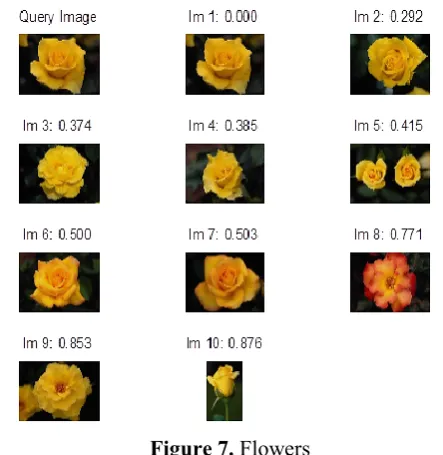
In this paper, firstly we collected all types of images and different subjects from WANG database. Now by using MATLAB, we will convert RGB into HSV. Afterwards we generate the 3D Histogram. Now, a query image will be given as an input which will be converted into RGB to HSV formats. After this, the
Euclidian distance is being calculated and then the distance array is sorted in ascending order.
Figure 7. Flowers
Performance Evaluation
The proposed method has been implemented using MATLAB 7.10.0 and tested on a database of 1000 images with 10 categories as shown in fig 10.1.
Precision for sample image of each class The performance of the system can be measured in terms of its recall and precision.
For evaluating the effectiveness, two metrics are being used-precision and recall values which are given below as:
Average Precision and Recall of some Images
IV.
CONCLUSION
Various types of query based image search are there. We will use the searching techniques that consumes less time and gives better result as output. Thus, we need to develop such a cbir technique which can help in the easy retrieval of images from database.
V.
FUTURE SCOPE
There is a lot of work which can be done for making this model more efficient and effective. Using the 3D Histogram, there are several techniques of CBIR that can be improved further for the efficient searching algorithms. Therefore, in future this work can be improved by using the other methods and techniques.
VI.
ACKNOWLEDGMENT
We express our thanks to the support given by management in completing our project. We also express our sincere gratitude & deep sense of respect to Dr. G. Joga Rao, Associate professor of the Electrical Department. We are thankful to the teaching and non-teaching staff of Electrical department for their direct as well as indirect help in our project.
VII.
REFERENCES
[1]. Bhar K. Hemachandran, Manimala Singha.
Content Based Image Retrieval using Color and Texture Signal & Image Processing : An International Journal (SIPIJ) Vol.3, No.1 ,2012.
[2]. M. Rehman, M. Iqbal, M. Sharif and M. Raza,
2012. Content Based Image Retrieval: Survey, DOI: 10.5829/idosi.wasj.2012.19.03.1506,World Applied Sciences, vol. 19, no. 3, (2012), pp. 404-412, ISSN 1818-4952; IDOSI Publications.
[3]. Shamik Sural, Sakti Pramanik, 2002.
Segmentation and Histogram generation using the HSV color space for Image Retrieval , IEEE IC IP.
[4]. Deepak John, 2014. Content Based Image
Retrieval using HSV-Color Histogram and GLCM , International Journal of Advance Research in Computer Science and Management Studies Volume 2, Issue 1.
[5]. K. Haridas, 2014 .Well-Organized Content based
Image Retrieval System in RGB Color Histogram, Tamura Texture and Gabor Feature, International Journal of Advanced Research in Computer and Communication Engineering Volume 3, Issue 10 .
[6]. Mussarat Yasmin, 2013. Use of Low Level
Features for Content Based Image Retrieval: Survey, Research Journal of Recent Sciences ISSN 2277-2502 Vol. 2(11), 65-75.
[7]. James Wang database available at