CSUSB ScholarWorks
CSUSB ScholarWorks
Theses Digitization Project John M. Pfau Library
2007
Stone's representation theorem
Stone's representation theorem
Ion Radu
Follow this and additional works at: https://scholarworks.lib.csusb.edu/etd-project
Part of the Mathematics Commons
Recommended Citation Recommended Citation
Radu, Ion, "Stone's representation theorem" (2007). Theses Digitization Project. 3087.
https://scholarworks.lib.csusb.edu/etd-project/3087
A Thesis
Presented to the
Faculty of
California State University,
San Bernardino
In Partial Fulfillment
of the Requirements for the Degree
Master of Arts
in
Mathematics
by
Ioan Radu
A Thesis
' Presented to the
Faculty of
California State University,
San Bernardino
by
Ioan Radu
March 2007
Approved by:
Dr. Belisario Ventura, Committee Member
___________
Date
II
Dr. Zahid Hasan , Committee Member
Dr. Peter Williams, Chair, Department of Mathematics
Jr. Joseph Chavez Graduate Coordir
Abstract
In mathematics, a representation theorem is a theorem th a t states th a t every
abstract structure with certain properties is isomorphic to a concrete structure. My
purpose in this thesis is to analyze some aspects of the theory of distributive lattices -
in particular the Representation Theorems:
• Birkhoff’s representation theorem for finite distributive lattices
• Stone’s representation theorem for infinite distributive lattices
The representation theorem of G arrett Birkhoff establishes a bijection between
finite posets and finite distributive lattices. Stone’s representation theorem for lattices
states th a t every distributive lattice is isomorphic to a sublattice of the power set lattice
of some set. As can be seen, each of these results gives a concrete realization for (abstract)
Acknowledgements
I would like to express my appreciation to my committee chair, Dr. Gary
Griffing, for this guidance, time, energy, and support in producing this thesis. I would
also like to thank the professors on my committee, Dr. Zahid Hasan and Dr. Belisario
Table of Contents
A b stract iii
A cknow ledgem ents iv
List o f Figures vii
1 Introd u ction 1
2 Ordered S ets 3
2.1 Ordered Sets ... 3
2.2 Chains and A n tic h ain s... 4
2.3 Order Isom orphism ... 4
2.4 P o w e rs e ts ... 4
2.5 The Covering R e la tio n ... 5
2.6 D ia g r a m s ... 5
2.7 The Dual of an Ordered S e t ... 6
2.8 Bottom and T o p ... 8
2.9 Maximal and Minimal E lem ents... 8
2.10 Sums and Products of Ordered Sets ... 9
2.11 Down-Sets and U p - S e t s ... 11
2.12 Maps Between Ordered S e t s ... 11
3 L attices and C om plete L attices 13 3.1 Lattices as Ordered S e t s ... '. . 13
3.2 Lattices as Algebraic S t r u c t u r e ... 17
3.3 Sublattices, Products and H om om orphism ... 19
3.4 Ideals and F il te r s ... 23
4 C om plete L attices and Q -structure 27
5 Join-irreducible E lem ents 31
7 R ep resen ta tio n Theorem : th e F in ite Case 45
8 R ep resen tation Theorem : th e G eneral Case 56
9 C onclusion 64
List of Figures
2.1 The Construction of Diagrams ... 6
2.2 Examples of D ia g ra m s ... 7
2.3 The Dual Ordered S e t ... 8
2.4 Maximal Elements and Maximum ... 9
2.5 Maps Between Ordered S e t s ... 12
3.1 Upper and Lower B o u n d s ... 14
3.2 Join and Meet ... 15
3.3 Sublattices ... 20
3.4 I d e a l s ... 24
5.1 Join-irreducible E l e m e n t s ... 32
6.1 M3 — TVs L a ttic e s ... 40
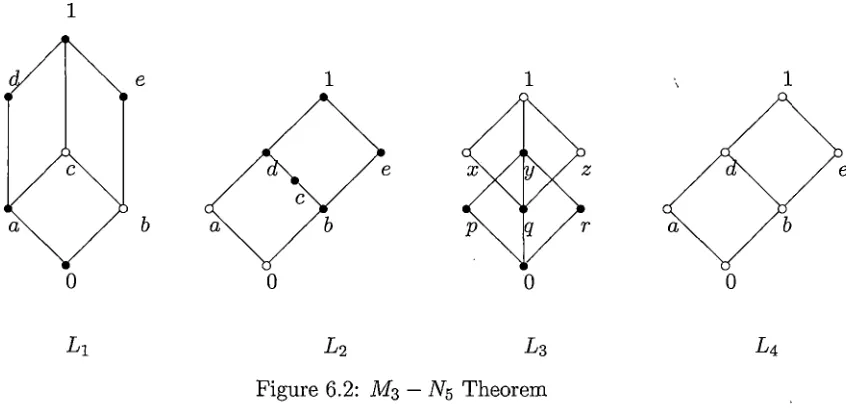
6.2 M3 — T h e o r e m ... 40
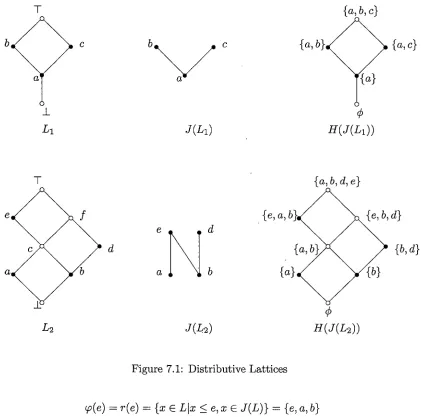
7.1 Distributive L a t t i c e s ... 49
7.2 Non-distributive L attices... '... 50
Chapter 1
Introduction
In Mathematics, representation theorems help us to investigate unknown ab
stract structures, by allowing us to consider more well known concrete structure. At
the core of every representation theorem is a stucture preserving map from the abstract
structure to the concrete one. The original structure is studied via its image under this
map.
According to Johnstone [3] the birth of abstract algebra can be traced to a paper
of Cayley on group theory (1854). Universal algebra established itself in the 1930’s as a
unifying tool for the theory of groups, modules, rings and lattices.
The topologist M. Stone introduced in 1934 the notion of topology to algebra
and proved his famous representation theorem for finite Boolean algebras [6]. In his
work, Stone proved th at every finite Boolean algebra can be realized as the full power
set of the set of atoms of the Boolean algebra; each element of the Boolean algebra
bijectively corresponds to the set of atoms (minimal elements) below it (the join of which
is the element). This power, set representation can be constructed more generally for any
complete atomic Boolean algebra; however in these cases, the image of the representation
is not the full power set.
Independently at around the same time (1934), G arrett Birkhoff proved a rep
resentation theorem for finite distributive lattices [7] (in this thesis see Theorem 7.4). It
states th a t every finite distributive lattice is isomorphic to a lattice of down-sets of the
poset of join-irreducible elements. This establishes a bijection between the class of all
In the same period of time (1936) Stone discovered a m ethod to extend his
representation result for finite Boolean algebras to arbitrary Boolean algebras [4], [6]
and Birkhoff adapted it to arbitrary distributive lattices [7] (see Theorem 8.6 in this
thesis).
In this work, we focused on distributive lattices and give a representation result
for both the finite and infinite cases. In each case, the result is due to both, Birkhoff
and Stone, and is purely algebraic in th a t no topology is used.
Throughout this thesis, unless otherwise stated, the references for definitions,
lemmas, corrollary, etc, can be found in Davey and Priestley [1] and Gratzer [2]. A nice
Chapter 2
Ordered Sets
We begin by introducing the notion of order. When we think about order we
refer to more th an one objects. An ordering is a binary relation on a set of objects that
compares them. Greater than, taller, less or equal, are examples of ordering.
2.1
O rdered S ets
D efinition 2.1. Let P be a set. A n o rd er (or p a rtia l order) on P is a binary relation
< on P such that, for all x , y , z G P,
(i) x < x Reflexivity,
(ii) x < y and y < x imply x = y Antisymetry,
(Hi) x < y and y < z imply x < z Transitivity.
A set P equipped with an order relation < is said to be an ordered set (or
partially ordered set). We’ll refer to the ordered set using the shorthand p o set and
we write (P; <) when it is necessary to specify the order relation. On any set P, the
discret order, and ‘< ‘ meaning strict inequality are order relations. We use x < y
and y > x interchangeably, and write x £ y to mean ‘r < y is false1. Also, we use x || y
when x is not comparable with y. We can construct new ordered sets from existing ones.
If P is an ordered set and Q a subset of P , then Q inherits an order relation from P;
given x ,y G Q, x < y in Q if and only if x < y in P . We say th at Q has the induced
2.2
C hains and A ntichains
D efin ition 2.2. Let P be an ordered set. Then P is a c h a in if, for all x ,y G P, either
x < y or y < x. A t the opposite extreme from a chain is an antichain. The ordered set
P is an a n tic h a in if x < y in P only if x = y.
The set R of all real numbers, with its usual order, forms a chain. The natural
numbers N, the integers Z, and the rational numbers Q, also have a natural order making
them chains.
We denote the set N U {0} = {0,1,2,3,...} by No- This set with the order in
which 0 < l < 2 < 3 < . . . becomes a chain. In particular, in the finite case we will use
the symbol n to mean the chain 0 < 1 < 2 < ... < n — 1.
The length of a finite chain C is |C| — 1. A poset P is said to be of length n,
where n is a natural number, iff there is a chain in P of length n and all chains in P
are of length < n. A poset P is of finite length if and only if it is of length n, for some
natural number n.
2.3
Order Isom orphism
We say that P and Q are (order-) isom orphic and write P = Q, if there
exists a map ip from P onto Q such th at x < y in P if and only if <p(x) < ip(y) in Q.
Then <p is called an order-isom orphism . This map is neccesarily one-to-one and onto.
2.4
Pow er sets
Let X be any set. The powerset P ( X ), consisting of all subsets of X , is ordered
by set inclusion: for A, B e -P(X), we define A < B if and only if A C B . Any subset of
P (A ) inherits the inclusion order.
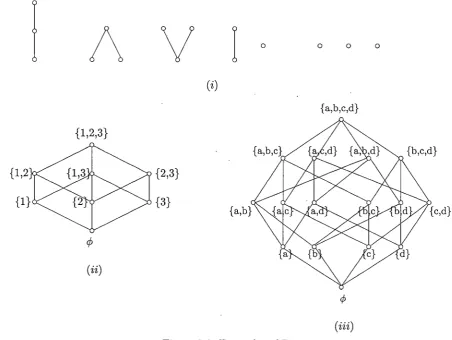
For example if we have set X consisting of 3 elements: X = {1,2,3} the powerset
P (X ) has the following elements shown in Fig. 2.2 (ii):
P (A ) = {</>, {1}, {2}, {3}, {1,2}, {1,3}, {2,3}, {1,2,3}}
2.5
T h e C overing R elation
Let P be an ordered set and let x ,y G P. We say x is covered by y (or y covers
re), and write x -< y or y >- x, if x < y and x < z < y implies z = x. The latter condition
is demanding th a t there be no element z of P with x < z < y. If P is finite, x < y if and
only if there exists a finite sequence of covering relations x — xo X\ x n = y.
For example:
• In the chain N, we have m -< n if and only if n — m + 1.
• In R, there is no covering relation since there are no pairs x .y such th a t x y.
• In P (X ), we have A B if and only if B = A U {6} for some b E X \ A .
2.6
D iagram s
Let P be a finite ordered set. We can represent P by a configuration of cir
cles (representing the elements of P ) and interconnecting lines (indicating the covering
relation).
To construct a diagram for a power set, we need first to associate to each point
x E P, a point p(x) of the Euclidian plane R 2, depicted by a small circle with center
at p(x). Then for each covering pair x -< y in P , take a line segment l(x ,y ) joining the
circle at p[x) to the circle at p(y). We need to do this in such a way that:
(a) if x -< y, then p(x) is ‘lower' than p(y) (that is, in standard cartesian coordinates,
has a strictly smaller second coordinate).
(b) the circle at p(z) does not intersect the line segment l(x, y) if z x and z / y.
Figure 2.1 (i) shows two alternative diagrams for the ordered set P = {a, b, c, d}
in which a < c, b < c, a < d and b < d. We can see also th at a || b and c || d. In Figure
2.1 (ii) we have drawings which are not legitimate diagrams for P . In the first c is ‘lower'
than b, even in our set b < c, so the 3(a) rule in 2.6 is violated. In the second the line ad
intersects the circle c but c a and c / d, so the 3(b) rule is violated. In Figure 2.1(iii)
we have the following relations:
• c < e < g
• a||c, 6||c, d||e, f\\g, and so on.
We have defined diagrams only for finite ordered sets. It is not possible to rep
resent the whole of an infinite ordered set by a diagram, but if its structure is sufficiently
regular, like in Figure 2.1(iv), we can sugest how the ordered set looks like. Figure 2.2
contains diagrams for a variety of ordered sets: ■
(i) all possible ordered sets with three elements.
(ii) the power set P{1,2,3}
(iii) the power set 7?{a,b,c,d}
2.7 T h e D u al o f an O rdered Set
For any ordered set P there exists a new ordered set P s (the dual of P ) defined
<t>
{Hi)
Figure 2.2: Examples of Diagrams
for the dual can be obtained simply by ‘turning upside down' the original diagram, as
we can see in Figure 2.3.
We can observe th a t for each statm ent about the ordered set P there coresponds
a statem ent about P s. For example, in Figure 2.3 we can say th at in P there exists a
unique element e covering exactly three others elements b, c, d, while in P 5 there exists a
unique element a covered by exactly three others elements b, c, d. In general, given any
statem ent $ about ordered sets, we obtain the dual sta tem en t <f>'5 by replacing each
occurrence of < by > and viceversa.
T he duality principle. Given a statement $ about ordered sets which is true
Figure 2.3: The Dual Ordered Set
2.8
B o tto m and Top
D efinition 2.3. Given an ordered set P , we say P has a b o tto m element if there exists
± G P with the property that ± < x for all x € P.
Using the duality principle, we get the definition of top element
D efinition 2.4. Given an ordered set P , we say P has a to p element if there exists
T G P with the property that T > x for all x G P.
L em m a 2.5. I f an ordered set P has bottom, then this is unique.
Proof. Let P be an ordered set, and let ± i and ±2 be two bottoms of the ordered set.
If l i G P is a bottom of P then ±1 < x for all x E P. T hat implies ±1 < ±2> since
± 2 £ P- If J-2 G P is a bottom of P then ±2 < x for all x e P, in particular, ±2 < -Li since ±1 is an element of P. Therefore ±1 = ±2 by the antisymmetry of <. □
As a consequence of the duality principle, if an ordered set P has top, then this
is unique. In C), we have ± = 4> and T = X . A finite chain allways has bottom
and top elements, but an infinite chain need not have. For example the chain (N; <) has
bottom element 1 and no top element, while (Z ;<}, the chain of integers has neither
top nor bottom.
2.9
M axim al and M inim al E lem ents
D efinition 2.6. Let P be an ordered set and let Q C P. Then a G Q is a m a x im a l
We denote the set of all maximal elements of Q by Max Q. If Q has a top
element, Tq, then Max Q = Tq and Tq is called the m axim um element of Q.
A minimal element and minimum are defined dualy. A minimum element of Q is
a maximum element of Qs and minimum of Q is maximum of Qs . The set of all minimal
elements of Q is denoted MinQ. If Q has a bottom element, ±q, then MinQ = Tq and Tq is called the m inim um element of Q.
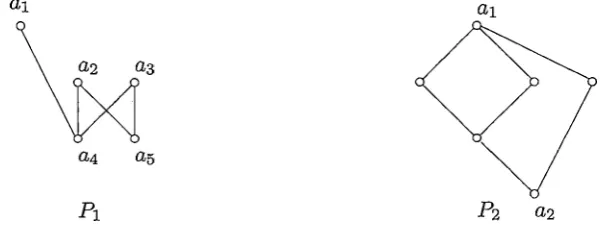
Figure 2.4: Maximal Elements and Maximum
In the Figure 2.4 P i has maximal elements 01,02,^3 and minimal elements 04
and <35 but no maximum or minimum. P2 has a± as maximum and a% as minimum.
2.10 Sum s and P ro d u cts o f Ordered S ets
Two ordered sets are join together in several different ways. In each of these
constructions we require th at sets being joined are disjoint.
D efinition 2.7. Let P and Q be disjoint ordered sets. The lin e a r s u m P ® Q is defined
by taking the following order relation o n P U Q : x < y if and only if
x ,y G P and x < y in P,
or x ,y G Q and x < y in Q,
or x G P and y G. Q.
A diagram for P © Q is obtained by placing a diagram for P directly below
a diagram of Q and adding a line segment from each maximal element of P to each
D efinition 2.8. Let P i,...,P n be ordered sets: The C a rte sia n p r o d u c t P i x ... x Pn is
an ordered set with the coordinatewise order defined by
(®i, ■■■, x n) < ( y i , y „ ) if and only if (V iX < y; in Pi
A product P x Q is drawn by replacing each point of a diagram of P by a
copy of a diagram of Q, and connecting corresponding points. In particular, 2” is the
cartesian product of the chain 2, n times.
L em m a 2.9. Let X — {1, 2, 3,..., n} and define p : P (X ) — > 2n by <^(A) = (e i,..., en)
where
1 (i £ A)
0 (i <£ A)
Then p is an order-isomorphism.
Proof. To show th at p is an isomorphism, we have to show :
(i) A < B implies p(A ) < p (B )
(ii) p is one-to-one
(iii) p is onto
Proof of (i)
Let A, B e P(X~) be two subsets of A, with A C B and let 99(A) = (e i,...,e n) and
p (B ) = (<5i,..., dn). We need to show th at p (A ) < p (B fi A C B <=> (Vi) i e A implies
i E B . This is equivalent to (Vi)ei = 1 implies = 1, which is equivalent to (Vi)e^ <
Si-This later statem ent gives us 99(A) < p(B } in 2n.
Proof of (ii)
Given p : P (A ) — > 2n , 99(A) = (ei,...,e„) and p (B ) = (5i,...,5„) and 99(A) = 99(B).
Then, since 99(A) = 99(B), we have (ei,C2, ...,en) = (5i, d%, ■■■, dn). This implies that
= (Vi) i = l,2 ,...n .
We can have either i £ A or i A. If i £ A, then Cj = 1, which implies di = 1.
Thus, i E B and A C B. If i A, then = 0 = di. Hence i B . Thus by contrapositive
B C A. Therefore p is one-to-one.
Proof of (iii)
2.11
D ow n -S ets and U p -S ets
D efinition 2.10. Let P be an ordered set and Q C P.
(i) Q is a d o w n -se t if, whenever x € Q, y G P and y < x, we have y e Q.
(ii) Dually, Q is an u p -s e t if, whenever x e Q, y G P and y > x, we have y G Q.
We can think about a down-set as one which is ‘closed under going down’ and
about an up-set as one which is ‘closed under going up’.
Given an arbitrary subset Q of P, we define:
‘down Q ’ : [ Q := {y E P \ (3x E Q) y < x}
‘down x ’ : J. x := {y E P | (y < a;)}
‘up Q’ : I Q - = { y e P | (3x G Q) y > x}
‘up x ’ : | x := {y E P | (y > a:)}
Up-sets (down-sets) of the form | x ( j x) are called principal.
The family of all down-sets of P is denoted by O (P ) and is itself an ordered
set, under the inclusion. When P is finite, every non-empty down-set Q of P is of the
form (Ji=i J- x > us the reader may easy verify.
E xam ple 2.11. In Figure 2.1(iii) the sets {c}, {a, b, c, d, e} and {a, b, d, f } are all
down-sets, but the set {b, d, e} is not a down set because a, b and a £ {b, d, e}. The set {e, f , g}
is an up-set, but {a, b, d, f } is not.
E xam ple 2.12. I f P is an antichain, then O {P )= P {P f
E xam ple 2.13. I f P is the chain n, then O (P) consists of all the sets J. x fo r x E P,
together with the empty set.
E xam ple 2.14. I f P is the chain Q of rational numbers, then O (P ) contains the empty
set, Q itself and all sets j x (for x E Q / We have also other sets in 0 ( P ) , like j aj\{a:}
(for x E<Q>) and {y E Q \y < a} (for a E R \ Q /
2.12
M aps B etw een O rdered S ets
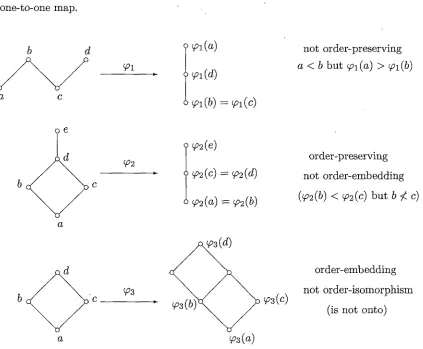
(i) o rd er-p rese rv in g if x < y in P implies < p(y) in Q;
(ii) an ord er-em b ed d in g (and we write p : P Q) if x < y in P if and only if
<p(x) < <p(y) in Q;
(Hi) an o r d e r -is o m o rp h is m if it is an order-embedding which maps P onto Q
In Figure 2.5 ip± is not order-preserving, since a < v b u t,^ i(o ) > <pi(b). On the
other hand <p2 is order-preserving but is not order-embedding. Note th a t p>2(b) < <p2(c)
but b / c. The function </?3 is order-embedding but not order-isomorphism, since is not
one-to-one map.
¥>2
9 ^ ( e )
9 <^2(c) = <P2(d)
° (^2(a) = <fi2(b)
not order-preserving
a < b but p i (a) > <pi (b)
order-preserving
not order-embedding
(<P2(b) < ip2(c) but b ft c)
Figure 2.5: Maps Between Ordered Sets
order-embedding
not order-isomorphism
Chapter 3
Lattices and Complete Lattices
Two of the most im portant classes of ordered sets are lattices and complete
lattices. In this chapter we present the basic theory of such ordered sets.
3.1
L attices as O rdered S ets
D efinition 3.1. Let P be an ordered set and let S Q P . A n element x E P is an
u p p er-b o u n d of S if s < x for all s E S . Dually an element x E P is an low er-bound
of S if s > x for all s E S.
The set of all upper-bounds of S is denoted by S u and the set of all lower
bounds by S 1-.
S u {x E P|(Vs E S') s < x} and S l := {x E P|(Vs E S') s > x}.
Since < is transitive, S w is an up-set and S l is a down-set. If S u has a least element x.
then x is called the least upper bound of S. The least upper bound of S is also called
the suprem um of S and is denoted by sup S. If S l has a greates element x, then x is
called the greatest lower bound of S. The greatest lower bound of S is also called the
inflm um of S and is denoted by inf S'. The supremum of S exists if and only if there
exists x E P such that
(Vy E P )[(fys E S ) s < y ) O x < y]
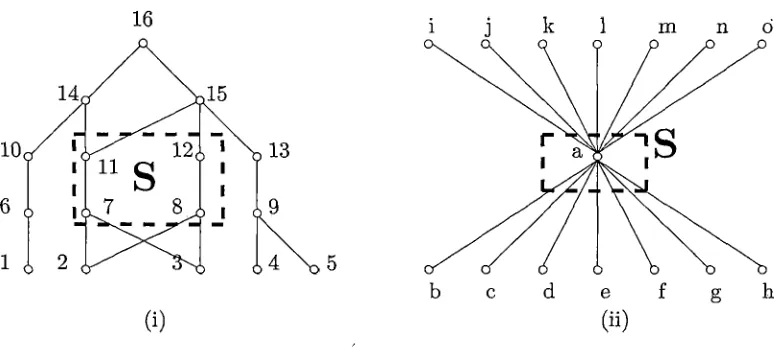
In ordered set (i) from Figure 3.1 S — {7,8,11,12}. The elements 15, 16 are the only
of all upper bounds and 15 is the sup S', since 15 is the least element of {15,16}. The
set S l = {2,3} is the set of all lower bounds and we have no infimum.
Figure 3.1: Upper and Lower Bounds
In ordered set (ii), S = {a}, S u = { i,j,k,l,m,n,o} , S l = { a,b,c,d,e,f,g,h}. Here
we do not have any supremum or infimum.
R em ark 3.2. There are two extreme cases for S as subset of P: when S is empty or S
is P itself. I f S is the empty s e t , then every element x 6 P satisfies s < x for all s 6 S.
Thus (f>u = P and hence sup <f> exists if and only if P has a bottom element, in which
case sup f> = ± . Dually, in f <j> = T whenever P has a top element.
N otation . We write a: V y (read as ‘x join y’) in place of sup {x, y} when it
exists and x A y (read as lx m eet y’) in place of inf {a;,y} when it exists. From this
observe th a t the commutative law holds. T hat is, x V y = y V x and similarly for meet.
Similary we write \Z S (the join o f S) and f \ S (the m eet o f S') instead of sup S' and
inf S' when these exist.
R em arks 3.3.
(1) Let P be an ordered set. I f x , y & P and x < y , then {a;, y }u = } y and {», y } 1 = | x.
x V y — y and x f \ y = x whenever x < y. In particular, since < is reflexive, we
have x V x = x and x / \ x = x.
(2) In an ordered set P, x \ / y may fail to exist for two different reasons:
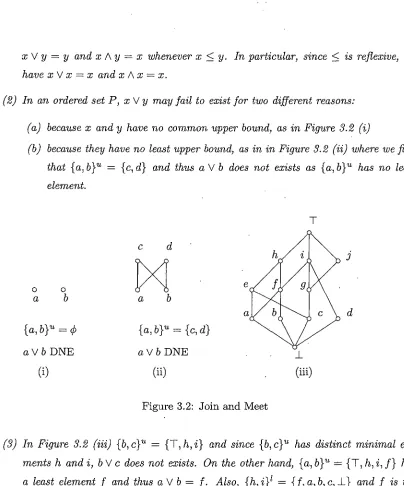
(a) because x and y have no common upper bound, as in Figure 3.2 (i)
(b) because they have no least upper bound, as in in Figure 3.2 (ii) where we find
that {a, b}u = {c, d} and thus a V b does not exists as {a, b}u has no least
element.
o o
a b
{a, b}u = fi
a \/ b DNE
(i)
Figure 3.2: Join and Meet
(3) In Figure 3.2 (Hi) {b, c}“ = { T ,/i,i} and since {6, c}u has distinct minimal ele
ments h and i, b \/ c does not exists. On the other hand, {a, b}u = {T, h ,i, f } has
a least element f and thus a V b = f . Also, {h, i} 1 = { f, a, b, c, ± } and f is the
greatest element, therefore h A i = f .
D efinition 3.4. Let P be a non-empty ordered set.
(i) I f x V y and x f \ y exist for all x ,y € P , then P is called a la ttice
(ii) I f \ / S and f \ S exist for all S C P , then P is called a co m p lete la ttice
E xam ple 3.5. Each of K, Q, Z, and N is a lattice under its usual order. By Re
mark 3.2(1), if x < y then a; V y = y and x A y = x. Hence, every chain is a lattice in
E xam ple 3.6. None of the lattices R, (Q>,. Z, and N is complete; every one lacks a top
element, and a complete lattice must have top and bottom.
E xam ple 3.7. For any set X , the ordered set {P (X f, Q)is a complete lattice in which
\ / { A i | z e i } = (J{A ; \ i e I} ,
f \ { A i | i G 1} = P ){ A \ i S I} .
Proof. First, we note th at we shall indicate the index set by subscripting it. Thus,
instead of (J { A | » 6 f} we write (Jigj A i, and instead of H { A | i € 1} we write Qigl Ai.
Let be a family of elements of P (X ). Since (Jig/ A D A j for all j E I, it follows th a t (Jigl Ai is an upper bound for {.AJieJ- Now, let B E P (X ) be another upper bound
of {>li}iej. Then B 3 Ai for a lii e I and hence B 3 (Jigj Ai. Thus (Jig/ A is indeed the
lowest upperbound of { A } is/ in P (X ). The assertion about meets is proved dually. □
E xam ple 3.8. With F/q = { 0 ,1 ,2 ,3 ,...} , a < b if and only if a|h, o V b = lcd(a, 6) and a / \ b = gcd(a, b) , (Ao; led; ged) is a lattice.
Proof. We’ll first prove th at the relation a < b iff a\b is an order relation. Since every
x E No is divisible by itself the relation is reflexive. If x, y E No, x\y and y\x imply x — y
and thus the relation is antisymmetric. Now, let x ,y , z E No, x\y and y\z. Then, there
exist p, q E No such th at y — x-p and z — y-q. T hat implies z = y • q = (x-p)-q = x-(p-q)
and x\z. Thus the relation is transitive. Therefore (No;lcd;gcd) is an ordered set.
Second we have to prove th at the lcm(a, b) and the gcd(a, b) are precisely a V b and a A b,
respectively. Let lcm(a, b) = c. T hat implies a\c and 6|c and by the definition of relation
in our ordered set, a < c and b < c. Since by definition c divides any other multiple
of a and b, c is the sup(a, b) and therefore lcm(a, b) = a V b. Dually we can show th at
gcd(a, 6) = a A 6. Therefore (No; led; ged) is a lattice. □ L em m a 3.9. Let P be a lattice. Then for all a, b,c,d E P,
(i) a < b implies a \/ c < bV c and a A c < b A c
Proof. For the (i) part let P be a lattice and a, b, c, d £ P and let a < b. Then by
Remark (1) above aVb = b. Consider the element b \/c = (a V b )V c (since aV& = 6). By
the associative and commutative laws (see next theorem) b Vc = (a V6) Vc = 6 V (aVc).
Using the definition of join, 6 V c > b and 6 V c > a V c. Therefore we have the result
a V c < b V c and the proof is complete. For the second part by Remark (1) above
a /\b = a. Consider the element a f \ c = (a A 6) Ac (since a A b = a). By associativity
a / \ c = a / \ ( b / \ c ) and by the definition of meet a A c < b A c.
For the (ii) part a < b implies a V b = b, and c < d implies c V d — d. Then
the element b V d in lattice P is equal to (a V b) V (c V d) and using the associative and
commutative laws is equal to (oV c) V (6 V d). Thus we have 6 V d — (a V c) V (6 V d) and
therefore, a V c < b V d. The element a A c in lattice P is equal to (a A b) A (c A d) since
aAc = a and cAd = c. Using the associative and commutative laws a/\c — (bf\d)/\(af\c).
Thus we have a A c < b A d. □
3.2
L attices as A lgebraic S tructure
Given a lattice L, we define binary operations join and m eet on the non-empty
set L by
a V b := sup{a, b} and a A b := inf {a, b} (a,b £ L)
In this section we view a lattice as an algebraic structure (L; V, A).
L em m a 3.10. C onnecting Lem ma.
Let L be a lattice and let a,b € L. Then the following are equivalent:
(i) a < b;
(ii) a V b = b;
(Hi) a /\b = a.
Proof We already showed in Remark (1) above that, (i) implies (ii) and (i) implies (Hi).
Now, assume (ii) a V b = b. We know from the definition of join th a t a < a ' i b. Thus,
a < a V b = b implies a < b which is (i). To show that (Hi) implies (i), we take a /\b = a
T heorem 3.11. Let L be a lattice. Then V and A satisfy, fo r all a ,b ,c E L,
(L I) (a V b) V c = a V (b V c)
(L2) a \ / b — b\l a
(L3) a V a = a
(L4) a \f (a Ab) = a
and
and
and (L3)5 a /\a = a
and (L4)5 a A (o V b ) =
(L \)5 (o Ab) A c = a A (b A c)
(L2)5 a A b = b /\ a
(associative laws)
(commutative laws)
(idempotency laws)
(absorption laws)
Proof. Let a,b G P and a < b. Then, {a, b}u = b | and {a, b}1 = a j, since the least
element of b | is b and the greatest element of a $ is a. Thus, a V b — b and a A b = a
whenever a < b. In particular if in the set {a, b} we let b = a, we get a V a = a and
a A a — a, which proofs L(4).
To prove L(2) we remember th at a V b = sup{a, b} and th a t is equal to
sup{b, o} = b V a.
To prove L(3) we’ll use the above lemma. If we have two elements belong to
the lattice L, both elements are less or equal to their join. In particular if our elements
are a and a A b, then a < a V (a A b). By Lemma 3.4 a /\ a V (a A b) = a and since a V a = a
(by L(3)), we have a V (a A b) = a.
To prove L (l) let a, b, c G L and d G {o, b, c}u be any upper bound of the
set {a, b, c}. If d is an upper bound of {a, b, c} then, by definition, d > a, d > b and
d > c, and moreover the upper bound d is an upper bound for any subset of {a, b, c}.
Thus, we have d G {a, b}u and d > c, which implies d > a V b and d > c, which implies
d G {a V b, c}“ . In the same time we can say th at d G {b, c}“ and d > a, which implies
d G {b V c, and thus d G {b V c, o}“ . Thus the set of {b V c, a}u = {bV c, a )u. That
implies th a t the two sets have the same least element and therefore (aVb)Vc = aV(bVc).
Note th a t the dual statements L (l)'5 — L(4)s are obtained simply by interchang
ing the V and A. □
T heorem 3.12. Let (L-,\/,/\) be a non-empty set equiped with two binary operations
which satisfy (LI) — (L4) and (L I)5 — (L4)5 from 3.11.
(i) For all a,b G L, we have oV b = b if and only if a /\b = a
(Hi) With < as in (ii), (£; <) is a lattice in which the original operations agree with the
induced operations, that is, for all a,b € L,
a, V 6 = sup{a, 6} and a A b = inf {a, 6}.
Proof. Assume a V 6 = 6. From (£4)s we have a = a A (a V b) and replacing a V b by b,
we have a — a A.b. Conversely, assume a A 6 = a. Replacing in ?? (£4), (b A a) by a, we
get b = b\/ a. Thus the proof of (i) is complete.
Now define < as in (ii). By £3, a V a = a and since by assumption a < b if
a V b = b we have a < a which shows reflexivity. To verify antisymmetry suppose first
th a t a < b. T hat implies a V 6 = 6. Second, suppose b < a, which implies 6 V a = a.
Since by £2, a V b = b V a w e have a — b. To show th a t < is transitive let a,b ,c S £,
a < b and b < c. If a < b, then a V b = b and if b < c, then bV c — c. Replacing these two
joins in £1, a V (6 V c) = (aV b) V c we find th at a V c = b V c and since b V c = c we have
a V c = c which implies th at a < c. Thus < is reflexive, antisymmetric and transitive,
therefore is an order relation. (
W ith < and V defined as in (ii), to show th at a V b — sup{a, b} in the ordered
set (£; <) we need to show th at aVfc € {a, b}u and th at d E {a, b}u implies d > aVb. The
following equality (a V b) V a — (a V a) V b holds by the associativity and commutativity
laws of V. Since a V a = a, by ?? (£3), we have a V (a V b) = a V b. Using Lemma ??,
a V b > a. On the other hand (a V b) V b = a V (b V b) = a V b, which by (ii) implies
th a t o V b > b. These two results, a V b > a and a V b > b allow us to conclude that
o V b E {a, b}u. Now let d E {a, &}“ . We need to prove th at d > a Vf>. If d is an element
of the set of upper bounds of the set {a, b}, then d > a and d > b, which imply that
d V a = d and d V b — d. Looking at the element d V (a V b) we see th a t by associativity
this is equal to (d Va) \/b which equals d\/b, which equals d. Thus we have dV (a'ib) = d
and therefore, by (ii), d > a V b. □
3.3 S u b lattices, P ro d u cts and H om om orph ism
D efinition 3.13. Let L be a lattice and (j> ^ M E L . Then M is a su b la ttic e of L if
E xam ple 3.14. Any one element subset of a lattice is a sublattice. More generally a
non-empty chain in a lattice is a sublattice.
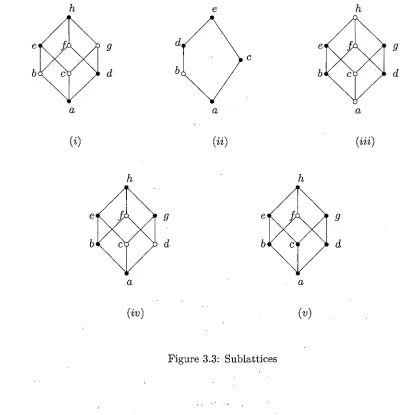
E xam ple 3.15. In the diagrams in Figure I I the shaded elements in lattice (?) and (??)
form sublattices. In {Hi}, since M = {b, e, g, d}, e,g e M but e V g — h and h M , the shaded elements do not form a sublattice. The shaded elements in {iv} do not form a
sublaitice, since e f\g = c and c is not shaded. In Figure I I {v} the shaded elements also do not form a sublattice since b y d = f and f is not in the subset of shaded elements.
E xam ple 3.16. The reader can easilly check that in Figure I I (w) the subset of shaded
elements forms a lattice in its own, without being a sublattice of L.
D efin ition 3.17. Let L and K be lattices with the ordered set L x K . We define V and
A coordinatewise on L x K , as follows:
G l, fel) V (Z2, fo ) = G l V Z2, ki V fo ) G l, fci) A (Z2, ^2) = G l A ^2, k t A kf)
It is routine to check th a t L x K satisfies the identities ?? (LI — (L4)5 and therefore is a lattice.
D efinition 3.18. Let L and K be lattices. A map f : L —> K is said to be a h o m o
m o r p h is m if f is jo in -p re se r v in g and m eet-p reservin g , that is, for all a,b G L,
f ( a V &) = / ( a ) V f(b) and f( a Ab) = f(a ) A f(b).
A bijective homomorphism is an isom orphism . If f : L —> K is a one-to-one
homomorphism, then /(L ) is a sublattice of K isomorphic to L and we refer to f as an
em bedd ing map.
E xam ples 3.19. In Figure 2.5, recall that <pi is not order-preserving since a||c and ip(a) > <p(c) but each of tp2,(p3,y>4 is an order preserving map. The map ip2 is an
homomorphism, the remainder are not. The map preserves joins but does not preserve
all meets. The map 723 is meet preserving but does not preserve all joins.
P ro p o sitio n 3.20. Let L and K be lattices and f : L —> K a map.
(i) The following are equivalent:
(a) f is order-preserving;
(b) (Va, b e L ) f ( a V b) > / ( a ) V f(b); (c) (Va, b E L ) f( a Ab) < f(a ) A f(b);
(ii) f is a lattice isomorphism if and only if it is an order-isomorphism.
Proof.
P art G) fa implies b).
(by Lemma ??),
(since the map / is order preserving)
(by Lemma ??).
(ya , b e L ) f (a \/b) > f (a) V f (fy.
Given a,b E L and a < b we have:
a V b = b
which implies / ( a V b) = f(b)
and /(a ) < f(b)
which implies /( a ) V f(b~) — f(b)
Using (L3) from Theorem 3.5, bVb — b. T hat implies /(b) V f(b) — f(b ). Replacing here
the values for f(b] found above, we have:
(/(« ) V f(by) V / ( a V b) = f ( a V b)
and therefore, by Lemma ??,
f ( a Vb) > f(a ) V f(b).
P art (2) (b implies a).
Given (Vo, b E L), a < b and / ( a V b) > f(a ) V /(b), we need to show th a t / ( a ) < f(b).
Given a,b E L and a < b we have a V b = b. Replacing this in / ( o V b) > /(o ) V f(b) and
using the fact /(a ) V f(b) > / ( a ) we obtain
f(b) > f(a ) V /(b ) > /(a )
and therefore / ( a ) < f(b~) what we needed to show.
P art (i) (o implies c). Let L and K be lattices and f : L K an order-preserving map,
we need to prove th at (Vo, b E L)
Given a.b E L and a < b we have:
a A b = a
which implies /( o A b) = /(a )
and /( a ) < /(b)
which implies /( a ) A /.(b) = /( a ) (by Lemma ??).
Using (L3)5 from Theorem 3.5, a A a = a. T hat implies /(o ) A /(o ) = f(a ). Replacing
here the values for /(a ) found above, we have:
(/(a ) A /(b)) A / ( a A b) = / ( a A b)
and therefore, by Lemma ??,
f ( a V b) > /(o ) V /(b).
(by Lemma ??),
(since the map / is order preserving)
P art (i) (c implies, a).
Given (Va, b G L), a < b and f ( a A £>) < f(a ) A f(b), we need to show th a t f(a ) < f(b).
Given a,b & L and a < b we have a A b = a. Replacing this in f ( a A b) < f(a ) A f(b) and
using the fact f(a ) A f(b ) < f(ti) we obtain
/(o ) < /( a ) A /(b ) < f(b)
and therefore f(a ) < f(b') what we needed to show.
P art (n) (=>)
Given f one -to-one, a, b elements of lattice with a < b and f ( a V b) — f( a ) V f(b) we need to show th at f(a ) < ffb ). In the given = /( a ) V ftff) replace a V b by b,
an d o b ta in
/(&) = /( a ) V /(b),
which implies f(a ) < f(b) (by Lemma ??).
P art (ii) (<s=) Given a,b G L, a < b implies /( a ) < f(b), we need to show th at f is bijective and preserves join and meet. Since f is order isomorphism, f is one-to-one and
onto (see 2.3). Since f is surjective there exists c G L such th at /( a ) V f(b ) = f(c ). By Lemma ?? /(a ) < /(c ) and f(b) < f(c ). Since f is order embedding, a < c and b < c.
Hence a V b < c. Since f is order isomorphism, /(a ) V b) < /(c ) = / (a) V /(b ) and thus
/ ( a ) V b) < / ( a ) V f ( b f By (i), f ( a V b > f(a ) V f(b ). Thus f ( a V b) = / ( a ) V /(b) and therefore preserves join. To show th a t / preserves meet it is enough to change
join with meet and < with >. Therefore, since / is surjective there exists c G L such th a t /( a ) A /(b) = f(c ). By Lemma ?? /(a ) > /(c ) and /(b ) > /(c ). Since / is
order embedding, a > c and b > c. Hence a A b > c. Since / is order isomorphism,
/(aA b) > /(c ) = /(a )A /(b ) and thus /(aA b) > /(a )A /(b ). By (i), /(aA b) < /(o )A /(b ).
Thus f ( a A b) = f ( a ) V and therefore preserves meet. Since / preserves join and
meet, / is a lattice isomorphism. □
3.4 Ideals and F ilters
D efinition 3.21. Let L be a lattice. A non-empty subset J of L is called ideal if
(ii) a 6 L, b G J and a < b imply a € J.
More compactly we can say th at an ideal is a non-empty down set closed under
join.
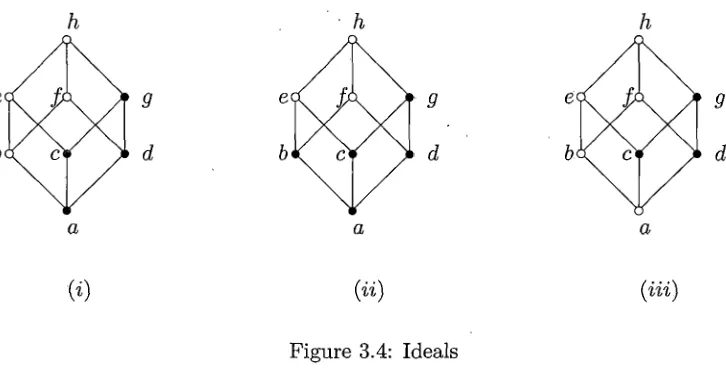
In Figure 3.4 the shaded elements in (i) form an ideal. The shaded elements
in {ii} do not form an ideal, since b, c G J but b V c J. In the same way, the shaded
elements in {in} do not form an ideal, since a G L, b e J and a < b, but a & J (the set
of shaded elements is not a down-set).
9
d
9
d
{i} {ii} {Hi}
Figure 3.4: Ideals
A dual ideal is called a filter. T hat means a filter is defined as a non-empty
subset G of L, such that:
(i) a, b € G implies a A b E G,
(ii) a E L, b G G and a > b imply a G G.
The set of all ideals (filters) of L is denoted by 1{L} {LF{L}}, and carries the
usual inclusion order.
An ideal or filter is called proper if it does not coincide with L.
For each a E L. the set J. a is an ideal and | a is a filter. J. a is known as
principal ideal generated by a and f a as principal filter generated by a.
P ro p o sitio n 3.22. Let L be a lattice and J C L a non-empty subset. J is an ideal of
(1 ) a,b € J implies a V b G J,
(2) a e L, b G J implies a Kb E J
Proof. Let L be a lattice and J C L a non-empty subset. We need to prove th a t J C L
satisfies (i) and (ii) from Definition 3.22 if and only if it satisfies (1) and (2).
Proof of (=>). Given a,b G J and (1) and (2), we have to show th a t a A b G J. From the
given a < b and using Lemma ??, we have a Kb = a and since a G J, a A b G J.
Proof of (<=). Given a G L, b G J, a < b and (1) and (2), we have to show th a t a G J.
From the given a < b and using Lemma ??, we have a K b = a and since a K b G J,
a E J. □
P ro p o sitio n 3.23. Let L and K be bounded lattices and f : L K a {0,1} homomor
phism. Then f - f i f f ) is an ideal and / _1(1) is a filter in L.
Proof. Given L and K bounded lattices and f : L —> K a {0,1} homomorphism prove
th a t / ~ 1(0) is an ideal. Then / _1(0) = {x E L \f(x ) = 0}. Let a,b G / _1(0). Now
a V b G L, since L is a lattice and / ( a V b) = /( a ) V f(b) since f is a homomorphism.
But /( a ) V /(&) = 0 V 0 = 0, since a,b G / _1(0). Thus a V b G / _1(0). Now let a G L,
b G / _1(0), and a <b. We need to show th a t a E / -1 (0).
a < b => a \/ b = b
=>- f( a V 6) = f(b)
=>/( a ) V /(&) = /(&)
=> f(a ) < f(b~) = 0
=> /( a ) = 0
= > a G / _1(0)
(by Lemma ??)
(since f is homomorphism)
(by Lemma ?? and since b E / _1(0))
(since L is a bounded lattice)
(since f is 0,1 homomorphism)
Therefore, / _1(0) is an ideal.
Given L and K bounded lattices and f : L —> K a {0,1} homomorphism prove
th a t / _1(1) is a filter. Let / _1(1) —> Il the image of 1. Then / _ 1 (1) = {a; G L \f( x ) = 1}. Let a, b E / _1(1). Now a Kb E L, since L is a lattice and f(a K b ) = f(a ) K f(fi) since f is
Now let a € L, b G f 1(1), and a > b. We need to show th at a G f 1(1).
a > b => a Ab = b
^ f ( a A b ) = f(b)
=> f(a ) A f(b)
= > /( a )A /( 6 ) = l
=> /(« ) = 1
^ a e f V l )
(by Lemma ??)
(since f is homomorphism)
(by Lemma ?? and since b G / _1(0))
(since L is a bounded lattice)
(since f is 0,1 homomorphism)
Therefore, / _1(1) is a filter. □
P ro p o sitio n 3.24. For any set X the following are ideals in P (X )
(a) all subsets not containing a fixed element of X ;
(b) all finite subsets.
Proof. Let X be a set and let xo G X .
Proof of (a). Let G be the set of all subsets of X not containing a fixed element xo G X .
Then
G = {A G P ( X ) | so i A}
Let A, B G G. If rco A and a;o B , then xq 0 A U B . Thus A U B E G. Now, let
A € G, B G PfiX) and B C A. If xq A and B C A we have xo $ B and thus B is an element of G. Therefore by definition, G is an ideal.
Proof of (b). Let G be the set of all finite subsets of X . Then
G = {A e PfiX) | A is finite}
Let A, B G G be finite sets. Since the union of two finite sets is a finite set, A U B G G.
Now let A E G, B E P ( X ) and B C A. Since B is a subset of a finite set is itself finite
Chapter 4
Complete Lattices and
Q-structure
Recall from Definition 3.4 th at a complete lattice is a non-empty set P such
th a t the join (supremum), \J S, and the meet (infimum), / \ S , exist for all subsets S of
P. First we list some immediate consequences of the definitions of least upper bound
and greates lower bound.
P ro p o sitio n 4.1. Let P be an ordered set, let S ,T C P and assume that \ / S, \ f T , f \ S
and / \ T exist in P.
(i) s < \ f S and s > f \ S for all s G S.
(ii) Let x G P ; then x < f \ S if and only if x < s for all s & S.
(Hi) Let x G P ; then x > \ f S if and only if x > s for all s G S.
(iv) \Z S < f \ T if and only if s < t for all t e T .
(v) I f S C T , t h e n \ f S < \ / T a n d f \ S > f \ T .
L em m a 4.2. Let P be a lattice, let S ,T C P and assume that \ / S, \J T , / \ S and / \ T
exist in P . Then
Proof. Since both supfS1) and sup(T) exist, to show th at the equality holds, it just needs
to be shown th a t the right side, sup(S') V sup(T), satisfies the definition for least upper
bound of the set S U T .
Upper bound: If x is in 5 U T , then x G S of x E T . Thus, x < sup(S') Vsup(T’).
Hence sup(S') V sup(T) is an upper bound of S U T.
Least upper bound: If y is an upper bound for S U T , then for each z in
S U T , z < y. This implies in particular th at y is an upper bound for S and an upper
bound for T. Thus, sup(S') < y and sup(T) < y. Therefore, sup (S’) V sup(T) < y and
sup(S') V sup(T) is the least upper bound for S U T. Therefore by definition of join
V (S 'U T ) = (\/ S') V
(V
T). Dually we can prove th at /\(S' U T ) = ( /\ S ) A (A^)> andthe proof is complete. □
L em m a 4.3. Let P be a lattice. Then \ / F and / \ F exist fo r every finite, non-empty
subset F of P.
Proof. Let F C P, non-empty, consisting of n elements F — {a-x, 0,2, <23, •.. an}. Then
V F can be defined in the following way: define an element S'{oi,. . . , an} recursively by
S ^ aq ,. . . , an} = sup{ai, S{a2, ■ ■ ■, an } with n > 2 and S'{a} = a. For example for n = 4,
5 { o i , . . . , o n} = sup{ai,sup{a2,sup{a3,a4}}}. First we need to prove S { a i , . . . ,a n} is
an upper bound for the set { a i,. . . , an}. To show S {<21,..., an} > ai, Vi, 1 < i < n,
either aj_ = S'{ai} > or by induction on n S{a2, • • •, an} > ai. Second we need to prove
th at S' { a i ,. . . ,a n} is the least upper bound. Suppose b > ai, \/i. Then, by induction
on n, b > sup{a„_i, a„} = S'{a„_i, an}- If b > sup{ak,S { a k+i , . .., o„} = S { a k, . . . , an },
we have b > sup{afc_i, S {a k, . . . , a,n} = S {a k~T, ■ • ■, an}- Thus b > S '{ ai,. . . , an} and
therefore S {a ± ,. . . , an}
= V{°1,
an}- □From the last lemma and the discusion about top and bottom in Section 3.1
the following holds.
C orollary 4.4. Every finite lattice is complete
By examining the proof of Exemple 3.7 the following holds.
C orollary 4.5. Let C be a family of subsets of a set X and let be a subset of £.
-(™) V D ie/ Ai G £ , then N c{A i\i G 1} exists and equals f) i e / Ai.
Consequently, any (complete) lattice of sets is a (complete) lattice with joins and meets
given by union and intersection.
L em m a 4.6. Let P be an ordered set such that f \ S exists in P fo r every non-empty
subset S of P . Then V S exists in P for every subset S of P which has an upper bound
in P ; indeed, \J S — f \ S u .
Proof. Let S C P , with S Assume S has an upper bound in P. Therefore S u <f>.
By hypothesis, / \ S U G P. Let a = / \ S U. We must show th a t f \ S = a. By definition,
/ \ S is the least upper bound for S. Will now show th at a = / \ S u is also a least upper
bound for S. If s G S, we want s < a. But Vt G S u, s < t Thus s < f \ S u and a
is an upper bound. Now if b E .P is also an upper bound for S we have b G S u and
thus / \ S U < b. This implies f \ S u < b and a is the least upper bound for S. Therefore
f \ S u = \J S . □
T heorem 4.7. Let P be a non-empty orederd set. Then the following are equivalent:
(i) P is a complete lattice;
(H) N S exists in P for every subset S of P;
(Hi) P has a top element, T , and / \ S exists in P for every non-empty subset S of P.
Proof. Let S be a subset of complete lattice P. Since by Definition of complete lattice,
N S exist for every subset of P, (i) implies (ii) automatically. Also, it is easy to prove
th at (ii) implies (Hi). Since f \ S exists in P for every subset S of P, N S exists for empty
subset of P. Thus, by Remark 3.2, P has a top element and since by (ii), N S exists in
P for every subset S of P, obvious it exists for every non-empty subset S of P. Now,
by Lemma 4.6 V S exists in P for every subset S of P. Given by (Hi) th a t / \ S exists in
P for every subset S of P, we have th at P is a complete lattice, by definition. Thus we
just proved th at (Hi) implies (i), and the proof of the theorem is complete. □
This theorem has a simple corollary.
C orollary 4.8. L e tX be a set and let £ be a family of subsets of X ordered by inclusion,
(a) A ig /A £ £ f or every non-empty family {A }ig/ £ , and
(b) X E C .
Then £ is a complete lattice in which
/ \ A i = ^ ] A i,
iei iei\ / A i = ^ \ { B E C \ \ j A i Q B } .
ieJ iei
Proof. (£\ C) is a complete lattice if \J S and / \ S exist for all S € £■ Thus by theorem
4.7 it suffices to show th at £ has a top element and the meet of all subsets of £ exist
in £ . Since £ is a family of subsets of X , X is the top element of £ . Now, let {A i}je/
be a non-empty subset of £ . Then A ^g /A e £ , by given (a). By Corollary 4.5, / \ igl A
exists and is equal to Aig/ A - Therefore, since £ has a top element and / \ ieI A l exists,
by Theorem 4.7, £ is a complete lattice. Now
V A = / \ { A i \ i e I } u (since X is an upper bound of {A } and Lemma 4.6)
ieJ
= Q { £ e £|(Vi e 7) Ai C B }
= Q { £ e £ | l j A c £ }
is/
Chapter 5
Join-irreducible Elements
D efinition 5.1. Let L be a lattice. A n element L is jo in -irre d u c ib le if
(i) x 0 (in case L has zero or bottom Jl),
(ii) x = a V b implies x = a or x — b for all a,b G L,
Condition (ii) is equivalent to
(ii4) a < x and b < x imply a V b < x for all a, b G L.
A m eet-irreducible element is defined dually. We denote the set of all join-irreducible
elements of L by J ( L ) and the set of all meet-ireducible elements by M (L ).
E xam ple 5.2. In a chain, every non-zero element is join-irreducible. Thus if L is an
n-element chain, then J ( L ) is an (n — 1)-element chain.
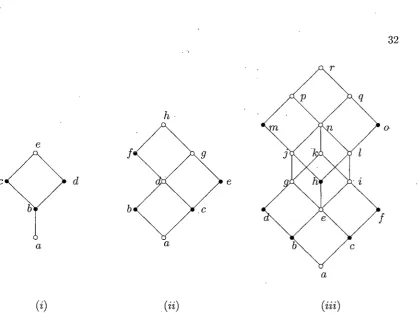
E xam ple 5.3. In a finite lattice L, an element is join-irreducible if and only if has
exactly one lower cover (see Section 2.5). This makes J ( L ) extremely easy to identify
from a diagram of L. In Figure 5.1 the shaded elements are all join-irreducible.
E xercise 5.4. Consider the lattice (No; lcm-,gcd) defined in Example 3.8. A non-zero
element m G No is join-irreducible if and only if m is of the form pr , where p is a prime
and r G N.
Proof. Let
a
(i)
(m) (in)Figure 5.1: Join-irreducible Elements
Define a V b — lcm(a, b), a f\b = gcd(a, b) and a < b if and only if a\b.
(=> ) Given m £ No, m = p iei - p ^ 2 ---- Pkek, distinct primes, a join-irreducible element
of L. we need to prove th a t m is of the form pr. First we’ll prove th a t the powers e1
with 0 < i < k can not be all zeros. For th at, we need to show th a t 1 is the bottom of
the lattice L and thus is not join-irreducible. Let ± be the bottom of lattice L. That
implies ± < x for all x £ L, or ± |s . Thus, x — y • _L for some y E No- Now, since x can
be any element of L let x = 2. T hat implies the only acceptable values for ± are ± = 1
or ± = 2, since ± |x . If we let x = 3 the only acceptable values for ± are ± = 1 or ± = 3.
Since ± |x for every x E L, the ± must be 1. Therefore, since m is join-irreducible in L.
m can not be the bottom and the powers e1 with 0 < i < k can not be all zeros.
Suppose one of e^’s is not zero. Choose i with e,; > 0 and ej = 0, Vj i. Then
m = p f is of the form pr . Now, let m — p f ■ p f ■ ■ ■ -P^ wEh distinct p ’s and write
m = p f1 • k, where k = p f ■ ... p ^ , ej > 0, j E { 2 ,..., n}. If k / 1, lcm (pf1 • k = m and
by hypothesis m is join-irreducible. This implies th at m = p f1 or m = k. If m = p f1 • k
we are done. If m = k we repete the above procedure. By induction on n, we have that
(<= ) Given m G L, m = pr, with p prime and r € N we need to prove th a t m is
join irreducible. T hat means we have to prove if m — a V &, m = a or m = b. Let
m — a \ / b, a, b G L. Then a < m and b < m, by Lemma ??. Using the definition
for join in our lattice m = lcm(a,b), which implies a|pr and b\pr . Since a divides pr,
a is of the form pi where 1 < j < r and since b divides pr , b is of the form p 1 where
1 < i < r. Thus m = or m = p9 where g — m ax{Lj}. If j — m ax{i,j},
then m = p9 = pi = a. If i = m ax{i, j}', then m = p9 = pl = b and therefore m is
join-irreducible. □
E xercise 5.5. In the lattice P { X j the join-irreducible elements are exactly the singleton
sets, {z}, fo r x E X .
Proof. Let X be a set. By Example 3.6 P (X ) is a lattice. We need to find the elements
A G P ( X ) such th at if A — B U C then A = B or A = C. We claim th at the elements A
are the singletons {$} for some x G X . Suppose |A| > 1. Then A = {oi, U2, • • •} and we
can write the element A as A = {«i} U{a2, • • • }. In the last expression A is not {ai} and
A is not {a2, ■ • • anf and thus A is not join-irreducible. On the other hand if |A| = 1 then
A is join-irreducible and therefore the singletons are the only join-irreducible elements
Chapter 6
Modular and Distributive Lattices
Before formally introducing modular and distributive lattices we prove three
lemmas wich will put the definitions in 6.4 into perspective.
L em m a 6.1. Let L be a lattice and let a,b,c E L. Then
(i) a A (6 V c) > (aAf>) V (a A c), and dually,
(ii) a > c implies a A (6 V c) > (a. A f>) V c, and dually,
(Hi) (a A 6) V (& A c) V (c A a) < (a V 6) A (b V c) A (c V a).
Proof. Let L be a lattice and let a, b, c S L
Proof of (i). We need to show th a t a A (b V c) > (a A&) V (a Ac). Now a A ( 6 V c ) > a A 6
since 6 V c > b and x > y => a L x > a f\y by Lemma ?? part (i). Using the same Lemma
?? and the fact th at 6 V c > c, a A (6 V c) > a A c. Thus we have
a A (6 V c) > a L b and
a A (b V c) > a A c
which implies a A (b V c) > (a A 6) V (a A c) (since x > a and x > b ^ x > a V b ) .
Dually, we need to show th a t aV (&Ac) < (aVfr) A (aVc). Now a'J (6Ac) < aVb
since bAc < b and x < y =$> a V x < o Vy by Lemma ?? part (i). Using the same Lemma
?? and the fact th a t b A c < c, oV (b A c) < a V c. Thus we have
a V (b A c) < a V c,
which implies a V (b A c) < (a V 5) A (a V c) (since x < a and s < 6 r < a A b).
Proof of (m) . If a > c we need to show th at a A (b V c) > (a A b) and a A (b V c) > c. We start with 6 V c > b which implies a A ( 6 V c ) > a A 6 (by Lemma ??). In the same
way since b V c > c we have a A (b V c) > a A c. Since a > c is given, then a A c = c
and a A (b V c) > c. Therefore (a A b) V (a A c) > (a A 6) V c. Dually, if a < c we obtain
a V (b A c) < (a V b) A c, just by replacing meet with join and < with > and viceversa.
Proof of (Hi). To prove th at {a A b) V (b A c) V (c A a) < (a V b) A (bV c) A (c V a) we need
to show th at
(a) (a A b) V (b A c) V (c A a) < {a V b)
(b) {a A b) V (b A c) V (c A a) < (6 V c)
(c) (a A b) V (6 A c) V (c A a) < (c V a)
(a). By the definition of meet