Volume 21 Number 6 pp. 485–494 C The Author(s) 2018. This is an Open Access article, distributed under the terms of the Creative Commons Attribution-NonCommercial-NoDerivatives licence (http://creativecommons.org/licenses/by-nc-nd/4.0/), which permits non-commercial re-use, distribution, and reproduction in any medium, provided the original work is unaltered and is properly cited. The written permission of Cambridge University Press must be obtained for commercial re-use or in order to create a derivative work. doi:10.1017/thg.2018.65
Fetal Origins of Mental Disorders? An Answer
Based on Mendelian Randomization
Subhi Arafat and Camelia C. Minic ˘a
Department of Biological Psychology, Vrije Universiteit, Amsterdam, the Netherlands
The Barker hypothesis states that low birth weight (BW) is associated with higher risk of adult onset dis-eases, including mental disorders like schizophrenia, major depressive disorder (MDD), and attention deficit hyperactivity disorder (ADHD). The main criticism of this hypothesis is that evidence for it comes from ob-servational studies. Specifically, obob-servational evidence does not suffice for inferring causality, because the associations might reflect the effects of confounders. Mendelian randomization (MR) — a novel method that tests causality on the basis of genetic data — creates the unprecedented opportunity to probe the causality in the association between BW and mental disorders in observation studies. We used MR and summary statistics from recent large genome-wide association studies to test whether the association be-tween BW and MDD, schizophrenia and ADHD is causal. We employed the inverse variance weighted (IVW) method in conjunction with several other approaches that are robust to possible assumption violations. MR-Egger was used to rule out horizontal pleiotropy. IVW showed that the association between BW and MDD, schizophrenia and ADHD is not causal (allp>.05). The results of all the other MR methods were similar and highly consistent. MR-Egger provided no evidence for pleiotropic effects biasing the estimates of the effects of BW on MDD (intercept=-0.004,SE=0.005,p=.372), schizophrenia (intercept=0.003,SE= 0.01,p=.769), or ADHD (intercept=0.009,SE=0.01,p=.357). Based on the current evidence, we refute the Barker hypothesis concerning the fetal origins of adult mental disorders. The discrepancy between our results and the results from observational studies may be explained by the effects of confounders in the observational studies, or by the existence of a small causal effect not detected in our study due to weak instruments. Our power analyses suggested that the upper bound for a potential causal effect of BW on mental disorders would likely not exceed an odds ratio of 1.2.
Keywords:birth weight, depression, schizophrenia, attention deficit hyperactivity disorder, Mendelian randomization
The fetal origins hypothesis, also known as the Barker hy-pothesis, states that low birth weight (BW), an indication of poor fetal nutrition, is associated with increased risk of developing adult onset diseases. The British epidemiologist David Barker and his colleagues first suggested a potential role of fetal nutrition in the etiology of ischemic heart dis-eases after they observed that individuals in regions in Eng-land and Wales who showed increased fetal mortality be-tween 1921 and 1925 also showed increased mortality rates from ischemic heart diseases several decades later (Barker & Osmond,1986). In follow-up epidemiological studies us-ing public records from Hertfordshire and Preston, Barker found that low BW was associated with mortality from is-chemic heart disease, and also with type 2 diabetes and hy-pertension (Hales & Barker,1992).
Attempts to explain the low BW diabetes association im-plicated insulin and other metabolic mediators in the causal
mechanism. Subsequent studies investigating this relation-ship advanced the thrifty phenotype hypothesis, which pro-posed that poor fetal nutrition ‘programs’ the fetus, causing long-lasting effects on health. Accordingly, the prenatal pe-riod is critical for the subsequent development; poor nu-trition during this period causes structural and functional adaptations, such as decreased insulin sensitivity, that en-hance survival and prepare the fetus for postnatal life in a nutrient-poor environment. However, such changes would have negative effects in affluent environments, predisposing
received 5 November 2018; accepted 8 November 2018
to diabetes and metabolic syndrome (Hales & Barker,1992,
2001).
Barker’s hypothesis gained momentum in the following decades. Results were supported by several epidemiologi-cal and animal studies (Skogen & Øverland,2012). The hy-pothesis also expanded to include other diseases, such as psychiatric disorders, and it was suggested that the role of poor prenatal environment might explain the associations between psychiatric and cardiometabolic diseases (Schlotz & Phillips,2009).
Importantly, and in line with this hypothesis, the Dutch famine studies provided the earliest evidence for the role of prenatal nutrition in mental disorders. While an extreme case that reflects complex effects, those studies showed that individuals conceived during the famine showed increased risk of several psychiatric illnesses, particularly schizophre-nia, and depression (Räikkönen et al., 2012; Schlotz & Phillips,2009). Subsequent case-control and cohort studies, however, yielded mixed results. A recent systematic review (Wojcik et al.,2013) indicated that the association between low BW and depression is rather weak. For schizophrenia, studies to date have produced contradictory results (Abel et al.,2010; Gunnell et al.,2005; Schlotz & Phillips,2009). The strongest evidence was provided for attention deficit hyperactivity disorder (ADHD), with several epidemiolog-ical studies consistently associating low BW with hyperac-tivity and inattention (O’Donnell & Meaney,2016; Schlotz & Phillips,2009).
Proponents of the Barker hypothesis suggest that the supporting evidence is strong, and that attention should shift toward revealing the causal mechanisms underlying the observed associations. However, the primary criticisms of the Barker hypothesis is that evidence for it comes from observational studies: observational evidence does not suf-fice for inferring causality, because the observed associ-ations might reflect the effects of confounding variables (Skogen & Øverland,2012). For instance, a meta-analysis of 55 studies investigating the relationship between BW and blood pressure suggested that the reported association could well be attributable to random error, reporting bias, or to other confounders (Huxley et al.,2002). Similarly, a systematic review, which established a weak association be-tween BW and depression, also noted several limitations of the pool of studies, including publication bias and lack of adjustment for potential confounders (Wojcik et al.,2013). Demonstrating that BW causally affects psychiatric traits, and estimating the size of such effects, would provide an impetus to health policies and would establish the pre-natal period as a crucial therapeutic window. Alternatively, refuting the hypothesis that the association is causal will help us to avoid basing interventions on incorrect causal-ity models. However, causal inference presents a challenge when tight experimental control is unfeasible or impossible. The question of whether BW causes adult psychiatric dis-orders cannot be addressed using a randomized controlled
trial, as one cannot assign individuals randomly to differ-ent BW conditions to study its effects on psychiatric traits. Mendelian randomization (MR), a well-established method to demonstrate causality using genetic data, has created an unprecedented opportunity to probe the causality in the as-sociation between BW and mental disorders (Davey Smith & Ebrahim, 2003; Evans & Davey Smith, 2015; Pingault et al.,2018). That the genes assort randomly and indepen-dently (by Mendel’s first and second law) serves a function that is similar to that of randomization in a randomized controlled trial. Specifically, one can form random groups of individuals based on their genes, given that the genes as-sort randomly and independently of other traits and of en-vironmental factors that may typically confound observa-tional studies (Burgess & Thompson,2015; Evans & Davey Smith,2015; Pingault et al.,2018). Therefore, by using ge-netic variants that are robustly associated with the risk fac-tor/exposure instead of using the exposure itself, MR makes it possible to study causal relationships isolated from the effects of confounders. This allows us to draw conclusions about causality from observational studies. In short, MR is a very suitable technique to test for effects of BW.
Recent MR results have demonstrated a causal effect of BW on risk factors for coronary artery disease (Zanetti et al.,2018) and on type 2 diabetes (Wang et al.,2016). How-ever, no study to date has employed this approach to study the causal effect of BW on psychiatric disorders. Psychiatric disorders are leading causes of disability worldwide, form-ing an enormous burden on the individual, family, and soci-ety. Reliably establishing a role of the prenatal environment in their pathogenesis may be relevant to public health poli-cies (Skogen & Øverland,2012). The present aim is to use MR to test whether BW has a causal effect on depression, schizophrenia, and ADHD. Our focus on these disorders is motivated by recent large genome-wide association studies (GWASs), which have established an increasing number of robust genetic associations. These provide reliable instru-ments that facilitate the application of the MR analysis.
Methods
We carried out two sample MR analyses to test the causal effects of BW on the risk of major depressive disorder (MDD), schizophrenia, and ADHD. We used publicly avail-able summary statistics from GWAS conducted by the Psychiatric Genomics Consortium (https://www.med.unc. edu/pgc/results-and-downloads) and by the Early Growth Genetics Consortium (https://egg-consortium.org/).
MR allows one to probe causality in the relationships between risk factors/exposures and outcomes like mental health in non-experimental data (Davey Smith & Ebrahim,
instrumental variable (IV) analysis; IVs are variables di-rectly associated with an exposure, with effects on the out-come assumed to be entirely mediated by the exposure (Lawlor et al.,2008). In MR, genetic variants (usually sin-gle nucleotide polymorphisms; SNPs) feature as IVs (Davey Smith & Ebrahim,2003). To feature as a valid IV, a genetic variant should (a) be strongly associated with the exposure, (b) be uncorrelated with confounders (influences common to exposure and outcome), and (c) affect the outcome ex-clusively via the exposure (i.e., pleiotropic effects of the in-strument on the outcome should be absent; Davey Smith & Ebrahim,2003).
Power Analyses
We estimated statistical power for each MR analysis using the tool by Burgess (https://sb452.shinyapps.io/power/). In calculating the power, we used the following settings: a sig-nificance level of 0.05 and a coefficient of determination of 0.02 (in the regression of the exposure on the genetic vari-ants used to instrument the analysis), and we considered two effect sizes — 20% and 10%, respectively, per standard deviation change in the exposure (i.e.,OR=1.2 andOR=
1.1).
Mendelian Randomization
The inverse variance weighted (IVW) procedure was em-ployed to probe causality (Burgess et al.,2013). The IVW causal effect estimate is calculated based on multiple SNPs and on the ratio of coefficients method. We used genetic variants from the largest GWASs of BW (Horikoshi et al.,
2016), depression (Wray et al.,2018), schizophrenia (Ripke et al., 2013), and ADHD (Demontis et al., 2017). The 60 SNPs associated with BW at a genome-wide signifi-cance level in the offspring genotype analysis (p<5×10⁻⁸) were used as instruments. For each genetic varianti(i= 1...NSNP), we computed the Wald ratio estimate as (Burgess
et al.,2013)
βIVi=βoSNPi/βESNPi (1)
where βoSNPiis the regression coefficient in the outcome
on SNPi regression, and βESNPi is the regression
coeffi-cient in the exposure on SNPiregression. As one does in a meta-analysis, we combined these ratios of coefficients by weighting them by their inverse variance (Burgess et al.,
2013). Effectively, using the IVW procedure, one regresses the vector of NSNP associations with the outcome on the vector of associations with the exposure, while fixing the intercept to zero and employing inverse variance weight-ing. The IVW produces unbiased estimates of causal effects as long as the SNPs employed are valid IVs (Bowden et al.,
2015). Assumptions (b) and (c) stated above are not empir-ically testable, and are unlikely to hold when many variants are used as instruments (as this increases the probability of pleiotropy; Bowden et al.,2016). To avoid the bias due to potential violation of the ‘no horizontal pleiotropy’
assump-tion, we used the following MR methods, which are known to be robust in the presence of invalid IVs: median- (Bow-den et al.,2016) and mode-based methods (Hartwig et al.,
2017), and the MR-Egger regression (Bowden et al.,2015). Furthermore, we used forest plots (Wickham,2010) to visu-alize the causal estimates based on each individual instru-ment, and the combined causal estimates (Hartwig et al.,
2017).
The simple median estimator is calculated as the median of the set of ratio coefficients from each SNP selected to instrument the analysis. Even if up to half of these SNPs are invalid instruments (i.e., pleiotropic), the simple me-dian method will produce unbiased estimates of the causal effect (Bowden et al.,2016). Unlike the simple median — where the ratio estimates from all instruments receive equal weights — the weighted median estimator weights the coef-ficients by their inverse variance to place more importance on instruments with more precise estimates. The resulting causal estimate is valid as long as at least half the weights are based on valid instruments (Bowden et al.,2016). The mode-based estimator is calculated as the most frequent es-timate (i.e., the mode) of the set of ratio coefficients esti-mated from each genetic instrument. In this approach, the strong ‘no pleiotropy’ assumption is replaced with the as-sumption that the largest group of SNPs yielding similar es-timates of the causal effect includes solely non-pleiotropic instruments (Hartwig et al.,2017). The weighted mode is similar to the simple mode, except that individual ratio es-timates are weighted (Hartwig et al.,2017).
We also used MR-Egger to correct for potential hori-zontal pleiotropic effects (Bowden et al.,2015). MR-Egger, similar to the IVW method, performs a weighted linear re-gression using inverse variance weights; yet unlike the IVW method, it freely estimates the intercept to capture potential pleiotropic effects.As such, under the weaker assumption
that the effects of the SNPs on the exposure are uncorrelated with the effects of the SNPs on the outcome, MR-Egger is expected to provide unbiased causal estimates even when all of the SNPs display pleiotropy (Bowden et al.,2015; see also Burgess & Thompson,2017, for more details on this proce-dure). Finally, we used funnel plots as a visual test for hor-izontal pleiotropy, where symmetry is indicative of lower probability of pleiotropy (Bowden et al.,2015).
Tests of Heterogeneity
TABLE 1
Description of the samples used in the genome-wide association studies of the exposure (birth weight) and of the outcomes considered in the Mendelian randomization analyses, and the statistical power to detect effect sizes of 20% (OR=1.2) and 10% (OR=1.1) per one standard deviation change in birth weight, given an alpha of 0.05
Phenotype Sample size Cases/controls Power (effect sizeOR=1.2) Power (effect sizeOR=1.1) Publication
BW 153,781 – – – Horikoshi et al. (2016)
MDD 173,005 59,851/113,154 99% 76% Wray et al. (2018) Schizophrenia 79,845 34,241/45,604 95% 47% Ripke et al. (2013) ADHD 55,374 20,183/35,191 83% 33% Demontis et al. (2017)
Note: BW=birth weight; MDD=major depressive disorder; ADHD=attention deficit hyperactivity disorder.
FIGURE 1
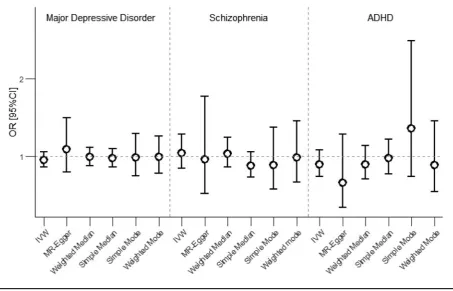
Results of the Mendelian randomization analyses testing causality in the association between birth weight and major depressive disorder, schizophrenia, and attention deficit hyperactivity disorder (ADHD). Error bars represent the 95% confidence intervals. Note: IVW=
inverse variance weighted.
Forest plots were also used to visually examine the degree of heterogeneity in causal estimates based on each individ-ual instrument (where non-overlapping confidence inter-vals indicate heterogenous effects).
Results
Power Analyses
Statistical power in a binary outcome MR analysis depends on sample size, cases-to-controls ratio, and on the coeffi-cient of determination of exposure on the instruments (R2;
Bowden et al.,2015). The SNPs used to instrument the MR analysis explained∼2% of the variance in BW (Horikoshi et al.,2016). Details on power, sample sizes and data sources are provided inTable 1.
The power analyses showed that our analyses were ade-quately powered (>80%) to detect a causal effectOR=1.2
given an alpha of 0.05. The power dropped under this opti-mal level when considering sopti-maller effect sizes (OR=1.1).
Mendelian Randomization Analyses Figure 1displays the MR results.
All the MR methods showed no evidence for a causal effect of BW on any of the outcomes (all 95% confidence intervals include odds ratio of 1). Figure S1 shows the MR estimates based on the individual instruments, and the combined causal estimates produced using the different two-sample MR estimators.
Tests of Horizontal Pleiotropy: MR-Egger and Funnel Plots
FIGURE 2
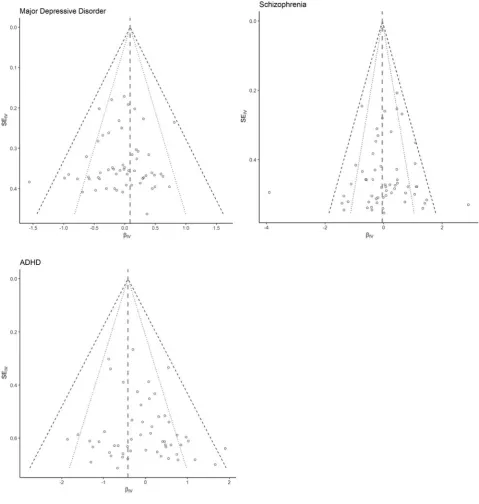
Forrest plots showing the relationship between causal estimates using each individual instrument (log odds) and the standard error of the estimate. The effects estimated based on MR-Egger are displayed as dashed grey vertical lines. The black dotted lines correspond to the lower and upper limits of the 95% confidence interval region, the black dashed lines corresponding to the 99% confidence interval region. Note: ADHD=attention deficit hyperactivity disorder.
causal effect of BW on any of the psychiatric disorders. Ad-ditionally, we could not reject the null hypothesis of no hor-izontal pleiotropy, as the test of the MR-Egger intercept was not significant; this result suggests that the assumption of ‘no horizontal pleiotropy’ holds. This is also demonstrated by funnel plots shown inFigure 2.
The plots were mostly symmetrical, which is consistent with the results of MR-Egger pleiotropy test.
Tests of Heterogeneity
Q(57)=97.554,p=7e-04; Schizophrenia: Cochran’s Q(57)
=231.647,p=6.46e-23; ADHD: Cochran’s Q(52)=97.72,
p=.0001). The large inter-instrument variation is also ev-ident in the forest plots in Figure S1.
Discussion
In this study, we used the two-sample MR procedure to test the Barker hypothesis concerning the fetal origins of adult mental disorders. We assessed whether the observed epi-demiological associations between BW, on the one hand, and ADHD, MDD, and schizophrenia, on the other, are causal. We used several methods that are robust to a cer-tain degree to violation of the ‘no pleiotropy’ assumption, hence providing a good means to check the validity of our results. Furthermore, we used several diagnostic tests that can detect bias resulting from potential assumption violation.
Our findings do not support a causal effect of BW on any of the outcomes that we considered. The results were con-sistent across the methods. However, the interpretation of these results hinges upon the tenability of all MR assump-tions. The first assumption (that the instrument associates robustly with the exposure variable) holds true, as the SNPs that we used as IV explained a significant proportion of the variance in BW (around 2%; Horikoshi et al.,2016). The second assumption (that the instrument is indepen-dent of confounders) cannot be tested rigorously because of the many potential confounders. According to Schlotz and Phillips (2009), socio-economic status, education, and maternal smoking may lead to an association between BW and mental disorders. To get an indication of whether the SNPs employed to instrument the current analyses asso-ciate with these potential confounders, we used summary statistics obtained from the GWASs of educational attain-ment (Okbay et al.,2016) and smoking behavior (Furberg et al., 2010). There were 26 and 59 BW-associated vari-ants that passed the quality control checks in the GWAS of smoking and in the GWAS of educational attainment, re-spectively. Of these, we identified only one SNP that passed the significance threshold of 0.05 in the GWAS of smok-ing, and 12 SNPs that associated with educational attain-ment (see Table S1 for details). We note that this alpha threshold is overly liberal given the large number of mul-tiple comparisons. We wanted to maximize the power to identify even very small genetic associations with the po-tential confounders. To check the effects of those correla-tions on our results, we ran the MR analyses after re-moving any SNP that showed a significant association with any of the confounders (13 SNPs removed). Excluding these SNPs from the analyses did not change the results and the current conclusions (see Figure S2). Davey-Smith and col-leagues (Smith,2011; Smith et al.,2007) also provided em-pirical support for the assumption that the genetic variants are distributed in the population independent of behavioral,
social, and physiological factors that might confound epi-demiological studies.
The MR-Egger pleiotropy test found no evidence for pleiotropic effects, although our results showed a high de-gree of heterogeneity (which might be indicative of hori-zontal pleiotropy). To further test this assumption, we used as an alternative test the recently developed MR-PRESSO (MR pleiotropy residual sum and outlier; Verbanck et al.,
2018). The MR-PRESSO conducts a global test to detect overall pleiotropy; next, variants yielding outlying causal effects are removed, as such SNPs likely have pleiotropic effects. While the test demonstrated that such outliers are present, correcting for them still produced no evidence for a causal effect (see Table S2).
Another important consideration when interpreting the results is statistical power. Our power analyses indicated that we had relatively good power to detect an effect as small as an odds ratio of 1.1 in the BW–MDD study, prob-ably owing to the large sample used in the GWAS of MDD (N = 173,005 individuals). The power was lower in the other analyses. The MR studies testing the causal associa-tion between BW and ADHD and schizophrenia had ade-quate power to detect effects as large as an odds ratio of 1.2 but not an effect of an odds ratio of 1.1.
range (up to 4.5 kg or more; Abel et al.,2010; Eide et al.,
2013). There is also evidence of no association between BW and schizophrenia (see, e.g., Gunnell et al.,2005), as well as evidence supporting a reverse J-shaped association, with the largest odds of developing schizophrenia observed in individuals with very small weight at birth (<2.5 kg; see, e.g., Gunnell et al.,2003; Moilanen et al.,2010). Unlike the present study, studies to date investigating the relationship between BW and mental disorders like schizophrenia and MDD were based on observational evidence and therefore cannot infer causality. It is likely that the previously re-ported associations reflect the effects of confounders, as ad-justment for known confounders does not suffice (Pingault et al.,2018); specifically, interpreting these associations as causal requires exhaustive adjustment for all possible con-founders, as well as the untestable assumption of absence of reverse causation. Our study, as the first to use the MR approach, which has distinct advantages such as increased ecologic validity and absence of confounding, does not sup-port a causal effect of BW on mental disorders. Our results, however, do not exclude the possibility of a causal associa-tion between (extremely) low BW (Lærum et al.,2017) and schizophrenia and more severe forms of depression (i.e., re-current severe depressive symptoms; Colman et al.,2007; Wojcik et al.,2013). Alternatively, it is possible that there is a small effect that went undetected in our study due to in-sufficient statistical power to detect relatively weak causal associations.
On the other hand, the evidence for the association be-tween low BW and ADHD produced by studies to date is more robust (Momany et al., 2018; Wiles et al.,2006). Importantly, there are also several studies that probed the causality in this association using the co-twin control method; these studies consistently demonstrated an effect of BW on ADHD symptoms and attention problems (Ficks et al.,2013; Groen-Blokhuis et al.,2011; Pettersson et al.,
2015). The co-twin method probes the causal effect of a risk factor on an outcome or disorder by comparing the within-pair mean differences/relative risk for developing the disor-der between unrelated participants, and monozygotic and dizygotic twin pairs discordant for exposure to the risk fac-tor (Hart et al.,2013; Kendler et al.,1993; Middeldorp et al.,
2008). While these studies employed a continuous measure of attention problems, our study was based on summary statistics obtained in the GWAS of ADHD (Demontis et al.,
2017), which employed a dichotomous outcome (the pres-ence or abspres-ence of ADHD, assessed based on a diagnos-tic interview or reported by parents or teachers). Using a continuous outcome confers larger statistical power rela-tive to using a dichotomous measure (Groen-Blokhuis et al.,
2011). Again, our results do not exclude the possibility that there is a small causal effect that was not detected in our study due to weak instruments and the use of a dichoto-mous phenotype. Another possible explanation of the dif-ferences in the results is that the co-twin control method
makes strong assumptions concerning the environmental influences not shared within a twin pair (Hart et al.,2013). It is plausible that there are intrauterine factors not controlled for by this design — such as the difference in blood flow between twins — that could confound the relationship be-tween BW and attention problems.
The Barker hypothesis suggests that poor fetal environ-ment is linked to increased risk of adult diseases. BW is of-ten used as a proxy for fetal development; yet, it might be possible that BW is a poor indicator of intrauterine factors contributing to the later development of mental disorders. To explore this possibility, we tested for causal effects us-ing another indicator of fetal development — gestational age — by employing the same MR methods. These analyses also produced no evidence for a causal effect of gestational age on mental disorders (see Figure S3). These findings do provide additional support for our results; however, it must be noted that these new analyses had limitations, such as the small number of available instrumental SNPs, low pro-portion of variance explained in the exposure (weak instru-ments), and low statistical power.
Strengths and Limitations
To our knowledge, this is the first study to evaluate the effect of BW on mental disorders by using new statistical methods that can test causal hypothesis on the basis of genetic data. MR methods provide several advantages over the observa-tional analysis, such as producing a causal effect estimate free from the effects of confounders (Lawlor et al., 2008; Pingault et al.,2018). Furthermore, the study applied var-ious methods, each employing different assumptions. The fact that these different approaches yielded consistent re-sults increases the likelihood that our rere-sults are robust. In addition, this study is the first to make use of summary statistics of the recently published GWASs to test the fetal origins of mental disorders.
Although MR-PRESSO is more powerful, its power de-pends heavily on the proportion of pleiotropic variants that made up the instrument. MR-PRESSO has good power if at least 10% of the variants have pleiotropic effects (Verbanck et al.,2018). However, a single pleiotropic variant is suffi-cient to bias the MR results. One final issue is that the as-sessment of outcomes was not always based on a clinical diagnosis; this might potentially affect the accuracy of the results.
Conclusion
Based on the current findings, we found no support for the Barker hypothesis concerning the fetal origins of mental disorders. To account for lack of power to identify small ef-fects, it is important to re-run the analysis when more SNPs associated with BW are identified, resulting in stronger in-struments. One way to further explore pleiotropy is to com-bine MR with twin models using the MR-direction of cau-sation model (Minic˘a et al.,2018). In addition, indicators for fetal development other than BW can be used as prox-ies, such as height at birth and head circumference.
Acknowledgments
Camelia C. Minic˘a was supported by the National Institute on Drug Abuse (grant number DA-018673). Subhi Arafat was supported by The European Union Education, Audio-visual and Culture Executive Agency.
Conflict of Interest
The authors have no conflict of interest to declare.
Supplementary material
To view supplementary material for this article, please visit
https://doi.org/10.1017/thg.2018.65
References
Abel, K. M., Wicks, S., Susser, E. S., Dalman, C., Pedersen, M. G., Mortensen, P. B., & Webb, R. T. (2010). Birth weight, schizophrenia, and adult mental disorder: Is risk confined to the smallest babies?Archives of General Psychiatry, 67, 923–930.
Barker, D. J., & Osmond, C. (1986). Infant mortality, child-hood nutrition, and ischaemic heart disease in England and Wales.The Lancet, 327, 1077–1081.
Bowden, J., Davey Smith, G., & Burgess, S. (2015). Mendelian randomization with invalid instruments: Effect estimation and bias detection through Egger regression.International Journal of Epidemiology, 44, 512–525.
Bowden, J., Davey Smith, G., Haycock, P. C., & Burgess, S. (2016). Consistent estimation in Mendelian randomization with some invalid instruments using a weighted median es-timator.Genetic Epidemiology, 40, 304–314.
Bowden, J., Del Greco, M. F., Minelli, C., Davey Smith, G., Sheehan, N., & Thompson, J. (2017). A framework for the investigation of pleiotropy in two-sample summary data Mendelian randomization.Statistics in Medicine, 36, 1783– 1802.
Burgess, S., Butterworth, A., & Thompson, S. G. (2013). Mendelian randomization analysis with multiple genetic variants using summarized data.Genetic Epidemiology, 37, 658–665.
Burgess, S., & Thompson, S. G. (2015).Mendelian randomiza-tion: Methods for using genetic variants in causal estimatio. London, UK: Chapman & Hall/CRC Press.
Burgess, S., & Thompson, S. G. (2017). Interpreting find-ings from Mendelian randomization using the MR-Egger method.European Journal of Epidemiology, 32, 377–389. Cannon, M., Jones, P. B., & Murray, R. M. (2002).
Obstet-ric complications and schizophrenia: HistoObstet-rical and meta-analytic review.American Journal of Psychiatry, 159, 1080– 1092.
Colman, I., Ploubidis, G. B., Wadsworth, M. E., Jones, P. B., & Croudace, T. J. (2007). A longitudinal typology of symp-toms of depression and anxiety over the life course. Biolog-ical Psychiatry, 62, 1265–1271.
Davey Smith, G., & Ebrahim, S. (2003). ‘Mendelian random-ization’: Can genetic epidemiology contribute to under-standing environmental determinants of disease?. Interna-tional Journal of Epidemiology, 32, 1–22.
De Mola, C. L., De França, G. V. A., de Avila Quevedo, L., & Horta, B. L. (2014). Low birth weight, preterm birth and small for gestational age association with adult depression: Systematic review and meta-analysis.The British Journal of Psychiatry, 205, 340–347.
Demontis, D., Walters, R. K., Martin, J., Mattheisen, M., Als, T. D., Agerbo, E., Belliveau, R., Bybjerg-Grauholm, J., Bækvad-Hansen, M., Cerrato, F., Chambert, K., Churchhouse, C., Dumont, A., Eriksson, N., Gandal, M., Goldstein, J., Grove, J., Hansen, C. S., Hauberg, M. E., Hollegaard, M. V., Howrigan, D. P., Huang, H., Maller, J., Martin, A. R., Moran, J., Pallesen, J., Palmer, D. S., Pedersen, C. B., Pedersen, M. G., Poterba, T., Poulsen, J. B., Ripke, S., Robinson, E. B., Satterstrom, K. F., Stevens, C., Turley, P., Won, H., ADHD Working Group of the Psy-chiatric Genomics Consortium (PGC), Early Lifecourse & Genetic Epidemiology (EAGLE) Consortium, 23andMe Research Team, Andreassen, O. A., Burton, C., Boomsma, D., Cormand, B., Dalsgaard, S., Franke, B., Gelernter, J., Geschwind, D., Hakonarson, H., Haavik, J., Kranzler, H., Kuntsi, J., Langley, K., Lesch, K.-P., Middeldorp, C., Reif, A., Rohde, L. A., Roussos, P., Schachar, R., Sklar, P., SonugaBarke, E., Sullivan, P. F., Thapar, A., Tung, J., Waldman, I., Nordentoft, M., Hougaard, D. M., Werge, T., Mors, O., Mortensen, P. B., Daly, M. J., Faraone, S. V., Børglum, A. D., Neale, B. M. & Cerrato, F. (2017). Dis-covery of the first genome-wide significant risk loci for ADHD.BioRxiv, 145581.
Evans, D. M., & Davey Smith, G. (2015). Mendelian random-ization: New applications in the coming age of hypothesis-free causality.Annual Review of Genomics and Human Ge-netics, 16, 327–350.
Ficks, C. A., Lahey, B. B., & Waldman, I. D. (2013). Does low birth weight share common genetic or environmental risk with childhood disruptive disorders?.Journal of Abnormal Psychology, 122, 842–853.
Furberg, H., Kim, Y., Dackor, J., Boerwinkle, E., Franceschini, N., Ardissino, D., … Merlini, P. A. (2010). Genome-wide meta-analyses identify multiple loci associated with smok-ing behavior.Nature Genetics, 42, 441–447.
Gale, C. R., & Martyn, C. N. (2004). Birth weight and later risk of depression in a national birth cohort.The British Journal of Psychiatry, 184, 28–33.
Greco, M. F. D., Minelli, C., Sheehan, N. A., & Thompson, J. R. (2015). Detecting pleiotropy in Mendelian randomisation studies with summary data and a con-tinuous outcome.Statistics in Medicine, 34, 2926–2940. Groen-Blokhuis, M. M., Middeldorp, C. M., van Beijsterveldt,
C. E., & Boomsma, D. I. (2011). Evidence for a causal asso-ciation of low birth weight and attention problems.Journal of the American Academy of Child & Adolescent Psychiatry, 50, 1247–1254.
Gunnell, D., Harrison, G., Whitley, E., Lewis, G., Tynelius, P., & Rasmussen, F. (2005). The association of fetal and child-hood growth with risk of schizophrenia. Cohort study of 720,000 Swedish men and women.Schizophrenia Research, 79, 315–322.
Gunnell, D., Rasmussen, F., Fouskakis, D., Tynelius, P., & Harrison, G. (2003). Patterns of fetal and childhood growth and the development of psychosis in young males: A cohort study.American Journal of Epidemiology, 158, 291–300. Hales, C. N., & Barker, D. J. (1992). Type 2
(non-insulin-dependent) diabetes mellitus: The thrifty phenotype hy-pothesis.Diabetologia, 35, 595–601.
Hales, C. N., & Barker, D. J. (2001). The thrifty phenotype hy-pothesis.British Medical Bulletin, 60, 5–20.
Hart, S. A., Taylor, J., & Schatschneider, C. (2013). There is a world outside of experimental designs: Using twins to in-vestigate causation.Assessment for Effective Intervention, 38, 117–126.
Hartwig, F. P., Davey Smith, G., & Bowden, J. (2017). Robust inference in summary data Mendelian randomization via the zero modal pleiotropy assumption.International Jour-nal of Epidemiology, 46, 1985–1998.
Horikoshi, M., Beaumont, R. N., Day, F. R., Warrington, N. M., Kooijman, M. N., Fernandez-Tajes, J.,… Grarup, N. (2016). Genome-wide associations for birth weight and cor-relations with adult disease.Nature, 538, 248–252. Huxley, R., Neil, A., & Collins, R. (2002). Unravelling the
fe-tal origins hypothesis: Is there really an inverse association between birthweight and subsequent blood pressure?.The Lancet,360, 659–665.
Inskip, H. M., Dunn, N., Godfrey, K. M., Cooper, C., Kendrick, T., & Southampton Women’s Survey Study, G. (2008). Is birth weight associated with risk of depressive
symptoms in young women? Evidence from the Southamp-ton women’s survey.American Journal of Epidemiology, 167, 164–168.
Kendler, K. S., Neale, M. C., MacLean, C. J., Heath, A. C., Eaves, L. J., & Kessler, R. C. (1993). Smoking and major de-pression: A causal analysis.Archives of General Psychiatry, 50, 36–43.
Lærum, A. M., Reitan, S. K., Evensen, K. A. I., Lydersen, S., Brubakk, A.-M., Skranes, J., & Indredavik, M. S. (2017). Psychiatric disorders and general functioning in low birth weight adults: A longitudinal study.Pediatrics,27(8): 1133– 63. e20162135.
Lawlor, D. A., Harbord, R. M., Sterne, J. A., Timpson, N., & Davey Smith, G. (2008). Mendelian randomization: Using genes as instruments for making causal inferences in epi-demiology.Statistics in Medicine, 27, 1133–1163.
Middeldorp, C., Cath, D., Beem, A., Willemsen, G., & Boomsma, D. (2008). Life events, anxious depression and personality: A prospective and genetic study.Psychological Medicine, 38, 1557–1565.
Minic˘a, C. C., Dolan, C. V., Boomsma, D. I.et al.(2018). Be-hav Genet 48(8): 337. https://doi.org/10.1007/s10519-018-9904-4.
Minic˘a, C. C., Dolan, C. V., Boomsma, D. I., de Geus, E., & Neale, M. C. (2018). Extending causality tests with ge-netic instruments: An integration of Mendelian random-ization with the classical twin design.Behavior Genetics, 1–13.
Moilanen, K., Jokelainen, J., Jones, P. B., Hartikainen, A.-L., Järvelin, M.-R., & Isohanni, M. (2010). Deviant intrauter-ine growth and risk of schizophrenia: A 34-year follow-up of the Northern Finland 1966 Birth Cohort.Schizophrenia Research, 124, 223–230.
Momany, A. M., Kamradt, J. M., & Nikolas, M. A. (2018). A meta-analysis of the association between birth weight and attention deficit hyperactivity disorder.Journal of Abnormal Child Psychology, 46, 1409–1426.
O’Donnell, K. J., & Meaney, M. J. (2016). Fetal origins of mental health: The developmental origins of health and disease hypothesis. American Journal of Psychiatry, 174, 319–328.
Okbay, A., Beauchamp, J. P., Fontana, M. A., Lee, J. J., Pers, T. H., Rietveld, C. A., … Meddens, S. F. W. (2016). Genome-wide association study identifies 74 loci associ-ated with educational attainment.Nature, 533, 539–542. Osler, M., Nordentoft, M., & Andersen, A.-M. N. (2005). Birth
dimensions and risk of depression in adulthood: Cohort study of Danish men born in 1953.The British Journal of Psychiatry, 186, 400–403.
Pettersson, E., Sjölander, A., Almqvist, C., Anckarsäter, H., D’Onofrio, B. M., Lichtenstein, P., & Larsson, H. (2015). Birth weight as an independent predictor of ADHD symp-toms: A within-twin pair analysis.Journal of Child Psychol-ogy and Psychiatry, 56, 453–459.
Räikkönen, K., Pesonen, A.-K., Roseboom, T. J., & Eriksson, J. G. (2012). Early determinants of mental health.Best Prac-tice & Research Clinical Endocrinology & Metabolism, 26, 599–611.
Ripke, S., O’Dushlaine, C., Chambert, K., Moran, J. L., Kähler, A. K., Akterin, S., … Fromer, M. (2013). Genome-wide as-sociation analysis identifies 13 new risk loci for schizophre-nia.Nature Genetics, 45, 1150–1159.
Schlotz, W., & Phillips, D. I. (2009). Fetal origins of mental health: Evidence and mechanisms.Brain, Behavior, and Im-munity, 23, 905–916.
Skogen, J. C., & Øverland, S. (2012). The fetal origins of adult disease: A narrative review of the epidemiological litera-ture.JRSM Short Reports, 3, 1–7.
Smith, G. D. (2011). Use of genetic markers and gene-diet in-teractions for interrogating population-level causal influ-ences of diet on health.Genes & Nutrition, 6, 27–43. Smith, G. D., Lawlor, D. A., Harbord, R., Timpson, N., Day,
I., & Ebrahim, S. (2007). Clustered environments and randomized genes: A fundamental distinction between conventional and genetic epidemiology.PLoS Medicine, 4, e352.
Thompson, C., Syddall, H., Rodin, I., Osmond, C., & Barker, D. J. (2001). Birth weight and the risk of depressive disorder in late life.The British Journal of Psychiatry, 179, 450–455. Verbanck, M., Chen, C.-Y., Neale, B., & Do, R. (2018).
De-tection of widespread horizontal pleiotropy in causal
rela-tionships inferred from Mendelian randomization between complex traits and diseases.Nature Genetics, 50, 693. Wang, T., Huang, T., Li, Y., Zheng, Y., Manson, J. E., Hu, F. B.,
& Qi, L. (2016). Low birthweight and risk of type 2 diabetes: A Mendelian randomisation study.Diabetologia, 59, 1920– 1927.
Wickham, H. (2010). ggplot2: Elegant graphics for data analy-sis.Journal of Statistical Software, 35, 65–88.
Wiles, N. J., Peters, T. J., Heron, J., Gunnell, D., Emond, A., & Lewis, G. (2006). Fetal growth and childhood behavioral problems: Results from the ALSPAC cohort.American Jour-nal of Epidemiology, 163, 829–837.
Wojcik, W., Lee, W., Colman, I., Hardy, R., & Hotopf, M. (2013). Foetal origins of depression? A systematic review and meta-analysis of low birth weight and later depression. Psychological Medicine, 43, 1–12.
Wray, N. R., Ripke, S., Mattheisen, M., Trzaskowski, M., Byrne, E. M., Abdellaoui, A., … Andlauer, T. M. (2018). Genome-wide association analyses identify 44 risk variants and re-fine the genetic architecture of major depression.Nature Genetics, 50, 668–681.