Available online on 15.06.2019 at http://jddtonline.info
Journal of Drug Delivery and Therapeutics
Open Access to Pharmaceutical and Medical Research© 2011-18, publisher and licensee JDDT, This is an Open Access article which permits unrestricted non-commercial use, provided the original work is properly cited
Open Access
Research Article
Formulation and Evaluation of Ezetimibe Lyophilized Dry Emulsion Tablets
Patil Dhananjay *, Bachhav Rakesh, Gosavi Dipika, Pagar Rahul, Bairagi Vinod
KBHSS Trust’s Institute of Pharmacy, Malegaon Camp, Malegaon – 423105, Dist – Nasik (MS), India
ABSTRACT
This article presents the development of lyophilized dry emulsion tablets prepared with the dry emulsion technique to enhance the in-vitro dissolution and in-vivo performance of the poorly bioavailable drug Ezetimibe. Ezetimibe (EZT) is a lipid-lowering drug that inhibits intestinal uptake of dietary and biliary cholesterol without affecting the absorption of fat-soluble nutrients. Ezetimibe has a very low solubility and dissolution rate resulting in highly variable bioavailability, which is also in part due to extensive efflux by p-glycoprotein (P-Gp). Tablets were fabricated by freezedrying o/w emulsions of Ezetimibe. The Emulsions were prepared using a matrix former solution (alginate or gelatin, 2 or 4%) containing a sugar alcohol (mannitol), as the water phase and Labrafac® as the oil phase under proper homogenization. In the present study friability, disintegration time, and in-vitro dissolutionof lyophilized dry emulsion tablets were done. Results showed the significant influence of the matrix former and emulsifier type on the disintegration time. In-vitro dissolution studies revealed the enhanced dissolution rate of Ezetimibe from the lyophilized tablets compared to the plain drug. DSC studies proved presence of the drug in the amorphous form in the fabricated tablets. The obtained results suggest a promising, easy-to-manufacture and effective dosage form for the treatment of hyperlipidemia.
Keywords: Ezetimibe, lyophilized dry emulsion tablet, and hyperlipidemia, freeze drying, Labrafac.
Article Info:Received 04 May 2019; Review Completed 06 June 2019; Accepted 10 June 2019; Available online 15 June 2019
Cite this article as:
Patil D, Bachhav R, Gosavi D, Pagar R, Bairagi V, Formulation and Evaluation of Ezetimibe Lyophilized Dry Emulsion
Tablets, Journal of Drug Delivery and Therapeutics. 2019; 9(3-s):630-635
http://dx.doi.org/10.22270/jddt.v9i3-s.2926
*Address for Correspondence:
Patil Dhananjay, KBHSS Trust’s Institute of Pharmacy, Malegaon, Nashik, MS, India.
1.
INTRODUCTION
Ezetimibe is an antihyperlipidemic agent capable of lowering blood cholesterol levels. It shows one of the most widely administered oral statins used in case of elevated plasma levels of cholesterol, triglycerides (TG), low-density lipoproteins (LDL) in addition to its ability to elevate the high-density lipoproteins (HDL). Ezetimibe (EZT) is a lipid-lowering drug that inhibits intestinal uptake of dietary and biliary cholesterol without affecting the absorption of fat-soluble nutrients. Ezetimibe is classified according to the biopharmaceutical classification system (BCS) as a class II drug , insoluble in aqueous solutions of pH 4 and below, while being very slightly soluble in water and ezetimibe shows limited oral bioavailability of about 14% which is attributed to its poor aqueous solubility, crystalline nature, hepatic first-pass metabolism and mucosal gastrointestinal
presystemic clearance. (1-3)
Hyperlipidemia is abnormally elevated levels of any or all lipids or lipoproteins in the blood. It is the most common form of dyslipidemia (which includes any abnormal lipid levels). (4)
In this research work, the importance of freeze dried tablet for enhancing the solubility of Ezetimibe was explored through the formulation of lyophilized dry emulsion tablet (LDET). The LDET formulation offers the advantages of both emulsions and freeze dried dosage forms. By preparing emulsion is efficient in improving dissolution rate and bioavailability of the poorly water-soluble drugs. When the freeze-dried dosage forms offer, good preservation and stability.(5)
Another specific advantage of freeze-dried formulations as a final dry product being a network of solid occupying the same volume as the original solution that was initially frozen, whereby, a light and porous product readily soluble is
produced.(6)
water-soluble polymer and accelerate the disintegration of tablets.(7-8)
In the present work, gelatin and alginate in combination with mannitol were used as the base for the formulation of
lyophilized dry emulsion tablet. (9) Gelatin, a mixture of
proteins, is an inexpensive polymer abundantly available in nature, can be readily processed into numerous forms and shapes. Being biocompatible, biodegradabile, non-toxic and non-immunogenic, both sodium alginate and gelatin have attracted high consideration and are extensively used in various biological applications. The selection of these excipients can potentially benefit the formulation in many ways. They are expected to form the highly porous matrix structure necessary for such dosage form. Also, the structural strength was provided by the gelatine whilst the crystallinity, hardness and elegance were provided by mannitol. Sublimation of water, the process media, induces the porous
structure during the freeze drying stage. (10-11)
The purpose of the present work was the development of fast disintegrating tablets for Ezetimibe formulated using combined emulsion-freeze drying techniques exploring the impact of the selected excipients through evaluation of the LDET produced, aiming at reducing the disintegration time and enhancing the dissolution rate of the drug.
2.
MATERIALS AND METHODS
Materials: Ezetimibe was kindly donated by Glenmark, Mumbai. Labrafac® lipophile WL 1349 (caprylic-capric acid
triglycerides) was supplied from Fine organics, Mumbai. Gelatin, D-Mannitol and Glycine, Sodium alginate from brown algae was provided from Vishal chemicals Mumbai.
Method
Preparation of lyophilized dry emulsion tablets
Ezetimibe lyophilized dry emulsion tablets were prepared as per Table No. 1 using either gelatin as the matrix former, a sugar alcohol (mannitol) and a collapse protectant (glycine). The emulsion was first prepared where mannitol and glycine were added to a solution of gelatin or alginate containing the surfactant, thus forming the aqueous phase. On the other hand, the oil phase was composed of 30 mg of Ezetimibe solubilized in Labrafac® lipophile WL 1349 (6%). The oil phase was then added to the aqueous phase containing matrix former, a sugar alcohol and a collapse protectant, under homogenization at 15,000 rpm for 5 min.
Prepared emulsion were then transferred to a freezer at -22°C and kept for 24 h. The frozen tablets materials were placed for 24 h in a Novalyphe-NL 500 Freeze Dryer with a condenser temperature of -45°C and a pressure of 7x10⁻² for 3 days. Then the freeze dried composition should be compressed into tablets by adding croscarmellose sodium, microcrystalline cellulose, and magnesium stearate.
Table 1: Composition of Lyophilized Ezetimibe freeze dried tablet Sr.
No. Ingredients F1 F2 F3 F4 F5 F6
1 Ezetimibe (mg) 10 10 10 10 10 10
2 Gelatin (%) 3 3.2 3.4 3.6 3.8 4
3 Sodium alginate(%) 2 1.8 1.6 1.4 1.2 1
4 Mannitol (%) 0.886 0.886 0.886 0.886 0.886 0.886
5 Labrafac (%) 6 6 6 6 6 6
6 MCC (mg) 4 4 4 4 4 4
7 CCS (mg) 10 10 10 10 10 10
8 Magnesium Stearate (mg) 5 5 5 5 5 5
3.
RESULTS AND DISCUSSION
Compatibility studies – FTIR:
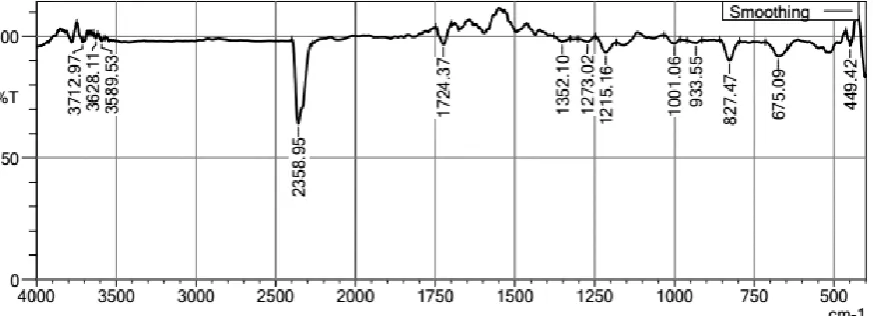
The FTIR spectra of the Ezetimibe and physical mixture of polymer were recorded to check interaction between drug
and polymers. The characteristic peaks of Ezetimibe appeared in the spectrum of physical mixture without any significant change in the position. It indicates that there was no interaction between Ezetimibe and physical mixture of polymers.
Figure 2: FTIR spectra of physical mixture Differential Scanning Calorimetry (DSC):
DSC thermograms of pure Ezetimibe and drug excipient mixture are shown in Fig. and Fig. respectively. Results have shown that the sharp exothermic peak was observed of
the drug individually at 164.20C, corresponding to its
melting point (1620C -1640C). For the sample containing the
drug and selected excipient mixture, sharp peak was
observed of the drug at 164.90C with reduction in peak
intensity. Thus as there was not a significant shift in exothermic peak of drug as that obtained from individual drug sample, it can be concluded that there was no interaction occurred between the excipient and drug Ezetimibe. Thus the Ezetimibe was found to be compatible with the selected excipient.
Figure 3: Differential Scanning Colorimetry of Ezetimibe Pure Drug.
Table 2: Evaluation parameters of tablets
Formuation Uniformity of
weight(%RSD) Friability (%) Total content (%) ezetimibe Disintegration time(s)
F1 0.55±0.17 0.65±0.30 98.06±1.4 158±0.94
F2 0.45±0.1 0.64±0.27 96.00±1.3 154±1.6
F3 0.44±0.1 0.63±0.25 97.70±1.3 150±1.88
F4 0.52±0.17 0.44±0.1 98.34±1.1 150±1.88
F5 0.42±0.3 0.69±0.06 98.04±1.2 140±1.24
F6 0.45±0.1 0.42±0.3 97.70±1.3 138±1.6
The data is presented as (n=3) mean value ±S.D.
Table 3: Dissolution profile of various batches of tablets in 4.5pH acetate buffer
Time (min.) % drug release
F1 F2 F3 F4 F5 F6
00 00 00 00 00 00 00
15 5.4 7.65 20.7 7.9 15.3 7.8
30 17.55 15.3 32.45 18.5 34.7 26.35
45 25.25 29.3 41.58 47.3 43.8 59.4
60 42.85 60.9 53.75 74.0 67.7 96.4
90 56.9 62.4 74.95 77.3 85.85 97.5
120 64.2 72.75 86.8 89.9 94.95 98.0
Figure 6: Dissolution profile of various batches of tablets in 4.5pH acetate buffer. Kinetics of Drug Release
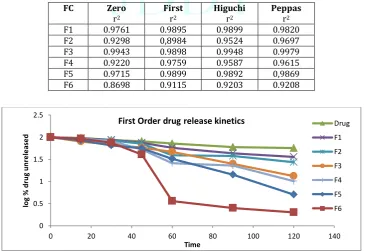
The value of coefficient of regression for different models of different mouth dissolving film formulations is given in Table No. 4 Table No. 4: Kinetic parameters of Ezetimibe dry emulsion tablets.
FC Zero
r2 First r2 Higuchi r2 Peppas r2
F1 0.9761 0.9895 0.9899 0.9820
F2 0.9298 0,8984 0.9524 0.9697
F3 0.9943 0.9898 0.9948 0.9979
F4 0.9220 0.9759 0.9587 0.9615
F5 0.9715 0.9899 0.9892 0,9869
F6 0.8698 0.9115 0.9203 0.9208
Figure 7: first order drug release kinetics 0 20 40 60 80 100 120
0 20 40 60 80 100 120 140
% cu m u la ti ve d ru g re le as e
Time in minutes
Dissolution profile of Ezetimibe F1
F2 F3 F4 F5 F6 0 0.5 1 1.5 2 2.5
0 20 40 60 80 100 120 140
lo g % d ru g u n re le as e d Time
First Order drug release kinetics Drug
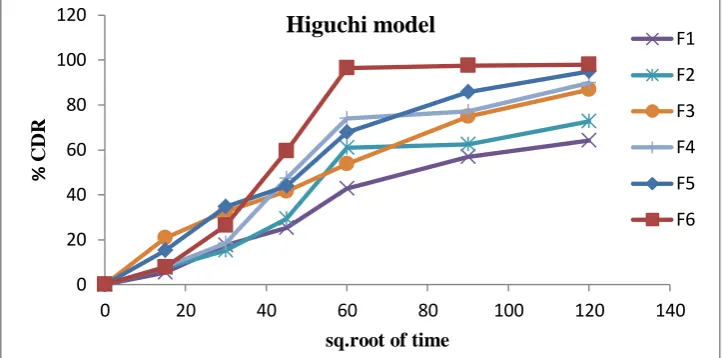
Figure 8: Higuchi model
Figure 9: Korsmeyer/Peppas model
4.
DISCUSSION
Binding agent is a important aspect in the formulation of LDET, because of it increases the hardness of tablets and also reduce the surface tension of the drug. In current formulation gelatine is used as a binder for freeze dried tablet and it acts also matrix former. Other excipients like sugar alcohol to produce the porous structure to the lyophilised matrix, which positively increase solubility of formulation. The porous structure of dosage form which leads to difficult to handling, so to influence of freeze dried tablets by evaluating the gelatine as a binder or other excipients.
All prepared tablets were acceptable weight variation values as indicated by the relative standard deviation (RSD) of the tablet mass which ranged from 0.42 to 0.55%.
Tablet friability was determined by Roche Friabilator and weight loss was calculated and presented in terms of % friability. From table we can say that percentage weight loss of tablets of each formulation was found in the range 0.42 ±0.3 to o.65 ±0.3. It had found that the disintegration time of all tablet batches is ranging from 138±1.6 to 158±0.9.
The total Ezetimibe content was found to be uniform along
all formulation and ranged from 96±1.3 to 98.34±1.1.
In-vitro dissolution study of the Ezetimibe freeze dried tablet
show significant percentage drug release in the formulation F6, because of higher percentage of gelatine produce the hydrophilicity of drug molecule and also reduce surface tension of same.
5.
CONCLUSION
Ezetimibe lyophilized dry emulsion tablets were successfully fabricated applying the lyophilization technique using Labrafac®, mannitol, glycine and gelatin.The poorly water soluble drug Ezetimibe used in the preparation was characterized for preformulation and spectral analysis by UV spectroscopy and FTIR spectroscopy. The physical characteristics and spectra of Ezetimibe were found to be identical with standard given in analytical profile of drug substance. Polymer and drug were checked for compatibility by FTIR and DSC. It was evident that there was no probable unnecessary interaction found between drug and polymer. Preferable tablet properties were obtained regarding friability and uniformity of weight in addition to enhanced drug release properties and excellent disintegration characteristics which are showed in formulation F6.
0
20
40
60
80
100
120
0
20
40
60
80
100
120
140
%
CDR
sq.root of time
Higuchi model
F1
F2
F3
F4
F5
F6
0
0.5
1
1.5
2
2.5
0
0.5
1
1.5
2
2.5
lo
g
%
C
D
R
log time
Korsmeyer/Peppas model
F1
F2
F3
F4
F5
REFERENCES
1. Salama AH, Basha M, Sally El, Experimentally designed lyophilized dry emulsion tablets for enhancing the antihyperlipidemic activity of atorvastatin calcium: Preparation, in-vitro evaluation and in-vivo assessment, European Journal of Pharmaceutical Sciences, 2017, 28-29. 2. Patil PP, Kate V, Payghan S, Potential Investigation of Peceol
for formulation of Ezetimibe self nano emulsifying Drug Delivery Systems Asian Journal of Biomedical and Pharmaceutical Sciences, 2016, 21-32.
3. Patil PP, Kate V, Payghan S, Development and Stability Assessment of Solid Self-micro Emulsifying System for Oral Bioavailability of Ezetimibe using Spray-drying Technique, Inventi Rapid: Pharmaceutical Process Development, 2016, 1-8.
4. https://en.wikipedia.org/w/index.php?title=Hyperlipidemia& oldid=890800569
5. Niczinger NA, Barnab´as K´allai S, Lengyel P, Antal K, Physicochemical analysis in the evaluation of reconstituted dry emulsion tablets, Journal of Pharmaceutical and Biomedical Analysis, 2016, 1-16.
6. Aulton, M.E, Pharmaceutics: The Science of Dosage Form Design. 2nd ed. Churchill Livingstone, Edinburgh, Scotland, 2002, 390-393.
7. Vora, N., Rana, V, Preparation and optimization of mouth/orally dissolving tablets using a combination of glycine, carboxymethyl cellulose and sodium alginate: a comparison with superdisintegrants, Pharmaceutical development and technology 2013, 233-243.
8. Stange U, Fuhrling C, Gieseler H, Formulation, preparation, and evaluation of novel orally disintegrating tablets containing taste-masked naproxen sodium granules and naratriptan hydrochloride, Journal of pharmaceutical sciences 103, 2014 1233-1245.
9. Liling G, Jiachao X, Xin G, Xiaoting F, Qing, Z, Effects of ionic crosslinking on physical and mechanical properties of alginate mulching films. Carbohydrate polymers 136, 2016, 259-265. 10. Sastry, SV, Nyshadham, JR, Fix, JA, Recent technological
advances in oral drug delivery - a review. Pharmaceutical science & technology today 3, 2000, 138-145.