www.scienceworldjournal.org ISSN 1597-6343
Optimization of Traffic Light Control System of an Intersection Using Fuzzy Inference System
OPTIMIZATION OF TRAFFIC LIGHT CONTROL SYSTEM OF AN
INTERSECTION USING FUZZY INFERENCE SYSTEM
Babangida Zachariah1 , Peter Ayuba2 and Luhutyit Peter Damuut 3
1, 2, 3 Department of Mathematical Sciences, Kaduna State University, Kaduna – Nigeria.
Authors e-mail addresses: [email protected]; [email protected]2 and [email protected]3
ABSTRACT
This paper considers an automated static road traffic control system of an intersection for the purpose of minimizing the effects of traffic jam and hence its attendant consequences such as prolonged waiting time, emission of toxic hydrocarbons from automobiles, etc. Using real-time road traffic data, a dynamic round-robin allocation of right-of-way to road users based on fuzzy inference system (FIS) was implemented as a decision support tool. The static phase scheduling algorithm for traffic light systems was used as a benchmark to measure the performance of our technique which is based on dynamic phase scheduling algorithm. The performance comparison records a significant improvement of about 65.35% in average waiting time. This clearly demonstrates the efficacy and potential of our solution strategy to address the traffic scheduling problem.
Keywords: Fuzzy Logic; Traffic Control Systems; Dynamic Phase Scheduling; Static Phase Scheduling, Fuzzy Sets
INTRODUCTION
There is no positive correlation between the rate at which new vehicles are being manufactured and purchased on the one hand and the corresponding capacity of roads creation due to a number of reasons including costs. Though roads are continually being created for road transport system, they have far less capacity to contain the number of vehicles being used daily leading to road traffic congestion. These concerns often lead to the creation of more road networks to address such concerns. However, the continuous increase in the number of vehicles renders this effort ineffective. This implies that traffic congestions require more effective and efficient management techniques; especially, where there are conflicts on the right-of-way introduced by the road networks.
One approach to traffic management is the Manual Traffic Management (MTM), where a Traffic Police officer is assigned to a conflicting right-of-way location to perform real-time scheduling using his intuition based on the situation of the road traffic at any point in time. The real-time scheduling is the advantage of MTM. However, the inefficiency associated with humans such as loss of concentration, unfair scheduling resulting in high chances of crashes and deadlocks often renders this method inefficient. Another approach to traffic management is the automated Traffic Light System (TLS). This scheme which is based on static scheduling, replaces the human being in the MTM. The TLS usually has the Green Wave, Yellow Wave, and Red Wave. While the Green implies assignment of the right-of-way, the Yellow
implies slow down and stop if it is safe and the Red implies stop. The downside of the Static Phase Scheduling of Traffic Light System (SPSTLS) is its inefficiency because of its use of fixed time phase duration for the scheduling (Salehi, Iman, & Yarahmadi, 2014). For example, when the control assigns green wave of 30 seconds to a particular road direction (flow), whether there are vehicles passing or not the green wave remains for such a direction until the time elapses. This implies that the road is ineffectively used irrespective of those waiting to be given the right-of-way. This leads to unnecessary longer waiting times which may arouse impatient drivers drive through even when they have not been scheduled, leading to possibility of deadlocks, crashes and other associated challenges.
For the purpose of improving the SPSTLS for effective traffic management, dynamic phase durations were introduced. The longer phase durations are assigned to the lane with more traffic congestions (having high priority) and shorter phase durations to the lanes with little traffic (having low priority). This is called Dynamic Phase Scheduling of Traffic Light System (DPSTLS). This works well with real-time traffic data much like the MTM approach to traffic management but with little or without the limitations of MTM.
This paper therefore seeks to optimize the allocation of right-of-way to road users (moving vehicles). Using fuzzy logic tools interfaced with a DPSTLS system, we seek to increase the efficiency of the utilization of a specific road junction by commuters especially during peak periods of a working day. The rest of the paper is organized as follows: Section 2.0 presents a review of related literature on the problem domain; section 3.0 presents the framework while section 4.0 presents simulation setup as well as a discussion of the results. The paper is concluded in section 5.0 with a summary of our perspective on any further work improvements.
LITERATURE REVIEW
Control system coordinates the traffic light Green, Amber, and Red Phase Durations which determines the efficiency of the system. Both the traffic light and the control system can be implemented on real hardware system or simulated using simulation tools. However, due to cost and need for higher efficiency, it is often simulated before being implemented on hardware (Hao, Xingguo, & Xuan, 2014; Qing & Jun, 2015). Traffic Light Control Systems may be implemented based on SPSTLS where the signal offset, phase duration, and optimal schedule are determined using historical data. This approach has since been applied in such simulators as MAXBAND (Little, 1966)
Fu
ll L
en
gt
h Rese
ar
ch
Ar
Optimization of Traffic Light Control System of an Intersection Using Fuzzy Inference System
and TRANSYT (Robertson, 1969). Traffic Light Control Systems may also be implemented based on DPSTLS where real-time data is collected by sensors or video cameras and processed to determine the signal offset, phase durations, and optimal scheduling in a dynamic way (Kok, Mamun, Mohd, & Tae, 2013).
The methods of Dynamic Phase Scheduling of Traffic Light Control Systems are categorized as being a Model-Based, Adaptive Control, Store and Forward, Traffic-Responsive Control, or Route Guidance and Driver Information System; and are all considered as Intelligent Computing Systems that are designed and implemented using different kinds of Computational Intelligence, Petri-Nets, or Agent-Based concepts (Kok, Mamun, Mohd, & Tae, 2013). Computational Intelligence approaches (such as fuzzy logic, artificial neural networks, genetic/evolutionary computing, and swarm intelligence) have been found to be more cost effective and efficient at managing the complex traffic situation of various traffic congestions of either freeways, or road intersections.
In the works of (Habib, Ilhem, Jorge, Ajith, & Adel, 2014), an Ant-Hierarchical Fuzzy Model was designed to simulate a multi-agent road traffic management system - a hybrid model that uses the traditional gadgets such as sensors for counting vehicles, cameras for detection of vehicular flows, variable message signs devices for displaying road status, and others used in traffic control and management. Variables such as roadwork, driver familiarity, maximum speed, usual driving speed, departure time are used as fuzzy input variables. Results of the work found that 31% of the proposed schedules were changed from the ant stage and 2.1% adjustment from the normalized average speed of vehicles; confirming the effectiveness of contextual factors and hierarchical fuzzy system in improving traffic management. However, the designed is based on SPSTLS not DPSTLS, which is our focal area.
In (Yi, Dongbin, & Jianqiang, 2008), a trapezoidal fuzzy logic concepts and dynamic programming is used for optimizing traffic lights with the goal of attaining efficient traffic management at a road intersection. It was shown that their system reduced the average waiting times of vehicles at the road intersection under heavy traffic congestion with fast recover from sudden change in the traffic situation.
In the work of (Yan, 2014), triangular two-stage fuzzy logic concept was used while considering traffic urgency degree to control traffic signals. A module that calculates the traffic urgency degree for red phases and the green delay of the current and next green phase is implemented using fuzzy inference systems. Queue lengths and average waiting time were used as fuzzy variables, evaluation and decision modules were implemented, and the results obtained were compared with pre-timed signaling system showing a significantly reduced average waiting times for vehicles at the road intersection.
In the work of (Salehi, Iman, & Yarahmadi, 2014), an autonomous traffic light control system based on multi-agent and fuzzy logic concepts using wireless sensors was designed. Image processing techniques were used for this research work to obtain traffic density and queue lengths from cameras; giving higher priority to emergency vehicles and in general minimizes the waiting times of vehicles in the traffic. Gaussian fuzzy variables were used as input and triangular fuzzy variables as output. Their solution was compared with a static time traffic light control system resulting in superior performance in terms of waiting time minimization.
In the work of (Mohit & Shailja, 2014), the traffic light controller of an isolated intersection with emergency consideration was implemented. The system was simulated in MATLAB and employed fuzzy logic controller with proximity sensors used to obtain the waiting time and queue lengths as inputs to the controller. The traffic controller has pre-defined conditions for traffic flows; depending on the waiting time and queue length, the phase duration is added to extend it. The phase duration and the waiting time are divided into sets; and of course the output which determines the extension of the phase or not is also divided into sets. The results showed that the fuzzy-based traffic light controlled system is better at traffic congestion management. Our paper adopts a similar method although, with differences in the algorithm driving the controller as well as the case study.
Efficient DPSTLS has been made possible with different technologies aimed at providing real-time information about the traffic situation at the location of interest. These technologies such as inductive loops (David, Anton, Taufik, & Hasniaty, 2011), piezoelectric tubes (Jon, 2011; Hazem, Samer, Ahmad, Omar, & Ahmad, 2013), pneumatic road tubes (Patrick & Michael, 2011), AutoscopeRackVision (Autoscope) with image processing technology, Infra-red Traffic Logger (TIRTL) with active infrared technology, Remote Traffic Microwave Sensor (RTMS), SmartSensor 105 (SS105) and SmartSensor HD (SSHD) with microwave radar technology and SmarTek’s Acoustic Sensor (SAS-1). These technologies can be broadly categorized as Infrared/laser, magnetic, video, or radar systems (Erik, Jerry, Scott, & Peterson, 2010; Xin, Panos, & Prevedouros, 2013). These could also be categorized as Intrusive or Non-Intrusive detections and have different performances, safety, environmental and road geometric implications respectively
System Framework
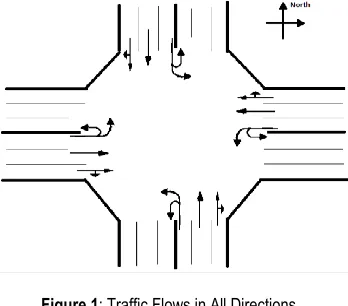
Our proposed system is based on a three lanes four-way intersection with North, East, South, and West traffic flows as shown in Figure 1. This is often the case of most intersections in urban regions. Traffic rules that apply in such intersections include that vehicles at the intersection can turn to any direction. That is, vehicles from southbound direction can turn to northbound, westbound, eastbound, and southbound directions, Vehicle opposite each other in direction often can move at the same time. That is, vehicles from southbound and northbound flow at the same time and so also the case with westbound and eastbound vehicles.
Figure 1: Traffic Flows in All Directions
Optimization of Traffic Light Control System of an Intersection Using Fuzzy Inference System
Assumptions
In modelling an intersection as shown in Figure 1 as well as designing its accompanying traffic control, we make the following assumptions:
1. The inner-most lane, next to the road Media-Separator shall from here be called ULeftLane; the middle-lane shall be called StraightLane; and the outer-most lane be called RightLane.
2. Just before reaching the intersection, vehicles that are to turn back to the direction from where they are coming from (U-Turns), and those that would be going left of the intersection shall queue up at (or make use of ) the ULeftLane. Those vehicles going straight, for example from northbound to southbound direction shall queue up at the StraightLane; and those vehicles going to the right direction from the direction they are coming from shall queue up at the RightLane. 3. Before and after the road intersection, all vehicles
maintain their respective lanes. That is, a vehicle on ULeftLane before the intersection shall be on the ULeftLane of the outgoing flow from the intersection. 4. All traffic flows at the intersection have equal (or same)
priority.
At about one hundred meters (100m), there is traffic detection system
Fuzzy Logic Controller
The fuzzy linguistic variables for our system are Insignificant (I), Significant (S), Large (L), Very Large (VL), Ultra Large (UL), Super Large (SL), and Extremely Large (EL) for queue lengths; Insignificant (I), Significant (S), Long (L), Very Long (VL), Ultra Long (UL), Super Long (SL), and Extremely Long (EL) for the waiting times. The fuzzy output variable for the system are; Insignificant (I), Significant (S), Long (L), Very Long (VL), Ultra Long (UL), Super Long (SL), and Extremely Long (EL). The block diagram of our fuzzy inference system with queue length and waiting time as input and phase extension as output is as shown in Figure 2. The choice of the numeric values for these variables should depend on the intersection of interest defined by average distance across the intersection, and the average velocity with which vehicles or commuters cross the intersection. The chosen values however should be as small and as large as possible to suit the maximum phase duration possible. That is, IF the Waiting Time is Insignificant AND the Queue Length is Insignificant THEN the extended Phase Duration is also Insignificant; where the Insignificant Phase Duration should be the Minimum Green Phase. But for more dynamism, it should be the Amber (Yellow) Phase just before it turns to Red Phase. Based on the fuzzy rules for our system, the surface plot is as shown in Figure 3
Figure 2: Fuzzy Logic Controller Schema
Figure 3: Fuzzy Input and Output Surface Plot
Solution Structure
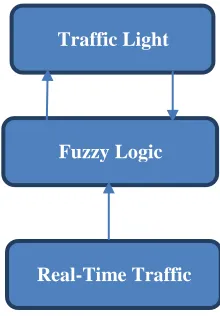
The Solution structure is as shown in Figure 4. The system is made of three components: Traffic Light System, Fuzzy Logic Controller, and Real-Time Traffic Data.
The Traffic Light System controls the intersection by displaying the Green wave for the lanes that should access the intersection and the Red wave for the lanes that should wait. In this paper, the Traffic Light System was modeled on SUMO which shows the intersection and vehicles approaching the intersection from the four different directions. Although the traffic light system is modeled on SUMO, the order of displaying the Green wave is controlled by the Fuzzy Logic Controller for optimum performance.
The Real-Time Traffic Data Component is also modeled on SUMO using Detectors. It is responsible for collection of the real-time traffic situation at the intersection. It reports the queue length of a lane and associate a timer to each passing vehicle so that a waiting time of such a vehicle can be determine. In this case, when a vehicle passes the first detector, the time is recorded and when it passes the second detector, the time is discarded while also tracking the number of vehicles that have passed the first detector for the determination of the queue length.
Figure 4: Solution Structure
0
100
200
300
0 10 20 30 20 30 40 50
waitingTime queueLength
p
h
a
s
e
E
x
te
n
s
io
n
Traffic Light System
Fuzzy Logic Controller
Real-Time Traffic Data
Optimization of Traffic Light Control System of an Intersection Using Fuzzy Inference System
The Fuzzy Logic Controller component interfaces with both the Traffic Light System component and the Real-Time Traffic Data component through the Traci4Matlab Application Programming Interface (API) implemented on Matlab. It receives the queue lengths of the various lanes and maximum waiting times of vehicles on different lanes determine the optimal schedule of the traffic control and send the phase schedule to the Traffic Light System. The computation and performance of the schedules is usually performed at the end of the last phase schedule.
The Algorithm
Giving an isolated intersection, Q is computed as the maximum of the queue lengths of the various lanes under consideration. It is given in equation (1)
Q = Max (∑𝑛𝑑𝑙𝑖=1𝑄𝑖, [∑𝑑𝑙𝑘=1𝑛 𝑄𝑘, [∑𝑛𝑗=1𝑄𝑑𝑙𝑗,… ]]) --- (1)
Where d specifies the direction; either south, east, north, or westbound; l specifies the lane being considered in the direction d; i, j, k, n all specify the counter and number of vehicles in the lane l under consideration.
Note that the square open and close brackets used in the equation (3) specify that at least one of the parameter must be provided to compute the Maximum queue length. Also, all divisions/fraction assume ceiling functions.
Having defined the above parameters, the following is the natural language algorithm of the whole system.
1. Get the waiting times Tl of all lanes Ldi of the
intersection;
2. Get the queue length Ql of all lanes ldi of the intersection;
3. Determine the lane Lrm with the maximum waiting time Tl;
4. Find all possible flows groups that can flow without conflict with Lrm;
5. Using equation (1), determine the maximum queue length of different lanes;
6. Supply the queue length and the waiting time as input to the fuzzy inference system (FIS).
7. Fuzzy inference system calculates the extended green phase duration of this cycle.
8. Set the traffic lamps to this phase 9. Goto 1
Simulation Setup and Results
The TRACI4MATLAB simulator is used in this paper for the Simulation of Urban Mobility (SUMO). The choice of this simulator is informed by the flexibility MATLAB provides TRACI4MATLAB in controlling SUMO objects (Andres, 2013; Andrés, Jairo, & Jorge, 2014; Hilbrich, 2015). For traffic monitoring, inductive loops which are set about 10 meters away from the intersection on each inflow lane are used.
To demonstrate the proposed algorithm, different simulation scenarios were designed. One setup was to simulate oversaturation from all the four ways of the intersection, oversaturation from two ways, oversaturation from one way, and normal flows where vehicles come to the intersection at random time interval and lower density
Case Study 1: Four-Way Oversaturation
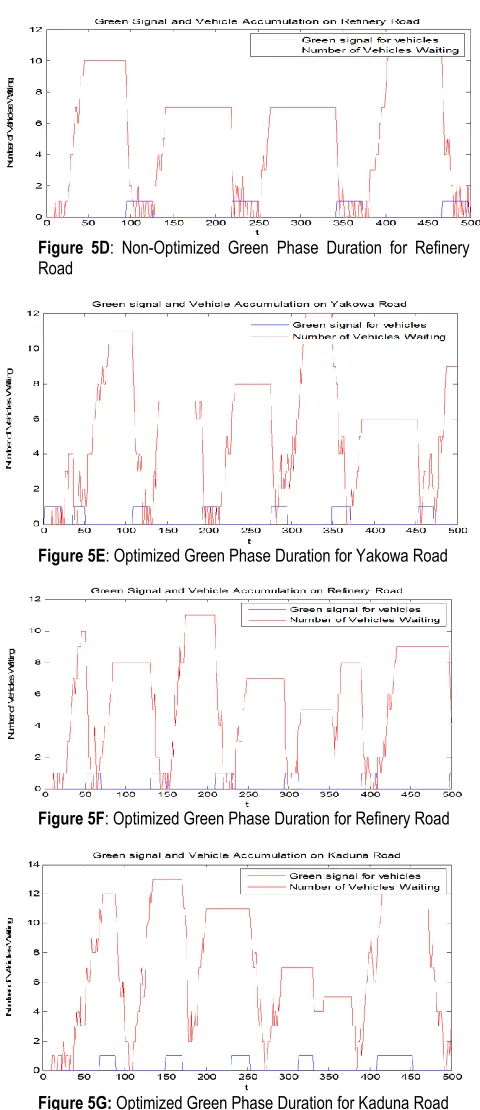
Here, we setup the simulation such that there are high-density flow from all the four-ways, the north, east, south, and westbound corresponding to our case study scenario located at the Kaduna Refinery Road Junction Kaduna (i.e., Yakowa Road). An average waiting time of 18.87 seconds was recorded in this scenario for non-optimized signal plan whereas, a 10.08 seconds waiting time was recorded for the optimized signal plan which is approximately 46.58% improvement. As can be observed from Figure 5A-H, the number of vehicles waiting at an intersection for a given flow tends to reduce when the flow has green wave allocated to it. However, the number of waiting vehicles may not necessarily tend to zero (0) as vehicles continually flow (arrive at the intersection) in a random and mutually independent manner – Poisson arrival method. The dynamism of our approach can easily be discerned from Figures 5A-D and Figure 5E-H respectively.
Figure 5A: Non-Optimized Green Phase Duration for Yakowa Road
Figure 5B: Non-Optimized Green Phase Duration for Kachia Road
Figure 5C: Non-Optimized Green Phase Duration for Kaduna Road
Optimization of Traffic Light Control System of an Intersection Using Fuzzy Inference System
Figure 5D: Non-Optimized Green Phase Duration for Refinery Road
Figure 5E: Optimized Green Phase Duration for Yakowa Road
Figure 5F: Optimized Green Phase Duration for Refinery Road
Figure 5G: Optimized Green Phase Duration for Kaduna Road
Figure 5H: Optimized Green Phase Duration for Kachia Road
Case Study 2: One-Way Oversaturation
Here, the road traffic is modeled to have high density in one direction in order to observe the behavior of our proposed algorithm. We chose to make westbound traffic to be high and those from the eastbound to have less density; while the north and southbound respectively had no vehicular traffic.
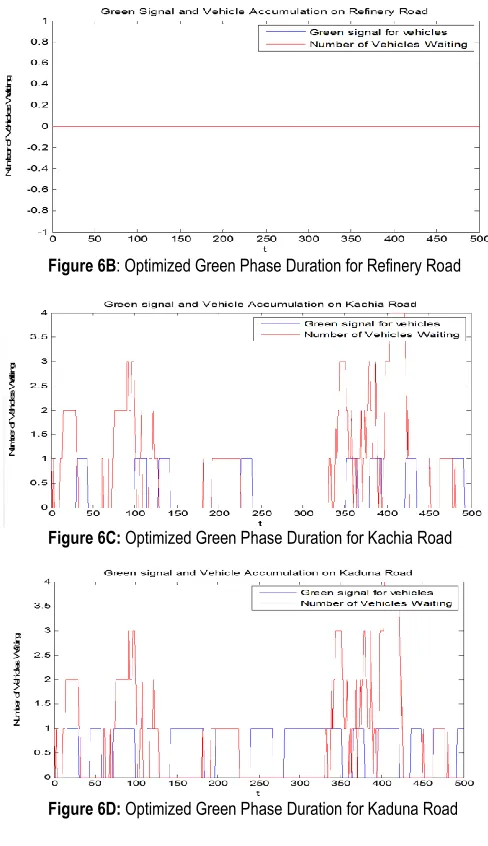
In this case, the average waiting time for vehicles using the non-optimized signal plan was about 13seconds and that of the optimized signal plan was 3.14s which implies a 75.85% improvement. It should be observed from Figures 6A-D and 7A-D that the numbers of vehicles waiting at an intersection for a given flow tend to reduce when the flow has green wave allocated to it. However, the number of waiting vehicles may not necessarily tend to zero (0) as vehicles continually flow (i.e., arrive) in a randomly and mutually independent manner – Poisson arrival method. Also, observe from Figures 6A and 7A respectively that though there are no waiting vehicles, green wave is assign to the flow. This is because when there are no waiting vehicles at all the directions, the algorithm takes a round-robin approach with the minimum phase duration good enough for a vehicle to pass through the intersection as defined by equation (2). But based on the traffic scenario, the flows on Figures 6B and 7B are never assigned the green wave because when the systems is in a round robin mode and at moment of scheduling, there are waiting vehicles on any flow direction, the system switches from the standard round-robin to the dynamic round-robin mode.
The dynamic allocation of optimal green phase duration is as shown in Figure 6A-D. It is clear from Figures 6A&B that in the optimized signal plan, only the minimum green phase duration is allocated to flow directions without vehicles in order to maintain synchronization.
Figure 6A: Optimized Green Phase Duration for Yakowa Road
Optimization of Traffic Light Control System of an Intersection Using Fuzzy Inference System
Figure 6B: Optimized Green Phase Duration for Refinery Road
Figure 6C: Optimized Green Phase Duration for Kachia Road
Figure 6D: Optimized Green Phase Duration for Kaduna Road
Case Study 3:Two-Way Oversaturation
Here, the road traffic is modeled to have high density on two-way direction of the road to see the behavior of our proposed algorithm. With this setup, the average waiting time for the non-optimized signal plan was found to be 14.56 seconds and that of the optimized signal plan was 3.84 seconds, representing a 73.63% improvement. Figure 7A-D shows the optimized allocation of green phase durations to the different roads.
Figure 7A: Optimized Green Phase Duration for Refinery Road
Figure 7B: Optimized Green Phase Duration for Yakowa Road
Figure 7C: Optimized Green Phase Duration for Kachia Road
Figure 7D: Optimized Green Phase Duration for Kaduna Road
The summary of the results depicting the effectiveness of our algorithm which employs the concept of fuzzy logic rules (i.e., optimized signal plan based on DPSTLS) against the non-optimized signal plan (based on SPSTLS) is given in Table 1.
Table 1: Comparing the average waiting times for SPSTLS vs DPSTLS
The improvement provided by the proposed approach stems from the fact that the allocation of phase duration to a given traffic flow depends on the queue length and the traffic flow given the green wave depends on the waiting time. That is, the traffic flow with the largest (maximum) waiting time is given the green wave to avoid starvation; and the duration which it is assigned the green wave depends on the queue length waiting at the road intersection.
Optimization of Traffic Light Control System of an Intersection Using Fuzzy Inference System
Conclusion
The goal of designing an algorithm that uses fuzzy logic inference system to optimize SPSTLS at an isolated intersection resulting in a DSPTLS was achieved through the deployment of SUMO and TRACI4MATLAB platforms. The results obtained in this paper show the superior performance of DPSTLS over SPSTLS in terms of average waiting time.
Based on the results obtained, we see the potential of adapting our algorithm to address the challenges bordering on vehicular traffic situations at roundabouts going forward. These locations (roundabouts) present unique opportunities to test the effectiveness of our approach for an optimal performance and utilization of our road intersections and hence reduction in traffic congestion with its attendant dire consequences.
Acknowledgements
We wish to acknowledge the grace of God and the support provided by our colleagues in the Department of Mathematical Sciences, Kaduna State University while conducting this research.
REFERENCES
Andres, A. (2013, 12 24). Traci4Matlab. Retrieved 01 26, 2016, from Mathworks - Matlab Central: http://www.mathworks.com/matlabcentral/fileexchange/44 805-traci4matlab
Andrés, F. A., Jairo, E., & Jorge, E. E. (2014). TraCI4MAtlab: Re-engineering the Python Implementation of the TraCI Interface. SUMO-2014, (pp. 145-155). Berlin.
David, D. R., Anton, S. P., Taufik, & Hasniaty, A. (2011). A Review of Sensing Techniques for Real-time Traffic Surveillance. . Journal of Applied Sciences, 192-198. Erik, M., Jerry, K., Scott, & Peterson. (2010). Evaluation of
Non-Intrusive Technologies for Traffic Detection. Minnesota Department of Transportation.
Habib, M. K., Ilhem, K., Jorge, C., Ajith, A., & Adel, M. A. (2014). Adapt-Traf: An adaptive multiagent road traffic management system based on hybrid ant-hierarchical fuzzy model. Transportation Research Part C. Vol.42, (pp. 147–167).
Hao, D., Xingguo, X., & Xuan, Z. (2014). Design and Implementation of a Real-time Traffic Light Control System Based on FPGA. ASEE 2014 Zone I Conference. USA: University of Bridgeport, Bridgpeort, CT.
Hazem, R., Samer, R., Ahmad, O., Omar, K., & Ahmad, M. (2013). ACCURATE VEHICLE CLASSIFICATION INCLUDING MOTORCYCLES USING PIEZOELECTRIC SENSORS . Oklahoma : Oklahoma Transportation Center (OkTC) .
Hilbrich, R. (2015, 05 07). SUMO - Simulation of Urban Mobility. Retrieved 01 26, 2016, from Institute of Transportation
Systems (DLR):
http://www.dlr.de/ts/en/desktopdefault.aspx/tabid-9883/16931_read-41000/
Jon, G. (2011, 12 1). Fundamentals of Piezoelectric Shock and Vibration Sensors. Retrieved 01 22, 2016, from Digi-Key Electronics:
http://www.digikey.com/en/articles/techzone/2011/dec/fun damentals-of-piezoelectric-shock-and-vibration-sensors Kok, M. N., Mamun, B. I., Mohd, A. M., & Tae, G. C. (2013). A
Brief Survey on Advances of Control and Intelligent Systems Methods for Traffic-Responsive Control of Urban Networks. Technical Gazette 20, 3, (pp. 555-562). Little, J. D. (1966). The synchronization of Traffic Signals by
Mixed Integer- Linear-Programming. Oper. Res, 14, 568– 594.
Mohit, J., & Shailja, S. (2014). Design Of Fuzzy Logic Traffic Controller ForIsolated Intersections With Emergency Vehicle Priority System Using MATLAB Simulation. Control Instrumentation System Conference. ariXiv. Onoja, N. (2015, Jul. 20). Coming boom in Nigeria’s automotive
industry. Retrieved Jan. 16, 2016, from Vanguard News Paper: http://www.vanguardngr.com/2015/07/coming-boom-in-nigerias-automotive-industry/
Patrick, M., & Michael, S. (2011). Accuracy of Pneumatic Road Tube Counters. Western District Annual Meeting of Institute of Transportation Engineers.
Qing, F., & Jun, Y. (2015). Design and Implementation of Traffic Lights Control System Based on FPGA . International Conference on Chemical, Material and Food Engineering (CMFE-2015), 822-825.
Robertson, D. I. (1969). TRANSYT Method for Area Traffic Control. Traffic Eng. Control, 10, 276–281.
Salehi, M., Iman, S., & Yarahmadi, M. (2014). TLCSBFL: A Traffic Lights Control System Based on Fuzzy Logic. International Journal of u- and e- Service, Science and Technology Vol.7, No.3, 27-34.
Tamás, T., & István, V. (2012, 01 05). Development of Road Traffic Control by Using Integrated VISSIM-MATLAB Simulation Environment. Rperiodica polytechnica, pp. 43-49.
Xin, Y., Panos, & Prevedouros, D. (2013). Performance and Challenges in Utilizing Non-Intrusive Sensors for Traffic Data Collection. Advances in Remote Sensing (pp. 45-50). Scientific Research.
Yan, G. (2014). A Two-Stage Fuzzy Logic Control Method of Traffic Signal Based on Traffic Urgency Degree. Modelling and Simulation in Engineering.
Yi, T., Dongbin, Z., & Jianqiang, Y. (2008). A Fuzzy Logic Controller with Adaptive Dynamic Programming Optimization for Traffic Signals. Fifth International Conference on Fuzzy Systems and Knowledge Discovery (pp. 191-195). IEE and Computer Society.