Original Research Article
A cross sectional study to assess the sleep hygiene among
the post graduates of KIMS, Hubballi
Geeta V. Bathija, Sushma H. R.*
INTRODUCTION
Sleep is a state in which the organism temporarily, partially and periodically loses its interaction with surroundings of different intensities and which can be reversed with stimuli comprising approximately one-third of human life.1
Sleep is a biological requirement of human life. It is important for maintaining good physical, mental and emotional health.2 Physiologically sleep is a complex process of homeostatic restoration, thermoregulation, tissue repair, immune control and memory processing.3 It
is one of the most important factors that establish quality of life. Sleep is critical for memory consolidation, leaving, decision making and critical thinking.4
Sleep hygiene is a collection of behaviour and environmental conditions that aim and ensure a restorative and good quality sleep and to avoid or to treat certain sleep disorders.5
Various factors that cause disturbance in the sleep are the age, demands of the occupation, their physiological and psychological characteristics, psychiatric illness, some type of physical illness.
ABSTRACT
Background: Problems related to sleep and poor sleep quality are important issues for medical students. Poor sleep quality is a stressing and worrying condition that can contribute to the risk factors of medical errors being made, adverse events and attention failure which has an impact on individual’s health, hence the objective of this study was to assess the sleep hygiene among post graduate medical students of KIMS, Hubballi.
Methods: A cross sectional study consisting of 260 post graduates of all departments of 1st, 2nd and 3rd year were chosen by convenient sampling method. A semi-structured questionnaire which included socio-demographic data, data to assess sleep quality by Pittsburgh sleep quality index, attention performance by EPSS scale, psychological health by self reported questionnaire 20 and data regarding factors affecting sleep. Data were entered in MS excel and analysed using SPSS software version 21.0 and suitable statistical tests were applied.
Results: Our study included 122 male and 138 female post graduates, it was found that sleep quality was better among males. Excessive daytime sleepiness indicating sleep loss, was assessed by using EPSS questionnaire, which showed that in our study that 63.1% have normal attention performance. Score >17 on EPSS was 4.2% which shows that it has a negative impact on sleep hygiene.
Conclusions: Poor sleep hygiene may be associated with poor sleep quality and excessive day time sleepiness. Stress and regular exercise were highly associated with sleep quality, the junior post graduates have significantly poor sleep quality than the senior post graduates.
Keywords: Sleep hygiene, PSQI score, EPSS
Department of Community Medicine, Karnataka Institute of Medical Sciences, Hubballi, Karnataka, India
Received: 28 January 2019
Accepted: 02 March 2019
*Correspondence:
Dr. Sushma H. R.,
E-mail: [email protected]
Copyright: © the author(s), publisher and licensee Medip Academy. This is an open-access article distributed under the terms of the Creative Commons Attribution Non-Commercial License, which permits unrestricted non-commercial use, distribution, and reproduction in any medium, provided the original work is properly cited.
Sleep hygiene practices is one of the important variables that affects sleep quality, inappropriate sleep behaviours are harmful for sleep. Many activities are considered as proper sleep hygiene that promotes good sleep. Some of them include the following: 1) avoiding caffeine, nicotine, and alcohol near the bed time, 2) avoiding napping as an occasional pattern, 3) maintaining a regular sleep and wake time, 4) keeping bed room relaxing and quiet, and 5) avoiding highly challenging activities in
bedroom. The knowledge of medical students
unfortunately is inadequate regarding sleep hygiene practices. Also, they are often unaware how poor quality of sleep deteriorates their academic performance and cognitive function.6
Sleep disorders is a clinical condition that manifests due to medical, psychological, environmental and work reasons, and that shows itself with insomnia as a result of restriction, disruption or loss of sitting pattern. Sleep is necessary to protect the normal functioning of modular
sleep system (MSS).4 The problem of resident sleepiness
has not been recognized and addressed by most of the programs. The “culture” of medicine often equates the number of hours on the job and without sleep, with professionalism and dedication to patient care.7
When there is no daytime sleepiness or dysfunction, the sleep is considered to be adequate. Sleepiness is defined as the inability or difficulty in maintaining alertness during the major wake period of the day, resulting in unintended lapses into drowsiness or sleep.8
Natural communication and balance between the neuronal centers is protected by sleep. Glycogen storages of brain is renewed in sleep. Best indicators of importance of sleep for CNS is deceleration of mental
activity and manifestation of psychic disorders
(hyperactivity, emotional liabilities etc.) in insomnia.9 Indeed, the paramount role of sleep in human physiology and health is exemplified by the fact that sleep deprivation has been shown to have a negative impact on metabolic parameters such as glucose tolerance and insulin sensitivity.4 It places individuals at a greater risk of serious disease, such as diabetes.10 In addition, even a few nights of poor sleep can impact alertness, memory, mood, and cognitive function.3
It is important to pay attention to sleep disorders in medical post graduate students because of their negative impact on quality of life, cognitive performance and other associated health disorders. Also the sleep deprivation, irregular sleep schedules and sleepiness are highly
prevalent among medical PG students.3
Since the education given in the family of medicine is long and difficult, the students are required to be active constantly. Responsibilities brought upon the post
graduate students including studying, patient
organization, being called on call at the emergency service, other clinic exams etc. set forth this situation.3
Substantial knowledge deficits exist at the medical school level as well as the post graduate training and continuing medical education levels. As sleep plays a major role in human functioning and since there are fewer studies regarding sleep hygiene among post-graduate medical students in India, this cross-sectional study was done to assess the sleep quality, daytime sleepiness and its impact on their health.
METHODS
This is a cross-sectional, study carried out during the period of April and May 2018 among the post-graduate medical students at Karnataka Institute of Medical Sciences, Hubballi, Karnataka, India. The study population consisted of 324 post graduate medical students out of which 260 of them were chosen by convenient sampling method. Permission for the study was taken from the Institution. Pilot study was done and necessary changes were made accordingly. PG students i.e., both males and females of 1st, 2nd and 3rd year of all the departments were included in the study. Verbal consent was taken from the participants for the study. Students who were unavailable during the study due to their busy schedule, due to exams, those who were on leave were excluded from the study.
The semi-structured Questionnaire was prepared which consisted Socio-demographic data, Pittsburgh sleep quality index (PSQI), Epworth sleepiness scale (EPSS), self reported questionnaire -20(SRQ) and the questions that aimed to bring out the factors affecting sleep.
Tools used are
Socio demographic data– name, age, gender, height, weight, address, department, year of study, monthly income, socioeconomic status, marital status etc.
Pittsburgh sleep quality index (PSQI) questionnaire11
It is used as a standard tool to assess sleep quality and patterns of sleep in adults. It differentiates poor from good sleep quality by measuring 7 components: subjective sleep quality, habitual sleep efficiency sleep latency, sleep duration, sleep disturbances, use of sleeping medications and daytime dysfunction over the last month. The sum of scores for these seven components yields one global score as sleep quality score. In each component, the scores varied from 0 to 3 and the total score of questionnaire varied since 0 to 21 and the higher scores indicating the worse sleep quality. For each components 0 indicates that no sleep difficulty, 1 mild difficulty, 2 severe difficulty in sleep. The total score of sleep quality was categorized based on the lower or higher 5 and labelled as good and poor, respectively.
Self reported questionnaire (SRQ)-2012
The SRQ-20 is a 20 item self report screening tool developed by world health organization specifically for the primary health care setting. It employs a yes or no answer format &is designed to detect non specific psychological distress including suicidality. The original format of the tool was utilized.
Epworth sleepiness scale (EPSS)13
The questionnaire asks the subject to rate his or her probability of falling asleep on a scale of increasing probability from 0 to 3 for eight different situations. Daytime sleepiness was scored using Epworth Sleepiness Scale (ESS) wherein values of ESS score>8 indicated excessive sleepiness (0-8: normal, 9-12: mild, 13-16: moderate and >16 –severe sleepiness)
Self administered questions were asked to know the factors affecting sleep like history of any chronic disease, coffee or tea intake, alcohol intake, smoking, use of mobile phone or laptop in the night, junk food habits any stressful conditions.
We approached the post graduates in OPDs, IPDs, Casualty, College, hostels, library etc. and explained them about the project to assess sleep hygiene, then oral consent was taken. We requested them to answer the questionnaire in 10 to 15 minutes. Some of the PGs were busy in their duty, so we asked them to answer it later and they were collected afterwards.
Statistical analysis
Data was entered in Microsoft excel worksheet and analysed using SPSS software version 23. Categorical variables were presented by number and percentages and association between sleep quality and different variables were shown by using Pearson’s chi-square test.
RESULTS
Our study included 260 post-graduates –out of which 122 were males and 138 were females. 95 of them belonged to first year of post-graduation, 84 to second year and 81 to third year. The BMI of the majority of the students i.e., 72.3% was in normal range (18.50 to 24.99) while 3.1% of them belonged to moderate grade of obesity (30.00 to 34.99).
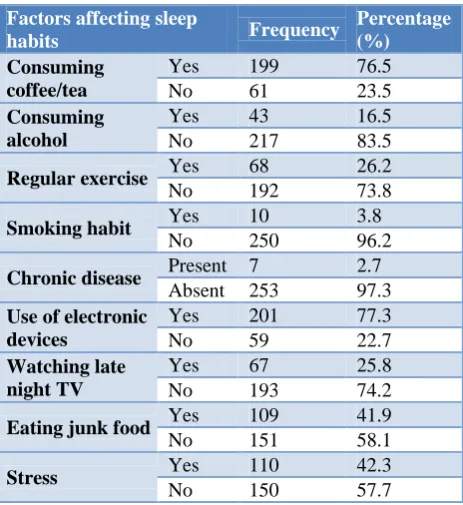
The various factors affecting sleep quality among post-graduates was studied which is as shown in Table 1. 76.5% were consuming coffee/tea, 16.5% were consuming alcohol, 26.2% were exercising regularly, 3.8% were smokers, 2.7% were suffering from chronic diseases, 77.3% were using electronic devices at night, 25.8% were late night TV watchers, 41.9% ate junk foods and 42.3% said that they were under stress.
Table 1: Distribution of factors affecting sleep quality among the post-graduates (n=260).
Factors affecting sleep
habits Frequency
Percentage (%)
Consuming coffee/tea
Yes 199 76.5
No 61 23.5
Consuming alcohol
Yes 43 16.5
No 217 83.5
Regular exercise Yes 68 26.2
No 192 73.8
Smoking habit Yes 10 3.8
No 250 96.2
Chronic disease Present 7 2.7
Absent 253 97.3
Use of electronic devices
Yes 201 77.3
No 59 22.7
Watching late night TV
Yes 67 25.8
No 193 74.2
Eating junk food Yes 109 41.9
No 151 58.1
Stress Yes 110 42.3
No 150 57.7
Sleep quality among the post-graduates by PSQI Scores: Each of the seven components of Pittsburgh Sleep Quality was assessed and the individual scores were used to calculate the global sleep quality score. The subjective sleep quality of an overwhelming majority of students i.e. 151 (58.1%) reported very good sleep quality. Sleep latency- 151 post graduates fell asleep within 15 minutes and 61 post graduates fell asleep after 15 min –30 min. 48 of them opined that they had trouble in getting the sleep within 30 minutes.Majority of them had sleep efficiency of >85%. Majority of them 170 (65.4%) spent 6–7 hours in bed. It was found that 127 (48.8%) of post graduates did not have day time dysfunction and 241 (92.7%) of the post graduates did not consume any sleep medication. The global PSQI scores showed that 78.1% had good sleep quality (PSQI score <5) and 21.9% had poor sleep quality (PSQI score ≥5), the mean value being 1.219 (SD-0.4145).
Figure 1: Attention performance of the post-graduates according to EPSS.
0 50 100 150 200
NORMAL MILD DAY TIME SLEEP MODRATE DAY TIME SLEEP SEVER DAY TIME SLEEP
164 62 23 11
Number of post graduates Attention performances of post-graduates
according to epworth sleepiness scale
Out of 260 post-graduates, 13 of them said that sleep deprivation had caused some minor medical errors in the past. The attention performances of post-graduates
according to Epworth sleepiness scalehas been shown in
the Figure 1 below where 63.1% had normal attention performance, 23.8% had mild day time sleepiness, 8.8%
had moderate daytime sleepiness and 4.2% had severe sleepiness during daytime. In our study the mental health screening was done by using the SRQ-20 questionnaire which revealed that 84.2% of the post graduates did not have any psychological morbidity.
Table 2: Association between socio-demographic variables and quality of sleep among the post-graduates.
Socio-demographic variable PSQI SCORE Total P value
Normal sleep quality Disturbed sleep quality
N (%) N (%) N (%)
Gender
0.60
Male 97 (37.3) 25 (9.6) 122 (46.9)
Female 106 (40.8) 32 (12.3) 138 (53.1)
Total 203 (78.1) 57 (21.9) 260 (100)
Year of study
0.001*
1st year 65 (25.0) 30 (11.5) 95 (36.5)
2nd year 63 (24.2) 21 (8.1) 84 (32.3)
3rd year 75 (28.8) 6 (2.3) 81 (31.2)
Total 203 (78.1) 57 (21.9) 260 (100)
BMI
Under weight 11 (4.2) 7 (2.7) 18 (6.9)
0.29
Normal weight 147 (56.5) 41 (15.8) 188 (72.3)
Over eight 38 (14.6) 8 (3.1) 46 (17.7)
Obese 7 (2.7) 1 (0.4) 8 (3.1)
Total 203 (78.1) 57 (21.9) 260 (100)
*Highly significant at p>0.05.
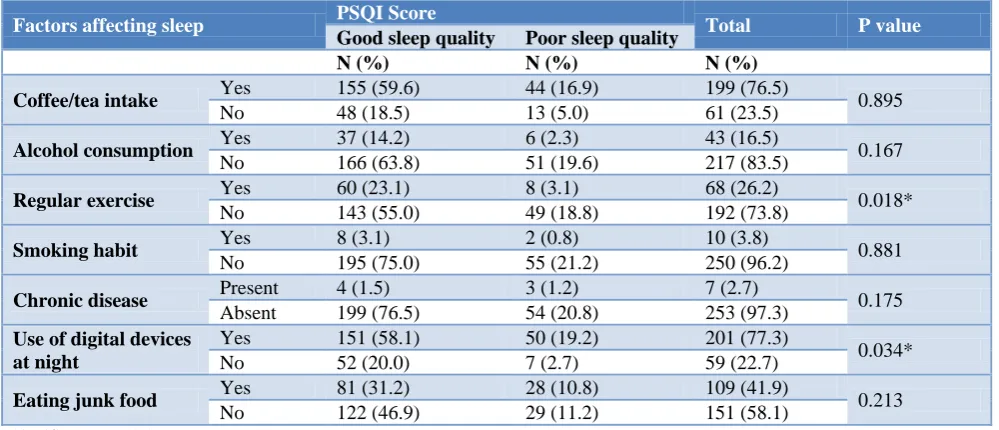
Table 3: Quality of sleep and its association with various factors affecting sleep.
Factors affecting sleep PSQI Score Total P value
Good sleep quality Poor sleep quality
N (%) N (%) N (%)
Coffee/tea intake Yes 155 (59.6) 44 (16.9) 199 (76.5) 0.895
No 48 (18.5) 13 (5.0) 61 (23.5)
Alcohol consumption Yes 37 (14.2) 6 (2.3) 43 (16.5) 0.167
No 166 (63.8) 51 (19.6) 217 (83.5)
Regular exercise Yes 60 (23.1) 8 (3.1) 68 (26.2) 0.018*
No 143 (55.0) 49 (18.8) 192 (73.8)
Smoking habit Yes 8 (3.1) 2 (0.8) 10 (3.8) 0.881
No 195 (75.0) 55 (21.2) 250 (96.2)
Chronic disease Present 4 (1.5) 3 (1.2) 7 (2.7) 0.175
Absent 199 (76.5) 54 (20.8) 253 (97.3)
Use of digital devices at night
Yes 151 (58.1) 50 (19.2) 201 (77.3)
0.034*
No 52 (20.0) 7 (2.7) 59 (22.7)
Eating junk food Yes 81 (31.2) 28 (10.8) 109 (41.9) 0.213
No 122 (46.9) 29 (11.2) 151 (58.1)
*Significant at p>0.05.
Our study showed that among 122 male post graduates 97 had good quality of sleep and among 138 female post graduates 106 had good quality of sleep. There was no significant association found. Here among 3rd year post graduates 28.8% had good quality of sleep, among 2nd year post graduates 24.2% had good quality of sleep and among 1st year post graduates 25% had good quality of sleep. There was highly significant association found
between quality of sleep and the year of postgraduation. It was found that out of 188 post graduates with normal BMI 147 of them had normal sleep quality and in 46 over weight post graduates 8 had poor sleep quality, but there was no significant association found (Table 2).
normal sleep quality and among 61 postgraduates, who do not consume coffee/tea, 18.5% of them had normal sleep quality and there was no statistically significant association found. Among 43 participants who were consuming alcohol 6 participants had disturbed sleep quality and among 217 participants who don’t consume alcohol 166 participants had normal sleep quality and no significant association was found.
Out of 68 post graduates who exercise regularly 60 were having good quality of sleep and out of 192 post graduates who don’t exercise regularly 143 were having good quality of sleep and this was found to be statistically
significant. The post graduates who do not smoke (75%) had good quality of sleep i.e., 195 out of 250. Among 253 post graduates who do not have any chronic diseases 199 had normal quality of sleep. In this study among 201 post graduates who were using digital devices 151 had good quality of sleep. And among 59 participants who were not using digital devices majority i.e., 52 had good quality of sleep. This was also found to be significantly associated. Here among 109 post graduates who eat junk food, 81 had normal sleep quality and among 151 post graduates who do not eat junk food, 122 had normal sleep quality (Table 3).
Table 4: Relationship between quality of sleep and stress among post-graduates
Under any Stress PSQI Score Total Test of significance
Good sleep quality Poor sleep quality
N (%) N (%) N (%)
Yes 77 (29.6) 33 (12.7) 110 (42.3)
Chi-square=7.267 P=0.007*
No 126 (48.5) 24 (9.2) 150 (57.7)
Total 203 (78.1) 57 (21.9) 260 (100)
*Highly significant at p>0.05.
Table 5: Association between sleep quality and daytime sleepiness of post-graduates.
PSQI score
EPSS attention performance
Total
Normal Mild daytime sleepiness
Moderate daytime sleepiness
Severe daytime sleepiness
N (%) N (%) N (%) N (%) N (%)
Good sleep quality 142 (54.6) 46 (17.7) 11 (4.2) 4 (1.5) 203 (78.1)
Poor sleep quality 22 (8.5) 16 (6.2) 12 (4.6) 7 (2.7) 57 (21.9)
Total 164 (63.1) 62 (23.9) 23 (8.8) 11 (4.2) 260 (100)
Chi-square=30.961; p value=0.0001.
Among 110 post-graduates who said they were under some stress, 77 of them had good quality of sleep and those who were not under any stress 24 of them had poor sleep quality and this was found to be statistically significantly associated (Table 4).
As shown in Table 5 it can be noted that most of the post graduates who have disturbed sleep quality have increased daytime sleepiness. This is also significantly associated.
DISCUSSION
Our study showed that 78.1% of the post-graduates had good sleep quality. In our study there were 122 males and 138 females and it was found that the sleep quality among males (79.5%) was better than females which was similar to the study done by Shad et al.15
Disorders related to sleep and hygiene practices are of major concern and it has long time social and demographic consequences. The post graduates have to juggle through the responsibilities, patient care, record maintenance and studies. In our study Global PSQI score
shows lower disturbances of sleep in the post graduates which is in contrast to the study done by Parthasarathi.14
Our study showed that majority (65.4%) of the post graduates sleep for an average duration of 6 to 7 hours. This result was similar with the findings of various researches.8
BMI
In our study 21.8% of the post graduates with normal BMI had disturbed sleep quality, also BMI was related to snoring and daytime sleepiness which was similar to the results in previous studies like that of Veldi et al.20
From the study, we can see that the first year post graduates (31.6%) have poor sleep quality when compared to 2nd year (25%) and 3rd year (7.4%) post graduates. First year (junior) post graduates have reported poor sleep quality than senior post graduates, this may be due to the better coping strategies for their curriculum by senior post graduates. Similar results were seen in studies
Consumption of tea/coffee, alcohol intake, smoking, having chronic disease have not shown any significant effect on sleep quality which is in contrast to study done in western Maharashtra.14
In study done by Saygin et al, excessive daytime sleepiness diminished in student who exercised regularly and hence, these individuals had more quality lives. But in our study 73.8% of post graduates did not exercise regularly but the sleep quality was not disturbed.1
In our study about 77.3% of post graduates used electronic devices at night and 25.8% watched late night TV or used laptop for internet surfing, studies or entertainment purpose and it did not affect their sleep quality where as in study done among medical students of Himalayan Institute of Medical Sciences showed that 57% of the students use mobile phones and extended forms of digital media for various purposes which causes emotional and cognitive arousal in the pre sleep period which lead to poor quality of sleep and insomnia.16
PSQI instrument was used in our study to assess the sleep quality. This scale is extremely important for monitoring of sleep health. By this, we found that 78.1% who have scored less than 5 have good quality of sleep which is in contrast to study done by Correa et al which had 12.9% of participants having score less than 5 which signifies impairment in sleep quality.17
An important finding of present study was that on assessing the subjective sleep quality an overwhelming majority of students (58.1%) reported very good sleep quality, in addition almost more than two third of the participants (79.2%) scored more than 85% in sleep efficiency component which indicates very good sleep efficiency, which was similar to the study in Ethiopia which reported a good or very good subjective sleep quality by majority of students, while high percentage (55.8%) had high PSQI scores indicating poor sleep quality. These results were in contrast with the study done by Siddiqui et al.2
Normal sleep onset latency should be within 15 to 20 minutes, shorter as well as a longer sleep onset latency indicates poor sleep. In our study the sleep onset latency within 15 minutes was reported by majority (i.e. 51.1%). Shorter sleep onset latency indicates sleep deprivation which was similar to the study done by Siddiqui et al.2
Use of sleep medication once or twice a week for sleep induction was identified in 1.2% of the study participants in our study which was similar to the study done in Saudi Arabia. This fact indicates the need for early intervention programs targeting poor lifestyle habits. This was in contrast to the study done by Nojomi.7
In our study out of 42.3% of post graduates who have reported that they were under stress, 30% had poor sleep quality due to any kind of stress. But in a study in
Malaysia there was 42% report of participants under stress. Our study also shows that there is a significant association between stress and sleep quality.18
Excessive daytime sleepiness indicating sleep loss, was assessed by using EPSS questionnaire, which showed in our study that 63.1% have normal attention performance. Score more than 17 on EPSS was 4.2% which shows that it has a negative impact on sleep hygiene. This was similar to the study done by Chutani et al.19 Our study also revealed a significant Association with sleep quality and attention performance.
SRQ 20 was used to assess the impact of sleep deprivation on the psychological health. So our study revealed that 84.2% of post graduates have no psychological morbidity which was in contrast to a Brazilian study which revealed a strong association between presence of minor psychiatric disorders, identified by SRQ 20 and thus concluded that Insomnia assessment might be a good tool for the identification of medical students who could benefit from psychiatric
assessment and preventive measures.9
Limitations
Our study was limited to a single medical college. As the work load and working hours varies considerably between clinical, para clinical and preclinical departments and also within them, it is difficult to generalize the results.
CONCLUSION
Sleep hygiene is one of the fundamental factors affecting sleep quality. Poor sleep hygiene may be associated with poor sleep quality and excessive day time sleepiness. Even though there are so many factors affecting the sleep quality, in our study it was found stress, regular exercise were highly associated with sleep quality.
It was concluded that the junior post graduates have significantly poor sleep quality when compared to that of senior post graduates.
Recommendations
Material college policies and schedules that encourage healthy and adequate sleep should be adopted which could have a positive impact on attention performance. Health education programs regarding sleep hygiene should be emphasized in medical colleges to increase the awareness of importance of healthy sleep.
practicing these principles would help to improve sleep quality.
ACKNOWLEDGEMENTS
The authors would like to thank the post-graduate students of KIMS, Hubballi and all the teaching staff of the Department for their co-operation and participation in Study.
Funding: No funding sources Conflict of interest: None declared
Ethical approval: The study was approved by the Institutional Ethics Committee
REFERENCES
1. Saygın M, Ozturk O, Gonca T, Has M, Hayri UB,
Kurt Y, et al. Investigation of Sleep Quality and Sleep Disorders in Students of Medicine. Turkish Thoracic J. 2016;17(4):132-40.
2. Siddiqui A, Al-Musa H, Al-Amri H, Al-Qahtani A,
Al-Shahrani M, Al-Qahtani M. Sleep Patterns and Predictors of Poor Sleep Quality among Medical Students in King Khalid University, Saudi Arabia. Malaysian J Med Sci. 2016;23(6):94-102.
3. Subhaprada SC, Vijayakumari S, Rajasekhar T,
Venkateswarlu U. An interventional study on sleep hygiene among medical students. Int J Community Med Public Health. 2017;4:352-6.
4. Basner M, Dinges D, Shea J, Small D, Zhu J,
Norton L et al. Sleep and Alertness in Medical Interns and Residents: An Observational Study on the Role of Extended Shifts. Sleep. 2017;40(4):1-8.
5. Voinescu BL, Aurora Szentagotai-Tatar A. Sleep
hygiene awareness:its relation to sleep quality and diurnal preference. J Molecular Psychiatr. 2015;3:1.
6. Yazdi Z, Loukzadeh Z, Moghaddam P, Jalilolghadr
S. Sleep Hygiene Practices and Their Relation to Sleep Quality in Medical Students of Qazvin University of Medical Sciences. J Caring Sci. 2016;5(2):153-60.
7. Nojomi M, Bandi MFG, Kaffashi S. Sleep Pattern in
Medical Students and Residents. Arch Iranian Med. 2009;12(6);542-9.
8. Brick CA, Seely DL, Palermo TM. Association
Between Sleep Hygiene And Sleep Quality in
Medical Students. NIH Public Access.
2010;8(2):113-21.
9. Azad MC, Fraser K, Ruhmana N, Abdullah AF,
Shahana N, Hanly PJ, et al. Sleep Disturbances among Medical Students:A Global Perspective. J Clin Sleep Med. 2015;2(1):69-74.
10. Serinolli MI, Novaretti MCZ. A cross-sectional
study of sociodemographic factors and their influence on quality of life in medical students at
Sao Paulo, Brazil. PLOS One.
2017;12(7):e0180009:1-13.
11. Buyssa DJ, Renyolds CF, Monk TH, Burman SR,
Kuppafer DJ. The Pittsburgh sleep quality index: a new instrument for psychiatric practice and research. Psychiatry Res. 1989;28(2):193-213.
12. World Health Organization (WHO). A user’s guide
to the self-reporting questionnaire (SRQ). 1994.
Available at: http://apps.who.int/iris/bitstream/
10665/61113/1/WHO_MNH_PSF_94.8.pdf. Accessed on 26 January 2019.
13. Johns MW. A new method for measuring daytime
sleepiness: the Epworth sleepiness scale". SLEEP. 1991;14(6):540-5.
14. Giri PA, Baviskar MP, Phalke DB. Study of Sleep Habits and Sleep Problems Among Medical Students of Pravara Institute of Medical Sciences Loni, Western Maharashtra, India. Ann Med Health Sci Res. 2013;3(1):51-4.
15. Shad R, Thawani R, Goel A. Burnout and Sleep
Quality:A Cross-Sectional Questionnarie-Based
Study of Medical and Non-Medical Students in India. 2015;7(10):361.
16. Misurya I, Singh K. Impact of Digital Media On Sleep Pattern Disturbance in Medical and Nursing Students. Int J Technological Res Eng. 2016: 85-91.
17. Correa CC, Oliveira FK, Pizzamiglio DS, Ortolan
EVP, Weber SAT. Sleep Quality in Medical Students: Comparison across the various phases of medical course. J Bras Pneumol. 2017;43(4):285-9.
18. Almojali AI, Almalki SA, Alothman AS, Masuadi
EM, Alaqeel MK. The Prevalence and Association of Stress with sleep quality among medical students. J Epidemiol Global Health. 2017;7:169-74.
19. Chutani A, Shenvi DN, Singhal A. Sleep, Sleepiness
and Medical College Students: A Comaparative Study among Medical And Paramedical Students of a Tertiary Care Teachimng Hospital from a West Indian Metropolitan City. Ann Med Health Sci Res. 2017;7(2):85-91.
20. Veldi M, Aluoja A, Vasar V. Sleep quality and more
common sleep-related problems in medical students. Sleep Med. 2005;6(3):269-75.