Original Research Article
Knowledge, attittude and practice among mothers of under five
children on immunization
K. K. Lamiya, Jesha Mohammedali Mundodan*, Sheela P. Haveri
INTRODUCTION
The outbreak of diphtheria in Kerala, South India was alarming news for public health professionals. India being one among the first few countries to adopt National immunization programmes to fight vaccine preventable diseases in the world, this sure was bad and discouraging news. It surely became a black mark on the well-known Kerala health care model. Lack of good knowledge and positive attitude about childhood immunization was believed to be the root cause.
Many parents have poor understanding of vaccine preventable diseases and believe in false propagations about the contents, side effects and effectiveness of vaccines. Parents lack realisation that a vaccine preventable disease can do more harm than a vaccine. Some even believe childhood immunization as a covert method of sterilization. Certain religious myths have been circulating among some communities against the need for immunisation. It is very sad that many still they think that these diseases are just an unfortunate event of life. Good knowledge and positive attitude about childhood
ABSTRACT
Background: Many parents have poor understanding of vaccine preventable diseases (VPD) and many believe in false propagations about the contents, side effects and effectiveness of vaccines. Lack of good knowledge and positive attitude about childhood immunization was believed to be the root cause for resurgence of VPDs. Aim of the study was to assess the knowledge, attitude and practice regarding childhood immunization among mothers of under five children.
Methods: A cross sectional study was done among mothers with at least one child in the under-five age group residing in the rural field practice area of a teaching institution. Assuming 61% mothers have good knowledge (Mangalore study) the sample size was calculated to be 235 with 20% error and 1.5 design effect. Data was collected with the help of pretested semi structured questionnaire by interviewing 15 eligible mothers from each of 16 wards. Descriptive analysis was done.
Results: The average age of the participants was 27.30±5.42 years with many of them educated up to 10th grade (40.3%) and most being housewife (74.5%). Knowledge of mothers regarding the diseases that can be prevented by immunization was fairly good. But the knowledge regarding individual vaccines, their dosages and schedule were found to be low. Majority of mothers had good attitude about immunization. Immunization coverage of the locality was relatively good (87.7%). Significant relation was established between attitude and practice. Sick at the time of vaccination was the most common cause of being partially immunised (68.96%).
Conclusions: Intensify the awareness classes for mothers and religious leaders on immunisation.
Keywords: KAP, Immunization, Under-five, Mothers
Department ofCommunity Medicine, MES Medical College, Perinthalmanna, Malappuram, Kerala, India
Received: 30 December 2018
Revised: 03 February 2019
Accepted: 04 February 2019
*Correspondence:
Dr. Jesha Mohammedali Mundodan, E-mail: [email protected]
Copyright: © the author(s), publisher and licensee Medip Academy. This is an open-access article distributed under the terms of the Creative Commons Attribution Non-Commercial License, which permits unrestricted non-commercial use, distribution, and reproduction in any medium, provided the original work is properly cited.
immunization are necessary to reduce the incidence of vaccine preventable diseases.1 Cultural receptivity and trust on the health care professionals play an equally important role in immunization coverage.2 The spread of inaccurate and irresponsible information by the anti-vaccination movement has made huge impact.3 A study conducted among mothers in Mangalore revealed that 61% had good overall knowledge and 68.7% had good attitude towards childhood vaccines.4
Therefore understanding the level of knowledge and attitude of parents towards childhood immunisation is essential for planning strategies to combat the upsurgence of the vaccine preventable diseases.
Objectives
To assess the knowledge, attitude and practice regarding childhood immunization among mothers of under-five children in Vettathoor panchayath, the rural field practice area of MES medical college, Perinthalmanna.
METHODS
A cross sectional study was done among mothers with at least one child in the under-five age group residing in Vettathoor panchayath of Malappuram district, over a period of 6 months (September 2016 to February 2017). Women who did not give consent to be part of the study were excluded.
Assuming 61% mothers have good knowledge, the sample size was calculated to be 235 with 20% error and 1.5 design effect.4 Using Cluster sampling, 15 eligible mothers were interviewed from each of the 16 wards in Vettathoor panchayath. The first house was selected randomly in each ward and consecutive houses were visited till sample size was met. Data was collected by interviewing eligible mothers, with the help of a pretested semi structured questionnaire after obtaining written informed consent. Knowledge was assessed based on the number of vaccine preventable diseases known to the respondents; schedule, dosage and the disease prevented by individual vaccines. Attitude was recorded as positive or negative. Immunization status of the under-five child as per the immunization card or as stated by mother was also assessed.
Data analysis
Using Epi info, descriptive analysis was done and proportion of mothers with good knowledge, good attitude and immunization status of under five children were expressed as proportions. Association between knowledge and practice, practice and attitude, knowledge and attitude and with other demographic variables were looked for using chi-square test.
Ethical clearance
Ethical clearance was obtained from the Institutional Ethics Committee [IEC/MES/05/2016] as well as written informed consent was taken from all participants.
Working definition
Children who have received BCG, DPT, OPV and
Measles vaccine upto their age was classified as fully immunized. Those who missed at least one dose of any vaccine was termed as partially immunized and others as unimmunized.
The details of immunization were taken as revealed by their immunization card. If that was not available, then relevant history according to site or route of drug administration as stated by mother was considered.
RESULTS
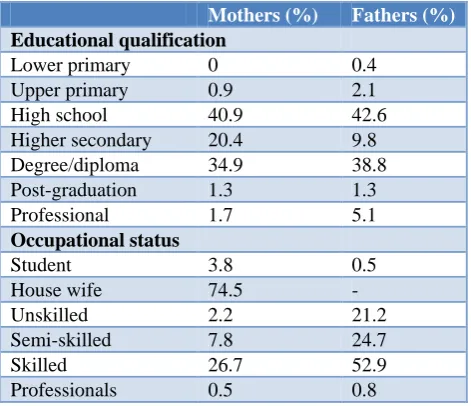
The average age of the participants was 27.3±5.4 years with many of them educated up to 10th grade (40.9%) and most of them being housewife (74.5%) (Table1). A mere 0.5% were professionals (Table 1). Most of the participants (68.5%) were muslims and over a quarter (26%) were hindus, while christians formed a minority (5.5%). About 40% mothers who were interviewed had two children and nearly one fourth had three or more.
Table 1: Basic details of parents of under five children (n=235).
Mothers (%) Fathers (%)
Educational qualification
Lower primary 0 0.4
Upper primary 0.9 2.1
High school 40.9 42.6
Higher secondary 20.4 9.8
Degree/diploma 34.9 38.8
Post-graduation 1.3 1.3
Professional 1.7 5.1
Occupational status
Student 3.8 0.5
House wife 74.5 -
Unskilled 2.2 21.2
Semi-skilled 7.8 24.7
Skilled 26.7 52.9
Professionals 0.5 0.8
Knowledge
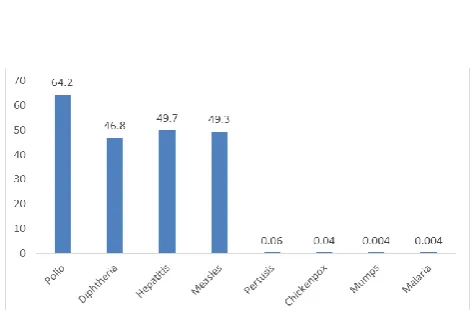
Nearly one third (31.5%) answered that 3 diseases could be prevented by vaccination; with 64.2% of them quoting polio as vaccine preventable disease (Figure 1).
Majority (66%) knew OPV drops protect against Polio and less than one fourth (23.8%) knew that BCG vaccination prevents tuberculosis (Table 2). Table 2 also reveals that 43.4% have the knowledge that DPT prevents
diphtheria, pertusis and tetanus while only 5.5% were aware of the diseases prevented by the Pentavac vaccine. Though nearly half (47.5%) knew that measles vaccine prevents measles, only 7.7% knew that MMR acts against measles, mumps and rubella. Knowledge about the schedule and number of doses were very poor for all vaccines except DPT, BCG and measles.
Table 2: Knowledge regarding vaccines and its coverage (n=235).
Vaccine Disease prevented (%) No. of doses (%) Schedule (%) Coverage (%)
BCG 23.8 33.2 30 100
OPV 66 6.4 8.9 97.43
DPT 43.4 40 36.2 95.23
Hepatitis B 39.1 1.3 0.9 97.43
Pentavac 5.5 7.2 8.1 95.23
Measles 47.2 22.1 15.7 93.96
MMR 7.7 1.7 0.9 94.1
Vitamin A 34.5 0.9 0.4 92.42
Figure 1: Knowledge regarding vaccine preventable diseases.
Table 3: Attitude towards vaccination.
Attitude Positive
response n (%) Need for vaccination 217(92.3)
Vaccination affects fertility 2(0.9)
Prioritisation of child health by
pharmaceutical companies 117(49.8) Family support for vaccination 230(97.9)
Faced discouraging events
against vaccination 15(6.4) Believed there may be vested
interests behind vaccinating 55(23.4) Felt compelled for vaccination 2(0.9)
The field health workers were the source of information for more than three fourth (77.4%) of the respondents while only 16.6% reported doctors provided them the information related to vaccination. A mere 6% reported that they received this information from social medias.
Attitude
Most of respondents (97.4%) had positive attitude about vaccination. Out of the 6 who had poor attitude regarding vaccination, three believed immunization is harmful for our health and two said their husbands felt so and one felt immunization is against their religious belief.
It is shown in Table 3, while majority (92.3%) think that vaccine is essential for healthy living, very few (0.9%) admitted that they think vaccination may affect fertility and feels compelled for vaccination. Nearly half the participants think that pharmaceutical companies care for the optimal health of children. Majority of participants (97.9%) reported that they have family support for vaccinating their children.
Practice
More than four fifth of the participants (87.7%) responded that their under 5 children are fully immunised for age. None of them reported having an unimmunized under five child. It is evident from Table 2 that cent percentage had given their children BCG and the coverage of individual vaccines was above 90%. The coverage for the booster dose of DPT (90.5%) was lower than that for routine DPT/Pentavac (95.23%).
Majority responded that they will seek help of a health worker in case of AEFI. Three fourths (75.7%) preferred Government hospitals for vaccination.
Association between variables
Statistically significant association were found between mother’s educational status and knowledge regarding
immunization (chi-square value 28.79; p-0.017) as well as practice (chi-square value 112.17; p-0.049). Similarly occupational status of the mothers was found to be significantly associated with knowledge regarding immunization (chi-square 53.74; p-0.001). Attitude of the mother towards immunization and practice was also found to be significantly related (chi-square 41.772; p<0.0001).
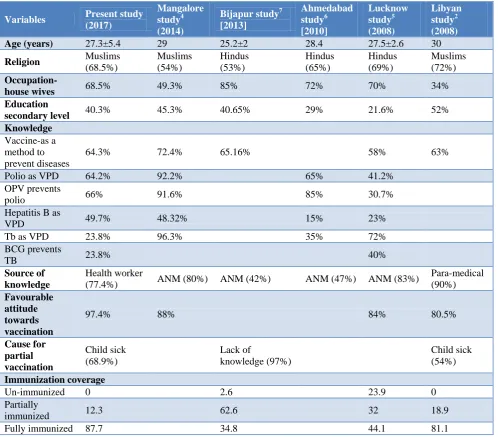
Table 4: Comparison of our findings with other studies.
Variables Present study
(2017)
Mangalore study4 (2014)
Bijapur study7 [2013]
Ahmedabad study6 [2010]
Lucknow study5 (2008)
Libyan study2 (2008)
Age (years) 27.3±5.4 29 25.2±2 28.4 27.5±2.6 30
Religion Muslims
(68.5%)
Muslims (54%)
Hindus (53%)
Hindus (65%)
Hindus (69%)
Muslims (72%)
Occupation-
house wives 68.5% 49.3% 85% 72% 70% 34%
Education
secondary level 40.3% 45.3% 40.65% 29% 21.6% 52%
Knowledge
Vaccine-as a method to prevent diseases
64.3% 72.4% 65.16% 58% 63%
Polio as VPD 64.2% 92.2% 65% 41.2%
OPV prevents
polio 66% 91.6% 85% 30.7%
Hepatitis B as
VPD 49.7% 48.32% 15% 23%
Tb as VPD 23.8% 96.3% 35% 72%
BCG prevents
TB 23.8% 40%
Source of knowledge
Health worker
(77.4%) ANM (80%) ANM (42%) ANM (47%) ANM (83%)
Para-medical (90%)
Favourable attitude towards vaccination
97.4% 88% 84% 80.5%
Cause for partial vaccination
Child sick (68.9%)
Lack of
knowledge (97%)
Child sick (54%)
Immunization coverage
Un-immunized 0 2.6 23.9 0
Partially
immunized 12.3 62.6 32 18.9
Fully immunized 87.7 34.8 44.1 81.1
DISCUSSION
The mean age of the respondents (27.3±5.4) is similar to the mean age of the participants in the Ahmedabad study
by Kapoor, Lucknow study and Mangalore study.4-6
Education qualifications were also similar to the studies done in slums of Bijapur by Angadi, Mangalore and Libya with most being educated up to the 10th grade.2,4,7 This was dissimilar from the findings of the Ahmedabad
study (29%) and Lucknow study(21.6%).6,5 Half or more
were housewives except the Libyan study where only 34% were home makers (Table 4). Majority of respondents were Muslims (68.5%) in our study in concordance with the religious pattern of Malappuram district but in contrast to the studies done in Ahmedabad,
Most of the mothers (64.3%) responded that vaccination is the method to provide immunity against diseases similar to other studies. Only a very few (0.9%) responded that 8 diseases can be prevented by the current national immunisation schedule for children. One third responded that 3 diseases can be prevented by vaccination in our study which is in contrast to only 11.1% responding similarly in the Bijapur study.7 64.2% responded that polio can be prevented by vaccination similar to the Ahmedabad study but a greater proportion knew this fact in the Mangalore study.4,6 Nearly half of respondents knew that Diphtheria, Measles and Hepatitis B can also be prevented by vaccination, in contrast to the studies done in Ahmedabad and Lucknow where only 15%, 23% respectively could quote these diseases as
vaccine preventable diseases.5,6 Only few of the
participants (23.8%) knew that BCG vaccination prevents tuberculosis and majority were not able to quote the number of doses and timing of BCG vaccine. Similar results were revealed in a study at Lucknow by Nath et al with only 40% being aware of the timings and doses of BCG although majority knew that TB was preventable by
BCG.5 Similar results were revealed for other
vaccinations also except Polio with majority (66%) being aware of the disease prevented by it which is in concordance to the Mangalore study by Mereena and Ahmedabad study.4,6
Most of respondents had good attitude about vaccination and many agree that it promotes good health similar to the other studies reviewed.2,4,5
Majority (87.7%) of the under five children were fully immunised for age comparable to urban Malappuram (93.6%) and the Libyan study (81.1%).2,8 The study by Nath et al at Lucknow revealed only 44.1% were fully immunised.5 None of the children were found to be unimmunised in rural Malappuram similar to Urban Malappuram and Libyan studies, while 23.9% were
found to be unimmunized in the Lucknow study.2,5,8 The
burden of partially immunized (12.3%) was double that of in urban Malappuram (6.4%) and almost similar to the Libyan study (18.9%) whereas 62.6% were partially immunized as per the Bijapur study.2,7,8 The high rate of immunization in rural Malappuram seen in our present study may be due to the accelerated IEC activities following the recent diphtheria deaths in the locality.
Among the partially immunised children the most common reason was found to be sick child at the time of vaccination (68.9%) followed by fear of AEFI (13.7%) in contrast to the Bijapur study which cited lack of knowledge as the main cause by 97% as shown in Table 4.7
Majority (75.7%) preferred Government hospitals for vaccination which is similar to the Lucknow study.5
CONCLUSION
Knowledge of mothers regarding the diseases that can be prevented by immunization was found to be poor. Most mothers knew the disease prevented by OPV followed by measles, DPT, hepatitis B, VIT A and BCG. Only few of them knew about MMR and Pentavac. The knowledge regarding individual vaccines, their dosages and schedule were also found to be poor. Majority of mothers had good attitude about immunization. Immunization coverage of the locality was relatively good. Significant relation was established between attitude and practice.
Recommendations
1. Increase and improvise the awareness classes for mothers and religious leaders on immunisation.
2. Continuing IEC activities focusing more on the
individual vaccines and their dosage, schedule and common side effects.
3. Proper awareness about AEFI and the reporting
procedure in case of any such event.
4. Skill based training for health workers for handling
the common reactions following vaccination.
Limitations
As the study was performed as a house to house survey with informed consent there is a chance that we may have missed the working mothers and those are reluctant to vaccinate.
Funding: No funding sources Conflict of interest: None declared
Ethical approval: The study was approved by the Institutional Ethics Committee
REFERENCES
1. Al-lela OQB, Bahari MB, Al-Qazaz HK, Salih
MRM, Jamshed SQ, Elkalmi RM. Are parents’ knowledge and practice regarding immunization related to pediatrics’ immunization compliance? A mixed method study. BMC Paediatrics. 2014;14:20.
2. Boffaraj MAM. Knowledge, attitude and practice of
mothers regarding immunization of infants and preschool children at Al-Beid City, Libya 2008. Egypt J Pediatr Allergy Immunol. 2011;9(1):29-34.
3. Ahmed A, Lee KS, Bukhsh A, Al-Worafi YM,
Sarker MMR, Ming LC, Khan TM. Outbreak of vaccine preventable diseases in Muslim majority countries. J Infect Public Health. 2018;11(2):153-5.
4. Mereena, Sujatha R. A study on Knowledge and
Attitude regarding vaccines among mothers of under five children attending paediatric OPD in a selected hospital in Mangalore. IOSR-JNHS. 2014;3(5):39-46.
Children in a City of North India – A 30 Cluster Survey. Online J Health Allied Sci. 2008;7(1):2.
6. Kapoor R, Vyas S. Awareness and knowledge of
mothers of under five children regarding
immunization in Ahmedabad. Healthline. J Indian Asso Prev Social Med. 2010;1(1):12-5.
7. Angadi MM, Jose AP, Udgiri R, Masali KA,
Sorganvi AV. Study of Knowledge, Attitude and Practices on Immunization of Children in Urban Slums of Bijapur City, Karnataka, India. JCDR. 2013;7(12).
8. Sameera KK, Jesha KK. Immunization status of
under fives in an urban area of Malapuram district. J Prev Med Holistic Health. 2015;1(1):2-5.
Cite this article as: Lamiya KK, Mundodan JM,
Haveri SP.Knowledge, attittude and practice among