Original Research Article
Reasons for delay of surgical treatment among patients with
senile mature cataract in Goa
Vishaka Devidas Naik, Ugam P. S. Usgaonkar, Vedvati Hemant Albal*
INTRODUCTION
Cataract accounts for 47.8% of global blindness.1,2 Of the total estimated 45 million blind persons , with a best corrected visual acuity less than 10/200, in the world, approximately 7 million are in India. And cataract has been reported to be responsible for 50–80% of the bilaterally blind in the country.3
Cataracts are one of the conditions responsible for painless and progressive decrease in vision in the very
elderly. The decrease of vision is a serious health risk for challenges of loss of balance, perhaps leading to falls and injury, along with lack of self-sufficiency, dependency, and decreased work productivity.4
As a result of the large population base and increased life expectancy, the number of visually impaired particularly due to age-related disorders such as cataract is expected to rise.3 With the current trend of population ‘greying’ in both developed and developing nations, the percentage of elderly is expected to increase manifold, with a
ABSTRACT
Background: Cataract accounts for about 81% of blindness in India. By 2020, the elderly population is expected to double, further increasing the number of visually impaired. Effective strategies to reduce cataract backlog include increasing the number of cataract surgeries performed. Despite significant efforts to increase accessibility of cataract surgeries, particularly in developing countries, studies reveal that availability of eye care services in such communities may not necessarily translate into their appropriate utilisation. Even with government funded and private hospitals offering cataract surgeries being present, we see many patients with advanced unilateral or bilateral cataract. The reasons for this need to be evaluated. A hospital based cross sectional survey was aimed to determine the socioeconomic and demographic factors responsible for delay of cataract surgeries in patients with senile mature cataracts in Goa.
Methods: This study was conducted over 6 months in 200 patients presenting to the Department of Ophthalmology, Goa Medical College with a senile mature cataract, with a pearly white lens and visual acuity of hand movements close to face projection of rays accurate. Patients were interviewed regarding reasons for delay in cataract treatment, covering awareness and attitude about cataract, misinformation, barriers to affordability, accessibility, and personal reasons.
Results: Chief reason observed was good vision in one eye, others being unawareness about presence and treatment of cataract, distrust in surgery and economical and conveyance challenges.
Conclusions: Based on this study, better public education, regular ocular examination and increasing accessibility and affordability of surgery will provide a solution to the challenge of delayed cataract treatment.
Keywords: Mature, Delay, Cataract, Surgery
Department ofOphthalmology, Goa Medical College, Bambolim, Goa, India
Received: 30 March 2018
Revised: 08 May 2018
Accepted: 09 May 2018
*Correspondence:
Dr. Vedvati Hemant Albal, E-mail: [email protected]
Copyright: © the author(s), publisher and licensee Medip Academy. This is an open-access article distributed under the terms of the Creative Commons Attribution Non-Commercial License, which permits unrestricted non-commercial use, distribution, and reproduction in any medium, provided the original work is properly cited.
corresponding increase in patients with visual impairment due to cataract. The prevalence of cataract increases with age in developing countries also, where it has been seen to often occur earlier in life. For example, in an Indian study, visually significant cataract was seen to occur 14 years earlier than in a comparable study in the United States.5
The challenge we face currently is to prevent the cataract backlog from occurring by delaying the development of cataract and by providing ready access to cataract surgery for all those who need it.5
The benefits of cataract prevention by study of genetic factors, impact of age and environmental agents such as ultraviolet rays, as well as modification of these factors, are obvious, but difficult and with a lesser likelihood of timely achievement.5
The cure for cataract is readily available, and is surgery. Serious efforts have been made and are still in process to improve accessibility, affordability and availability of cataract surgeries, especially in developing countries.5 Despite rapid increase in the availability of quality cataract services, however, surgical acceptance is still low in the community.1–6 Studies have shown that availability of eye care services may not necessarily translate into their effective and adequate utilisation.7
For example, in the state of Goa, ours is a government funded tertiary care centre providing cataract surgery services. In addition, many private centres are in place. Yet, we get to see a large number of patients with advanced and mature cataracts, unilateral or bilateral.
It has been seen that in developing countries there are many more solid barriers to the availability of, access to, and uptake of cataract surgery. Accessibility comes forth as a major barrier, with a vast majority of patients residing in rural areas and the surgical facilities located more frequently in towns and cities, being accessible readily only to people in the vicinity. These patients also face an economical challenge, with many living below poverty line. Along with the direct costs, there are also indirect costs incurred by these patients, such as loss of daily wages, expenditure on transport and delegation of responsibilities.5
Poor knowledge of cataract, its progression and its treatment, misinformation and myths surrounding cataract and surgery, distrust of surgery also play a vital role in causing delay in cataract treatment.5
An Ethiopian study found that retaining enough vision to live independently with ability to perform daily activities without support from family and retaining enough mobility is another factor delaying timely cataract surgery.Palagyi et al found that people with gradual onset poor vision due to cataract or refractive error had a lesser
likelihood of seeking treatment than those with a more acute onset or painful problem such as eye injuries.3
It has seldom been acknowledged that age itself has a substantial impact on the results of cataract surgery— independent of the effects of ocular and systemic co-morbidities or complications of surgery. Wescott and colleagues recently showed that in patients with no ocular co morbidity, the odds of achieving a visual acuity of 6/12 or better after cataract surgery were decreased by a factor of 4.6 (1.8 to 11.4) for patients aged 80 years and more, compared with those aged 60-69, after adjustment for complications of surgery and grade of surgeon.8
Hence, a delay in treatment often provides additional difficulties pre-, intra- and post-operatively.
Studies have identified increasing age as a major factor associated with reduced recovery of visual function following cataract surgery, along with ocular co morbidity (glaucoma, macular degeneration, and retinopathy), and pre-existing cognitive impairment. Factors such as age and cognition may also influence recovery of daily living activities, thus contributing to overall dependency.9
Advanced age itself is not a contraindication for cataract surgery. Studies have shown that when systemic conditions are stable, both phacoemulsification and Extra- capsular cataract extraction (ECCE) with intra-ocular lens (IOL) implantation for very elderly patients are effective and safe.4 However, with an earlier treatment, better visual outcomes would become more achievable even in those with co-existing ocular and systemic illnesses.
It is important, thus, to analyze barriers that obstruct early cataract treatment, especially in mature cataracts, where the patient has significantly low vision, so as to try and provide a better visual outcome and improve quality of living by limiting dependency and risk of injuries. With timely detection and good quality of surgical methods, recovery of visual function will be earlier and easier.
METHODS
The study was a hospital based cross sectional study, conducted in 200 patients who presented to in- and
outpatient departments of the Department of
Ophthalmology, Goa Medical College and Hospital and were diagnosed to have a senile mature cataract.
The study was carried out over a period of 6 months, from January 2017 to June 2017.
Sampling method employed was convenience sampling.
acuity reduced to hand movements close to face projection of light accurate.
The following cases were excluded: congenital cataracts, uveitis, traumatic cataract, complicated cataracts, presence of psychiatric illness, bedridden patients.
Necessary clearance and permissions were taken from the Ethics Committee.
Demographic data of each patient was recorded: name, age, sex, area of residence (rural or urban), level of education, and occupation.
Thorough ocular examination along with fundus examination where possible, and best corrected visual acuity for each eye was carried out.
Each patient was interviewed, over an average duration of 15 to 20 minutes regarding the reasons for delay in cataract treatment. They were questioned pertaining to these points: awareness and knowledge about cataract, attitude towards cataract, misinformation, accessibility and cost of available services, and any personal reasons causing delay in seeking intervention.
Data thus collected was compiled and analyzed using SPSS software, and results were formulated.
RESULTS
In this study, 40.5% of the patients were in the age group of 60-69 years, 30% of patients belonged to 70-79 years, 22.5% belonged to 50-59 years and only 7% were of ages 80 and above.
Figure 1: Age wise distribution of patients included in the study who presented with senile mature cataracts.
Out of all subjects, 51% were males and 49% were females, thus showing an almost equal occurrence in the study population.
Majority of the patients, about 75.5% were residents of rural Goa and whereas 24.5% resided in urban locales,
thus highlighting the extent of these barriers in not only rural but also in the urban population.
Figure 2: Proportion of males and females with senile mature cataracts in the study population.
Figure 3: Percentages of study population residing in rural and urban areas.
Figure 4: Education levels of the patients presenting with senile mature cataract included in the study.
10.5% of the patients had no education or had studied only in primary school, 75% had education up to high school level, 9% had studied up to higher secondary and only 5.5% had gone for further education. Data in this regard may be helpful in deciding ways and approaches to educating the people regarding cataract.
0 5 10 15 20 25 30 35 40 45
50-59 60-69 70-79 80+
Age in years
AGE IN YEARS
51 49
Gender
Male
Females
49
151
Urban
Rural
0 10 20 30 40 50 60 70 80
Below primary Upto SSC Upto HSSC Higher education
Education
Figure 5: Vocational distribution of patients under study.
63% of the patients in this study were unemployed and/ or retired, 19% were labourers, 18% were working in the private sector, and none were professionals. Overall, it was observed that the visual requirements of the study group were towards the lower end of the spectrum.
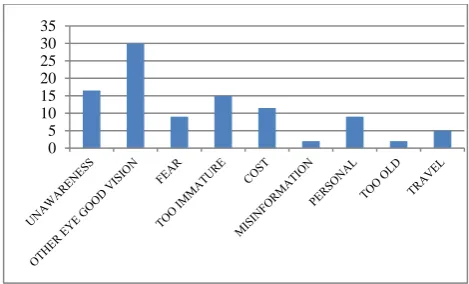
15% of the patients, during their last ophthalmological examination, had been told that their cataract was too immature to operate on and hence, delayed follow up. 30.5% of the patients delayed the surgery because their visual demands were satisfied by the vision of the other eye. 16.5% out of the 200 patients interviewed either did not know they were suffering from cataract or were unaware of the fact that it is curable.
Figure 6: Distribution of barriers for timely cataract intervention in patients presenting with senile mature
cataract in the study.
5% of the patients delayed the surgery because of the cost of transportation and medications. 8.5% of the patients with mature cataract delayed the surgery out of fear. 2% of the patients had misinformation regarding cataract surgery. Only 2% of the studied population deferred coming to the hospital because they thought they were too old to undergo the surgery. 9% of the patients delayed the cataract surgery because of their personal reasons.
It was seen that the proportion of patients who said that they delayed the surgery because their houses were too far from the health care service was 11.5%.
Table 1: A sample of the proforma used for evaluating patients with senile mature cataracts in the study.
Patient data:
Serial Number:
Name:
Age/Gender:
Area of residence: Urban/Rural
Education level: None/Primary/Secondary or High School/ Higher Secondary Occupation: None/ Labour/Private business/Professional
Ophthalmological examination
Best corrected vision in Right eye and Left eye Slit lamp findings
Fundus examination
Assessment of patient’s knowledge of cataract:
Do you know why you are unable to see? Is the disease curable?
Barriers relating to patient attitude
Did you delay treatment because you were afraid of undergoing an operation? You were worried about the cost of the operation?
You could see clearly with the other eye? Your cataract was not mature?
You were very old to undergo the surgery?
Misinformation You feared that operation would lead to loss of eyesight?
You feared that operation would lead to death?
Barriers relating to service delivery, cost and affordability
Did you delay treatment because: You were living very far from the hospital and transport to the hospital was an issue?
Did you know the cataract services were available free of cost? Were you worried about the indirect costs involved?
Personal reasons You were busy with work?
No one could come along with you?
0 10 20 30 40 50 60 70
Unemployed/retired Labourers Private
OCCUPATION
DISCUSSION
Cataract has been demonstrated to be the most significant avoidable cause of blindness in India, accounting for about 50 to 80 per cent of bilaterally blind in the nation. The most recent estimates from World Health Organization (WHO) reveal that 47.8% of global blindness is due to cataract and in South Asia region which includes India, 51% of blindness is due to cataract.10
The National Programme for the Control of Blindness (NPCB) has been operational in India since 1976. The resultant development of infrastructure and increased manpower in ophthalmology have caused an increase in the output of cataract surgeries from 0.5 million in 1982 to over 2.7 million in1996 to 3.9 million per year by 2003.10,12
Global agencies such as World Health Organization and International Agency for Prevention of Blindness have pledged support for the elimination of avoidable blindness via implementing strategies to reduce the burden of cataract blindness by the ″Vision 2020: The right to sight″ initiative. Recent WHO reports have shown a 25 per cent decrease in cataract blindness in India. The increased number of cataract surgeries, thus, has definitely been pivotal.10
The cataract surgery rate and coverage in India have both increased, as has been seen in various comparative studies.11 Nevertheless, with the increasing number of elderly, the backlog of cataract related visual impairment in India has not yet been eliminated. Health education methods and strategies will only be effective if they are able to curb the barriers that prevent these patients from seeking timely treatment services.12
A few studies, mostly conducted in other developing countries, have addressed barriers to acceptance of cataract surgery. However, a very limited number of studies have been conducted in the Indian scenario, addressing specific regional issues. Determining these challenges to use of eye care services is critical for planning and implementing strategies to prevent blindness.13
Barriers toward going for cataract surgery have traditionally existed and still do in the rural areas, yet the urban areas, where eye care facilities exist in ample, are not totally exempt. Urban poverty, migration from rural areas, unattended senior citizens owing to changes in family structure, and the presence of serious systemic illnesses are important barriers for the uptake of cataract surgery in urban communities.3
With delay in intervention, patients only make matters more difficult for themselves and their relatives, as well as for the ophthalmologist, who has to encounter
additional pre-, intra- and post-operative challenges, along with ocular and systemic co-morbidities that compound the situation. Getting cataract surgery done while there is still useful vision in the other eye enables the patient to travel independently, look after himself in the hospital, and thus reduce the dependency and burden on relatives.
Different studies have found the following as main reasons why patients in developing countries do not accept cataract surgery:
Economic difficulties and the high cost of surgery, Lack of ophthalmologic surgeons,
Deficient knowledge of cataract diagnosis and treatment, and
Gender discrimination.
Many studies have even demonstrated a shift in these barriers from attitudinal and awareness related to the current service related.12
However in our study, the main reason observed was a good vision in the other eye, indicating that the visual requirements of patients in our study group were lower. This correlates with the fact that 63% patients were unemployed or retired.
16.5% patient were not aware about the disease process, suggesting that the information available about cataract as a disease and its treatment was limited. This emphasizes the point that a better public education regarding cataract would definitely prevent delays in treatment.
About 22.5% patients studied were less than 60years of age. A greater education about the importance of timely cataract surgery for younger patients would also prove beneficial so as to increase their likelihood to have timely surgery to restore their visual acuity and allow for increased work productivity.
It is noteworthy that 8.5% people expressed their distrust of surgery. These people had all undergone surgery in one eye with poor visual outcome. Creation of competent, clinically and surgically sound ophthalmologists is a must to reduce cataract surgery associated morbidity, with better skills training as well as better selection of cases according to the surgeon’s skill level.
Efforts need to be made to reduce these indirect costs, such as conducting operations in the nearest health facilities or facilitating transport to and from the surgical facility for the primary and follow up visits.
Like in other matters of community health, health care workers can play a pivotal role in this case too: they can be trained and, thus, be helpful in education, counselling, early detection and timely referral of these patients.
Ophthalmologists also play an important role in this regard. If patients who present for treatment are told to wait because cataract is not mature or advanced enough, other barriers may make it difficult for the patients to present again for a timely intervention. In the present era of cataract microsurgery, it is no longer necessary to wait for the cataract to mature before operating; many phacoemulsification surgeons rather prefer operating on immature cataracts. Therefore, a proper explanation of cataract process and progression and counselling the patients regarding treatment options is necessary. Any anxieties, fears or queries that they may have should be addressed satisfactorily.
This study poses a limitation that the patients represent a hospital-based population. Thus, the barriers reported by them may be very different from those of other members of the community who never present at all. Also, many barriers may act synergistically and be inter-dependent. Further studies encompassing a wider study population are required to assess the impact of these interactions.
CONCLUSION
This study was helpful in uncovering a few of the various barriers encountered in the treatment of senile mature cataracts in particular, and cataract in general. In this study, good vision in one eye was seen to be the most frequent reason for delay in seeking treatment for mature cataracts. Other factors such as unawareness about cataract, fear and misinformation regarding surgery, accessibility, affordability and personal attitudes and reasons were also highlighted as hurdles that need to be overcome.
Cataract being an avoidable cause of blindness, prevention and treatment of this condition have gained a significant value in this age. The ability to identify the factors affecting effective utilization of eye care services is crucial for the policymakers, given the high social as well as personal costs associated with blindness.
Extensive health education amongst the public through various modes is the need of the hour. Efforts should be directed towards alleviating their fears, misconceptions, and towards clarification of their doubts. This will play a key role in improving acceptance to cataract treatment.
Health care workers need to be trained to detect and refer cataracts in time.
The challenge of accessibility can be tackled with surgical camps, and arranging transportation to and from the hospitals.
Innovative approaches need to be designed and implemented on priority to provide high-quality services at a lower cost. Awareness among the population regarding cataract progression and safe surgery should be increased as it benefits not only the patients but also their family. Creating strategies to reduce barriers will improve the uptake of cataract surgery, and help reduce the magnitude of cataract blindness in India.
ACKNOWLEDGEMENTS
The authors are grateful to Head of Department and faculty at the Department of Ophthalmology, Goa Medical College and Hospital, for their support and encouragement for this study. The authors also express gratitude towards Dean, Goa Medical College and Hospital, for his input and guidance.
Funding: No funding sources Conflict of interest: None declared
Ethical approval: The study was approved by the Institutional Ethics Committee
REFERENCES
1. Resnikoff S, Pascolini D, Etya’ale D, Kocur I, Pararajasegaram R, Pokharel GP, et al. Global data on visual impairment in the year 2002. Bull WHO. 2004;82:844-51.
2. Jose R, Bachani D. World Bank-assisted cataract blindness control project. Indian J Ophthalmol. 1995;43:35-43.
3. Dharmadhikari S, Bakare PN, Deshpande M,
Hegade A, Kesari A. Study on barriers causing delay in cataract surgery of bilateral cataract blind at a tertiary eye care center in urban India. J Clin Ophthalm Res. 2017;5:69-72.
4. Michalska-Małecka K, Nowak M, Gościniewicz P, Karpe J, Słowińska-Łożyńska L, Łypaczewska A, et al. Results of cataract surgery in the very elderly population; Clin Interv Aging. 2013;8:1041–6. 5. Brian G, Taylor H. Cataract blindness- challenges
for the 21st century. Bull WHO. 2001;79:249-56. 6. Limburg H, Kumar R, Bachani D. Monitoring and
evaluating cataract intervention in India. Br J Ophthalmol. 1996;80:951-5.
7. Fletcher A. Barriers to using eye services and recommendation to improve service uptake. Research finding and international workshop recommendation. Madurai, India 1998:10.
8. Wong TY. Effect of increasing age on cataract surgery outcomes in very elderly patients. BMJ. 2001;322(7294):1104–6.
- We need better means of assessing priorities for surgery. BMJ. 1999;318(7195):1367–8.
10. Murthy GVS, Gupta SK, John N, Vashist P. Current status of cataract blindness and Vision 2020: The right to sight initiative in India. Indian J Ophthalmol. 2008;56(6):489–94.
11. Bharath B, Krishnaiah S, Imtiaz A, Ramani RV. Prevalence and determinants of cataract surgical coverage in India: findings from a population-based study; International Journal of Community Medicine and Public Health. Int J Community Med Public Health. 2017;4(2):320-7.
12. Vaidyanathan K, Limburg H, Foster A, Pandey RM. Changing trends in barriers to cataract surgery in India. Bull World Health Organ. 1999;77(2):104-9. 13. Dhaliwal U, Gupta SK. Barriers to the uptake of
cataract surgery in patients presenting to a hospital. Indian J Ophthalmol. 2007;55:133-6.