* To whom all correspondence should be addressed. E-mail: [email protected]
Universal Differential Mechanism
Ildar Ilgizarovich Salakhov*, Vladimir Vladimirovich Voloshko, Ilnur Dinaesovich Galimyanov and Ildus Rifovich Mavleev
Naberezhnochelninsky Institute (branch) «Kazan Federal University», Russian Federation, 423812, Naberezhnye Chelny, pr.Syuyumbike, 10A,
doi: http://dx.doi.org/10.13005/bbra/1552
(Received: 09 September 2014; accepted: 06 November 2014)
The existing differential mechanisms - the planetary systems, which are the basis for creation of automatic transmissions are analyzed, the prospects for the application and development of planetary automatic transaxles are examined. The kinematic diagrams of differential mechanisms, which are the part of developed universal differential mechanism structure and the very mechanism, are presented. Its key structural parameters, kinematic connection between parts, which are summarized in the table, are detected. The design procedure of the universal differential mechanism, which is associated with the design philosophy and internal gear ratios, determined in accordance with the required gear ratio transmission is expounded.
Key words: Automatic transmission, The planetary system, Universal differential mechanism.
The use of automatic transmissions in vehicle transmission makes it possible to improve their technical, economic and environmental performances, and create comfortable conditions for the driver and ensure traffic safety. Nowadays many types of transmission vehicle schemes are known and each of them has its own advantages and disadvantages. Most of today’s planetary gearboxes of automatic transmissions built like one of these two planetary systems: Simpson System and Ravinia System (with participation of planetary rollers)1.
These planetary systems allow to implement four transfers, while two control elements are activated at the same time, that defines
the data of a system as three-degree system with a full use of control elements : - two reduction gears; - direct gear; - backing, using five control elements , including – two blocking friction clutches, two friction brakes and freewheeling clutch.2.
transmission with two degrees of freedom the only clutch is used) and significant complication of the control system3, 4, 5.
When designing new schemes of planetary gear boxes, for easy device, it is necessary to contain the least number of ACT links, planetary mechanisms and controls. When building a polyspeed ACT, the two-stage differential mechanism with four or five gears, having the least possible number of main units can be used. And thereby metal consumption, dimensions of a multi-stage automatic transmission can be minimized6, 7.
The new universal differential mechanism. In the research laboratory “Differential toothed and hydro-mechanical variators” (KFU), new universal differential mechanism was developed (UDM), which has the opportunity to combine the minimum number of planetary gear and the maximum number of differential mechanisms, in the presence of the least number of major units. There also the patent of RF ! 2384773 “Automatic speed planetary gearbox” was given, which has the aim of improving the technical performance of vehicles7.
The developed universal differential mechanism is different from the already known mechanisms in the power circuit of common carrier for all three planetary gears at four differential mechanisms in the presence of the minimum number of basic units. It allows to implement a packaged design with short kinematic chains and advanced kinematic and force capabilities, to provide five transfers in the output link at one of the input links, determining the possibility of using them as a module projectible automatic transmission vehicles8.
Differential mechanisms, which are used in implementing UDM, are represented in figure 1. New UDM consists of three planetary gear sets, which include four basic types of differential mechanisms with a common carrier8, 9.
The first planetary gear set consists of a sun gear 1, carrier 5(”), satellites 2 and the crown wheel 6. The second planetary gear set consists of a carrier 5(”), linked satellites 2', 3and crown wheel 7. The third planetary gear set consists of a sun gear 4, carrier 5(”), satellites 3 ‘and the crown wheel 8.
The first planetary gear set, linked satellites 2-2', 3-3' and the crown wheel 8 represent a differential mechanism with a negative value of the gear ratio between the crown wheels 6 and 8.
Sun gear 1, the second planetary gear set , satellites 3' , crown wheel 8 represent a differential mechanism with a positive value of the gear ratio between the crown wheel 7 and 8.
Sun gear 1, the carrier 5, linked satellites 2-2', 3-3', sun gear 4 represent a differential mechanism with negative value of gear ratio between sun gears 1, 4.
Sun gear 1, the carrier 5(”), linked satellites 2-2', 3-3', crown wheel 8 represent a differential mechanism with a positive value of the gear ratio between the pinion and crown wheel 1, 8.
The number W of degrees of freedom UDM10 is determined by the structural formula
where:
... (1) where – the number of main links;
– the number of the planetary differential mechanisms.
Thus, the UDM has two degrees of freedom ( ), has six main links ( ), four of which are brake units ( ), two links are the leading and the driven. The number of gears ( =5) is equals to the number of controls. Kinematic diagram of the UDM is in Figure 2.
Drive connections of the UDM links
Drive connections of links at leading link 1 are determined by the following equations11:
...(2)
...(3)
...(4)
...(5)
According to the equation (2), try to find out :
..(6)
At find from equation (3) :
Solving in conference (6) 8 (7):
...(8)
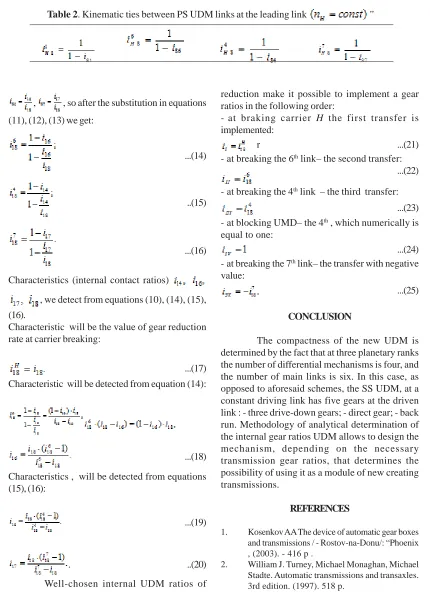
Kinematic ties of UDM links are represented in Table 1 and 2.
At leading link H (carrier), the equation of the kinematic ties between the links of UDM is:
...(9)
where p – a locked link.
Methodology of analytical determination of the internal gear ratios UDM
The solution of equations (2), (3), (4) and (5) make it possible to get the following analytical
dependences for the determination of the internal gear ratios, i.e. the characteristics of the differential mechanisms (Figure 1):
...(10)
...(11)
...(12)
...(13)
As, according to Tables 1, 2 ,
Table 1. Kinematic ties between UDM links at the leading link 1
Fig. 1. Differential mechanisms in the structure UDM
, , so after the substitution in equations
(11), (12), (13) we get:
...(14)
..(15)
...(16)
Characteristics (internal contact ratios)
, we detect from equations (10), (14), (15), (16).
Characteristic will be the value of gear reduction rate at carrier breaking:
...(17)
Characteristic will be detected from equation (14):
...(18)
Characteristics , will be detected from equations (15), (16):
...(19)
. ..(20)
Well-chosen internal UDM ratios of
Table 2. Kinematic ties between PS UDM links at the leading link ”
reduction make it possible to implement a gear ratios in the following order:
- at braking carrier H the first transfer is implemented:
r ...(21)
- at breaking the 6th link– the second transfer:
...(22)
- at breaking the 4th link – the third transfer:
...(23) - at blocking UMD– the 4th , which numerically is
equal to one:
...(24) - at breaking the 7th link– the transfer with negative
value:
...(25)
CONCLUSION
The compactness of the new UDM is determined by the fact that at three planetary ranks the number of differential mechanisms is four, and the number of main links is six. In this case, as opposed to aforesaid schemes, the SS UDM, at a constant driving link has five gears at the driven link : - three drive-down gears; - direct gear; - back run. Methodology of analytical determination of the internal gear ratios UDM allows to design the mechanism, depending on the necessary transmission gear ratios, that determines the possibility of using it as a module of new creating transmissions.
REFERENCES
1. Kosenkov AA The device of automatic gear boxes and transmissions / - Rostov-na-Donu/: “Phoenix , (2003). - 416 p .
3. Sharipov V.M. Building and calculation of tractors / - M. : Publishing Mechanical Engineering, (2004). - 590 p.
4. Mathias F. Brejcha, Ronald A. Tuuri. Automatic Transmissions and Transaxles. Theory, operation, diagnosis and servise. 4th edition. (1997), 688 p.
5. Tomngton Service Catalog. - The Torrington Company, (2001).
6. Bird R.B. Stewart W.E. Lightfoot E.N. Transport Phenomend. - New York-London: John Willy and Sons, (1960). - 710 p.
7. Salakhov I.I., The development of automatic transmissions rational schemes, based on the planetary system of universal multi-threaded
differential mechanism : Author. diss . Candidate of tehn. Science. - Izhevsk : M.T. Kalashnikov IzhSTU, (2013). –p. 24
8. Patent number 2384773 RF IPC F16H 3/44 . Automatic speed planetary gearbox / Voloshko VV, Salakhov I.I. Publ . 20.03.2010 , Bull . ! 8. 9. Design Practices: Passenger Car Automatic
Transmissions. 3rd edition. (1994), 912 p. 10. Kirdyashev YN Multithreaded transmission of
differential type / - L: Mechanical Engineering Publisher , Leningrad department, (1981). - 223 p.